Master ANTIOXIDANT Glutathione: Anti-Aging, Detox, & Wellness Secrets from Dr. Nayan Patel
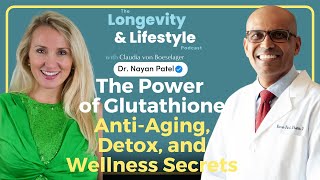
In this Longevity and Lifestyle Podcast episode, host Claudia von Boeselager interviews Dr. Nayan Patel, a pharmacist and founder of Aura Wellness, about his 12‑year research into glutathione—the body’s “master antioxidant.” Dr. Patel explains why glutathione is crucial for detoxification, oxidative‑stress mitigation, and overall health, and he details the scientific and practical challenges of delivering it into cells. He recounts the evolution from early liposomal and injectable attempts to the breakthrough topical spray (Glutaril/Glutaril Plus) that bypasses skin and cellular barriers. A series of anecdotal validations—burn‑pain relief, blood‑level spikes, and dramatic patient stories (his father’s cardiovascular and metabolic improvements, an autistic child’s sleep, a billionaire’s neuropathy recovery, etc.) illustrate real‑world impact. The conversation moves to practical dosing protocols (pre‑ and post‑alcohol, travel‑related oxidative stress, dosage limits to avoid rash), lifestyle factors that deplete glutathione (chemical exposures, alcohol, travel, aging), and the role of genetics (SNPs that impair glutathione conjugation). Dr. Patel also shares his personal biohacking routine (hydration, meditation, hyperbaric chamber, cold showers, BioCharger) and outlines future research directions (stable NAD, GHK peptide, skin‑care line). Finally, he emphasizes the need to educate physicians and consumers, provides product and contact information, and hosts a giveaway to encourage listeners to try the spray.
Chapters
Welcome, dear audience, to another episode of the Longevity and Lifestyle Podcast. I'm your host, Claudia von Boeselager, here to bring you the latest insights, learnings to improve your health, life, and happiness for longer.
Thank you so much for being part of this tribe and make sure to sign up for my weekly free newsletter at llinsider.com.
My guest today is Dr. Nayan Patel, a well-known pharmacist, health consultant, and the founder of Aura Wellness, a company dedicated to enhancing health through innovative glutathione.
Delivery systems. His innovative work has changed the way people think about improving health and longevity by raising natural antioxidant levels in the body.
His 12 years of clinical research and expertise focuses on the importance of glutathione, and often referred to as the master antioxidant, which plays a crucial role in detoxification and overall health maintenance.
He has developed products like Glutaril and Glutaril Plus, which are topical sprays designed to deliver high doses of glutathione glutathione directly to the skin, enhancing absorption and efficacy. Please enjoy. Welcome to the Longevity and Lifestyle Podcast, Dr. Patel. Nayan, thank you so much for taking the time to be with us today.
Well, it's my pleasure to be here today, so thank you for inviting.
Oh, my pleasure. So, Nayan, I want to dig into what inspired you to focus your research on glutathione, and how did your journey in pharmacy lead you to this groundbreaking result?
Well, in the mid-'90s when I first graduated from pharmacy school, it was kind of an exciting time in my life because first time now I'm able to help people live the best years of their life with medicine. And quickly realized that, no, I mean, oh my goodness, all we were doing is managing people's problems. We're not solving any problems. And so quickly led to me and said, this is not the way I would like to live my life. Financially was not making sense either because the sick care model was not going to pay you anything. People are not going to be willing to pay for just staying sick. People are willing to pay for getting healthy. I said, okay, if I want to make some financial resource, I want to gather those out. For that, I have to figure in a health business to see people healthy. And, like everything else, when you start looking at something, start digging in research and try to figure out what's out there, what can What can move the needle, right? And, it all led to me is that, hey, I need to work on the master antioxidant glutathione. And, at that time, it was kind of very, very difficult because people were talking about vitamin C. That's all they talked about is, hey, just let's just get some vitamin C. And, vitamin C research was proliferating like crazy. Somebody came up to me and said, "Hey, can you make some liposome vitamin C?" I said, "What about glutathione?" I said, "No, give me some vitamin C." "Not interested." "What are you talking about?" "What are you talking about? It's all about vitamin C." "It's all about vitamin C." And so, we made the first liposome form of vitamin C in my lab. I said, "You know what? Let me just make some glutathione as well just so that I have a second product as well ready." And, I quickly researched that it actually did not work very well. I mean, get the results I was looking for in some of the patients, but not in all the patients. And so, I thought there has to be a better different way to do these things. And again, it's just one of those things that when you start looking at outcomes and if you're not getting the outcomes, you say that the medicine is bad. The medicine is good, the science is good, but the only thing we could not figure out is that Is it going where it's supposed to be? And the example I give is about money, right? What good is money if it's stuck in a bond where you have no access to it? I want money in my wallet. I want money to be spent today. I don't care if my CD is going to mature in 6 months from today. I'm not sure if I'm going to be alive for that long either. And so I want money to be in my wallet now and so I can use it up. So, what good is glutathione if the body doesn't have access to it? What good is it to us if the work the glutathione does is profound but it's stuck in some part of the body that your body has no access to it? And so, my job as a pharmacist, try to figure out, can I get this glutathione molecule from anywhere outside the human body inside the body? Where it's supposed to be, which is in the mitochondria. And so that's what led to all this research for me. Sorry, it's a long-winded answer, but—
No, I loved it. And I want to dig into that. So what was, you know, take us on that journey from saying, okay, you know, I understand that. Can we take it from external and bring it into the body, into the mitochondria, into the cell? How did that research, like, what was that journey for you? And what was the aha moment when you finally got it? Can you take us there?
Well, Let me just tell you this one thing before I start this answer this question. I'm not as smart as you think I am. Okay. Only thing that I do know.
Says all the smart people in the world, by the way.
All I can tell you is that we don't need too many smart people. We just need people that are highly observant because everything is around us. And guess what we do? We don't observe everything. And so, my job was just to keep on looking at the science that was unfolding in front of my eyes. And so, my first job was to, can I stabilize glutathione outside the human body in a bottle? If it's stable in a bottle, I can figure out what to do next. And so, my first job was just to create a stable product. And as you can know, glutathione is a tripeptide, it's a 3 amino acid coming together. One of the amino acids which is cysteine, which is highly reactive. It gets oxidized really fast in the open air if it comes in contact with oxygen. So, my first job was to put a chemical cap on the cysteine molecule. If I can put a chemical cap on there, that means it's still alive, it's not getting oxidized, but it is kind of staying stable so that it stays on the shelf for longer periods of time. So, we have time to make it in the lab, get to the patients, use it for a month or two, and still have a chance of getting the results we're looking for. So that was my only goal I had, right? And hopefully there's somebody else who take from that on and figure out what to do with it. So we figured that portion out very early on in 2005, '06, something like that. We're very early on, we figured that portion out. And long story short, nobody was coming to my rescue, said, oh, I'll take from here onwards and I'll do all the work. No, nobody's gonna do that.
Paddle your own canoe, as my grandfather would say.
It's like, where are they?
I figured it out.
And so I started putting my mouth. It tastes awful. It did not work. It did not work either because the levels were not rising. I squirted my nose and it burned my nose off, of course, a little bit. It worked, but, you know, nobody's going to put a burning stuff in their nose all the time. It's not very pleasant either. And so, the only route I had left that I thought was going to be good was a skin route. But, the skin route was a little bit more difficult too because the skin as a barrier is very protective of anything going inside, anything that is water-based, right? If it's an oil-based, kind of slow passive diffusion into the lipid layers of your skin can go slowly inside. But the water-based product, forget about it. There's no chance, right? Otherwise, you blow up in the shower, you just come out with this whole big water balloon in your body. Yeah. So, that doesn't work. And so, we were tinkering around with another molecule. I say, you know what, there has to be a way to get through the skin somehow. And we saw some research that was done in Japan early on. I said, "You know what? How about we do this with glutathione? It's never been done before." And so, we did it. And, like everything else, you make a product and if you don't get the results immediately, "Ah, you know what? Let me just shelf it." And so, I had so many other things going in my life at that time. I was making all kinds of intravenous medications I was preparing on. I was working with hypothalamic hormones and pituitary hormones. And, I was I was this crazy kid on with the lab. Normally, you're a crazy kid with the lab. I was making all kinds of medications trying to figure out how can I improve patients' health. And so, I make the product and I shelf it. And, a year later when we're cleaning up the lab, I say, "Hey, let's just dump all the old stuff out." We looked at the product. I said, "Oh, my God, this is still great." It still smells awful, right? It's still, well, but it's awful as rotten rotten egg.
Same.
The same. And about the same time, somebody in my lab had some kind of little burn in there, right? And of course, we know the glutathione is great for burns. Rub it on, right? It's just, we have this product, rub it on. And to our surprise, oh my God.
Wow. What happened?
It, the burn pain went away, like instantaneously. Wow. They applied for a couple more times and it completely healed the skin. I said, wow, okay, what happened? Maybe it's a burn, so the skin is already damaged, so it kind of went through that part. It's not an issue. So quickly I said, figure, I said, you know what, let me try myself. So I played myself and drew my blood. I said, what happens? Boom, the glutathione levels went up. And so it was Even though we created about a year ago, we never really tested because when you have too many things good in your life, you don't test every single thing. And, that's when we had the aha moment. I said, "Oh, my God, we did create this one." It was just too early on. We didn't believe that our science was solid and we didn't believe in ourselves, but we keep on observing results and we start seeing blood data that proved it to me that, okay, We did, we did accomplish our goal a year ago.
That's so exciting. And I'm so glad that you decided to do some spring cleaning, right? A year later.
Yes.
To realize what you had on your hands is all. So can you share with my audience, perhaps just people unfamiliar with glutathione, you know, you referred to as also the master antioxidant. What is it exactly? And what are some of these amazing benefits? You were sharing about the burns, etc. But why do we want these high levels? In our bodies to be maintained?
Yeah. So, so the glutathione, it's in the chemical terms, it's just a tripeptide coming, 3 amino acids coming together. Peptides nowadays is the biggest buzzword in the world. People are talking about peptides all over the world because they are the small building blocks that helps create this enormous amount of benefits in our health and wellness in a longevity journey. And so this is the simplest form of peptide. It's the most abundantly produced peptide in our human body. And so, what is known for is two things. One is antioxidant properties, which is what it does, it gives up its electrons. The free radical scavengers all over the body is hungry for an electron to get it neutralized. If not, then they're just going to bring havoc in our body. And so, glutathione actually donates its electrons to kind of calm them down and to get them neutralized. In that process, glutathione itself gets oxidized and it doesn't get destroyed but gets oxidized. And, with the help of something else, it can revive itself again. So, there's a recycling process going on in the glutathione as well. So, that's one thing that is abundantly known everywhere. The second part is still learning, but we do know a few things about glutathione is the master detoxifier. And, what it does is that it helps identify chemicals that are not part of the human production, right? Because we produce all the chemistry, all the chemicals that we need, we produce internally. We don't need to take from outside sources, right? Only thing we take from outside sources are the building blocks. I said, hey, give me all the nutrients I need and I'll make my own stuff, right? But some of the chemicals that are not produced internally and there's a byproduct of a chemical reaction has to be neutralized and get rid of them. So, the glutathione helps identify those chemicals, helps them neutralize it, and it helps them get rid of it. And that process is actually the most profound process that I think in my history of says, hey, antioxidant is great. I can take some vitamin C. I can do other things like that. But what I cannot do is have somebody get rid of all the toxic chemicals out of my body because there's nothing much out there. And so, that to me led to a lot of different things. But in the simplest term, that's what glutathione is. And we produce so much of it that my research led to me is to figure out, I said, when do we need it? Can your body produce enough? You know? Do I have to supplement with the glutathione or can I just improve my diet? Can I do other things to make sure my levels never drops? Right?
Yeah. So let's touch on that. And this particularly, just to highlight a point about, you know, excreting those chemicals in our body. And I think now more than ever, people are waking up to the awareness of the amount of toxins that we have in the, from the pesticides in our food to our environmental toxins, etc. So our body's being constantly pounded with it. And hence antioxidants like glutathione are all the more important. But let's look at, you know, is it, what are the different factors that help with glutathione, right? Can it be through lifestyle, exercise, or do we have to take it as a supplementation? And how does that vary as we age?
So if you think about it, by the time you wake up and leave your house for the morning, job, you're exposing yourself with about 70 different chemicals from hair product to face products to brushing your teeth and putting all kinds of chemicals on our body, ingesting internally. It's a lot of chemicals that our body has to process as soon as we wake up. And so, the two things that I always recommend is in order for you to be rich with glutathione in your body is you to reduce expenses. The only way you get rich is you don't spend enough money, right? So if you get rich in glutathione, spend less of the glutathione on some things that is avoidable, right?
Yeah.
If you can avoid using a full of chemical toxic products on your body, avoid as much as possible. I don't say avoid every single thing because you still have to live your life, but avoid as much as possible. And we know the solvent which is we drink knowingly and it comes in 1,000 different flavors and they taste really good, which is alcohol. But in reality, it's just a solvent. As a chemistry guy, I'm telling you it's a solvent. And solvents are not good for you, right? But if just because it's flavored so beautifully, I said, oh my God, this is amazing. It's still a solvent and the body use up all your glutathione reserves to kind of neutralize it, break it apart and try to get rid of it, right?
Just a point on that, right? So people listening, they're like, oh, Dr. Patel, I like my glass of wine on a Friday night. So what should I do? Right? And obviously we've talked about non-alcohol use and alternatives on the podcast before, but what would you recommend? Is it like if you know you're going to go out for a drink or a few drinks on a Friday evening, do you stock up in advance on the glutathione or is it on the Saturday then you, you know, take your glutathione? What would you recommend or both?
Both, both, absolutely both because glutathione actually does not get rid of the buzz. What it does, it processes the alcohol in your liver. So I would do both. I would apply the glutathione before you go for the night out. And as soon as you come home, you're still buzzing and apply it afterwards. I have— so, I stopped drinking, but when I used to have a glass of wine or something like once or twice a month, I would probably apply about triple or quadruple the dose before I said drink. Even if I have 2 glasses of wine, even 1 glass of wine, I'll apply it triple or quadruple the dose before I start drinking and maybe another half a dose, another like a double, but that's a half of the highest amount I took, maybe double the dose again after I stopped drinking. So, within 4 hours, right?
So, that's how potent alcohol is essentially. It's so depleting.
It is so depleting. And, make sure that people need to hydrate themselves because it does take away a lot of the water out of the system. And so, make sure to drink lots of water as well. But yeah, that was my protocol when I used to drink. But now that I've stopped drinking, I don't have to worry about it. But I do have to worry about because when I travel a lot, I do travel a lot and going from conferences to conferences every day, almost every week I'm out of town. And I do have to load up myself with lots of glutathione because my oxidative stress is extremely high.
So, so I think that for people to note also, maybe you can explain, right? So why is travel such an, you know, impact for glutathione levels? Maybe you can expand on that.
So I will, I will explain that as well. Let me just finish up the first question you asked.
Sorry, of course.
Yes. I wanna, I wanna go in the orders. I don't know if people lose the audience either. So anyway, stop the expenses. That's number one. Number two is that make sure your diet is, is healthy enough that contains the 3 amino acids, glycine, glutamine, and cysteine, that in your diet will help produce enough glutathione. So I would say majority of the people, they don't have gene mutations, they don't have gene SNPs, they don't have any issues with production of glutathione. They should be able to take those amino acids, give it to the body, and the body takes those amino acids, combine them together with 2 ATP molecules, 1 NAD molecule, 2 enzymes. I mean, there's a process behind that, all the process. And the body will make its own glutathione. And trust me, you don't have to do anything except for eating healthy diet. Body will take care of the rest. And so, either have a proper diet or make sure you reduce expenses or do both. I'll absolutely do both. Even by doing both of them together and having completely clean life, about the age of 30, 35-ish, your body's actual need for glutathione and what your body can produce, there's a slight difference. Your body can produce— even at the age of 30, 35, it starts. I'm not sure the exact time. Everybody's a little bit different. But about the age of 30 to 35 is when we start seeing the discrepancy between how much your needs are and how much your body can produce. Because like it or not, we're still not going to give up our modern-day conveniences ever.. Right? And so, there's always going to be some little bit of oxidative stress, always going to be there. And, our ability to produce enough glutathione, it's there but it's not going to keep up with the demand all the time as we start aging. And, the energy production goes down as well. The ATP production goes down. NAD production goes down in your body as well. So, there's slight discrepancy that happens. And then, what happens, the discrepancy over time, gets doubled in the differences because now your needs are higher because you have more toxins and you can't produce enough glutathione, the needs are getting higher and higher and higher. And so, supplementation may become advantageous at that point. And so, having the right supplementation that actually improves the glutathione levels without having the body do the extra work is what my research was. And, I mean, if you look at oxidative stress with the question you asked me about traveling, oxidative stress is, I mean, we all know oxygen is causing oxidative stress, right? But we cannot tell everybody to stop breathing. We still need oxygen, right? Nitrogen is bad for you, but I mean, without nitrogen, nitric oxide, your body cannot function. So, even though these are all good gases that we need in our body, Excess is what I'm talking about. Or, after the job is done, they need to be neutralized and get rid of it. That's what I'm talking about. So, even though they're good for you, it's the how long it stays inside the body is what I'm worried about. And, when you're traveling, going in this aluminum chute, so to speak, in a 30,000 feet up above the Earth and you basically have zero protection against cosmic rays. And, that's another issues. The people that fly the most are the one that exposed to a lot of cosmic rays. We have little protection against from ozone layer. And so, we have to worry about what kind of mutations are we going to get because have overexposure to cosmic rays. And again, there's plenty of studies that are out there that talks about that the more you fly, the faster you age. And so, my job is that I'm going to do whatever it takes to make sure my antioxidant levels are super high. I mean, when I travel, and this is my own experiment, okay?
Yeah. What's your protocol?
Share it, please. I usually apply about 4 sprays of my product twice a day at my home. That's all I use. Anything more than that, I get that sense that it's too much because if you have too much of glutathione, it gets you rashes and itching all over the body. That means you have too much of glutathione. And so, but when I travel, I'll probably put down at least triple or quadruple the dose twice a day. Wow. And I still don't get rashes. Wow. And so, what is— Nutrition is so fun. Yeah. Incredible. So, I was talking when I was doing my own research, I would say, hey, this is crazy. When I travel, I can apply as much as I want and I don't see any levels of toxicity in my body. But if I apply the same amount at home, oh my God, it's just full of rashes, right? So, I know it's too much at home because I'm much more calmer, quieter, plus my dog comes and gives me hugs so my stress goes down extremely low. You're happy. But, yeah. So, traveling puts a lot of oxidative stress. And, when I am on the airport in the plane, I cannot stop noticing how many people pound alcohol. It doesn't matter if it's 5 in the morning or 5 in the evening or midnight. It doesn't really matter.
I've noticed this too.
And, if I got lucky and got in the business class, people are pounding down on alcohol like that's free alcohol. So, it's not free. Your body's paying the price. Your body is paying the price. And so, I don't judge people for that particular reason, but I do see that people need, do need help. And I'm hoping that those people that are traveling a lot, consuming alcohol on the flight and before they go on the flight to up their glutathione levels.
Yeah, for sure.
I want to understand the different modalities.
So you said you were, you know, testing it in your mouth and in your nose and spraying your nose and then on your skin as well. There are other modalities like of mixing it in water, et cetera. Like, what is your view on the different modalities of delivery of glutathione? And you've landed on spraying, so I'm assuming that that's the most effective, or what would you say?
Well, the spray was, again, you let the science lead you because nothing else was working. And so, when we apply on the skin is when we found out that it was working through the skin. But before that, in 1999, we made the first liposomal form of glutathione, which is the people, it's an orange yellowish liquid that you encompass the glutathione inside, bypasses the stomach. So, it has a very good chance of absorption through the intestines. That was the whole purpose of making liposome technology product. But when we saw that it worked a lot of patients, it did not work on everybody. So, I couldn't pinpoint it down as to why this was not working on everybody, why it wasn't only working on certain people. The research was kind of spotty at that time. People said that, hey, if you take glutathione, you're gonna get all these results. I said, okay, I, I can see the results are coming in, but how, how is it getting there? Right? Is it, can I get the results on every single human being on this planet? Right? And the medication will tell you, oh, this, this does, does, does not work on everybody. It only works on some people. And my job as a pharmacist, I said, why? Yeah. Where does it need to be? And can I get there? And so, liposome did not work for me. And later on in 2011, the researchers did some trials and they found out was actually the liposome form of glutathione, it did work on people that it raised the levels like a couple of weeks later. But the way it was doing is it was the— when you take the by mouth, the body actually broke down the peptide into amino acids. Amino acids gets easily absorbed and then amino acid gets crosses the skin barrier or the cell barrier, it gets inside your cell. And that's where the body takes this amino acids and makes into glutathione again. Oh, okay. And so, I said, okay, even though I knew something was not right, somebody else did the research in 2011 to prove that point. So, I moved on from liposome form in 2001 to injectable form of glutathione. And so, I said, "Hey, you know what? I'm just going to inject it straight into the bloodstream." So, we were making the injectable form of glutathione. And, injectable form of glutathione, there was a research in 1991 which I was not aware of it because I didn't get the research on time. And, I saw the glutathione, I can give any dose I wanted to give them and people will feel fine. There was no side effects from I said, okay, then why was there no issues with it? In 1991, the research was done when they gave a big dose of glutathione, like 2 grams of glutathione, which is a very, very high dose of glutathione. And what they found out was that in the, when they drew the blood, everything, all the glutathione was in the plasma, which is not the blood cells, but the water part of the blood. It was there and nothing was in the blood cells. I said, okay. But they also saw an increase of cysteine in the blood. Where did the cysteine come from? We didn't give any cysteine. So, the researchers concluded that glutathione was actually getting broken down and the cysteine was getting reabsorbed. And so, even though it worked, even though it worked, What do you care if it's working by cysteine or glutathione? Hey, it works, right? So, people that say, "As long as it's working, I'm fine. Leave it alone. Let's not reinvent the wheel." And so, I was making the glutathione IVs and for a long time, for 20 years, I was making it and the results were sporadic, right? There's one doctor who did research on Parkinson's who injected a big dose of glutathione, got great results, but did not get the results on every patient. Or maybe the patient did not have glutathione deficiency. That's why the Parkinson's was a little bit different. And for me, it did not jive very well. And so, my thing was always been looking for, I said, "Hey, how does it actually, actually works?" And so, all this technology that's out there, capsules, liquids, injections, and topicals, and whatever, unless you have a technology that can actually bypasses the skin barrier, the cell barrier, which is cell barrier is more intact than the skin. The skin, you can laser it off, you can put it in a sauna and open up the pores. You can break the skin with some needles and just pour it in there. You can break the skin barrier. Yeah. But you cannot break the cell barrier. And so, getting from a skin barrier into the cell barrier, into the intracellular level, that's what it needs to be at. And so, with our technology, and again, it was so far ahead of the schedule because the world was not ready yet. When I first discovered 2007, we were not ready yet because there was no literature out there to support what I was doing. And so, I said, I can't release this product to the public because I don't know what to do. I just did not know what to do. Took me 13 more years to work on it with countless physicians all over the United States and a few people outside the country as well. And tried to give me some data. I say, hey, this is how it's working. This is what's working. It's not working. And so, 13 years of research, finished writing my book because I had to keep— I had documented every single thing I did. So, I finished my book with all the stories that I got from my patients and all the results I got from my patients. And then, eventually, we launched that company knowingly very well that this product is— if it goes in your skin, there's two things have to happen. It has to feel good. It has to smell good. And my product smells like rotten eggs and feels extremely sticky.
So it didn't tick the boxes essentially, but we know how toxic perfumes are. So maybe it's good that it doesn't have a smell.
Dearest friends, I want you to experience the power of glutathione for yourself. So I'm hosting a special giveaway. Glutathione is a powerful antioxidant found in the body that decreases as you age. It's key to your body's detoxification, immune function, skin health, and enhancing energy levels. We're giving away 3 glutathione, glutaryl sprays from Aura Wellness, developed by leading glutathione expert Dr. Nayan Patel. To enter to win, head over to Instagram or Facebook, links in the description, and number 1, Tag 3 friends in the comments below. And number 2, share your biggest takeaway from my latest podcast episode on glutathione with Dr. Nayan Patel. The giveaway ends on November 13th and winners will be contacted via DM shortly thereafter. So go check it out and good luck.
Exactly. But so anyway, so that's where we are at. And so there's a lot of technology products that are out there. This is the only one that actually bypasses all the barriers and get inside where it's supposed to go, where the results are going to be. Sort of instantaneously. Now, nobody— and when I say instantaneous results, what I'm talking about is that there's certain subset of people, and this is, again, this is the last 10 years of research that's coming out now, right? And over the last 10 years, the gene testing or the gene SNPs testing has become so affordable. Before, it used to cost you $5,000 to $10,000 and only available to the rich and famous. And even if they did the testing, the doctors were not, had not learned all the different things they can do. But today, the same test costs you $500. So, a lot of people are doing some gene SNPs testing, some GPX testings. They're called all DNA type testing companies out there right now. They do all these testings. And what we are finding out is there's a huge subset of people that cannot conjugate glutathione. So you can take all the products in the world that, that gets broken down, absorbs the cysteine and remix it again. And if your body cannot make it again, guess what? You're outta luck.
Yeah. There's no point. So, so how do you help? Yeah. How do you help the, the, those people?
But that's what, so that's what, so with, with the, with our product, the, the one we created, it doesn't rely on any conjugation pathways. Yeah. So, it goes to your skin, goes in the cell. It's like you don't have to work to get your money in your wallet. Imagine that, right? Well, in that case, I'm going to become lazy. I said, yeah, that's up to you. But yeah, most the body doesn't become lazy because there's a glutathione coming to your body completely intact to be used. Because keep in mind, to make glutathione, You need energy, you need 2 ATP molecules and 1 NAD molecules. And that ATP, NAD is used in literally millions of chemical reactions in your body every single day. Mm-hmm. So if we have all this energy that you are saving from producing glutathione, which is the number 1 molecule in your body, now that energy has been used to help get all the other chemical reactions in your body optimized. And so, over time, you start seeing the results within 2 weeks, 4 weeks, 8 weeks, 2 months, and 3 months later, your body's getting optimized over and over again. Amazing. And so, that's what this is all about is that I'm not saying that this is going to— well, I am saying that it's going to increase your lifespan or your longevity. But what I'm saying is that your body is resilient enough to regenerate and rejuvenate as the time goes by because now the biggest molecule the body produces has been delivered. And by doing so, I'm sparing all this energy. This energy is used to have all the other body functions work efficiently.
So exciting. And can you share some of your favorite client patient stories from over the years that really blew you away or your favorite ones? What would they be, Nayan?
Well, there's 2 or 3 because these are all my family members because that's They were the only one who had access to it for the last 15 years plus. So, my dad, bless his soul, he's not with us today. It was an unfortunate death, but I'll tell you his story. It's just absolutely amazing. So, at the age of 78, he had type 2 diabetes, he had arthritis, blood pressure issues. He was traveling, I believe Australia or New Zealand for about a couple of months and he went for a vacation. He was single because my mom passed away 25 years ago. So, he was single. So, He was traveling the world, like, just, he was, it was a chore for him. So when he goes someplace, he probably kind of settles in. He doesn't want to fly for one week or so, right?
So good for him.
He came back, he came back and had a lot of shortness of breath. And so we scheduled an angiograph and what we found out, that his main artery was completely blocked. Wow. 99% block. And the doctor goes, oh my God, how the hell did you survive in the first place? So put a stent in Of course, list of medication came out from the hospital, comes home, and my dad goes, "What do I do?" I said, "Well, one thing is you don't have a cholesterol issue, so why are you taking anti-cholesterol pills? Your blockage was not because of cholesterol, but something else." And so, your oxidative stress was very, very high because of arthritis and diabetes. And so, I said, "Dad, we have this molecule. We just discovered it in my lab, and I'm going to be using you. You're my first patient." He goes, well, whatever, whatever you think is right for me, right? So, of course, I didn't take him off all the medications, but I gave him some medications and started using glutathione. 2 years later, we didn't even think about it. We were just sitting down and he was 80 at that time. And he goes, you know what? I really feel good now. And so I said, Dad, you do look good. You know, you do look good. I think it's that it's a stress to the— your mental stress is down because everything is functioning fine. And then told me, he shared me his data because he was doing his blood sugar testing. My sugar has not risen in over a year. Wow. I said, what? I said, yeah. I said, okay, let me go to the doctor's office. I do a 3-month test and say that his levels were normal. Wow. Like no more diabetes.
He's reversed his diabetes.
Well, it's not reversing, it's what is it? It's reverse insulin resistance.
Resistance, okay.
Yeah, because he still became a diabetic again when he had a surgery on his knee, like 10 years later. He still became a little bit diabetic for about 6 months again. So, the diabetes does not go away, but you go into some what we call remission, right?
Remission. Okay.
I can understand. So, he went backwards. It was 2 years later. I forgot.
Okay.
Amazing. What else? And he goes, you know what? I have no pain in my joints. I said, okay. I said, I'm walking 6 miles per day now. He was walking 6 miles a day at the age of 80. He was doing gardening in the backyard. You know, California, beautiful weather. We do gardening in the backyard. He wants to grow fresh tomatoes. Tomatoes and all those eggplants and whatever he wants to do. Amazing. Right? So, he works in the backyard. He does everything. And, I started noticing that, "Oh, my God, he's getting healthier and healthier." And, he started getting comments from all his friends. I said, "What are you doing?" I said, "You look so healthy." And, his hair was always there. He's not like me. He had a full set of hair until the day he died. And so, That was the best thing I could have seen. And then fast forward to this year, he just passed away this year at the age of 89. And he was traveling the world. He started traveling everywhere, right? Every day, picks up the bags and just leaves, right? He goes to India, goes to Africa, and comes back over here after 3 months. But he does everything by on his own. At the age of 88, 89, he was still traveling, doing everything on his own. Open the house, get the people to come and help him clean up the house and get all these things, just groceries and food. He takes care of everything on his own. He doesn't need any help from anybody. And at one point, his hands were kind of weak because of arthritis, of his type 2 diabetes was out of control. He was a little bit overweight. Now, he's completely back. Weight was back to normal. And then, he went a little crazy this year. I think he had some street food. He got diarrhea from it, got dehydrated, and boom, fell down, broke his skull. And a day later he was gone.
Oh, I'm so sorry.
Even half an hour before he passed away, even half an hour before, he FaceTimed all of us. He was talking to us like, he was talking to us like, I'll be there next week. Don't worry about it.
Right?
Yeah. And so even today, I feel so comfortable talking about him is because you know why? I don't feel like he's gone. You have no memories. I have zero memories for him suffering.
Zero.
Yeah. Right? Even though half an hour before he passed on, he was talking to us like there was no end.
Right? And full of energy and vitality and all the rest of it too. Yeah. I'm so sorry.
I mean, so that was tragic. So it was tragic, but at the same time, Guess what? I want that death.
Well, very true. Exactly. If you're going to go, go like that.
Yeah. Pick me up from a golf course. Pick me up from somebody where I'm enjoying my life and doing what I love to do. When my time is up, please don't give me disease. Just pick me up. And I'm okay with it.
Yeah, I'm with you. I agree.
Right? That's my favorite story. The second story that I have was I had a mom with an autistic child. That the, the, I'm sorry.
No, it's okay. Take your time.
Yeah. I had an autistic child and the mom was absolutely hasn't slept for 7 years. Wow. Because the kid was just too hyper and would not go to sleep. And just imagine the parents haven't slept for 7 years. It's kind of distraught a little bit, right? They use the Gliothione and in 2 weeks I got a humongous letter I said, I just woke up. I slept for 7 hours for the first time. And it's so, you know, that really tells it. And when the story comes around, you're so ready to— oh my God, I didn't launch this product, I didn't launch this product, right? And I said, oh no, I gotta wait, I gotta wait, I have to wait. And so, so many different things like that happened. One more story was, uh, there was a a billionaire client in Utah and he was wheelchair-bound, suicidal because he had the neuralgias which was secondary to some viral infection he had years ago. And, because of the virus infection, he developed neuralgias in his lower extremities. He couldn't walk. And, all the money in the world, I mean, he can fly anywhere in his private jet, right? Anywhere he wants to go. And, he had 24/7 watch because he would have killed himself because the way he was suffering. And 30 days later, he got out of his wheelchair with a cane. Oh my God.
Wow.
Just imagine I'm getting calls from his lawyer to try to figure out what can I do to help you. Wow. Right?
That's amazing.
And I wish I took some help from it because I was not ready yet because I never thought that people would be willing to pay me to do more research, right? Because until now, nobody had paid me. Me ever. And so I started looking at that kind of this as, okay, you know what? And then shortly after that, he passed away because he had some other disease. He was already 91 years old, but for him to walk for the first time at the age of 91 was like amazing. It's incredible. Anyways, I can go on.
I love your stories. No, but it's so exciting. So my mother in 2020 had a very bad fall. She had, it turned out then there was blood clots in her legs that went to her lungs. Her blood oxygen levels were so low. Caused her to faint, but she must have really fallen like a plank, opened the back of her head. She had hemorrhaging, but in the ventricles, not in the brain matter, thankfully. But anyway, so it was this whole series of events as well, and it propelled her dementia. So my audience is familiar with this fact. And last year she had a fall and she was in hospital and they kept her in for a week and she essentially forgot how to walk. And now she's been in a wheelchair since. And I'm listening to this and I like, I need to get her more glutathione. Like, let's try this. Yeah. And to see what's possible. I mean, is there any situations that it's not helpful? And would you recommend to many people suffering different things to just give it a try, just to take it and see, you know, how it impacts them? Or would you, are there some cases would you say that you have to, you know, keep away from it?
So if you have physical damage, right? If you have physical damage, like if you have a broken arm,. It's not a broken arm. So, it's not a physical issue. It's a chemistry issue. And so, anybody— so, I always go back to why people die today, right? So, if you look at the top 10 causes of death in the world, and if you take one of them out of them, which is number 4 or 3, or number 4 is accidents, right? If you take it out of there, all the other 9 causes, are linked to oxidative stress, right? And so for the oxidative stress, our body is well equipped to deal with it by producing enough glutathione. And so when I say that, can gluten help with any diseases or any conditions or any issues that you have? I have absolutely zero idea how oxidative stress is manifesting in your body. And so, I always tell people that try it because I have no idea how it's going to help you. But, if you're going to try this part, be extremely diligent to know and look, reflect on yourself to see what changes are happening in your body. And, that's the most difficult part because most people don't even know what they have, right? Yeah. When I say somebody that, hey, you do look a little overweight. Am I? I never noticed that part, right? I mean, they're not overweight at all, but sometimes they're a little bit overweight. Oh, I didn't notice that part. Because they don't see themselves in the mirror long enough to understand, okay, I have this, this, this issues. Physical issues with what you see with your eyes, they notice that part. Oh, I have a spot over here. Are my wrinkles getting over here? They notice those kinds of things. But what they do not notice is how the body is deteriorated in terms of energy because of the subtle changes, how the body is not able to function as normally as like you used to before. Why can't I bend my— can I twist my body like I used to do before? And so, everything is kind of settling in as you age. And you're accepting the fact that you're aging, right? And so I tell everybody, give it a shot. You got nothing to lose. We do offer 100% money back because I have no idea how it's going to help you. And if you look at the stories I get, I get every single day, my phones, I get emails on my phones from my staff. Anytime I get a success stories or a failure, please, please, please email it to me directly. So, I see my staff forwards everything to me and I get so much joy out of that because the reason I'm doing all this work is, guess what, is I want to change people's lives. That's the whole purpose of it. I'm still a pharmacist. I still have pharmacy. I still work in a pharmacy as well. I still see patients. Well, not so many, but I still work with doctors and help design drug plans for everybody even today's day. State. But the real joy comes in when somebody emails me and said, oh my God, I heard you on this podcast and my life's changed. That's why I do what I do. That's why I do what I do today.
Yeah. And having that strong why is amazing. And when you have a product that you know has such an amazing impact and with this glutathione peptide is just so exciting as well. And what is some areas where you wish people would know more about it? And particularly around maybe healthcare practitioners, you know, why is it not more widely spread? Like, what would you like to see in the next months and years in terms of knowledge, information distribution around glutathione?
Well, my urge right now, I'm heavily, heavily interested in educating the physicians at this point. I do this kind of interviews with a lot of podcast celebrities. And the reason is because I do want to make sure the masses get the get a first experience as well because doctors honestly don't have time to talk to the patients anymore. They just don't have time. But, I want them to recommend this product. And, when they recommend this product, I know for a fact they don't have time to explain all the benefits of it. And so, talking like this today is basically all you're doing for me at this point is you're just reinforcing what the doctor just told the patient that, hey, this is what you need. And they can listen to us and say, okay, now I understand why my doctor told me to take this product. Because doctors, they just write prescriptions. Hey, here's a prescription. Go get your pharmacy and pick one up. This is not a prescription item. It's over-the-counter. And so, the doctor says, use this product. Well, what am I supposed to do with it? What am I going to feel? How am I going to do? And, the doctors honestly don't have time. To do the X-Plan. So my job is to educate the physician first so they, they're willing to recommend because they're the one gonna be looking at all the markers, doing the blood test and see the improvement. Right. And when they see the improvement, they know exactly where it came from.
Exactly.
Right. Can you share where people can find the product? Oh yeah. The name of it, et cetera.
Yeah. Just so the product name is called Glutaril and I'm so sorry. If you give a pharmacist the name of a product, they're going to give a chemical name to it.
So, this is glycerol. And, we'll link it in the show notes for everybody listening or watching.
Yeah. And, the website is aurowellness.com, A-U-R-O wellness.com. And, of course, there are a lot of women consumers that are out there. They're altered into the skin health. And so, the same technology, guess what? I can deliver a lot of different molecules inside your inside all your cells. So, we create a whole skincare line as well with it. Same exact product, same exact technology. I can deliver vitamin C, CoQ10, L-carnosine, resveratrol, cycloestrogenol, DMAE, and glutathione, everything for your skin. Amazing. Because skin is only 6 square inches, but yet it requires a lot of nutrients. You don't have enough enough space to put up 10 different creams. So, our technology, we can combine everything and give you some small regimen as well. So anyways, that's—
And you have great skin, so clearly it works very well as well.
One thing I want to mention before we do anything further is that people always ask me about longevity. I said, what can I do to increase longevity? Is the longevity product. And I said, if you live longer, don't die. I mean, it's simple, right? It's simple. Just don't die. And a lot of people die prematurely. Like last 20 years of the nursing home, they already dead 20 years ago, right? Even the physical body is gone today, but they were dead a long time ago. So, please don't die. Listen, right? Listen to you. Listen to other people. Listen to everybody. Live a long life. And hopefully that I will be able to give you the joy and the pleasure to use your body, the physical body, by reversing some of the toxic load that has been out there. So hopefully you can enjoy the body as well while you're still living your life.
Oh, beautiful. Yeah, exactly. And I think it's really making those, the healthspan, right? Living in your highest, the highest version of yourself today for as long as possible, right? So I think people sometimes like, oh, longevity and who wants to be 150? And it's not about reaching a certain age, for me at least, it's more about living those beautiful years of vibrant energy really well for as long as possible, whatever that number might be. And then as you shared in the beautiful story with your father, then I think, you know, quick, a quick ticket out. That's it. It's not a bad thing. Exactly. Let's talk about some emerging antioxidant research. Is there any research that, or areas that you're really excited about? Do you expect to see in the next sort of 1 to 3 years?
So, in my lab, with this technology now, I can work on peptides, I can work on some other molecules. We have worked on NAD molecule. At this point, we have a stable NAD product in my lab at this time for the last 4 or 5 years. We've been testing it out on ourselves. I'm not too happy yet. And, if I'm not too happy, I'll never release a product until I'm fully convinced it's going to do some great things for you. So, I'm not too happy. So, it's still more work to do. We are working on another GHK peptide. That one is ready. Now, we've been testing it out for a couple years as well. And, that one shows some promises out there. And so, we are working on that as well. We have a couple more peptides that we're working on, some fish proteins as well, because I need to do both ends. I need to also take care of the skin for beautification. But a lot of the stuff the skin needs— but skin is the largest organ we have. Yeah. So, whatever your skin needs, so does your heart, so does your liver, so does your lungs. And so, I don't see skin as just for beautification. I'm seeing skin as an organ. I say, hey, what does the skin need? And can I get the same thing for other organs as well? And so, I'm working on those few different peptides right now. If I get another maybe 1 or 2 products in my lifetime would be I'll see myself accomplished. And hopefully, somebody will take on my research from here onwards and to create more products for you guys in the future.
Yeah, maybe someone listening here is like, oh, this is a great idea. Yeah, exactly. I'll get in touch. And I'll ask you shortly where people can find you. But I want to— I'm curious, like, what are your your daily habits, daily routines, daily rituals to keep you in such vibrant health and thriving and doing so many amazing things?
So right before I came here, I probably had at least 2 liters of water in the first, because as soon as I wake up in the first 2 hours, I'll probably have at least 2 to 3 liters of water.
And with fresh lemon or just purified water?
Purified water. Great. Well, recently I'm drinking the hydrogen water. I'm testing it out. I see a lot of benefits on the literature out there. I personally have not noticed a lot of benefits. And again, that's why I'm very into the own body, trying to understand every single thing, how it works and how it does not work. So, I'm not pooping the idea about hydrogen water at all. All I'm saying is that for me, I still drink it every single day. And if there's subtle changes, I don't notice it.
Right. So, they're harder to notice.
It's hard to notice. So, I'm not stopping. I'm still doing it every single day as well. So, that's one thing I do. Meditate in the morning every day and it's combined with gratitudes. There's so much things to look in life positively that I don't want anything negative bringing me down at all. So, that's one thing. I have so many gadgets in my have in my house too. That one thing that I do, I try to do on a, whenever I'm home, I'll get it in the hyperbaric chamber. That's one thing that I would do for sure. I still, even today's date, I'll still take cold showers. I start with the warm, a little bit like a lukewarm shower and then end up with a cold shower by the end of the day.
I'm still— You're a full biohacker here.
Nice. Yeah. I mean, I got all kinds of things. I've I even got this charger unit that I use in my house once in a while. Again, I try all kinds of things.
What type of charger unit?
I'm curious. It's called BioCharger.
Uh-huh. I know it, sure. I've had them on the podcast as well. Yeah. Beautiful energy.
Yeah. Yeah. So I've used that part and I have not seen any benefits for me personally, but my wife sees a lot of benefits herself. So she's been using it a lot more than I am using right now, but that's okay. I do have a masseuse that I do twice a week minimum. And he is absolutely amazing for me. Brilliant. Yeah. I just go there, lie down, and basically just he knows exactly where things are going. And he'll tell me, oh, you've been traveling a lot because your hip is out of alignment or this thing is not good and whatnot. Or he will check my colon and say, yeah, stop eating foods that you cannot digest properly. So, this masseuse is just beyond the world. He knows everything. He knows a lot more about me than myself itself. So, I go to him. Him at least twice a week. What else? I mean, I got so much stuff.
So much fun. Yeah, but you've named some great ones too. Yeah. But I think what I'm really hearing though from— because you have such a very positive, optimistic sort of outlook as well. And I think what you were saying as well is that gratitude practice and know that there's so many beautiful things there and not just to focus on the negative. So you're just spreading this beautiful energy and creating all these beautiful products to help people. So that's absolutely wonderful. Where can people follow and find out more what you are up to, be it social media or website, where do you want to direct people to?
So social media, my personal social media is @nanoro, but I don't post anything, so please don't follow me over there. All my posting I do at @aurowellness, A-U-R-O wellness. That's my Instagram, but that's why my team will take care of that one. But you can go to the website at aurawellness.com, A-U-R-O wellness.com, and subscribe to the newsletter because that's where I try to write at least one article a week. All my research that I do, we have so far, we have published 3 articles in the last 3 years and we are funding more and more research. Everything that I do, I fund my own research. I don't get money from anybody else. So, you support me, I'll support the research and we'll bring on, we'll keep on bringing out more information for everybody to to learn because people have taken care of me because I didn't invent anything. I didn't invent the phone, but we enjoy the luxury of the phone. We didn't even invent the cars, we feel the luxury of the car. But I want those people to survive and thrive because they're going to create better products for me to make my life easier. And so, I want to do the same thing for other people that cannot make good medicine. I want to do it for them. So, everything that I do, I want to to put back my, my time and energy into funding other further research so that people can enjoy the benefits of it.
Excellent. Thank you so much for coming on today, Nayan. It's been such a pleasure. Thank you to your audience for listening and tuning in as well. And yeah, when the next products are out or papers, it would be a pleasure to have you on for round 2.
Thank you very much.
Thank you for coming today.
More from Claudia









Can Psilocybin Slow Aging? The Study on Telomeres, Inflammation & Survival with Dr. Louise Hecker

