Medical Cannabis, Ketamine & Neuroplasticity: The Future of Healing Chronic Pain with Dr. Weiner
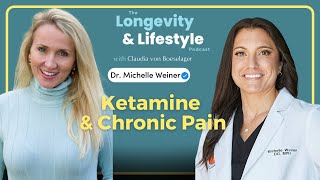
In this Longevity and Lifestyle Podcast episode, host Claudia von Boeselager interviews Dr. Michelle Weiner, a double‑board‑certified physiatrist and founder of Neuropain Health. Dr. Weiner explains her integrative, biopsychosocial approach to chronic pain, emphasizing that pain is processed in the brain and is shaped by stress, emotions, and maladaptive neural circuits. She describes how neuroinflammation, mitochondrial dysfunction, and glutamate/GABA imbalances link chronic stress to co‑occurring pain and depression, and how promoting neuroplasticity can reverse these patterns. The conversation delves deeply into ketamine‑assisted psychotherapy: its NMDA‑blocking, glutamate‑boosting mechanism, the importance of preparation, intention‑setting, a safe therapeutic environment, and post‑session integration, as well as typical dosing protocols (IV vs. intramuscular vs. Spravato) and session frequency for pain, depression, PTSD, and other conditions. Dr. Weiner also discusses medical cannabis as an opioid‑sparing alternative, highlighting the endocannabinoid system, dosing strategies that minimize psychoactivity, and the benefits of reduced tolerance and opioid‑induced hyperalgesia. Practical guidance is offered for patients seeking legitimate ketamine clinics, including required preparation, trained staff, and integration support. Finally, they explore future directions—insurance coverage for ketamine and psychedelic therapies, regulatory hurdles, the promise of MDMA and psilocybin for pain and PTSD, and the need for more robust evidence while maintaining personalized care. The episode ends with resources for Dr. Weiner’s practice and a call to empower patients to become their own healers.
Chapters
Hey there, I'm Claudia von Boeselager, a former investment banker turned entrepreneur, longevity coach, biohacker, and mother of two. Once burnt out and overwhelmed with chronic health issues, I've transformed my life and helped thousands of people do the same. I've even reduced my biological age by 17 years. Yes, I'm 26 again. Now I'm here to share the tools, strategies, and inspiration to help you live healthier, happier, and longer. On this podcast, I interview world-leading experts in health, biohacking, mindset, and performance, and share personal stories and learnings to bring you the latest insights and tips. Think of this as your go-to space for real talk about all things health and optimizing your life. Ready to unlock your best self? Let's dive in. This is the Longevity and Lifestyle Podcast.
Welcome, dear audience.
Today we are diving into a topic that affects nearly half of the adult population globally. Chronic pain. With estimates suggesting that over 1.5 billion people worldwide suffer from chronic pain, and a staggering 40% of adults with chronic pain also experiencing clinically significant depression and anxiety, our traditional approaches are often falling short. My guest today is Dr. Michelle Wiener. She's a visionary redefining what pain management means. She's not just treating symptoms, she's pioneering a holistic integrative path to healing through her work at Neuropain Health and her groundbreaking research. Her clinics are based in South Florida. Her work incorporates cutting-edge therapies like ketamine-assisted psychotherapy and medical cannabis, and her research explores innovative solutions such as using cannabis as a substitute for opioids in chronic pain and comparing psychedelic versus psycholytic doses of ketamine to treat both pain and depression. Today we'll dive into the power of personalized integrative care for pain management, the role of psychedelics in pain and mental health, and how redefining pain management can transform lives from the inside out.
Please enjoy. Welcome to the Longevity and Lifesub Podcast, Dr. Wehner. Michelle, it's such a pleasure to have you with us today.
Thank you so much for having me. I'm very happy to be here.
So Michelle, as a double board certified physician, you have seen limitations in conventional medicine firsthand and knowing that the traditional pain management system, which is often siloed from mental health, can leave patients with chronic suffering. Something made you decide to change, and I'm curious, what was that pivotal why behind you opening Neuropain Health? And how does your vision fundamentally differentiate from the typical pain management clinics or even standalone mental health practices?
Well, Neuropain Health was founded as an integrative center to help with healing and promote neuroplasticity. And this was founded because of my experience with thousands of patients who have chronic pain, understanding that all pain is biopsychosocial, meaning it's not just what's going on in the physical body or their genetics or the medications, but what's actually happening to their nervous system because of connection or disconnection or due to chronic stress or unprocessed emotions. And so for us, we really like to understand the person's story, how they got here, who they are, who they believe they are, what's limiting them. And so pain is processed in the brain and it can be emotional, it can be physical, and it's usually both. And so it was difficult for me to treat a patient and tell them that these meds or these injections were gonna cure their chronic pain when I knew that the pain is now being processed in the brain. And so a lot of what we do is trying to use a holistic approach using different team members. So coaches, nurse practitioners, as well as therapists to really try to use different techniques to steer their brain and their nervous system in the right direction. And a lot of it is having them feel safe with themselves and safe with us first. So that they can process whatever is underlying the reason they developed chronic pain.
I love the holistic approach, and as we know, it's just so, so important. So excited to dig into that. And I love the concept of that biopsychosocial model. You speak a lot about, and very compellingly about, disconnection creates chronic illness. Can you dig into that a little bit more for someone maybe listening, suffering with chronic pain, and is kind of like, well, what is this about? I don't, I've never heard this before. My doctor's never talked about this.
Sure. Yeah. So, so my main specialty is physical medicine and rehabilitation. And before I did interventional pain, we were really focused on trying to get the person to physically function and have quality of life as opposed to focus on pain scores, which are so subjective. And I felt that a lot of people were disconnected from who they are and who they wanted to be. Even myself, while I was practicing as a physician, I felt like I had to be more authentic and actually handle what I was doing at work with a different lens. And I felt that, you know, everyone does have a story. And a lot of times we just have to understand who that person was and what happened to break that. And there's usually some type of disruption in their life that created a hypersensitive nervous system. And that really started to put the person into a different direction. And so unless you really understand the story behind the person, you know, when I sit with patients, it's the experience of the person. Do they feel anxious to me? Do they feel depressed to me? Are they hopeless? Do they have a lot of energy? You know, if you don't understand what's going on with their nervous system, then you can't really educate them properly. And so a lot of times people are coming to the doctor for the answer And for us, we try to help the person understand that they have all the answers. They just have to feel comfortable with us so that we can help them process it properly.
So let's look at stress with pain and depression, right? So the data is stark. Obviously chronic stress significantly escalates the risk of both depression and chronic pain. From your extensive clinical experience, what are the primary mechanisms by which chronic stress can lead to the development of these co-occurring conditions?
So stress has a bidirectional relationship with pain. And I think that neuroinflammation really fuels the nervous system in a way that creates cytokine pathways. It changes the blood-brain barrier. We have mitochondrial dysfunction, microglia activation. There's so many reasons why people have physical pain in their body that's not actually in the periphery anymore. The nervous system is really something that should be examined in a different way when we're treating physical pain, as opposed to just looking at the body. We really have to look at the brain and the way that, that the brain is processing things. So I think that when it comes to people who are dealing with chronic stress over time, we have to really look at their lifestyle habits and sleep and nutrition and movement and social connection. And a lot of times there is this abnormality with glutamate and GABA. And those are the neurotransmitters that we really focus on. And I think a lot of the science has been looking at serotonin for depression and even dopamine. And so now what we're seeing is that glutamate is really responsible for neuroplasticity and a lot of the learning and memory that's happening. And so people actually have these learned neural circuits. And so if someone senses pain or feels overwhelmed, there's a pathway in the brain that allows them to then respond. And what we're trying to do is get them to take a little space to feel what they're feeling in their body and not just become reactive to it. And so it's almost like brain retraining.
Yeah. Rewiring the neuropathways.
And a lot of people, you know, the metaphor of like rebooting the brain, a lot of people are stuck in these rigid mindsets where we are just trying to loosen them a little bit so that if we loosen it, maybe the nervous system resets in a way where they're able to be more flexible in their mind and their body. And so a lot of what we do is focus on functional movement, having them focus on posture and alignment. And it's not exactly physical therapy.
You just sit up straight here or stand straight rather.
And now, now the good thing is there's actual evidence showing how even low back pain should be treated with something called pain reprocessing therapy, which is more of a psychologically informed physical therapy. And really, a lot of the data shows that we have many imaging studies that we do for, let's say, low back pain. And the study shows that 50% of people that are 30 years old have some type of MRI imaging showing a disc bulge or herniation, but they're asymptomatic. So what ends up happening with science and technology is we have all these great tests, but now we're treating the imaging results and not the person. And so for us, it's really understanding how they got here, because if we're just treating, let's say, you know, a peripheral neuropathy related to diabetes, but not actually talking about their diet and exercise, then we're not really helping them long-term. And I think a lot of, you know, what you talk about is lifestyle and longevity, obviously. So the chronic stress is causing the chronicity of the pain, but then they, it becomes their identity. So now they're stuck in this mindset that they can't do certain things and they're restricted. And then that's where the rigidity plays in. So it's really a very holistic integrative approach to treating pain.
It's like music to my ears. I love this, Michelle. So I just wanna congratulate you so much on this. And I want to look at prevention, right? So prevention is better than cure, as we know across the board for everything. For individuals experiencing acute pain, whether from an injury or a new diagnosis, what are the crucial proactive steps they can take both physiologically and psychologically to prevent that acute pain from spiraling into this persistent chronic condition? What would you recommend?
So the first thing I think is their internal language with themselves, being more compassionate and kind. So their actual internal self-talk, that is something that we really talk about because we wanna know what they believe is happening and we wanna know how they talk to themselves. If they are very aggressive or they have this language that they're talking to themselves in a very negative way, that will show up in the body and the beliefs that we have really can shift our biology. So first we really focus on who they think they are, why this developed, and how can they have a little bit more compassion for themselves. And then we also try to figure out if there's any underlying unhealed emotions or unprocessed feelings, for example, shame, guilt, anger, you know, all of these can underlie why someone develops chronic pain. And so the story—
Which a lot of people must say yes to, right? I mean, if they admit it. Yeah.
Well, and yeah, and actually that's really important is for us to make them feel safe and supported with us so that they can really let go and tell us who they are. Because initially they are so skeptical because of what they've already gone through with different doctors telling them that this is gonna help them, this is gonna take away their pain. And then it's either a short-term bandaid or it doesn't help. And then they get very frustrated with the medical field. So when they come to us, we, even our physical environment looks very different than a doctor's office. We have, you know, more like, even sometimes when patients come in, they're almost hesitant. Like, I'm not sure if this is for me. Is this the right one?
Is this the right place?
I'm not sure if it's for you either, but are you willing to just sit and tell us your story? Work with us. And so safety is first for us, and then making them aware of their beliefs, and then really focusing on their habits. Because if someone is not sleeping well, they're gonna have more pain. If they're not sleeping well, their brain is gonna be hyper-responsive to a lot of different things in their environment also. Who is supporting them, meaning when they go home and they tell stories of when they were spending time with us, Is that person going to be supportive and are they able to have connection with other people? So a lot of it is, is just, you know, starting off with the basics. And then eventually we get to the point where we start to understand who they think they are, which is really their default mode network, right? That's a part of the brain that's like your autobiography of who you think you are. And we try to quiet that a little bit so that we allow other parts of the brain to connect and have a different perspective on things.. And we ask them, you know, what does better look like? If you were to have less pain, what would you want to do instead? Just simple things. But really, a lot of us focus on function and movement because sometimes we believe that action will create the change that you're feeling, and it can actually change how you're thinking. So instead of trying to think different or trying to repress this feeling and make it go away, Sometimes moving your body actually causes you to have more energy and it allows you physiologically to feel like a person who has meaning in this world. So movement is a big part of our practice. And then we have some other medications that we use that we can also discuss.
We can dig into that now. I'm super excited to dig into this as well. And I've had, you know, people like Dr. Pamela Crisco, who you'll know on as well. We've had Talia Eisenberg as well from the Ibogaine Clinic in Mexico, and they're doing work in Texas to support more funding in that.
I just want to say two really strong women that I have a lot of respect for. So thank you for putting me in that category.
Oh, of course. 1000%. And Julia, our mutual friend, Dr. Julia Mear has been on twice actually already as well.
So yeah, amazing. The master connector, Julie.
Exactly. Amazing people. So you've been doing really pioneering work with ketamine and its remarkable efficacy for both mental and physical pain as well. And so this dual power is really, really compelling. From a neurobiological perspective, why does ketamine work so effectively for both conditions? And maybe you could share some of your insights from your research at the University of Miami comparing psychedelic versus psycholytic doses of ketamine.
So ketamine blocks the NMDA receptor, which is a receptor responsible for neuroplasticity. So right there we have what is happening in the brain is that there's an increase in glutamate, which is an excitatory neurotransmitter. And that helps people learn different things. It helps them reconsolidate their memories and it allows them to have a change in perception of what's actually happening. And so when you give someone ketamine, it can come in all different doses, all different routes of administration. But my goal with them is to create neuroplasticity. There's an increase in brain-derived neurotropic factor that happens, which also can happen with many other things like exercise. Exercise, yeah. Yeah. And, and, and then sometimes they do get that dissociation. And so ketamine is a legal medication. It's a dissociative anesthetic. It was first used in Vietnam, very safe, and it doesn't affect respiratory drive. So that's why they use it in Vietnam instead of morphine to help with pain. But it allowed people to separate from themselves. And so a lot of people find they're stuck in a belief system or they're stuck in their physical body or they have some type of something that has to shift. And unless that shifts or unless the nervous system resets in a certain way, they continue to behave and act and feel and think the same. So ketamine really can create this neuroplasticity. And they also have the opportunity to change their perspective on what's happening in their lives. And that's the when you kind of quiet the default mode. So you're not really in your story. And if you weren't in your story and you felt safe, you can see what's happening to you from a different lens. So, you know, it has to be done properly with a lot of preparation. And we like to have them understand what they're gonna feel or what could potentially happen. For pain patients, it's an anesthetic. So they end up disrupting those pain signals and just giving them a break from their pain allows their brain to actually become hopeful that this is a potential possibility for them. So the ketamine over time, it's usually done a few sessions in a row and it can create this neuroplasticity. And then the question really is how to integrate these sessions. Sometimes people have really profound insight as to the source of their pain or their stress or how to make changes. And other times people don't have these visuals and they just are getting the medical benefits of stimulating that glutamate and creating neuroplasticity. And I, I think that for a lot of people, it's something that has to be done with a lot of care. We really do like to understand the whole process from preparation to the medicine, to the integration, even for pain. I think a lot of pain doctors think that they could just give people ketamine, it disrupts the pain signals, and then they can move forward with their lives. But But sometimes they do have these profound sessions and you really do want to get to the heart of what actually came up so that it can be processed because now it's just living in their body, living in their brain, and they need someone to talk to about what just happened. So, you know, it's a full process to do ketamine-assisted therapy. And we always do ketamine-assisted therapy for physical pain and mental health.
Dear friends, want to boost your brain clarity, energy, and focus in just 5 minutes a day? I've created a powerful free guide just for you. It's called Unlock Your Brain's Superpower: The 5-Minute Blueprint to Boost Mental Clarity, Focus, and Lifelong Vitality. Inside, I share the exact microhabits I use and teach my clients to rewire mental patterns, grow new brain cells, balance energy, and protect long-term brain health, all backed by cutting-edge science. Whether you're feeling foggy, stressed, or simply want to future-proof your brain, this guide is your first step. Download it now for free at longevity-and-lifestyle.com/brain. That's longevity-and-lifestyle.com/brain. And start unlocking your brain's full potential today.
Please enjoy. I'd love to unpack that a bit for people who might have chronic pain but don't know ketamine. They're like, What is this that you're doing and what are these experiences that you could have? So maybe you can talk a little bit about the preparation piece and then also what is the type of experience? Maybe there's some anecdotes because it's a dissociative, right? So they can separate themselves as you were saying. And then what does integration mean? As we know with many psychedelics, how important it is and obviously ketamine as well. So could you walk somebody through that?
So preparation is allowing the person to understand that we are about to quiet who, you know, their ego basically. So if their ego wasn't front and center and we were just putting it off to the side and their story of who they are and why they have chronic pain, or perhaps they lived an actual trauma and that trauma is keeping them in this hypervigilant state, or maybe they've had chronic depression for a long time. And their views of the world have shifted a little bit. So if that, if you feel safe enough to put your story to the side for a little while and you are able to just lie in a recliner with your eyes closed and listen to a very relaxing playlist and we give you a medicine, it just feels like you're drifting off into another setting. And that setting for a lot of people can be very expansive. A lot of times they feel like they're flying in the sky. They feel like they're going through different tunnels or pathways. The music really helps guide them. And the preparation is, is for us to allow them not just to feel safe, but to give them a specific intention. For example, they're willing to release the belief that they have chronic pain, or they're willing to release the belief about them that they perhaps have to have depression. Or, you know, a lot of times we're taking limiting beliefs like they're not lovable or they're not good enough. And so it's amazing to see someone, let's say, with chronic migraines who really has these migraines because they believe they're not lovable. And how can someone, you know, a pain doctor talk about love and connection and being good enough and tying that to migraines? Well, there's many causes of these headaches and these migraines, but when you track someone, you realize when do you have these migraines and is it stress-related? And so the important thing is for them to feel that they understand what's about to potentially happen. And usually if they feel safe, they're able to just calm their nervous system enough to allow for a different perspective on things. And so during that time where We're guiding them. Sometimes people want to talk. Sometimes we just are facilitating whatever is happening. A lot of times it's just this non-directed guidance where they're having their own experience and we're just with them to make sure they feel safe. And then—
So just to pick up on that, just so people can imagine. So they're reclined in a chair, they're listening to nice music, and there's another person there in case something comes up, or what's that setting like? Just so someone maybe listening can kind of visualize that.
A lot of times we Sometimes they'll talk in the middle of it and they'll say things. And so we'll have someone like Julia sitting there and taking notes. Sometimes, you know, sometimes they want to do their session themselves and we're right outside. And it really depends the person, but we try to create an environment for them to feel safe enough so that they can just fully let go. And if they were to let go, what would come up? And it's usually something from their subconscious. That was fueling their stress or their trauma that then created their chronic pain. It's, you know, like sometimes there's a story about this doctor did this procedure to me and now created this physical pain, trigeminal neuralgia, for example. They'll have this pain in their face and they feel like this numbness, tingling, burning, and it's all stemmed from a procedure that a doctor did, let's say.. And so they have anger about that. But if they were not to have that story and their heart is a little bit more open and they're in this state that is a little bit more parasympathetic, let's say, they're able to have a different perspective on things and realize that was a story I created about a pain that I have. But really, I'm able to look at it now and see it wasn't like this person did this to me on purpose or that, you know, they even have compassion for the person who perhaps traumatized them. So there's a lot of different shifts in the story that then can change their physiology. And I think a lot of times they're just the concept that they can have a different perspective on things really helps shift them. So they're, you know, sometimes people have these visuals, sometimes they get these thoughts or these words just come to them, you know, and they'll tell me like, okay, the word liberated came to me or, you know, peace. And we set these intentions to help them to guide, but whatever comes up comes up. And then that's kind of the beauty of it because it's their own session. And then usually afterwards, we end up talking about the session and what you see, how'd you feel. Sometimes it's a feeling, oh, I haven't felt this peaceful in years, or I felt love for someone and I truly missed that connection. And even that helps them feel better. And it may not be related to their pain, but it's going to cause a shift in their neuroscience, which is then going to shift the way that they show up in the world. And usually when it comes to ketamine, it's a very rapid antidepressant. It's an anesthetic. So you feel better quickly. And that's nice because they're able to feel well right away. However, it doesn't last unless you're doing multiple sessions and also pairing it with coaching and therapy.
What is the typical protocol in terms of sessions and maybe for different use cases? So we're talking specifically pain, but you were mentioning some other modalities like depression, also for PTSD, things like this as well. Maybe you can talk about the use cases and, and what certain protocols would look like.
So for chronic pain, it's usually done through an IV and we're usually doing multiple sessions over 2 to 3 weeks. So it could be twice a week for 3 weeks. Let's say some, some places actually do 5 days in a row, longer sessions, like 4-hour sessions. And originally when I trained, that's how we used to do it. 4 hours of ketamine, 5 days in a row, and absolutely no preparation, no integration, no coaching. The goal was just give people this medicine. Disrupt their pain pathways and rely specifically on medication, which is to me not the right way of treating anything chronic because the person has to participate. The person has to have some type of autonomy. And so what ends up happening in our clinic is we do, we treat chronic pain and mental health very similarly because the mind and the body are always connected. And pain is always physical and emotional. So we end up usually doing twice a week for 3 weeks for chronic pain, let's say, or for PTSD or depression. And then it's also personalized. Sometimes someone can only come once a week and they're doing it once a week for 6 weeks. But usually the medication is going to last for a few days and they'll get this afterglow effect. They'll have, you know, their brain is primed to make change. The glutamate in their system is there. And then we're pairing it up with obviously positive lifestyle habits, but they usually come for, let's say, 6 sessions. And then there's obviously maintenance that happens afterwards. The 6 sessions is something that I am not a fan of. And I think that a lot of that came from a research study that was done where they were using ketamine in a short period of time. And the problem was they didn't look longitudinally to see how that patient was doing 6 months later or a year later. And it was really just trying to help as a rapid antidepressant or even for someone who's suicidal to get them out of that state quickly. So I usually personalize it based on whatever's going on in that person's life. And sometimes they're able to do it twice a week for a few weeks. Sometimes we will do twice a week for 2 weeks and then we'll do once a week for 2 weeks after that. But usually you need a few sessions in a row because the first session they're a little bit anxious and we're just trying to help them understand what they're gonna feel. Usually we increase the dose each session if they can tolerate that. We happen to like the intramuscular way of doing it, especially for mental health. And usually we're doing 2 shots divided by 15 minutes. I was trained by the Ketamine Training Center, Phil Wolfson and Geeta Vaid, really wonderful. People. Actually, Bessel van der Kolk was there also who wrote The Body Keeps the Score. And we learned intramuscular dosing and I learned it from them. And that was from the psychiatrists. And so pain doctors, they just do the IVs, you know, and the intramuscular, you could really dial into the patient. You could do 3 shots. You could keep the dose low. You can do more therapy during the ketamine sessions. And then another type of ketamine that we use is called Spravato, which is the intranasal one that is covered by insurance that's indicated for treatment-resistant depression and major depressive disorder. And the nice thing about Spravato is that it comes only in two doses. And so the dissociation is much more controlled. And so a lot of people who've had chronic depression and been treated with all these SSRIs and not really getting better, now you give them a medication that increases glutamate, completely different, causes a mild dissociation, allows them to separate themselves from their story. And that, and that's something that also is helpful because they don't have to pay for it. And so the nice thing about having something covered by insurance is that people can continue to come back and not worry about money. And that's really important for me because I really like to treat everybody and I don't just want to treat people who can afford IV ketamine, of course.
What are some non-negotiables if someone, let's say, doesn't unfortunately have access to one of your neuropain clinics? What are some non-negotiables that you would recommend that they seek out to make sure that the practitioner is legitimate, that the program is legitimate?
What are some flags and what are some important points to really look out for? That's, that's really a great question because there's a lot of ketamine clinics and a lot of places I hear just, you, you, you know, you show up, you tell them a little bit about your diagnoses, your medical conditions, and then you get an IV and you get ketamine. And that could really traumatize someone if they're not prepared for what they're about to feel. That, that dissociation can be very overwhelming if they're not prepared. So I would say regardless of what your condition is, whether it's physical pain or any type of mental health condition, the ketamine place should always help prepare you for what you're about to feel, usually with a coach or a therapist. And there should be, it should be properly trained in psychedelic-assisted therapy or ketamine-assisted therapy. There's many people who've used ketamine before, like the ER or anesthesiologist, right? But those people are not prepared to help your mindset, help you integrate these processes. So I think it's important to really use a team approach and to understand and feel comfortable with your practitioner. You know, a lot of times there's many people that are very passionate about this field. And I find that those people are the ones who do it well. And a lot of times it's not about the dose and people I think people have to really understand that more is not better when it comes to ketamine. We wanna put you into this state where you're able to remember what's happening and you're able to process it afterwards as opposed to sending people to the moon and them feeling very disconnected from themselves when they already feel disconnected. So I think it's, there's a sweet spot with ketamine that you really have to tailor to the person.
And I love that holistic approach you have too. So ideally these clinics would have some sort of holistic approach doing the, this pre-prep and then that integration after. And the dosages. I wanna touch on medical cannabis, Michelle, a game changer for opioid reduction. Your research exploring cannabis as a substitute for opioids in chronic pain is incredibly timely given the ongoing opioid crisis. What compelling insights have you gained from your studies and clinical experience regarding the efficacy and safety of medical cannabis in mitigating chronic pain and its potential to significantly reduce reliance on highly addictive conventional pain medications?
Yes, so we obviously have an opioid epidemic. It's the first time in many years that we're seeing less opioid overdose deaths. And this is just something recent because we're having these conversations and we're educating people, even young people, about how opioids can create addiction. And what happens with addiction is that the person is just narrowing their mind to find that substance and it creates this rigidity. And so, you know, the, the interesting thing is the United States uses 80% of the world's opioids. Many other countries don't use opioids the way we do. And a lot of it stemmed from when pain became the fifth vital sign that in the hospital we had to use these medications for mild, moderate, and severe pain. And so everyone who has some type of surgery gets an opioid. Now you expose someone to an opioid They, you send them home from the hospital with 5 days supply of a pain medicine and they physiologically become dependent on it. And they think they need this because their doctor gave it to them or there's unused opioids in the medicine cabinet and someone else gets a hold of it. And so the opioid epidemic is not just from doctors giving out pain meds, it's also from people suffering. And from them, people treat their depression with opioids. You know, and the interesting thing is, is that opioids and endorphins are very similar. They both activate our opioid receptor. So we make endorphins from exercise, from positive things, right? Yeah. Yeah. So when you're taking opioids, you're actually occupying your opioid receptors to not allow the endorphins to work. So you end up having this chronic depression over time. And so I find that cannabis was an outlet for me to help patients who were dealing with chronic pain, especially older patients, because first of all, there's so many medications that older people are on that all interact. And so a lot of times when we're using medical cannabis, we can start to deprescribe different pharmaceuticals, have them sleep better, their mood improves, their pain is better. But there's no potential for overdose. There's no toxicity when it comes to cannabis. The most important thing with medical cannabis is, first of all, we have an endocannabinoid system, a whole system in our body where we make a THC-like molecule, and all of the neurotransmitters are really being balanced by our endocannabinoid system. And so sometimes when we're using medical cannabis, we need to properly inform patients how to use it. So what I started to do almost 10 years ago was learn how to mitigate the psychoactivity of cannabis to help with chronic pain. And a lot of times that's using the other cannabinoids like CBD to decrease the high, so to speak. And so now that, now you can get so many different types of cannabis, but we really focus on tinctures and things that we take by mouth, and I like to use specific dosing because it is a medicine. And so when the person understands that this becomes their medicine, we sometimes have to break down the stigma. How do you feel about this plant? You know, what, what have you learned about it? And now all of a sudden the plant that people used to get high from is now their medicine. And so it's actually educating them about how to use it in a safe way. And what's interesting is over time they use less of it because they're feeling better. So there's less of this tolerance that builds up with opioids. You need more and more to get the pain relief. And the other problem with opioids is there's something called opioid-induced hyperalgesia where taking more opioids make you more sensitive to pain. And so that's why I use things like low-dose naltrexone. That's a good one for neuroinflammation and chronic pain. It helps actually increase your own endorphins. So, you know, medical cannabis was really my first step into the holistic plant medicine world. And not only was it helpful with pain and mental health, but I also did realize that that change in consciousness that can happen allows them to either connect with themselves or change their story in a different way. And the nice thing about the plant is that it can come in many different formulations and you can personalize it. And then once a person feels comfortable, the personalization gives them that autonomy empowers them to take their health into their own hands, and then they don't rely on the medical system as much, which is the goal for any type of long-term health plan.
Says an amazing holistic practitioner. Let's talk about the future frontier. You're deeply involved in advocacy for progressive change. So, so important, including efforts around FDA pathways for new therapies. So looking, say, 5 to 10 years down the line, what does the future path you envision for pain and mental health treatment look like?
It's a great question. So I would love to see ketamine covered by insurance for chronic pain conditions. I would also love to see the coaching and therapy and preparation and integration covered by insurance. And that, that's very important because we need to give access to everyone. And people at different socioeconomic status have different types of pain and suffering. And so for me, I I do like the use of ketamine for mental health and chronic pain, but if it was accessible because it's covered by insurance, then I think that a lot more people, we would have more data and understand it better. So, you know, the goal is to, to not just get the medication covered, but also to have them understand the importance of the therapy because really the, the ketamine can help them soften their defenses to do the work that they need to do with the therapist. So, you know, one would be insurance coverage for ketamine-assisted psychotherapy. And then I do believe that MDMA has a lot of promise for chronic pain and PTSD. And I think that as the studies continue, there will be certain psychedelics that will become available through the FDA process. I think that MDMA is a really a wonderful medicine because it not only activates the 5-HT2A psychedelic receptor, but it increases oxytocin and it has a stimulatory effect. And so I think that it could be very helpful for different chronic pain conditions as well as PTSD. I think that many companies now are looking into psilocybin for treatment-resistant depression. So the goal is, I think, to change the way that we treat chronic pain, through education, understanding that pain is always processed in the brain. And as much as we can help people reset their nervous system to a place where they feel more calm, they could then start to have the capacity to hold these emotions. And we're always gonna have pain, but usually pain persists because we're resisting something. So if we're able to help people understand where they feel stuck and how they can shift, These medications could just be a catalyst to create change in the nervous system as opposed to, yeah, and then really helping them rely on themselves to help them move forward in their life. So it's really always gonna be an integrative approach. And I think that, I think that it's promising as long as we continue to move in that direction towards more integrative and holistic pathways.
What's the biggest regulatory hurdle? What needs to happen, Michelle? Do we need to get you to DC? What's needed to expedite these changes because the research is so compelling at how powerful this is?
Well, yeah, I think it's really just evidence. And I think that research takes a lot of money and a lot of time. And then there's specific conditions. So we end up generalizing things. So for example, if it works for chronic migraines, will it work for peripheral neuropathy? Or can you just say it will work for low back pain when it's always multifactorial? So I think a lot of it comes down to the evidence and then I think it's difficult because we are moving into this personalization era of medicine. And so it's difficult to do evidence-based research when everybody's different and every person's having— essentially, right. Everyone has a different experience and everyone experiences pain differently. And so I think that's the challenge that we're facing right now.
Doing things with AI as well is like, how do you at least have a cohort, right? So yes, you'll have every— an N of 1 and everyone's a bit different, but can you categorize a little bit and then see certain outcomes from that? There's the joys of technology as we began the podcast with and the challenges that come with it as well. There's so many things I'd still love to cover, Michelle, but we need to do a round 2 at some point. I know our time is up. Thank you so much for coming on. Where can people find you? Where would you send them to, to learn and follow you? And we'll link everything in the show notes.
Sure. My website's drmichelleweiner.com and the same for Instagram and LinkedIn. That's where most of my information is. Our clinics are in Miami and in Hollywood and South Florida. So we are looking to continue doing what we're doing and hopefully other people will understand the value of an integrative approach to chronic pain.
Beautiful. Do you have any parting thoughts or message or piece of advice for my audience today?
I guess I'll leave you with the concept that our beliefs and our stories do shift our physiology and our biology. So when we are dealing with physical pain or any type of issue that we think is in the body, we have to understand that sometimes our own beliefs are what's actually causing us to stay stuck where we are. And so one thing can shift, someone can fall in love, someone can get a new job, and then their whole life changes. So instead of relying on medication, it's helpful to empower patients so that they become their own healers.
And just to empower people to know that the healing can be from the inside. So thank you so much for your work, Michelle. Such a pleasure to have you with us today.
Thank you.
Thank you. Hi everyone, it's Claudia again. Before you take off, would you like to get a short email from me to you several times a month with top tips, insights, and strategies to help optimize your life, health, and business? This could be interesting posts or articles I've read on life and longevity optimization, cool biohacking or lifestyle products that I've discovered, and other fun things to help you be at your best. It's a very short piece of inspiration for you, so if you want to receive it, check it out by going to llinsider.com. That's llinsider.com, and leave your email to get the next one.
More from Claudia









Can Psilocybin Slow Aging? The Study on Telomeres, Inflammation & Survival with Dr. Louise Hecker

