Muscle Wins: JJ Virgin on Aging Powerfully, Fixing Metabolism & Building Strength at Any Age
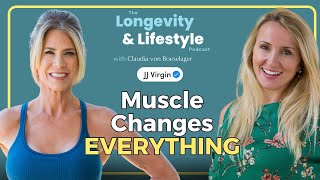
In this episode of the Longevity and Lifestyle Podcast, host Claudia von Boeselager interviews triple‑board‑certified nutrition expert and fitness Hall of Famer JJ Virgin. The conversation frames muscle as the "new organ of longevity" and explores how resistance training, nutrition, mindset, and recovery can reverse age‑related decline. JJ shares personal stories of his parents’ health trajectories, explains the rapid loss of muscle mass, strength, and power after age 30, and describes the myokine signaling cascade that links muscle contraction to improved mood, immunity, bone health, and fat metabolism. He outlines practical, muscle‑first protocols for beginners and older adults, emphasizing body‑weight, free‑weights, or machines, progressive overload, and the distinction between hypertrophy, strength, and power training. The discussion then shifts to insulin resistance, food sensitivities, and elimination diets—highlighting common culprits (gluten, dairy, eggs, soy, corn, peanuts, sugar/fructose) and the role of gut permeability. JJ advocates using continuous glucose monitors (CGMs) and wearable data (HRV, Oura) to personalize nutrition and detect hypoglycemia or early insulin resistance. Mindset is presented as a critical longevity factor, with JJ describing a “what would I love” framework and the importance of embracing hard challenges at any age. Finally, he shares recovery rituals (sauna, red‑light therapy, sleep, HRV tracking) and a simple entry point for listeners: the free "Eat Protein First" challenge, plus his online platforms (website, YouTube, Well Beyond 40 podcast, Instagram). Sponsor messages are interspersed but are not central to the core content.
Chapters
Hey there, I'm Claudia von Boeselager, a former investment banker turned entrepreneur, longevity coach, biohacker, and mother of two. Once burnt out and overwhelmed with chronic health issues, I've transformed my life and helped thousands of people do the same. I've even reduced my biological age by 17 years. Yes, I'm 26 again. Now I'm here to share the tools, strategies, and inspiration to help you live healthier, happier, and longer. On this podcast, I interview world-leading experts in health, biohacking, mindset, and performance, and share personal stories and learnings to bring you the latest insights and tips. Think of this as your go-to space for real talk about all things health and optimizing your life. Ready to unlock your best self? Let's dive in. This is the Longevity and Lifestyle Podcast.
My guest today is JJ Virgin. JJ is a force of nature in the world of health and high performance. A triple board-certified nutrition expert, Fitness Hall of Famer, and 4-time New York Times bestselling author, JJ's on a mission to redefine aging not as decline but as a bold new stage of strength, vitality, and purpose. Best known for her groundbreaking concept, Muscle Changes Everything, JJ challenges outdated weight loss dogma with her muscle-first approach, showing how building strength transforms metabolism, hormones, energy, and even brain power.
Her philosophy, aging gracefully, is optional. Aging powerfully is the new standard.
As the founder of the Health Business Growth Collective, formerly Mindshare, JJ has built the most influential community of health entrepreneurs in the world, helping launch more bestselling books, PBS specials, and even 7-figure wellness brands than anyone in the industry. Her own story is one of resilience and reinvention, from Broadway-level tap dancer and national TV host in Japan to powerhouse entrepreneur and warrior mom who turned personal adversity into global impact. A regular on the Today Show, Dr. Oz, Rachel Ray, PBS, and Tony Robbins' Life Mastery, JJ has inspired millions to take control of their health, mindset, and destiny. Her podcast, Well Beyond 40, has surpassed 23 million downloads, and her social reach spans millions across YouTube, Instagram, TikTok, and beyond. Today, JJ leads a movement that blends science, strategy, and soul, helping people build muscle, Boost metabolism and age with power, purpose, and possibility.
Please enjoy.
This episode is brought to you by Pendulum. If you've been listening to this podcast, you'll know that longevity isn't about quick fixes. It's about supporting your body at the root. And one of the biggest realizations I've had from talking with experts is that so many foundational systems, from your energy and metabolism to immune health and even mood, all start in your gut. That changed the way I approached my own health, and it's exactly why I'm such a fan of Pendulum. They're a science-driven company pioneering a whole new approach to gut health. In fact, Pendulum is the first company to bring live akromancia to market. This is a game changer. I recently started taking their Metabolic Daily, and I can tell you I'm already noticing a real difference. My digestion feels smoother, I have more consistent energy, and I love knowing that I'm supporting my gut at such a foundational level. For me, this is a cornerstone of longevity. If you're serious about your health and lifestyle, this is where to start, because when you support your gut, you support your entire body. And for you, dear audience, get 20% off your first Pendulum membership order by heading over to pendulumlife.com/claudia. That's pendulumlife.com/claudia20. The discount is automatically applied at checkout. This episode is brought to you by CaroBike. Did you know that one of the strongest predictors of how long and how well you live is your VO2 max? It's a key indicator of your cardiovascular fitness. The challenge is VO2 max naturally declines by about 10% every decade after age 30. As someone who's always looking for the most efficient ways to optimize my health and longevity, I knew I needed something that fit into my busy schedule. That's where CAROL bike comes in. Backed by published research, this isn't just another stationary bike. CAROL uses AI-powered reduced exertion HIIT, or reHIIT, to deliver the same cardio benefits as a 45-minute jog in under 5 minutes—just 2 short sprints. Studies show CAROL can improve your VO2 max by 12% in just 8 weeks. Making you up to 10 years fitter. It's truly a game changer. If you wanna future-proof your health and longevity without spending hours in the gym, check out carolbike.com/claudia for a $300 discount just for you, dear audience. That's carolbike.com/claudia.
Welcome to the Longevity and Lifestyle Podcast, JJ. It's such an honor and pleasure to have you with us today.
I'm thrilled to be here.
JJ, you've helped redefine aging, is a topic of keen interest to us all, from something to endure to something to own with power and purpose. You're a living example, of course, of strength, energy, and reinvention. So you say aging is a privilege, aging powerfully is a choice, and I love that.
Was there a personal moment that made that philosophy come alive for you?
So it was interesting growing up. So I'm an adopted kid, and so I watched my— now, as we know, genes actually don't play that big of a role here, which is kind of good news for all of us. But still, I was like watching these two people raise raising me, my mom and my dad, kind of watching what they were doing and realizing what your daily habits could do for your life, right? 'Cause I have my mom who basically moved every day. She wasn't do real exercise, but she did all the housework, two-story house, all the gardening, like all the stuff and golfed. I just don't call golf, to me golf is not exercise. You know?
Depends if there's a golf cart involved, I would say. Yeah.
Always seems to be. Now, when she first started, there weren't, but then by the end, you know, everyone had to take the golf carts so they could speed things up. However, and she golfed till 93, which was pretty darn cool. Amazing. My dad, on the other hand, would start, come home at night and literally it was like, I look at this and go, this was so crazy to think about. Like she would get all dressed for him coming home at night. He'd come in the door, she'd get him a drink. They'd sit down together, you know, talk. He'd read the paper. He'd eat. Those horrible salted peanuts that are fried in peanut oil and then have like, eat all that, have a couple martinis, and then we would have dinner. And every night she made dinner and we had, we always had White Wonder Bread sitting in a basket. I don't know why, 'cause no one ever ate it. You know, you look at it and go, this was just a thing. It could have been the same White Wonder Bread for years. It wouldn't have changed. And we always had like an iceberg lettuce salad with some kind of Kraft dressing, but then she would always make a starch, a veggie, and a protein, right? And my dad would have more drinks during dinner and then quite often an after-dinner drink and he would be smoking and, you know, so stressed out with work, on blood pressure medications. So you're watching these two people. I mean, their health could have been 180 degrees different. And my dad would always talk about how his ship was going to come in. He was working for a company and when they sold, he had stock and then he was going to get to do all the things, you know, he'd get a boat. We would go on 2 weeks of vacation each year. Then we'd go, we'd do more vacations. We do all these things. And the company did sell. It finally did. And his ship came in. However, when this all happened, I remember because all this is going down and he's got this cough and we kept going, you know, you need to check that cough. And he goes and checks the cough. And of course the cough is lung cancer when you smoke for that long. And so literally his ship comes in and my last memories of him as this is all happening is him in my parents' bedroom in a hospital bed in adult diapers. He had gone from, you know, 240 pounds down to like 150 pounds. Delirious. I remember just thinking, people, they talk all the time, I don't want to get old. I'm like, I want to get old. What's the opposite? It's like, yes, I want to get old. However, I don't want to get old like that. Because I contrast that with my mom who lived 23 years longer than my dad. And I think she would have lived longer, but she got a wink, wink, COVID little turbo cancer. You know, which doesn't happen at 93. She literally like was fully aware, totally active, golfing at 93, doing all her own housework, doing up and down the stairs, carrying heavy groceries, all of it, aging powerfully. And that's when I looked at it and you go, okay, really? When we find out that genetics has not that big of a role here, that the majority of this is all within our control. So choose wisely. And what's so funny to me with all of the longevity movement is that so much of what you look at for longevity comes down to, I mean, if you had to pick one thing for longevity over everything else, I would pick exercise hands down. Now I'm an exercise physiologist by training.
So I was like, finally, we're not the, like, you know, but the science shows it too.
So it's not only shows it, you know, but you look at all the things that are cool. Hey, I've got my own longevity recovery room at the house with not one, but two saunas and three different red lights. When you look at what makes the biggest impact, it's gonna be sleep and food and exercise and relationships and belief in something bigger than yourself.
And that's what I love as well, that so many things are free, right? So people are like, what biohacks, what supplements, but actually just start with the basics and you don't even need a big budget for it as well. So, yeah. Exactly.
Well, I think you should have to earn your biohacks. It's an unpopular opinion. However, you know, Couple years ago, I was sitting, it was New Year's Eve, and I was sitting next to someone at a party, a 70th birthday party for a friend. And this guy was telling me about all the things he does. He went to Mark Hyman's conference and he went to this retreat and blah, blah, blah, right? And all the biohacking, et cetera. And I go, that is great. What do you do for exercise? Right? And nothing. Oh, crickets. I didn't do nothing. And I'm like going, you know what? Like spend the time there first. You're spending all this time, just hire a trainer first. Yeah. So I love all the stuff, but the stuff is, it's to me, it's like supplements. Use them to supplement your diet. Don't use them in place of, right?
So muscle is now being called the new organ of longevity.
Thank you, Gabrielle.
More than delighted exactly to hear. And you've obviously been saying this for years, yet adults lose 3 to 8% of muscle per decade after 30, accelerating after 50. One of the biggest predictors of mortality, as we were just talking about. Discussing. And you often say muscle changes everything. What's actually happening, JJ, inside the body that makes muscle the most underrated biomarker of health in your view?
It's so exciting. This, this whole, all the muscle stuff, because literally since grad school, I've been bringing skinfold calipers. I've been doing fat-free mass. Like I've been, this has been my focus for over 3 decades now. It's like, let's put the muscle on. Now I'm going to push on these stats a little bit. You know, you've seen the stats. So the stats are basically up to 1% a year, 3 to 8% a decade, and then that can start to double at age 60. That's just muscle size. That's not looking at strength or power. Strength is twice, twice the accelerated loss and power 3 times. Wow. And that's even more, more scary because that's, you know, your gait speed is directly correlated with your cognition, with all-cause mortality, same with your grip strength. So here's an interesting little N of 1, and that's what it is. It's an N of 1, but I looked at this and I went, well, Why is that happening? You know, we hear there's hormonal shifts and so you're not able to build muscle as easily, but you hear a lot with anabolic resistance that it could be more because of insulin resistance, because of being sedentary. So at 39, I did a DEXA scan and then I did another one at 59 and they were exactly the same, same weight, same bone density, same fat-free mass, same fat mass, the same, the same. And I went, okay, so are we losing muscle? Are we aging because we're losing muscle? Are we losing muscle because we're aging? Which one is it? Now, I think it's because starting at around age 30, I know how my life started to change. You start having kids, you've got a job, like all these things. So you're not as active as you used to be. You know, before kids, I would spend the weekend biking and like just doing all sorts of fun stuff.
And all of a sudden you're like going to the soccer field and standing on the sidelines.
You're not even playing, right? Standing there with other mothers who are probably drinking rosé, you know, chit-chatting. Kids snacks, right? So, I mean, things shift dramatically. Now you're at Chuck E. Cheese, you know? So I just wonder if a lot of it is just because our lifestyles change so much, our stress goes through the roof, we aren't sleeping as well, all these things start to shift, and this isn't the priority because our kids are a priority. So you just kind of wonder, does it really have to be that way? And that's, that's the first part, because when you look at muscle, and yes, muscle changes everything. When it muscles 3 things. It's that metabolic Spanx that holds everything in tighter. And if one more person says, I don't want to get big, but I want muscle tone and I want your arms. I'm like, well, that's putting muscle on. When you put muscle on, then it partially contracts to build tone. That's what muscle tone is.
Personal trainer friends. And they're like, if the next woman comes to me and says she doesn't want to get big, they're like, you don't understand how long it takes to get big.
I'm like, okay, so 40 years I have been taking people to the gym. I've been taking women to Gold's Gym down in Venice back before there was any anything there but, you know, a big room with a lot of weights and big dudes. And in all that time, I've never once had a client get too big, ever. I've had them get big when they quit and sit on the couch. You know, you get bulky because of fat, not because of muscle. Muscle takes up way less space, holds everything in tighter. And because it gives your carbohydrates a place to go, now they don't have to be turned into fat and stored, you know, around your visceral adipose, stored around your viscera as, as fat.. And then to me, the most exciting part about muscle altogether is the myokine story, is the messenger story, is this idea that your muscles, when they contract, send these messages all throughout your body, in the muscles, next to them, all over, all sorts of cool things. Boost my mood, you know, make new mitochondria, reduce my inflammation, boost my immune system, build new bone, burn off fat. I mean, just incredible cool stuff. And like, it's basically. Your body making its own pharmacy.
And many are still though chasing that weight loss or fat loss, right? Instead of muscle gain. So why is that focus dangerous, especially for women? What would you like people listening to really understand?
This is actually my whole next book, which— The Metabolism Fix. And the whole idea is that we need to take a muscle-first approach to improving our body composition, that we must ditch the scale. The scale has set up, especially women, to fail because it has you chasing losing weight, not fixing what that weight's made up of. And if you want to lose a lot of weight, and in fact, this happened when I was on Dr. Phil, we had a contest. And so we had these weight loss challengers. We had 13 of them. We divided them into 2 groups and the group that lost the most amount of weight in a month was going to get to go to Canyon Ranch. And so the night before the weigh-in, one group, well, that whole day before the weigh-in, they didn't eat or drink. The night before the weigh-in, they went into their hotel rooms. They went into their bathrooms. They cranked their water up as as high as it could go, and they shoved towels underneath the doors. And the next morning when they did the weigh-ins, because I was using a bioimpedance scale, I could see that they were super dehydrated. However, I also knew that the contest was about weight. I had a really expensive professional-grade bioimpedance machine that I could never talk about the body facts. No one wanted to talk about it because it's not exciting, you know, because changing your body composition is like watching grass grow. So I knew— here's the craziest part— that group won. By a half-pound loss overall, not per person, overall total dehydration, right? They just did what a boxer would do to weigh in. I was like, it was super smart. You can't fault them for strategy, but I was like, oh, you know, and in fact, I was, as I was monitoring people going through that challenge, because it was a whole thing of whoever lost the most weight, it was like pre-Biggest Loser, was going to win a big prize. And at one point, I, one of the guys hit a plateau and I was looking at his cortisol numbers. I was looking at the bioimpedance and I'm like, I was like, you're going to have to bump up your calories a little bit and back off some of the intensity. And he's like, what? You know? And I go, you're just going to have to trust me on this. And it was interesting because he did. And I know there's all this stuff all over the internet about people overtraining and too high cortisol. And you know, the reality is that's like 1% of the population, maybe. Like all this fear of cortisol and exercise. I go, you know what? That's not going to be you. You know, your 60 air squats are not the problem. You know, let's be honest. Who's like, I think of everybody I know, I don't know anyone who's overtraining. There's so few people out there overtraining. So, but for this contest, he actually was one of those people and you actually could see it. And he said, you know, every time I've ever gone on a weight loss program before, this is the point where I would fail. And I go, all we had to do was kind of take what, uh, Alan Aragon calls it a little diet break. We did a little diet break, let him adjust, and then we went right back at it and he was great.
To that recovery component as well. And, but I used to do the 2 hours in the gym and I realized that for me, much more effective are those smaller doses and then lifting the weights. I am in much better shape and in much better health in my forties. I'm 43 now than I was in my twenties. Isn't that so fun? Not sleeping, overdoing. I love it. I'm like, I'm just so excited about the next 20 years to come as well. It's like, bring it on. Yeah. I know.
It's like game on. I look at it and go, you know what? Like most people are just going, oh, it's too, it's too late. I'm like going, Bring it on. I'm going to show you how to be in the best shape of your life at 50, 60, 70, 80. Like, because all the competition's dropping off, everybody's going, oh, it's too hard.
The best are like the high school reunions or the college reunions, because then you can see those who have aged and have done something about themselves well, and then the others who've just let themselves completely go. So that's where you have the benchmark.
It's sort of like making it fair, because I don't know about you, but my high school, we had a girl, her name I think was Judy Chong. And she smoked, she drank, and she ate more candy. Like, her whole diet was basically ultra-processed food, but candy.
And she was skinny.
Oh, I know. And her skin was perfect. And I'm sitting there, my skin doesn't look good. And I'm like, always having to do everything I can to keep my weight where I want it to be. And I'm like, going, what the heck? You know? And it's like, these things catch up with you, Judy Chung. So That's what I look at and go, it's like the great age is the great equalizer because all those people that could get away with it in their 20s, maybe into their 30s, it's like, nope.
At some point it catches up and you're like, ah, all those years of hard work are paying off now. Plus you have the discipline. So you set yourself up to win as well.
Well, discipline, but you also have that muscle mass base. And there is now muscle memory is a real thing. But I mean, in our perfect world, back when I was growing up, you weren't allowed to lift weights. I always thought this was the dumbest thing because I was an acrobat. So I'm like, well, what am I doing then? I'm doing pull-ups. I'm doing like all this stuff. What, what would you call that? And so, but remember they used to think your growth plates would like seal off early, all this dumb stuff that we now know is ridiculous. I mean, the thing you want your kids to be doing is really getting exposed to as many different types of movement as possible and building muscle. Like, so that's just what they know to do for life.
Yeah. Let's talk about that, JJ. Like what are some optimal protocols for different stages of life? And I think that's really important cuz I had a conversation with an exercise specialist recently was like, yeah, no, no. When they're growing and the hormones, like you, you need to be really careful in a gym, et cetera.
So would you— would you need to be really careful in the gym? If anything, like, it's like you can do just about anything.
I know my kids are here. They're lifting my like 5 kilo weights and she's 9 and the other one's 11. I'm like, yeah, but they're like enjoying it. The form is important, right? Yeah.
Form's always important. That never changes with age. Form never changes. Right. But like, think about this, and this used to just twist my brain. And I remember even in graduate school, we were taught so many dumb things in graduate school. We were taught, don't lift weights till you lose the weight. I was like, well, that's dumb. I just didn't listen to that one at all. I had all my clients doing resistance training. Cause I'm like, this is how we change your bank account. Like now our interest rate's going to be better. But that, but like, that was absolutely just have them do lots of cardio. But the other big one was don't let kids lift weights because again, their bones are growing and it will close their bones off, the plates will seal too, and they'll be shorter and they'll stunt their growth. That was the concept. But then you think about it and you go, but kids are climbing. Kids are doing, like, I was an acrobat and in gymnastics, which is stupid for a 6-foot-tall person, but I was a gymnast.
Yeah. You're a little bit taller than me. I'm 5'11".
Right.
I had to give it up when I got too tall. Yeah, exactly.
Like, just not our sport, but it's like such an athletic sport. And I was always drawn to very athletic things. So how is that not resistance training? Like, how is it not? Like, I don't know about you, but I could lie on the floor and take myself from flat on the floor to all the way into a handstand.
That's resistance training.
And the strength is— right. So if that held true, I would be like 5 feet tall. So it doesn't, it's never made any sense. I think the most important thing is to help kids get exposed to as many different things so they find what they love. I mean, if you look at the pro athletes, what the study shows that the kids that have been exposed to the most and actually had tried the most different sports and did the most different things. Are the most successful in a single sport later. So I think that's the, that's what we do when kids are younger is get them out there. Cause it's such a great, it's also beyond just the health aspect of it is the social aspect of it. And also the winning to lose, learning to win or lose aspect of it. Like there was a brief time when my kids were young, when everybody got a trophy, I go, nope, nope. Everybody's not getting a trophy. Nope. Everybody didn't win. Not the lesson to teach the kids. Like, You win if you show up. No, you don't. Exactly. So I think, um, you know, that's to me, the most important piece is, is getting your kids off to a good start. So it's just what it's like brushing teeth, flossing teeth. I tend to focus the most and have for years. My focus has always been like 40 plus and what to do in that age group because they, that's all my clients. When I started in grad school, all my clients were 40 plus. So that's where I spend all my time, 40 plus. To me, that's the most interesting. Although the reality is, if you look at it, we should really be focusing on, you know, teens and 20s and laying down a lot of bone, especially for girls. Right. So if I was looking in that age range, I'd be saying, get your girls jumping and doing impact. I still remember the days back when I used to teach high impact aerobics and we were told that impact was bad. So we had to move it to low impact. Well, that was dumb.
What about things like the Power Plate or Juvens, right?
So the micro vibrational— I have a Power Plate and I have another cool thing from that company called a Rev Bike where the pedals on the bike vibrate. You do lact— and it's lactate trainer. So you do a round of 3 and a half. It's like a Wingate trainer. So you do 30 seconds all out with this vibration that's really hard and then you recover and you do it again. And so I use that as one of my ways to do HIIT training, I love the power plate. I can't understand why this isn't a more utilized thing for so many different things. I've been rehabbing an old broken foot injury from when I was 20. So, you know, the power plate's been great for that cuz it's a lot of it's proprioception. But when you look at it, it's just like pulling your nervous system in way more and making your body have to adapt, which I like to think we train to get better at life. And in life we have to adapt to shifting surfaces and being able to correct quickly. And, you know, our, it's really how well our nerves and muscles can chat with each other, which, which the Power Plate's helping, which is great as well.
Yeah, I have the Juvant Plate here, so I stand on it sometimes, and it almost feels too easy because you just kind of stand on it. And then the Carrow Bike for the re-hits. Yeah, too much.
Oh yeah, well, I've been doing yoga poses on the Power Plate. Oh, I love it.
That's what I do. I love it. So JJ, can you share a little bit of— for people interested, maybe they're relatively new to weight training, or they've been a bit cautious, and they're like, okay, I'm listening to JJ, she's talking about weight training, muscle training, how do I started? How do I have a protocol? Assumably they would have a trainer at the gym, but let's just say for financial reasons, whatever it might be, they don't wanna go to the trainer at the gym. What are some things that they should start with? Okay.
I love this. Thank you. This is like my favorite of all time question. I do have a video on YouTube on how to get started on a resistance training program with a cheat sheet on it. What I like to do, here's the thing, whether you're just starting or you're coming back to it, yay. You know, the best time to start working out was like when you were 16 and now the second best is now. And what we now know is that you can build muscle at 30, at 60, at 80, at 90. In fact, I, when I was at USC and my doctoral work, I was working with 90-year-old master-level athletes. Like, so it's all ages, right? And my favorite ages are really to take the person who's brand new to all of this in their 60s, 70s, 80s, and get them moving. Couple important things. Number one, the first thing that you're doing when you start to do resistance training and resistance training is just challenging your muscles. So they are doing more than what they're used to. So they have to grow and adapt, right? That's really what you wanna think of it as. It can be your body weight, it can be free weights, it can be machines, it can be bands. The research shows it doesn't really matter. What matters is that it's hard enough so that in the amount of reps you do, that you get to a point where if you did another 1 or 2, you'd be totally at failure. You don't have to go to failure failure, and you don't ever wanna go to the point where your form breaks. To me, form is failure. Like, that's like technical failure. And I can usually tell when I need to stop because I'm slowing way down. I try to do movements quickly because I wanna incorporate power. And if you train slow, you go slow. I never understood this super slow training. I know it's time under tension, but it's stupid. So I could just, I don't go slow in life.
I don't wanna train that way. JG's 100 miles a minute. Love it.
If I was gonna do, you know, if I was gonna do that, I'd just do isometrics, right? Cuz there's a place for those. I look at the body in 4 different body parts. There's 3 planes, but basically upper body pushing. So that would be things like pushups or overhead presses or dips, upper body pulling. That would be a bent-over row or a high pull or a pull-up, hip and thigh hinging. So squats or deadlifts or step-ups, and then core. And I actually don't really train core because I do pushups and squats and bent-over rows. Like I do all the things to pull in my core. And to me, I'm looking at training to get better at life and at life, I never lie on the floor and crunch into a little ball.
Like, I just don't do it.
You don't need it. But I do pick things up off the floor, you know, I do throw things into an overhead. So I'm always looking at what's functional there. So I don't focus on core. I focus on doing exercises that pull the core in, in a way I would functionally use them. When you're building muscle, there's hypertrophy, strength, and power. They're actually trained a little bit differently. Now, they cross over. If you wanted to purely train for strength, you would do very, very short reps with very long rest breaks because it's a really big tax on your nervous system. So you would do somewhere in the 1 to 5 rep range with like a 3 to 5 minute break and do it again and do like 3 to 5 sets of that. Andy Galpin has it, the 5 by 5 protocol. If you are training for, for power, you do longer sets, you know, you do more on the, the anywhere from 15 to 30 with lightweight. So you can even do 10 to 30, but lighter weight, like 40% of what your max would be. And you're doing it with a lot of force, a lot of speed. So you're really focusing on moving as fast as possible. So that might be a medicine ball slam or a kettlebell swing. I start people with hypertrophy. I know that they'll get some power and they'll get some strength when they do it, cuz there's some crossover. The hypertrophy range can be anywhere from 6 reps to 30 reps. I'm old school. We were taught in school 8 to 12. So, and I just find that's easy for people to do. Yeah. If you can get past 12, make it heavier. If you can't get to 8, lighten it up. Take about a 90-second to minute, 2-minute rest break. You can do something else in between. Like if you're doing pushups in between those, you could do pull-ups or you could do squats, something that's not using the same muscles. I like to start people with more body weight or light weights to start. I'd rather err on the side of easy, not hard, because the first thing you're learning is form. And the first thing that's happening is your muscles and nerves need to learn how to talk to each other. I still remember the first time I went to a real gym with this overly enthusiastic trainer. I mean, even lunges had me sore for like a week and they weren't hard. They were just like, they're effective. They were just like, whoa, right. It just, I wasn't used to it. So, I mean, it's as easy as starting with an air squat over a chair and then a pushup either against a wall, a bench, or the floor, and then some kind of a pulling exercise. And that could be something as simple as like grabbing water bottles and doing a bent-over row. We use your core in all those. We use pushing and pulling and hips and thighs. And then you just build on that. Right. But the first month you're doing this is a lot of your muscles and nerves learning to communicate. Your strength will jump up a lot, but it takes a lot longer to start to see muscle actually build. It's usually gonna take you at least 6 weeks to start to see any of that. And if you're new to this, I mean, you might put on a pound of muscle a month. If you've been doing it forever and you're just shifting things up, then it might be half a pound or quarter of a pound. I mean, that's, that's why when people say I'm worried about getting big, I'm like, Okay. Well, if you start to get big, stop. I know. Wait until you get there and then you can stop. Yeah. And it never happened. So maybe you'll be that one unicorn out there.
Jumping in quickly. It's Claudia von Boeselager. I absolutely love bringing you these conversations for free each week, and I can do that thanks to the generous support of our sponsors. These are brands I've personally vetted and believe in, and I think you'll love them too. Supporting them means you're also supporting the show and your own longevity journey. Thanks for supporting them. Now here's today's sponsors. This episode is brought to you by Juvent. If you or someone you love has been struggling with chronic pain, arthritis, poor bone health, neuropathy, circulation issues, or even something as frustrating as constipation, this could be a real game changer. The Juvent Micro Impact platform breakthrough technology trusted by leading doctors and supported by over $45 million in research. Stand on the vibrational plate for 20 minutes and its gentle micro impacts work at the cellular level to stimulate circulation, strengthen your bones, and ease pain naturally and effectively. And because I want you to experience this for yourself, Juvent is offering you $300 off Just head to juvent.com/claudia. That's juvent.com/claudia. And use the code Claudia to claim your discount today. This episode is brought to you by Kineon. When it comes to longevity, it's not just about living longer. It's about staying active, strong, and pain-free as you age. And that's exactly what the Kineon Move+ Pro helps you do. It's a wearable red light and laser therapy device that works at the cellular level to reduce inflammation, ease pain, and speed up recovery naturally. I love that it helps support your body's own repair process, not just mask symptoms. It's portable, easy to use at home, and trusted by athletes, biohackers, and health enthusiasts who want to keep moving and performing at their If you're ready to move from pain to possible, head over to kineon.io/claudia. That's kineon.io/claudia to get 10% off your Move+ Pro. This episode is brought to you by Calocurb. For those of us who struggle with food cravings, Calocurb is a natural, science-backed way to support appetite control and reduce cravings without relying on synthetic appetite suppressants. Its key ingredient, amaracate, works with your body's natural GLP-1 response to help regulate hunger signals and promote a feeling of fullness. Clinically evaluated and made from botanical ingredients, Kalocurb encourages mindful eating and healthier portion control. Personally, I take it before going out for a meal or whenever I feel cravings creeping in. If you want to experience it for yourself, visit kalocurb.com/longevityandlifestyle. And use code Claudia10 at checkout.
And I think for just the overall health, even like the posture, which means more blood flow to the brain, better oxygenation, there's just so many benefits as well. And it's been a real game changer for me when I shifted to focusing on weight training, which I'm obsessed with. And actually one of my trainers at Equinox here, he's number 2 in the world for deadlift weight training. Yeah. So he really pushes us when we do the classes as well, which I love.
It's fun. It's fun. Like you can actually see, like, you know, You're on a treadmill or a StairMaster and you don't go, wow, I did a personal best today on that. Like, I mean, it's like boring. It's boring. You go in the gym. I mean, it's fun and you can always switch. There's so many different ways to challenge yourself. So when you get to a point where you're not progressing, like, I mean, you do get to that point where you're like going, okay, I can't lift any heavier weight this way, but maybe I can switch over to, you know, a bent over dumbbell row, or I can switch over to a single leg Romanian deadlift. Those are my current nemesis. You know, what is the thing? Or a Bulgarian split squat. Like, there's so many things, right, that are, that are like fun and horrible at the same time.
Exactly. But you feel so amazing afterwards, and I think that that's the benefit, is the endorphins and everything that's going on around it. So yeah, can only really highly recommend, and you're listening to one of the world's leading experts here on it as well. So I hope everyone is feeling inspired at the moment. I want to shift gears for a moment, and you revolutionized how people think about food sensitivities and sugar impact. And as we know, over 70% of adults have some level of insulin resistance, which is just mind-boggling. What do you think is really driving this, and what's step one to reverse it for people who are potentially unfamiliar with this realm?
All right, we'll dig into food sensitivities first, but I just have to say a little thing on insulin resistance But to me, it correlates with how many people are— so they say that 20 or 30% of adults, I think it's 30% of adults, and then it's 20% when you get down to like 60 or older, actually lift weights. And it's so interesting because 70% are insulin resistant. What's the fastest way to fix insulin resistance?
Sleep and weight training. Wow. That's a really phenomenal correlation. Okay.
I haven't heard that before. Yeah. Because gosh, if you— I mean, you, that's one of the first places you can start to restore insulin sensitivities in your muscle tissue. And if you like eat pie, go do some air squats. I mean, don't eat the pie, but if you do eat pie, cause sometimes you do, you know, and I think that's to me always the takeaway is like, you don't want to become that person who's so like, they can't handle anything. Like that's not life. So years ago I was teaching for a lab company and one of the tests that I was teaching about was a food sensitivity test. And what we would do is we would, um, and the doctors actually would come in and we, I was training them and they would all prick their fingers and then we send the labs out and, you know, and then they do the same thing with their patients and we'd wait for the results to come in. Well, the results could take 2 to 3 weeks. And what I started to see, cause I started to look at so many labs, is that the same foods kept showing up. The biggest foods that showed up were eggs and dairy. And then the next tier were, were soy, corn, and peanuts. Now gluten wasn't looked at. This was an IgG4 test. Gluten is a different type of test. It looked at wheat and that would show up, but it didn't look at gluten per se. And so I kept seeing these things. Now I knew that gluten can cause leaky gut, as can stress, as can things like glyphosate. So a lot of the stuff that we are being hit with is making our gut more permeable than it should be. And right below our gut, that single lining of the gut, right below it is our immune system. Right there. And so if things are passing into circulation that your immune system sees as problematic, it's going to launch an immune attack. And so basically I would see these same foods and then I would pull them out. People felt remarkably better. And so what I decided to do, since it was 2 to 3 weeks before the test came back, was just pull the foods out in the interim. And so I started by pulling out gluten because gluten of course was causing a big part of the problem, right? If not, if not the entire problem. And I always wonder here, is it the gluten? Is it the hybridized gluten? Is it the, Is it the glyphosate? I don't know, but it all matters because in the US that's what you're getting. Because like, we all go to Europe and we're like, we're fine. You know, pasta. Yeah. It's like, I'm, I can eat any of it in Europe. I can't eat it here. So I started pulling out 6 foods at the time, gluten, dairy, eggs, corn, soy, peanuts. And then it works so well that I started kind of going, I wonder if I really even need to do the test. Cause like I'd have them pull the foods out. Then when they'd come back, they go, I feel great. I don't really— like they didn't care. And I go, well, now we'll just use it to know which of these foods you actually have to stay away from. And I realized even more importantly than that is if you pulled these foods out, gave your body time to kind of reset, lower the inflammation, then started pulling in things that are gonna help it heal, like collagen, then you could go back one by one and see which foods work for you and which foods didn't. When I first was doing this with one-on-one and then with groups, I did it with 6 foods and then What I discovered was they started eating a lot of sugar because it wasn't pulled out. So I was like, what are you doing? Why are you eating all this like gluten-free junk food? And so I pulled out sugar too, because what also came out was not only does zonulin, uh, gluten triggers zonulin and leaky gut, fructose does too. Fructose can like basically cause holes in the small intestine. So those two were the problems. So I cut out sugar, added sugars, doesn't mean you can't eat fruit. And then I cut out those other 6 and that's where the food sensitivity thing came from. I was using it purely because we had this time anyway. And then I started using it with my clients who are mainly coming to me because they wanted to lose fat. Right. And all of a sudden, you know, people have been using elimination diets for years, but not for weight loss. But what happened that I didn't plan was that people started to use it for autoimmune disease. For all sorts of other things. Right. And I'm like, oh, well, I wasn't using it for osteoarthritis. Like literally I had a gal with chronic tendinitis who had been going to a PT 3 times a week for a year who goes on this and 2 weeks later he goes, it's gone. Like, wow, my tendinopathy is gone. I'm like, I, I don't know. I don't even, I really, you know, so it's to me kind of a first line of defense is why don't we make sure that what you're eating is really working for you. Now you can dig way deeper than that. Like you can look at oxalates. Carbohydrates and histamine and all these other things. But I always like to start as macro as possible and then just keep, keep going deeper and deeper if you're not getting to where you need to be. And so many people noticed such a difference quickly. And part of that probably is because they got rid of a ton of ultra-processed foods, you know? And when I pulled the sugar out, they couldn't eat all that gluten-free junk food that emerged. It's just like now there's all the protein junk food, which thankfully isn't as bad as the gluten-free stuff. But so again, that's where that started. And then I had a group of people who failed on the Virgin Diet because they couldn't get rid of their sugar. And I was like, huh, well, let me understand that because I don't have a sugar sweet tooth. However, I was raised, my mom who raised me, dessert every night after dinner, like every night. And I was raised every morning for breakfast, I had Captain Crunch or Pop-Tarts. My nickname was Poppy because I ate so much sugar. So many Pop-Tarts, right? So I knew that I'd had a sugar issue in the past, but I don't anymore. Right. And, you know, happened when I was 12 and I got into dance and I started being really careful about what I would eat. So I looked at what we could do to retrain people's taste buds, because I figured that's what you have to do. You can't white-knuckle your way through this. What I discovered is if you eat more protein, it can really get rid of your sugar cravings. So can sour, so can savory. So basically I did a 2-week 2-week, you know, kind of sweet detox, getting rid of all that sweetness because even, even things that are healthy sweets like allulose can make you want more sweet. And then got them really into savory, spicy, sour. And then we retried things at the end of 2 weeks and taught how to eat lower sugar impact overall, which is basically eating foods closer to nature, like not choosing fruit juice, eat a piece of fruit, right? That type of stuff, the obvious stuff. People are still falling prey to the green drink that's got more sugar than a Coke because of the marketing.
Oh, exactly. And so I just want to clarify one point because you were talking about sugar and then you mentioned fructose, but I'm assuming also glucose you are putting under this category.
Well, sugar was all sugar, but fructose gets a special dishonorable mention. Now that is not, I'm not talking about don't eat blueberries. What I'm talking about is don't unwrap the fruit. And turn it into candy by drying it or, you know, soda by juicing it. And what's really happened with fructose is, you know, we see it with high fructose corn syrup, yet apple juice is higher in fructose than high fructose corn syrup. We see it with them using it in natural healthy products. It— facetiously, they will use things like apple juice concentrate or agave. These are very problematic because fructose is metabolized than any of the other sugars are. So fructose can only be metabolized by the liver. And so it goes to the liver where it's converted and stored in the liver as glycogen. And if there's not enough space there, not a lot of space in the liver for glycogen, then it gets converted to fat, right? And, and by the way, to store it as glycogen, you're going to have to go fructose to glucose to glycogen. Much easier to just fructose to fat. So in any kind of caloric excess, this will get easily stored as fat. Which is why we have so much fatty liver. It used to be, you know, that fatty liver was for alcoholics. Now we have non-alcoholic fatty liver disease that I think if we actually were looking for it and diagnosing it would be ridiculously high from what the stats seem to point to.
Yeah. Yeah. So I think that's a really important thing, especially like also drink. I've had Dr. David Perlmutter on who had his book. I love David. Yeah. David's wonderful.
And so I think that was a really— that was the birthday party I was referring to actually. Oh, fun. How fun.
And I think that's so important about drinking sugar, which includes fruit juice. And I had a conversation with my cousin last week and she's like, oh, but it's apple juice.
And I think that that's the worst of the worst.
The worst of the worst. Well, there's an apple in it. It's like, it might be in there somewhere, but the majority of it, the fructose is actually super detrimental. And I wonder, JJ, do you recommend people to, as non-diabetics, or hopefully they're still not diabetics, to try a CGM, a continuous glucose monitor, to actually track and see?
It's so funny. I was, you know, like, I guess, 2 years ago when we all started playing around with them, I was wearing one, watching all these things, and I got reamed by these diabetics who said I was stealing their CGMs. I go, there's not a shortage of CGMs. I mean, if there was a shortage, I could get it, but there's not a shortage. So, you know, like everyone, everyone's so triggered by everything. I think that, like, I love all sorts of wearables. I think we just have to get to the point where we're not using them in an orthorexic way. Right. So I wore one a couple times to spot check and where I really found the most interesting data was the gym. So what I wanted to see was how high I could get my blood sugar at the gym. And it's funny because one of my buddies who has this company Theia, that's a blood sugar, he was like kind of watching going, what the hell are you doing? Because he could see my reports. And I'm like going, how high can I get my blood sugar, which was The answer was really high if you really go intense, right? And intense in terms of running on a treadmill or intense in terms of like reps, hard, hard reps. Yeah. Pushing it out, doing power moves, et cetera. And so I think this is really important for people to understand is you want to use the right fuel for the right situation. And sometimes you'll want your blood sugar to go high because you are doing intense exercise and that's good. And you're actually depleting— it's bringing out glycogen out of your muscle stores, it's depleting it so that guess what you get to do? You get to have carbs to put it back. How fun is that? What you want to also do is just kind of know what your fasting blood sugar is in the morning. That was probably one of the more interesting things for me to really help me just absolutely do not put anything in my mouth after dinner because boy, you see it in your Oura Ring and you see it in your CGM. Like, it is like, wow, I had friends over, we ended up eating late and the next morning it's like, there's a CGM. My blood sugar is like 100, you know, and my sleep sucked and like, great. So I think it's very helpful. I get concerned about all the, like, what do we really wanna do? We wanna have a tight control on our blood sugar, you know, like 80 to 120. We wanna, you know, have a slow rise and bring it back down. And we wanna make sure that if there's something you're eating that spikes your blood sugar for some reason, and you see it, then go do some air squats. And don't, you know, it's like, but I also think we can get kind of whacked with some of this stuff, you know, and get obsessed with it too.
And I think, yeah, like, I mean, during, and this is back in 2021, I decided to try from Levels Health. I tried the CGM and an Oura Ring and two things were really interesting. One, a homemade sweet potato soup, which I thought was going to be super healthy, nutritious, like we're all N of ones, but it was totally spiking my blood sugar. So I was like, okay. But also I was doing longer periods of intermittent fasting at the time because I assumed it's great at at all times of the month. Well, now I know better. And I was becoming hypoglycemic at night. I was dropping down to 40, which was causing a cortisol spike to basically kick my liver up and to be awakened and to keep me alive, essentially. And so at the time, back in 2021, I was like, find me a physician that at the time, as a non-diabetic, would have looked at my Oura Ring data and my CGM to pick up on something like that. And so for me, a workaround was just making sure to have like seed oil-free, sugar-free almond butter closer to bedtime. Still making sure I had the gap, but it just allowed those stable blood sugar levels. Yeah. And you feel so much better. So I encourage people to slap on a CGM for 2 weeks, even just a month, every now and then, just to see what's happening in your body. Right.
Yeah. And every now and then, because you can become insulin resistant, like these are moments in time, doesn't mean you're gonna be like that forever. You can be, develop a food intolerance, you can become insulin resistant. You know, these things don't happen overnight. They happen over time and they're gradual. So this allows you to pick things up before it becomes a problem. And also they help you lock in better habits, just like you said. We used it with my son because he was waking up at a crazy time each night. We're like, okay, is this hypoglycemia? And sure enough, that's what it was. So, you know, and I think when you said that and described that, I'm like, my buddy, Dr. Sarah Sals would have found that one out and told you in a heartbeat what was going on.
And so I'm glad that more and more doctors are awakening to, okay, let's look at the data because it's there and understand it as well. And I think unfortunately traditional medical school does not allow doctors to advise on something that they're not trained in and look at what's there and, and available as more and more people are interested in tracking their own data. So yeah, it's exciting times ahead. I wanna shift gears again to look at mindsets, JJ, and you're a big speaker on this and I think it's so fundamental. And as we know that Harvard research shows a positive aging mindset can extend lifespan by up to 7.5 years, and your philosophy blends muscle metabolism and mindset. And the mental state is often overlooked. So what would you say, what does aging powerfully actually look like day to day for someone in their 40s, 50s, and 60s? Can you set that, that bar, what people should be aiming towards?
Well, I think everything has to start with vision. So I have, I've had these amazing mentors in my life. The first one was actually when I was 30 and she just put so many things into who I was that it's just how I, I live now and I don't even think about it. Everything from, you know, the only limitations are the limitations in your mind. I'll tell you, when she first laid that one out on me, I go, that's not true. I was like very black and white. And she's like, you know, there is no right or wrong. There just is. I'm like, yes, there is. So it was interesting kind of like going through a lot of this because I was like, you know, my little, my little very left brain, black and white brain was like, what? But it really something I owned and I now work with Mary Morrissey, and she has this great question. She wrote the book Brave Thinking, and she has a question I think is the question that you really operate from, and it's the what would I love question. And I think what happens, 40s, 50s, 60s, I, for me, when I was in my 30s and 40s, I was just so from like 34 to 48, I was just so busy with kids and everything going on with them that I couldn't I couldn't even think really till 49. And so it was, I kind of put everything about me on the side burner. You know, if it wasn't helping my kids, I wasn't doing it, which I think is a mistake, honestly. So I think if we start with the, what would I love? And everything is created from there, because if you don't have that figured out, then you're not going to get that. And that you can actually do that and it's not selfish. So, and I was actually working on that this morning. I'm like, okay, what's the next What are the next things? I had a big bucket list thing happen already this year and I'm like, okay, what's the next one? What are the things that I want to do? What's fun? What's exciting? And it's just a really, something happens around 50. It happened for me right at my 50th birthday where you just really stop caring about what people think and asking for permission on anything. And I wish people in their 40s, I wish that was a 40th or a 30th birthday thing rather than a 50th. Because it's a great place to be. But that to me is really powerfully means that you are continuing to learn, continuing to grow, continuing to challenge yourself. You're never better than when you're challenged. Why I love lifting weights so much is when you do hard things physically, you can do hard things mentally. And everything really worth having is going to be hard. It's the reality. You have to work hard, you know, otherwise it's like you won't, it won't mean anything to you. So it's continuing to really stretch yourself. Literally my big thing was I wanted to speak in an arena through for like tens of thousands of people. And so I got to do it and I got myself totally worked up about this. And then I, 2 days before I kind of had this moonstruck slap your face and knock it off. I was like, stop it. Just stop it. It's the same thing. It's no different. You've spoken for 5,000 people. This isn't gonna be any different. I remember walking on the stage for the little rehearsal earlier in that day, I go, oh, this is No different. You know, it really doesn't. But you know, you create these things. So, so I think it's just really kind of looking at all of this going, what are the things? What would I love? What do I want to create? What do I want to go for? And then going for it. Cause it's not like anyone else, there's no white knight coming, you know?
I love that. So what, yeah, what would I love? I know one of Mary Morrissey's mentees as well, who was a mentor of mine and she also iterates this as well. Yeah.
Maya Camarado.
She's actually been on the podcast as well. I don't know if you know her, she speaks with Charlie and Dean too. And I also love the shift in the mindset of doing hard things. So I tell my girls also that like we do hard things and we love doing hard things. And it's just kind of appreciating that because that's how you grow and that's how you do these out of the ordinary experiences. We might be signing up for a Murph challenge, which you'll appreciate, although it's doing 100 things that are hard for you next year on Memorial Day. So let's see, because it definitely feels out of the comfort zone.
It's gonna be improvised. You gotta look for things like I'm going to the Amazon with a 25-pound backpack, which last summer I went on a boat with Jeff Bland and David Perlmutter and they said, you can bring 25 pounds. They were laughing at me because, you know, I, 25 pounds is my purse. And so I'm like, okay, you know, so, but I'm going deep in the Amazon on boats. I mean deep. I was like, okay, this is— Bring mosquitoes. I was like, yeah. And they're like, and I'm bringing Dean. You know, you better believe it. Yeah. This is so beyond my comfort zone in so many levels.
Okay. It's beautiful, though. I've been to Venezuela in the Amazon there as well, and I had not only the DEET cream on but also the spray over. And I think, like, I got one mosquito bite on the one patch. I forgot. Wow.
But it's amazing and it's beautiful. Yeah, I'm excited about—
I'm excited and completely freaked out. Yeah. I think you kind of have to throw comforts away and just kind of embrace embrace the local. There's a few, few questions before we finish up today. You teach that peak performance isn't about pushing harder, but recovering smarter. What recovery rituals or tech do you rely on for that?
So I love sauna. If I had to go down the line on things, sauna is first, red light is second. Those two are big things that I use. And, and of course sleep is number one. So those are my big, big things. I use my HRV tracking. I have a, when I really want to do it, I do it with the Polar H10 strap because my ring makes me look, look so low. But if it starts to really go lower than the low it normally is, which when I did my Polar, I was like, oh, okay. I talked to Molly Maloof. Cause I'm like, am I dying? What's going on? She goes, no, no, no. You just have to do it at your chest. I'm like, oh, okay. Okay. People are like, I've got an 80. I'm like, I got a 10. Oh gosh. No, but it's like, I know where it should be. And then if it drops, then I start to just pay attention, but I'm like, you know, I've been working out since God, I started lifting weights at 16, but I started doing like dance and stuff in my, when I was 5. So I feel like I kind of know my pace. And if anything, I wish I had more time to work out more. So I don't find, you know, my rec— I'm so good about recovery that it's not an issue.
And again, for people that that think they just go, go, go. How would you tell them they need to prioritize some sort of recovery?
Like, what would you recommend? Well, but it depends, you know, I think about this. I was going to get my hair— I get my hair blown out because I can't blow out my own hair and I can get some work done. And this gal who's blowing out my hair is like, don't you ever relax? And I'm like, no, I actually, I don't really actually, but no, it's not just not like I'd rather go for a walk. You know, she's like, I just like to chill in front of the TV. I'm like, shoot me.
Just shoot me.
Like, we don't own a TV. That is not my, like, I don't wanna do that. I would like to go for a walk or I'll go paddleboard or I'll go, like, there's a lot of things I'd love to do. That's not one of them. You know? And if I'm gonna be here, you're working and I'm working. Like we're both working. I'm not gonna relax at a hair salon and listen to the dumb chatter of the hair salon. Like that's dumb. Like I don't wanna do it. Right.
You're like me. My hairdresser comes to the house and I'm working in front of my computer.
And I used to have a hairdresser that came to the house, but then it was like, became a whole thing. And I'm like, no, no, I just want you to come in. Cause it's like, okay, scratch that. So I think we also have to really consider the N of 1 there and how much recovery and rest and puttering do we need? You know, what I find that I need at night is I have to read a dumb book. So this, this is my shift is I read a rom-com or a, like a sci-fi, like some dumb book. You know, it's nothing, no learning, no growth is happening, nothing. Because if I do one of those, then I don't go to sleep. Then I start plotting and thinking. And so I have to do something that just goes, oh, boop, you know? And it's a 10 to 15, and it can't be an amazing book. Like it can't be a Dan Brown book because I will just stay up all night. So it has to be, uh, eh, you know, kind of a dumb book.
Yeah. And that's my issue too, JJ. You're a little bit like me that I love to learn. I'm forever eternal student, curious. So the majority of my nightstand are things to learn or to become, you know, more educated on, et cetera. So rarely do I allow myself to read one of these rom-com or one of these type of books as well. But then I'm always like, I could be doing something better. I'm like, no, no, this is on purpose. Like I'm supposed to be able to fall asleep afterwards.
So it is, it is just giving your brain a time to go, I don't have to like la la la. So, cause otherwise, yeah. So that's, that's my guilt-free little, like, that's what I'm going to do.
Recovery moments. Love it. JJ, I'm respectful of our time and I can't believe the, the hour's up already. I would love to do part 2 at one point, but maybe when your book comes out, I'll be excited for that. And you've inspired millions to own their power at every age. So for listeners who want to build strength, resilience, and purpose, where would you recommend they start? And where's the best place for them to follow you and your work? And we could link everything in the show notes.
Oh, thank you. I do have a very easy starting point. It is our Eat Protein First Challenge, cuz I find that changing it with puts at the end of your fork is the fastest way to make some kind of a shift. So that is at jayjvirgin.com/proteinfirst. Free, easy to do. Like, I, I like to simplify. I'm a simplifier by nature. In fact, that's what we're doing with the book right now is simplifying it. And then of course the website's JJ Virgin, but I do a lot on YouTube. I have my Well Beyond 40 podcast and then Instagram. Those tend to be the places that I spend the most time.
Beautiful. We'll link them all. JJ, do you have a final parting thoughts or message or ask or a piece of advice for my audience today?
Yeah, you brought it up earlier, so I'm gonna just reiterate it that the whole idea of doing hard things, I do believe that we are never better than when we're challenged. And the reality is we are so much stronger and more powerful than we think.
So go push it. Love it. Thank you so much, JJ, for coming on the show today. Dear audience, thank you for tuning in.
It's been such an absolute pleasure. Hi everyone, it's Claudia again. Before you take off, would you like to get a short email from me to you several times a month with top tips, insights, and strategies to help optimize your life, health, and business. This could be interesting posts or articles I've read on life and longevity optimization, cool biohacking or lifestyle products that I've discovered, and other fun things to help you be at your best. It's a very short piece of inspiration for you, so if you want to receive it, check it out by going to llinsider.com. That's llinsider.com, and leave your email to get the next one.
More from Claudia









Can Psilocybin Slow Aging? The Study on Telomeres, Inflammation & Survival with Dr. Louise Hecker

