Podcast Episode Remix on Brain Health, Love and Mindset
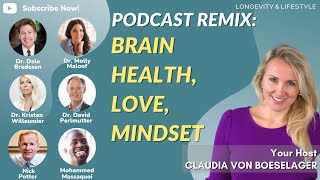
In this recap episode, host Claudia von Boeselager stitches together short clips from six previous interviews to showcase a wide‑range of longevity‑focused insights. Dr. Kristin Willemeyer explains how brain volume peaks in early adulthood and declines after age 40, emphasizing that diet, nutraceuticals, hyperbaric oxygen, and gene‑based telomere therapies can restore cerebral perfusion, as demonstrated by SPECT scans of former athletes. Dr. Molly Maloof argues that relationship quality—especially romantic love—outweighs smoking, obesity, and inactivity for long‑term health, and she envisions a future where psychedelics and “love‑enhancing” drugs (the so‑called love‑potion biotech) could repair trauma and deepen bonds across family, work, and social contexts. Celebrity osteopath Nick Potter (via a hedge‑fund trader’s description) highlights the physiological cascade of stress, the loss of respiratory‑sinus‑arrhythmia coherence, and simple diaphragmatic breathing techniques that restore vagal tone, improve digestion, and reduce chronic inflammation. Former NFL player Mohamed Massaquoi shares leadership lessons from a turbulent team environment, stressing the importance of seeking help, building trust, and teaching others to “save themselves” during crises. Dr. David Perlmutter links a pro‑inflammatory Western diet to impaired prefrontal‑amygdala communication, which hijacks decision‑making, empathy, and climate‑action, and he warns that chronic low‑grade inflammation (the “cytokine drizzle”) erodes rational control. Finally, Dr. Dale Bredesen outlines the ReCODE/PreCODE framework for reversing or preventing cognitive decline, promotes early screening via cognoscopy (blood panels, online cognitive tests, optional MRI), and argues that Alzheimer’s should become a rare disease through proactive, personalized biochemistry‑based interventions. The episode also promotes a free “10 Hacks to Improve Your Life and Longevity” playbook.
Chapters
Hello, longevity friends. I'm your host, Claudia von Boeselager, and welcome to the Longevity and Lifestyle Podcast, where I invite pioneers and thought leaders in all things longevity and lifestyle to give you the strategies, tools, and best practices to live better and reach your highest potential. Today's episode is a special recap episode with a remix of short clips from 6 previous episodes to give you a teaser of the wealth of insightful topics, entertaining anecdotes, and useful tips to help you live at your best longer. First up, we have Dr. Kristin Willemeyer, neuroscientist and former director of brain imaging at the Amen Clinics, from episode 20 on cutting-edge therapeutics and shocking discoveries on how to improve your brain. Second, we have Stanford professor Dr. Molly Maloof from episode 40 on psychedelics and the importance of love and relationships for longevity. Third is celebrity osteopath Nick Potter from episode 19 on why dealing with stress is so essential and how fundamental breathing correctly is. Fourth, former NFL player Mohamed Massaquoi from episode 22 talks all things mentality, effective team management, and strong leadership. Fifth, we have Dr. David Perlmutter from episode 36 on the effect of diet on brain function and how inflammation affects decision-making. Finally, sixth, Dr. Dale Bredesen from episode 3 talks about the challenges of modern medicine, reducing cognitive decline, and making neurodegenerative diseases a thing of the past. Also for you, dear audience, I've created a freebie with my 10 Hacks to Improve Your Life and Longevity Playbook. Just go to longevity-and-lifestyle.com/freebie and sign up to get your free copy of my playbook. Please enjoy.
From birth all the way till age 25, your brain is in this tremendous growth phase, right? And it's setting down all of the neural architecture. Age 40 is when the brain then starts to shrink in volume. By the time we hit 40, we really need to be very proactive about our brain health. If you start taking care of your brain in your 20s, you're actually ahead of the game because you're working with the brain in a time where it's very plastic and it's making all these connections and it's in this very active growth phase. We lose about 5% of our brain per decade. So that shrinkage keeps happening and we have to be proactive to help prevent the shrinkage and to help keep those beautiful neurons connecting with their neighbors. I had no idea that we could impact perfusion to the brain and restore brain function in such a profound way in these professional athletes.
That's really exciting.
With these very simple dietary and lifestyle modifications. So we found, you know, the first, 25 players that came back, or no, it was the first 30 players that came back after 6 months on this protocol, and we rescanned their brains. So we did the SPECT imaging and we gave them the neurocognitive assessments. And I will tell you, I was shocked to see how much we could improve perfusion to the brain. Things as simple as changing your dietary practices and including nutraceuticals could help make such a profound change in perfusion to the brain, I was blown away. There's a lot of power in the foods that we're eating, our ability to keep our blood vessels open, right, and healthy. There are certain nutraceuticals that can help do that, right? We talk about omega-3 fatty acids can help thin the blood. So cardiologists love them because they keep the blood nice and thin, and thin blood usually means nice oxygenated blood. Those omega-3 fatty acids help to maintain brain structure and volume, and they help build all of your cell membranes. Now there's very simple ways to keep your blood vessels open, like a good exercise routine. But if we are restoring and rehabilitating brain function, you have to go the extra mile. I didn't realize how powerful supplements could be until I saw this with the neuroimaging. We're now in a really extraordinary space where we are doing cutting-edge therapeutics, you know, to help restore and revitalize and rehabilitate brain function. I mean, hyperbaric oxygen chambers, gene therapies that are being used to lengthen telomeres. I mean, we're doing some really extraordinary things, which is why, you know, even if you've played these sports and you're listening, you're like, is there any hope? Yes, I promise you there's hope.
One of the biggest discoveries I made in my teaching at Stanford was like reading all this literature on longevity and realizing that relationship quality has a larger role in long-term health and happiness. Than any other factor. And social disconnection is actually worse for health than smoking, than obesity and sedentary behavior. And so I was like, oh my God, I've been so focused on metabolism for so long. And don't get me wrong, like, I'm fully still committed to teaching people about metabolism and I'm coming out with an online course this year. And so it's really in-depth tool for like teaching people about metabolism. But once I figured out how to hack metabolism, I got kind of bored with it. Because I was like, everybody else knows this stuff and there's already a bunch of companies trying to do what I was trying to do for like 6 years. And, you know, I should have started a CGM company a long time ago, but I'm on the advisory board of Levels and there's still a lot of work that needs to be done for CGM to really make it to the masses. But if you want it bad enough, you can get a CGM from your doctor and it's not within a few years where everyone's going to have these. So I was just like, okay, well, why do people make such bad decisions with their health? Why, why do they cope with discomfort with food, right? Like, everybody can know the principles of mastering a healthy metabolism, but the vast majority of people won't do the things they need to do for optimal health. And the real question is why. And I kept on asking why, why, why, and always just asking, okay, so why do people make these bad decisions? And it always came down to their social conditioning and the way they were raised by their parents and the way that their parents raised them around food and the way that they had unresolved trauma, and the way that people naturally, as a stress response, respond to fear with trying to gather calories. And it was like, oh, so what if we could actually just feel safer? And what would make us feel safer as a society? And like, what would make us live longer? And it was really just relationships at the end of the day. And I was like, why are we not doing more to optimize relationship quality? And why are relationships so hard for people? And it really— I got interested in attachment and love, frankly. I was like, okay, so like, love is clearly this unbelievable force. It's a motivational force that basically gets us to spend more time together, right? Like, love is what brings us together. And I believe that we know very little about love, and we're just starting to like really dig into the neurobiology of love. So I got interested in specifically the neurobiology of romantic love and why we would have evolved this motivational force. Like, what was it from? You know, what does this divine spark of life come from? You know, like, why do people come together and make children? And it really comes down to survival and reproduction, right? Like, the biological imperative is to get us to survive and to pass on our genes. And so love is almost this reward system that's been created to get us to to spend more time together in order to actually enhance our ability to live as long as possible. So there's this great paper called Love and Longevity. And it's all about the oxytocin hypothesis, which is like, we are like wired to connect, and disconnection and loneliness are the consequence of a society, frankly, that like hasn't prioritized social connection, a society that's prioritized individual pulling yourself up by your bootstraps and succeeding by a meritocracy. And really what I believe is necessary for true longevity and really creating a life that's really meaningful and purposeful is our relationships. So I was like, well, why can't we actually enhance our relationships, right? Like in my social community in the Bay Area, psychedelics were normal. It was very much normalized, just like marijuana has been normalized. Now psychedelics are gonna be very normalized in the next 10 years. And we'll see an entire industry around psylocybin, just like you see it around marijuana. Now my company is specifically a biotechnology company because what we're doing is we're essentially commercializing a pharmaceutical love potion. I mean, the substance creates a deep bond between people. And I believe that there's this concept of neuroenhancement of relationships. And there was actually a couple ethicists who wrote a book called Love Drugs: The Chemical Future of Relationships. And we already have drugs that actually change the way that we connect, like hormones, for example, change the way we interact sexually. And SSRIs actually change our sexual function. So if we already have things that are already altering relationships, then why can't we live in a world where we can actually improve relationship quality and help really heal trauma, which is actually underneath a lot of relationship dysfunction? And so that's the first aim of the company, is to figure out, can we help people who've experienced sexual trauma heal from the sexual dysfunction as a consequence of this trauma. And largely it's because sexual trauma causes changes in the brain that actually change the way that you respond to the world. And you're in a state of hyperarousal and not in a good way. It's actually the kind of hyperarousal that causes sympathetic nervous system overdrive. And so I'm really passionate about helping people who've experienced sexual trauma heal. I'm really passionate about stopping pediatric sexual trauma. Because it looks like that might be one of the more damaging facets of human existence, especially when it comes to future relationships. And then I'm also just interested in the neuroenhancement of love. Like, can we create longer lasting relationships through giving people medicine that creates deeper bonds? And could that prevent, you know, resentment from building? Could that prevent people from getting divorced? Could that actually reignite gray marriages that are just passionless, with very little intimacy, and that are just commitments left over, right? Like, can we take these marriages and can we revive them? It's very frontier, right? It's very bold. And it's extremely— I mean, it's very exciting. But it's also like, I've talked to a lot of people about this. And there's a lot of ways to do this ethically. And there's also a lot of ethical questions that come up, right? So I think the purpose of this company is really to be a pioneer in this space of human relationships and enhancement of human relationships. And hopefully I would like to see an entire category of drugs for a variety of different relationships, right? Like, imagine if you could actually enhance your work relationships. Imagine if you could enhance your friend relationships. Imagine if you could enhance your family relationships. And what would the world look like if we actually had these deeper bonds? And maybe this would actually get us to live longer because it looks like that people who have strong relationship bonds last about 10 years longer than people who don't.
I work in a hedge fund. I have done for 10 years, looking at stress relating to how people make decisions. And trading floors are interesting places because there are guys staring into a big load of chaos called the markets, and they're required to place glorified bets. They look into that chaos, they become mentally stressed. And that's what's quite interesting. And we looked at what happens in their bodies when they become stressed. And it's absolutely fascinating because you always have a physiological response because stress in fact is a response. Fatigue is not a thing. So it's not the stressor, the thing that's stressing you, it's how you respond to your environment. And there are many elements and factors of your environment that stimulate them. So it could be a bad boss, it could be an unhappy marriage, it could be just, you know, the markets are bad that day, or it can be the length of time you've been under stress. But very quickly we discovered that when you stress people, they begin to change. They go into what we call sickness health or health changes. So they begin to show the signs of this. In their health. So the classic responses are that people can get gastric reflux, they can get neck and back pain, they can get visual disturbances, they can get rapid heartbeats, etc. They get skin reactions, you know, all sorts of extraordinary manifestations of how stress affects you. There is a fundamental relationship in the human body called— very long-term word— called RSA, respiratory sinus arrhythmia. Now that is the gentle coherent relationship between your pulse rate your breathing rate and your blood pressure. And it's the kind of understood relationship the brain has and the heart has, because they talk to each other in real terms but through nerves, that when you are breathing, you have to adjust for the drop in pressure in your chest, otherwise you'd faint. Yeah. So what that should happen is when you breathe in, your pulse rate should go up. Okay. When you breathe out, your pulse rate should go down. And we should listen for that. Most doctors don't know why they listen for it. Okay, what you're listening for is to hear the coherence and the bonding of those three things. What we've discovered is stressed patients— and this is really key, in fact I shouldn't be telling you this because it's a huge secret of my business, but anyway— stressed patients lose that coherence, and we think it can be as early as 10 years old. Okay, well, so it shows that it's a kind of sociocultural effect. It's not just, you know, later on. And if you lose that coherence you lose the body's ability to maximize and optimize circulation of oxygen around the body for the fewest numbers of pulse rate beats. Does that make sense? Because the body's always looking for efficiency. It's an incredible thing. It doesn't want to be stressed. It wants to return to a lower energetic state. So it gets stuck in this cycle. And if you look at a lot of people who are quite stressed, they often hold their breath. You're doing it now, okay? You're holding your breath.
I've been practicing trying to breathe as I'm—
there you go. But it's often when they're intense, so when new things, things they need to concentrate on, okay? So it's like Bambi in the woods.
Yeah, no, but I do, I hold my breath, yeah, as you know.
Yeah, but the problem is that you will notice, and people can do it out there listening, is if they, when they hold the breath, they hold it in, they never hold it out, right? They don't go— they go—
why is that?
And they hold it there because, good question, we think we've got the answer, but bottom line is because you're used to holding an inspiratory tendency. So hyperventilators, worriers, tend to breathe too quickly and too shallowly. They also tend to do it all up in their neck and chest. So not only are they wasting energy, because instead of just using their diaphragm, okay, they're having to jack up against gravity. So I call them sort of RoboCop. They walk around like this. You see they kind of just don't move their shoulders. And you can see I'm like—
I'm going to push my shoulders down as we speak, yeah.
And interestingly, actually, when you first— if you say drop your shoulders, they go, you know, they can't because they don't know that they've got to breathe out first. Yeah. The other sinister thing that it does, which is weird, is it actually fires all of the small motor end units. Now those are the little tiny nerves that come into your muscles and tell them when to fire. And what we found is that in special deep ones, it turns all of their tension up. So when people feel tense, they are, it's 'cause they're priming to run effectively. And those are the patients you can say, come on, relax, let go. You know, I am, no, no, you know, you're not, you know. So then you get them to do the breathing and the muscles just go boom. And what happens is, so breathing is the only thing that we have that we can monitor easily. That gives us access to what our subconscious brain is doing. So all the control mechanisms, etc., because you have no idea what you're consciously doing. But what it does, and then it teaches the brain to calm, to return to that coherence. But more importantly, before brain, your thinking brain switches back on, you can think more rationally, so you can think yourself out of stress. But most important, your vagus nerve, which is the nerve that teaches you to relax and digest— I mean, that IBS, you know, it's just stressed people's bowels, right? So it's not biome, it's rubbish, right? It's the nervous system shutting down your bowel because when you're going to flee from the saber-toothed tiger, you don't need to be digesting. Why do you give a child with a breathing pattern disorder a stress hormone to treat it? Right? Salbutamol is cortisol.
For life as well.
For life. And of course, well, because they've become inured to their own cortisol, that's why. And of course they become more inured to it, so what happens is we need to give them more and more. Oh, and the other one, Ventolin, is an adrenaline agonist. You know, it opens up your airways. Okay, yeah, I get that's necessary, but why are they opening up their airways in the first place? And it's nothing to do with allergy. Allergy comes second, right? If you breathe badly, you get increased mast cells in your airway. That's where the allergy comes from, because there are plenty of kids in India who breathe pea soup for a living who aren't asthmatic. So don't tell me it's all allergy. And you ask any of the respiratory nurses I know running up in the north where they see some really deprived areas, etc., where kids are in constant menace in their household from domestic violence, they will tell you all of those kids have worse asthma. So really easy, put one— we call it high-low— so you put one hand on your chest, you put one hand on your belly, and then breathe it down imagining your tummy is like a bag, and you paralyse your upper hand, the chest, so you don't— if your chest heaves, you're doing it wrong. It's that simple, okay? What should happen is your belly should come out. That's why Buddha is always depicted with a big belly. And then you take a long slow breath, nose only, in and out. Send it into your abdomen, make a big belly. What you're experiencing is your diaphragm descending and pushing the belly out. That's why the belly is important. Long and slow. Generally the rule is 5 seconds in, 7 seconds out. There are lots of variations— pranayama, 444, you know, they're all there to achieve more of it. But most of the time, do 5 sets of 10 breaths a day. So 10 in the morning, 10 mid-morning, lunch, and so on, as long and slow diaphragm breathing. By 5, you'll often hear your tummy gurgling, which tells me that your vagus nerve's switched on and your digestion's come back on. So your whole nervous system's in a rest-digest. It's quite reliably 5. It's weird. I do it with patients all the time. You can hear, and it's engaging. Will cure your reflux and your digestion problems overnight. Certainly any of you who get a bit of IBS, honestly, if you keep it— but you've got to do it daily for 2 weeks. 5 times a day, just 10 breaths, that's it. You don't have to be lying down, it's better if you can, but don't worry, you can do it sitting at desk. If you catch yourself breath holding, you know, yawning or sighing, those are the 3 indicators that you've gone back into naughty breathing. Put on your— on the top of your computer, breathe, breathe, breathe, check every 10 minutes, say, am I breathing regularly?
I have this from something else.
They're born for breathers. And, you know, use your Outlook, get it to ping every 15 minutes, check your breathing. Even with a sniff, if you breathe and your chest comes up, you're doing it wrong. If you breathe and your tummy comes out, you're in good breathing.
The NFL team that I went to, Cleveland Browns, we were a transitioning organization. And so new head coach, new ownership. Lots of turnover in terms of who was on the roster. And so it was very challenging and probably like the first time where it was like the game was really frustrating and not knowing how to navigate that. And I think that's why like the mental health piece is super important. Even though you've shown to be able to perform at a high level and be resilient, that doesn't necessarily mean that you know how to tap into that all the time or that you should tap into that all the time. By yourself. And we're not the only ones going through what we go through. And so had I known a little bit more, I probably would have reached out to more people. I think sometimes we harbor things internally and we're not always checking in and say, hey, you know, this is how I feel right here. How do I get through this situation? And sometimes that's not even within your own organization. You know, it may be somebody on a different team or in a different sport or in a different industry. That may be going through something similar. So I think what that experience taught me was in those moments where it's really thick, where it's really heavy, where, you know, it's not necessarily going the way that you want it to, zoom out so that you can take inventory of what is actually going on, you know, what piece of your hair is in the soup, and not just try to figure out if it's external. But sometimes it's internal with how you approach the situation. Like I said, we have all the answers that we want, and so somebody else has probably been through that. Somebody else could probably tell you, hey, focus your energy in here, or maybe this may be helpful over here to help you move through that situation. And maybe the situation doesn't change around you, but the way that you adapt to the situation may change. If we're going through a challenge, we're taught to self-protect, self-persevere, and we're going to do that with the people that we identify with. And so if it's— that's my friend and they're in something, or we just merged two companies together, hey, our culture has to stick together because these new people are trying to do this. And so naturally, that's what's going to happen. And so when you are stripping all that back and you're saying, okay, it's not about better or worse, but I use that all the time, it's just different. And so if I know that you have a piece of the puzzle that I don't have It doesn't matter, like, how I feel about you. It's if we're actually trying to move this way and we need this piece of the puzzle, we're going to use it if we're intelligent people. And then over time, you're going to start to realize that, oh my God, like, this person isn't threatening. We actually want the same thing. And so it's just really changing the way people view things, because if you go at it and it's like, okay, this is the best of this company, this is the best of the company, this person is this, this person like this demographic is better or worse than this demographic. It's like, no, let's strip all that back. If we're here to do a job at a high level, what are the pieces that we need to do at a high level? And naturally, since none of us have all the talents that we need, we have to look outside of ourselves. You're going to find those things in different places, across different demographics, across different ages, across different people, gender, sexes, religions, all those things. And so you can bring those things together in a very non-threatening way once you understand the backbone of why people feel the way that they feel. I was over at a buddy's house, a guy that I've known a decade or more, and his son comes downstairs, and his son wants to go swimming. It's like 7 o'clock at night, and he's like, we'll do it tomorrow. And the kid's 3, 4 years old— 4. And I'm like, man, he knows how to swim? And he's like, yeah, man, he loves being in the water. And I'm like, I don't know how to swim. He's like, you got a daughter, how do you not know how to swim? And he's like, come over here tomorrow. I'm gonna teach you how to swim. And I'm like, you're not even a swim instructor. How are you gonna teach me how to swim? And he's like, man, come over here. I'm not gonna let you die. First point, I'm not gonna let you die. And so I come over the next day and I'm like just scared. His kid, I mean, is jumping in the 8 feet going down. There's a little floaty thing that he's like, he's going to the bottom of the pool. He's a fish. And he's like, are you gonna let the 4-year-old like outdo you or whatever? And the 4-year-old's like, come on, jump in the pool. Come on, jump in the pool. And so I jump in the pool, think I'm about to die. He pushes the floaty until we do that to the point that I can swim. And then by the end of it, I'm like diving in, and I'm going to get the thing at the bottom of it. And he looks at me, and he was like, now you know how to swim. And no, he says, now you know how to save yourself. And so those two things— one, I'm not going to let you die, but I care so much about you that I'm going to teach you how to save yourself. And so that's what happens with these leaders in these crazy times. Like, the leader is going to tell you, I'm not going to let you fail in this moment. I'm not going to let anything happen to you. I'm going to make sure you get out of it. And not only am I going to make sure you get out of it, when we do get out of it, you're going to know how to save yourself. And you're going to know how to go save other people. And I think that's what these crises show us when we're able to weather the storm. When you trust somebody so much with your life, with your talents, with your family's life, like all the things that surround you, that you know for sure that they're not going to let you down. But in addition to that, they're going to set you up in a way that you can go do whatever you want to do.
Let's just say that we have two major centers in the brain that are involved in decision-making. One more primitive area called the amygdala is the area that responds impulsively, immediately, in terms of what we decide to do. It wants to do whatever it wants to do now. The rest of the world be damned. As contrasted to another area of the brain called the prefrontal cortex, which is behind your forehead. One-third of the brain's cortex is this prefrontal cortex. It brings in lots of other relevant information as it relates to our decision-making. And it really is the adult in the room. It exercises control over the amygdala, control over the more primitive area that says, I want to do it now. The problem is that there's a connection between this prefrontal cortex controlling, then through top-down control, the more primitive area. That connection is incredibly important. When you reduce that connection, then the amygdala gets its way. Then we become more impulsive. We make decisions that are not thought out, that have no concept of what it's going to be like for our future self, much less how it affects other people, how it affects the planet, meaning that we lose the sense of empathy and compassion. That pathway, that connection between those two areas is threatened by something called inflammation, the underpinning of coronary artery disease, of type 2 diabetes, of Alzheimer's. We live in a world that's very inflammatory, that's increasing the amount of inflammation in our bodies. Everyone's heard in COVID this thing called the cytokine storm, where suddenly there's this incredible uptick of inflammation in the human body that goes around destroying things like the lungs and the brain and the heart. All kinds of things get damaged by these chemicals. But at the same time, as Dr. Bredesen has pointed out, we have what is called the cytokine, not storm, but the cytokine drizzle, meaning just a little uptick in the amount of cytokines that are produced, but over a long period of time, that can similarly cause damage. Dr. Bredesen talks about the cytokine storm in the context of Alzheimer's, and what we talked about in our last book called "Brainwash" is how inflammation over time damages that connection, takes the adult out of the room, the connection between the prefrontal cortex and the amygdala so that our decision-making is hijacked and we are left to being guided by the desires of this 8-year-old that wants everything now, that wants everything for himself or herself, and loses the sense of acting in a way that's beneficial not just to self but to others, which is so incredibly valuable, especially today. The standard American diet, which has now become the Western diet, which has now become the global diet, is a very pro-inflammatory diet. These, you know, highly modified processed foods that are global is very pro-inflammatory. So in a very real sense, these global changes in nutrition through increased increasing inflammation are changing how people globally are making decisions. It's locking people into self and away from a sense of connectedness. And, you know, we see that playing out in terms of politics, in terms of decision-making, in terms of the overall rejection of the importance of making climate decisions, caring for the planet. So, wow. That big corporations have insinuated themselves into dietary changes that are affecting the planet and how that plays out in our decision-making. That's pretty much what I think I covered on that podcast that you referred to. It's something I think about quite a bit. And, you know, early on in our time together today, you asked sort of the question, or you made a statement about why I do what I do. And over the years, it's becoming more and more clear that these ideas that we put forward as it relates to brain health have far bigger implications in terms of our decision-making and our behavior. That's a heavy concept, isn't it? How the global change in food is affecting global decision-making. Yowzers.
The major goal here is to reduce the global burden of cognitive decline and ultimately the global burden of neurodegeneration. We're starting to take the same approach and adapt it to the unique biochemistry of each of the other neurodegenerative disease. It's different for Lewy body, it's different for Parkinson's, it's different for frontotemporal dementia, it's different for macular degeneration. We're just starting to look at these others. But the idea here was, let's now train physicians. We've now trained over 1,700 different physicians in 10 different countries and all over the United States so that people can go to people who have been trained in this area. Having said that, of course, it's continuing to evolve. We're continuing to understand because again, the human brain is complicated. So we're continuing to understand, okay, what are the critical things? And a good example is a few years ago, we didn't recognize plasmalogens as being one of the important players. And some brilliant work from a biochemist, Dr. Diane Goodnow, who has looked at plasmalogen, and these things are dramatically reduced in Alzheimer's disease. So ongoing work from his group. We'll see how important this is. You know, again, it's just the outcome at the end of the day. How much better can we make people? How much can we prevent this? Now, as you indicated, we then broke this up into reversal and prevention. In the long run, of course, we'd like to have everyone on prevention, And so we suggest that anyone, just like we all know that when we turn 50, we should get a colonoscopy. And actually, my wife and I had his and hers colonoscopies on Valentine's Day.
How romantic.
Okay, yes, we decided, look, let's get this over with and let's just put this behind us. It's not a particularly pleasant thing to do. Now, interestingly, cognoscopy is much easier.. So we recommend, look, anyone who's 45 or over should get a cognoscopy. Why? Because this problem, the cognitive decline that we used to think of as a problem, a disease of our 60s, 70s, and 80s, is really a disease of really late 30s, 40s, 50s, and it's just that you get the diagnosis 20 years later. So everyone has had that feeling, wow, you know, I'm in my 40s, I'm not as good at staying up all night as I used to be. I'm not as good at organizing things. I don't have the memory I did in my 20s. Okay. That's an issue. And so we're told, oh, you're just getting a little older. No. What this means is your metabolism has changing. You may have a little bit of insulin resistance. You may have some ongoing inflammation, as they say, inflammaging. It's a critical part of the aging process. There is a reason for being less sharp than you used to be, and in fact, performance is critical. And so, what we do is get a cognoscopy, and you could actually go online and get this directly, MyCognoscopy, if you want to, or go to your doctor and talk about this. But you want to know 3 things. Number 1, you want to know a set of blood tests, and some of the ones we've just talked about are in there. Number 2, you want to know an online cognitive assessment. It's pretty simple. You don't have to spend hours and hours with pencil and paper to get a cognitive assessment anymore. You can do this in 20 or 30 minutes online. And then the third part is optional, which is an MRI with volumetrics. That's optional. If you're asymptomatic, you don't need an MRI. If you're having symptoms, you should then get it. If you're clearly having some cognitive decline, please get one. So we recommend, again, everyone 45 years or older, Now, if you're asymptomatic, we developed what's called PreCode, which is prevention of cognitive decline. If you're symptomatic, then you want ReCode, which is reversal of cognitive decline. Because no surprise, once you've started down the pathway, you want to do more. And again, as a scientist, the idea here was we wanted to pull out all the stops. This is a terminal illness. If you have cognitive decline, if you are developing Alzheimer's, It's a terminal illness. Either we're going to make you better or you're going to die. So this is a huge issue, and this is why, yes, you want to have extensive tests. Some people say, well, you know, why do I want to have all these tests? In some places, people will have to pay somewhere around $1,000 for these tests. Okay, but the average cost in the US for someone with Alzheimer's, by the time you die, is $350,000. It's because a lot of it's because of nursing homes. So actually, let's avoid that. Let's keep you out of nursing homes. Let's make sure that you do very well. And it actually makes a lot of sense, not only financially, but also for your cognition and for your family members. So that's the idea. And actually, pre-code was a couple hundred dollars because you need fewer tests. There's less you need to do. But the idea is Whatever you're going to do, please get on top of it. Some people will think that, hey, I'm doing pretty well, but I want to check. We had one woman who came in, for example, who said, this is common in my family, Alzheimer's. She turned out to be ApoE4 positive, and she said, I think I'm okay, but I just want to make sure. She was in her late 40s. She took a simple test called the MoCA test, which is for Montreal Cognitive Assessment. It goes from 0 to 30, and most people should score 28, 29, or 30, even 28, it's getting a little suspicious. She scored a 23. So she had very significant MCI already, mild cognitive impairment. She was on her way to Alzheimer's. Now she may not have had full-blown Alzheimer's for another 10 or 15 years, but she was clearly on her way. She went on program, she's now at 30 doing very, very well. And so again, get in early. This idea that, oh, don't worry about it, it's just a a little bit of aging. What happens is doctors, because they have nothing to offer, tell people year after year after year, yeah, it's mild, it's just aging. And then finally one year they say, oh yeah, this is Alzheimer's, there's nothing we can do for you. We'll give you a drug that doesn't work very well. It's barbaric. This is a paradigm shift out of the dark ages to making it so that there should be— this should be a rare condition. Alzheimer's should be a rare disease.
Hi everyone, this is Claudia again. Before you take off, would you like to get a short email from me with some short but sweet fun tips, tricks, and updates on all things longevity and lifestyle? This could be cool products that I've discovered, interesting posts or articles I've read, and other fun and helpful things around longevity and lifestyle. I found for you. It's a very short piece of inspiration for you a few times a month, so if you want to receive it, check it out by going to longevity-and-lifestyle.com. That's longevity-and-lifestyle.com, and leave your email to sign up for the next one.
More from Claudia









Can Psilocybin Slow Aging? The Study on Telomeres, Inflammation & Survival with Dr. Louise Hecker

