Power of Personalized Medicine, Re-Thinking Health and Healthcare with Dr. Molly Maloof
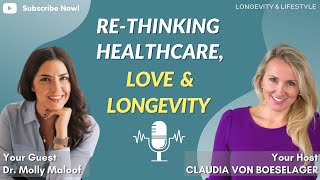
In this Longevity and Lifestyle Podcast episode, host Claudia von Boeselager interviews Dr. Molly Maloof, a Silicon‑Valley physician who left traditional practice to build a concierge health‑optimization practice, advise biotech startups, and launch a stealth biotech company focused on neuro‑enhancement of human relationships. Dr. Maloof recounts her personal transformation from a burnout‑prone medical student to a high‑performing doctor who uses evidence‑based lifestyle medicine, continuous glucose monitoring (CGM), heart‑rate‑variability (HRV) tracking, and a rigorous supplement regimen. She explains how insulin resistance drives skin aging, the importance of carotenoids and gut‑skin health, and reviews her daily morning and evening routines that include meditation, cycling, weight training, cold exposure, sunlight, fasting, and gratitude practices. The conversation pivots to the central thesis that social connection and relationship quality are the strongest predictors of longevity, prompting her to develop a “love‑potion” biotech aimed at healing sexual trauma and deepening bonds across romantic, familial, and professional relationships. Dr. Maloof also discusses the emerging accessibility of CGM and next‑generation HRV devices, the democratization of personalized supplements, the role of psychedelics in trauma healing, and the need for regular biomarker testing. She closes with a call for community, sharing her social‑media handles, and a parting message that disconnection is not a natural state.
Chapters
This episode is brought to you by Nootopia. Nootopia is a bioptimizers company with the first ever 100% personalized nootropic stack. Think a powerful brain-specific supplement. Nootopia has been a real game changer for me. When I take one of their stacks, I get hyper-focused for the toughest tasks. My verbal fluency and creativity improved dramatically and reduced stress to boot. To say goodbye to afternoon energy crashes, boost your emotional intelligence, activate neurogenesis, and more, check out nootopia.com/claudia to receive 10% off your order. That's nootopia.com/claudia.
Hello, health optimization friends. This is your host, Claudia von Boeselager, and welcome to the Longevity and Lifestyle Podcast. Where I invite pioneers and thought leaders in all things longevity and lifestyle to give you the strategies, tools, and practices to live better and reach your highest potential. Today's guest is Dr. Molly Maloof. Dr. Molly has been shaping the future of healthcare in her pioneering Silicon Valley medical practice and is on the frontier of personalized medicine, medical technology, health optimization, and scientifically based wellness endeavors. Since 2012, Dr. Molly has also worked as an advisor or consultant to more than 40 companies in the digital health, consumer health, and biotechnology industries needing help with clinical strategy, product development, clinical research, and scientific marketing. In her concierge practice, Dr. Molly provides health optimization and personalized medicine to high-achieving entrepreneurs, investors, and technology executives in San Francisco and Silicon Valley, as well as award-winning Hollywood actors and musicians. Unveiling the future of patient care with actionable insights on adopting the latest practices on personalized medicine, Dr. Molly challenges health practitioners as well as industry influencers to rethink health and healthcare in order to reduce costs, improve patient outcomes, and improve the human condition. In this episode, we dig into why health optimization and personalized medicine is such a game changer, skin health and longevity, the importance of love, biofeedback-assisted lifestyle interventions, blood sugar, and much more. Before we begin, please hit subscribe to the podcast to your weekly dose of longevity and lifestyle inspiration and share this episode with those you love. I would also love to hear from you, so please leave a comment to let me know what you think below or reach out on Instagram @longevityandlifestyle. Please enjoy.
Welcome to the Longevity and Lifestyle Podcast, Molly. It's such a pleasure to have you on today.
Thanks for having me.
Really, really great. So Molly, I'd love to kick off with letting my audience know what a revolutionizing and pioneering doctor you are that has moved from traditional medicine into the longevity and health optimization space. So could you talk a little bit about that journey and what drove you to where you are today?
Yeah, I was always interested in optimizing my performance since I was young, like 8th grade, and I started using supplements in 9th grade. I started— I mean, I definitely had plenty of periods of burnout in my life from just overworking myself. And so medical school came along and I remember just being like, really unhappy and not doing super well and getting like average grades. And everything really was just a result of not really taking care of myself. I was just working incredibly hard and not really doing much for my health. And so I started studying evidence-based lifestyle medicine and it just became very clear that I was like building so much more energy into my body and I was able to perform at much higher levels and I was getting better grades and I was just like getting more done in less time. And I was like, what is this craziness? And so I ended up doing really well on my second board exam after I changed my lifestyle. And all of my peers were like, how did you do it? How did you go from like an average on your Step 1 to a 99th percentile? And I go, look, I was just changing my lifestyle and I started doing all these different things. And they're like, oh my God, tell us everything you know. So I started a course and I got really interested in education and I just built a course for my peers. Ended up winning a bunch of humanitarian awards for it and then get to my residency, find myself really unhappy and just like, in a system that frankly was just miserable and doctors were unhappy and sick around me. And I was just like, this system is not for health. So I decided to carve out my own career on my own, started my own medical practice, got my license, started working with startups and really saw that wave of innovation happening in startups and in technology and basically was like, I'm going to be a part of that world because that world is going to change medicine. And so I just happened to have been very intuitive and aware of like what was coming. Always been a bit of a futurist and I've always been able to see a few years ahead of everybody else. That was actually really cool and enabled me to like build a reputation as somebody who's an innovator. And a lot of things that I was doing young were like very much looked down upon by people. They were like, oh, why would you know, I was wearing a pedometer in, in medical school and my attendings were like, nobody pays for behavioral health. And I was wearing a CGM in 2014, and everybody was like, you don't need to wear a CGM unless you have diabetes. And then like, I was using continuous heart rate variability monitoring on my clients in like 2017. And like, everybody's like, well, stress is just part of life. What are you going to do about it? And I just really never listened to people for the most part when they told me not to do things. I was very fortunate to spend time with people who were in this rationalist community. And honestly, being in the Bay Area, I got exposed to all sorts of thinkers. But initially, one of the things that really helped me become an independent thinker was just being around people who are really interested in first principles thinking. And then I also spent quite a lot of time with hippies. And so I realized that there was a major role of relationships and health. You know, it was hanging out with the people at Esalen Institute that opened my eyes to, you know, really pursuing things that were completely out of the box, like stuff that you couldn't even talk about in mainstream society.. And so I got this really interesting balanced kind of worldview from these two worlds. And, you know, the process just built a life for myself that I'm really happy with and proud of. And all of my career is finally starting to really blossom after like 10 years of just being like, I know what I'm doing is right, but everybody thinks that I'm crazy. And so now everyone's like, oh yeah, you totally, everything you were doing was totally, totally legitimate. And you know, I've been doing lots and lots of data collection on my clients. I've been doing lots of supplementation and lots of nootropics and all sorts of stuff that was like very fringe, you know, doing like tons of data gathering on people was never really considered normal. Now there's like lots and lots of companies that are like coming out with these systems of taking labs and analyzing them and providing personalized recommendations. So I'm just happy that the world is waking up to all this.
They're catching up with you, Molly.
That's, that's awesome.
Catching up.
It's great. I mean, like, I fully want my brain to be replaced by software eventually. So like, You know, I still am a private doctor. I still teach at Stanford. I'm now a CEO of a biotech company I started. I'm about to go into fundraising and I'm just like really passionate about education and the frontier of what medicine can look like and in creating medicine that people actually wanna buy instead of medicine that's like, oh shoot, I just spent all my money on this crap that I don't feel like I'm getting anything from. Like I'm spending $500 a month on insurance and I don't even use the system that I'm paying into. And it sucks because you're like, It would be great if the system actually gave you something for your money and cared about your health and really wanted you to live a long time. But they only really care if you get sick and are broken. And that's what it's designed for. And so we really do need to see a new system emerge that's about building health and creating resilience and enhancing connection. And I'm hopefully going to be part of that.
It would be so exciting. I mean, that's also part of my mission as well, right? And getting away from that reactive to proactiveness. I mean, what an exciting place it would be if— it's not about— I mean, my parents, right, they're older and it's all about which medical visits they have and tests that they need to do, etc. But what if you can go away to a system where you're free of all of that and you're actually just living your true purpose and doing really cool things in the world? And congratulations on all your exciting projects. Are you okay to share the biotech company, what you're doing there?
Yeah, I can talk a little bit about it. It's pretty stealth right now, but I am going into fundraising, so I'm happy to chat a little bit about it. But essentially, one of the biggest discoveries I made in my teaching at Stanford was like reading all this literature on longevity and realizing that relationship quality has a larger role in long-term health and happiness than any other factor. And social disconnection is actually worse for health than smoking, than obesity, and sedentary behavior. And so I was like, oh my God, I've been so focused on metabolism for so long. And don't get me wrong, like, I'm fully still committed to teaching people about metabolism. And I'm coming out with an online course this year. And so it's really in-depth tool for like teaching people about metabolism. But once I figured out how to hack metabolism, I got kind of bored with it because I was like, everybody else knows this stuff and there's already a bunch of companies trying to do what I was trying to do for like 6 years. And, you know, I should have started a CGM company a long time ago, but I'm on the advisory board of Levels and there's still a lot of work that needs to be done for CGM to really make it to the masses. But if you want it bad enough, you can get a CGM from your doctor. And it's not within a few years where everyone's going to have these. So I was just like, okay, well, why do people make such bad decisions with their health? Why, why do they cope with discomfort with food? Right? Like, everybody can know the principles of mastering a healthy metabolism. But the vast majority of people won't do the things they need to do for optimal health. And the real question is why? And I kept on asking why, why, why, and always just asking, okay, so why do people make these bad decisions? And it always came down to their social conditioning and the way that they were raised by their parents and the way that their parents raised them around food and the way that they had unresolved trauma and the way that people naturally, as a stress response, respond to fear with trying to gather calories. And it's like, oh, so what if we could actually just feel safer? And what would make us feel safer as a society? And like, what would make us live longer? And it was really just relationships at the end of the day. And I was like, why are we not doing more to optimize relationship quality? And why are relationships so hard for people? And it really— I got interested in attachment and love, frankly. I was like, okay, so like, love is clearly this unbelievable force. It's a motivational force that basically gets us to spend more time together, right? Like, love is what brings us together.. And I believe that we know very little about love and we're just starting to like really dig into the neurobiology of love. So I got interested in specifically the neurobiology of romantic love and why we would've evolved this motivational force. Like what was it from? You know, what does this divine spark of life come from? You know, like why do people come together and make children? And it really comes down to survival and reproduction, right? Like the biological imperative is to get us to survive and to pass on our genes. And so love is almost this reward system that's been created to get us to spend more time together in order to actually enhance our ability to live as long as possible. So there's this great paper called Love and Longevity. And it's all about the oxytocin hypothesis, which is like, we are like wired to connect, and disconnection and loneliness are the consequence of a society, frankly, that like hasn't prioritized social connection. A society that's prioritized individual pulling yourself up by your bootstraps and succeeding by a meritocracy. And really what I believe is necessary for true longevity and really creating a life that's really meaningful and purposeful is our relationships. So I was like, well, why can't we actually enhance our relationships? Right? Like in my social community in the Bay Area, psychedelics were normal. It was very much normalized, just like marijuana has been normalized now. Psychonautics are gonna be very normalized in the next 10 years. And we'll see an entire industry around psilocybin, just like you see it around marijuana. Now, my company is specifically a biotechnology company, because what we're doing is we're essentially commercializing a pharmaceutical love potion. I mean, the substance creates a deep bond between people. And I believe that there's this concept of neuroenhancement of relationships. And there's actually a couple ethicists who wrote a book called Love Drugs: The Chemical Future of Relationships. And we already have drugs that actually change the way that we connect, like hormones, for example, change the way we interact sexually. And SSRIs actually change our sexual function. So if we already have things that are already altering relationships, then why can't we live in a world where we can actually improve relationship quality and help really heal trauma, which is actually underneath a lot of relationship dysfunction? And so that's the first aim of the company is to figure out, can we help people who've experienced sexual trauma heal from the sexual dysfunction as a consequence of this trauma? And largely it's because sexual trauma causes changes in the brain that actually change the way that you respond to the world. And you're in a state of hyperarousal and not in a good way. It's actually the kind of hyperarousal that causes sympathetic nervous system overdrive. And so I'm really passionate about helping people who've experienced sexual trauma heal. I'm really passionate about stopping pediatric sexual trauma because it looks like that might be one of the more damaging facets of human existence, especially when it comes to future relationships. And then I'm also just interested in the neuroenhancement of love. Like, can we create longer lasting relationships through giving people medicine that creates deeper bonds? And could that prevent resentment from building? Could that prevent people from getting divorced? Could that actually reignite gray marriages that are just passionless with very little intimacy, and that are just commitments left over, right? Like, can we take these marriages and can we revive them? It's very frontier, right? It's very bold. And it's very, I mean, it's very exciting. But it's also like, I've talked to a lot of people about this. And there's a lot of ways to do this ethically. And there's also a lot of ethical questions that come up, right? So I think the purpose of this company is really to be a pioneer in this space of human relationships and enhancement of human relationships.. And hopefully I would like to see an entire category of drugs for a variety of different relationships, right? Like, imagine if you could actually enhance your work relationships. Imagine if you could enhance your friend relationships. Imagine if you could enhance your family relationships. And what would the world look like if we actually had these deeper bonds? And maybe this would actually get us to live longer because it looks like that people who have strong relationship bonds last about 10 years longer than people who don't. So I really think that this is something that needs to exist. If I didn't do this, somebody else would do this. So I know I need to do it because somebody needs to do this from a very ethical place and from a place of love at the end of the day.
So that's really the story of the company. Yeah. So beautiful and so exciting, Molly. Thank you so much for sharing that as well. And obviously, you know very well, and for my listeners listening as well, the longest ever study from 1938 from Harvard is the key to longevity is relationships, right? And if you look at the blue zones, Sicily and Japan, the relationship, the community building, the sense of connection and belonging. Yeah, that completely makes 100% sense. You know, what a beautiful place if you get rid of the trauma, which so many people have, help people to deal with it and then move on to be free to love as well. So, so beautiful. And would love to, when you get a bit farther with that, get you on for a part 2. Really exciting. Yeah, I'd love to jump over to skin health and longevity. What is your take on— obviously it's a more outside thing. We've been talking about love from the inside, right? But what is your thinking around skin health, longevity, and where are we going with that?
One of the most interesting things that has happened to me in the last, you know, 8 years or so is as I've really worked on the insulin resistance that I was dealing with when I was younger, I have like seen my skin age in reverse. I really don't think enough people realize that they're insulin resistant. And there's literally many, many, many, many millions of people who have no idea they have prediabetes. And I was right on the line of prediabetes. I was right below, and this is 2014. So, I was younger and I actually had worse skin. I actually had more acne and I actually had more wrinkles than I do now. And it's really a big testament to improving my blood sugar metabolism because when you improve your blood sugar metabolism, you reduce advanced glycation end products in the skin. And you also reduce mitochondrial dysfunction, which actually creates more skin autofluorescence. So you actually have more light that comes out of your skin. So it's funny because this company comes along to me and I'm friends with the founders and they're like, we really want you to be the spokesperson of our company. And I was like, look, I do not have time to be a spokesperson, but I'm flattered. You guys are great. And they're like, let's just send you a bottle of the supplement. And I'm like, fine, but my skin's really pretty good. I don't really need a supplement for skin. Now, I gave the supplement to my sister, and I noticed her skin developed this beautiful rosy glow. And I was like, okay, now we did change her lifestyle, but it was also pretty obvious that, like, her hair was growing stronger and her nails were growing stronger. And I was like, okay, what's in this stuff? And so they kept on kind of hammering. They're like, Molly, we really want you to be the spokesperson. So I had been living in Austin, and I didn't have a kitchen because I was living at a hotel for a little while, trying to try on Austin as a place to live. And I wasn't getting enough produce. And so when they gave me these supplements, I was probably like the least amount of produce I'd normally eat. And I found myself taking it and I was like, oh my gosh, within a month I stopped wearing about half as much makeup. And I was like, guys, this stuff is really great. Like, what is in the supplement? It's Qualia Skin by Neurohacker, and it's an optimized aging supplement and it's really aimed at hydration, elasticity, and firmness. But really what I think they should put on is like gives you a rosy glow because being that it's got— that's so great is the carotenoids. So it has tons of different carotenoids in it. And there's actually evidence that people who have higher amounts of carotenoids in their skin, they actually smell more attractive to the opposite sex and they look more attractive to the opposite sex. So I was like, what's the mechanism behind all this? And it turns out that carotenoids are just really great for optimizing skin health because a lot of people are deficient in them. And then there's also just the fact that carotenoids are great antioxidants. They're great for gut health. We know that there's this gut-skin relationship. I actually had a little bit of SIBO at one point last year, and I definitely started getting more acne. And it wasn't until I fixed my SIBO that my skin improved. You know, a lot of people ended up with SIBO eating way too much in the wrong times during the pandemic. But I have to say that, like, people don't realize that, like, if you have problems with your skin, it's almost always from the inside, and there's something going on inside that's a problem. And it's typically a hormone dysfunction, could be nutritional deficiency, it could be gut dysfunction, could be just stress-related, right, which we know contributes to gut dysfunction. So vitamin A, you know, I'm very careful to get my nutrients measured, making sure I get proper amounts of vitamin A in my diet. And you can get vitamin A from plants and from animals, so like organ meats or red vegetables, red fruits. And so this supplement is vegan, and, and it gets its carotenoids and vitamin A from plants. But it also has things like aloe vera, which is great for hydration and also gut health. And then also has things like a soy germ extract, which is great for hormones and hormone balancing. And then it has bamboo stem and leaf, which is great for skin and nails, and ornithine, which is great for collagen. And then it's got a bunch of different minerals of which chromium's really important for blood sugar metabolism. So I love this thing. I'm going to be taking it consistently. And it's funny because, like, I don't think enough people even know their phytonutrient intake. So I actually give my clients a phytonutrient questionnaire, and it's a way for people to actually see, like, how many servings of fruits and vegetables are you actually eating? And most people are not getting 5 a day. And oftentimes if they are getting vegetables, it's green vegetables. So you really remember to eat the rainbow. Yeah. And that's something that I actually really hammer into all my clients is like, I know there's this whole world of people who are like, oh, carnivore people do not need plants. And I'm like, look, if your gut is so dysfunctional that you can only eat meat to function, then the problem is your gut dysfunction. And it's not that meat is the only answer, although meat's a very nutritious food. All the evidence, at least in animal models, suggests that omnivores live the longest. So I'm a full-on omnivore. I don't really buy into the whole carnivore or the vegan movement.
The most obvious nutrition is omnivore diets. So yeah, Molly, before we dive into a few more questions, I'd love to throw a few rapid-fire questions at you. What is your morning routine that you do? I'm sure you have one to set yourself up for success.
I definitely have a morning and evening routine for sure. Morning, I wake up and I lay in bed and do some meditation and body scanning and just like Sometimes I'll just like purposely go back into my dream state for lucid dreaming, but most of the time I'm like laying there doing a body scan. I wake up usually around 6:30 and 7:00. I'll make either like a half-caf coffee or a matcha or a Mud Water I've been really into lately and read the Wall Street Journal. I really love reading the Wall Street Journal because it's just like so interesting to see what's going on in the world. And then I'll go and ride my bike to the gym. And lift weights. And I do lift weights about 4 days a week these days. And I'm biking right now every day. And I just have noticed such a difference in my energy levels by cycling. I've really fallen in love with it in the last couple months. So those are like sort of non-negotiables. And then I'll take my supplements when I get back from working out. If I'm lifting, I'll definitely get protein-rich breakfasts in. And if I'm not lifting and I'm just cycling, I might delay breakfast an hour or so. But generally speaking, I'll eat breakfast around 9-ish. And then I used to do a lot more fasting, but because I'm doing so much exercise, I'm doing a little bit less fasting. But I still fast at least 12 hours a night, sometimes longer, sometimes 14. I'll take my supplements after breakfast, and I will shower and start my day. Sometimes I'll do a cold shower. Yeah, I did that a lot in the summertime last year. I would end with a cold. It really depends on if my shower can get cold enough, you know. But it's been pretty cold outside just to go biking. And so I do feel like I'm getting a bit of cold exposure just by cycling outside in like pretty cold weather. But yeah, I'm a really big believer in sunlight in the morning and, you know, try not to be too much on your phone. I try to get work started around 9-ish or so, like 9:30, and then I will work. I mean, for hours and hours and hours and hours. And I'll try to split up my day. With like phone calls, right? So at least a few phone calls I like to spend walking if I can, unless it's an absolutely necessary Zoom call. I try to not be in front of my computer all day long. I do know you lose a lot of information by not being face to face, but I just like to get my steps in. I try to get at least 10,000 steps in or minimum 7,500 steps a day. And just getting your body outside is just nicer than being indoors all day long. We spend like way too much of our day indoors. And so if you're lucky and you live in a nice neighborhood, being outside is great. And even when I lived in downtown Austin, I was still walking around by the water. So I'm just a big believer of trying to walk as much as you can. And then just breaking up your day with like, I will eat something for lunch. If I'm like on my own, I'll definitely be eating my biggest meal of the day as lunch. And then my smaller meal would be like a chia bowl for dinner. Most of my meals are gonna be like protein, vegetables based. And/or like chia and fruit and maybe a teaspoon of honey with some salt. And I like nuts and gojis. I love basil seeds too. There's a company called Zen Basil. So I'm doing a lot of chia or basil bowls these days. And then evening, like there are some days where I do work, you know, 12-hour days and like some days I'll work 9-hour days. Some days I'll work very rarely longer than 12-hour days, but I do try to get some stretching in if I can. And I do like to have like a devotional practice at night. Like, it's just a habit now. I do pray and I'm not religious, but I do find prayer to be like really just soothing, you know? And I do practice gratitude every day. I think it's really important to practice gratitude for things that you don't think are necessarily like big deals. Like, I'm grateful for that dinner that I just had, you know, I'm grateful for getting to spend all this extra time with my parents and getting my mom into like better shape physically. I also have a practice of like yesterday was a full moon. So I set my intentions and I set intentions every full moon and new moon. And then I review my intentions from the previous one. And I'm always astonished at how many have come true. And it's like, whoa. So I do have a connection to the rhythms of life and nature for sure. And I might journal. I did journal yesterday as well. So journaling is also a practice of mine. Yeah, it's weird. I actually worked all weekend this weekend. I worked like Saturday and Sunday when I don't normally recommend that. But I surprisingly woke up today with like really good HRV. And so I really try to follow my heart rate variability as a tool for whether or not I need more recovery. If I'm feeling really energized, then I'll sometimes work 2 weeks in a row. And if I'm not feeling really energized, and I will notice when my body starts to wear down and I'll start to add in 2 days off. But most of the time I'll work 6 days a week. And that's just because I'm in a very busy time in my life where I'm finishing a book and a course and I'm teaching at Stanford and I'm about to start fundraising for my company. And I'm still seeing clients as a doctor.
One person.
Yeah, I do have help now, which is great. I have a few assistants that are helping me, which is awesome. And I'm really going to start handing off more and more work to people this year. But it's really a testament to if you build capacitance in your cells, which is literally like your cells have batteries and capacitors in the mitochondria. And everything I've been doing for my health for the last few years has been completely focused on mitochondrial optimization. It is 100% true that if you build more capacitance in your cells, you actually will have more capacity and you will have more energy. You will feel like you can get more done. You'll just have more ability to do work. And so like the one thing that I really started adding in is the cardio. So I hadn't been doing a lot of cardio for the last few months. And then in December I really started upping the cardio and I was like, oh my God, I cannot believe I have so much more energy than I do. And I really feel like I recovered from like an intense year. 2021 was an intense year of work and accomplishment. And I have to say that like I worked pretty damn hard the last month of this year, but I did sleep a lot. I have to say like sleep is a non-negotiable for me. I do not sacrifice sleep for performance ever. I would say maybe a few days of the year I will have to do a late night because of a project deadline, but for the most part, I just would rather work a few hours on a weekend than sacrifice sleep during the week. So. I'm really a big believer of going to bed at the same time and waking up at the same time. And I think your body really likes it when you get consistent mealtimes as well. So I just believe if you can get your circadian rhythms in balance, if you can get your morning and evening routine dialed, and if you can get your fitness dialed and your nutrition dialed, then like everything is easier. And you just got to pay attention to your biomarkers. You got to pay attention to your blood sugar, to your stress, to your sleep, to your movement, to your intensity of your movement, making sure you get proper amounts of intense exercise in. And if you can do all those things, these are the basics.
But many people don't do them, right?
Most people don't even do the basics. Most people are just trying to supplement their way to better health. And don't get me wrong, I have a very significant supplement regimen. I mean, I am always optimizing with supplements. I'm currently using Zembrin and saffron for neurotropics as well as CBD. And I'm like super convinced that these things have made a big difference in my brain. Also a big believer in getting your vitamin D, magnesium, your B vitamins and your omega-3s covered. Yeah, everybody needs those. There's probably not a single person who doesn't need those unless somebody eats a lot of fish. And so, yeah, I just am a believer that you got to keep track of the very minimum nutrients. And if you're a woman and a man, you should be looking at your ferritin levels and making sure that you're not too high or too low. Women are most often too low. Men are most often too high. Women need to supplement. Men need to actually donate blood and cut their ferritin levels. Because a lot of men are actually too— they're oxidative. They're just— it's oxidatively stressful to have too much iron in your body. Well, those are the big secrets of longevity. No, amazing.
And thank you for sharing that as well.
How often would you, or do you recommend to your patients to be tested and to test? It's all dependent on what they can afford and what their time will allow. I at least try to get my blood drawn. It really depends on the year, but like during the pandemic, I started testing a lot more frequently because I had a concussion and it caused a bunch of hormone dysfunction. And so I had to fix a bunch of problems and it was like, it was kind of like when your car breaks and you have to take it in. Well, instead of my car breaking, it was my body had broken and I had to fix it and I had to like do a bunch of upgrades. And so I was testing it every quarter. Now I'm testing it probably every 4 months or so. And I would say that like most people do not necessarily pay attention to their labs like I do, but most people aren't high performance race cars. And or most people don't care enough. Like most people just don't care about their bodies and they just fill them with garbage. So why would they measure their blood markers if they don't care what they put in their mouth? You know, like most of my clients are extreme high performers and they're not normal people. And so because of that, they're expecting a lot more out of their bodies and they expect their bodies to function really well. I do think that in the future there will be opportunity for more people to get cheaper labs, but right now they aren't cheap. Like I'm spending $400. To do a full panel. And at the same time, I also just love data and I love knowing about what's going on.
You know, I think that's really helpful as well for people that are really trying to get into peak performance, how important the bloods are in tracking that as well, because any bloods will just be a snapshot in time. And it's actually doing that regular consistency and comparing that, you know, what's actually going on and where the trends are going as well. I'm wary of time, Molly, and would love to do a part 2 with you, but I just wondered before we close, what are some of the most exciting developments that are happening in the longevity and healthspan space that gets you most excited?
Oh gosh, what's most exciting? I mean, the fact that CGM is going to be available to people very easily, very quickly, and just the data we're going to be able to get from that is going to be amazing. I personally know how to use CGM to optimize lifestyle, and sooner than later, people will be able to actually, like, learn all about how to use biomarkers to actually change behavior. There's a company called Hanu Health, and they're going to be coming out with like a really next-generation heart rate variability monitor, and they're going to be able to give you personalized recommendations. And like, just by listening to my friend who runs the company's recommendations for optimizing my HRV, I've literally raised it about 42 points, 44 points actually. And that was like height peak stress. To now, and that was about 2 months. And so the fact that I was able to, like, raise my HRV that quickly. Yeah, it was like, I mean, first of all, it was social connection, lots of sleep, lots of recovery, lots of meditation, lots of exercise, and lots of just learning to breathe more slowly. But I was amazed by how quickly I could do that. And HRV is a major marker for longevity. And so you really got to keep track of your stress levels if you want to live a long time. You know, personalized supplements are only gonna get better and better and cheaper and cheaper and more accessible by people. So I'm excited about that coming to the market. I'm not a huge fan of any of the companies yet, but I am excited that there's ones that are coming. Food is something I really, I'm obviously a huge fan of food, but the fact that like there's now so many companies that are making it easy for people to get food delivery that's actually really produce-rich foods. There's like Daily Harvest and there's all these just great food delivery companies that are nutrient dense. I'm excited about the fact that like, that will someday be medicine for people, you know, like, it's gonna be easier for people to prescribe these things as medicine. And then, I mean, I'm excited about psychedelics, you know, I'm excited about the idea that like, we might be able to reprogram minds from trauma, you know, that we might be able to actually change. Like, if I can heal from trauma, then anybody can, you know, like, it's possible to actually change your brain.. And it's possible to actually potentially change your attachment style. And I think like attachment science, it's almost like the world of medicine kind of separates itself from the world of psychology and psychiatry a lot. But there's definitely a lot of research in just energy and how energy flows in a coherent or chaotic or rigid manner in different brains. And I just love Dan Siegel's work on attachment because he really created a language around the mind. That feels very scientific. And it feels a lot less abstract. Like, I really think that his beliefs around like attachment in couples— I'm taking a course on this. And I'm just like, so fascinated by how people interact and how we think our mind is our own. And we think our mind is bound by our body, but our mind is beyond our body, actually. I mean, it's energy and information flow. And so when we are connecting with someone, there's energy and information flow exchanged. And there's like a collective mind created. Being able to measure our interactions of the mind of two people interacting and the biometrics that are coming from two different bodies and being able to help people find more coherence through their relationships. If we could fix attachment and trauma and relationships, we would have far less disease and far less mental illness and far better quality of life. So this is a big part of medicine that I want to be a part of, and I want to dedicate the rest of my life to it.
So exciting, Molly. I think on that note, where can people follow you, what you're up to, all these exciting projects you're working on?
Maybe social media, websites. Best spot to find me is Instagram Stories, drmolly.co, D-R-M-O-L-L-Y dot C-O. I definitely post pretty consistently on my stories. And then I'm also on Twitter @MollyMaloofMD. I'm on LinkedIn, so you can find me on LinkedIn. And those are the best places to find me.
Yeah. Do you have any final ask, recommendation, or parting message for my audience, Molly?
The pandemic has forced people into believing that disconnection is normalized, and disconnection is not a normal part of existence. We are totally meant to live in community and in tribes, so take every single opportunity you can to connect to people.
Love that. Wonderful. Thank you so much, Molly, for coming on today.
It's been It's been such a pleasure. Hey everyone, it's Claudia von Boeselager here. Before you take off, I hope you enjoyed the episode and learned as much as I did. If so, please hit subscribe so you don't miss out on our next episodes. I would also love to hear what you thought, be it your favorite part, quote, or other feedback from the episode. So please leave a written review on Apple Podcasts or on social media. And if you think this episode will help someone in your own life, share it with them. Together we can change our own lives and the lives around us for the better. Until next week. Goodbye.
Farewell.
And choose to live well.
More from Claudia









Can Psilocybin Slow Aging? The Study on Telomeres, Inflammation & Survival with Dr. Louise Hecker

