Recap on Stress Resilience, Nature’s Energy, Olive Oil & Cancer, Salt’s Impact on Metabolic Health!
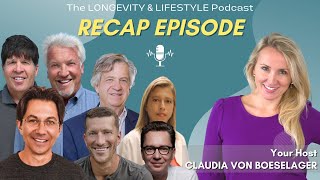
In this recap episode of the Longevity and Lifestyle Podcast, host Claudia von Boeselager stitches together short clips from recent shows to give listeners a rapid overview of several cutting‑edge longevity topics. The segment begins with Rick Johnson warning that both sugar and salt act as metabolic “switches” that can drive obesity, diabetes, fatty‑liver disease, heart disease, cancer and neuro‑degeneration, and he advises minimizing added salt, reading labels, staying hydrated, and favoring grass‑fed, wild‑caught protein sources rich in omega‑3s. The conversation then shifts to Dr. Jay Wiles explaining how stress triggers the same physiological response as physical exertion, and how heart‑rate‑variability (HRV) bio‑feedback via the Honu platform can turn stress into a tool for resilience through self‑awareness, breathwork and real‑time alerts. Next, a discussion of “nature’s energy” introduces the BioCharger, a device that mimics four natural energy modalities (light, electromagnetic, plasma, and earth‑magnetic fields) to restore cellular voltage, a concept championed by Dr. Jerry Tennant. The episode then moves to a scientist (G) describing his discovery that oleocanthal‑rich extra‑virgin olive oil can kill cancer cells in vitro, linking higher oleocanthal concentration to stronger anti‑cancer effects and motivating his book, The Science and Technology of Growing Young. Sergey Young of the Longevity Vision Fund explains the fund’s role in scouting 200 longevity startups a year, the rapid progress of genomics, CRISPR and wearables, and the need to cut through the noisy, contradictory health advice. The segment closes with a brief call‑to‑action for listeners to sign up for a short longevity‑tips newsletter. Throughout, the host frames each clip as a teaser, encouraging deeper exploration of the full episodes.
Chapters
Welcome to another episode of the Longevity and Lifestyle Podcast. I'm your host, Claudia von Boeselager, here to uncover the groundbreaking strategies, tools, and practices from the world's pioneering experts to help you live at your best and reach your highest potential. Today's episode is a special recap episode featuring a short clip from the previous week's episodes. It serves as a teaser into the wealth of insights, entertaining anecdotes, and valuable tips from the various conversations to give you a flavor of the episode and guest. If you'd like to check out the full episode, simply go to longevity-and-lifestyle.com/podcast. Please enjoy.
I'm not against salt and I'm not against sugar. I just think we need to be aware that they can activate the switch. And so I recommend for healthy living to minimize eating a lot of sugar and to avoid sugary beverages. Really, it'll help. It'll help you a lot. Doesn't mean you can't have sugar cake at a birthday or things like that, just, but you just have to be aware that it activates the switch. The same thing with salt. Salty food is going to activate this switch. It's a slower activation, it seems, than with sugar. It takes longer. You have to be careful, and so try not to add salt to food. Try to keep your salt intake down. If you are eating salty food, drink water. Just drink water with it. You can neutralize it. And if you're on a low-carb diet, you probably don't have to worry about because you don't, you're not eating the carbs that are required to convert the glucose to fructose. You should know that when you're on a low-carb diet, your body is making glucose. You would call it gluconeogenesis. So glucose is in your blood, but it's being made from muscle and fat, and you're not producing a lot of it. But when you're eating carbs, you can eat a large amount of glucose. Is a problem.
That's really helpful to understand as well. And I think the key is with that water consumption, obviously, barring those 3 scenarios, just to hydrate the body and to give it the right resources. And obviously then cutting down on salt. And again, I think just that education around reading labels and— oh yeah, salt is actually in pretty much anything. And even in— I was looking once at a packet of chocolate chip cookies, and not only the amount of sugar in there, but the amount of salt that they were putting in there to neutralize the sweetness. It was really—
Wow. Wow.
That's really interesting. I have a friend who's in the food industry and he's been, he started telling me about how all these foods get injected with salt. And what they do is they inject meats and stuff and it makes the meat look bigger. Like a shrimp looks really bigger because it's been pumped with salt water. And then the truth is that the— it's actually much smaller. And when you put it on the frying pan, all the water comes out, the salt stays, and now you gotta process. Look at— sometimes they'll tell you whether or not it's been injected with things, and salt water is a favorite thing to inject into these shrimp and stuff.
Oh my, actually really interesting what you were saying, because literally a few weeks ago I was at my parents' and I was making some shrimp, but I try to always, where possible, find the wild-caught shrimp. Now, it was still in its shell, but they don't shrink in size. And I was thinking how astoundingly— what a difference. And I'm very wary that a lot of the shrimp, even if it says— you have to really read the label— but a lot of them are farmed, filled with antibiotics, etc. But yeah, that must be the telltale sign— how much shrimp, when you warm it up, shrinks or not.
Yes.
Shrivels up in front of you. But processed food, there's so many studies that show that if you can try to reduce your intake of processed food, you can really help. And it's cuz of the sugar and salt, high fructose corn syrup and all these things. MSG.
It's horrendous. Exactly. So I think, and with seafood, it's finding that wild caught seafood. And then for meats, right? The grass-fed meat as well. And you can taste the difference. And I think it's Moving away from having to have a huge steak every night to actually seeing it as like an exception, like a nice pleasure a few times a week instead, and then rather invest and buy the quality versus the quantity as well. Right?
Yeah. Grass-fed is really better than grain-fed. And I didn't really talk about this in my book, but it's really true. With grass-feeding, you get much more omega-3 and with the grain-fed, you get more omega-6 and the meat, and there's really increasing evidence. And I do talk about this in the book about how omega-3s are so healthy and omega-6 tends to be pro-inflammatory. And these seed oils that are omega-6 rich, not so good. And they interact with this fructose pathway. So if you give omega-3, you can block some of the effects of sugar, especially on the brain. So if you give sugar fructose to an animal, you can actually show that it can impair their ability to get through a maze. And you can reverse that with omega-3. Walnut oil is a flaxseed and fish that are rich in omega-3, salmon. That's good.
Rick, what would you say? And I'm just trying to hypothesize here, cuz I know you are also amongst other, the research scientists in you, but I'm looking at like a Venn diagram intersect of between salt, and sodium chloride specifically, fructose, and all metabolic or many metabolic diseases. Would you almost say that combination is a major driver?
Oh, it's unbelievable. And so one of the strong associations initially was, yes, sugar intake, salt intake, they're associated with obesity, they're associated with diabetes, metabolic syndrome, fatty liver. This is where the my research was kidney disease and these kind of classic diseases, then leading to heart disease and so forth. But what one of the two incredible areas that we started looking at is how the switch and the— can also be important in cancer and also how it's important in neurologic disease, especially dementia. The cancer one is really interesting.
Fear, self-doubt, worry about putting yourself out there, afraid to fail. When things shift, especially after 2 years of COVID and now inflation and a looming recession, whatever insecurities or self-doubt or imposter syndrome you had is gonna be magnified. And you're like, ooh, that's great. Thanks for that uplifting message, right? But if you know that, wouldn't it be better to anticipate and prepare and fortify your mind rather than reacting. And that's what I'd love to challenge you to think about today is how do you feed your mind to fortify it against the enemy that's coming? And the enemy is that inner self-doubt where you turn into the thermometer of life with your emotions going up and down by the news or your friends or the kitchen table talk rather than being the thermostat and saying, hey, in times like these, real success can be found on a whole nother level. Google when the most money is made. It's usually during a recession. But it's by the few who look for opportunity, not for obstacles and what's wrong. Robbins always says, what's wrong is always available, but so is what's right. So what I would say going into a shifting world is the first thing we have to do is go upstream and fortify the mind, whatever that takes. If it's listening to audios, reading books, being with your family, praying to God, I don't know what it is, but find something to fortify your mind and train yourself to look for opportunity through this. That's the first thing I think more important than any—
you're helping to build resilience to your stress response. The body does not know the difference between you running like a marathon and you sitting there being stressed in a meeting. It experiences that exactly the same, all of the same, maybe not the severity of the response.
It could be.
And there's some people who will get into a conference meeting, a board meeting, and their heart rate will go up to 140, 150. And it looks like, yeah, they're like in a really good steady run, but the The body doesn't know the difference. What the body does know is how you react to it, how you respond to it. And so, this is why we say, like, when we think about heart rate variability, when we think about stress resiliency, we want to think less about my intention is to increase my value. No, my intention is to really, number one, access or look to see what is my self-awareness of where my mindset is right now, and then how can I then make actionable approach to change my physiology in the moment that also helps to change my mindset around it. So for me, it's all about how do I use this stress? Not how does this stress use me? How does it knock me down and throw me every which way? Because in the past it really has. And for a lot of people, it can really shake, rattle, and roll them because stress can just have a chokehold on them. So we think that there's those two things, self-awareness and then self-regulation. Like, what do we actually do about it in the moment? So finding your baseline is incredibly important. So at Honu, the first thing that we do is that we look to see what is your upper ceiling. So where is like your high average, where's your low average, and then what's your actual baseline average. So we basically create this box like this window and we say, and we get better with time. So the more data that we get, the more that we can hone in the window, we can broaden it or we can shrink it down. We know that when people are in a stressful situation, physiologically or psychologically, that heart rate variability is going to significantly decrease. And so when it decreases below that threshold, and this is how we do it with Honu, is that you'll receive an alert. We'll say, hey, something looks like it's going on. We just wanted to check in. And you had the ability to log like, this is what was going on. I was engaging in more— my number one, like, large-scale stress response is email apnea. That is unconscious breath holding when I'm writing an email, especially if one's a little bit contentious. And it happens to a lot of people. But if I'm holding my breath while writing an email, I'll I'll look on my heart rate monitor. I've got it right now. And as I'm talking and stuff, heart rate goes up, HRV goes down. I'll just see it pull on it. And I'm like, oh, there it is. And that's when I can then engage and I'm self-aware. I'm engaging in like self-awareness. Now let's do some self-regulation and get myself back up to my baseline range. And really what we say is with HRV, normal is good. Normal is best. We're not trying to say, hey, let me inflate my HRV as high as I can. There is benefit to that. But really when you're experiencing a stress response, it isn't saying, let me go down. I've got my HRV. HRV, let's say my HRV baseline's 50 and it went down to 15. Oh, now let me get it up to 75, 80. That might be really difficult in that moment for you to do. I just want you to engage in some quick breathwork techniques, some biofeedback techniques to just get you back up to your range, to your boxes, your happy place. So that's how we do it at Honu. And really nobody's doing it like that, which is why I've explained it. That's why we built Honu is because we wanted someone to have a reference that acted like a stress radar or monitor all day long, but also a stress coach. We give you something actionable to do in the moment that's accessible to you and is all about training a different response to increase your fortitude and adaptability to stress. That's probably a really long-winded answer for your question. I hope I covered the basis there.
I think it's super helpful as well, because obviously speaking with different people around biohacking and biofeedback and devices, they're like, what am I supposed to do with all this data? And you guys really solve for that and actually proactively help people. So one is the awareness, as you were saying as well, but then, and I'd love to uncover a little bit like the tools and strategies and how you do it at HANU. Over time, you have the window, you have the ceiling, you have the floor, you have your sort of baseline, and you see what's going on as well. What are some of the trainings that you offer? And I would assume that some of the trainings are done at a time, not during the board meeting, but in terms of you get trained to do it so that when you're at the board meeting, you can then use those tools. So can you walk a little bit like that client journey and how the training works? And then what are some of the tools and mechanisms that you recommend?
Yeah, absolutely. A lot of it has to do with intention. So the first thing that we want to know is what do you want resiliency for? What do you want stress resiliency for? So a good blanket, 30,000-foot view type response would be, I want better longevity, better health span. Great.
Great.
Okay. So we'll focus on that aspect. But a lot of people, it's like, I want increased cognitive performance, or I've worked with a lot of business professionals and executives who say, I want less emotional reactivity. Like I fire off the email and then I send it and think, oh goodness, can I I retract, I regret it. Like, and that happens so often. Or they think, oh man, I shot some words out of my mouth that I'm not very proud of. Or I threw some gestures with my hands at the car next to me when they cut me off in traffic. Or I rolled down my window and yelled at them. Like, a lot of people, like, will say, like, in the moment, everything takes over. Their stress response takes over— anger, aggression— and then they just engage in the behavior. And then when they get home, they think, my goodness, what was I doing? Or if it's like me, it's, man, I said that word out loud and my two boys are, like, sitting behind me. Great example psychologist, Dr. Jay Wiles. It's like all those things. So how can we then have an intention of what do we want to do? Increase performance, increase resiliency, just like engage in better relationships. So it starts there. So once we know what you want to get out of this, then we can tailor, we can curate a personalized pathway or journey for you. And I want to speak, I know I'm speaking directly to Hanu, but this doesn't have to be done with Hanu. The great thing about this is that any type of wearable that you have is going to give you insight into your response A lot of the wearables are created for recovery, which this is a wonderful recovery tool. I always say that anytime you're not working out, you're recovering. So this can be a beautiful tool for that. But a lot of them, again, they give you one static score that's taken maybe typically overnight, whereas we do it differently when we're actually monitoring you all day long, continuously looking at fluctuations or changes in heart rate variability. So let's say for instance, a lot of people who are like using our platform now is like alpha testers. So the first people on it who are like our close advisors, they, a lot of these individuals just want like better overall fortitude and resiliency and want to enhance performance and whatever that, that they do. So the thing that we say is like, okay, the best response is that, well, number one, we need to see what are those things that are like ticking away at your resiliency? So we have to create better self-awareness. Like, what are those things that are really like knocking down your nervous system and it's having a hard time recovering from that? So that's key point number 1. Number 2 is that when that experience happens and we alert you to it and you become self-aware of how stress is impacting you at that time, then we always wanna follow up. And this is like operant conditioning 101 in psychology. We always wanna follow up with the therapeutic or the response to that. And the reason is because we do want to indeed condition a different response. We want to condition a response that is different than what might be your normal response. Maybe your normal response is that you fly off the cuff and you send that nasty email, or you hold your breath during an email. And this, everybody's going to be like, oh, I know what Jay's problem is.
Right.
We then change that response by putting something else in there. What does that typically look like? We like to use the single greatest low-hanging fruit, which is breathing. So this kind of comes back and I'll give a little bit of the psychophysiology and science behind this. This comes back to, well, what is the single greatest influencer on the human stress response in the moment. That can be done anywhere, doesn't require technology.
The EPA, Environmental Protection Agency, here in the U.S. did a study in 2021 to determine what percentage of time Americans spend indoors versus outdoors, and it turned out that we spend 93% of our time indoors. I started tracking this shortly after we started in this business, was the rate of chronic disease and the in increase in chronic disease in the US. And in 5 years ago, 45% of American adults had at least one form of chronic disease. Last year, 6 in 10 adults have at least one form of chronic disease. 40% have two or more. And you say, okay, what's the relationship here? I think it really became more evident with the work of Dr. Jerry Tennant, who, world-renowned MD, has quite an interesting story himself. There's a lot of information available about him and his work, but he wrote a book called called Healing is Voltage. What he was able to prove is that all chronic disease has one common characteristic, and that's inadequate cellular voltage. When we step back and say, okay, we were designed to be in nature, we all feel better when we're in nature, but it's actually vital to our health and wellness. And if you think prior to modern day, we went outdoors all day long and worked outside, and then we came in and didn't have light, so you You didn't have to worry about our circadian rhythms and things, but modern-day life has introduced a lot of challenges to us. And one of them is the fact that we spend so much time being blocked from 4 key energies that exist in nature that we'll talk about a little bit more, but at the same time being bombarded by man-made energies. So things like cell phones and Wi-Fi and microwave, which are all around us, and we don't have to debate if if they're bad for your health, but I think we could all agree they're not the kind of energies that nature intended for us to thrive on. So in a nutshell, the lack of energy at the cellular level is what we believe to be the root cause of much of this chronic disease. You simply don't have enough energy for your cells to function correctly, and I'll let Jim touch on that in a minute. And what the BioCharger is actually doing is replicating and amplifying those 4 energy types so that we can bathe your body with those energies in a very short period of time, 12 to 15 minutes, and give your body at the cellular level the energy it needs to have proper cellular function. Jim, can you talk a little bit more about the detail?
Sure. So as we start to look at what is this energy outside, and as I started to delve into it further, realized it was really these lightning discharges that we have on this planet. So most people don't realize it, but we have 100 lightning strikes on the planet every single second. Each one generates hundreds of thousands of harmonics and frequencies that span the entire spectrum of AM, FM, shortwave, longwave, microwave, millimeter, all the way up to visible light. Now, other planets are doing the same thing. They have their own local atmospheres that are generating their own storms that also contribute to that. We also have the sun doing the same thing, which is what we call solar flares and solar storms. And right now we're in another major solar flare, solar storm where 92 million miles away from the sun, it's generating so much energy that it's actually disrupting communication here on Earth. And when you look at that in totality to the rest of the universe, it's just a minor compared to what the rest of the universe is doing. So any spinning object is generating wide ranges of frequencies and harmonics that we call cosmic rays. Now here also on Earth, we have the magnetic field generating from the Earth as it's rotating. It's got the iron core that's generating these magnetic fields that are also a very important part of life. And then there's that visible light component, not just the natural sunlight, but the light from the gases in the atmosphere that get excited to fluorescent that produces thousands of different wavelengths in that visible, infrared, far infrared, near infrared, visible light, ultraviolet spectrum that's also vital for our life. And when we're in buildings, especially large buildings that have beaten rebar, they're literally blocking all that natural energy and because we're spending so much of that time, it has a direct effect on that voltage that's within the cellular level. What we decided to do is actually replicate and amplify those energy levels, much like nature does it through plasma discharge. So simply put, the BioCharger's replicating these 4 different energy types to mimic what's happening in nature. And we do a little bit different than what manmade does. So manmade is more of a continuous wave. We're pulsing it just like nature does.
So incredible that you're able to consolidate the galaxy and the universe of energy right into one of, one of these devices as well.
I'm much more attracted to the concept of food as medicine and like all the big philosophers always knew, and every drug can be a poison or it can be a drug, can be beneficial. It all has to do with the dose. So I started playing around with that and I started testing different olive oils and trying to see if olive oils themselves are, could be toxic to cancer cells and not to normal cells. And I found that they could be. And actually that, that was a really interesting story how the discovery came along.
Yeah, please share.
So when we published the first study about oleocanthal, we were contacted by olive oil producers from Greece that their olive oil that they were making was tested and it was found to have the highest concentration of oleocanthal ever found in olive oil back then. In 2014. So that was exciting, and they offered to send us the olive oil. So they sent us a bottle of the olive oil, very fancy. It's called The Governor, and I, I, I'm— since I started actually selling that olive oil because I believe in it so much, um, I tasted it and it was nice and spicy and peppery. And that is something I knew at that time that is a sign of oleocanthal. So when you try different olive oils in a supermarket or in a specialty store if an oil gives you a sting in the back of your throat, that's the sign of oleocanthal. So I knew it has a lot of oleocanthal and they sent me the proof that it does, but I was wondering if I can treat cancer cells with olive oil. So I poured some of that Governor olive oil on, on a plate of, I think it was prostate cancer cells that I was working with at the time. And I went home and I came back in the morning, all the cells were dead. Wow. So I was I was thinking to myself, geez, all right, is it every olive oil? Like, I go to the supermarket, I pick up a bottle of, you know, the most common $10 olive oil. Would that do the same? I went down to the supermarket, I picked up a bottle of a $10 olive oil, I poured it on a plate of the same prostate cancer cells. I went home, I came back in the morning, and there were double as many cells in the plate.
Oh, wow. Why do you think that was?
Because that's what cancer does. Cancer doubles every day. Cancer grows. So basically the olive oil from the supermarket did nothing to the cancer cells while that fancy olive oil from Greece did something. So I knew there's something in it. And then I started sourcing many, many different olive oils from all over the world, from many olive oil producing countries, and started comparing their ability to kill cancer cells in a dish. And what I found was that some olive oils are better and some olive oils are worse, but the common denominator and what showed really beautiful linear correlation was the higher the oleocanthal concentration in the olive oil, the better it was at killing cancer cells. So that was very encouraging.
And so, yeah, so what happened from there? So you have— and you literally just poured olive oil on the cancer cells. You didn't do any extraction process or anything.
It was just I didn't extract it. I made sort of vinaigrette, I guess, because if you know, like, images of how cells are grown in a lab, they're grown in Petri dishes with this like reddish liquid. It's basically a buffer, a salt buffer. So I vigorously shook that together with the olive oil in a centrifuge and kind of made a vinaigrette so it would be— it would absorb better. But yeah, I didn't extract it. Other labs would extract phenols from the olive oil and test purified, but I was really wondering whether just like like olive oil as we consume it have any effect. Whether that would be the explanation for this phenomenon that we know that people who consume more olive oil are healthier.
Yes, exactly. And so what happened from there? You made this discovery and what was your next steps?
Well, publish it. You know, it was published in the scientific literature and then I finished my PhD. I graduated. That was my thesis project.. And I just knew that I need to do something with it. I didn't feel ready just to move on to a different research project and take a research job. And I knew I wanted to bring this to the masses or educate consumers and advocate for that. I felt my life would be better served outside of the lab, but with the knowledge that I acquired.
Let's talk a little bit more about your book, The Science and Technology of Growing Young. First of all, congratulations on writing a book. Not everyone gets that far. So really Fantastic. And I also love the title. I think it sums it up really nicely. What was the purpose behind writing the book? What was your vision when you sat down to start writing it?
Yeah, so, well, a number of things. One, in Longevity Vision Fund, we're looking at 200 companies a year, and we allow to labs, to the minds, the thoughts of entrepreneurs and greatest scientists. And I thought I just need to share it with the public. It's such a unique access that we enjoy through our fund. And again, there are very few funds investing in longevity technologies today. So it's a very rare knowledge and I wanted to share it with the audience. So that's number one. Number two, longevity became such a confusing information space. I think it's always been like, but recently it's been a problem. Like today you read you need to do your stem cells injection like immediately, and then tomorrow you read, well, it's FDA hasn't approved that, so you just need to wait. It's very risky. And then this happens with everything, like putting butter in your coffee. Coffee is right or wrong. Blueberries are great. And then next week blueberries are eroding. It is toxic. Yeah, it's toxic. And the acid from the blueberries erodes your stomach from inside. So a lot of people just going into default mode, like, if this is important enough, this will find me through the medical system. Otherwise I'm not going to bother because it's really confusing. So I thought I just need to bring a more balanced view because we have a lot of brilliant scientists in our scientific advisory board or in the companies that we're investing in. We have like access to the best technologies and I'm doing a lot of experiments. I'm not a biohacker, actually. I'm pretty conservative guy, but whenever I have access to something really modern, you know, I'm just doing that. Jumping on it.
Yeah.
And you're one level down from the biohacker. We have to coin a term, Sergey.
Yeah, yeah, yeah, yeah. That's true, by the way. And I kind of thought, well, this is what I need to share with the public. And I also do believe that we are so focused today on like a negative side of the healthcare system today. So we actually forgot, and we don't really take time to celebrate. Think about gene editing and gene therapy. 30 years ago, it took 13 years and $3 billion in the US to sequence the human genome. In fact, they actually wanted to stop the experiment after the first 2 years because they managed to sequence like 1% of the human genome. So they quickly calculated that it's going to be What, 100+ years to do that. And funny enough, and luckily the computing power has been more and more affordable and the cost of it has been democratizing itself. And they finally completed it. Well, these days you can sequence human genome, like the most important parts in the course of few hours. And it costs $200. Or 30 years ago, the gene editing in the form of almost like the only technology which was available these days, which is CRISPR, like genetic scissors, it's been available only to the people who had like nothing to lose on this planet. They were terminally ill, they were about to die, and they become like the only people. Yeah, the guinea pigs.
Yeah, exactly.
Like a last resort experiment. Well, right now we all participating in a gene therapy experiment on a global scale. I do believe it's the positive experiments, but like Moderna, AstraZeneca, all these are all the outcome of gene therapy. So that's amazing. And this is what happened in the last 30 years. And it's going to be more and more like our wearables. I'm like full of wearables. I'm streaming.
I've got the trackers.
Yeah.
Our ring here, continuous glucose monitor.
Levels Health.
Okay.
Yeah.
I've got those as well. So I, Like if we are taking care of our cars with computers, with sensors, our body and our mind are much more important. We should do that. So then watch the wearable space. All these Apple Watch, Fitbits, Whoops will become our personalized healthcare devices. I think with addition of like measuring glucose in the blood and measuring our blood pressure in the next couple of ears. I think Samsung Watch already launched this feature, and it's going to be 90 to 95% of the indicators that we would like to measure on a regular basis.
Hi everyone, this is Claudia again. Before you take off, would you like to get a short email from me with some short but sweet fun tips, tricks, and updates on all things longevity and lifestyle. This could be cool products that I've discovered, interesting posts or articles I've read, and other fun and helpful things around longevity and lifestyle I've found for you. It's a very short piece of inspiration for you a few times a month. So if you want to receive it, check it out by going to longevity-and-lifestyle.com. That's longevity-and-lifestyle.com. And leave your email to sign up for the next one.
More from Claudia









Can Psilocybin Slow Aging? The Study on Telomeres, Inflammation & Survival with Dr. Louise Hecker

