Red Light Therapy for Pain, Gut, Thyroid & Brain Health | Forrest Smith of Kineon
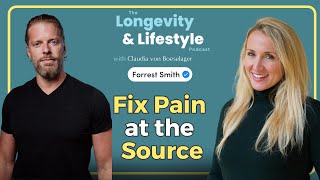
In this episode of the Longevity and Lifestyle Podcast, host Claudia von Boeselager interviews Forrest Smith, co‑founder and CEO of Kineon, about the role of red and near‑infrared (NIR) light therapy in healthy aging. They discuss why pain management and mobility are essential longevity pillars, debunk common myths that treat pain with pharmaceuticals, and explain the cellular mechanisms of red/NIR light—boosting mitochondrial ATP production, increasing nitric oxide‑mediated blood flow, reducing chronic inflammation and oxidative stress. Forrest details how Kineon’s Move+ Pro wearable laser device delivers precise dosing across eight known photo‑acceptors, the importance of wavelength selection, and why flexible, laser‑based wearables outperform generic LED bulbs or sauna‑type devices. Real‑world anecdotes illustrate benefits for elite athletes (accelerated injury recovery, championship wins) and chronic‑pain sufferers (restored sleep, functional movement, improved mood). They outline practical protocols such as 15‑minute treatments on the neck (proximal priority therapy) and lower‑gut/waistband to address leaky gut, thyroid support (especially for perimenopausal hypothyroidism), and gut‑brain health. Forrest emphasizes a preventative, habit‑stacking approach—pairing red light with exercise, resistance training, cold‑plunge, sauna, whole‑food diet, and targeted supplements. The conversation ends with a call to demystify the misconception that any red‑light bulb will suffice, highlighting the need for clinically‑validated dosing and device engineering. Throughout, the tone is conversational, enthusiastic, and optimistic, underscoring Kineon’s mission to make high‑quality, affordable red‑light therapy a daily tool for extending healthspan.
Chapters
Many people accept pain as an inevitable part of aging, right? My father's 87 and he's just like, oh, this is normal aches and pains. We know that chronic pain can reduce life expectancy by up to 10 years. So it's really, really critical.
One of our friends who's a CrossFitter was a good example. Tore his bicep off the bone, was going to have to miss a year for that, came back and went through his recovery process using the Move+, and came back 6 months before he was anticipating it and actually won the, won the championship that year. So that was that's, that's on the kind of performance side. Yeah, invest in yourself. You know, you're— there's only one of you. You have this one life. Take care of your body. This is, this is an awesome meat machine, and it's going to make you healthier and better if you invest in it and if you, if you take care of yourself.
Hey there, I'm Claudia von Boeselager, a former investment banker turned entrepreneur, longevity coach, biohacker, and mother of two. Once burnt out and overwhelmed with chronic health issues, I've transformed my life and helped thousands of people do the same. I've even reduced my biological age by 17 years. Yes, I'm 26 again. Now I'm here to share the tools, strategies, and inspiration to help you live healthier, happier, and longer. On this podcast, I interview world-leading experts in health, biohacking, mindset, and performance, and share personal stories and learnings to bring you the latest insights and tips. Think of this as your go-to space for real talk about all things health and optimizing your life. Ready to unlock your best self? Let's dive in. This is the Longevity and Lifestyle Podcast.
My guest today is Forrest Smith, co-founder and CEO of Kineon, Greek for kick ass. Forrest is a dynamic entrepreneur and respected leader in the tech hardware industry, bringing an impressive 20-year track record of creating and scaling successful startups. His journey with Kineon Labs reflects his unwavering optimism and innovative approach to health and wellness technology, combining science, technology, and practical solutions to improve lives. Forrest is a man of many talents, including a remarkable command of Chinese, which he speaks, reads, and writes fluently, and he currently calls Mexico home.
Please enjoy. Welcome to the Longevity and Lifestyle Podcast, Forrest. It's such a pleasure to have you with us today.
Super excited. I can't wait to, to dive in with you. Thank you so much for having me.
I'm really excited to dive in. Red light, one of my favorite things to discuss, and of course, exercise mobility. And as you'll know, Forrest, that so much of the longevity talk centers around diet and supplements, but obviously mobility and pain are equally vital and often overlooked. And as we know that studies show that adults with mobility limitations have twice the mortality risk compared to those that stay active. So this is so fundamental. Mental. Why do you see pain management and movement as such critical pillars of healthy aging?
It's a, it's an excellent question. And there's, there's a number of different things to dive into. So we'll start with a couple of these. I think there, there are the risk factors. And so the risk factors for mortality, but the bigger risk factor that we're finding with kind of some of our older cohort is living in an aged and kind of feeble way is not what people want to do. And the only way to stay out of that is to keep yourself mobile and to reduce inflammation in your system and really to kind of take action and promote this with my parents as well. And we've, we've kind pushing them into, you know, a core foundation of resistance training, you know, at least once or twice a week because you have those, you know, that tendency to kind of drop off in muscle mass. And that's a really big kind of impact as well. The mobility, getting out, getting walking, getting back into movement so that when you do have inflammation, when you have joint-based kind of osteoarthritis or ongoing chronic inflammation, that you have some way to reduce that. And then also just your energy levels. And I, I think those are, you know, really, you know, what, what people want to see and, and, you know, If you can extend your lifespan but not your healthspan, is that, is that really an attractive thing to do? Or can you get kind of a hopeful or a more optimistic approach to be able to reduce inflammation and increase muscle mass and really live your, your best life?
So many people accept pain as an inevitable part of aging, right? My father's 87 and he's just like, oh, this is normal, aches and pains, et cetera. And we know, right, that chronic pain can reduce life expectancy by up to 10 years. So it's really, really critical. What are the biggest myths you hear about pain and aging and how does Kineon challenge them?
I think I think the myths about this are kind of the gold standards that have been set by the medical community in many cases. So, you know, take, you know, my doctor told me to take these NSAIDs to reduce pain. That's an anti-inflammatory drug. Well, yes and no. So it's really not helping you. I think there's, we've done ourselves a disservice by using pharmaceuticals as a crutch culturally. And, you know, there's a lack of education on the alternatives. But, you know, thankfully there's a really kind of optimistic approach to this, which is instead of thinking of technology as something where doomscrolling and blue light and microplastics and all of this, there's actually some really great things happening in technology that can help, help us take a, a more proactive approach for preventing downstream issues by reducing inflammation, increasing blood flow, increasing cellular level energy generation. And it's, it's just great to be a part of something that, that can bring so much hope and optimism and, and tools to help people move forward in a way that's gonna make them healthier.
So Kineon's Move+ Pro is leading the charge in home-based red light and laser therapy. But let's unpack what's really happening inside the body. So I'd love to start with, for listeners new to light therapy, they might be like, what are they talking about, this light therapy, right? So how would you explain in simple terms what's happening? What is red light therapy and what's happening at a cellular level when we use red and near-infrared light?
I love it. It's a great question. We, we tend to talk about kind of 4 main pillars that, that you impact with red light therapy. And we can talk about the kind of mechanisms that, that go into that. I would talk your ear off about that. We spend tens of thousands of hours in the research, but high level, increasing cellular level energy production.. So your mitochondria are your powerhouses of your cell. How do we make them a factory that works effectively and increase the amount of energy that, that, that they generate? Increase blood flow. So when you use red light therapy, you introduce more nitric oxide. And we can talk about, again, the mechanisms of how that happens, but that's a dilation factor for your blood vessels and helps deliver more, more blood and more oxygen to the tissue. Reduced inflammation. And I think this is one of the core and most key ones we're seeing more and more now from a research standpoint, as imaging and as our research technology gets better, how devastating chronic inflammation can be. And to give one example of this, there's a great study from Harvard and the NFL over decades. What kind of impact do you see from inflammation from things like ACL tears? And so you would anticipate in most cases, or at least I did coming into it, that you tear your ACL, maybe you have some local inflammation that's increased over time. But what we see is not just local. When you've torn your ACL, as an example, that generates inflammation that causes longer-term degradation of the soft tissue in the knee. It also causes the regional impact of not delivering blood flow as well to the, the quad above the knee because of the same inflammation. And then you also see a 50% increased risk of severe cardiovascular events over, over decades. And this is people who have, this is professional athletes who have had this surgery, gone back on the field, continued training, continued playing, and decades later later have this massively increased risk. And that's because of that inflammation doesn't stay local or regional, it actually continues to go throughout your body and you see stiffening of the cardiovascular endothelial tissue and a much higher risk long-term. So this isn't something where you tear your ACL. I had a slap tear in my shoulder, it healed and I'm back into playing sports or kept going in your body. It's kept generating this negative impact from the inflammation standpoint. And then the last pillar is the reduced oxidative stress. And so when you can reduce oxidative stress, when you can keep oxidative stress within a band, a healthy band in your cells, it's a very similar outcome to what you see from exercise. It actually teaches your body how to manage this oxidative stress in a way that, that is super healthy ongoing and can really contribute to a number of different things from cardiovascular to immune health to neurological benefits. And again, these are, these are still relatively unknown. So I'm happy to kind of unpack any of that that you, that you'd like to dive into.
And I just want to maybe just pause, or maybe you can expand a little bit on the red and near-infrared lights as well. Because once I had a client ask me, she's like, well, you know, can I just buy a red light bulb on Amazon? And so can you explain what the wavelengths and what they do and what's the difference, let's say, from this type of red light versus even a red light sauna?
Absolutely. So, so red light saunas are typically kind of not near-infrared and they're, they're doing things like heating up your tissue. And there are benefits to that. There's massive benefits to saunas. I, we, we do it quite frequently. And, and in my middle age, trying to, trying to keep an extra few years of competitive sports in and and these type of things. So, there's super good benefits for long infrared and heating your tissue as well. But, the difference for kind of the bulbs and the sauna approach is this is near-infrared. And, there are near-infrared bulbs as well, but what we've done with Kineon is we've spent tens of thousands of hours looking at what are the actual physiological responses that we're triggering. So, we know we have 8 different key photoacceptors in the body and we know what triggers each of those and we know kind of the order of magnitude in which they exist. So how many of these, for example, kind of broadly known kind of molecule in your body is hemoglobin. People kind of know hemoglobin as a carrier molecule. One of the things that we do with, and with hemoglobin, it's one of the things that is a very big trigger for near-infrared in particular, these heme cores. So an iron core for these different molecules in your body. When we trigger hemoglobin with near-infrared, hemoglobin's a carrier molecule that not just oxygen, but also nitric oxide. There's some, there's 4 different binding sites on hemoglobin. Hemoglobin that are competitive for nitric oxide and oxygen. So, what we do is we help parse with near-infrared, remove the nitric oxide that dumps nitric oxide into your bloodstream, helps that the bloodstream, that, that those blood vessels open up and deliver more blood, but it also opens up a binding site for oxygen so that you can bind an additional oxygen in there. So, you get it kind of a lift in both sides of the, the equation there. You can actually deliver more blood and each kind of blood cell has more oxygen in it. So, that's a one example. But again, there's 8 of these. And so one of them is in your mitochondria, and then some of them are ion channels kind of balancing different things from, from outside your cells to inside your cells. The key point of what makes a good laser therapy or light therapy or red light therapy device is how is this dosed? So how are we dosing each different individual area of tissue that we're working with? And that's, that's where the tens of thousands of hours comes in is we build models showing how photons distribute through to these. As effectively as possible. And then we test those. And so, it's very difficult with bulbs or with LEDs to be able to penetrate into the internal tissue as an example. So, if you wanted to treat your skin, things like panels and LED products are not bad. You, you see an increase in fibroblasts, you see an increase in type 2 collagen. But if you want, if you'd like to treat internal tissue and start treating some of these, I think one way to describe it would be inflammation fountains in your body that, that cause so much risk. Like these injured knees or the synovial tissue in your, in your knees, your hips, or your elbows, or any of these places where you've had an injury, treating the internal tissue is key and having lasers is the key to be able to do that. And so it's more complex to go build those products, but it just delivers better outcomes for the users.
So I love my Kinion Move+ Pro because I put it on my shoulder and I love the fact that it's flexible. So a lot of these red light devices that you see out there, they're not flexible to go around the joints. I already feel like after, after using it, I already feel a difference, less inflammation as well. I'm a huge fan.
I really appreciate you saying that. We're mission-driven, so that's— you couldn't tell me anything that made me happier in the world.
And that's what I love as well, that you guys really spend so much time in the research and understanding it and really dig deep. That makes such a difference, and you can tell that the quality of the products are just there. So yeah, absolutely love it and highly recommend it. So dear audience, if you have any things that are bothering you, be it your neck, your back, the flexibility of it is just absolutely phenomenal that it gets around the joint. Like, a shoulder is so complicated, right? It's just such an awkward position. And you guys have thought about the engineering and putting it on as well. So it's super easy, super lightweight. And also, I think what I found really exciting when researching for this was that from Harvard, the research found that the red light can boost ATP, which is the energy produced in the mitochondria, the energy packs of the cells, by up to— and I couldn't believe this number, I was like, is this a typo— by up to 50%, 5-0%, and lowers inflammatory cytokines by 40%. I was like, is there too many zeros in here? But that is absolutely phenomenal. So how do those mechanisms translate into real-world results users are seeing with Kineon's Move+ Pro? Maybe you can share some anecdotes that, that you've been seeing as well.
This is one of my favorite things. We're a mission-driven company, and our mission is to increase the quality of life for the largest number of people we can in the most measurable way we can. So we do a lot of follow-up with a lot of different users, and it's been amazing to see how this has been so life-changing. But I would say It's kind of on a spectrum. So on one end of the spectrum is we work with 60 different professional sports teams, Olympic teams, people who are really at the performance end. And really, I have to say in a lot of cases from a repetitive stress standpoint, kind of abuse their bodies. Like they're just getting after it. Like the CrossFitters and the Olympic weightlifting teams are great examples. It's repetitive stress on knees, lower back, and it's really cool to see those guys. And I think one of our friends who's a CrossFitter was a good example. Tore his bicep off the bone, was going to have to miss a year for that, came back and went through his recovery process with the, using the Move+, and came back 6 months before he was anticipating it and actually won the, won the championship that year. So that was, that's, that's on the kind of performance side. But I think one of the things that, that really kind of focuses and motivates our team is the other end of the spectrum where we see people who have been in chronic pain. And, and I can think of a, a number of them that we actually keep up with on a personal level as well. Who were early adopters and just gave us great feedback for it. But people who haven't been able to sleep for 10 years through the night because of chronic pain, being able to sleep through the night. One guy's wife couldn't walk up the stairs and she just wants to be able to walk up and down the stairs and get back into her walking routine. And then within a month, she's able to do that. And so those kinds of things on the other end of the spectrum where this is actually adding years to people's lives and adding functional movement and like healthspan, not like being able to enjoy the life that you have versus kind of, you know, just existing. We're building a company. Running a small company is never easy. There's a lot that goes into it. A lot, you know, not enough sleep. You're always behind on all of the work. But when you go into these groups that we share with our internal team and see these life-changing impacts, it's just so motivating and it just gets everyone's energy back up to go do more.
And I think another important part around pain and then obviously pain relief, it influences your mental health and obviously longevity behaviors, things like sleep, exercise, and optimism. How have you seen influences on that too? I think people neglect that. They think pain is pain, but it, it will affect you. So what are some things that you've seen or how does Kineon help with things like that?
Some of the, the best things that we've seen around this are those, those reduced pain points seem to not just stay within the individual, but go to their family and their community as well. And I think that's one of the most exciting things that, that we've really seen for this is not only with, with pain, but also with other pathologies. So we have, we have a, a gut and brain device coming out later this year where we see really powerful impacts for for different neurological issues. And, you know, it's the, the science is still not 100% there yet on the, on the sensing side of this. But what we're seeing is cognitive impacts for people with things like, like Alzheimer's or, or other types of pathologies for their neurological tissue. And those are things that we're really targeting longer term because it can change people's quality of life just so much. But I think right now, you know, pain, pain from gut is another one where there's been a chronic pain and there's a lot of people who have IBS and Crohn's and, and ulcerative colitis and these different type of gut-based pathologies that are just so life-impacting that it's, it's just amazing to see them getting out of that. And again, you can see just with our follow-ups with them how that trickles on into improved relationships, improved confidence levels, improved recovery. It's this one blocker, kind of like a small dam in the river, that, that kind of stops the rest of their life from, from being watered or kind of growing the plants that it would grow otherwise. And seeing those blockers come out and people to be able to take on their full life again, it's just awesome. I, I, you know, I'm so excited to be part of this journey.
It's so exciting. I love your enthusiasm as as well. And I think for people, you know, that gut-brain access is so important. And my audience obviously knows, but my mother sadly passed a few weeks ago from Alzheimer's. So it's a huge passion area of mine as well. And what is so possible, like the majority of doctors and neuroscientists that we saw from traditional worlds, right? They don't know about red lights and the power of red light as well.
Your brain's kind of the center of so much that it's, you know, it's nice to be able to have an impact on that and give people, again, hope and optimism. And particularly the earlier you can start these type of preventative treatments, the better.
1000%. And a lot is inflammation in the brain as well, right?
Jumping in quickly, it's Claudia von Boeselager. I absolutely love bringing you these conversations for free each week, and I can do that thanks to the generous support of our sponsors. These are brands I've personally vetted and believe in, and I think you'll love them too. Supporting them means you're also supporting the show and your own longevity journey. Thanks for supporting them. Now, here's today's sponsors. This episode is brought to you by Kineon. When it comes to longevity, it's not just about living longer, it's about staying active, strong, and pain-free as you age. And that's exactly what the Kineon Move+ Pro helps you do. It's a wearable red light and laser therapy device that works at the cellular level to reduce inflammation, ease pain, and speed up recovery naturally. I love that it helps support your body's own repair process, not just mask symptoms. It's portable, easy to use at home, and trusted by athletes Biohackers and health enthusiasts who want to keep moving and performing at their best. If you're ready to move from pain to possible, head over to kineon.io/claudia. That's kineon.io/claudia to get 10% off your Move+ Pro.
So for us, the biohacking and recovery tech world is booming, but But of course, not all devices are created equal, and consistency seems to be the real differentiator. I saw some statistics around the global wearable market. It's supposed to exceed $170 billion by 2030, so it's really booming. How do you see devices like Kineon fitting into the mainstream shift from treatment to preventative and proactive longevity? And what are certain protocols that you recommend for users trying to keep fit and healthy for as long as possible?
Well, that's an awesome question. I think, you know, one of the things that we work on, and again, our mission is to not just help people kind of improve their quality of life through pain management and inflammation reduction and these type of things, but to be able to measure it. So our long-term product roadmap is exactly in line with what you're saying. It's, you know, how do we measure? And we're working on some technology that will launch next year. How do we measure and display for people what's happening in their physiology? What are we triggering that's going to help them? And then when people can see that from our early tests, they really stay on their therapeutics a lot longer. But our goal has been to always reduce— when we started Kineon, and it's still very much the case, laser-based Battery-based devices are much more effective, but they're, they're really kind of only available in clinical level, $30,000 to $50,000 devices that plug in and that sit on a desk. And at the best, you're going to be able to use kind of once a week or once a month whenever you go see your clinician. Those are very good devices, but what we wanted to be able to do from a design standpoint was how do we, how do we drive better adoption and make this something that people can use in home instead of having to take pharmaceuticals? Because a lot of people don't want to take pharmaceuticals, but there's not really any great options and alternatives outside side of that. So our goal was to reduce the price by customizing our lasers and get this into something that's wearable, that's easy, that's low friction for people to be able to adopt and use from a habit-forming standpoint. So we really kind of push habit stacking. And I have to say, and this sounds funny, but it's really true. We found a lot of people using aspirational habits. So like, hey, should I do this with my meditation that I, that every morning? It's like, well, how many times you meditated in the last 2 weeks? Once you're watching Netflix every day, do it with the Netflix. Let's use pragmatic kind of habits to stack this with. But one thing that's super exciting that I think we've, that I've actually taken on as part of my daily usage of the device and has had amazing impact for me is we work with a Japanese lab who helped develop a protocol called the Proximal Priority Therapy, where you treat basically the largest kind of easily accessible blood vessels in your, in your body or in your neck. So you put it around your neck for 15 minutes. Pants, and then you put it around your, your lower gut. And so I just kind of, we have an extender strap, but I just kind of tuck it into my waistband in my, in my, in my pants. And then I do 15 minutes in 15 minutes. And the impact for this, both from the research standpoint, but also from my personal anecdotal experience, and then kind of our, we've, as we start telling users about it, their anecdotal experience is immune impacts are just amazing. You just don't get sick anymore. And then after about 2 weeks of this, you, you see these really powerful lifts in energy and in focus. And just in cognitive kind of awareness and in mood. In the research, this is typically labeled affect. So there's different ways through surveys that they kind of follow up on the affect or the mood of, and energy levels of people, but it's just awesome. You just feel good. And so that's one of the ones where we were working with a couple of different labs and actually with some really cool supplement companies that are kind of focused on gut health. But it looks like from what we're seeing that it's just endemic to have kind of poor tight junctions in your gut to leak inflammation into the rest of body. And so when you can reduce that inflammation in your gut, you shore those up, you stop leaking the inflammation into the rest of your body. And there's some really powerful impacts, both from a neurological standpoint, from that gut-brain axis trigger, but also in increased insulin sensitivity. Just your, your body just responds to reducing inflammation in a really powerfully healthy way. And so you just, you just feel better from that. So that's, that's one of the ones that's been most exciting for me over this last year.
That's really exciting. And so it's 15 minutes around your neck. And is it anything to do with the thyroid at all, or is it just because of the, the blood vessels are here.
If you, if you treat your thyroid, this is another one that's been really fun to research on. You can actually treat the thyroid as well. One of the things that, that's come up in the, in the literature around this very recently, my, my business partner had Hashimoto's and so we were digging in to see if there's anything we could potentially impact to help him with that. And, and we did in the end. There's a great protocol that we can kind of send through, but it's essentially treating your, your thyroid for 15 minutes per day and then taking vitamin D3 and selenium and they, they trigger different benefits. Benefits. And so they're stacking synergistic outcomes for it. But one of the things that's actually come up from our interactions with our users about this is the really broad hypothyroidism that you see around perimenopause and menopause. Our research team leans male, and so it wasn't really on our radar until my partner's Hashimoto's kind of brought this in for us. But it's really, it's something like 70 to 80% of women going through perimenopause and menopause. It triggers this hypothyroid, and this is something that you can absolutely target with the red light therapy and also again see those synergistic kind of supplement impacts as well.
Absolutely amazing. Yeah, so many women are suffering and it's just criminal that so many years the women were completely forgotten out of research. So I'm glad that you are addressing this as well. So you do 15 minutes and then I'm just curious around the gut. So you do around your waistband of your, of your pants, right? And so that's helping with leaky gut. Is that what that's helping with?
Gut-based inflammation. We see typically what you'll see is, is this is, this is microplastics and a lot of environmental factors, but also just really kind of not the best diet that we have now as a, as a general society. No, but you'll see mucosal lining, which can be damaged by that, that environmental stress. And then you see these inflammation in the gut actually causes the, those tight junctions to open up and, and for you to see much more systemic inflammation. And so this is also what one of the things we were talking to our friend from Just Thrive, Kieran, about. He's a biochemist. They, they really have, they have a great spore-based product for gut health that, that stacks synergistically with what we're doing. So what we'll be doing is some ongoing work with them in that space. Your first step is this poor diet and environmental factors causing these, these tight junctions to open up. And then, you know, you go through a number of different things. So metabolic dysfunction, diabetes, but what we're thinking of with the brain right now is kind of a type 3 diabetes is neurodegeneration. So there's, there's a lot of really negative impacts downstream from this inflammation that you can get ahead of and really take a much more proactive and useful approach to.
Absolutely amazing. You're not getting sick, so you're more active as well. So it's a win-win-win, which is That's great. Looking forward for the chronic inflammation, which we know contributes to over 50% of deaths worldwide, what are your go-to tips to reduce inflammation naturally? So you stack with Kineon, and what other advice could you give for my audience?
So I do a couple of different things from a training standpoint that I think have been quite effective, but I would say outside of training, which I can, I can dive into shortly, and not everybody's going to want to go crazy on the, on the training like I do, but you know, I don't mind sharing those ice kind of ice plunge, cold plunge, ice barrel, try to get that in, you know, 4 or 5 days a week. Sauna has been, has been very useful as well. And then also kind of the combination of those with contrast therapy. And then diet is a huge driver for this. So kind of more whole foods, less processed foods is a very simple and easy and straightforward way to make a really big impact. And then obviously less kind of added sugar. The sugar is an inflammatory fixture in so many diets. It's just, it's just crazy now. But yeah, this, and then obviously the laser therapy and the training, I think 2 2 big pieces for that. One is building more muscle is, is great. So kind of approaching through time under tension-based protocols for some level of hypertrophy during the week and then kind of training both types of energy systems so that the kind of lower, longer zone 2 long walks, kind of low, low kind of intensity, and then get in a couple of high-intensity ones when you can. And those can be, you know, as short as 30 seconds on an assault bike is, they call it the devil's tricycle. It is painful, but it's, it's very effective for triggering research terms for this will be high-intensity interval training or sprint interval training. And those really have kind of additive effects in combination with, you know, the muscle growth and the lower-intensity training as well.
It's amazing. Yeah, I have a Carol bike as well, which is quite fun for the VO2 max training.
Oh my goodness. I love those guys though. It's a really powerful tool.
It's amazing. Yeah, it's so funny. I would, the first time I was like, what's going on? It was hilarious. And before we finish up today, Forrest, I wanna ask you, what is the biggest misconception about red light therapy you would like to demystify for people listening? So that they really understand how important it is to be focused on red light therapy in a daily practice?
I think you mentioned one earlier, which is, oh, well, I can, I can just get a bulb and get these, these benefits. And you may get some level of skin kind of benefits, some, some level of wound healing, but you know, you might be at the 10% level of what you could actually do with that versus kind of trying to find what's going to move the needle the most. And I think one of the other things that I really see as a big kind of systemic opportunity that people can embrace is when you look at the, the poor outcomes that we have, whether that's obesity, type 2 diabetes, neurological disorder, cardiovascular disease, we, we think of these as kind of bad products rolling off of, off a production line. When you see a bad product rolling off a production line, going to fix the product is probably not the, the, uh, the best approach. Going, let's, let's go take all of these and start trying to fix each one. I'll take this pills for this and that pills for that, and then I'm going to have an intervention for each one of those bad The better approach for it is let's go look at the production line and why it's generating these bad products. Where, what are the steps here that we can get ahead of? And so, you know, we, we really see those as inflammation and a lot of these upstream kind of preventative measures we can take. We don't want to sell it as, as like the, the only thing you should be doing, but it's an incredibly powerful tool for your toolkit to fix that production line and just, just get ahead of, save yourself, you know, 10, 20, 30 years down the line, your joints will thank you. You, your, your entire body. You, you just, you would just be a healthier human being by being able to prevent these outcomes. I think that's how we, we kind of really like people to think about the preventative side is let's, let's go in proactively and take the tools that we have that are the best in the world to go try and get ahead of this. And, and you'll see the benefits for it over time.
Amazing. Where can people find you, Forrest? And, and Kineon, where would you like to send them to? And we'll link everything in the show notes.
That's fantastic. Thank you. Kineon.io, K-I-N-E-O-N.io. And, and we publish a lot of really cool blogs in there trying to, to kind of kind of bring forward some of the science and, and put it into an easily digestible and, and reasonable way and to let people know what to expect out of this. So that we're not making claims or promises that aren't in line with what we can deliver, but that we are letting people know what this is actually going to be changing in their physiology and what they can expect from it. So come check us out. And I, I really appreciate you taking the time with me today.
This has been awesome. I do too. And I really appreciate all the research and, and passion you put into it. Do you have any parting thought or message for my audience today?
For us. Yeah. Invest in yourself. I, you know, you're, there's only one of you. You have this one life. Take care of your body. This is, this is an awesome meat machine and it's gonna make you healthier and, and better if you invest in it and if you, if you take care of yourself. So, and you're, you're doing a great job in, in spreading these awesome tools and, and messages and, and educational pieces. So I, I really appreciate again for the taking the time and, and letting us, letting us kind of bring our, our little piece of that in as well.
Well, appreciate what you guys are doing and helping so many people stay mobile. So thank you so much. Thank you for taking the time to come on the show. Thank you to your audience for listening. It's been such a My pleasure.
Likewise.
Thank you. Hi everyone, it's Claudia again. Before you take off, would you like to get a short email from me to you several times a month with top tips, insights, and strategies to help optimize your life, health, and business? This could be interesting posts or articles I've read on life and longevity optimization, cool biohacking or lifestyle products that I've discovered, and other fun things to help you be at your best. It's a very short piece of inspiration for you. So if you want to receive it, check it out by going to llinsider.com. That's llinsider.com. And leave your email to get the next one.
More from Claudia









Can Psilocybin Slow Aging? The Study on Telomeres, Inflammation & Survival with Dr. Louise Hecker

