Remix - How To Relieve STRESS, Optimizing HEALTH, Web 3.0, DeFi, DeSci, NFTs, and more!
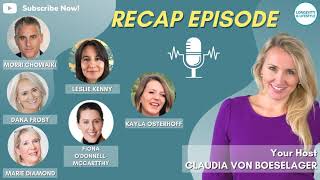
Claudia von Boeselager stitches together expert interviews on stress relief and health optimization. Spermidine, found in fermented foods like cheese and natto, restores youthful autophagy levels. Morning routines that delay phone use and protect cortisol rhythms, plus breathwork techniques, improve heart-rate variability and stress resilience.
Chapters
Welcome to another episode of the Longevity and Lifestyle Podcast. I'm your host, Claudia von Boeselager, here to uncover the groundbreaking strategies, tools, and practices from the world's pioneering experts to help you live at your best and reach your highest potential. Today's episode is a special recap episode featuring a short clip from the previous week's episodes. It serves as a teaser into the wealth of insights, entertaining anecdotes, and valuable tips from the various conversations to give you a flavor of the episode and guest. If you'd like to check out the full episode, simply go to longevity-and-lifestyle.com/podcast. Please enjoy.
And does it change depending on if it's in your office versus in the bedroom? You want to be facing a different direction and you move furniture around.
Or—
Yeah, so this is about activations that I just shared, but there's another part is about what direction to face.
Okay.
First rule is always to see the door.
Yeah.
So sometimes you cannot face one of your good directions, but you can always face the door. Yeah. Right now I'm sitting and I see the door.
The door is right there.
So you always want to make sure you're in what we call the queen or king position. So you never sit with your back to the door. People that sit with their back to the door, they don't see the universe coming in, because the universe comes in through people and it comes in with you, literally to the door. So if you're with your back to the door, you're actually saying to the universe, I'm not open to all the opportunities and the possibilities. And just by that simple change in your desk, that you're taking your desk and you're facing the door, people have seen amazing results with getting more income, promotions, more recognition, more respect. I think you can see the door where you're sitting right now. Yes, I can see that because you become more powerful. Yeah, so that's the first rule. The second rule, if possible, it's not always possible, is then to take your compass and to see if you can see the door and also face, look at your good directions when you're awake. When you're asleep, you want to see the door when you wake up, like you wake up, oh, I see the door. And you want to sleep with your head pointing at one of your good directions.
Okay.
Now, it's not always possible, but you always can activate these directions by placing the right things, yeah, or the right images. But that's actually the ultimately best if you can do that, because then you are in the flow of your own energy. And the more you're in the flow of your own energy, the stronger the universe will respond. So Then people experience like I'm asking something and immediately there's a flow because you want to flow with you, you don't want to flow against you. Yeah, so you will still, like I said, if you have a bike and you go on top of a mountain and you bike against the wind, you will still get to the top of the mountain, but you'll be exhausted.
Yeah, struggle.
So if you have the wind with you, that's what Feng Shui does. If you have the wind with you, you go quicker on top of the mountain and you can do the second mountain because you still have so much energy left.
Okay. I definitely need to do some shifting as well. So it's a mixture of understanding—
lots of your listeners know about the benefits of fasting and sauna and cold water plunge. All of those things will trigger autophagy as well, but you can do the same with some of the molecules in foods. So I mentioned earlier that spermidine is produced by you, me, our children, our pets, every plant. That houseplant behind you is making spermidine as well. And it's just that the older that we get, the less spermidine we manufacture. So if you look at the octogenarian or centenarian populations, those healthy populations, they actually have the same spermidine levels as young people. Which is interesting.
Yes.
And our gut biomes can actually produce spermidine as well. So we produce in our tissues and our gut biome, and we also get it from food. As we get older and the tissue production declines, we need to rely more on the gut biome and also on supplementing with food. So these populations often have high spermidine content foods in their diet. If you think about the Mediterranean diet. It has a lot of plant material in it. The Nicoyans in Costa Rica Peninsula, same for them. Okinawa, exactly the same. And then the Italians, the Sardinians, they have cheese as well, and cheese actually has some spermidine in it. The longer the maturity, the higher the spermidine content. So there's something about fermentation that seems to increase the amount of spermidine. Same in Okinawa with natto, which is a fermented soybean dish.
And kimchi as well is also kimchi, Korean cabbage.
That's right. So I've not actually seen the statistics on how much spermidine is there, but I'm sure that cabbage will have some. It's not going to be the same as, say, mushrooms, shiitake mushrooms, but there will be some there and the fermentation process will increase that amount as well.
And so with Oxford Healthspan and your products, what you've done is really packaged the best, or the level or ratio of spermidine in a tablet form as a supplementation? Yes.
So remember that those centenarians that I talked about in the blue zones, their blood markers of spermidine were just as high as when they were young, which says it's the gut and/or the supplementation. The food that they're taking in is actually allowing them to create the spermidine or to get it into their bodies. So we've taken just food-derived spermidine and we've concentrated it with our original product, which is a wheat germ-derived product.
Yes. And I actually have 4 different morning routines for each phase of my cycle, of course, but consistently my morning routines typically include some kind of mindfulness practice. And I always start my day slow, even if that means it's gotta start slow within a 5-minute period, or it's gotta start slow within an hour or 2-hour period. I always start slow, meaning that first of all, I don't wake up to a cortisol-inducing alarm. I usually, if I have to set an alarm, then I will do it to some kind of something that's more soothing, like music or chimes, something like that. And then I don't just hop out of bed and I certainly don't hop on my phone and start checking my emails right away because all of that will spike your cortisol and cause cortisol dysregulation, which by the way, cortisol regulation is intimately tied with insulin regulation and hormonal production or production of estrogen and progesterone. That can be something for another day, but it's really important to have healthy cortisol function, meaning that your cortisol shouldn't peak until later in the morning. And then from that point, it should should steadily decline. And so having a morning routine that will support that natural cortisol curve is really important anytime throughout the cycle.
Very proactive in it. And you can avoid— like, Alzheimer's is reversible. Like, you don't need to have Alzheimer's, cognitive decline. Like, a lot of these neurodegenerative diseases, like, you don't need to suffer them. Type 2 diabetes as well. There's so many things that shouldn't even exist anymore because we have the tools. And it's just like, how do you push the adaptation of that to a much quicker pace.
And how do you make that feel like something that's empowering to people versus making it feel like you're blaming the victim of these things? So I think that psychological shift is so important that this should be seen not as blaming someone for the condition that they have, but rather empowering them with things that they can control and they can do, and that they don't have to turn their body over to the medical system in order to get relief from some of these really debilitating conditions.
Exactly. Yeah. And to proactively look and take steps to avoid it, to do certain tests so that they understand. And I think it's that self-education and it's exciting. I think coming out of COVID people have become more scientifically and medically aware and have a better understanding and also understanding like what implications are. And the more people are attuned to their own body, they realize, okay, my body's telling me something like this is bothering me. What can I do to solve it? And not just go to traditional methods of, okay, here's a pill and it's not really helping, but what else could I do fundamentally? But underneath that. Yeah.
Amazing.
So that's around health. And any other emerging tech around health or what about global commerce?
Oh, in global commerce, this is something I've spent a lot of my career in commerce, both on the infrastructure for e-commerce side and on various consumer brands, both in the health space and the fashion space. And I think what's interesting in global commerce is that the promise of the internet was that you could access any information or any product anywhere in the world. And this led to an explosion of new brands and food and fashion, content, wellness, and innovation. And that's been amazing. And as consumers are buying Buying patterns used to be heavily influenced by retailers' decisions about what to carry on their shelves, whether it was the food that we ate or the magazines we consumed, the newspapers we had access to. But today we can find anything we want online. The problem though, is now there's a huge number of long-tail brands competing for our attention. And the cost to acquire a customer online for these companies is often unsustainable today. And so this is an area where innovation is just hugely necessary. And so I love meeting with entrepreneurs who are focused on this problem because how How do you break through the noise and as an emerging brand that has an amazing product, actually build interesting market share in a globally competitive online directory of every brand in the world?
So what would be the key part of it's also like data and really understanding and targeting that customer, or what would you say are some of the—
Well, there's data and targeting, and then that has implications for how we think about our privacy as individuals as well, and what information you want to choose to share with brands and not. I also think there's interesting marketplaces.
So we all think broccoli, spinach, kale, Brussels sprouts are wonderful for us. They may not actually be, depending on who you are as an individual and what you have in your microbiome. In fact, they may actually harm you and ultimately cause inflammation. And inflammation is the cause of most chronic disease. So we look at that, we give our customers a very detailed list of foods that are good and bad and why.. And then we go one step further and we say, okay, you can't get all the supplementation and all the nutrients from your food that you used to 50 years ago because of all the generally genetically modified things and whatnot. And so we actually give all of our customers a list of supplements they should also take on a daily basis with exact dosages. And we don't charge them for this. We tell them, here is your exact list. And up until about a year and a half ago, the last— for 4 years before, that was all we did. We sold the kits and we said, Here's your food list, here's your supplements. We had a lot of backlash. We had a lot of people saying, this is crazy, you're giving me this list, I can't find these products at my local retailers, it's too much. So Naveen decided to make a massive commitment and commit millions of dollars into a fully state-of-the-art robotic facility that actually makes every single customer's formula on demand. So we provide the food list and then we provide the vitamin list and we actually make the supplements. And then here's the kicker. 6 months go by because that's about how long it takes for the microbiome to adjust. We ask our customers to retest, and when they retest, their scores have hopefully improved. Their foods have become different. Now all of a sudden, when it said don't eat tomatoes, now you can eat tomatoes, and here's why. And then their vitamin formula has changed because their body has changed. It's always changing. And so at that point in time, we then completely revamp the supplement formula. And we manufacture the new one on demand. So the whole point is test, analyze, here's a solution, try that solution, 6 months go by, retest, see if things have worked, optimize. So you're always getting what your body needs and nothing that you don't. And that's basically the consumer division of ION. And then there's much more on the other side.
Yeah, we'll talk about that in a minute as well. And I just want to hone in for people as well to realize, I think people are like, oh, I'm allergic to this or I'm sensitive to this and not understanding actually the science behind it and what's going on and what you can actually do. So what you're describing now perfectly is by taking certain supplements and regaining and building up some certain good gut bacteria, you mightn't be allergic to something again. I hear people like, I'm sensitive to this, I'm sensitive to that. I was like, when was the last time you test? Oh, 15 years ago.
Yeah. And I am not scientifically or medically trained at all. Take what I say with a grain of salt. We have 200 PhDs on our team who are much smarter than me. Both in the world of science and AI. We have our algorithm is built by one of the guys who invented IBM's Watson. But I will say this is that when you look at what we're trying to do, what we're trying to do is to improve humanity. Okay. And we don't look at the valuation of our company. We don't care about the money. We care about positively affecting the lives of a billion people. When you do that, you'll have a company worth $100 billion.
So we really want to neutralize when we have stress. The nervous system is in, it's in either freeze, fight, or flight. It's dysregulated. And we want to know how can we neutralize that? And it really doesn't have to be— it is as simple as going to your breath and inhaling and exhaling, visualizing, and just connecting to yourself, calming that right there, it calms the thoughts.
But I love that as well, like the embodiment as well. And Dr. Mark Atkinson, I'm not sure if you're familiar with his work as well, but he calls it being in the mind is like in the cave, and if you drop into the body, it's like being in the ocean. It's just so much more wise, and there's so much wisdom there. And one hack he also recommends is like lightly smiling and relaxing the tongue, which also helps with the vagus nerve. So I think just that, that breathing— and I personally as well have been, have to really work on my breathing because of bad habit for many years. And I think this is also many women, is this sort of ribs tight, shallow breathing from the top part of your lungs. And if you think about how badly you breathe, and if you even watch like a baby breathe, I think it's beautiful, you just see the whole belly like completely inflating. And I think for so many people, just even to check in with that, like, how do you breathe? Do you breathe into your diaphragm, into your belly, like this big sort of Buddha belly, or inflating a balloon in your belly? Even just retraining that, and that was really tough for me because I was it's just such a habit to breathe badly. So breath is so powerful, like you were saying.
Yeah, that was really before I was introduced to HeartMath. Actually, it was before I had my health crisis. I was studying the work of Dr. Andrew Weisz, and he's a functional nutrition integrative medical doctor in the U.S. who's done a lot of work on integrative holistic healing. And through his work, I started retraining my breathing pattern because if you remember, I talked about that cough and I did have some cranial sacral work that helped with the cough that really took it. It really actually took it away, but my breathing was still dysregulated. And so physically, when we talk about HeartMath, it's that visualization, inhaling and exhaling, you're imagining. When we talk about physically, where do you want the breath to do? There are 4 qualities from Dr. Andrew Weil's book. It's deep, so you get the Buddha belly. It's quiet. If you think about if you're sitting next to someone and you can hear their breath, it's disturbing.
I'm doing it right.
Yeah, exactly.
They have—
disturbing.
Yeah. Yeah.
Or you could maybe have actually some physical issue with your sinuses. So we want it to be quiet. We want it to be regular. And this, that regular is what I was talking about with heart rate variability. The regular breath moderates the heart rate variability. So you want your inhale and exhale to be roughly the same and you want it to be deep, slow. That's the fourth one. Deep, slow, quiet, regular. So we, this just makes sense, right? A quick breath. We need the quick breath. We're running. We're, we're fight and flight is a real thing. We need the stress response. It actually is. Yeah. Yeah. But everyday breathing pattern, we want it to be slow. So So this is another like very powerful stress management tool is to begin, as you said, you had to retrain your breath. I did too. We were taught in our education system that the breath is a part of the autonomic nervous system and you don't need to think about it. But okay, we all have trauma and at some point the trauma put us in flight and we just get stuck there.
Yeah, exactly. And I think yes, you automatically breathe. To survive. It's also the audience of this podcast, all about optimizing, right? Who wants to live in the basic state when you can live in an optimized state and live really well? And as you said, it's a free tool. It's so powerful and you can do it anywhere, anytime, even sitting at your desk. And it's just that taking 2, 3 minutes and just recentering, rebalancing. And there's an expression, I'm going to butcher it, but it's like when you think you don't have time to take a few minutes to meditate or to breathe, that's when you definitely need to do it.
Hi everyone, this is Claudia again. Before you take off, would you like to get a short email from me with some short but sweet fun tips, tricks, and updates on all things longevity and lifestyle? This could be cool products that I've discovered, interesting posts or articles I've read, and other fun and helpful things around longevity and lifestyle I've found for you. It's a very short piece of inspiration for you a few times a month. So if you want to receive it, check it out by going to longevity-and-lifestyle.com. That's longevity-and-lifestyle.com. And leave your email to sign up for the next one.
More from Claudia









Can Psilocybin Slow Aging? The Study on Telomeres, Inflammation & Survival with Dr. Louise Hecker

