Reverse Aging, Skincare, Weight Loss, Epigenetics & Overcoming Midlife Crisis with Larisa Petrini
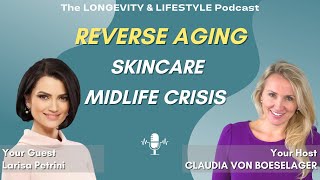
In this Longevity and Lifestyle Podcast episode, host Claudia von Boeselager interviews health coach Larisa Petrini about her personal transformation from a high‑profile PR career to a decade‑long practice helping high‑performing women reverse aging and regain confidence. Larisa recounts a 2009 personal crisis (divorce and a misdiagnosed thyroid cancer) that prompted a sabbatical in Borneo and a career pivot into nutrition, sleep, and epigenetics. The conversation covers the central role of mindset, the science of sleep (hormone timing, chronotypes, and the impact of sleep deprivation on weight, hormones, inflammation, cognition, and skin), common skincare misconceptions (diet outweighs products, the “whites” to limit, and simplifying routines), sustainable weight‑loss tactics (protein = 1 g per pound, step goals, hydration, breakfast protein, gradual habit building), and the power of epigenetics and personalized genetic testing to guide individualized prevention plans. Larisa describes her coaching program (12‑month structure, mindset first, gut/hormone reset, skin protocol, app‑based “Body Bible”), the use of biofeedback tools like Oura Ring, and offers resources (connectwithlarissa.com, 10yearsback.com, keepglowing.com). The episode emphasizes small, consistent actions (kaizen) and a holistic, data‑driven approach to longevity.
Chapters
This episode is brought to you by the BioCharger NG. With the average American spending 92% of their time indoors bombarded by man-made energies, Many of us are experiencing an energy shortage at the cellular level where it's needed most. The BioCharger NG is the world's only cloud-based health optimization platform that simultaneously generates 4 distinct energies known for supporting health and wellness, enabling your body to reenergize, refocus, and recover to be at your best. So check out how the BioCharger can energize your life and get $500 off by going to biocharger.com/claudia.
That's biocharger.com/claudia today. Hello and welcome to another episode of the Longevity and Lifestyle Podcast. I'm Claudia von Boeselager, your host, and I'm here to uncover the groundbreaking strategies, tools, and practices from the world's pioneering experts to help you live at your best and reach your highest potential. Have you ever wondered how love and longevity are connected? Well, this is exactly what my guest today, Dr. Molly Maloof, Stanford University professor, pioneering physician, technologist, and entrepreneur, is working on. And we discuss so you can learn today all about how to build stronger and healthier connections, why relationships should also be considered as a health area to optimize, Solving trauma with psychedelics like MDMA, how oxytocin is linked to childhood trauma, the role of relationships in metabolism, how to build connection in a constantly changing world, and much more. And don't forget to please help spread the word and share the show with family, friends, and colleagues. The more people we can help with the message, the better place the world will be. So thanks so much for sharing. Please enjoy. Welcome to the Longevity and Lifestyle Podcast, Larissa. It's such a pleasure to have you on today.
Thank you so much for your invitation.
My pleasure. So I'd like to start with your journey, Larissa, and understand why you're so passionate, because we share a very mutual passion here. So why are you so passionate about helping high-performing women reverse their age and— I love this— sizzle with energy and confidence? Can you share with us?
Yeah, sure. My story begins in 2009. I will start there. I like to call it a pivotal moment for me. Two major events happened back then. The number one event was an unexpected divorce from my former partner. A few months after, I was misdiagnosed with thyroid cancer. These two events literally put me on my knees. So it was very hard for me back then. I was running a very successful communication and public relations agency. I was on the COVID of magazines. I was in all the tops possible. I was visible. I had the reputation, the image, the financial means, everything was there except for the way I felt inside. And the number one decision I took right after was to go to Malaysia for 2 months. It was like a small sabbatical, a smaller version of a 1-year sabbatical. So I went to Malaysia. I spent 2 months right in the jungle, in the middle of jungle, in Borneo to be exact. And for 2 months, I literally spent some good amount of time having a look in the mirror, the metaphorical mirror, of course, and asking myself what happened and how come I arrived in that place. And I came up with, of course, lots of answers. And that was also the moment when I took the decision to completely shift my life and also change the domain. I wasn't 100% sure what I'm going to do is nutrition and health coaching. That was the first insight I had. So it took me a few good years from 2009 till end of 2014. So 5 years to actually step out. I started to certify myself. I went back to school. That was another very good decision. I went back to school. Institute for Integrative Nutrition from New York was the first school and first certification. And then a few others followed Cornell University, Precision Nutrition, Spencer Institute, and so on. So I moved from nutrition and health to sleep. I became a certified sleep coach. I'm also a certified sleep coach. And then the next frontier, I don't want to say the last one, was epigenetics. And I did that while I was working with hundreds, literally hundreds of women. So this year I am also celebrating almost 10 years. Soon I will get there, 10 years of doing this with so many women. And what happened back in 2009, I should say, I took the decision. The decision was the following: I will help as many women as possible, high-achieving women ideally, to avert this type of crisis, whether it's a medical crisis Or it's a personal crisis because this is what happened. I was in my thirties, so it wasn't— some women are 100% sure a midlife crisis is somewhere around forties. I wouldn't say that. And in general, I strongly believe something happens in between decades in our thirties and then in our forties and then in our fifties and so on. Then it's different for everyone. And the decades are different, of course, for everyone. In my case was in my 30s, and then I arrived where I am today.
That's such an incredible story. And I think a lot of us in this space and in this field, as I'm sure you'll know, a lot of it comes from a very personal place. I think so many, like similar to me, started investment banking, tech startups, serial entrepreneur, but moving into the space just became really— started as a passion project out of own personal experience. Out of interest, Larissa, can you share what your self-talk and thinking at the time was to take that time out and go to Malaysia and Borneo?
My son was small back then. He was 3 years old. And I oftentimes share the fact that the first emotion that came out or was triggered by this thought, and the thought was, I need some I need a place where I am not connected with anything and anyone. And I simply spend that time with myself. I am almost forced to do that with myself. And the first, or what triggered next was another thought. And the thought was, yeah, but you have a child to raise and your son will spend 2 months without you. And I still had the courage to do that. So I was like, okay, 8 weeks, it's a lot. And he's small, but I need this. If I'm not going to do this, if I'm not going to replenish my cup, chances are I'm not going to be well. Like what's coming next in terms of the whole chapter after the divorce and moving out from our house and so on and finding a new place is going to be shaky or challenging. If I would have to look back, and this is something that I do as we speak, because I'm working on my book and my book is going to be out in autumn. And I had to relive so many important pivotal moments of my life. It's very interesting to go back, to travel back and to see how much fear and how much— it was a cocktail. I oftentimes say it was a cocktail of emotions, fear mixed with courage, mixed with worry mixed with what if mixed with power and strength and so on. And some of the decisions I took back then were crazy, to be honest with you. I don't know if right now I'm 43. I turned 43 at the end of May. I don't know if I would do that again. Some of those decisions again.
Yeah.
So in a way it was good. Because I was in my 30s and I had the courage to do that. And even later, end of 2014, so many people around me, they were like, are you crazy? You give up all this reputation and images and that great, amazing salary. I was a managing partner, not just the managing director. For what? For something completely new. And back then, no one in my country at least was a health coach. It was a completely new domain, completely new position and positioning. Yeah. And I was like, I don't care. I will take the risk. And the first thing I did was we launched a startup, a corporate wellness startup, and it wasn't successful. We ended up saying no to actually investing. The level of investment was half a million. We tried to make it work for a few years and then we said, okay, in order to move on and to step to the next level, we need to invest half a million in this startup. So what do we do? And the decision was not to do that. So I had to start over. We closed that startup. We, me and my former business partner moved in different directions and then I had to start over and that happened not right away. There was another interesting pivotal, I would say, period of my life. I was running very successful aesthetic clinic, anti-aging clinic in Eastern Europe about that specific chapter. It was a 6-month project. I oftentimes say the fact that specific chapter actually helped me move or be interested in reverse aging and aging in general and age management, and also take into account epigenetics. As a way to intervene and to actually follow and implement a coaching process for my clients. Every single step was a building block, in fact, and there was a silver lining in every chapter that actually was important or was there for a reason. And this is something that I oftentimes laugh about because right now, if you would ask me, I would definitely tell you the fact that everything happens for me and not to me. But back then I was scared and confused. And sometimes I was like, what if it's wrong? What if I should do something else? What if the initial decision was not right? And so on. And another thing, this is something that I would really love to mention. And I speak about this also in my book. I had the best, literally the best mentors and coaches ever available on planet Earth. I always say that whether they were mindset coaches or business coaches, or even money mindset coaches, all of them helped me move forward and do what I do today. So I am very grateful for every single person who crossed my life, and some of them are still in my experience. So I am truly grateful for that.
It's wonderful. You touch on so many important topics there. I think one is also the connecting the dots that life happens for you, not to you as well. And sometimes it's really tricky to see that in difficult moments. And just focus on that. And I think also in terms of mindset, I think I used to underestimate the importance of mindset, but now, and obviously through the work that you and I both do, it's number one. If you don't get that mindset right, and it takes conditioning. And I think what I love, one of my mentors is hugely successful, very famous, millions of followers, etc. And he said he has to work on his mindset every day. And we assume that you can just do it once and it's fine, or that fear is completely normal. It's a human thing, but it's what you do with the fear as well. So I think it's so important for people to realize that, see things as opportunities, like try and find the opportunity in it as well. So thank you for sharing that. Really exciting. I'd love to dig into some specific areas. Let's start with sleep. This is obviously a very big thing and sleep deprivation effects. Can you share with my audience your insights into the importance of sleep and the impact of sleep deprivation?
Sleep is one of the main chapters I oftentimes talk about and the way I arrived here or the decision or the reason behind the decision to become a certified sleep coach was a very simple one. I figured out by working with so many women, the fact that weight loss, and this is just one topic when it comes to sleep. If we want to lose weight in an efficient way and also sustain the weight loss process, sleep is instrumental. It's very important. Can make or break, I like to say, our ability to lose weight, our ability to age slowly, our ability even to prevent diseases such as cancer. There are important studies about this and also our ability to perform at a high level. And the reason for that is the fact that sleep regulates most hormone production. Sleep is also part of our circadian rhythm, meaning that it occurs under a repeatable 24-hour process. And it's determined by the light-dark cycle of our environment. At least 15% of our DNA is controlled by circadian rhythm, including certain repair mechanisms of our body. Because I mentioned the studies and I love using them as for those people who want to check, who need to check. Data from my perspective should be used more and we should know about those studies more. Every single time I have the opportunity to share anything interesting, I do that with my audience. It looks, and this is for everyone, but specifically for us women is a very important piece of information. So taking sleeping medication, even as little as one pill. 20 times a year, and in most cases we do this more often, has been shown in 3 large studies to be associated with increased mortality. Another important and interesting thing there is the fact that our, let me call it, favorite prescription medication or prescription pill will only add 30 to 40 minutes of sleep on our schedule. Now, why sleep is so important? So what happens when we get sleep and what happens when we don't get the sleep we need? And when we talk about sleep, there are 2 important things. Number one is the quantity. In other words, for how many hours we sleep. And the other one is the quality of our sleep. And oftentimes we only judge whether or not we sleep well or the quality of our sleep is good enough by judging the number of hours. Timing our sleep is more important than the number of hours we spend sleeping. It's one thing to go to sleep at 10:00 PM, for example, and catch the, what I like to call the primetime hours. And these are between 10:00 PM and 2:00 AM and completely different thing to go to bed at 2:00 AM and to actually miss the prime time hours and sleep until 9 or 10 the next day. The main reason for that is the fact that our body is designed in such a way in which it releases certain hormones in certain time intervals. Human growth hormone, for example, this is one of the juiciest hormones, especially for us women. When it comes to aging and aging slowly, to be more specific. And then melatonin is another very important hormone. It's also called sleep hormone and it's called like that for a reason. And we get the first melatonin, I like to call it injection, around 10:00 PM. We like to use a very funny metaphor and say the fact that it's almost like a train and we miss the 10:00 PM train with that injection. And then the second one is at around 4:00 AM. And for those women who experience issues around 4:00 AM with their sleep, chances are the melatonin, the quantity, the level of melatonin they get from their body is not high enough. And we lose, we start— the level of melatonin is decreasing as we age. So this is changing. And melatonin is also associated with youth, same with human growth hormone. So for those women or people in general who miss these prime time hours and also don't have a predictable routine around their sleep. Chances are some of these juicy good hormones are not in place or they are not produced as they should. Another important thing, and this has to do with us women as well, is the fact that human growth hormone is a great way, probably the best way for us to protect or to do prevention for breast cancer. It's the number one hormone helping us stay away from this specific type of cancer. So I hope it gave away a very important incentive for those women who like to, I don't know, binge on Netflix maybe, or spend some time in front of TV or screens, going to bed around 10 is definitely important. So sleep is when growth hormone and melatonin is released. When this is happening, our body can maintain and also repair muscle mass in general, and also decrease belly fat. Sleep also helps us consolidate our memory and has the ability to literally change the structure of our brain by providing a wash of cerebral— this is how you spelled it, cerebrospinal fluid that removes the damaging molecules associated with neurodegeneration. That's huge for someone who is predisposed. And as I'm using a genetic report when I work with my clients, and this is a 200-page report, and one of the chapters, the pillars is all about mental health with a specific focus on Alzheimer's, dementia, and Parkinson's. So we can see whether or not someone is predisposed for those specific diseases, the prevention plan is definitely one that incorporates healthy sleeping hygiene for those specific clients who discover the fact that they are predisposed to get those diseases. If we move a little bit to the way our skin looks, because this is usually very interesting for women, right? Dark circles. I'm sure everyone knows about that. So dark circles are there. And if we move to the emotional and not just dark circles, of course, the level of hydration in our skin is changing. And also the glow we all want, right, is not there the next day. And there is another very interesting thing happening, and this has to do with our emotional health and the way we interact with other people, the way we interact with our kids as parents or key relationships in general in our life, right? We snap at people. We are not nice when we don't sleep enough. Work productivity and our level of productivity declines definitely. Our level of cortisol, which is a stress hormone, is a key hormone when it comes to stress, is higher when we don't get the right amount of sleep. And that makes us eat more and also store more belly fat. The next thing happening in our body is the fact that our thyroid slows down when we don't get enough sleep, and then insulin doesn't work the same or as well as before. So all these changes are important. We are not always aware about the way our hormones become unbalanced the moment we don't sleep enough or we skip some hours of sleep. So I think it's important to remember the fact that timing our sleep and also prioritizing sleep is important. So what do we get when we sleep enough, right? What are the juicy things we get? First, skin health, a more youthful appearance, a more rested appearance, if I can call it like that, emotional regeneration and better relationships. I just mentioned the fact that we snap at people and we are cranky and we are not the same. We are not ourselves. I like to say this to my clients. Then there is a decreased risk of stroke. And this is coming out from studies and also cardiovascular disease. Fewer accidents. I don't know if you are aware, most accidents happened, big accidents happened in history. They were associated with someone who was in charge with a specific task and that person was sleep deprived. Most of them happened around 4 in the morning, which is interesting because that's when we get the second injection of melatonin, right? So of course we become more sleepy because that's a sleep hormone. So most accidents happen around 4:00 AM or 5:00 in the morning. Lower levels of inflammation. We speak more and more about inflammation. We like to call it silent inflammation. This is the chronic inflammation and it's called silent Also because we are not aware of that necessarily, unless we don't do— there are specific ways we can identify that. And inflammation is the type of condition, if I can call it like that, that triggers so many diseases in our body. And we want to keep that as low as possible. And I oftentimes talk about the impact of whites. I like to call them whites and the whites are sugar, dairy products, white flour, and alcohol. The more we consume those, the higher the level of chronic inflammation in our body. What's going on the plate is definitely very important as well, along with sleep. So I would say if we would need to prioritize two health factors in order to age slowly and to do age prevention, these two, I would start with these two and then with lotions and potions and minimally invasive procedures and There are so many things available on the market, but the fundamental factors are definitely diet and then sleep, or I would place them at the same level. I wouldn't say sleep is the second. I would say they are on the same, definitely they have the same importance. Our immune system is also triggered when we don't sleep enough. So when we spend the right amount of hours and also the quality of our sleep is right, is high, our immune system is definitely in the right place. Lower risk of cancer and infection is also on the list. Our hormones are balanced, more balanced when we sleep. And then we have a faster rate of weight loss. I mentioned this earlier. One of the interesting things happening when we don't sleep, we lose our brain glucose, a significant percentage of glucose, and our body next day, and this is something that everyone can check. Next day after, I don't know, skipping a few hours of sleep, we are prone to consume more junk food and more sugar. And the reason for that is definitely our brain's wish, if you want, or desire to put back the glucose. So it's interesting to see how we behave the next day, because lots of things are so different. The way we feel, the way we react in conversations and in certain relationships, and then also of how we behave around food, right? Alzheimer's, there are studies, important studies showing the fact that there is a lower risk of Alzheimer's disease and cognitive decline in general, better memory, longevity overall, stronger bones. So the list is so long. I don't have enough words to persuade everyone to prioritize sleep. It's so important.
Thank you so much for sharing that. So I have a few follow-on questions for you, Larissa. One is also, and I get this question with the clients a lot, is that some people have different sleep chronotypes, right? So they're naturally more productive in the evening. That's when they finally get their best work done in their view. What is your view on this in terms of sleep chronotypes and when is the right time to sleep? I appreciate obviously the melatonin surges at 10 PM and 4 AM, but for these people who feel they work best at night, what do you recommend?
This is coming out from our report as well. So we are indeed different. However, the majority of people are not what we call night owls. I would say the percentage of night owls or people who are able to be productive later in the night is under 1%. Oftentimes this is actually coming out of someone's habits and the way they operate it. Just because they are used to get the work done later in the night, they also believe the fact that's actually normal or it's the right way they operate or they get productive. And this is a very interesting conversation we also have with our clients because we show them what's coming out from their DNA and our DNA doesn't lie. It's the most accurate way you can actually assess what's going on inside. And how you can take action based on your DNA. And some of them say, yeah, but I work well late in the night. Sometimes because they need to put their kids to bed. Some other times, just because they used to do this when they were students in the university and the habit somehow stayed there. Again, it's under 1%. The rest of us don't function And chronotypes is a very interesting concept and it's valid and it's true.
Dr. Michael Breus, I think.
Exactly. Yeah. So I am familiar with that. And indeed, if we look at the percentages, the highest percentage are bears, right? I am a bear. Another thing we have in common is, yeah. So I'm also a bear and the majority of the population, if I'm not wrong, 50% of the population. And then we also have some other, we have the lion and the lions can wake up early in the morning and they can run marathons and so on. So it's interesting again, for dolphins, also for wolves, it's a little bit difficult and it's, the conversation is interesting. However, our body functions the same or pretty similar when it comes to hormones and the way our body is releasing those specific hormones. And if this conversation can be somehow nuanced, and I personally could do some compromises when it comes to men, when it comes to women, and hormones. I take this pretty seriously, especially as we age in our 40s and beyond. We need to take care of the way our hormones behave, and we lose some of the hormones anyways once we hit 40, 41, around 40s. I don't want to say once we hit because it's not a gong there for us. It's different for every woman, but there are things changing in our body. Aging accelerates in our 40s. That's the reality, whether we like it or not. We lose muscle mass. We lose some of the hormones and it's not the same for every woman. Also, our hair is changing. Our emotional and mental resilience is changing. Even in regards to sleep, we start waking up for no reason around 4, or we have difficulty falling asleep. Then it's more difficult for us to lose weight. The weight loss process is not the same. Our body doesn't respond the same. Our metabolism is slowing down. So there are lots of things. Changing in our body. And if we don't understand what's going on there, and also we don't have a prevention plan for that, chances are we arrive or we get in a place— we like to call it the mirror moment— when we have a look in the mirror and we don't recognize ourselves. We don't recognize our body. So many clients of mine say, I want my body back. Where is my body? I want my body back. So this is happening in our forties and beyond, and we can definitely prevent so many things.
Yeah, thank you for sharing that as well. And I think just to really help and support women to understand that a lot of it is hormonal driven, and it's not just a matter of taking hormones. How are hormones produced in the body? You need the right nutrients, you need the right lifestyle choices like sleep, etc. So yes, hormones play a big role. Support your system because I think let's remember that the body actually wants to produce properly, and it's just having that support and that awareness as well. And then the prevention action plan— I like that word— to help each and every one of us really optimize ourselves as well. Um, so yeah, so important for women and for also for men to a little bit lesser extent with the hormones than women. I'd love to jump over to skin and skincare. You touched on it a bit before, and obviously that sleep helps with that lovely dewy glow, but what are some misconceptions about skin and skincare?
One of them is the fact that the most important thing we should do is to buy some of the most expensive potions and lotions. And then also to focus so much on our skincare routine. 70% of the way our skin looks is influenced by what we eat. 70%. The rest of the 30%, the minority percentage, if you want, is about sleep, hydration, lotions, potions, and skincare routine. That's it. Very easy. And this is something that It's shocking for my clients, right? Oh my God, 70%? It's all about that. And then it's not even very difficult if we skip those whites mentioned earlier for 80% of the time. No one says you should ditch everything forever and 100% of the time, but at least in 80% of the time, which means if we consume 4 meals, 20% would be 4 meals a week with some of those ingredients. Again, the whites are white flour, sugar, dairy products, and then alcohol. So we are allowed here and there to consume them. It's just that they are not the foundational or the necessary fuel of our body and also of our skin. So this would be the first thing. One of the most important differences between one woman and another is the way each woman reacts to sun exposure. Then rate of skin aging, very different from one woman to another. And then the ability to convert beta-carotene, for example. This is vitamin A, very important for our skin, right? And then also what we call dermal sensitivity. Some women are good candidates for minimal, even high-invasive procedures when it comes to taking care of their skin. For some women, this is damaging. This is not good because it would trigger inflammation. So this is coming out from our report as well. I am, I like to say, famous for ditching or asking my clients to throw away 90% of their skincare products. So this is part of our protocol. It's part of our coaching agreement. The fact that I do a diagnosis, I have a look at their products, and then I also check labels and assess whether or not those specific products are good for them. And in 90% of the cases, they don't consume what they should, or they don't apply what they should. So we recommend different products. And then again, it's a combination of lotions, but also supplements and sometimes even minimally invasive procedures. I'm not against that. It's just that the big game is definitely on our plate.
And the nutrition. Yes. What are some of the typical products that you see your clients use that you just say, has to go straight to the garbage, straight to the bin.
I will not mention brands because I don't usually do this, but for example, they use 4 or 5 products to take the makeup off. For example, they take it off with a specific lotion and then they wash their face with another lotion and then they apply a toner and then they apply a, who knows what type of serum and so on. So X amount of steps. First of all, we don't need so many steps. We only need a few steps with the right products for ourselves. Collagen is another interesting trend. Supplements so many women are buying and consuming, thinking that they all need that, and it's not true. Collagen breakdown, for example, is one of the topics coming out from our report, whether or not we should take that or not. And we lose collagen as we age, but it's not the same for everyone. And then another conversation is obviously the quality of collagen our body is producing as we age, and this is also coming out from the report. So there are lots of insights We take into account when we design an intervention plan or the epigenetic plan, and the results are incredible. So in a matter of few weeks, literally they don't recognize their skin and the way they look. So it's my program, for example, the mastermind, I only have one program. Plus of course the VIP option in which anyone can work with me, it's called Glorious 40 and it's written with glow. Because of that. So it's, you get back that glow. And if you take care of it and you put this, we like to call it body Bible, this 200-page report, you put this on rinse and repeat, you end up getting the glow and keeping the glow, not just getting the glow, but also keeping the glow for medium and long-term. We also have our own app and this is dedicated to clients. It's not for mass market. And it's in your pocket. You can see what's there. You can definitely use it in your advantage. You have of personalized meal guide training and so on. It's about information, definitely, and getting the best information so that you can put on the side all the trial and errors and guesswork. But you mentioned something that's very important for our coaching process as well, and that's mindset work. So the foundation in our program and also in, in my coaching practice is definitely mindset. I can give away the best strategy and intervention plan. If the mindset is not in the right place, and we are not used to prioritize ourselves, or we are not used to actually, even with habits, it takes patience and time and energy to acquire the new good juicy habits in our lives. It doesn't happen overnight. We don't jump on 5 habits at a time for sure. And it's definitely a transformation. And I usually give the deadline, I give or share with everyone at least 6 months, if not 12. So our program is 12 months long. For a reason. The first 3 months are all about mindset. And then we move into gut reset and hormonal reset if needed. And then we take care of the nuances and the things like skincare is very important for most women. And most of them are coming our way with these 2 topics, losing weight, a significant amount of pounds, and then also transforming or taking care of their skin. And from my perspective, this is not the number one priority right now. Your mindset is, and acquiring new habits, this is more important because we do it for life. It's an interesting conversation. Everyone is anxious, right? To get the results right away, to see the results in the mirror right away. And it's, it's about patience as well, for sure.
I think so too. And I think. We are so triggered by marketing to believe that there's like a pill you can take and you'll lose 20 pounds overnight and all the rest of it. But, and I'm— and so many people know yo-yo diets and things like that as well, or some miracle cream and their skin is perfect. And I think that it's also that mindset shift to understand it starts with self-love, self-care, prioritizing yourself, carving out the time. I tell also for some clients when they plan their weekly schedule, number one thing you do is when self-care time. That should go in number first, then work from there. And really focusing on that, because as you were saying before, you have to fill up your cup. And I think it's like they say on the airplane, you have to put on your oxygen mask first. How are you supposed to help others? So it's that mindset we shift. But then what miraculously starts to happen without even really focusing on it— and I'm sure you see this with your clients as well— is that the skin as a result gets better. You don't need to just focus on the skin, but it actually gets better by those interventions and changes as well. And weight loss, and I'd love to talk about weight loss and weight management, as I prefer to call it as well. What are some of your recommendations for sustainable weight loss for your clients?
I would start with what we like to call a recovery protocol from diet mentality.
I like that.
Yeah, we don't do that. We don't recommend a specific First of all, we want to ditch that, even though if we go back to the dictionary, diet has a different meaning, right? By diet, a regimen. And I talked about whites, but whites are not about taking out a whole food group. I never said we ditch proteins or we ditch carbohydrates or anything like that. So anything that sounds like that or forces you to take out a whole food group macronutrient group is a red flag from my perspective. And then of course we can take into account intermittent fasting and we can take into account lots of other things. And I'm not against fasting. I actually, I also do that intermittent fasting is also the way I have an 8-hour window every day. It's just that we do that once we have the foundation. And the foundation, right, means a few things, or, and there are a few things. Number one, take minimum 7,000 steps outside in the nature. You don't need to kill yourself in the gym necessarily in order to feel healthy, in order to help your body process the nutrients it needs to process and so on. So before doing the gym subscription, before engaging ourselves in high-intensity training, That's another trend there, right? If you don't do high-intensity training, you don't lose weight. Not true. So we start with basic stuff. We start going outside and not even 7K steps right from the beginning. I always tell my clients, start with 1K steps, 15 minutes outside. First of all, you will get lots of juicy, yummy serotonin. Your body will produce more serotonin when you do that. Number 2, you will sleep better when you are exposed to natural light and you get more serotonin in. You will definitely sleep better. So you need for the beginning, 15 minutes is enough. So we always start small and then you don't need to start and revamp all your diet. You can start with breakfast, having a healthy breakfast. And this in itself is a very simple, but very important and effective strategy for weight loss. Start your day. If you need to lose weight with a breakfast composed, made from protein, proteins and greens. Now what I saw, and there are hundreds of women I work with in the last almost 10 years, the number one thing happening there when it comes to losing weight and also managing a little bit or taking care of the diet is the fact that most women don't consume enough proteins. And then the formula is very simple. 1 gram per pound, kilogram, pounds. I think this is the right way to put it. So you put yourself on the scale, see how many pounds you have there. And then for each pound, you consume 1 gram of protein. I'm not in favor of obsessively tracking food or anything like that, but I usually recommend my clients to track their proteins for a while just to make sure they consume enough proteins.
Is that per meal or is that per day?
1 gram per pound per day. Yeah. So this is the right amount. Hydration is another foundational strategy for our weight loss process. And we underestimate this as well. So that would be another one. So usually we can start with steps, getting enough water, and then at least making sure breakfast is the right one. And then of course we can play with the lunch and we can play with the dinner and we can restrict the feeding window and we can do lots of of things. But first, and generally what happens when we eat enough proteins and we also start our days with proteins instead of carbs— and this is so popular, right? And so many experts would recommend us to consume carbohydrates in the morning because your body has the time to process them and so on. What happens there in fact is we trigger our body or put our body in a position to be in a roller poster for sugar cravings for the rest of the day. When we start our day with sugar, especially with refined carbohydrates. So the best way to manage cravings and also to start losing weight is to start our day with proteins and in general to consume enough proteins. Proteins will make us or help us feel satisfied and full for the day. And in general, instead of being always on the lookout for pretzels and bread and who knows biscuits and so on. So I just gave a few examples and a few strategies anyone can start with. Then of course we can talk about nuances and differences and genetic heritage and so on, but oftentimes the strategy, and I oftentimes say losing weight is simple, is not easy.
That's really good. Yeah. I think it requires those shifts to take place and I really liked the advice to start with breakfast as well. I see this as well. So many women don't think about— they just focus on having fruit, which obviously has an insulin response in the body as well. And fructose is shown to do also many things, including raise uric acid levels, which with its consequences as well. And just that focus on protein and shifting away from that. And I think also for me personally, what really helped is to think of food as fuel. You're fueling your body because you want to be at your best and you need to give it the best fuel possible, and particularly at the start of the day. So I think that I've seen, and also in some of my clients, the real game changer and shift to help the rest of the day and set you up to success. And it's even— do a test. I encourage people have a really healthy, maybe an omelette with lots of vegetables in the morning, see how you feel, also in the afternoon, and then have a sugary cereal the next morning, and then Watch the crashes happen.
Yeah, we can have omelette in the evening as well. That's another misconception. We cannot eat eggs in the evening, and that's not true. We can eat eggs whenever we want, and we can eat as many eggs as we want. That's another thing. We are not limited to 2 or 3 eggs a week or something like that. It's a very interesting—
organic eggs, I would highlight.
Yeah, that's my go-to as well. It's either eggs or tuna or sometimes salmon. I do the same. I love eggs. And it's not only about, again, it's not just about what I love. It's also about what, what works for my body.
Exactly.
And I'm very creative in the way I cook them. So I don't eat the same thing necessarily every day, but eggs are definitely my go-to breakfast.
Exactly. It's great to mix it up. And I think also for some people, what I found as well is with different herbs, you can make it spicy one day. You can add chipotle another day. You can have oregano and make it more French another day with the Herbes de Provence. Let's jump over to epigenetics. I think a lot of my audience will be familiar with this, but perhaps just to start with, to make sure everyone is on board, can you explain to people what epigenetics are and why it's so important to understand epigenetics?
First of all, I would— it's a— when you hear, it's almost intimidating, right? When you hear epigenetic, you are like, oh my God, what's this? What is this new thing? Called epigenetics. Epi is a Greek prefix, to be more exact. So it's a Greek prefix meaning on top of or in addition to. And what epigenetics does is helps us, helping us control how our genes behave and also function. And the easiest way to explain is by saying that it's the intersection between genetics nutrition, environment, and also how diet, micronutrients, exercise, stress, and sleep can all change the methylation and expression of our genes. So our DNA doesn't change. What we can change is the way our genes are expressed in our body. And epigenetics also gives us the great opportunity, or the greatest opportunity, to literally press press certain buttons and avoid other buttons, if you want. It's a huge opportunity we have. It's almost as if we have a remote control in our hands and we can, based on, of course, the prevention protocol each person has, we have the choice, we have the power and the choice to navigate through that so that we can avoid and prevent those specific diseases.. So this is, in short, epigenetics. I always say this is the future of health from my perspective. We will hear about epigenetics more and more because it's all about personalization. It's all about taking into account and maximizing the, what we like to call the good genes and avoiding or implementing a prevention protocol in order to avoid the not so good genes. I don't like to say bad genes. So it's the greatest opportunity we have to actually take into account this type of report or this type of intervention. And once we do this, I always say this to my clients, it's an investment for life. You are a former investment banker. You would understand what investment means.
And I invest in my age as well.
Exactly. Yeah. So this is the greatest investment someone can do for their body. Get this body Bible or user's manual. We like to call it like that. You do it once in your life. And then you put on Read, Repeat, the strategy. We also offer a bonus test, and this is happening 6 months after for people to see how their biological age changed, because this is what we can influence. What happens at the cellular level. We cannot change what's on the ID, definitely our chronological age, but we can definitely change and influence our biological age depending on every single decision we take every single day. Right. Yeah. Decide to eat something from that wide spectrum or not, if we move our body or not, if we sleep or not and so on.
And the tests that you do, are they customized tests that you have, or do you use some external testing partners as well?
We partnered with the worldwide leader in genetic testing and we have our own algorithm. So our algorithm and the way the report is done and also the app algorithm is part of the app as well. It's our own algorithm. And then the provider, the lab is the number one lab in the world.
Okay. Wonderful. Yeah, no, cause I've done a few different things myself and I'm proud to say my biological age is 14 years younger than my chronological one. Congratulations. I'm trying to get down. I'm 28. Sorry, 26, I should say. Sorry, 26. And I'm trying to get down to 20 and then stay there until I'm 150. So let's see on this journey.
Yeah. This is the most complex report available right now. I like to say it's almost like you would do 4 or 5 genetic tests in one, because first of all, this is the only one who has skin incorporated. There is a big chapter about skin. And then we also have gut and immunity, another very important chapter, disease prevention, diet, movement, supplements. And then mental health is a very big chapter, whether it's stress, sleep, And also if you, if we are prone to develop any disease related to cognitive decline. So there are lots of insights plus the epigenetic part, biological versus chronological, and then the rate at which we are prone to age and so on. So lots of very interesting insights and it's definitely better to take one single, to do one single test instead of 4 or 5.
Separately. There's a lot of, yeah, a lot of different ones out there. So that is for sure very helpful. And what would you say is the first step for people listening interested in an age reversal journey? What would you recommend where they should start?
I would obviously say I would recommend the test we do and without, it's not about being biased. It's about, this is what I would do. Even if I would still be the head of the agency I managed for so many years. I say this because instead of going, there are so many solutions, recommendations, books, courses, experts, and so on, on the market. What we do is, and I mentioned this earlier, we put on the side the trial and error work and the guesswork. And especially when we are in our forties and beyond, we don't really have time to do that anymore. We don't want to waste time in doing that, in trying again and So I would definitely say this would be the first step. And then of course, diet, I would start with diet and sleep. And then I would move to some other health factors that are important, such as hydration, the way we manage stress, skincare, why not? And skincare, skin is just a feedback. I like to say it's a feedback mechanism or a feedback. I don't know how to even call it. Gateway almost.
Sorry? Gateway almost.
Yeah, exactly. We have a great opportunity to understand what's going on at the gut level just by looking at our face and looking in the mirror. Certain symptoms are associated with certain issues, if I can call them like that, gut level issues. And we can understand that just by having a look in the mirror at our skin. From aging spots to inflammation and having puffy type of face to acne, there are so many ways in which we can do what I like to call face mapping or face reading if you want, but it's a different type of reading.
Yeah, I love that. Some rapid-fire questions for you, Larissa. And you have the word successful. Who's the first person who comes to mind and why?
Successful? Jennifer Lopez.
Expand on why.
I have a good feeling why, but because of her inner power and the fact that she doesn't give up no matter what. I think that, and that she's also embracing— I just probably that's why she came, she was the first one who came out. Yeah, I just saw the documentary documentary about her journey and her life. And it's one of the best ever.
Amazing. Where is the documentary?
On Netflix. Ah, Netflix. It's called Halftime. Yeah. It's amazing. She has the level of resilience and power, like inner power. And she also has the ability to embrace, literally embrace failure and turn failure into fuel. It's incredible. I really recommend everyone to watch that.
Okay, definitely going to be checking that out as well. Do you have a favorite quote or piece of advice that was a real game changer for you?
Quote or piece of advice? Moving forward is more important than doing it right. Piece of advice, I would say never give up. And it's very— it's pretty, pretty well aligned with the quote as well. I truly believe, and it was not always the case, I truly believe This is the only way to succeed, to have the ability or the availability to fail and to move forward without the fear of judgment or the fear of what anyone would say or should say or will say or anything like that.
I totally agree. It's such a freedom as well when you get to that point of just being, I'm just going to be me as imperfect as I am because yeah.
And taking imperfect action was one of the hardest things for me because I am still recovering, but I was a perfectionist and I thought this is a quality. It's not. Perfectionism is definitely not a quality.
What is it? There's an expression like perfection and done don't live on the same street.
Exactly. Yeah.
I thought that was good. What are some of the biggest learnings or insights that your clients that you work together with have found the most valuable?
Mindset. Mindset. They say things like, I don't recognize myself. The woman I am today is so different from the woman I was one year ago when I joined your program, or I am a rock. No, nothing can put me down or things like that. So they develop this very strong mindset and even with weight loss or taking action around self-care, they understand the fact that a detour means nothing. So instead of having that all-or-nothing mentality, and this is often happening, if I don't hit the gym 3 times a week or 4 times a week, because this is what I set as an expectation, I'm not going to go at all. So we also have a joke inside the program and we say, we will go on the highway and have a destination in mind. And when a detour happens or we miss a workout or steps or anything, it's just a potty break for us. So we go back on the highway and continue our journey. Yeah. So every time we laugh about this a lot because they come in the session and say, yeah, I had a potty break again, but I want to be back on the highway and continue and do what needs to be done. It's one thing to have a, a bed or a cheat, even though I don't like this word, cheat meal and another thing to have a series of cheat meals or a cheat day, or even a cheat week is a completely different thing. And instead of saying, oh, I screwed this, or I ruined the whole day, or I'm not good enough, or I'm a failure, or I can't keep up or anything like that. If we go back on track, back on the highway or back on the horse, if you want, metaphor I use. The next meal is healthy and then the next one is also healthy and so on. And we need a certain type of mindset to be able to not to beat ourselves and feel guilty and actually to go back and keep our focus on the road.
What trends and developments in the health and longevity space do you find most exciting?
We talked about Oura ring, right? It's phenomenal. From my perspective, and I know it's not probably the latest tech gadget, if I can call it like that, but I truly recommend every single person to invest in something like this. And I have no commercial attachment to the company. It's not about that. It's about getting, having access to precious information about our body and anything that gives us access to precious information that has to do with our body, whether It's a genetic test or a ring or anything like that. It's a goldmine for everyone because there are things we are not aware of. Even a simple intolerance test, for example, it's key. It's not a big investment. Everyone and anyone from my perspective should do that in order to assess whether or not they have a special or specific sensitivity or intolerance in order to avoid those foods. So I would say somewhere here. Without giving specific examples, not necessarily.
Biofeedback. Where can people learn more about what you're up to? Social media, websites, and yeah.
What would you like to share with people? connectwithlarissa.com is the place where they can book a free discovery call with me if they liked what they heard and they're curious to discover how we can work together. 10yearsback.com is the place where they can download the free guide. With my favorite age reversal hacks. And then keepglowing.com is the place where we announce our upcoming free masterclasses, and we do masterclasses on different topics from sleep, skin, weight loss, mindset, and so on. I would say these three places are the best.
Wonderful. Larissa, do you have a final ask, recommendation, or any parting advice or message for my audience?
I would say start small and keep blowing.
Yeah, exactly. One step after the other.
Kaizen.
Thank you so much, Larissa, for coming on today.
Thank you. Thank you so much. Thank you for having me.
Hey everyone, it's Claudia von Boeselager here. Before you take off, I hope you enjoyed the episode and learned as much as I did. If so, please hit subscribe so you don't miss out on our next episodes. I would also love to hear what you thought, be it your favorite part, quote, or other feedback from the episode. So please leave a written review on Apple Podcasts or on social media. And if you think this episode will help someone in your own life, share it with them. Together we can change our own lives and the lives around us for the better. Until next week, goodbye, farewell, and choose to live well.
More from Claudia









Can Psilocybin Slow Aging? The Study on Telomeres, Inflammation & Survival with Dr. Louise Hecker

