Reverse Hair Loss, Transplants, The Scalp Microbiome, Causes of Hair Loss, Hairspan with Dr. Bauman
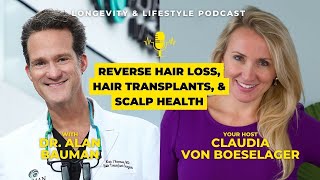
In this Longevity and Lifestyle Podcast episode, host Claudia von Boeselager interviews Dr. Alan Bauman, a board‑certified hair restoration surgeon with over 12,000 transplants performed. Dr. Bauman explains why hair matters from evolutionary, social, and psychological perspectives, and introduces the emerging science of the scalp microbiome and its impact on hair health. He outlines the multiple causes of alopecia—including androgenetic factors, inflammation, mechanical damage, and autoimmune conditions—and discusses mainstream and cutting‑edge treatments: oral and topical finasteride, minoxidil, PRP, stem‑cell/exosome therapies, red‑light caps, and the newly launched trans‑epidermal delivery (TED) system. Dr. Bauman shares his personal journey into hair restoration, the evolution from linear strip harvesting to follicular unit extraction (FUE) – a minimally invasive, scar‑free technique that allows precise control over graft angle and orientation. He describes the patient evaluation process (medical history, photos, AI‑assisted microscopy) and candidacy criteria, noting alternative donor sources such as beard and body hair for those with limited scalp donor supply. Recovery is rapid because FUE avoids sutures, allowing patients to resume light exercise within days. Success stories illustrate profound psychosocial benefits, and Dr. Bauman emphasizes the concept of “hairspan” – maintaining a full head of hair throughout one’s healthspan. He recommends BaumanMedical.com and professional societies for reliable information and highlights ongoing innovations in hair‑restoration technology.
Chapters
Welcome to another episode of the Longevity and Lifestyle Podcast. I'm your host, Claudia von Boeselager, here to uncover the groundbreaking strategies, tools, and practices from the world's pioneering experts to help you live at your best and reach your highest potential. My guest today is Dr. Alan Bauman, who is a surgeon and has been a board-certified hair restoration specialist since 1997, and I know hair loss is a big issue for a lot of people out there, so I'm really excited for our conversation today. Dr. Bauman has performed over 12,000 hair transplant procedures to date. He has an artistic approach to protecting and restoring the hair and scalp and has successfully treated over 33,000 patients in preserving their hair. Dr. Bauman was voted number 1 top hair restoration surgeon in North America by Aesthetic Everything for the 7th consecutive year. Top Hair Restoration Surgeon of the Decade and received the 2022 Lifetime Achievement Award in Hair Restoration. He's also recognized by Forbes as one of the 10 CEOs transforming healthcare in America. Such a pleasure to have you on today, Alan. Thank you so much for coming on.
Claudia, great to be with you.
Alan, I'd love to start with a question that should be quite simple, but I actually don't know the detail of. So why is hair so important in the first place?
Yeah. First of all, hair makes you look good and feel great. So of course it's gonna be important evolutionarily. We know that hair is a great determinator of your ability to reproduce. And so you can imagine that to propagate the species, you wanna choose a good mate, make sure that they're healthy and that they're well nourished and they've got good DNA. And for eons, obviously there's been outward signs of how we look at how we feel and how our DNA is made up. And hair is a big part of that, obviously. Right? So for most, it's a clock, right? Meaning that over time, as the clock goes on, you decrease your amount of hair, hairline recedes. In men, it gets thinner sometimes. In women, for sure. And this tells our, our outward sign, if you will. You can tell from across the room, you can make a snap judgment, maybe how old or healthy that person is. Now, of course, as you know, we're not just superficial beings. And so, you know, in the modern age, it comes down to more than just hair, but that's why we're hardwired. To like our hair, to want to keep our hair. And there's no way around that. You know, our midbrain, our reptile brain wants to pair us up with somebody who has great skin and great hair and looks good. And that's to make sure that we propagate the species. So it all comes down to Darwinism, like many things in health.
And is there a scientific scalp microbiome impact of maintaining good hair for the head?
Well, gosh, that is an amazing new field of study for sure. We know so much. About the microbiome when it comes to our gut and its impact on inflammation and all these little organisms that live symbiotically with us. It's so important. And we're learning more and more about what's going on in the microbiome of the skin and how it helps protect us from infection and disease and dysregulation. And so we know for sure that there's a microbiome on the scalp. And when this microbiome gets disrupted, all kinds of scalp health issues can can occur, and sometimes those issues can exacerbate hair loss. So you're absolutely right. I mean, that's a nuance that most physicians aren't even aware of yet, and of course most consumers are not yet aware of it. But the research is pretty clear. For example, simple overgrowth of fungus, right, which is part of the natural microbiome of the scalp, is a trigger for dandruff. And, uh, that's really one of the reasons why treatments like Head Shoulders, which happens to be the most popular shampoo in the world, is effective, because zinc pyrithione is something that helps dysregulate the fungus that actually triggers that inflammation and irritation and flaking and all of that. So in fact, scalp health is really important here at Bauman Medical. I have an entire department that's geared towards the health and wellness of your scalp and the beauty of your hair. So beyond what we do for hair growth, we want to keep that scalp healthy. That's like the soil in the garden, if you will. So my trichology lab, staffed by a certified trichologist and cosmetologist and her team, helps our patients every day to help maintain a good, healthy scalp and healthy scalp microbiome for sure.
Wonderful. So what causes hair loss?
What's happening there? So there's many, many reasons for alopecia, which is the general term for hair loss. Sometimes alopecia is caused by inflammation, your body attacking the hair follicles. Sometimes alopecia or hair loss is caused by our own doing, meaning that we're not treating our hair and scalp properly, where maybe we're pulling on our hair with braids or extensions or wigs or weaves. And so we're causing it ourselves. Sometimes, as I mentioned earlier, androgenetic alopecia or male or female pattern hair loss happens over time. And that's the most common type of hair loss actually out there is the genetic variety. Our genes determine our hair loss destiny, at least to a large part, and we have to fight that. So in men, for example, what we're genetically sensitive to is a breakdown product of testosterone. And so that androgen DHT, dihydrotestosterone, is the main or primary trigger for miniaturization of a hair follicle. And when DHT levels whether they be normal or low or in the middle in averages, they can always and usually degrade the quality of the hair over time. And it's a very common pattern to see. You can recognize it, like I said before, across the room, a receding hairline and thinning in the crown is what you would observe in men. And very often these same androgens can affect hair loss in women as well. You could see thinning in that frontal zone, but yet the back is totally preserved. And sometimes in women you see a receding hairline a little bit as well.
Is there a way to treat the androgens as well, going directly to the source? Has that been developed?
Well, absolutely. I mean, the mainstay of therapy for decades literally has been the use of medications in men to slow down the hair loss process or reverse it using a 5-alpha reductase inhibitor. So 5-alpha reductase is that enzyme that converts testosterone into DHT. And there's a couple of different versions that we're aware of now in the body, a couple of different types of that 5-alpha reductase enzyme, but the main one is type 2, and the type 2 enzyme can be blocked using a medication called finasteride. So it was launched as Propecia back in the 1990s, and by lowering or inhibiting the production of DHT, you can preserve and protect the hair follicles pretty well, actually. So 9 out of 10 guys who take an oral dose of about a milligram a day are going to see either a stoppage of their hair loss process or even some hair regrowth. So it's a pretty effective treatment, but it does come with some risk of side effects. And men, of course, are very concerned about their libido and sexual performance. So even if you tell them only 2% of patients have this side effect, many are concerned and may not necessarily want to use the oral version of this medication. But the good news is that we have topical finasteride, and that eliminates virtually the risk of systemic side effects and still has that nice, good, strong effect on blocking that androgen production at the level of the scalp. And many of our postmenopausal women are also on androgen blockers for this reason, to help protect and preserve the function of the hair follicle. Becomes even more important in men who are looking to maintain vitality and lean muscle mass by doing hormone replacement therapy. And I'm sure in the spheres of longevity, you know about hormones and peptides and such. And so when you replace testosterone in both men and women, sometimes, not always, but sometimes that can trigger an acceleration of hair loss depending on your genetic profile.
I'd like to take a step back, Alan, and just understand why you became so passionate about hair restoration and a hair restoration physician.
Well, gosh, that story starts early in my childhood years. My grandfather on my dad's side never had hair, never met him with hair. And my dad started losing his hair when he was in his 30s. And so I always wondered if that was going to happen to me, although I didn't really think about a therapy or treatment or even that it was medically possible to do anything about it. I really got interested in plastic surgery and cosmetic surgery as a teenager. I was mentored by a plastic surgeon at that early age, and what he showed me was this amazing artistic skill that he had really to change people's lives using surgical intervention. Right. So rejuvenation of the face or the eyes or change in the nose and body contouring and such made such an impact in their lives. And I saw his work as just being so exciting. I always thought that that's what I was going to end up doing. And later on in my surgical career, after medical school and my residency in general surgery, I became aware of hair transplants. It was mainly by a patient who had had a procedure done. And I looked at him and I was trying to figure out— I knew his medical history, but I couldn't tell that he had had a hair transplant. And so our conversation started something like this, you know, do you mind if I ask about where you had your hair transplanted? And he said, oh, up in Toronto. And I was in New York at the time and I was thinking to myself, first of all, that's weird because we're here in New York, the greatest technology. Is right here. But I was more concerned about where on his scalp because I couldn't tell that it was a hair transplant. So we kind of had a little bit of a laugh and he told me in layman's terms about single follicle implantation. And I was a casual observer, but I really could not tell that he had had a transplant and I thought it looked amazing. So I kind of stored that in the back of my mind because what he described was something artistic and microsurgical and unique. And it really kind of struck me sideways. I wasn't really aware of it. So I always kept that in the back of my mind, like, well, maybe I should look into this. And so over the years, as I went through my mentorship with my plastic surgeon mentor, I always kept my eyes open in the field of hair transplant surgery. I did some traveling, I visited clinics, I went to conferences. And the more that I learned, the more that I realized that the technology of hair transplant was way beyond the plugs and the nastiness that was very common and what I considered typical in the 1990s. And it was evolving into something that was actually looking good. You didn't need a scalp reduction or this pluggy look was not required anymore. You could actually create something that was artistic and natural. And that's what drew me into the field. And the more that I learned, the more I got excited about it. And the rest, they say, is history. As I got into a, a preceptorship program up in New York in hair transplantation, I did that for about a year, worked in a very busy practice. Practice and then eventually struck out on my own here in Boca Raton, Florida, back in the 1990s. And so we set out with this goal of creating a beautiful result for each and every patient, to provide an exceptional patient experience, and also to protect the hair that patients had. And so by combining these kinds of philosophies together, my practice grew very rapidly and came to local and national attention pretty quickly. And to what we built today, which is, as you mentioned earlier, have treated tens of thousands patients, well over 10,000, almost 15,000 procedures, and over 30 staff members in a 12,000-square-foot facility here in Boca Raton, Florida, which is certainly a super exciting place to live and work.
I'd love to hear a bit more about your pioneering methods and the technologies that you're using specifically around hair transplants. Can you share that?
Yeah, for sure. So people ask me all the time, you know, how we innovate here at the practice. And I guess the basic philosophy is that I'm a bit of a problem solver. I always like to tinker with things, attracted to new technologies, and new techniques. I always thought in the early days of hair transplants when I first got started that the strip harvest, the linear harvest, seemed very invasive. And remember that I came from general surgery where things were moving towards laparoscopic procedures, small cameras, small incisions, minimally invasive procedures. And I always wondered, was there a way to get the follicles out one at a time or in small groupings without having to cut that big strip out of the back of the scalp? And I wasn't the only one thinking about that. There was maybe 6 or 8 of us around the world that were kind of pioneering that in the late 1990s and the early 2000s. And it wasn't an easy process. We didn't have great technology. We had manual tools that varied in their sharpness and so forth. And even our magnification and lighting was not so great. And patient positioning was a challenge. But over time, I developed techniques that allowed me to harvest those follicles in those individual ways using a very, very tiny instrument without the use of a scalpel or stitches. And so that's how we came to really be experts at FUE, follicular unit extraction or excision. And that technology obviously has caught on around the world and today is the mainstay of therapy. The vast majority of all procedures around the world are performed that way, and in some countries it's the only way it's performed. Here in the United States, we still have surgeons that perform the linear harvest. And for them, if that's what works in their hands, that's great. For us, I haven't taken a linear strip in over 15 years, so I'm an FUE-only practice. Oh, and the benefits of FUE, obviously, is no linear scar, much faster recovery. Just a couple of days, you can be back in the gym. You don't have to worry about stitches or staples becoming infected. And of course, using individual grafts that are as small as a single hair follicle, we have unique control control over their angle, orientation, position, and essentially the naturalness of the final outcome is determined by the stroke of my hand, which is really, really nice for our patients who want to keep their hair transplants undetectable and totally and 100% natural. It does take a long time, though.
I can imagine, just from my understanding. So you're literally extracting a hair follicle by hair follicle from the back of the head, just bit by bit. Is that what's happening?
Yeah. So each follicular unit contains between 1 and 3 hair follicles. Those are the natural groupings of hairs that exist on the scalp. That's how they're extracted and they're placed into very tiny incisions that we make. If it's the crown area, for example, most people have at least one swirl back there, if not more. And so we have to adhere to those angles and the orientation, the position, making sure that we're not damaging the existing hair. So it's an artistic process, and especially the hairline or an eyebrow. There's a lot of intricacy that goes into the process and the problem solving and the puzzle working and the artistry. That's all part of what I do. In conjunction with my team, because it is a labor of love. It's a lot of labor that goes into these procedures. And without my team, I would not be able to do it. So there is a lot of work involved. Each procedure is about 20 man-hours start to finish. So when I say man-hours, obviously there's more than one person working on the procedure at any given time. So parts of the procedure are 100% me, like the artistry, the design work, the pre-made recipient sites. I'll make all of those myself., and then my team and I will work together to do harvesting and then eventually implantation. So there's a lot of people working in some phases of the procedure to get the job done over time.
For people who are like, I think my hair might be getting thinner, but I don't know if I am a candidate for a hair transplant. How do you do that evaluation process for men and for women as well? And are there potential candidates that are just not relevant for a hair transplant or that's not possible to do it with them?
Sure. A lot of patients want to know, like, am I a candidate for this kind of procedure and what can it do for me? And sometimes patients are not candidates for a procedure if they have like an autoimmune condition, a hair loss condition that is not related to their genetics. Sometimes we see women with scarring alopecia. So getting the right diagnosis really is the take-home message, and that starts with a consultation. So many of my patients, over half of them, may start their consultation process online. Meaning that we'll have a video call just like what we're doing today on your podcast. We can connect with patients from around the world, from anywhere, all four corners of the globe, from their home or their phone, as we say, with a video call with Zoom or another method of FaceTime or Skype and whatnot. And we're able to evaluate their current situation. Now, can we do measurements over the phone? No, of course not. We can't do that over Zoom, not yet, but we're working on that. And so we do encourage patients to come in if there's a question.. And so many patients will come in for measurements. AI-powered microscopes are available to give us a complete readout of data, what's going on in each area of the scalp. But again, it all starts with the medical history and the current physical exam that we can see on photos and video to know primarily most of the time what's going on. And then we want to make a plan, right? So sometimes the plan may be 100% noninvasive. We're in the early stages of hair loss. All we need are some good quality nutraceuticals, proper hair care, get the scalp healthy, maybe some topical or oral medications. Sometimes it's a laser-like device, but you can see that there may be things that you can do at home to help protect and enhance the area that you have. And these are well-documented, scientifically studied, FDA-approved medications or FDA-cleared devices for hair regrowth. You know, so this is not the age of snake oil from decades ago. This is the stuff that actually works. And when we talk about compounded medications for home use, we don't want you going down to your, you know, regular pharmacy or local drugstore. We want to go with a pharmacy that has a quality control process with expert pharmacists who know what the product is supposed to look like, what it's supposed to literally smell like, and do the testing to verify that the medication is actually as potent as the manufacturer says it is. And then that's the medication that I might feel comfortable taking myself or giving to my family or friends. And that's what we use, compounded medications.
Can you talk about the recovery process? You mentioned that after a hair transplant, someone could even show up at the gym a few days later. How come it's so quick?
What's going on there? So hair transplantation today, as I mentioned, the follicular unit extraction process requires no scalpel or stitches or state and that's very different than the years past, because if you had a row of stitches in the back of your head, the last thing you want to be doing is doing some kind of exercise to stretch out that area. That's going to really cause damage and increase your risk of scar tissue. And unfortunately, a lot of patients who didn't have good guidance years and years ago ended up with wider scars, nasty looking scar tissue, no fault of the surgeon, but just really the post-operative care, which is a big issue. So because we're taking the individual grafts one at a time, there is no risk of that. There's nothing that could stretch out or cause any poor healing. And so you can be back in the gym in 3 or 4 days as long as you're not putting the transplanted zone at risk for damage. Right. So the transplanted area is fragile. It's got a graft sitting in the scalp right into the sites that I created. If you rub or scratch or bump that area, you know, you could put it at risk. And so no MMA fighting or, doing yoga poses on your head. No rough play, as we say, at least until those crusts are gone, which usually takes about 6 or 8 days with today's technology that we have.
Can you talk about some client success stories? What are some of the impacts you see from your patients after undergoing hair transplant with you?
I mean, truly, Claudia, that is the payoff of being a hair transplant surgeon, is you get the chance to see the quote unquote payoff that you say, right? And so what is that? That's the change in someone's life that a hair restoration procedure brings. And so I remember vividly, even just dating back to that time when that first hair transplant patient that I met that was not pluggy looking, one of the things that stuck with me from that conversation was how he described the change in his social life and his professional career after he had the hair transplant. And so that was the first patient I ever met. And I didn't do that procedure, but he was telling me, and I remember it so vividly in my mind, that job opportunities came his way, that he felt more confident in social situations, that he met the love of his life, and, and his whole life had changed just from the hair restoration process and the procedures. Just on the flip side, when patients come in with hair loss, men or women, it can be very sad. It can be very emotional. Sometimes my nurses are crying, we're crying, everybody's crying. We've got the tissues on hand, you know. But obviously on the back end, when we're completed the work and the patient is doing well, even just the measurements initially as they start their medical regimen or recover from, let's say, a stem cell therapy or regenerative treatment, it's super exciting to see their faces light up when they have had an improvement in their hair numbers. And of course, visually, when they look so different, I get the chance at 6 months, 9 months, and 12 months to put those before and after side by side with those patients. And show them. And that's the really, really fun payoff for me is to see that their big smiles light up and they just walk differently. They walk a little bit taller, you know, shoulders back, chin out, you know, they just, they just have a different look when they're coming in after the hair growth is happening. And so that's a really, really fun part of the practice. And most patients say that they just wish they had done it sooner.
One of the points of longevity and living long, I mean, my goal is to live to 150, but we don't want to look 150 when we live to 150. We want to keep that youthfulness and on the outside as well. Do you have any limitations to who you can treat?
So the, the limitations certainly are not age. 150 sounds great. You know, Dave Asprey wants to do 180. That's good. I will definitely be skiing at 100. So I'll see you guys all there. I've got my, what is it called? The Centenarian Decathlon training ongoing. So those are the exercises I hope to be able to do when I'm 100 years old and do them well. And so I definitely have a plan for that. And it's not, as you say, just lifespan, which is the amount of years, right? But it's also healthspan. So that's the amount of vitality that we have during those times, keeping our brain and our body functioning well. I'm certainly a big advocate for that. But what we do in the practice is primarily hairspan. We want to have that hair all the way through until the end. And, you know, the amount of years that we spend with a thick, full, healthy head of hair is really important to my patients. And so, no, I don't have an age cutoff. But certainly there are some limitations. If we think about how much hair is available for transplantation around the sides and the back of the scalp for an extensively bald male, for example, there's a limit as to what we can do. But sometimes we have to tap into the beard or the body hair, and that's certainly a viable technology that comes with some questions and concerns, obviously, but is workable for many, many patients, especially if they've had previous procedures or scarring in the back of their scalp. We often use the beard. I mean, nearly every single week we're harvesting beard and transplanting it onto the scalp. And it's a very, very effective way to tap into these alternative sources of donor hair to make candidates who have been turned down by other surgeons into absolutely viable candidates for surgery moving forward in hair transplantation. So that's one way to go. And then, of course, keeping and enhancing the existing hair with a variety of tools we've previously mentioned, you know, medications and nutrition and hair care and scalp care. But of course, red light therapy is, is a big part of that. Using something like the Turbo Laser Cap or regenerative treatments like stem cell therapy, PRP, PDO, exosome therapy, the latest and greatest technology in that regard, or even TED, trans epidermal delivery treatments. So there's a lot we can do to turn patients who are really kind of almost fallen off the wagon in terms of not being a good candidate, get them back on the path and growing some really good hair. And tapping into alternative sources of donor hair to shift that supply and demand in their favor. And that's what I love to do, is turn these difficult cases like my dad's, for example. He had total baldness before we started with him, and he needed a couple of sessions to get the job done, but he had a good amount of hair around the sides in the back. And today he enjoys a full head of hair from transplantation.
Must be really exciting. I know for some men they're very self-conscious and they feel like it ages them and emotional distress that comes with it. I mean, I think it really opens up a pathway to feeling the youthfulness and having the look that people want to as well. Alan, what are the breakthroughs that you're excited about, either recent ones or upcoming ones that you see on the horizon?
I think probably for me, being in the field of health and wellness and longevity, you know, we're seeing hormone replacement therapy, peptides coming of age. We're learning about these small molecules and their effect on not only organ systems, but also the organs of the hair follicle, the mini organs of the hair follicles. And so the latest and greatest technology that we've used in our practice is something that was just launched literally a year ago here in the United States. I don't even think it's available in Asia or Europe yet, and that's called TED, trans epidermal delivery. And so TED uses sonophoresis, which is not really all that new. It's been around for about almost 70 years to deploy medications and other things through the skin without a needle. But combining that technology of ultrasonic sound waves and this impact pressure wave to push stuff through the skin, combining that with the new knowledge that we have about these really, really powerful growth factors and peptides, that's really what the technology brings us, is that this combination of the delivery system and then the serum that really gets the job done. So TED is a really nice treatment if you're experiencing a lot of shedding, like from some trauma, physiologic trauma or otherwise. TED treatments are done typically in a package of 4, 4 treatments, 1 month apart. And it's the first thing that many patients say is that it stops the shedding, which is really, really nice for a treatment that requires no needles, no blood draw, no pain, no preparation, no recovery. So as we say, no trauma, no drama with TED. It's a great treatment modality, and it only takes about a half an hour to 40 minutes to apply that serum through the skin. So there's a preparatory process where we're priming the skin. Making it more permeable, and then applying that peptide and growth factor serum right through with the impact delivery in the ultrasonic delivery system. So I'm super excited about that. I was just in Paris recently lecturing on that topic, and we've been lucky enough to be one of the only locations qualified to perform that here in the United States.
For my listeners interested in understanding hair loss, but also hair transplant more, what are some resources you would recommend they start with?
So a great resource that I've had for over 25 years is BaumanMedical.com. It's got thousands and thousands of pages of information about the different treatments and procedures and surgeries that we do, the latest information on health and wellness and how it affects your hair from the scalp microbiome all the way down to the latest and greatest transplant procedures and devices. It includes information on the TED that we talked about. Platelet-rich plasma and how we do it differently. It includes compounded medications like AD2M and AD2F, which contain either minoxidil, finasteride, or both. That's a great place for people to start. And obviously, you know, there's other locations around the web, but I would just caution folks because, you know, a lot of medical information on the internet is maybe not that accurate. Even today when we look at things that are being produced using AI-powered blog posts and things like that, what we find is that if you go search up the references, the are not real. And so I would just caution people, even though that may quicken your search engine, it may not necessarily be accurate. And we have to be more critical today of everything that we read or see and wonder, was it created with accurate information? And so you can be sure that at baumanmedical.com, that's where it's going to be. And the good thing about baumanmedical.com is that patients can also ask a question. You just go to baumanmedical.com/ask. You can ask any hair loss question you want, and my team and I will respond personally. With an answer. And obviously people can request consultations. You can see some of the different products and devices that we recommend, things that we've curated, things that we've developed ourselves. So that's a great place to start. But there are other places. The American Board of Hair Restoration Surgery has lists of physicians, as does the International Alliance of Hair Restoration Surgery. There are some good consumer advocates out there like Spencer Speck Stevenson, who compiles a list of the top 20 surgeons in the world today and what you should look for in your hair restoration physician or surgeon, but I feel very blessed that I have an amazing team and they're always wondering, hey doc, what's new? And there's always new technologies on the horizon. And that's one of the reasons why we have a newsletter that goes out twice a week to keep people informed about what the latest and greatest treatments are.
And helping people live longer, better, increasing healthspan and hairspan. I love the term hairspan.
Well, it's really great. Absolutely.
Alan, do you have any final ask or recommendation or any parting thoughts or message?
For my audience today? Well, I would just say that if someone's out there and you're struggling with hair loss, whether you're a man or a woman or, you know, somebody could be a family member, whether it's a mom, dad, or son or daughter or somebody that you know that you care about, hair is probably important to them, whether they admit it to themselves or to you or not. So I would just encourage them and you to seek action. You can make a referral, as I said, at ballardmedical.com. You can send them a link. You can tell them that you heard this podcast and that there's a lot that can be done today. And if you're in a, a place of despair about your hair, well, don't worry. There's always something that we can do to help. Everything from the treatments that you've heard about today to things that we didn't get a chance to cover, like cranial prosthetic devices and things like that for extensive hair loss and even chemotherapy patients as well, or trauma or injury victims. And those are some of the most rewarding cases that we do. So I, I do want to end with just a feeling of gratitude, Claudia, for having me on and for me to help get the word out. About the treatments and the procedures that we do. And it's really been a pleasure to be on with you and to get that word out to other folks because we're on a mission to help billions and billions of hair strands. And so we need millions and millions of people to hear the message about what we do and how we do it.
Wonderful. Thank you so much, Alan, for coming on today. Such a pleasure to have you on.
Thank you. Same here.
Great to be with you. Hi everyone. This is Claudia von Boeselager again. Before you take off, Would you like to get a short email from me with some short but sweet fun tips, tricks, and updates on all things longevity and lifestyle? This could be cool products that I've discovered, interesting posts or articles I've read, and other fun and helpful things around longevity and lifestyle I found for you. It's a very short piece of inspiration for you a few times a month. So if you want to receive it, check it out by going to longevity-and-lifestyle.com. That's longevity-and-lifestyle.com, and leave your email to sign up for the next one.
More from Claudia









Can Psilocybin Slow Aging? The Study on Telomeres, Inflammation & Survival with Dr. Louise Hecker

