Shawn Wells On Psychedelics, Healing Trauma, Mental Health, Neuroplasticity & The Latest Research
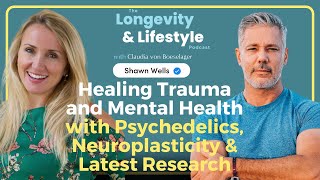
In this Longevity and Lifestyle Podcast episode, host Claudia von Boeselager interviews biochemist, dietitian, and formulation scientist Shawn Wells about his personal transformation from a traumatic, depressed childhood to a thriving health entrepreneur, largely catalyzed by psychedelic experiences. Wells recounts his early life of abuse, obesity, and suicidal ideation, his shift into fitness, supplement formulation, and clinical nutrition, and the pivotal high‑dose psilocybin ceremony that revealed love as unconditional. He contrasts the limited, often harmful outcomes of SSRIs with emerging psychedelic research showing 50‑80 % remission rates for depression, anxiety, PTSD, and suicidal thoughts. The conversation delves into neurobiological mechanisms—suppression of the default‑mode network, massive BDNF and neuroplasticity spikes, and widespread brain activation—explaining why psychedelics can produce rapid, lasting change when paired with psychotherapy. Wells outlines how to design safe sessions: careful set and setting, rigorous facilitator screening (experience, gender balance, trauma‑informed), pre‑journey preparation, and post‑journey integration (journaling, mirror work, accountability, community, nature exposure). He introduces his proprietary supplement stacks for pre‑, peri‑, and post‑psychedelic phases, including electrolytes, B‑vitamins, theanine, paraxanthine, Zembrin, 5‑HTP, SAMe, luteolin, mucuna, acetyl‑L‑carnitine, alpha‑GPC, Huperzine A, adaptogens, and the neuroplasticity‑enhancer 7,8‑dihydroxyflavone. Wells also coins “echo dosing,” a micro‑dose strategy that mirrors the original ceremony to reinforce neural pathways. The episode closes with reflections on the importance of self‑compassion, play, and granting grace during integration, and a hopeful outlook for psychedelics in mental‑health and neurodegenerative research.
Chapters
Welcome back, dearest audience, to another episode of the Longevity and Lifestyle Podcast. I'm your host, Claudia von Boeselager, here to bring you the latest insights, learnings, and yeah, just ways to improve your health, life, and happiness for longer. Thank you so much for being part of this tribe and wanting to be at your best every day. And I encourage you to share if it resonates with you, share with your loved ones so that they can also start on this health optimization journey too. My guest today is Shawn Wells, a returning guest and dear friend. He's a biochemist, dietitian, sports nutritionist, and formulation scientist. He's been dubbed the world's greatest formulator. So Shawn really knows from A to Z everything about longevity supplements, health optimization, and has also been on an incredible personal journey, which we're going to dig in today, including using psychedelics to overcome suicidal thoughts and also help with other areas. So we're going to dig into lots of science as well and research that has come out on this topic today. So please enjoy this conversation and very much look forward to digging in. Welcome back, Shawn, to the Longevity and Lifestyle Podcast, dear friend. I'm so excited to have you back on today and for our conversation. So thank you so much for taking the time.
You know, you are an incredible human being and I'm very excited to be here.
Well, thank you so much. You're such an inspiration on many fields, but I really love one particular thing about you, Sean, is that you are so open about your vulnerability, about your journey, and I feel like it's just so inspiring. And even in the room in Dallas in June at that conference when you held that beautiful talk that I'd love to, you know, pick up on today and talking about your journey, and we'll dig into that, the amount of people that felt confident enough to raise their hand, which was across the whole room. I'm sure you saw better than me. And I think by being vulnerable, it allows other people to open up and be vulnerable too and realize that we're not alone, that we're actually all in a similar boat and that we can help each other. So could you share for my audience, obviously unfamiliar with your story, a little bit about that and how, you know, what were the major shifting points for you that have brought you to this new level of Sean today?
Yeah, um, so much of my life, difficult childhood, uh, my brothers ran away and kicked— got kicked out at an early age. Um, I, you know, went through abuse, and it was, uh, it's still difficult to think about at times. And I was very depressed, suicidal, Most of my childhood I was bullied even by teachers because I was morbidly obese, because that's how I therapeutically dealt with it myself. I would go into spaces where, you know, I just hide away and— but at the same time, I had a lot of creativity. A lot of passion for emotion. Like I would dive deep into music and movies and things like that. And I was very into things that were more on the emotional end of the spectrum because it helped me feel, it helped me deal with my emotions. And even going into college, I was doing what everyone told me to do. I was doing business. I went to the top business specialty school in the country. It's the number 2 business school in the country right now, Babson. It was great for business, but that wasn't necessarily my passion. And I started working out. I started taking supplements and, you know, reading all these muscle magazines and different books, and my body started transforming. I went to a doctor in between my sophomore and junior year because— you know, you're supposed to get a physical and, and I had so much extra weight in the past and, and was really humiliated. Typically, like, I, you know, couldn't get a date with a girl to save my life. And all of a sudden I was losing this weight. I was putting on muscle. I was looking a lot different. And I talked to the doctor and I was so passionate about these supplements and telling him what I'm doing. And, and he was excited for me. And I really expected him to, you know, say that supplements are kind of silly. I mean, this is, let's see, 30 years ago, so literally 1990. And I was expecting, you know, that kind of response. And instead he said, that's amazing. And he drew out a lifeline for me between 20 and 80 and said, why not be happy between here and here? And he changed my life path. And I said, yeah, why don't I do this thing that I'm really excited about that, that's changing my health, changing my confidence, changing my life, changing my vitality. And I did, I did finish up business school. I decided to go back to school and get a couple of years worth of science prereqs. And then I finally got into my dream school, which was UNC Chapel Hill. And I did nutrition and biochemistry and exercise sports science and got my master's there. And my dream was to be a supplement formulator, and that's exactly what I did. I also became a registered dietitian, and for about 10 years I practiced clinically, but I did chase down my dream. But even still, I was still bringing a lot of that energy into my studies, into the jobs that I was working. I was always working my whole life. I've worked 80+ hours a week and there was never room for anything else. I just poured myself in my work. I often shamed myself, you know, if I got on a big podcast like Ben Greenfield. The first time I got on there, I was so excited. And then literally hours later, I'm like, well, you're not on Joe Rogan. You know, it's like it didn't matter, like whatever I did, whatever I accomplished, I never really like basked in it. I never enjoyed it. I was always continuing to look up the mountain instead of looking back down the mountain and being so impressed at where I was. It was never enough and I was never enough. And I was, uh, right before 2020 New Year's, I ended up getting involved in my first psychedelic journey with a bunch of celebrities, many that you know from the biohacking space and wellness space that have best-selling books, very famous. I won't say anything more. I was about to say something more, but like, you know a lot of these people, and I was the least important person in room according to accomplishments, in your view. And, and, uh, I ended up, you know, doing about 5+ grams of psilocybin, so a very large dose. And I was really on the edge of, of life. Like, I was either going to kill myself directly or indirectly through work. Like, my health was suffering from just how hard I was driving. Little did I know we were also about to head into a crazy time with COVID and all those things. And I ended up being shocked because I was in this what's called a cuddle puddle on the floor because I could barely move. But I was like having these epiphanies. I was smiling and people were just holding space for me. All these people that are very well-known people that don't really know me. Almost none of them knew me. And they were cuddled up around me. They were saying nice things to me. They would kind of come in and out of my space because they were doing much lighter doses and supporting me, loving me. And I kept thinking, like, why? Why would they do that? They don't know who I am. They don't know my accomplishments. They I don't know how I can help them, serve them. And then it just hit me that I could just have love and be loved. And up until that point, I always felt love was earned, love was fleeting, love was conditional. And so I always was trying to prove myself, prove myself. You know, I'd walk into these rooms and these masterminds, and I was always giving my resume. Trying to tell people like why I'm worthy of their attention and affection. And I was always the human doing, not the human being. Like being wasn't enough to be loved. And finally, that was the epiphany there in my first journey that I can just have love. I can just be loved. And it sounds really obvious. If you had told me that Prior, I could have logically walked through that and said, yeah, of course. But when you anchor that in your heart, my whole life shifted. Everything shifted. All of a sudden, I had purpose. All of a sudden, I had love for myself. All of a sudden, I had hope. Psychedelics changed my life pretty radically, as well as the facilitators that I was working with that were incredible and I continued to work with. And as a result, I'm here. And when I've given these talks on stage, one of the messages that I deliver is if you don't believe in these things, if you don't support these things, that's okay. But know that there's people that are on the fringe of life. There's people that are hurting themselves and other people around them that this could be the solution for. People that have maybe even sacrificed for our freedom, our livelihood, whether it's like EMTs, soldiers that have a lot of trauma, and they deserve to have options. And I tell them that I wouldn't be standing here on this stage had I not gone through that process. And and hopefully things do continue to change. I do want there to be safety around it, but I also want there to be the option to potentially use it.
Yeah, I mean, I'm also an advocate for it as well. I think people can be judgmental. I think if even just looking at the history of, you know, why were psychedelics banned? And I think, you know, I ask people if they're like, oh, you know, those are, you know, highly toxic and they're really bad. And they come up with some comment. It's like, well, look at the history, right? That it was banned because no one wanted to go to Vietnam War. So it was a great idea to ban them all and try and force everyone to fight because everyone felt this beautiful love with the LSD that was going around, etc. Back then they're like, why would we go and kill people we don't even know in another country? And so I think it's always important to go back, like, where did this stem from? There were so many— in psychiatry it was used, right, in the '50s and '60s when it was started to be discovered, like, how these beautiful benefits that it had. And Anyway, so I think there's a lot of these naysayers, but what's really exciting now is the scientific research that is coming out. And can you share some of the most exciting statistics around the research, Sean, that you also were sharing before and things that have come up as well to help people understand that this isn't just a personal one, you know, n-of-one experience, that this is actually done at scale and can really completely shift people's lives in many different regards in the mental health space?
Yeah, so there's probably— well, I'll start off with first, there is two meta-analyses on SSRIs, uh, 2017, 2022, in some of the most prestigious journals. And meta-analysis is where you look at all the studies collectively and see what the through line is, essentially what the common thread is. And in those two meta-analyses, they found that they potentially did more harm than good, and the results were at best inconclusive. So those drugs are widely prescribed and up 25% in terms of prescription since COVID happened. And so the side effects as they were saying, were greater than the benefits. And think about that. And that's what we're using as our major number one go-to tool for depression. And depression is pandemic. It is pandemic along with PTSD, along with suicidal thoughts, along with clinical anxiety. These things are pandemic right now. Yes. And if we look at the studies that have been done over the last, like, maybe 8 to 10 years on psychedelics, where we look at MDMA, we look at psilocybin, we look at ketamine potentially, we are seeing 50 to 80% cure rates.
Which is, I love those numbers.
Let me run that back.
Let's say that again. This is huge.
That's 50 to 80% cure rates where they no longer meet the definition for depression, for anxiety, for PTSD, for suicidal thoughts. They no longer meet that definition. Now, some of these, like with MDMA, there might be 3 experiences over a period of, let's say, 6 months. Where they use it. They are facilitated. They do have integration work that they have to do. It isn't just give them the drug or plant medicine, so to speak, or entheogen or empathogen, and then just leave. That's not how you do this. You want to, when you work with a facilitator, you set intentions. You are in a safe environment where set and setting and dose are all important in terms of mindset, your environment, and then the dosage of the, of the empathogen and theogen given. And then lastly, you are worked with in terms of integration and how does that, are you held accountable moving forward? And so all of that is very critical. To change. And when we look at psychotherapy alone, I know this might upset people, but psychotherapy alone isn't actually that effective. I'm not saying that it's a negative. It's a good thing. It often prevents you going further down the slope, but it rarely makes a huge difference in terms of making significant change for the better. What needs to happen there is you need to analyze or break up your constructs, your beliefs, your ego. And ego is in full effect in default mode network. When we suppress default mode network, when we suppress ego, that's when we can make great change because we're just seeing the truth as we see it unfiltered. Without all the constructs, without all the beliefs. One of the things that you do work through potentially with a good therapist would be, how did you come to believe that? Who told you that? How do you know that to be true? These are the stories we tell ourselves that are part of our ego that become woven into our identity. And so psychotherapy is highly effective when combined with these plant medicines because they turn off default mode network and increase neuroplasticity. When we're depressed, when we're anxious, when we're suicidal, when we have PTSD, we're basically in a non-neuroplastic state. BDNF, brain-derived neurotrophic factor, that protein associated with neuroplasticity along with nerve growth factor, along with mTOR in the brain, These are all minimal. And so that's why we stay in loops when we're depressed. That's why when we're hurting, we're repeating and staying in these loops over and over and over, telling ourselves stories, creating stories. We can't get out of that story. We don't have the cognitive resilience to get out of it. But in these psychedelics, we have incredibly high BDNF, incredibly high neuroplasticity, and incredibly low default mode network. The combination of that, when combined with psychotherapy, extremely powerful. Then massive change can be made because default mode network, you can think about as the classic analogy is when you're skiing down the slope, that there's the ski trails that are there and you just put your skis in those marks and you just go down the hill because you've always gone down the hill. Yeah.
Or like the superhighway.
Yeah, exactly. Yeah, but when you have BDNF high and you have default mode network off, it's like fresh powder. And now you can make the decision that suits you best, not the decision that you always did.
And that's really interesting. I didn't realize that the psychedelics, and I don't know, is it all of them, increase BDNF? That I didn't appreciate that fact.
Wow. Yes. Yes. Like radically. Wow. Not just somewhat. And when we look at how the brain's lit up in terms of neuronal activity is literally like 90+ percent of the brain is completely lit up. When we look at scans. And whereas, you know, normally it's, you know, 10, 20, 25%, the brain might, you know, have certain areas of the brain lit up. But when we're in that space, we're making new neuronal connections when we're highly neuroplastic. So we can literally see things as we've never seen them before. Those aha moments, the epiphany moments, Those are happening constantly when you're in the psychedelic space.
Which is the beautiful opportunity then, as you're saying, to reprogram. Sean, for people perhaps that are hesitant or they're like, how do I imagine the process? Can you just walk through kind of step by step? You kind of mentioned, right, with you find the right environment and being safe, et cetera. But what are some of the things to look out for in terms of who are the right people to go to in the first place? Because I think safety is huge. So is there any dos and don'ts you would say around that. And then what actually happens during the experience? Is somebody talking to you? Like, if you can walk through for people listening that are interested, you know, are you having a therapy session in the middle of the experience? You know, how is that? And then what does actual integration look like? Is it just a weekly check-in with accountability? But maybe just to break it down a little bit step by step for people, that would be, I think, really helpful.
Yeah, different medicines are approached differently. You know, and when you have a clinical application versus maybe a facilitator that's a little bit more on the spiritual side, it can be different. Sure. I have done a lot of different experiences and a lot of different medicines just to explore this so I can speak on it. If you're doing like clinical MDMA and clinical ketamine, you would be potentially in a somewhat clinical environment. It would be comfortable. But there would be nurses, nurse practitioners, doctors present, and you would potentially have guidance as well, at least before and after, immediately after the session, and then in between sessions. Ideally, hopefully that is taking place on MDMA. It is very possible that you can have some guidance, some psychotherapy during the session, not the entire thing, but, but during. And with psilocybin, it is possible to have a facilitator check in. What you want to make sure is that they're not hijacking your experience or overtly programming you. So you want these things to be beliefs that you're coming to for your truth. You don't want someone telling you your truth. If I was to tell you the biggest lesson, if we're to look at kind of the meta-analysis of all psychotherapy with psychedelics, it would be that you come to know your truth. You come to be able to speak your truth, live your truth. Instead of suppress it. When we suppress it, that becomes disease, that becomes enabling and empowering trauma. You know, trauma gets stored in the body, the body holds the score, right? You know, that kind of thing. So when we're in these environments, that's what can happen is your truth can come through. Now the hard part is now what are you going to do about it? Yes. That's the hard part, because quite often you might be going back home to an abusive situation, a toxic situation at home, at work. You know, you might have to quit your job. You might have to, you know, leave your marriage. You might have to— maybe it's, you know, maybe you want to be gay, for example. I, you know, there's a lot of things that we've suppressed in our identity that we can come through as true. And that looks different for everyone. And I've seen those various things come through. And don't believe that people are often freaking out when they're on their way to a journey, a ceremony, this session, because they're like, who's going to see me? Oh my God, what's going to come up? The truth will come up and the truth, like Martin Luther King said, will set you free. I promise. It is more difficult for a little while to deal with it. But when you unburden yourself from that lie that you've been living, that's so powerful. And when you can actually step into your truth and like, that's the other thing, like that people, I've seen people like just want to be witnessed. Sometimes people like when I've been in these group journeys, speak out and just state it for the whole room. And that's the first time they've said what they actually believe or what they want to be or who they really are out loud. They've suppressed it. And this gets into, you know, more of the woo side, if you will, like the throat chakra and all these different things. But it's so true that we're suppressing, we're suppressing, we're suppressing. This is what we get taught. You know, when we're in school, you know, sit down, be quiet. This is what we get taught when we're potentially at church. And, and I'm actually very spiritual, and I've even come around to being very religious because of these empathogens. So I'm not saying that like you just have to be spiritual, non-religious, and woo. Like, Ben Greenfield found his Christianity through psychedelic use. That's his story to tell. But like it's, it's, it can be very powerful to establish that relationship with your creator, whatever that looks like, however you see that. I can tell you that Neo-DMT, like, which, you know, the, that's the synthetic poison, right? Bufo. Yeah, bufo is like, you know, from the toad and, you know, all that. That is like a 15-minute experience. It's kind of a weaponized version of DMT, that spirit molecule that gets released when you're dying, you know, and you see the tunnel and the whole thing. But man, I will tell you, it is transformative. Like, you literally just not only like go to God, to space, to the ether, but you like melt into everything. When your ego is fully turned off, there is no identity. There's zero filter. And that means that you are not your body. That's a really heavy thing. Yeah. That means that there actually is soul, right? And so when you fall into the ether and you feel like you're a part of everything, like I'm a part of you, I'm a part of that tree, I'm a part of that star, like—
That we're all connected.
Yeah. That it's all connected. And there's like a powerful knowing that comes through. My fear of death has been greatly reduced because there's this sense that like I've always been and always will be a part of it all, however that looks. And that is a powerful feeling. So these like universal truths come through as well as your own truth, whatever that looks like. And so these can be powerful experiences. But going back to like the environment, I do think it's critical. To have a safe environment. There are people that go into these things with these kind of wounded healers that call themselves gurus or, you know, shamans or whatever that don't have the experience. Yeah. And I'm telling you that trauma can come through. Maybe even spiritual things can come through on certain entheogens that you want to be around the right people that have the right experience, that have gone through this hundreds of times, that have trained under someone highly experienced hundreds of times until they're ready to do it themselves. You don't want someone who's like just recreationally messing around with this.
That's not the way to go. Yeah, because I think with some of these, you hear about more and more retreats and someone's doing it in their basement or, you know, they went for 2 weeks to Costa Rica or Peru and they know, you know, and these are not things to mess around with. And you do hear about people having a bad experience. Experience. It's just how I also think that a facilitator can walk people through that. And I think this is such a huge point, I just really want to do an underline on it as well, that the feeling safe, but having really highly experienced facilitators that have hundreds if not thousands of sitting experiences. And friends also work in the space, etc. And again and again, like, people who come in sometimes are like, they had a bad experience because it was a friend of a friend who thought they would have a ceremony or whatever as well. And you are in an altered state, you are very vulnerable. And especially if you have had a lot of trauma and haven't learned the tools on how to process that, you can open yourself up to more dangers. So big caveat to people listening and are like, oh, I can just do it myself, it'll be fine. Just know that this is to be taken also seriously.
Yeah. And more on the woo side and spiritual side, people will clean and clear the energy and the space and all that kind of stuff. I will tell you, that regardless of whether you think woo or science or whatever, there also is not only the energy of the facilitator, but if you're in a group setting, you are in a highly, highly empathic, sensitive state. Colors are brighter, sound is different, feelings are more intense, dramatically. You can hear stuff almost on the other side of the house, or you can feel things that are downstairs if you're in a house. Like, there is the degree to which you can sense and feel your field is so wide open because especially if you feel super safe, but then the wrong energy can come in. Like, if someone, you just have to be sure of like, not only a facilitator, but like who's curating this experience because the wrong person can really create tension or the wrong environment. And I don't want to create something in anyone's head that, you know, I don't want to manifest this, so to speak. But it is important to think about. It is like when I worked with my facilitators, we did a 2-hour intake on me. On my traumas, on my experiences, on my goals, how I react in certain situations, what medications I'm on.
And that was, that was one-to-one as well, right? That wasn't even any group.
And then, and then it moved into group settings and we did different experiences at different doses and, you know, different times of day with different goals. Um, you know, moving through those experiences. I will also say that someone could be an amazing facilitator. Let's say it's me. I'm very empathic. I have tons of experience. I have clinical background. I have a deep understanding of these empathogens. I do have a spiritual side. I do know how to deal with some trauma, depression, and I'm in a good place myself in terms of mental health. At this point. But let's say it's a woman. Let's say she's been through sexual assault. Let's say that could come up during the journey. I may not be the right person, clearly. Like, that could end up being not safe. That could end up feeling triggering. I don't know. That's why, at the very least, if I was to do work like this, I would always have a woman present. I never want anything to feel any bit sexual ever in these experiences. That's unsafe. Yeah. But also, you know, maybe this woman for the first so many journeys should only have a woman. And then maybe eventually she can move into a couple. And then maybe eventually, maybe she can move into like only a male facilitator or something that is safe. But I do like the idea typically of there being a man and woman just because of yin and yang, masculine and feminine, parasympathetic, sympathetic, you know, just energetically like mother, father. There's a lot of those wounds. And I've been in these environments a lot. And when there's a couple present, sometimes both of them need to be there. Sometimes just one of them needs to be there. Because of certain wounds or because of an energy that's coming up. And so that's something that I would encourage as well, is that there's, I think, a male and female present. And even better is when they're a powerful couple, they have a strong relationship, and they can dip and dive into different spaces. That is extremely powerful, like to witness, to model. But again, I can tell you that my facilitators never say, this is what your experience is. This is what's going on. If I say anything, my facilitator would say, you know, that's interesting. Tell me more about that. Yeah. How can I support you? That's fascinating. Okay. What do you need right now?
So really holding space.
You're guiding. They're pulling it out of you. They're creating safety. They're inquisitive, but they're not hijacking your truth, your story. And that's really important too.
That's really important.
Yeah.
Not leading as well. So that's during the session, the ceremony. And then for the integration piece, Shawn, what have you found most helpful, beneficial? You talked a bit about accountability. Like, what does that really look like?
So, you know, for some people, they literally do something big like ayahuasca and they never, ever, never need to go back to a journey again. Literally, it's just one and done. But I can tell you that months and months and months of work follows that with this integration, with the accountability, with your facilitator holding space for you on an ongoing basis and saying, how can I support you? How can I hold you accountable? How can we achieve what you felt was your truth in that experience? Because one of the worst things that you can do that can have happen in this space is that you have your epiphany, you find your truth, you speak your truth, you're committed to your truth, you feel radically different, you have this big aha, serendipitous, And then you go back to your regular life and you fall right back in and you're in that toxic situation. You're now not living your truth, but now you know your truth. That's different. It's one thing when you've suppressed it and you've hid it away and you're not really sure about it. But when it comes to light and it's right in your face and you know your truth for a fact, more real than anything, more real than the sun is shining or the grass is green. You know your truth and you don't live it. Now there's cognitive dissonance. Now you are a liar. Now you will have more pain as a result. So one of the most dangerous things is like when I hear these people, oh, you know, I went to the Amazon or I went to Peru and you know, I had this ayahuasca experience and it was mind-blowing. And then they seem like the exact same person 6 months, a year later. That's not good. That is not good. The work needs to be done. Yeah.
Yeah. It's a lost opportunity. But I'd love, like, to walk through and, you know, share some tips and advice because what did you do in your integration work that was so pivotal? Like, did you reflect and do like a meditation daily or like once a week, go back and think, okay, what were the insights? What came to me? What was channeled, communicated to me? And then make an action plan. Like, what did that look like for you, Sean?
Exactly. That's exactly it. You journal. One of the most powerful things is you read it, you write it, you say it, right? Those are like all the senses. You're locking it in if you're using that. So it's really great. I've had an experience of what's called the clarogenic, where it's less psychedelic and it's more like gratitude and love pouring out. So it's more like, think MDMA, ketamine versus like psilocybin, DMT, ayahuasca, those kinds of things. And the whole time that I was in this experience, we recorded it. And then it was my job with the facilitators to transcribe my recording. Not transcribe like with using AI and Google Gemini and ChatGPT and blah, blah, blah, all these things. No, you have to listen to your words, listen to the tone, listen to the pauses, listen to the pain, listen to the joy, the inflection. There's power in that. Listen to your truth. What lights you up? What gives you energy? What pulls that energy away? That is your greatest truth. That's actually advice I always give everyone that comes up to me because I've built many businesses. My first piece of advice when they say, "How do I get to where you were? How do I get to maybe beyond where I am, whatever that looks like? How do I live out my dream?" I always tell them not just chase your dream and all this stuff. It's like, "What gives you energy?" What takes energy away? Make that list. The people that you're around, the things that you do, the hobbies, colors, music, movies, books. Make that list of what is toxic for you and energy pulling, the energy vampires, and what is like lighting you up. When you're around that person, you both get more and more and more and more energy. Dive into those people, dive into those things.
This episode is brought to you by Sunlighten Saunas. As part of living your longest, healthiest life, discover the power of Sunlighten infrared saunas, where heat and light combine to support nearly every system in your body. Infrared sauna therapy is a natural whole-body longevity hack that eases the effects of aging with every use. Enjoy improved cardiovascular health, better sleep, reduced inflammation, and a stronger immune system, all from the comfort of your home. For 25 years, Sunlighten has led the way in light science. Their patented heaters deliver the best infrared quality on the market. The M-Pulse Smart Sauna stands out with its advanced technology and customizable settings, offering the most effective infrared experience available. Ready to transform your wellness journey? Visit sunlighten.com and mention code Claudia, C-L-A-U-D-I-A, when you fill out the get pricing form to save up to $600. That's sunlighten.com and mention code Claudia on the get pricing form to save up to $600. This episode is brought to you by OneSkin. If you're like me, you know the power of feeling confident in your skin, and that's why I'm so excited to share today's sponsor, OneSkin. Their products make it simple to keep your skin looking and feeling healthy, strong, and vibrant without the need for complicated routines. It's all about science-backed, effective skincare. OneSkin's secret is their proprietary OS-01 peptide, the first ingredient scientifically proven to target and reduce aging cells that cause lines and wrinkles and thinning skin. I've been using their products for a while now, and the difference is amazing. My skin feels refreshed, hydrated, and looks younger. But don't just take my word for it. OneSkin has over 4,000 5-star reviews. Now's the perfect time to try it for yourself. For a limited time, get 15% off your first OneSkin purchase using the code Claudia15, C-L-A-U-D-I-A-15, when you check out at oneskin.co. That's O-N-E-S-K-I-N dot CO. Start your journey to healthier, younger skin today.
This was literally a conversation I had with a friend last night as well, that, um, I think this is kind of a wisdom as you get older, but for anyone younger listening to this, listen carefully, that you grow to know yourself so well that you actually have little time for people that are those energy vampires and energy zapping and that bring the drama and all this chaos that you're like, this, I, this doesn't resonate with me anymore. And spend your precious time that you have available above and beyond your normal days with people who elevate your energy. And I think that's always the deepest truth, like checking in with yourself, like, do I feel energized or am I totally depleted? And just prioritize that energizing because as we age, energy levels go down as they are, right? You might as well just spend time with the people that bring you joy. So yeah, really wanna iterate that point.
The two most important assets you have is time and energy. It's not money. Money is maybe a product of that time and energy, but it's time and energy. So, how are you spending those really critical assets? So, going back to your question, thinking like what I've kind of missed out, like what else could I dive into from there?
Yeah, you were talking about the integration, but I think, I think we covered that. I think what would be interesting as well is to look at different applications of using psychedelics, right? So for performance, for example, I know that Dr. Bredesen, who was on the podcast as well, he's doing research around psilocybin for people with dementia, Alzheimer's, and neurodegenerative diseases with very promising results. So I think it's the new frontier. There's a real renaissance happening and it's really exciting. But maybe you can share what you're seeing, Shawn, and your experience as well, and microdosing, et cetera, what people—
Yeah, yeah. So that's a great point. Yes, I was going to get into that with the integration. So that's a great segue too. So one, there's a study that shows with depression that you have an increase in 10% in the number of neurons and the size of the neurons. Wow. In one experience with psilocybin. Massive. Now, in depression, know that there is a little bit of shrinkage of the brain, so this is kind of returning the brain back to its kind of ideal state, if you will. But there's certainly data to show that the brain can create many new neural connections even in someone that's mentally healthy. Unfortunately, typically the studies we're looking at are around these, as you said, like neurodegenerative states or these psychoanalytical scenarios. Yeah, exactly. So we're not looking at kind of if you're already in an ideal mental health state and how is it increasing your creativity, et cetera.
They need to research.
Yeah, we know that it is powerful. So, I was going to say that one thing that's really cool is I've explored the idea of psychosomatic anchors, right? So, that's the idea. I've studied a lot in NLP, neurolinguistic programming, things like Jim Quick uses, Tony Robbins. What's his name with The Body Holds the Score is a doctor.
Pull it up.
Keep going. Yeah, well, there's Bruce Lipton is one doctor that does a lot of that work too. Dispenza, Joe Dispenza.
Joe Dispenza, exactly.
You know, all these guys are doing work.
Van der Kolk is the Body Keeps the Score.
Yeah. Yeah. And, and so there's a lot of that work around NLP in these psychosomatic anchors where we connect neurons, connect on like the, like, for example, like this is like the Pavlov's dogs thing. Right? Like where they hear the bell and they get the treat and then they start drooling, right? And like eventually, like, they, they hear the bell but they don't get the treat and it's just the drool. They're like anticipating the treat, they're salivating, right? So this can be powerful to be used in your favor, to be leveraged. So there's music playing potentially in your journey, and you know, when you go back to that playlist, it can take you back into that journey space where again you're EDNF is elevated and your ego becomes suppressed because it's reminding you, it's echoing back, right? But if there's that specific song, when you have that specific aha, that epiphany, that is 10x as powerful if you go back to that, especially if you only use it on rare occasions and you don't reconnect it with something else, right? And then Exactly. When you talk about microdosing, same idea. I've worked on this concept where I take that up another several notches. As you do. Yeah, it's called echodosing. It's a, it's a term I came up with where you take the microdose of the, the empathogen or entheogen that you took during your journey. Prepared the exact same way. So let's say you have psilocybin, and let's say it's, uh, Penis Envy is, is the strain. And let's say that you had it in ceremonial cacao, and maybe you had a heart opener of MDA prior to. And maybe the next day you do something like huachuma, also called San Pedro, to kind of ground and integrate and let nervous system get and stay in parasympathetic. Well, then you could make a microdose of that journey to tell your body, "Hey, this is a little reminder of that journey I was once on." So yes, a psilocybin microdose, that could work just like the songs of your whole journey could work. But when you had the epiphany, that is more powerful if you have the exact strain. Maybe it's prepared, if you believe in this kind of more woo part, it's prepared by your facilitator. And maybe you take that microdose when you're on with your facilitator maybe once a week on Zoom or whatever it is. And maybe you listen to that song as well, and now you really add it all back in. Now I have a whole like supplement stack around pre, peri, post journey that I've built out and a lot of different supplements to help replete neurotransmitters to help the body get into a more parasympathetic state, relax the nervous system. That is super critical. We can talk about that. I think it's really, really important.
Sure.
Let's, but it's important to replete these neurotransmitters. So once you have that expansive experience, you can feel like a deep contraction afterwards. So it's important to kind of get yourself back online. And one of the things I'm experiencing with is kind of the flip side of this echo dose would be now I take microdoses of all these things I'm going to give them post-journey and give it to them during the journey. Tiny, tiny doses. So now they're taking the microdose.
Tiny dose. Just so I understand. So you're giving them a microdose during the journey of the supplements?
What they're going to take post-journey so that they're connecting, they're connecting the journey before, during, and after. The echo. This is like the tiny doses. It's like kind of like homeopathic, you know, concept, right? Yeah. So your body does make these connections. That's psychosomatic connections. And so that can be very powerful when anchored. Now, going back to the idea of being in parasympathetic, what I've found is it has zero to do with, you know, my weight. I am, you know, 225 pounds. I'm a man. I am, you know, 6'3". I'm, you know, over 100 kilos. And so, oh, I should take twice as much as this woman next to me. No, it has nothing to do with that. That's really important. It's everything to do with your nervous system. Where is your nervous system? Are you relaxed? Are you in parasympathetic? So an example of this would be if people know alcohol very well, maybe they don't know the psychedelics as well. So if you were drinking, maybe you're even kind of drunk, to be honest, and someone next to you, a friend cracks their head on the pavement and there's blood everywhere. Now cortisol comes in, epinephrine, norepinephrine. You're like, okay, now you're completely sober, right? And if you were somehow able 20 minutes later to relax deeply, you would go right back to being drunk. This can happen in the psychedelic space. If you are not relaxed, if you are not in parasympathetic, It takes massive, massive doses to overpower that. And I found that actually the more I've done this work, the lower and lower and lower my doses have gotten to where I had 1 gram of psilocybin and I was having like, you know, the full psychedelic journey, you know, with all the colors and all the things. And, you know, I didn't need like 5 grams like when I started, when I need to be overpowered because I was a type A person at that time. I was a workaholic. And now it's radically different.
That's such an interesting point. And I have from a few friends that have different types of journeys, they, that very first time they were taking so much and, you know, they were like, this doesn't seem normal. But after with facilitators or, you know, with the shaman, it was like, it was this ego death. The ego was so strong. It was like clinging on. Didn't want to shift until it got to a certain threshold. And then it was obviously this whole nother experience. But that really makes sense. And I think it's really important. People are like, oh, you know, I'm, I'm a big guy. I can, you know, take whatever. It's like, it's not. And I think that's a really interesting correlation. I haven't heard anyone talk about that before, Sean. It's actually where you are with your parasympathetic nervous system and relaxed that you are as well.
Well, the, the more you can lean in, think of it like I, I make the analogy of like when you're a deep sea diver or or you're in deep space and you're tethered to that oxygen line and you're allowed to swim out into deeper water, out into the inky black, into the spaces that are maybe a little bit more scary, that are a little bit more tenuous. But because you feel safe, because you're in parasympathetic, because you have that facilitator, because the environment feels safe, because maybe you've done several of these experiences before, you can swim out a little further and discover a little bit more. And, you know, that can ironically be deep inside you, not deep outside, but that you're doing this work, right? And so that's where the deepest, most powerful work is done. That's why it's critical to have that set setting and dose, right? Like, and that's where a facilitator becomes critical because they're a big part of it. The setting's a big part of it. The dose is a big part of it. And that's why we might use MDA or MDMA prior to the journey to open the heart. And that's why we might do breathwork and stretching and intention setting and meet the group and connect with the group and do some journaling prior to the experience so that we connect, we get relaxed, we feel good with the group, good with the space that we're in. It's all really critical. None of that is happenstance by a good facilitator.
Yeah, it's, it's really, really critical. Shawn, I'd love you to explain a little bit more about your supplementation before, during, after. If you can talk a little bit about that. I love that you put that together.
Yeah. And I'll have this available. I can put it on my site, shawnwells.com/stacks.
We'll link to it.
Yeah, that's great.
Yeah.
Slash stacks. So S-T-A-C-K-S. I'll, I'll make sure I have that on there. I have a brand new site, so we're, we're working on it, but by the time this goes live, it, it, it'll be ready. So I do pre, peri, post, as well as microdosing supplement stacks. You don't have to do all the things that I have on there, but it's a great list. And there are places like Ceremonia that are here in the United States. That is a great, I'll say, retreat space that is using my stacks. There's a number now. So when I'm pre-journey, pre-ceremony, I want to, again, improve resilience, modulate these neurotransmitters. I want to make sure that I'm in a relaxed space. Because the journey really happens the second you commit to it, right? That's when things start coming up from unconscious to subconscious to conscious mind. And I have seen this literally 100 times with people that start freaking out as soon as they commit to it. And then even just going to the journey, like stuff is bubbling up. It's already ready to come out. Your truth is dying to come out. And it's scary. It's scary to have someone see your shit, or you to see your own shit. And that's why I will tell you, one of the most powerful things you can do, period, the end, in psychedelics is mirror work. Mirror work. And especially if you have body image issues or any kind of confidence issues, get naked in front of the mirror. You know, you go to the bathroom, lock the door, Have the facilitator know that you're there, right? And just look at yourself, talk to yourself. You will see the beauty that's there. You will see the power that's there. It's really powerful work to see yourself. That's beautiful. Because a lot of our lives, we haven't felt seen or heard enough. And when you see and hear yourself, That is powerful. I had a facilitator, actually a hypnotherapist, do this with me. Had nothing to do with psychedelics, but you can get into similar spaces with breathwork. Look up holotropic breathing that releases DMT. You can do it without psychedelics and you can do it with deep meditation. And a kind of shortcut to that NLP, if you will, is hypnotherapy. Very powerful. Yeah. And this guy brought me in to where, you know, I looked at myself at a certain age. I think I was like 5 years old. And this was going back to a traumatic situation in my childhood. And I was crying. I was sitting there by a Christmas tree and I was crying. And that was already powerful, just going right back there. And then he asked me, How does that child feel about you looking back at you as an adult? You right now. And holy shit.
Whoa.
Like, I started— I was already sobbing from just hugging myself and loving on myself as a child, like little Shawnee. But when I said back to myself, I was blown away and I'm so proud. Oh my God. That was what I was craving my entire life and looking for from someone else. And I gave it to myself.
So beautiful.
That was powerful because as a child, I didn't know that I'd go to 60 countries, that I'd build all these businesses, that I'd impact all these lives, that I'd write a bestselling book. The energy formula and all this stuff. I'm always caught up in like, it's not good enough, not good enough, not good enough. Do more, do more, do more, do more. Yeah. And here I am as a child. And I thought going to Myrtle Beach seemed like a big deal. Like, you know, having like a toy or like just having a car someday would be a big deal. And like, I'm like, oh my God, who is this incredible human being that I've become? Are you kidding me? This is my life?
And it's that gratitude and appreciation. Yeah.
And being able to see that. So, so powerful. Yeah. So anyway, it's important to, circling back, to get into deep parasympathetic. But like one of the things, the most important thing in the journey, uh, if you're going to supplement, is not much. It's going to be electrolytes, it's going to be hydrating, maybe some B vitamins, maybe some like something like theanine could be in your water bottle, which is like a nice kind of tonic relaxing agent. And then on the post-journey side, this is when I get into You know, paraxanthine's an ingredient I brought to the world, actually, what I'm drinking here. And that's a metabolite of caffeine. You've probably heard of Update, the energy drink that has it. And but it's in a lot of products, a lot of nootropics now. And it's a much, much, much cleaner ingredient than caffeine. And it increases BDNF and increases dopamine, serotonin, acetylcholine. It increases nitric oxide to the brain. It decreases beta amyloid plaque. It increases glutathione catalase to the brain. Amazing. Just incredibly powerful. Yeah. And then I'm going to take things like Zembrin, which is a branded form of kanna, which is a natural SSRI. I don't want to stay on SSRIs, but I like the idea of repleting, which means building back after my journey, serotonin. I'll also take 5-HTP. I'll also take SAMe. I'll also take vitamin D3, saffron. Like, these are going to help with modulating and increasing serotonin levels. Next, dopamine. Like I said, the paraxanthine is important for that, but sensitizing— this is a new one that I need to add— but sensitizing dopamine receptors Luteolin is a really interesting ingredient. Also things like mucuna increases dopamine levels as well as does tyrosine, the amino acid tyrosine. Acetyl— sorry, acetylcholine. So I like acetyl-L-carnitine that donates the acetyl group, also helps with brain health. I like alpha-GPC. To increase choline levels and increase acetylcholine levels. And then lastly, again, to replete and be an acetylcholinesterase inhibitor, I like Huperzine A. I do.
These are all on seanwells.com/stacks, right? So we'll, we'll as well, just so people are like scribbling to write them all down as well. And did you say like the dosage? And yeah, okay, perfect. They're all, all detailed.
Yeah. So a couple other things that are, that are important here is the adaptogens. I'm a huge fan of like rhodiola, ashwagandha, maca. I kind of cycle them in and out, whether it's pre or post journey. I like to keep myself resilient. I like myself to be antifragile, harder to kill, to be— have, have a greater allostatic capacity, allostatic load. Is lowered, right? So that means that you can just take on more physical and cognitive stress, and that is the ideal. So like adaptogens are really powerful, love them. And then lastly, I want to increase neuroplasticity. And so I want to stay neuroplastic. Now part of that can be, you know, doing that kind of echo dosing, maybe, you know, having some kind of psilocybin microdosing experience post-journey. But I also like the idea of taking a 7,8-dihydroxyflavone. This is an ingredient that dramatically increases neuroplasticity way more than lion's mane, way more than neurofactor or these— that green coffee berry extract. 7,8-dihydroxyflavone. And maybe even better, there needs to be more research, is its metabolite, 4-dimethylamino-7,8-dihydroxyphenylalanine. You can get these on Nootropics Depot. I actually use the stack together of those two ingredients and it is powerfully neuroplastic, especially along with that paraxanthine.
And you use that as part also for the longer-term integration. I guess this is the whole point, right? So you're having these amazing experiences, you're having these epiphanies, you're trying to rewire those neural pathways to the positive, not to go down that depression route. But also I think this is such a key component that you wanna make sure you're not depleted, that you're not going to trigger that depressed state, but instead you feel resilient, you feel strong, so you can act on your action plan from those epiphanies as well. So I think that this is such an important component that more people and more facilitators and more facilities should have as part of their core protocol, frankly.
And connection is going to be critical when you're getting, like, going from expansive to kind of retracting back, right? Then you want to connect, connect, connect, connect to nature. Get in the sunshine, get in the fresh air, do grounding, put your feet in the water, put your bare feet in the grass and the dirt. You know, get out and walk, breathe that air in. You want to connect to creator, to source, to God, whatever you're calling it. You want to have deep prayer, deep reflection. You want to have meditation where you're connecting to self. And I love doing like float tanks, for example, especially like I find I can get deeply into that connection with self when kind of everything else is tuned out. And then connecting to friends and connecting to your facilitator with that accountability, that integration. All of that connection. When people have connection, typically they're no longer depressed. Depression and these constructs get built when we're pulled away from each other, when we're pulled away from nature, pulled away from source, pulled away from our friends. That's when that happens.
When you feel disconnected as well. And I think maybe Sean, you could share from someone who did feel depressed for such a long period of time. There might be people listening who will say, well, I struggle with social interactions. I don't feel myself. So how does one rebuild that connection, those social interactions, even just for oxytocin and things like that? It's just so highly important. But what were, what would be some tips to someone who maybe grew up not having that ability to connect so well? What would you say?
That's a, it's a great question. And that's where safety is critical. Like, that's where safety is the most critical. Like, early on for me, like, once I, you know, once I started going down this path, once I got a start, started being comfortable with the uncomfortable, it was much easier for like, if someone was screaming, something was, someone was acting out, if I took the wrong dose of something, if you know, I don't know, the power went out or whatever it was, I was okay. And that's a space that's powerful that translates to your real life when you can be okay with things being off or wrong. But early on, it's critical, critical that they are safe, that everything is facilitated, taken care of, that your needs are met and that you can ask for your needs to be met. That's another big thing. When you just learn to say, I need some water. I need some hydration. I need some food. I need a hug. I need to be held or, you know, I need your weight on me right now. I need, I need a woman to listen to me right now. I need a man to listen to me, whatever that is. Most people will not speak that out, their needs. Like early on for me, I would always say, I'm fine. I'm fine. I'm okay. You know, check on that other person. I'm good.
I'm okay with this.
Yeah.
Everything's fine.
And I'm not good. I did need things and it is a muscle that you need to flex. But maybe early on it's just you and the facilitator. You might need your space, but you'll start coming closer and closer into the circle as you start hearing other people's journeys, other people's vulnerabilities. The biggest lie that we can ever believe. When I was depressed, I believed I was alone in this, going back to connection, that I was the only one suffering, that everyone else was living their best life. This is complete and utter bullshit. Everyone is going through shit. Everyone is hurting. Everyone has had a journey. Everyone has had their massive ups and downs, has dealt with crazy amounts of pain. And when you hear it, when you're in the intention-setting circle, when you're in the journey, when you're in the integration, when you're staying connected to these people, You hear it. And now you realize that I am not alone. And you become vulnerable enough to connect and trust.
Beautiful. Sean, as we finish up today, and thank you so much for sharing all these beautiful insights. I hope we've been able to support some people that might be struggling with mental health challenges. I know that there's just astronomical numbers and growing, sadly. So hopefully this is a new stage, a new chapter for, for many people listening. So thank you for tuning in. Shawn, do you have any final ask recommendation or any parting thoughts or messages for my audience today?
I think the most important thing that maybe I've learned along the way is when I first started going into these spaces, like I would say I need to do the work, I need to do the inner work and I was bringing work into my journeys. When I started setting the intention for play and getting back to safety for that inner child and allowing myself to be silly, to have fun, to connect to source, to connect to my gifts, my true genius, to find that energy source that's infinite, That's powerful. To know that I'm not broken, I don't need to be healed. I'm a Ferrari or a Lamborghini made by God that's so perfect, so beautiful. I've just built up a layer of grime. It just needs to be washed and waxed, and then I can see how beautiful it truly is. We're just washing and waxing it when we go into these journeys and we do the integration work. And lastly, just granting myself grace. Be easy with yourself, especially coming out of a journey or going into a journey. Just be kind to yourself. You know, if anyone talked to you like you talk to you, you wouldn't be their friend. You need to be easy with yourself. Love yourself. Do the self-care that you need. You're your own best advocate.
You're such a role model in this space, Sean. Thank you so much for sharing your journey, your stories, being open, being vulnerable as well. Such gratitude. Thank you so much for coming on today. Thank everybody for listening as well.
Thank you.
More from Claudia









Can Psilocybin Slow Aging? The Study on Telomeres, Inflammation & Survival with Dr. Louise Hecker

