The Art Of AcroYoga, Connection, Learning To Trust Yourself with Eugene Butcher
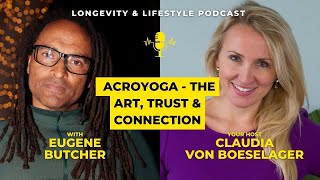
This content was created by Claudia von Boeselager. This content was uploaded by Claudia von Boeselager. This is a YouTube podcast episode titled "The Art Of AcroYoga, Connection, Learning To Trust Yourself with Eugene Butcher" (created 2023-05-11; last edited 2026-03-03). It is an interview-style conversation hosted by Claudia von Boeselager with guest Eugene Butcher, an acroyoga coach and movement artist. The discussion covers what Acroyoga is and how it differs from traditional yoga, different acroyoga styles and practices (L-basing, therapeutic flying, hand-to-hand, artistic partner flow), benefits for fitness, flexibility and relationships, the Heart Dance Meditation practice (including reports of intense emotional/trauma-release experiences), teaching and learning advice, and where to find resources (karniyoga.art, partneryoga.art, Instagram @acroyogacoach). The episode mixes practical instruction, personal stories, and experiential/therapeutic insights aimed at longevity, movement, and connection.
Chapters
Welcome to another episode of the Longevity and Lifestyle Podcast. I'm your host, Claudia von Boeselager, here to uncover the groundbreaking strategies, tools, and practices from the world's pioneering experts to help you live at your best and reach your highest potential. If you want to get top tips, insights, and strategies on optimizing life, health, and business, grab my weekly newsletter by going to llinsider.com. My guest today is Eugene Butcher. Eugene is an acroyoga coach, movement artist, co-founder of Acroyoga Dance, and plant-based biohacker. He's also a 4th Dan black belt in Choi Kwang Do martial arts. Eugene has integrated his practices and is constantly pioneering new and improved teaching methods. He has performed around the world teaching students from the age of 3 to 96, which we love here at Longevity and Lifestyle. So at 96, hopefully I'll be doing acroyoga still as well. Eugene, welcome to the Longevity and Lifestyle podcast.
Thank you. Excited to be here.
Delighted to have you. And I'm delighted also to share because as we know, for optimizing our life and our health, taking care of our bodies and our minds is so important. And I recently got to try with you, Eugene, acroyoga, which observed last year at a conference where I first saw it and I thought, you know, I've done gymnastics previously, I've tried yoga, but flying through the air, and for those who haven't seen Acroyoga yet, we'll try to describe it in a bit. I definitely didn't think this was something that I would be able to do. But again, that was my belief system. And lo and behold, I was flying through the air. So thank you, Dean, for this amazing experience.
You're welcome.
So I'd love to start with those perhaps unfamiliar with Acroyoga. What is it exactly? And how does it differentiate from more traditional yoga practices?
Okay, so the biggest thing about Acroyoga is that it's a partner yoga practice. It's two people. There's normally a guy who's the bigger person and normally a woman who's the smaller person. It's not obviously set in stone. There's variations, but the guy's normally lying on his back most of the time in what we call an L-based position, legs at 90 degrees to his torso and supporting his partner on his feet. And connected with the hands. That's kind of where it starts, traditional Acroyoga position. So that's the biggest difference is that it's two people and you need to navigate the challenges and the benefits of working with somebody else.
I saw a quote that Acroyoga is a type of yoga that blends yoga, acrobatics, performance, and healing arts, which I thought was a pretty cool summary as well. Where does it stem from?
It's quite a recent practice, Claudia, and it's, I'd say, you know, 15 to 20 years. There are some really old photos of Krishnamacharya. Krishnamacharya is one of the original gurus of traditional yoga, normal yoga, solo yoga. And then I think it's him doing some acroyoga with his grandchildren or his children. I'm pretty sure it was his grandchildren actually. But other than that, it started about 20 years ago. You've seen how yoga's grown in popularity over the last 20 years. And so acroyoga is just a part of that growth.
What are the different types of acroyoga? We practice a few different areas. Can you expand on what they are?
There's normal acroyoga where the aim is to do some poses and the base supports the flyer and it starts very simple, just one pose at a time. Let's kind of learn, get some stillness, get some calibration, get used to each other, get some success in terms of it works, we can do it. And then we can start looking at transitioning from one pose to another pose. And those poses and those transitions get more and more gradually, progressively, progressively being the keyword. Hopefully get progressively more challenging and interesting and needed more skill and more time and patience.
And for those who haven't seen it before, when you watch the professionals, if you like, and your Instagram page is phenomenal, so we'll link that in the show notes, but these beautiful sequences of flow, it's like dance through the air acrobatics. It's hard to describe, but it just looks even optically to watch is just phenomenal. Eugene, can you share about your journey to what brought you to Acroyoga and the practice that you have today?
Sure. Okay. Well, when I discovered Acroyoga before, up until that point, I'd been teaching and studying martial arts. That had kind of been the obsessive physical movement practice in my life. And it was also an art form, I guess. And at school, there were two things I was interested in: movement, you know, physical education and art. Everything else academic. It's just, it was too much. And I had arrived in this position, which was a longer ambition as a martial arts teacher to have my own studio. And it was a beautiful studio on the coast, just outside Brighton. And actually, I've been into longevity, anti-aging, and vitality and all those things as well. So I actually called it a wellbeing center. You mentioned teaching children or people from age 3 to 96. I must emphasize that's in martial arts. I haven't taught a 96-year-old in Acroyoga. I'd be willing to try, but I haven't done it yet. I was teaching what I refer to as a wellbeing martial art, and we had to pioneer that because martial arts are not something— in other words, there was a famous 80-year-old woman in America and she was constantly being referred to as the example of someone at 80 can do it. And I'm like, well, that's Mrs. Kong. That's great, but she's in America. Where are the rest of the examples? So I've set out on this mission to prove that this wellbeing art could be done by anybody, but I totally had to change the way we advertised because I couldn't say martial art because I wanted to attract people in their 60s, 70s, and 80s. And these people are not looking to respond to martial arts adverts. So I started calling it a wellbeing program. They then show up. And the challenge was when the first couple came to class and they saw martial arts uniforms and belts, they'd be like, what are you talking about? I'm 75. You know, I've got an armpit for me and an armpit for him. But long story short, it worked. And once we had a few of them in, And they came in and they saw people like them, then it just grew. And one time we had 3 black belts who were grandparents grade for their black belt at the same time as the first. I don't know anywhere else in the world where that's happened because we were just on this mission to prove it. So that was exciting. But yeah, anyway, so Acroyoga, I lost that business. Long story short, recession, bad management on my part. So for the first time in a long time, I had the space where I felt okay. I don't have to be careful not to get distracted from martial arts. I can look around and try some new things, which I hadn't really allowed myself before. I was so focused. And I saw this thing called acroyoga. And initially at first, I didn't think it would keep me interested or keep me entertained. I thought I'd get bored because I looked at it and I thought, okay, it's the girl or the woman in the air on top. The smaller person is being challenged for mobility, coordination, orientation. She's upside down, she's twisting, she's turning. And the guy is lying on his back bending his arms and legs, I'll get bored. That was, that's what I thought. Um, luckily I saw a couple of videos on YouTube that planted a seed for me in this partner yoga thing, this acroyoga thing, this way of two people working together, collaborating together to see what's physically possible in terms of movement. It could be an art form. It's actually about, you mentioned ballet and gracefulness, there's actually a ballerina and a yoga teacher that I saw they'd never studied acroyoga, but they were just exploring this format of one supporting the other. And they did this beautiful performance. It's still on YouTube now. I can send you a link if you're interested. This is about 12 years ago. I saw this and it just blew my mind. Wow, look at that. Look at the control. Look at the really obvious synergy and harmony and understanding and trust and elegance. And it's not two people. It is two people, but they're in such connected flow state that It's like, wow, that's— and then I thought, oh, this acroyoga stuff that I've prejudged and thought is going to be boring. I wonder, maybe I'm not giving it a chance.
So, and now you get to travel to great places around the world. Can you share where you are at the moment?
I'm in Thailand and on an island called Koh Phangan. And I came here 4 years ago to visit 2 friends who were living here. And they had me and my friend Alex, he had traveled all over Asia, all over the world. And he considered Bali, considered Philippines, Vietnam, and he'd ended up in this little island called Koh Phangan, which isn't the easiest place to get to. And he said this, this was the place, it's full of creative types and artists. And I thought, well, look, if you've done all that research, and this is the place you end up, then can I come and visit you and check it out? And that was 4 years ago, I loved it. And I came back this time, I'm in Southeast Asia for 3 months touring around. And I booked a scooter for 10 days. And I think I'm on day 22 at the moment. So I need to extend Um, but yeah, it's, it's, it's an amazing place. I love it.
Beautiful. Let's touch on the benefits of Acroyoga. What would you say are some things that you've noticed in yourself as you've developed your practice? And what are some things clients that you teach notice from the get-go? And then how does that progress over time?
For me, the big benefits hinge around the collaboration with another person. The opportunities to connect and to learn to work with another person in terms of verbal communication, being able to listen physically as well as with our ears, something called receptivity. How, you know, especially for guys, often told about the benefits of strength, but what about the benefits of real physical sensitivity to another person and being able to sense and feel what's going on for them, what they need. Flow state is another one, whether that's in a kind of traditional acro yoga, more technical situation, pranayoga, or something that we call heart dance meditation, which is much more organic, much more kind of free flow, much more kind of unscripted, spontaneous, intuitive. So there's, there's this vast opportunity to explore connection and collaboration.
You have a particular form of acro yoga that's maybe different from the more traditional one. Can you explain what that is?
Yeah, I think traditionally in acroyoga, the focus is on everybody connecting with everybody, everybody trying to do some basing, everybody trying to do some flying, everybody sharing. And that's a very beautiful thing. It creates this big bubble of everybody connecting. And as someone who kind of went to art school and left art school actually at the end of the second year, because I didn't feel I'd found my medium, my thing, that my way of creating art. So I'll come back to it when I'm older later on. And then I discovered, you know, I saw that performance I told you about with this couple and it planted the seed. And then sure enough, I find myself exploring and expressing and creating things with another person that with a completely artistic focus, that's the aim. And to just see what we can create in terms of something that feels beautiful to us to perform, that flows. We can create it and practice it in a way that becomes increasingly effortless, increasingly elegant, increasingly graceful and smooth and free-flowing.. And, um, that's kind of been the thing when people come to our workshops or classes or reach out to work with me when I say, well, you know, why do you come to me? There are other acroyoga teachers. They tend to say, I saw a video and I like how easy you made it look, or I like how it flowed. So it's always nice to hear that.
When we were testing it out or when we were doing our session together, you were showing me different types of acroyoga for different purposes.
What were they? Okay, so I took you through a thing called The Experience, which is a coaching program when I'm coaching someone one-to-one. So we started with acroyoga in its kind of most fundamental form, which is called L-basing. So I'm lying on my back, I pick you up, you know, we all did it as kids probably. And then just slowly, progressively, you know, we got more and more elaborate with the poses and with the transitions to the point you were being turned upside down and twisting and turning and And things, if I'd probably shown you photographs of what we were going to do, what do you think you would have said? Are you sure? Or would you said?
I would have smiled at you, Eugene, thought like, thank you for your trust, but I'm not sure that I will be able to actually do this. So thank you for actually showing me that I can.
Yeah. We started with those. Acroyoga definitely comes under the heading of acroyoga. Then we did, what did we do next? We did some therapeutic flying, which is where you, the person in the other flyer, are completely relaxed. And it's almost like Thai massage from underneath, where it's your body weight is the functional weight, and you can just let go and just kind of have an experience. And then the last thing is a new thing I've been developing, especially over the last couple of few years, and we call it Heart Dance Meditation. And that's kind of a very accessible partner flow state. It's where two people, I invite them to close their eyes, have some kind of contact, whether it's hands, arms, whatever, and I cheat. I cheat by using the most beautiful, mesmerizing music I can find in the world and just ask them to just experience it. Just be there, be present with yourself, be present with your partner, be patient. Nothing needs to happen. I often say, look, if for 1, 2, 3, 4 songs nothing happens, you're approaching it perfectly. Instead of trying to create from my head what we think we should be doing and starting to move that way. So that's, yeah, that's what we did. I told you about two Brazilian friends and they, I took them through the same thing and they called it The Experience. They kept referring to it as The Experience. So it kind of stuck. So that's why that program's called that.
I'm excited to dive into more of the heart dance meditation shortly. But before we do, I also want to share with my audience things that I found, especially if you sit at a desk and things like that as well, that It's such a beautiful way of exercising the body, if you will, without actually thinking about exercise, and also for flexibility and opening up, just opening up the chest, you know, instead of leaning forward at a desk, you're really kind of doing the reverse and holding these beautiful poses while flying in the air. I just, I mean, I think as a child, this is like totally normal. It's like, of course I can do this. But, you know, as we grow younger, I should say.
Absolutely.
Yeah. It's such a phenomenal way to open up as well and to really feel into the body and, and stretch and have that flexibility and mobility. So those were some of the benefits also that I, I really enjoyed. Eugene, I'd like to touch on connection and Acroyoga. What exactly is going on there? As you said, it's a partner yoga system, ideally with somebody you know and can work continuously with, but let's talk about the connection piece. What's happening?
Okay, there's a lot of communication that's required, more so than any other practice that I know of. I mean, you know, I've dabbled with salsa, I've dabbled with bachata, but there's no real verbal communication needed there. But here there absolutely is because somebody is 5 feet in the air or more. And so there is a safety aspect. And with that safety aspect, it means we cannot take chances. We have to be very clear what we're doing, when we're doing it. How are we doing it? Are we ready to do it? Should we come down because we're feeling tired or we're not sure or something aches or we're just not, you know, so communication is developed in more than any other area that I've kind of worked in. It can be quite amazing. Trust is obviously a factor as well. It's interesting though, I mean, it's obviously a case of trusting each other. Obviously the person in the air needs to trust the person who's supporting them. As a base, I need to trust the person I'm supporting. I need to trust them not to do something silly, not to surprise me with this and that. And also we need to trust ourselves. And often that's the area that someone needs to work more with, trust themselves more than trust in their partner.
That's a big thing for a lot of people as well. And we discussed when we did our session also for couples, for relationship couples, this is a good therapy form. Why is that?
Well, we often say that if it's a couple in a relationship, that their relationship brings a lot to their Acroyoga practice, and the Acroyoga practice brings a lot to their relationship. To begin with, they're playing. And okay, you know, there's a name and there's some poses and this can be a beautiful art form, but it's fun. And if it's not fun, then we're definitely not doing it right. But then in order to accomplish a pose, they have to communicate. And chances are they need to consider the way they're talking or possibly not talking enough and learn to talk more. And not just that, the way that they're communicated. For example, if I was to pick you up in an acroyoga position, my feet on your hips, my hands are connected, I'm supporting you, and say my foot was digging into your stomach, you might go, oh wow, hang on, hang on, hang on. That foot's really digging into my stomach. It really hurts. That's not great. Oh my God. Can we do something about that? This really isn't good. And I'd get the message and I'd try and fix my foot position. Alternatively, another level of communication, a better method is you'd say, Eugene, this foot, can you turn the toes out slightly for me? You haven't distracted me with any drama. You've just made a request. You've asked me for what you need. I've given you what you've asked for and that's it. Case solved. Or maybe you need to ask me again, a bit more, now the other foot as well, or whatever. So it's learning things like that, this idea of asking for what we need, which is kind of easier in an acroyoga context because there's a reason, there's a functional reason, but then hopefully that carries across into life as well. The idea of asking for what we want. Beautiful.
For people interested in learning and practicing Acroyoga, what would you say are some of the best ways to learn it? And what should they look out for?
Our approach is slightly different in that we approach Acroyoga or partner yoga as an art form, and therefore we highly recommend trying to work with one person. Consistently. And if that happens to be a partner, husband, wife, girlfriend, boyfriend, best friend, then amazing. You've just solved the biggest hurdle of who you're going to be practicing with. And if it is someone you know closely, then obviously the practicalities are easier. The logistics of being in the same place at the same time. Yeah, that's the first thing. And then, you know, someone to learn from, whether it's a local teacher or online, a safe space to do it, enough space. And these phones that we spend a lot of money on can be really useful to video ourselves. It's amazing because we're so focused while we're practicing that we get the opportunity to look back at ourselves. If they haven't got access to teachers locally, then I've got an online program that teaches partner yoga, which includes acroyoga, includes kundalini dance meditation, and some other things that we really enjoy.
And where can people find more about that?
That is partneryoga.art.
And we'll link that in the show notes as well. For people interested in learning Acroyoga, are there any Acroyoga mistakes to avoid?
Yes, there are. And probably the biggest one, whether it's you're working with your husband, boyfriend, girlfriend, best friend, or whatever, or so someone you've just met, is to be patient with it rather than in a hurry. You know, we're all kind of successful in some walk of life and it's easy to kind of bring that Expectation for success, but I'd say to make success having fun and just some increase in understanding of whatever it is that you're practicing, because it's such a moving target because it's, you know, it can be challenging learning new skills by ourselves, new physical skills. But when you're learning, being supported by someone else who's also learning a new skill, or you're supporting someone who's learning a new skill, you're compensating for someone else's learning while also trying to compensate for your own learning, the bits you know, the bits you don't know. I often use an analogy, and I still don't think it's a good enough analogy. Imagine you're learning to drive, but there's two sets of controls and your friend is learning to drive next to you. There's two steering wheels, two brakes, two accelerators, two clutches, two gearboxes, and they both influence the car equally. What would be the most important thing for you to drive successfully, do you think?
To be in sync, right?
Yeah. How would you acquire that sync?
Communication, practice.
Yeah, communication. It's like, you know, people often comment when they first see, you know, if we're doing acroyoga in the park or something, people might walk by, oh my God, wow, that's amazing. And they point usually at the base and they say, you must be so strong. And strength is a factor, but I'd probably put it at something like 9th priority. There are far more important things and communication is the biggest one. Nobody walks past and says, wow, you guys must be so good at communicating.
Let's talk about the heart dance meditation. We also did this practice and it was so powerful. Can you explain what is this practice? How did you learn it? And how do you incorporate it into your teachings today?
Well, I first experienced something like it about 10 years ago, 11 years ago at a festival. And it was the biodanza session. And biodanza was developed by an Argentinian therapist on the basis that we humans need physical contact. We need eye contact. And in the Western world, So many people do not have enough connection, do not have enough physical contact and connection. And it was a process that's step by step by step. And then you ended up working and dancing to music with a partner with contact. And that was the first time I've done something like, wow, what is this? It's amazing. It's, it's creative. And I feel like I'm in a flow state and I really connected with you. I didn't connect so well. It's okay with you. And, you know, but sometimes you just really connect with someone and it works and it's beautiful. And then Biodanza just seemed to disappear over the couple of years after that festival. And I struggled to find places where I could have the opportunity to explore this thing. Then it kind of dawned on me when I'm teaching, I'm working with somebody in a very kind of trusting environment all the time, whether I'm teaching someone or coaching someone or practicing. I wonder if I can just explain it to someone and try and recreate it. So that's what I started doing with different levels of success, but gradually I got better and better at describing this thing. And basically it's two people and what I invite people to do now, whether it's me coaching someone or two people working together, I say, look, can you close your eyes? We're going to play this beautiful music. It's the most beautiful music I can find anywhere on the planet. Most beautiful, mesmerizing, super mellow and emotional and inspiring. And if you close your eyes and breathe, you're going to feel incredible just being present with that music. And then I encourage you to have an experience or invite you to have an experience and just be present with partner, whether it's me or somebody else, and be patient and just wait and see and give yourself permission to be okay just standing in stillness. And that can feel a bit weird at first. It can feel a bit vulnerable, like, surely I need to do something. You know, we used to be an actor. We used to consciously fill in those gaps, aren't we? Those awkward moments. But if we just accept, breathe, be present and listen, listen, not so much, okay, we're listening to the music, but we're also listening physically, we're being sensitive to the most subtle of impulses, our own. And what happens is eventually a kind of combined intuition to move or to express or to shift. And it's not one person, it's neither partner leading, it's combined. And it's beautiful. It's just kind of surrendering and creating space to explore that and this kind of flow state, this whole beautiful creative mode opens up.
And what comes up for people? What have you found?
It can be really moving. It was always a creative thing and it was always very beautiful, blissful. As long as I knew the person I was doing it with was enjoying it, I could just keep doing it for hours. But then it's different for everybody and depending on their willingness and their ability to be open and to explore and to surrender to this thing that they don't really know what on earth it is I'm trying to show them yet. And to tell you one story, two Brazilian friends, and they came, they said they got in touch, they'd done a little bit of Acro with me at a festival. And they said, can we come for one of your coaching sessions? And can we come together? But we both want to fly. And I'm like, okay, yeah, we can do that. So I'll fly one of you, the other one watches, then we swap and we repeat. Yeah, yeah, we'll do that. So they came and I did that. And I did the normal Acro coaching, and they really enjoyed it. And then I did something called hand-to-hand, which is them doing a handstand in my hands with the only connection, they're in a handstand, I'm lying on my back, and the only connection between us is our hands and I'm balancing their handstand. And that's one of those things where people people perceive that as being really, really difficult. It's not. Most people think it's impossible for them, and because most people can't do a handstand and balance it themselves, that's a really, really hard skill. And so they, they assume them doing a handstand on my hands is harder than them doing a handstand by themselves. The reality is it isn't, as long as I know my part, which I do. It's something I've obsessed over for years. So I'm able to take someone who can't do a normal handstand and get them into a handstand on hands. And it kind of blows their mind a little bit. It's a little bit like Tony Robbins uses firewalks as a metaphor where most people think they can't walk across hot coals and he'll get 8,000 people to walk across hot coals. And the whole idea is, well, look, you didn't think you could do that. You've just done it. What other areas of your life are you shortchanging yourself and deciding you can't do something without even giving it a try?. And this hand-to-hand thing I find is even more powerful for people because there they are in a handstand and then, you know, we send them a photograph or a video and it's just like, so yeah, we did that. And then we did the therapeutic flying. Therapeutic flying is another acroyoga practice where the flyer is completely relaxed and passive and just lets go. It's a little bit like having Thai massage, but the person giving the massage is underneath. So therefore it's your body weight that's providing the stimulus. And so we did that. And then I was a little unsure. I'd never done it before, but in this context, anytime I'd explored heart dance meditation, it was with someone with a dance background and they were very comfortable with the idea of saying, look, we'll explore this kind of contact improvisation kind of context. Sure. Yeah, we can do that. So this is the first time I was exploring with two people who weren't dancers. And I was just going to say to them, look, there's this other thing. It's called heart dance meditation. I'm going to play some beautiful music. I'll lead it. Just close your eyes and have an experience. That was the big difference to the way they'd done it before. Long story short, I was doing it with one, the other one's watching, this beautiful music's playing and their eyes closed. And then I hear the one who's watching is crying and it's just halfway through one song and I'm like, wait, she's crying. And then, and then it's the one I'm, I'm doing the heart stance meditation is also crying. So then we finish, they wipe their eyes, they have a hug and then they swap. And then the same thing happens. The one who's watching, I hear them crying. I'm like, yep, sure enough. And that was the first time that I'd really seen that response or that effect. Then it happened in an even bigger way. And I was teaching at a festival and a woman who— she didn't join the workshop, but she came up and said, look, I saw what you're doing. And I've got to tell you that it's got so much potential for trauma release. It's really exciting. I said, wow, can I get your details? Can we continue this conversation? I'm really interested. How do you think about how I might be able to explore that? I'd never thought that. I've never seen that. Didn't connect it to the crying so much, or maybe I did. I'm not sure.. And then a couple of weeks later, I had someone who's now a friend, but she was coming to her first coaching session in acroyoga. Again, I just met her, so I wasn't sure about the whole hard dance meditation thing. You know, we did the normal thing, did the acroyoga, we did the handstand balance, did the therapeutics, and I thought, okay, I'm gonna go for it. I said, now look, this is one other thing just before you go. It's called hard dance meditation, something new. It's something I'm working on. You just kind of close your eyes and I play this beautiful music and then it seemed to go horribly wrong because she seemed to not be responding the way people had always responded before, where they were quite easy for me to kind of suggest and move. And she just seemed to be very heavy. Her limbs were so heavy. And I thought, oh my God, this is going so badly wrong. I really hoped I could show it to her. And I thought, okay, when this first song ends, she's just going to open her eyes and run to the door because I've messed this up. But she didn't. This first song ended, she stayed there with her eyes closed. And I thought, Okay, it can only get better because I've done a really bad job so far. So, okay, let me see if I can improve this. And it got slightly better, but she kept her eyes closed. Anyway, long story short, third song, fourth song, fifth song. Halfway through the fifth song, she starts to shake. And the shaking's getting stronger and stronger and stronger. At that point I thought, oh, I think I know what's coming. And I was grateful for my Brazilian friends who'd shown me the whole crying thing. And then I was also grateful for the the woman that came up and said about trauma release, 'cause I thought something big's coming. And sure enough, boom, the floodgates opened and this woman was just sobbing. I can't remember a time where I've seen an adult sob, not just cry. She'd lost the ability to physically hold herself up. I had to hold her up. She's just sobbing and it's vocal and everything. And it took 2 songs for that to subside. And she sat down and I expected her to tell me about this terrible trauma that had been released. And she said, look, I had this amazing experience. I was kind of out of my body. I was looking down at myself. I felt at one with the universe. I felt at one with the world. I felt this amazing sense of peace. I couldn't help but cry. It was, it was so beautiful. I said, wow, you know, I was expecting a trauma story, but this is wonderful. And then she said, look, I've done a lot of growth work. And I've been in a lot of environments where it's normal to have a bigger release or trauma release, whatever you call it. And I said, wow, that's really interesting. I thought it's interesting for a couple of reasons is because maybe the fact you've been in those different environments where it's normal, you know, made you comfortable with the idea of letting that kind of release happen. And maybe in those other environments, you say you never had one because maybe the knowledge that you could have one created an expectation to have a release and therefore you were maybe waiting for that release and therefore that's why it didn't come along, whereas here you couldn't have been expecting a release because I didn't even know that you could have a release like that. This is a new discovery for both of us. It was a real, it was an amazing thing for me to witness, let alone kind of support and facilitate. And then long story short, I invited the Brazilians back. I've been keeping in touch with them, the Brazilian friends who only had had one song, remember. So they came back and they were all really looking forward to it. And sure enough, halfway through the first song, the first one, they're not just crying, wailing vocally. I've got recordings of this, and they didn't mind that we videoed it, just sobbing. And their face, makeup is an absolute mess. They don't care. And there's something in that. There's something in maybe their different cultural upbringing regards expression and emotion that they were just open and receptive and willing to let it wash over them. And we danced for 20 minutes and they cried for pretty much 20 minutes. You know that song, It Comes and Goes in Waves? That's what it was like. Just It's like, how intense is this sobbing, crying? And it seems to fade off and then it comes strong again. And then we swap. And I felt a bit bad for the one who was watching. I'm thinking, what's it like for her watching a friend cry for 20 minutes and sob and experience this kind of really intense emotion while she's waiting for her go? I'm thinking, oh, does that not create a kind of expectation or something? I needn't have worried because halfway through the first song, same thing. So I wasn't expecting that. Like I said, this started as a creative slow state thing, an artistic thing, but then discovered that this got this incredible healing potential as well.
What do you think is happening there that's triggering these deep, profound emotional releases and shifts?
I don't know entirely. I think I need to give some credit to the music because I'm choosing the most beautiful, mesmerizing, emotive music that I can find on the planet. Like the soundtrack to Schindler's List, like The Nature of Daylight, which was recently used in the Now series about us. They used it as a really beautiful point anyway. So the music is already beautiful and emotional. And when we listen to music, we're not always present, relaxed. We're often active doing something. We're driving, we're engaged in some kind of, which doesn't allow us to surrender and be taken by the music in the same way. So give the music a lot of credit, but then there's also something about the connection and just kind of a harmonious shared intuition. And what's beautiful about this flow state is it's very accessible that sometimes someone can get it almost immediately in a matter of minutes. Hence these women crying halfway through the first song. So I don't fully know. I'd love to— any ideas?
Because you experienced it, right? From my observation, and when we did it once, is that first of all, because the eyes are closed, I'm not sure what to expect. So it's this trust. It's just feeling into the present moment and this energetic flow connection with another human being. And obviously the music is very powerful as well. So I guess it's this like deep surrendering, deep presencing, and then movement and flow of it as well. And I guess that combination and the presence of another person, it's different because it's in unison that it triggers and shifts things for people who maybe, you know, typically we talk about blockages, right? Emotional blockages and stuff as well. So that essence, movement and that energy and that being in that sort of higher vibration, I guess, opens and releases and allows these blockages to just open up and to release and to just come to light. I guess it's also a very vulnerable state, right? So thank you for sharing that. And thank you for doing this work as well. It's, you know, clearly changing people's lives, which is so beautiful as well.
I just feel very lucky, very grateful, very fortunate that somehow I've stumbled into things like that. I love it. I could do it nonstop. And then to also just, I love the, like you say, the experience of it, but then to see the effect it can have on someone. I mean, I did it with someone on the beach who asked me for a coaching session. She practices yoga. She saw that I was doing acroyoga. She said, could I have a coaching session? I said, sure. I was lying in the water actually. It's a big place. It's really shallow, you know, where the tide goes out and it's just really shallow for a long time. So I could just lie and bass in the water, which is beautiful.. But, and we did that. And then I said, look, you know, there's this other thing. There's this thing, I call it art dance meditation. And it's like, it's like a partner. It's not really a dance. She said, oh no. So I don't think, I don't know. And, you know, I just accepted the no, but then she elaborated. She said, look, I'm not a good dancer. I'm not someone who's got coordination. I don't really know how to dance and especially a partner dance. I'm just not that kind of person. And when someone says that to me, it's a bit like when someone says, I don't want to do something like the hand to hand, but when they start giving me reasons. Oh no, I can't do handstands because I'm not a strong person. My arms aren't strong enough, and whatever. Then I'm like, okay, look, now that you've told me your reasons and showing up, I said, look, give it a try. All the pressure's on me. Just close your eyes and just have an experience. You don't have to do anything. It will work better if you're not trying to do anything. Um, oh, okay, go on. And she loved it. Again, she had tears in her eyes. It wasn't a bawling, crying real loud, experience, but she loved it and ended up lying on the beach looking at the stars, completely blissed out. Beautiful.
Eugene, I'm going to ask you some rapid-fire questions before we finish today. Do you have a favorite quote or piece of advice that's been a real game changer for you?
Yeah, I've got two actually. Can I sneak two in? Sure. So the first one is very practical. Slow is smooth and smooth is fast. And especially in acro, which is very technical, people often want to move quickly, but the slower they go, the smoother it is, the smoother it is, the quicker they're going to progress. And then the second one is a Rumi quote, and he goes, let the beauty you love be what you do. Let the beauty you love be what you do.
And I try to live by that one. Clearly by looking at your Instagram, which we'll link as well, it's beautiful images and flow, and you can just see the artistic form taking place. Metaphorically speaking, if you could get a message out, Eugene, to a billion people, what would it be?
What would it say and why? I had this on my WhatsApp for a while. If it wasn't let the beauty you love be what you do, it would probably be the magic was always within you. So it presupposes that we're capable of way more than what we believe we're capable of. And I see that all the time with that creative People, oh no, I can't do that. Oh no, no, no, no. I can't do a handstand. I can't do part of those meditations. And then they do it. Oh my God.
Can't believe I did that. For my listeners interested in understanding more about acroyoga and your form of artistic acroyoga, what are some good online resources that you would recommend people start with?
Sure. My main website is karniyoga.art and there's different aspects of the partner yoga practices or disciplines under that umbrella, the acroyoga, the heart dance meditation. We even do the acroyoga sometimes on a standup paddleboard. That's another opportunity to go somewhere amazingly beautiful. We went to Switzerland last year and we climbed up to these glaciers, these lakes in the Alps, mind-blowingly beautiful. And we went out on the SUP board and with a drone and shot these poses.
They're on your Instagram, right?
So can you share with people how they can follow what you're up to, Eugene? So my Instagram handle is @acroyogacoach.
We'll link all of those in the show notes. Eugene, do you have any final ask or recommendation or any parting thoughts or message for my audience?
I saw a quote, was it John Lennon that said, every child is an artist and believes they're an artist until they're told that they're not. And I think whether we've been told that or believe that, I think we've all got the ability to create beautiful things.
Eugene, thank you so much for coming on today. It's been such a pleasure and I really love the acroyoga session. For those listening, give it a try. Definitely out of your comfort zone if you've never done something like this before, but you definitely feel exhilarated and so much more after it. So thank you so much again, Eugene.
Thanks for having me, and thanks for being open to try the Acro as well and the heart dance meditation.
All of it was beautiful.
Thanks.
Hi everyone, this is Claudia von Boeselager again. Before you take Would you like to get a short email from me with some short but sweet fun tips, tricks, and updates on all things longevity and lifestyle? This could be cool products that I've discovered, interesting posts or articles I've read, and other fun and helpful things around longevity and lifestyle I've found for you. It's a very short piece of inspiration for you a few times a month. So if you want to receive it, check it out by going to longevity-and-lifestyle.com. That's longevity-and-lifestyle.com, and leave your email to sign up for the next one.
More from Claudia









Can Psilocybin Slow Aging? The Study on Telomeres, Inflammation & Survival with Dr. Louise Hecker

