The Big Lies in Medicine | Dr. Robert Lufkin on Reversing Chronic Disease, Rapamycin & Longevity
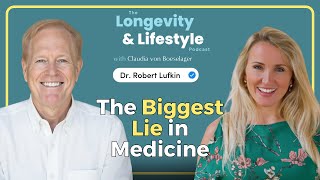
In this episode of the Longevity and Lifestyle Podcast, host Claudia von Boeselager, a former investment banker turned longevity coach, introduces Dr. Robert Lufkin, a physician, medical school professor, and bestselling author. Dr. Lufkin recounts his personal health crisis—four chronic diseases diagnosed despite being a medical professional—and how conventional medicine’s reliance on pills failed to address the root cause. He argues that a single underlying metabolic dysfunction (insulin resistance, inflammation, oxidative stress) drives diverse chronic conditions such as obesity, diabetes, heart disease, cancer, Alzheimer’s, and even mental illness. By adopting a holistic lifestyle—low‑carb, high‑fat nutrition (avoiding seed oils and often grains), time‑restricted eating, adequate sleep, stress management, and regular physical activity—he reversed his diseases and now helps others do the same. The conversation expands to discuss aging as the greatest risk factor, the emerging field of geroscience, and specific longevity interventions: rapamycin (mTOR inhibition), metformin, psilocybin, ketamine, and partial epigenetic reprogramming using Yamanaka factors or small‑molecule analogs. Dr. Lufkin critiques the over‑hyped “Blue Zones” data, noting socioeconomic and record‑keeping biases, while emphasizing community, intergenerational wisdom, and personal agency. He stresses that doctors can treat disease but health is a personal responsibility, and optimism and mindset are crucial for longevity. The episode ends with practical advice, contact information, and a brief sponsor message for Pendulum, a gut‑health supplement.
Chapters
Hey there, I'm Claudia von Boeselager, a former investment banker turned entrepreneur, longevity coach, biohacker, and mother of two. Once burnt out and overwhelmed with chronic health issues, I've transformed my life and helped thousands of people do the same. I've even reduced my biological age by 17 years. Yes, I'm 26 again. Now I'm here to share the tools, strategies, and inspiration to help you live healthier, happier, and longer. On this podcast, I interview world-leading experts in health, biohacking, mindset, and performance, and share personal stories and learnings to bring you the latest insights and tips. Think of this as your go-to space for real talk about all things health and optimizing your life. Ready to unlock your best self? Let's dive in. This is the Longevity and Lifestyle Podcast.
My guest today is Dr. Robert Lovkin, a physician, medical school professor at both UCLA and USC, and a New York Times bestselling author who is on a mission to empower people to reclaim their metabolic health. A regular voice in the media, Dr. Lufkin has appeared on the Today Show, USA Today, Fox, and other major networks, and his weekly video podcast now reaches more than half a million people worldwide. What makes his story especially powerful is that he's not just teaching theory, After reversing his own chronic disease and transforming his life, he's now dedicated to helping others do the same. His latest book, Lies I Taught in Medical School, became an instant New York Times bestseller and is shifting the conversation around metabolic health and longevity. Beyond his work as a practicing physician, he has authored over 200 peer-reviewed scientific papers and 14 books now translated into 14 languages.
Please enjoy.
Jumping in quickly, it's Claudia von Boeselager. I absolutely love bringing you these conversations for free each week, and I can do that thanks to the generous support of our sponsors. These are brands I've personally vetted and believe in, and I think you'll love them too. Supporting them means you're also supporting the show and your own longevity journey. Thanks for supporting them. Now here's today's sponsors. This episode is brought to you by Pendulum. If you've been listening to this podcast, you'll know that longevity isn't about quick fixes. It's about supporting your body at the root. And one of the biggest realizations I've had from talking with experts is that so many foundational systems, from your energy and metabolism to immune health and even mood, all start in your gut. That changed the way I approached my own health, and it's exactly why I'm such a fan of Pendulum. They're a science-driven company pioneering a whole new approach to gut health. In fact, Pendulum is the first company to bring live akkermansia to market. This is a game changer. I recently started taking their metabolic daily, and I can tell you I'm already noticing a real difference. My digestion feels smoother, I have more consistent energy, and I love knowing that I'm supporting my gut at such a foundational level. For me, this is a cornerstone of longevity. If you're serious about your health and lifestyle, this is where to start, because when you support your gut, you support your entire body. And for you, dear audience, get 20% off your first Pendulum membership order by heading over to pendulumlife.com/claudia. That's pendulumlife.com/claudia20. The discount is automatically applied at checkout.
I'd love to start with your personal transformation. I always think that's always a powerful place to start.
Yeah, sure. Well, my background I'm a, I'm a physician. I'm actually a medical school professor. So I not only practice medicine, but I teach and do research and all that. And everything was going fine. I was minding my own business doing that when all of a sudden I came down with 4 chronic diseases. I went to my doctors and the doctor said, you know, hey, you've got these diseases. Don't worry, we're going to give you pills. And, you know, take the pills and you'll be fine. And I go, what about lifestyle? And they go, nah, that really doesn't work.
You know, you don't need that. It doesn't matter.
They said, you know, you're going to be on these pills the rest of your life. So get used to it. And, and I knew enough about medicine, you know, that, uh, this wasn't going to end well. And I had, you know, two young daughters at the time and they're still, they're still in high school. So that wasn't that long ago, but I realized if I didn't do something, um, you know, this is going to be a big deal. So I began to question what I'd been told, what I taught, what my colleagues were taught. And I realized there was a whole bunch of knowledge, research that I wasn't aware of, my colleagues, many of them still weren't aware of, that shows that a lot of things about these diseases that I didn't realize. And short story, basically, I was able to transform my lifestyle and to implement relatively simple things in my lifestyle that when I did them actually reversed the diseases. The doctors couldn't believe it. They thought, they, they thought the labs were broken or something. So at that point, I've now made it my mission to help others take back their health and not make the same mistakes that I did. So I wrote a book and now spend my time helping other people, you know, not, not go down the path that I I was going down.
I love that too. And it's almost from mess to mission. I had also multiple chronic disease. I was totally in denial. I'm like, I'm fine. But I had zero energy, blood markers in the red, 2 weeks away from being hospitalized, but I was fine. It's like, something is wrong. And I think that that's the beautiful thing about this space is that so many people have gone from their own personal stories and histories, but we all have so many loved ones and family and friends. Sadly, my mother just passed from Alzheimer's dementia, which my, my audience will know about just last week as well. And just to see someone that was such a shining light there, thank you, go to have to suffer from this chronic disease. And had we picked up on things much earlier, she might never have gotten to that. And my father has cancer, et cetera. And as we know, about 80% of US healthcare spending goes to chronic disease management. So it's so important for people to understand this. So I really appreciate your your mission and turning your own challenges and, and revelations, I guess, into your mission as well. I'd love to touch on your book, The Big Lies in Medicine. So your book is The Lies I Taught in Medical School. You challenge some of the most common lessons doctors still learn. Given that 42.5% of US adults are obese and 73.6% are at least overweight, which medical lie do you think has been most damaging in fueling this crisis?
Wow. That's, that's a great question. Unfortunately, there are so many, and let me, let me just say, I'll put a disclaimer out there. The book, the book is very critical of what do you want to call it? Western medicine. It's not necessarily in the West, but the East has it also, but more like allopathic conventional medicine. And, you know, obviously confession, I'm a part of the problem because, you know, as a medical school professor, I represent the establishment and the Western medicine, if we call it, we call it that. But even though the book is critical about that, I want to say that in the 20th century, those of us who were around then, at least Western medicine was truly transformative. You know, it, it made our lives so much better. The pills, the surgeries that were invented made all of humanity much, much better, largely through public health measures and other things. But, but medicine was really magical then. And the problem— even today, if I get hit by a car out on the street, I'm going to want Western medicine. You know, I'm going to want that blood transfusion. I'm going to want my bones set. I'm going to want my spleen, my ruptured spleen removed, all those things that Western medicine can provide. But the problem is, you know, as you point out, 80% of healthcare is now spent on what are called these chronic diseases, which were present in the 20th century, but now they are, they are really truly in biblical proportions, biblical numbers never before seen in history. And these, these diseases are things like basically obesity. Most adults in America are overweight. Hypertension. Most adults are hypertensive, or they have, they're on hypertensive medicines. Diabetes, type 2 diabetes, especially cancer. Alzheimer's disease, heart attack, stroke, even mental illness. And the problem is when Western medicine is faced with these chronic diseases, what's the response? Well, we have all these pills and surgeries that were magical, you know, in the last century. The problem is when these pills and surgeries are applied to these chronic diseases, they may work for symptoms and they, they can accrete handle the acute things, but they don't, in most cases, change the underlying chronic disease and the disease continues to progress. And that's really the problem that we're not, we're not addressing these things. And maybe, maybe that's the biggest overall lie that the, you know, that the pills and surgeries don't work for the chronic diseases other than the acute symptoms. In other words, if I'm a diabetic, insulin is life-saving, no question about it. It saves my life from a hyperglycemic coma. But the problem is treating type 2 diabetes with insulin and the other drugs like metformin and, and sulfonylureas may keep you alive, but it doesn't keep diabetes— type 2 diabetes becomes a chronic progressive disease. What does that mean? Well, it progresses to things like amputations. The number one cause of surgical amputations today is type 2 diabetes. What else? Renal failure, kidney failure. The number one cause of dialysis is type 2 diabetes. Blindness, retinal blindness, number one cause of retinal blindness is that on and on and on. And, you know, type 3 diabetes, Alzheimer's, heart attack, stroke, all these things. And if we treat type 2 diabetes with the drugs, it progresses to these complications. They're, you know, but when we treat them with lifestyle, we actually reverse the disease. And people who treat diabetes with lifestyle, type 2 diabetes, tend— they don't tend to have those complications. In other words, they arrest the disease. And that's, that's the idea that there is a way and that The message isn't getting out there, and that's for all sorts of reasons.
And it's so exciting and so empowering, I think, for people to know this, and it's not taught in medical school, right? So I think that's where the challenge is, is that people are going to their doctors and like, oh, we have a pill and this will prolong your lifespan, but in what state? And I'm curious, what were the lifestyle interventions that helped you solve for your 4 chronic diseases?
Yeah, I mean, one of the lies that I believed, and one of the truths, is that my 4 chronic diseases, and indeed all the chronic diseases that I mentioned were separate diseases. In other words, one of the truths that I came to understand was that I didn't have 4 diseases. I only had one. And that's another empowering, liberating concept for me is that these chronic diseases, although they seem very differently, you know, Alzheimer's disease seems very different from cancer. And it is, you know, in the manifestations, it's very different from gout or arthritis, You know, which is one of the things that I had and, and it's very different from diabetes, but the evidence is very, very strong to show that they, they all arise from a fundamental metabolic dysfunction, a fundamental abnormality involving things like insulin resistance, oxidation, inflammation that drive all these chronic diseases. The really, the empowering message is that Lifestyle will impact and improve our metabolic health. And if we do lifestyle to improve our metabolic health, we'll improve our risk for all these diseases. What does that mean? Well, it means that the same intervention that, you know, God forbid, you know, your mom, I'm so sorry. My mom passed from Alzheimer's disease not a few years ago also. But you know, what it means is that diseases like Alzheimer's, we find that ketogenic diet helps people with Alzheimer's disease. Fair enough. It's, it's a metabolic fix for things and improves metabolic health. Well, a ketogenic diet also improves people with cancer. It also reverses mental illness in some, but not all cases. It also, you know, stops seizures. It also reverses type 2 diabetes. It also, the same types of lifestyle interventions affect all these diseases. Back to your question that I haven't answered yet. What, what were the lifestyle changes? So basically 4, 4 big categories. And it's what a lot of, there's a lot of consensus about this. So, and then, and the question is, everyone thinks you should have a good lifestyle. No one disagrees what, you know, hey, have a good lifestyle. You'll be healthy. Of course you will. You know, if it's, but what does good mean? Right. And for many years, a good diet meant a low fat, high carbohydrate diet. And there's some medical institutions that still recommend that. But, and my mom was a dietitian, so I was raised on a low fat, high carb diet.
We had it in our house too, because it was fat was bad and you want low fats and yeah, but knowing now what we know.
In my opinion and what worked for me, and I would submit it's, it's not a special case. This works for most people. In other words, it can be broadly applied. Everyone's different. We're all slightly different. That's why, you know, one person gets metabolic dysfunction and they will get, they will manifest as Alzheimer's disease. Another person will get metabolic dysfunction and they'll get cancer. Somebody else will have a heart attack. Well, what's that about? Well, we're all different. We all have different genes and epigenomes that manifest, but at the root cause is our metabolic dysfunction, and we can improve that with lifestyle. So nutrition, simple things, low carb, higher fat diet, good fats, don't eat seed oils. For some people, a lot of people, I would submit avoid grains also. And then restrict your time, your window of eating to a narrower time-restricted window that will benefit everybody. Even if you don't change what you eat, just eat less often and you'll be healthier. So that was nutrition. And then sleep. Sleep is key. Stress, mind state, stress, mindset, how we look at the world, how we deal with the world, and then also exercise, both mental and physical exercise. And the key thing is you have to do them all. In other words, you can't fix your diet, fix your stress, fix your exercise, but then your sleep is messed up because any of these will put you off the rails. So, you really have to do them all. But, it's, it's fun. It's a great lifestyle. I mean, I feel better doing these things. I mean, it just, not only I think I'm going to live longer and I reversed my chronic disease, but I literally have more energy. My mind's clear. It's just, it's a great way that I choose to live. It's not a diet. It's the choices I'm making for myself and my family for the rest of my life.
Beautifully said. You can tell your vibrant energy. And I think that's the thing that people forget. They're like, oh, but it's not just about living really well till you live 100. It's really having more energy today so you can do more of the things that you love doing and be more present, be there for your family, your loved ones, etc. So it's really impactful. And I think for a lot of people, they're like, oh, but it's difficult to change. And I think it's— if you understand that it's the beginning, when you start on the journey, yes, it's more complicated and there's adjustments, but it's soon it becomes your day-to-day and your routine. You don't even think about it. So it becomes easier.
I was just going to direct it to one more thing on the, because your podcast is about longevity as well as lifestyle. Yes. Interesting thing that I realized is, you know, I fix all this law, I fix all my lifestyle and everything, right? And we reverse our, we, we lower our risk for all these chronic diseases. No question. You know, the evidence is very, very strong, you know, whatever, whatever you're on the path for, it will improve your improve your chance of getting them. And in some cases, even reverse those diseases. Because one of the other things I became aware of is that the doc— these diseases don't start when the doctor diagnoses them. In other words, I walked in the doctor's office, I got that diagnosis, but then I realized these diseases were present years to decades, literally decades before I get the diagnosis. And if I wait until the doctor makes the diagnosis, I'm missing a tremendous opportunity for prevention, reversal, and maybe stopping it so I don't even get it at all. So that's, that's a key point. And the problem is, even though I'm a doctor, a physician, I know that doctors don't make me healthy, right? Doctors, our job is just to make people less sick, right? We deal with sickness. We don't deal with health and, and we're not equipped. Doctors are too busy trying to manage disease. To help me as a patient be healthy. And out of fairness to doctors, the medical system isn't really equipped for doctors to, to manage lifestyle and all these other things. That's why coaching and communities and so many other things. And really, if I want to be healthy, that's on me as the patient. And, and that's the empowering thing too. I'm in charge of my health. My doctor may be in charge of my diseases,. But if I manage my health right, I'm going to get fewer and fewer of those diseases later and later on. But the point I was going to make— oh, go ahead.
Yeah. No, I just wanted to applaud you. I mean, that is so well said and that people really feel empowered because like, oh, but I have my doctor and they're outsourcing their thing.
But it's true.
Doctors don't have the time to do the deep dives. They don't have the time to read your sleep tracker. And if you're just wearing a CGM and see what you're doing day to day, they only see you once every 6 months, once every 12 months, there's no way they're able to keep on top of everything. It's not fair. So I think, you know, people really feel empowered to get on top of it. So you said it so beautifully there. So I just wanted to—
Oh, thank you. Yeah. And, and yeah, the healthcare system is not set up. It's much easier to write a prescription for a pill and things. And furthermore, you have to wait till you cross a certain threshold for the disease. In other words, I used to think type 2 diabetes was you know, in many diseases where like an on and off switch, you either had it or you didn't. Right. And that's the way the medical system's set up. Once your, your hemoglobin A1C, which is a blood marker for diabetes, crosses a certain threshold, you have diabetes or prediabetes, which is really diabetes. But below that, you're normal, you know? And the problem is an interesting thing I didn't realize that's changed my thinking about diabetes is that if you look at hemoglobin A1C markers, in non-diabetic adults in America, this is from a large population studies like the Framingham data and, and Haines data. It shows that hemoglobin A1C increases with age. In other words, the older we get, the higher and higher our hemoglobin A1C goes. What does that mean? Well, what it could mean and probably means that type 2 diabetes and hemoglobin A1C elevations, insulin resistance is like gray hair. In other words, if I don't die of something else, sooner, earlier, I will eventually get diabetes. And I would suggest that many, perhaps most people are on the path to type 2 diabetes. But let me circle back to make the longevity point if I can. Your podcast is about longevity, and that was a real wake-up call for me because I, you know, I wrote this book, it, you know, made New York Times bestseller, all this stuff. I got all this publicity and it's all about lifestyle. And I'm going along, I fixed my lifestyle, everything's good. Then, then the question is, well, you fix your lifestyle, you're still going to die of something, right? And so what do old people die of? You know, centenarians, supercentenarians, 100-year-olds, 110-year-olds, do they die of special diseases? Not, you know, other than the ones we're talking about. Well, as it turns out, they don't, they die of the same things that that you and I, and most of us die of for the most part, except they get them much later in life. So what does that mean? It means by doing the lifestyle stuff, we're pushing the disease back, but like, like my old neighbor in Venice, California, uh, once said, Jim Morrison, nobody gets out alive. You know, we all have to die of something. So as I say, yeah, exactly. These chronic diseases are still there. And if you look at the numbers, lifestyle bad lifestyle is a huge risk factor for chronic disease. You know, diet is a huge risk factor. Smoking is a huge risk factor. Sedentary life, poor sleep. These are all drivers of chronic disease, but there's one driver that exceeds all of them. And that is age. Aging, aging is a greater driver. In other words, a 70-year-old woman who's never smoked cigarettes has a 10 times risk of getting lung cancer than a 30-year-old who smokes 4 packs a day. Wow. Now that's, you know, there's some, some nuances in there because, you know, there's a latency time with smoking. You know, 30-year-old's not going to get lung cancer for a while. But anyway, the point is that as you get older and older, your chance of these chronic diseases increase greater and greater so that age becomes the single greatest risk factor for these diseases. Then the question becomes, well, is it turn— go ahead. Do you have a question?
I want to ask, and I'm curious if I may start to jump. Is it because the detox pathways and mitochondrial function and are all declining with age so that the risk factor is exponential? Because if something actually happens, the immune system, the bodily functions are not there to clear it out. Is that, is that the reason why it's so high?
It's, that's a great question. I mean, that's, that's what it comes down to. Well, what happens with aging is we, we talked about insulin resistance. It goes up with almost everybody over time. Insulin resistance is, is a driver for, for metabolic dysfunction. Inflammation increases with aging. Oxidative stress increases with aging. So all these things increase and increase the older and older we get. Well, fortunately, there's also been a revolution in longevity, in geroscience, anti-aging, to now There are actual drugs that reverse aging. You know, there's, there's a number of them now. There's a, there's a molecule called mTOR that, you know, we, we may have talked about that's, it's part of a complex metabolic pathway with AMP kinase and sirtuins and a bunch of other things that drive metabolism. But mTOR famously can be affected by a single drug called rapamycin. And rapamycin is the single most powerful longevity drug in animals that's ever been shown. And now humans can take it. I take it for longevity. Yeah. Yeah. And it's, it's pretty remarkable that it works. I mean, the, um, you can ask, well, is there any evidence? I mean, there's evidence in animals, right? But is there any, any evidence? Let's say the phenotypes of aging, if rapamycin is truly an anti-aging drug, what is it? What is the evidence? Well, phenotypes of aging, like wrinkles. Well, there's human— there's a human study and others coming where the actual wrinkles and collagen is increased with rapamycin use. And this has been shown in humans.
Your skin looks great.
So gray hair, wrinkles, hair loss, that's been shown with rapamycin. Things like periodontal disease is seen with aging. That's why old people lose their teeth, right? Inflammation, periodontal That's also reduced in animal models with aging. Now they're studying it in humans at the University of Washington. What about, what about the one disease that half the population gets for sure and the other half never gets? It's an age-related disease. It's called ovarian failure, right? It's a disease of aging, right? Menopause. Well, if rapamycin is an anti-aging disease, what does it do to menopause? Well, it's been shown in animal models that rapamycin actually delays menopause in mice and increases the litter size so much so that it was a human trial that, that's underway currently at Columbia University. Yeah, exactly. Yeah. Oh yeah. You know that. Yeah. So basically it hasn't been, it's a, it's a prospective randomized controlled study. So it's very, very solid. The results haven't been published, but the leaked information is that, and they've done it only with 50 people. So it was just a pilot study. But it showed that rapamycin, you know, 6 milligrams once a week had the effect of delaying menopause projected up to 5 years in women. And so much so that they're now expanding the study to 1,000 people. And but, but then the question, yeah, it's really exciting. But then the question you say, well, as a, you know, you say, hey, nobody dies of baldness or gray hair, or even nobody dies of menopause. So does it really affect longevity? It may affect aging, but does it affect longevity? Well, let's look at the, the diseases of longevity that we all die of, you know, basically heart attack, stroke, cancer, and Alzheimer's. So just quickly, in heart attacks, rapamycin is FDA approved to coat the stents in the coronary arteries. When we get a heart attack, the surgery we get is a stent. But, you know, like we said, the surgery doesn't do anything for the chronic disease, right? Your disease still progresses and you still die of a heart attack later and the thing still clots off, but rapamycin slows it from clotting. So it slows atherosclerosis in this indication. Cancer, there's evidence too. There's, there's 8 indications, FDA-approved indications for rapamycin for cancer. And then finally, for Alzheimer's disease, we talked about the, the thing, but, but, you know, that's, that's, those are the diseases of aging. And then longevity itself, you can look at the ITP data where it actually prolongs mouse life greater than any other pharmaceutical intervention. But then, then the question becomes, okay, well, hey, wait, I'm going to take rapamycin and screw all that lifestyle stuff. I'll just sit on the couch and watch Netflix. Right. So, well, actually, no, that's probably not a good idea. Why? Because every few months there's a new study coming out. The ITP is, you may have talked about, they give, they give a drug to mice and then a control group, and then they see if the mice live longer in a nutshell. Well, every few months there's more and more data, like rapamycin by far was the most, the longest prolongation, like 20, 30% lifespan improvement. Well, then they combine rapamycin with metformin. And they got an even greater effect and they combined it with other acarbose and then other drugs and other drugs. And then, hey, who knew? A few weeks ago, they took a mouse model, same thing, longevity study, and they gave them psilocybin, which is an active ingredient in magic mushrooms, once a month dose, which is very interesting in 70-year-old equivalent mice. So they started late in age once a month and they got a significant improvement in the mice and then some questionable data on human fibroblasts also. So there are a lot of different molecules. Molecules that actually improve aging. And it may be that we can improve aging. And in addition to just the longevity thing, just the lifestyle things we're doing.
I love that. And I think it's that compounding or stacking, whatever you want to call it. But just a question on the psilocybin study. That's really interesting. I know for neuroplasticity, for Alzheimer's, there's a lot of things being studied around it, which is really phenomenal. Mental health, of course. Was it paired with the rapamycin? So that was psilocybin once a month and a weekly. Rapamycin dosage, or was it independent?
To be clear, the, the ITP is an interventions testing program. ITP is run by the National Institutes of Aging. It's a government program that it's been running for 20 years. You can suggest things that they will test. They've tested green tea, curcumin, coenzyme Q, statins, you know, all sorts of stuff. And, you know, to see if they have an effect. This was run by another lab somewhere else, again, using mice, but a similar, a similar approach, and it just came out literally in July. Everyone's scratching their heads and we can all think about, you know, improvement in default mode network and reprogramming. I mean, personally, I think psychedelics use are going to become very important as a normal part of therapy as we all go through life that we periodically reset things with those. And, you know, we'll see, time will tell, but it's, it's fascinating that there's this direct evidence. They hypothesize it's related to telomere function, which is the lengthening of the chromosomes. But nobody knows. It's kind of speculation now.
I agree with you. It's very exciting. And I've had some pioneers in the space, ones that are working with ibogaine and that have rallied with the Texas Senate as well. And now it's opened up in other states as well, which I think is really interesting. And there's research out of Stanford on it that it reverses brain aging, essentially neuroplasticity by a year and a half through one flush dose to others that are working with psilocybin and other things, you know, out of Johns Hopkins or Imperial College. I've had multiple conversations and the results are of the research are staggering compared to SSRIs, which again, it's looking at that sort of Western medicine, SSRI temporary fix, not solving for the underlying versus actually getting to root cause and having deeper therapy essentially, and that reset as you're calling it. So not only for therapeutic benefits as it originally started with, right, in the 1950s before the whole war on drugs and all the rest of it, but I think it is a very, very exciting area for helping humanity also fix this mental health crisis that we are so desperately struggling with. So if you can compound that with living longer, but living really well longer and bringing in different tools, including the lifestyle, et cetera, then it's a really exciting time.
Yeah. And even ketamine, which is, which is a different molecule and is different principle, but it, you know, it has remarkable effects on depression and other things. And ketamine is much more widely available. You know, it's, it's basically available through a doctor and through, through clinics. So we'll see the effect of longevity on that. There's an interesting nuance though, for people who take ketamine for depression, they did a study, a very small study. They wanted to show that they thought rapamycin would block BDNF, which is brain-derived neurotrophic factor, because it blocks, it, it blocks mTOR, which turning mTOR down would seem to turn BDNF and proliferation down. So they gave 6 milligrams of rapamycin before a ketamine experience for these depression patients, thinking it would somehow blunt the effect of ketamine. And what happened was it actually doubled the, the effectiveness of ketamine at 2 weeks for depression. And the study hasn't been repeated. It's kind of a one-off thing, but it's interesting showing that there's like so many things we don't know and we don't understand about the effects of interactions of all these drugs. The other one that's super exciting now is partial epigenetic reprogramming that you, you may have talked about on your podcast where the idea is, you know, we have our genome, which stays the same, basically, you know, a few mutations there, but not not really much, but our epigenome is what reacts to our environment and the lifestyle. And we program it throughout our lives by the choices we make, by our lifestyle. And, but every generation, the epigenome is wiped clean when we have new offspring. Basically, that's what's rewound to make stem cells. And stem cells are the pluripotential cells that make all cells, right? But they have to rewind and sort of wipe the epigenome of a lifetime kind of back to that basic one. And famously, uh, Shinji Yamanaka in 2006 discovered some compounds that he won the Nobel Prize for 6 years later in 2012 that would allow us to rewind adult cells to this stem cell state, this, this embryonic stem cells. And they were pluripotential stem cells or Yamanaka factors. It was remarkable. So people began doing research says, well, if we can rewind them to stem cells, Can we rewind them and just, hey, I'd like to be 20 years old again. I don't want to be an embryo. If you rewind stem cells to— if you go back all the way, you induce things like cancers and tumors called teratomas and things. So you don't want that full pluripotentiality, but can you get rejuvenation without that? And the short answer is yes. Guys like Dave Sinclair out of Boston and others have been using a subset of the Yamanaka factors, O, S, and K, to rewind the genome back to a younger— the epigenome, excuse me, back to a younger state. And they've actually progressed very rapidly with this. Dave has shown work showing a model of optic nerve damage in the mouse and in non-human primates. And this damage mimics age-related changes. And by giving Yamanaka factors, they rewind the genome back to where it heals. And the idea is it's a younger state. So these chronic diseases reverse. And literally this fall and in early 2006, they're trying the first trials in humans for non— they're doing a couple types of optic neuritis and glaucoma that in humans, and they're doing trials with these Yamanaka factors. And the idea is, it's interesting if you think about it, because they're not treating the specific disease. They're actually treating aging.
Yeah.
And the disease gets better because the cells get younger. And the idea is that the same thing could, a rejuvenation tool could make everything younger. It's super exciting. The downside is these Yamanaka factors are transcription factors. So you've gotta inject a, you know, a viral, um, carrier, and, you know, they're very expensive to make. Well, fast forward, OpenAI has started working with these longevity companies, and now Dave's lab and other labs have come up with short-chain, basically small molecules that have the same effect as the gene therapy. So they're like Yamanaka factors, except they're cheap, inexpensive. You take them as a pill. You know, so the idea would be, I mean, and this is, this is a lot of speculation, a lot of fast forward, but you could take these pills and rewind your epigenome back to a more youthful state. And it's super, super exciting.
It's super exciting. But what do you think are some of the risks or consequences? So let's say that it is possible to just take a pill and we're staying youthful forever. What are some of the potential risks that you see?
That's a great, that's a great question. Like increasing longevity, every, you know, I grew up, I'm of the generation where we were taught that overpopulation was a problem and that the world was going to be overpopulated. Well, we now know that population collapse is the problem. And, you know, many, perhaps most Western countries are having population decline. In other words, there aren't enough babies being born to make up for the people who are dying. So there's one argument there that that one helps that. But I think it's an interesting thing. I think our mindset has to change about longevity because, you know, if I ask a 60-year-old, you know, 65-year-old, they just retired, right? Say, what do you want to do for the rest of your life? They go, oh, well, I love golf. You know, I want to play a lot of golf. I love my children. I want to spend time with my children, my grandchildren now, and hopefully my great-grandchildren. Well, those are great things. You know, that's, You know, who wouldn't, you know, what can you say about that? Well, if I ask my, my 14-year-old, hey, what do you want to do with your life? And they go, well, I love Frisbee and you're a great family. I want to hang out with you guys. That's not acceptable, right? You've got, you know, at least another 40 years until age 65 that those things, they're good to do, but they're not acceptable. Well, why are they acceptable in a 65-year-old who's going to live another 60 years? To just hang out on the golf course. No judgment against golf. I'm a miniature golfer myself, but, or any sport, you know, but I think it's about finding our purpose. What if we looked at our lives from age 20 to age 60? In those years, how much we grew, how much we changed as a person, how much we evolved. And then at age 60, we take that same perspective going, I'm in the next chapter of my life. And that's not, no, a golf course in a nursing home and bothering my grandchildren, you know, annoying them. No, it's, it's about reinventing myself and evolving into something that I can't even imagine that isn't even possible, you know, and doing, doing great things, make the world a better place. You know, the wisdom of the elders, you know, that's, that's something that shouldn't be, you know, shouldn't be overlooked. So, I think, you know, I think there's a lot of possibilities, but our world is changing so fast with AI and, you know, humanoid robots and people, jobs being displaced, you know, post-capitalist society. I think longevity is going to be one thing in there, but there's so, you know, I think the world in 10 years is going to be unrecognizable.
There's so many pieces of gold in there too. I think it's looking at the blue zones also. That's one thing you really notice is the respect of elders and cherishing the wisdom that they have and that intergenerational exchange. So I think that is really phenomenal. And then also to the state of the world, I was listening to an interview with Sam Altman of OpenAI, and the interviewer was asking him, what do you think in 5 years' time? And then she asked, what do you think in 10 years' time? He said, that's too far out, I can't predict it. And that's the exponential pace. And so I agree with you, I think there is so much opportunity, but I think It's also an opportunity for us to become more human, to spend more time with social connection, to leave these little boxes we carry around with us, these little telephones down, be present, have conversations, connect with people, and share wisdom and knowledge. So exciting times ahead in all aspects, right?
Yeah, no, that's a great point. And back to the Blue Zones, I love the Blue Zones, the concept of family, and, you know, the idea of aging as a model. Into your hundreds, why not? You know, it's a, it's a great thing. I'm disappointed that the, the Blue Zone as a brand has been co-opted. It was recently sold to a religious organization, which has a specific nutritional agenda that they're going out with the Blue Zones. And even, even the Blue Zones, the science that the Blue Zones are based on, although there are a lot of great messages about, you know, community and everything like that. It appears that the science that the blue zones is really an artifact. They're typically poor communities with poor birth records. And when recently a study came out when they analyzed the birth dates of the centenarians and, you know, few supercentenarians in the blue zones, they found that the birthdays were non-random. In other words, they were more frequent at the beginning of the month or the middle of the month, or something like that. Whereas a normal population, the birth dates are going to be random, right? And this has come up with, you know, like income tax fraud and stuff. They know statistically that when people make up numbers, they make up numbers, you know, they'll pick the beginning of the month or the end of the month, you know, people aren't very good at randomizing things. So anyway, the point is there's strong evidence that the longevity the longevity numbers that the blue zones are based on is probably not trustworthy, but that doesn't mean we can't learn from community and, you know, exercising and eating well and having a good lifestyle, whatever that means.
And living well. But I'm curious to this point. So the data is saying that all these centenarians, they're all born At the beginning or the end of the month. So as in like, let's make up a number so that the amount of centenarians don't truly exist in these blue zones, or I just wanna understand what you mean.
Well, a lot of them are, a lot of them have, are, are, they're poor socioeconomically, which is kind of a red flag because zip codes and longevity skew with socioeconomic status. You know, the, the wealthier people are, the longer they live and poor people don't live as long, you know, and it's, it has to do with being poor. So, uh, it doesn't make sense. First of all, why were all these poor people living really long? Well, maybe there are other things in their lifestyle, but that it appears there's record keeping when you follow the blue zones over the years too, as more modern record keeping comes in, they're not living longer, you know, that the sort of that, that effect goes away if you accurately check your birth records. Rather than someone you just ask them, when were you born? I was born in 1865, you know, on June 1st, you know, but so those tend to go away. That, that effect tend to goes away. Now, on the counterpoint, people are saying, well, no, no, that's the effect of junk food because these communities, even now, even as isolated as they are, they're still being bombarded with crappy food that we all eat now. So that longevity effect is being, you know, is So who knows, but it appears at least, uh, we, we should, we should be cautious about interpreting it, but I think they're good messages to take from the blue zones.
Yeah. There is some fundamentals with family and good food and intergenerational wisdom.
We'll stick with that.
I have so many questions remaining, but I'm appreciative of our, of our time here. So how about some closing wisdom, Dr. Lufkin? If you had to leave people with just one red flag symptom to watch for, one lifestyle change to make immediately, or one mindset shift to carry forward, what would those be?
Well, I think, I think it's about how you feel about how you feel about life. You know, optimists live longer and the world we experience is the world we create. You know, the reality we see is seen through the lens of our expectations and our memories. And a final thing people ask me, go, hey, aren't you depressed after writing this book? You know, seeing all this, you seeing how far we have to go and, you know, all the, all the issues. And actually, no, I'm, I'm, I, I'm empowered. I wake up in the morning feeling great because I think it's a new era in medicine. I think doctors are still going to be important. You know, they're still going to take care of disease. But like we talked about earlier, health, that's me as a patient. I'm the CEO of my own health. And this is something I get to choose every morning when I get up. What I eat, when I exercise, what I, when I sleep, all the choices I make in my lifestyle is very empowering. And that's something that no doctor can do for me. And it's a new era in medicine, I think. And we see that people are demanding to take charge of their own health. And it's so exciting. I can't wait to see what happens.
Very, very exciting. So thank you so, so much for your time today. Where can people find you? Where would you like to send them to? Website or on social media?
Well, let's say my website's robertlufkinmd.com. I'm very active on social media.
My wife says too active, but she's like, don't forget about me over here.
Yeah. But yeah, please, please say hi. And I'm out there. Beautiful.
Do you have any parting thoughts or message or piece of advice or ask for my audience today?
Yeah, just listen to what Claudia says, and it's great advice. And I love your podcast, and I'm looking forward to seeing your future episodes down the road.
Well, it's been such an absolute pleasure to have you on. I really much enjoyed our conversation, and we'll have to do a round 2 at another stage to get through all these other questions that I had. But thank you again so much for your time.
Definitely. Thanks a lot, Claudia.
Such a pleasure. Hi everyone. It's Claudia again. Before you take off, would you like to get a short email from me to you several times a month with top tips, insights, and strategies to help optimize your life, health, and business. This could be interesting posts or articles I've read on life and longevity optimization, cool biohacking or lifestyle products that I've discovered, and other fun things to help you be at your best. It's a very short piece of inspiration for you, so if you want to receive it, check it out by going to llinsider.com. That's llinsider.com, and leave your email to get the next one.
More from Claudia









Can Psilocybin Slow Aging? The Study on Telomeres, Inflammation & Survival with Dr. Louise Hecker

