The Healing Power of Qi Gong: How to Transform Stress Into Vitality | Lee Holden
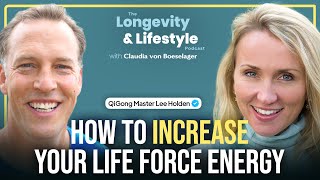
In this Longevity & Lifestyle podcast episode, host Claudia von Boeselager interviews Qigong master Lee Holden about the nature of chi (life‑force energy) and how Qigong can turn stress into vitality. Lee explains chi as the aliveness that permeates body, mind, and emotions, describing its mysterious, fluid nature and how modern science can detect the heart’s electromagnetic field. He outlines the three main Qigong categories—medical, spiritual, and martial—and shares practical, time‑efficient routines (5‑7 minutes, morning or evening) that anyone can use to release tension, improve breathing, and shift emotional states. The conversation covers the physiological basis of stress (sympathetic vs. parasympathetic), the importance of early stress management to prevent disease, and specific techniques such as shaking, deep diaphragmatic breathing, gratitude practice, and the “purge‑then‑tonify” protocol for detoxification. Lee also discusses his personal journey from childhood meditation to studying with Asian masters, his vision of Qigong as a modern bio‑hack for longevity, and practical advice for sensitive practitioners and healthcare workers on maintaining energetic boundaries. The episode ends with resources for learning Qigong (website, YouTube, Instagram) and a call to integrate the practice for a healthier, longer life.
Chapters
Health is not a destination. It's a journey. Each and every day you do your qigong practice, your meditation, your breathing, so that you transform stress back into vitality and you stay healthy. You clear problems in your body almost before they manifest physically.
My guest today is Lee Holden. Lee is a lifelong explorer of qi, or life force energy, beginning his journey at the age of 10 through his parents' meditation lessons. His passion for understanding the body's inner energy led him to martial arts like karate, kung fu, and capoeira. Beyond the physical, he delved into Taoism and Qigong, uncovering the power of chi. Lee also explored Chinese medicine, bridging ancient wisdom with modern understanding. Today, he shares his knowledge as a renowned Qigong master, advocating for holistic well-being and helping others unlock their chi's potential. For vitality and inner harmony. And I would add longevity as well. Welcome, Lee, to the Longevity and Lifestyle Podcast. Such a pleasure to have you with us today.
Oh, thank you so much for having me. Thanks for that great introduction as well. Yeah, let's add longevity to that.
We'll add longevity to that as well. So, Lee, I'd love to start with life force energy, chi. What does that mean to you?
Yeah, I mean, I love this topic too because life force energy is what it's all about. And, I think people intuitively know what it is but not intellectually. What is chi? What is energy? Anybody you ask, you say, "Hey, how's your energy?" They're going to answer you like, "Oh, I feel a little low. I feel a little down. I feel happy." So, we intuitively kind of know what energy is, but it's hard to put our finger on exactly how to use it. And what it is in our minds, which makes it confusing. So like you said, she means life force energy. And let's just do a very basic definition that it means aliveness. It means you are alive. Now, this life force is very mysterious because we can't explain the beating of your heart, let alone the consciousness in your mind. All of this would be chi. We experience it, but we can't explain it. So, there is a mystical aspect about Qi and the practice of life force energy. And, it is so self-evident because we are alive that we don't know exactly how to define it or explain it, so it becomes very mysterious. So, let's just say in ancient Chinese medicine, there are many different kinds of Qi. There's the Qi of your heart, there's the Qi of your lungs, there's the Qi of your mind, There's the Qi of emotions. And so, we can work with this life force energy on many different levels. You can say, "Wow, I'm feeling really emotionally stressed." And, Qi Gong is going to say, "Well, let's work with that stress and transform it into vitality, back into its pure essence, and then redefine it and reshape it." So, Qi, like water, is going to be very fluid and flowing, and it's going to take the shape that you pour it into. And so, in a practice like Qigong, we're saying we have power to move this energy in the direction that we want.
And is it almost like reincarnating that energy, if you will, from say a negative or stress energy and transforming it into a positive one? Is that the imagery I'm sort of getting?
Yeah, that is the practice because life does the opposite. We could be happy and hey, excited about the day, and then we have a few stressful things happen and then we're just like, boo, down. So, the practice is how to transform stress, tension, pain, illness back into something healthy. So, health, vitality, energy, emotional balance, clarity of mind, a deeper connection to each other, a deeper connection to nature and the universe. These are all part of the practice.
Beautiful. And, how is it measured if you will? So, are there different like a scale that the heart lets off certain chi energy? Energy versus stress is at a different level? And when you're transforming it, are you elevating the vibration of it? What's going on there?
I love this question too because we can talk about energy as form and formless. So, let's look at the heart. The heart as the form is a pump that circulates blood. Now, we can say if the Qi of the heart is off physiologically, we might have arrhythmias, we might have palpitation, we might have chest pain. But when we look at the formless, we're going to say, well, the formless Qi of the heart is emotions like love, joy, excitement, passion, compassion, all these things. Loving kindness would be a formless energy of the heart. We can't do heart surgery, open heart surgery and say, oh yeah, you need a little extra love. There's not enough love in there.
Not yet, Lee. Not yet, Lee.
Not yet. Yeah. Yeah. Right? I know. Modern technology is pretty amazing. Yeah. So, this formless energy, it's the frequency of the heart. Now, very interestingly, we know science and medicine can measure the electromagnetic frequency of your heart some 5 to 10 feet away from your body. And, that electromagnetic frequency is like a fingerprint. It is very unique to you. So, we have to redefine ourselves. Are we actually skin encapsulated? Are we just inside here or are we more than that? And, when we talk to the ancient mystics, they say, "You are much more than that. There's this energy about you. There's this vibration, this invisible field." And now, modern science is saying, "Yes, all the organs, the brain has an electromagnetic frequency that extends beyond the body." and especially the heart. The heart's electromagnetic frequency is the biggest. So, practically speaking, we can sense and feel people's emotions, personalities from a distance. We can walk into a room and get a vibe and get a sense. And this is what we might call heart wisdom. Now, what do we do with it? So, we have all these very complex emotions, and we're talking about the emotions of the heart, like love and joy, but there's also the negative side when we feel anxious, nervous, anxiety, worry, stress. Now, this is a different vibration, a different frequency, a different energy. And just like being on a different station on a radio or a different channel on your Spotify, that particular frequency is either going to be harmonious or discordant to you. And what we want to feel is more harmony. We want to feel the right energy at the right time. So, you know, speaking of the radio, maybe you're on, you know, hard rock and it's not that time of day for you to be listening. You want smooth jazz. So, you being able to change the frequency, being able to shift and change the station to something appropriate for you in the moment, is a skill set. So, working with that energy in practices like qigong, the word gong means skill. Skill at working with qi, working with energy. What is energy? So, it's skill at working with the energy of your body, creating health. Skill at working with the energy of your heart, creating emotional positivity or emotional balance. Skill at working with the energy of your mind, creating presence, creating positive thoughts, creating focus and clarity. These would also all be part of this practice. So in qigong, it's like, let's say, like a yoga practice where you're doing movements and you're breathing, but it addresses all aspects of ourselves.
Beautiful. For those unfamiliar, can you maybe just share briefly the history of qigong? People are like, maybe chi what?
What is this?
And like, what?
You know, folks, the hardest part about this practice is saying the name. Qigong, spelled Q-I, which is a translation from Chinese, but it actually is spelled more like C-H-I, chi gong. Interesting, the word gong, the word gong is like kung fu. Kung fu means expertise. So, you have this expertise at working with energy. So, qigong is an ancient practice. It's about 4,000 years old. It's part of Chinese medicine, which is really interesting because Chinese medicine was a practice of prevention. So, I don't know if you know this, Claudia, but the way the medicine worked was you would pay your healthcare practitioner as long as you were healthy. And, as soon as you got sick, you stop paying. You're like, "Buddy, you're not doing your job. I don't feel well. I'm not going to pay you for sickness." This totally makes sense.
What if we could reintroduce this model, Leigh? What do you think?
That is definitely my fantasy. Reintroduce it because we don't have a healthcare model, we have a sick care model, and we don't focus on how to stay healthy. You don't go to your doctor and say, "I feel pretty good. How can I feel better?" And that's what the ancient masters said. This is true medicine. How do we feel better and better? Because health is not a destination, it's a journey. Each and every day, you do your Qi Gong practice, your meditation, your breathing, so that you transform stress back into vitality and you stay healthy. You clear problems in your body almost before they manifest physically. That's what the Chinese medicine approach is. It's like, "Oh, my energy is a little down. My energy is a little off. Let's tune into that on that subtle level and make improvements there before it manifests as a headache or neck pain or anxiety or insomnia," all those things that we as modern people are facing.
And I think this is so fundamental because people underestimate a lot of disease that we have can be brought exactly back to an emotional trigger, a stressful incident, chronic stress, of course. And there's a lot of emotional energetic things that are going on that contribute to the body then finally saying, I've had enough. And it manifests then in a tumor or cancer or migraines or whatever it might be. Yeah. And so for people listening, Lee, obviously, you know, is— does everyone have to become an expert qigong master, right, to practice? Or like, what are some strategies and tools and things people should look out for if they're like having a stressful day? And they're like, this is going to, you know, cause burnout in a few days' time if I don't get on top of it? What are things people can do to tune in, first of all, to see what's off? And then some, let's say, basic steps without going to the full mastery? What would you recommend?
Well, this is such a great question and such a great point because you are exactly right that stress is the root cause of disease and illness. The ancient masters and Chinese medicine doctors have been saying that for thousands of years. And recently, what the latest research shows that stress is about 89% like almost 90% of why we go to our primary care doctors. So, the rate is very high. So, an emotional stress, we were just talking about this, a formless energy, something that we're thinking about, it could be mental stress. It doesn't even have to be happening right here. It could be sitting in traffic because what is stress? That's a good question to think about. What is stress for you? It might be different for me. And so, stress is a perception. It's not necessarily real. So, we need to get our minds and our emotions in order and really orient to actually what's happening. And is this stress necessary? Because stress is a reaction in your nervous system that brings you into the sympathetic branch, which we call fight or flight. And you might just ask yourself, "Hey, I'm getting stressed out. Is this actually a life-threatening circumstance?" Is sitting in traffic life-threatening? And if it's not, do something about it to clear it. Is thinking about tomorrow's meeting a life-threatening circumstance? Most of the time it's not. So, we don't want this overreactive stress response to chronically be going off in our bodies because it does wreak havoc on your health. So, addressing the stress as it comes up in our minds and just saying, "Okay, look, All right, let's just take a deep breath. I'm sitting in traffic, there's nothing I can do. Instead of banging on the steering wheel and tightening my body, it doesn't help the traffic, right? The guy in front of you is not like, "Whoa, that guy behind me is getting real stressed out. Let me change lanes and let you go ahead of me." That's not going to happen, right? So, we have to like, what's a better response? Turn on a little music, change your breathing, notice where you're carrying tension and stress in your body. And people can do that right now. You can say, "Where am I carrying stress, tension, and tightness?" tightness in my body, like your neck and shoulders, you can relax a little bit more. Why doesn't everybody just try that? Just relax a little bit, take a deep breath. And now you just did qigong. You just did something that's going to help your energy because carrying stress in your body takes energy. If you contract your muscles unnecessarily so, you're going to be using energy for that contraction. And by, you know, 2 or 3 o'clock, you're like, why am I so tired? Well, you've been walking around as a stress ball and carrying this tension, and now you're not very efficient at working with your energy. So that's qigong right there. What I always recommend for people is to have a practice because we're all going to get stressed out. We're all going to carry too much tension in our bodies. So each and every day, have a little practice or a long practice. You know, you can, you know, come to my class online. You can follow a video. You can learn a little qigong. And just implement that. It doesn't take very long. In fact, you could do a qigong routine in like 5 minutes and just start to transform that stress back into vitality. And, in that transformation, you have just done very high-level medicine. You've uprooted the problem before it arised as a, like you said, a headache or full-blown neck cramp or carpal tunnel. All these things are rooted in emotional stress. So, don't let emotional stress be like, "Ah, I'm just stressed out. Everybody's stressed out." Don't let that be your way of moving through the world because your body will talk louder and louder. It'll start as discomfort in your neck and then it'll move to neck pain and then it'll move to a headache and then on and on and on. Address it early. And as they say in Chinese medicine, dig your well before you're dying of thirst.
Very smart.
Yeah.
There's a lot of wise Chinese proverbs. And I had the pleasure of living in Shanghai for 4 months.
Did you really? Oh my gosh.
A while back now. Yeah. But I would notice in some parks the qigong sort of collective in the mornings. And so is morning the best time? Is it throughout the day when you need it? And I'm thinking of maybe somebody who might be working in an office, they obviously mightn't be able to just stand up and start doing qigong as well. So are there certain times that you think are very beneficial to have a qigong practice?
Yeah. Yeah. I mean, I think I love the idea of doing it in the morning. First thing in the morning, you think of your qigong practice as your lightning flash of vitality. We want that get-up-and-go energy in the morning. So, most people have a cup of coffee. Well, qigong can be a great substitute or addition to your morning ritual. And you could do— I have a practice, I have a 30-day challenge and it's only 7 minutes every day. So, it's just 7 minutes. And I usually say, "Let's try it, guys. Try 7 minutes in the morning and see how you feel for 30 days." And, you know, that's the same amount of time on your snooze button. So, get up, do your 7 minutes, get your lightning flash of vitality, and see how you feel. Usually, what happens, people want to do more and more. The other good time to do it is sometime in the end of the day where you can just say, "I need a little practice to whatever stress I picked up today, I want to clear it out so that I could sleep well. I can discharge it." I'm not just accumulating stress each and every day. Every day, I'm actually letting it go and coming back to a place of balance or transforming it into a calm relaxation. So, I love that the flexibility of the practice to be able to meet you where you need it. It doesn't have to be a morning practice. It definitely can be. It doesn't have to be an evening practice. It can be middle of the day. It could be a late morning. Just do your practice and take charge of your energy. And, that's really the most important thing.
And, you're saying even 5 minutes is okay or in some meditation types like TM meditation, they say twice a day, 22 minutes. Is there any sort of optimal qigong for vitality protocol?
Right. And, this question is going to be very individual because we are all leading very different lives. So, I like to create practices that meet you where you need it. So, I feel like Hey, everybody's got 7 minutes to try this and do it each and every day, whether it's before cooking dinner or before breakfast, do it together as a family and try it out. Usually, time is a very interesting thing. People say, "Well, I'm busy. I got 4 kids. I got 2 jobs. I don't have enough time." And I'm like, for those people, I'm like, "You don't have enough time not to do this practice. You need to be efficient. You need to be energized." You can't afford to be going through the day stressed out and fatigued. So, get your practice in. And I think, you know, a great way of practicing, two 20-minute routines, fantastic. One-hour routine, great. But if you don't have it, just do one 20-minute routine, you know, 5 days a week, something like that is really a great way to keep your energy moving in the right direction.
Beautiful. And are there different types of qigong? Can you talk us through that? And what are the difference in their characteristics? Like, what makes them different?
Absolutely. And because qigong is such an ancient practice, there are many styles of qigong. I think recorded, there's something like 3,500 different styles of qigong. So, it's a lot. You know, let's say one form of qigong would be tai chi. People don't know this. They know tai chi is its own thing, but it really can be a style of qigong because qigong is basically broken into 3 categories. Number 1, medical qigong. Do exercises to prevent problems, to create health and vitality. Number 2, spiritual qigong. Use qigong as a way to connect to the divine, your higher self, the universe. The third one is Qigong to build energy for martial arts. Martial arts— martial artists use Qigong as exercises to build energy, to create strength and flexibility. There's lots of overlap between these styles, like Tai Chi. People usually do Tai Chi as a form of energy cultivation, relaxation. But, originally, tai chi was a martial art and every movement in the tai chi form is self-defense or a martial application. So, you have these 3 distinct styles. I've really specialized in the medical qigong, helping people go like, "I have a headache," and then I'll say, "Here's the routine for a headache." "Well, I have high blood pressure." "Well, here's a routine for high blood pressure." "I have neck pain." So, I've created all these condition-specific routines. Means to help people overcome their illnesses. I just saw so many people so frustrated with Western medicine, whether it's sitting in a doctor's office for hours or I need to go get a doctor's appointment. Oh, we can see you next month. Well, what am I going to do in the meantime? Just suffer through and be worried about it? I wanted to give people things that they could do, tools and research that they could do immediately to help them activate their own natural healing power within themselves.
So beautiful and so powerful. And the fact that, you know, once you've learned the practice, it's free. You're not dependent on, you know, somebody else or a machine or a doctor's office or an appointment, which is really phenomenal. But can you share with people listening what are different use cases? So you mentioned, you know, with like headaches or, you know, stress, but what are other, as you said, medical scenarios where you have worked with people with? And maybe you can talk about some of the success that these patients and clients have had?
It's really all walks. I mean, everything from neck pain to terminal cancer, Parkinson's to insomnia. I mean, it's just like from mild health things to very, very severe. And, we've seen miraculous things, absolutely miraculous things where it's just like, well, get your affairs in order, you got a few months to live. People start their qigong practice and they are in remission. Now, why is this? It's not necessarily that the qigong healed them or I created some magic formula. No, it's really you have healing power in your own body. Now, that healing power isn't activated when we're stressed out. It's simple physiological explanation because when you are in survival mode, your body allocates all its resources to focus on the external and to be in fight or flight, right? So, all your energy is going to your muscles, all your pupils are dilated, your breath is fast. And so, your body's like, "We don't have time to self-regulate and self-heal because we got to be on alert for danger." When you can relax, relaxation, your energy moves from sympathetic to parasympathetic. What do we call parasympathetic? We call it rest and digest. So, that means your energy is going back to your center. You're actually going to be able to digest your food because your body's like, "We can digest now. We're not about to be eaten by a grizzly bear. Now, we can bring that energy inward." The other thing in parasympathetic, what happens? Your internal healing power gets activated, reignited. So you do your qigong practice, it clears stress. You start to relax, you start to feel really good. And all of a sudden, your body's like, oh, we got problems in here. Let's start to clean it up. Let's start to heal. We all have tremendous healing power when we set up the right context. And qigong sets up the right context for healing to happen.
And now a quick word from our sponsors. Thank you so much for your support as it helps keep our content free for everyone. This episode is brought to you by Mimeo Health. As many of you will know, intermittent fasting can offer incredible benefits such as improved mood, energy, metabolism, and longevity optimization. But long-term fasting can be tough. Enter Mimio Health, the world's first biomimetic supplement designed to mimic a 36-hour fast at the cellular level. It allows you to activate your body's regenerative abilities, even during meals or shorter fasts, for optimized metabolism, hunger control, enhanced energy recovery, and improved mood and mental clarity. I'm a big fan of Mimio's health supplements because it uses naturally occurring molecules which align with your body's biology, backed by a 100% happiness guarantee. So start complementing your health with Mimio Health supplements today by going to www.mimiohealth.com. That's M-I-M-I-O Health, H-E-A-L-T-H, dot com. And for you, dear audience, get 10% off with code Claudia10 at checkout today. And now back to the show. Does it also shift? So I think from an energetic perspective, let's say a cancer would have, cancer cells would have a different energy than other sort of healthy cells. Does it sort of detox and clear those more stuck energies that can happen in the body? Is that also what's happening?
Yep. And it's called, you know, cancer would also be called stagnation. It could also be called depletion, like we're just completely depleted. So, you don't have enough energy to actually— your body to perform physiologically and then this other energy takes over. So now, as you start to build healthy energy and get it to circulate, there's a saying in qigong, "Flowing water doesn't get stagnant and the hinges of an active door don't get rusty." And, the same is true of your body. So, if you if you are just sitting too long, stressed out, not moving, not breathing properly, mind is full of worries, or we're emotionally stressed out, it's going to create stagnation. Over time, like stagnant water, that water just becomes gross and yucky. Yeah. Right? Those are official Chinese medicine terms, gross and yucky. So, in that stagnation, what happens is you can get things like a tumor. You can get this proliferation of bacteria, negative energy. Your immune system is dramatically compromised in those circumstances. Get that chi, get that energy to circulate. And again, your body's energy becomes like healthy flowing water and it removes that stagnation. So, that's where this practice can become magical and miraculous. All of a sudden, you get the energy to circulate and your body responds and you're like, "Wow, I feel better." Not only do you feel better, you are better.
And, it would have an impact on mental health as well, right? So, you're essentially always clearing the stress and clearing any of those negative charges.
That's a big thing for me. I think people really suffer from mental and emotional disturbance. People just don't know what to do. I'm stressed out, I'm anxious, We're always looking for something external to do or to take. Nothing wrong with that, but know that you have the power to shift your mind and your emotions. Now, the simple thing is that your emotions follow your body. So, breathing, for example, is reflected in your emotional state. So, if somebody's sad, how are they going to How are they going to breathe? They're going to breathe shallow. Their chest is going to sink down, right? And they're going to breathe very shallow. And when someone is sad and depressed, they have a hard time inhaling, right? So, they can't— Extreme sadness also has a hard time exhaling, like we don't want to let go. So, you can see how somebody's breathing and how they're feeling. Stress is rapid breathing through the mouth.
Shallow, right? Well, right.
If you try this, if you look up and everybody can try that, just kind of, you know, bring your chest up, look, bring your chin up, take a slow, deep breath through your nose. And it's a posture for happiness. In the same way, if you sink your chest and bring your chin down, you go, suddenly you're like, oh, people are going to look at you and say, what's wrong? So, change your body, change your breath, and your emotions will start to follow. This is a simple technique. And, of course, there's much, much more to it because we've been ingrained with a lot of emotional patterns, but you can really help your body and your emotions by changing the way you're breathing, the way you're standing. And, a simple thing is to, for example, when you're really stressed out or nervous or anxious, if you shake your body, this is a qigong exercise. Like animals do, or you see an athlete before an event, they're like, they're shaking, they're breathing. You know, we don't do that before a meeting. We don't do that before we take our kids to school and get in the car. I mean, I do. I have 3 teenagers, so I'm like, you know, 3 teenage girls. I mean, if I get them a healthy breakfast, in the car, no fighting, and to school on time, I'm like, yes, where's my gold medal?
Exactly.
So, I prep for that kind of stuff because you want to bring your best energy into the things you're doing in your life. And, you know, a qigong exercise of shaking and audience, you can do this really simply by just taking your hands and shake like this. You know, the heart meridian is right there on the inside of the wrist. So, discharging it by shaking, shaking your wrist and taking a few deep breaths is going to help your chi. Is everybody doing it?
Okay.
Now take a deep breath while you're shaking your wrists. Take a deep breath. Don't do this if you're driving, guys. Don't do this if you're driving.
Keep your hand on the steering wheel, please.
Yeah. Do one hand at a time. And then if you just put your hands in your lap, you're going to feel a little buzz or tingle in your hands and your fingers. Now your chi has been activated. The sensation of activated energy is electricity, like electricity moving, tingling. And you want that tingling energy to move in your body. And this is just one little exercise, but you can really get this buzz and energy and strong vibration where you're like, "Wow, I feel so good." Most people don't know how good they can feel. You know, in a scale from 0 to 10, most people are living at a 3 or a 4. You know, these practices take you up to an 8 or a 9 where you're just like, Yes, I feel great. I'm charged up. I'm excited about my day.
Beautiful. What a nice way to start the day as well. And is it enough to just do the hands or do you think people should be shaking?
Do the whole body. Yeah. What you do is when you stand up, you just bounce into your legs and you shake your arms, your spine, the back of your neck. And that is a fantastic way of discharging stress. So anytime if you feel stressed out, You stand up, shake for 2 minutes with real deep breathing, and you're going to be like, wow, where did that stress go? It's not in my body anymore.
It's so amazing. And I mean, for people who have pets, they'll notice it as well. Like, you know, I have a dog, right? So, if there's anything that bothers her, she'll kind of shake it off, either if she's like very excited or something kind of a bit strange, she'll shake it off and then she's fine again. And we forget to do that as humans. We're just like in the stress state the whole time, kind of wandering around the place. Piling on the stress energy over and over again. So everyone listening, just remember to shake a bit more often. Plus it's good for you, right? So a little bit of movement and jumping around.
You do it when you're standing in line at the coffee shop. I mean, you know, what happens is you're just like shaking and the person in front of you is like, you know, buddy, you should go ahead of me. So not only do you clear stress, but you get to the front of the line faster.
Or everyone will get inspired and you can break into dance in the whole coffee shop.
Yeah.
Team up. Exactly. Lee, I'd love to switch gears for a minute and just learn more and share with my audience more about your background. How did you get into this? And can you share a little bit about your journey?
Yeah, you know, number one, I think you mentioned in my bio, my parents were very much into creative visualization, meditation, hypnosis. They were sort of exploring all that stuff. Like you. Yeah, right on me. They took like a weekend workshop. Yeah. They're like, we took a weekend workshop on hypnosis. Let's try it on the kids.
That's a bit like me and biohacking devices with my kids as well.
Yeah, yeah, exactly. So, you know, my parents would come in and, you know, kind of count us down and lead us through meditation. And I started feeling energy. So, I remember being about 15 years old and just having this surge of energy in my body. Tingling, buzzing electricity. And, I was like, "What is this?" And, it really wasn't until I was in college exploring a bookstore about Chinese medicine, tai chi, meditation, qigong, and I started seeing meridian lines and acupuncture, acupressure points. And, I was like, "That's what happened to me." And, I got really interested. So, I started reading books on it, exploring. I went to some workshops on the practice. And, I was also a collegiate soccer player. So, playing collegiate soccer and at a school like UC Berkeley was very stressful. And, I had a low back injury. And, Qi Gong and acupuncture is what healed me. So, I was like, by my junior year of college, I was like, "I want to do more of this stuff." So, Interestingly enough, the first qigong book I bought at this bookstore, that particular teacher would come through my university town. And, about once every 6 months, I'd take a workshop with him. And, I kept asking him, "Hey, can I work for you?" And, he finally hired me as a ghostwriter. I started writing his books and organizing his material for him. I'd take a workshop, I'd write up notes, I'd help I'd help him organize it into a book format. And then, he had me come— as soon as I graduated, I went to Thailand. And, that's kicked off my journey of traveling through Asia and studying with various healing arts masters, tai chi masters, qigong masters. I'd go to China, Japan, Indonesia, Thailand. And, not only was I working with this master writing his books, I was also studying with a lot of other teachers. And my question was, how do I explain all this esoteric wisdom to my soccer player friends that are now working in Silicon Valley getting all stressed out? So, I started really figuring out how do I make this applicable to Westerners.
Thank you for doing that, Lee, because the world needs this and especially in the West as well. Obviously, in Eastern medicine, they're more familiar with it. What were some of the most pivotal or profound insights during that journey and traveling in these incredible places around Asia? That really, really were game changers for you?
Yeah. Well, you know, I mean, some of these masters just blew my mind on what the human potential is. You know, they could do incredible things, not only healing, but just when they would, you know, send you energy either through like an acupressure point or just even from a distance. It was so tangible. It was startling and scary for me at first because they were just so powerful. And I was like, oh, these are the Olympic athletes of qigong practice. These are the masters that have just reached a high, high level that most of us haven't achieved. So, I've met a lot of those kind of masters.
So, in terms of boosting energy, boosting energy, Lee, what is the best way of implementing qigong? Is it you were mentioning breath and releasing some of the stress and things like that as well. But, let's say someone is going into that board meeting or presenting to 100 people on stage or whatever it might be, what is a beautiful way using qigong to really up your energy levels?
Yeah, beautiful. And, I think this is so key. I think of qigong as the practice of increasing energy and decreasing stress. And, as you decrease stress, your energy levels will go up just because you're not using your energy inefficiently. One way to boost energy, and this is somewhat counterintuitive, is to move your body slowly and in sync with your breath. And so, when you see people doing qigong, they're moving slowly. And the reason is because when you slow down, your body relaxes and you're more receptive to taking energy in and to circulating the energy you have within yourself efficiently. So, it's this really beautiful practice because you move your body slowly, when you slow down your body, you slow down your mind. They're connected. And so, there'll be all these different patterned movements where you're moving very slowly with relaxation, very gracefully, flowing like water. And all of a sudden, you're like, "Wow, I just feel not only more energized," but you feel this high-quality energy. You feel so good. And that is the beautiful thing about the practice because Qigong is called the art of effortless power.
Oh, that's a very good phrase.
You just have to observe nature. You're like, oh, wait a second. We are doing something counter to what nature is doing. You know, the river at the top of the mountain isn't all stressed out about getting to the ocean. It's not like, oh my God, look at all those rocks. How am I ever going to get around those rocks? No, that would be a neurotic river, right? So, Nature actually moves very efficiently, very effortlessly, and we can too. We just have been ingrained to be stressed out, to feel busy, whether we are or whether we're not, to feel anxious. Our stress pattern is hypervigilant. And so, we're getting all this stress when it's not necessary. And we need to do some practices to be able to Relax, center, and return to flow.
Beautiful. And I think that's such a good analogy of people. I was just literally before our conversation observing how beautifully the trees are just swaying in the breeze. And it's like this effortless ease and grace that's happening with them. Yet we all think we have to be busy and here and the next thing and grabbing the coffee as we're running out the door. And we stress ourselves out so much. So I love the concept of to boost energy, you slow down and that will refocus, rebalance you. And that energy that you have is not going to be stressed out, but actually to the beautiful power that you can have then to, to create wonderful things in your life. So I love that. And I'd love to ask about detoxing and Qigong. Can you guide us through how you can use Qigong for detoxing and for increasing, obviously, your health in that respect? Regard as well.
Yeah, yeah. And your body is naturally designed to get rid of toxins. So, you know, we eat food, you know, a lot of it's nutritious and healthy. Your body's designed to eliminate the waste. Now, what people— I think this is fascinating— we are designed to do that emotionally as well. So, we go through your day, you get stressed out, that is toxic. And there's a lot of good things that happen, you know, like people say nice things to you, you have a great conversation, you have a good laugh, What we tend to do as human beings is let go of the positive and hang on to the negative. So, detoxification emotionally would be hang on to the positive, let go of the negative. So, what do we call this? We call this gratitude practice. You practice gratitude, that's like, "Oh, let's reverse it. Let's not keep the stress and be like, 'Oh, that person said this.'" "Out of 100 things that happen, 90 could be positive, and we're going to hang on to those 10 negative." Change that, transform that. At the end of the day, think about a few things that you're really grateful for, that you really appreciate it. Put some energy, attention, and focus on it because it does take training. We're more hardwired to focus on the negative emotions. We're just designed that way. It's part of our survival mode. So, to be truly happy and to be relaxed, it takes some training. We're not— your system doesn't prioritize that. So, gratitude can be a good emotional detox. Now, physically, how do we physically detox? So, you can work on breathing. You can breathe from your belly because a lot of the diaphragmatic breathing is going to help to massage the organs. And help detoxification. I don't know if people know this, but about 70% of toxicity is eliminated through exhaling. Most of the toxins in your body are stored in your blood, and we want to work on exhaling. Exhaling is an act of letting go. So, longer exhales, long, much longer exhales. Like, if you try exhaling right now, you're going to find at the bottom of where you say it was a normal exhale, there's a lot more breath that you could still blow out.
Yeah.
So, longer exhales is really good. Now, in Qigong practice, we have a whole set of exercises. They're called purging. And really, they're just about detoxing, clearing areas where you hold stress, letting go of emotions, making sure that we're emptying out before we, what we call tonifying, which means to bring in. So you purge before you tonify as part of our practice. And we're going to do a whole bunch of those kinds of exercises right in the beginning of practice.
Beautiful. So you're kind of having a fresh palate, if you will, that you can build up on. Yeah.
Empty the muddy water out before you pour the fresh water in.
The traditional Chinese medicine sludge and slime.
Exactly. Dredge the channels.
What are you excited most about in the qigong space and getting your message out to the world? What's your vision for the next few years?
I mean, I just, I love being on podcasts like this. I've been doing a lot of TV interviews. I'm going all over the country doing morning shows and I'm teaching like the hosts of the morning shows like a 5-minute routine. And it's hilarious because some people I'm like, oh, you don't know how to move the body. You're just like, how does this thing work? How do I drive this thing? I'll teach a simple movement and they're just doing something completely different. And I'm like, "Oh, right." We're living up from our necks up. People really don't know how to move their body with relaxation or with ease, and they don't know how to breathe. So, I love teaching people these tools and resources because I see profound effects on their health and just their overall enjoyment in life. So, this is really inspiring. It's fun for me. I'm passionate about it. I'm doing all kinds of things online because I could just reach more people than I can if I'm just doing things live and in person. I do live and in-person events as well, but I love being online and teaching people how to circulate their energy and really help them to address those things that are bothering them with condition-specific routines. And so, I love people to just be in my class and get as many people doing it as possible.
Beautiful. I wanted to ask you a question from something you mentioned before, and it was the more energetically aware you become through your practice, are there any sort of negative implications? Are you much more sensitive, let's say, to negative people or stressful situations? Let's say you observe a fight or something like that, or are you not bothered because you know you can clear it straight away?
Right. And that's the hope. So the gong, the skill set of working with energy, is that yes, you become more sensitive, so you're more empathetic, you're more intuitive, you are more perceptive. But in that sensitivity, it's very important to be able to clear or to be able to delineate. That's their energy. That's not my energy. You know, like at a buffet, you don't have to eat all the sugary foods. You can say like, that's their energy. I'm not going to choose to ingest that. Emotionally, we can do the same thing. And that's a skill set to say, Hey, that's your energy. I can really be here and support you and I can offer my listening, my presence, my suggestions, but I don't have to take it on as my energy. And this is extremely important for healthcare workers, whether you're an acupuncturist, a doctor, a psychologist, people are telling you their problems all day long. So, there are great qigong routines just to keep you protected if you are one of those sensitive people that feel like they take on other people's energy. And emotions and stuff. You're just like, "I don't know why I feel depressed." Or, I had friends that were acupuncturists and they would come home. They're like, "I have a headache and I have PMS and I'm a guy. I don't know why I just took on all this energy. I better learn something to clear it." Beautiful.
And, I think that's a very good point with people who maybe work in the medical or therapeutic professions that are dealing with sick and illness and complaining the whole time that that can have a real impact on the psyche, right? So, being able to clear it out, Even just standing there and just shaking it up between patients, it's probably very helpful.
Big time. Yeah, it is. It is huge. And, I think for those people, the time to do a 10, 20, 30-minute qigong routine is at the end of the day. A lot of just clearing, move your body, deep breathing, a little reset, flowing moving meditation, and you're just like, I'm back. Now I can transition from being at work to coming home and not take all that energy of work into my family.
Yeah, I think this is a great practice for in front of the front door of the house. People can start a Qigong practice and not bring it in, right? Or leaving the office maybe as well.
I love that.
Yeah, that would be really, really great. Lee, if you could live to 150 years old with excellent health, doing lots of Qigong, obviously, how would you spend it?
Oh my goodness, that is my goal, right? That is definitely my goal. Qigong is called the art of preventing disease and prolonging life. So, the Qigong masters were definitely the original biohackers. They were very interested in longevity because life is enjoyable when you're living it in a skillful way. And, there's so many things to experience and through experience, we gain wisdom. So, the longer we're here, the more wisdom that we can gather and gain, the more we can share that wisdom with others. I think, for me, living into 150 would be enjoying my family, my community, seeing this beautiful world, and really being an instrument to help people live their best lives. I mean, I think that is really something that I'm extremely passionate about. To help people create that shift. I think if there's more happy, healthy people on this planet, we're going to treat each other much, much better. And we're going to treat this beautiful planet that we live on with respect and honor and enjoyment.
Yeah. We share similar passion as well because then people can focus on living their true purpose and creating a beautiful impact on the world. So, here's to more of that. There's so much overlap with qigong and longevity, so I absolutely love it.
Yeah, absolutely.
Lee, where can my listeners and people watching interested in understanding Qi and Qi Gong for longevity purposes as well, where can they find out what you're up to and find out more resources for it?
Beautiful. Yeah, come to my website at holdenchigong.com. So, Qi Gong, Q-I-G-O-N-G, holdenchigong.com. And, we have a subscription where people can just join on Zoom and take classes with me weekly. We have, I do workshops, like 3-hour workshops on specific topics. And, I did one on longevity, Qi Gong for longevity. And, it was great. It focuses on the principle of resiliency, which is strength and flexibility, like a tree in the wind. It's strong, but it's also flexible. And this workshop was really focused on that. And I learned this from a teacher of mine who was 106. And she taught this whole set of movements and she said, like, "Hey, you do these movements, I guarantee you're going to live past 100." And so, I was like, "I'm going to learn those." Done. So, that was it.
I'd love to share the link with my audience. We'll put it in the show notes as well. So, I'll get that separately off of you. That would be beautiful. And what about social media? Is, can people follow what you're up to?
Yeah, Instagram, Holden Qigong Official. And we have a great YouTube channel with lots of free content. It's Holden Qigong on YouTube. Yeah, subscribe there and you get all kinds of great little videos and quick little routines for this, that, or the other ailments.
Beautiful. Lee, do you have a final ask or recommendation or any parting thoughts or message for my audience today?
Wonderful. It was so nice to be here. I mean, I think find your flow, find your own unique energy because you are unlike anybody else on this planet. And, when you connect to it, that authentic expression comes forth and you feel this effortless power moving through your life where unseen energy conspires with you rather than against you. And, whether it's a practice like qigong or meditation, contemplation, you know, tune into who you truly are from the inside out.
Beautiful. Thank you so much, Lee, for coming on today and sharing your wisdom. And everyone interested in longevity, it sounds like we all need to get into qigong very soon. So we'll be following your work, Lee.
Thank you so much, Claudia von Boeselager.
Pleasure. Thank you.
More from Claudia









Can Psilocybin Slow Aging? The Study on Telomeres, Inflammation & Survival with Dr. Louise Hecker

