The Journey to Waking Up, Curiosity & Gratitude
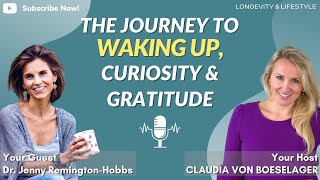
In this Longevity and Lifestyle Podcast episode, host Claudia von Boeselager interviews Dr. Jenny Remington Hobbs, a psychiatrist‑turned‑coach who survived a severe, rapidly progressing form of multiple sclerosis. The conversation traces Jenny’s personal health crisis—from a bone‑marrow transplant unit where an Einstein‑quoted mug sparked a pivotal shift in her thinking—to her subsequent deep dive into neuroplasticity, gratitude, and the power of curiosity. Jenny explains how the disease forced her to confront her unconscious belief systems, leading to a broader understanding of the Hero’s Journey as an allegory for personal awakening. She describes the AHA framework (Awareness, Heart, Action) she co‑founded with her husband Max, detailing the structure of their 10‑week group programs, the role of online community, and the practical daily routines she uses (cold‑water immersion, breathwork, brief yoga, music‑driven movement). The dialogue also covers her rapid‑fire reflections on success, favorite quotes (Einstein, Nietzsche, Jung), and a closing message urging listeners to stay curious, embrace the “I don’t know” mindset, and lead from the heart. Throughout, Jenny weaves together personal narrative, scientific concepts, mythic storytelling, and concrete tools for lasting behavioral change.
Chapters
Hello, lovely listeners. I'm your host, Claudia von Boeselager, and welcome to the Longevity and Lifestyle Podcast, where I invite pioneers and thought leaders in all things longevity and lifestyle to give you the strategies, tools, and practices to live better and help you reach your highest potential. Today's guest is Dr. Jenny Remington Hobbs. Jenny is a coach and guide to many people around the world. She's a leading expert in human behavior and neuroplasticity. Jenny's work combines her years as a medical doctor and psychiatrist and her own amazing healing journey with decades of studying psychology, neuroscience, physiology, functional medicine, nutritional science, fasting, and breathwork. Jenny started her career as a doctor in London specializing in psychiatry. Her own healing journey woke her up to some timeless wisdom about the nature of the mind and our unconscious programming. She drew all of this to co-found AHA, that's A-H-A, with her husband Max. The AHA team's mission is to empower people to wake up, reconnect with their true nature, and contribute their magic to the world. Jenny guides groups of women on transformational journeys of awakening and reconnection. Her clients come from all walks of life, from CEOs, entrepreneurs, coaches, psychologists, doctors, actors, students, many of whom are mothers. In this episode, we dig into the waking up journey, the power of being curious, how life can be transformed from an Einstein quote, curing MS, multiple sclerosis, gratitude and learning even hell has joy, living from true purpose, not egoic purpose, and much more. Before we begin, please hit subscribe to the podcast and share with those who would like to improve their health for longevity too. I would also love to hear from you, dear listeners, so please leave a comment below or reach out to me on Instagram @longevityandlifestyle. Please enjoy.
Welcome to the Longevity and Lifestyle Podcast, Jenny. It's an absolute pleasure to have you on today, and I'd like to take a moment to express my deep-felt and profound gratitude for you and all the amazing work you've done, because you've literally changed my life over the last year. So with all the amazing teachings and sharings, I'm so excited to have you on today to also share with my audience the work that you do and the incredible insights that you have. So really a huge, huge welcome to you today.
Oh, thank you, Claudia. It's absolutely wonderful to be here. And yeah, from my side, just immense congratulations on your fabulous podcast. Like, seriously, bringing to life what's so meaningful to you. It's just, you had this vision, something that really matters, and you went for it. You know, you took action serving other people and doing what you love and what you're so passionate about. So from my heart to yours, just a super huge well done. It's a real treat to be with you here on this podcast that you've created. So thank you for having me.
Thank you so much, Jenny. Jenny, I'd love to start with your incredible health journey, which has brought you to where you are today. Is there a particular moment in time when the course of your life, the trajectory, just shifted? Can you talk about that?
Gee, Claudia, that's a great starting question because, you know, there has been a massive shift. I'll circle back to sort of the story, but there was a shifting point. Absolutely. I was on a bone marrow transplant unit, very sick and feeling very sorry for myself, very focused on all the misery of my disease and chemotherapy I was receiving and the treatment and life in general. And there was a nurse who used to come and sit with me in the early hours of the morning when I was feeling my most sick. And she had this mug with Einstein's face on it and a quote. And the quote said, we cannot solve our problems with the same thinking that we used when we created them. And I saw that quote sort of every morning at sort of 2 in the morning for quite a long period of time, in a very intense period of my life. And it just struck the deepest chord inside of me. And how profound is that, Claudia, that we can't change our problems with the same thinking that we used when we created them? And yeah, that was a real turning point for me. I started to think, 'What have I created here? And what kind of thinking am I using?' I suppose that was a turning point moment, a real aha. But just to circle back before that image, I was a successful London doctor living a very high-octane life, you know, just really going for it. I suppose in many ways thinking I was on purpose. As we all know, there's a big difference between true purpose and egoic purpose, as there's so many people out there chasing what they think their purpose is, is actually very different to their true purpose. And I really discovered that my life went down a very different trajectory when I got sick and I started to discover that. So yeah, Claudia von Boeselager, my health journey in was— now as a doctor, and to go from the doctor to the patient in a very short space of time. And I got really quite sick. I had a rapidly evolving type of multiple sclerosis and was going downhill really fast. And my life was turned upside down. So pre that moment with the Einstein mug, I suppose the day I got my diagnosis, you know, that's a life-altering moment. And as I said, it absolutely flipped everything on its head. There's a story in a story with all of that, I suppose, leading all the way through all the different treatments and things I tried through to an aggressive, highly aggressive experimental treatment that I ended up having in the States involving a lot of work with my bone marrow and stem cell transplants and pretty much a year in quarantine. So I was well prepped for this period in our lives right now.
Who would have known?
Exactly. Who would have known?
It's good training for, you know, 2020. And yeah, by the end of that year, I had sort of new autoimmune diseases and my bone marrow sort of being attacked and platelet issues and needing more chemotherapy and daily transfusions just to be okay. So I think it's impossible not to have your life absolutely flipped on its head when you're going through that kind of a physical, emotional, psychological journey. And I would say that, you know, the journey from there into wellness, sometimes I think it never ends because as you know, you know, we carry so much layer upon layer in our fascial layers, all different aspects of us. And I think it never ends. For me, certainly disease and the disease process has been the greatest awakener and gift of my life, my life and my husband's life. Honestly, we would not change a thing of the journey that we've been on. And I think the big thing is just how much I've learned and how humble I am through it and how wondrous it is actually to have these sorts of experiences in one's life where you really hit rock bottom and get to evaluate what really matters, how you're operating, possibly asking some very deep questions that, you know, we don't get to engage in a normal day life when we're just buzzing around coping. So yeah, there was so much that's been learned along the way from the way back from that Einstein Cup.
I love the analogy of the Einstein Cup, and of course, what an appropriate person as Albert Einstein to be giving guidance at the lowest point.
Exactly.
I'd love to just dig a little bit into that. What was the self-talk like, Jenny, in those moments? I mean, I can't even imagine what you must have been going through, and, you know, it must have also felt very isolated, alone. You said you were in the US, not in London. Going from being the doctor to the patient, what were the questions and what was that journey of self-talk that brought you out of that experience to heal?
Wow.
The first thing, as you asked that question, that I thought is, what was the self-talk? I'm not sure I had any. I know that sounds strange, but I think my level of awareness about my own inner chatter was really quite low.
But there was definitely a lot of noise and a lot of woe is me. I felt sorry for myself and extremely angry and very unconsciously sort of wanting to lash out on the world around me, expecting all sorts of things from people, you know, the source of all of our suffering, expecting life to be different and people to be different. So it was very, very loud. And as you identified, alone. But there was something strange, Claudia, that is a bizarre thing to admit, which is in the midst of all this sort of trauma, there was curiosity as well. And there was a tiny part of me that popped up every now and again, but I didn't know what to make of it or how to address it. That sort of was asking questions or posing just little insights of, huh, this is interesting. This is a pretty full-on experiment. And my identity, my brain, my mind was sort of thinking, what are you talking about? This is all happening to me. This is devastating. You know, I'm a young woman in her prime with I've got an incredibly successful career ahead of me and I can't walk. I've got an amazing marriage and I can't engage in all the things that people of this age do. And I had had chemotherapy. My ovaries had been destroyed, so I was infertile and in menopause. So there I am kind of in the prime of my life, infertile, not able to have a child, suffering with, you know, all kinds of side effects from the treatment as well as the hormonal knock-on So very alone and very disconnected from my own age group and really asking big questions. What is the point of this all? You know, what is the point of life actually? What is the purpose? And so that took quite a long time. And I suppose working through that, and I'm sure we'll come to it, but, you know, I had the most amazing healers and teachers and went on a ride of amazing self-knowledge and studying. But probably the biggest thing that I woke up to through disease which I know probably sounds bizarre, but was gratitude. The strangest place to find it, isn't it? The gratitude. And I don't mean rainbows and the sun is shining. I mean, for everything as it is, you know, very sick in bed, sort of having chemo for breakfast. It was the sense of when there's meaning and purpose and an open heart, even hell has joy. And that's the thing that I was really struck How even amidst all of that, when I started to ask questions of myself, this seemed like a purposeful time in my life. It was tough, but I felt like I was learning so much. And as I said, you know, through that little tiny portal, just that Einstein quote and just sort of being awake all night and looking on the internet, I felt purposeful. I felt like I was discovering something. I had no idea what, and I thought it was just how the hell to get through this., but it was much deeper than that. And for yourself or for your listeners, you know, multiple sclerosis, it's a demyelinating disease. It demyelinate nerves in your brain and in your central nervous system. And it was through my journey and my disease that I became very, very interested in the brain. Now, obviously as a doctor and as a psychiatrist, I already had quite a big interest in it, let's say, but when it's your own brain, you know, demyelinating in front of you. And you can see the physical effects in your body as it's happening in real time, I think your focus becomes a lot deeper. And because of this demyelinating disease, I became really, really interested in neuroplasticity, which is the brain's ability to rewire itself. So that in itself was almost where you could imagine the story stops, because it was such a profound thing for me to wake up to this really, Claudia, to start to do some deep work once I finished that year and I really had hit rock bottom again. You know, new disease, more chemo. It's like something's got to radically shift here. Like, what is going on here? There must be another way to look at all of this. And that's when I did a lot of work on rewiring my perceptions and of myself and of others and life around me, asking some quite counterintuitive questions and really allowing myself the time to go in deep. And as that was happening, look, in conjunction with amazing things that were going on medically, I watched in real time as my body began to heal. Medically, we were hoping to progress the rapid rate of progression of the disease, but the craziest stuff started to happen as I became more grateful, more centered, and asking real questions like, how is this serving me? And how is this actually on the way to what I'm most interested in, which is human behavior and the body and the mind and the body-mind link and every single miraculous aspect of each cell and the depths of our psychology and what's driving us. Like, how could this not be more perfectly sort of teed up for me as a massive learning experiment? But as I got to look at things in that way, the old lesions actually started to disappear, which was something we could never have even imagine that fibrotic tissue regenerating is not something that was even potentially on the cards. And sometime down the line, there was no evidence of multiple sclerosis. There was no evidence of the other various illnesses and things that had been brought on by the chemotherapy. And actually, I suppose one of the best parts of the story is I ended up having an ovary transplant just to try and help with the menopause and everything that was going on so radically with my estrogen levels. And the next thing I was pregnant. My 7-year-old daughter says she spotted a gap. She said, "Mom, I saw a gap and I came in." So, you know, it was a few years of all this. Like, we tell the stories if it happened quickly, but really there was this just sense of the power of gratitude and seeing the order in our lives, especially when the chips are down and you feel like everything has fallen to pieces and you're knee-deep in all of your own darkness and noise, you know, that in itself was a healer, was a great, great healer. And of course, as you can imagine, once I'd seen that, there was really no turning back as to what's possible when we start to understand our minds and also how our psychology affects our physiology and also the connection that we have with so much of what's actually going on around us. So as I said, it was just phenomenal journey and so many great teachings. But, you know, there was a point, if I'm really honest with you, after several years and I was working with clients doing sort of neuroplastic work and having, you know, great progress with myself and those I was working with. But I did feel that I started to sort of hit a glass ceiling. And I know that you're in the longevity lifestyle game. So we all know that, you know, you try something and it works. And then there comes a point where the sort of the hedonic adaptation and And you have to get into the next layer of your understanding and your awakening and your realizations. We are— now I say to people who I'm working with, you know, we're all works in progress. There's no there to get to, and there's always a lot more to learn. So there was a point where suddenly it was like, okay, just gratitude, like it's not doing everything I want it to do.
Oh, so many questions following on from there, but maybe we just take one brief step back. And you said, you know, you were trained as a medical doctor, started off with focus on the brain and psychiatry. Can you just talk briefly about that? Was this always your passion since childhood? What made you decide to become a doctor and go into psychiatry, which ended up serving you quite well with what you're doing now?
Certainly did. Almost planned. Yeah, I was in the UK with my education system, and I couldn't pick whether to go with more the arts or the sciences. It just wasn't an obvious thing for me at school. I love both of them. And when it came to that sort of point of really deciding on big subjects, you know, I wanted to have art and English at at the same time as chemistry, biology, maths, physics. But Edson seemed to be the answer to somehow bridging art and science. That excited me. And biology A-level, the parts on the human body, I had the most superb tutor. I actually, I was sick. That's probably when some of my health journey began. I missed a year of school in my A-levels and I had a fabulous biology tutor and we did the whole syllabus in probably a couple of months. And I got an A without even thinking about it. And it just felt so obvious to me, like I sort of come home to myself. So yes, there was something from a quite young age that loved the body. And I've been fascinated by psychology and humans and what makes us tick. You know, my parents got divorced when I was younger and we jumped between different continents. And between my husband and I, I think we've got about 10 parents and multiple siblings and the complexities of who likes what and who thinks what of who. And all of that, I think, was hardwired in me to try to figure out what's going on here, why are we triggered, what's the way through, what makes someone happy and somebody else not happy. But really, you know, when I got into medicine, psychiatry wasn't the obvious one. I loved trauma. I loved working fast, and I was very geared up. I'd done all my initial training, and as I was getting into my much more senior post, that's where I was going into trauma training.. And it was literally almost a week before the final part of the applications. And I was heading into sort of being, you know, in my senior role, the finishing training. I just had this light bulb of, what are you doing? It was a week of nights working in A&E and everybody who came in who had any kind of psychological distress from attempted suicide to psychotic breakdown, they kept calling me. They're like, oh, Jenny loves this stuff. And at the end of the week, I had seen hardly any trauma, a few gunshots, but mainly the psychiatric patients. And I found so much joy and fulfillment. And it was just a thing of, what are you doing? You've got to pick a lane. And it almost felt like a no-brainer. And you can imagine my seniors and my mentors absolutely appalled. People don't go from trauma to psychiatry. It's like different worlds. Within a week, my life changed quite quickly and I applied very quickly. I did my psychiatric exams very fast. And so yeah, it wasn't something I'd always wanted, but as I progressed, it just became more and more clear that that was my calling.
Super exciting. I'd like to take a segue into the hero's journey, which was such an eye-opener for me when you shared it with myself and the group. And we'll get into those details soon. But for people unfamiliar, can you talk about what the hero's journey is and why it's so powerful?
[Speaker:CLAUDIA VON BOELZER] The hero's journey, it's an allegory. It's an allegory of the journey of the soul and the psyche. And it was developed by Joseph Campbell, who was a professor of comparative mythology and religion. And he wrote the seminal book, you know, "The Hero with a Thousand Faces." And in it, he synthesized the myths and the legends from human civilizations across many cultures, many cultures over thousands of years. And it was remarkable, his findings, which were that, you know, he synthesized all of this into realizing that there's basically all those different sets and settings, and those were different for all these different cultures and civilizations. Our human stories sort of share the same structure and the same themes. And the hero's journey, it really speaks to something intrinsic about who we are and why we're here and what our true nature is. And it's an allegory. A lot of people take it very literally. But it's an allegory that speaks to us the way that we interpret the hero's journey, speaks to us about something far deeper and us all sort of coming from, you might call it, the great beyond, something bigger than what we can understand and being born into mortal understanding. And that's what the hero's journey is, is being born into mortal understanding, into our minds and our bodies, and actually forgetting, forgetting who we are, forgetting the creator inside each one of us, our true nature, our hearts, and our unique purpose that seeks to express itself in the world. And so the hero's journey, it's you, hero meaning it's not masculine, it's masculine and feminine, it's the masculine aspect inside each one of us. That's our personal myth, you know, our unique story. And when we take a bigger step back, you know, it's almost sort of the unconscious beliefs that us humans have about our hearts not sort of being viable in the world. And the journey expresses the urge within us all at the deepest level to come back to our hearts, back to much more of who we truly are. And, you know, many great thinkers over thousands of years have got their version of this to explain our human journey. And through so much of our studying and putting together these different strands. It's just magnificent to see from a Western perspective, you know, the lineage tracing all the way back its roots through Neoplatonism, Hermeticism, Stoicism, Gnosticism, Aristotle, Plato, Pythagoras, you know, way before that, back into ancient Egypt. And then you've got other lineages in the East, you know, all have their— since tracing back thousands of years, it's just amazing that, that both sides And so many religions are grounded in this story. And many of the great stories that we all love, you know, The Lord of the Rings and Superman and Star Wars. Star Wars. Exactly. Harry Potter, The Lion King. It's like there's just literally thousands of different stories, all with the same underlying meta point. And the hero's journey, we could talk about it for ages, but it's really about, as I said, it's got the outer and the inner meaning about being born and going into hiding, going into our egoic vehicle, which we need. We need in order to be human and in order to be individual and in order to orientate ourselves on Earth. It's our identity, you know, it's a sense of separateness. We need that to have our own individual identity. We speak a lot in the work that we do about the individuation process, sort of coming through that separation process, which we all need to go through to experience life as individual humans. But the hero's journey, that's the part where you actually sort of come to believe this separation and you make up all sorts of stories you're unaware of about who you are, about others, about life. All of these stories that are not based and grounded in truth. They're there as a necessary part to be separate, but it's almost like we have these stories about ourselves that are all negative that sit in our unconscious about somehow us being unlovable. And then we go into hiding, and we over-identify with all of these beliefs and our personality, forgetting who we are, and all sorts of things. And I might not be good enough, I might be unworthy, I might be powerless, whatever it is, and spend the rest of our lives putting all of the energy into resolving this, to resolve these underlying beliefs, this identity, that was formed through our separation. So that is really the beauty of the hero's journey. It's realizing how much energy is going into protecting one's heart rather than living from it. And there comes a point in the journey where people, each one of us, we meet what they call in the journey the wise man, the wise woman, our intuition. It can be through initiation, through ancient practices, but it's sort of the coming out of hiding, and it's stepping into your intuition, like, you know, be reminded of who you are, that you are the hero, you're the hero of your journey, and that you are part of the great dance of life, you know, and that you have a purpose. And the wise person, your intuition, sends you off on the quest to face your demons and kind of reclaim your birthright. And again, it's all those same stories, you know, Gandalf or Morpheus or John the Baptist, you know, sending the hero off into the quest where you meet your head-on, you know, the myths that sit at the heart of your personality. And it goes further and further into pacifying that dragon and stepping into, you know, the highest form of love and acceptance of yourself, including your so-called dragon. And that's through awareness and observation and integration. And something magical happens on this journey. It's almost like you start to transmute your beliefs into something different. And you stop putting all of the power into resolving these beliefs and resolving stories of your ego, and you take the power back and you step into much more your true nature. And in the story, you connect with the treasure that the dragon was actually guarding, you know, the elixir, the, the magic potion, the Holy Grail. And the inner meaning of all of this is you reclaiming your inner treasure, remembering who you are, your unique talents and your gifts and your heart and your creative superpowers, and that you're connected through time and space to so much. And it's a journey that we're all going through. It's just whether you're doing it consciously or unconsciously. And then the hero brings that treasure back to the community, you know, it's in service of one another. Come back connected to your purpose and you use those gifts and those talents in service of life, in service of others. So that is sort of a bit of a summary of waking up from poor little me, poor little kid, you know, the victim of life, into realizing, you know, the powerful creative warrior that you are. So I suppose, you know, going back on my story, that waking up journey was a great example of the hero's journey, which, as I say, we're all living the entire time. It's just how conscious are you of what's going on.
And how powerful it is to have that awareness as well, which is what you help your clients, myself included, to realize. I'd love to circle back on something you said before about hitting a glass ceiling and some of the learnings that when you realized gratitude brought you really far, but you realized that you needed some other tools, let's call them, to move beyond. Can you talk a bit more about those learnings and what those other tools are?
Absolutely, Claudia, and that almost ties in the hero's journey in many ways because, you know, that was journey that I was sort of consciously going through. Well, consciously and very unconsciously. But, and gratitude, not to belittle it, gratitude is the elixir. It's just, it's a template or it's the foundational block. But I started to sense that I wasn't getting down to the heart of the issue. And, you know, in terms of what we just spoke about there and the hero's journey, I didn't understand what was actually running me, what was creating my thoughts, and my feelings and therefore driving my behavior. But I was on this quest, you know, I was on my journey and I had this deep desire to heal and to understand and to grow and was very happy to experiment. And that took me down many different paths and decades of really studying physiology and functional medicine. I got into nutritional science and neuroscience and fasting and psychedelic research and breathwork, just to name but a few. And that sort of knowledge and that direct experience was profound. I had some profound experiences, some mystical, but to be honest, still not understanding what was keeping me and my clients, you know, in their default ways of thinking. It's like you wake up to something and then you realize you're still back in it. And I think that's the struggle for all of us, isn't it? It's, you know, our heart versus our ego, our mind versus our creative spirit. And, you know, this took me and my husband down a path of exploring all sorts of sort of deep wisdom traditions and depth psychology and philosophy and, and of course came into mythology and things like the hero's journey. And what I really came to see was that we, like the vast majority of people, vast majority of humans were asleep at the wheel, you know, in the hero's journey, the child in hiding, sort of the waking sleep, you know, unaware of our operating systems, unaware of what was running the whole show. I couldn't hide from it, Claudia. I just saw in such crystal clarity, there was no way of getting away from it. And I was seeing it with people I was working with all over. It was just so clear that none of us had any idea really of our unconscious programming, you know, the lens you see the world through. And isn't that everything? It's like the lens dictates everything. It shapes how you think, and it shapes how you act, and ultimately how you experience life. And that was a big waking up. It was sort of— because until you wake up to your program or your programming, it runs you, and you end up just creating situations and problems again and again, you know what I mean? That sense just rinse, repeat. Here I am again.
Yeah, and I think that that is, you know, so profound. I'd like to just, you know, dive into people listening really realize that one is to realize that we are choosing how we perceive things. So to even realize that that belief system that we have ingrained is so running the program that we need to wake up to the fact that it's even in place. I think so many people don't even realize it. And I think always a good test is, you know, if you reflect back on your life, and it's particularly the things that maybe didn't work out or whatever, and you see the repeat pattern. I think that that is just such a perfect telltale sign that you're running in that same cycle of this unknowing unconscious belief systems. And this is why, Jenny, you have the solution to this, which I love. Could you talk a little bit more about these belief systems and how they trigger us, how they, you know, how they come to part as a child, but what are some of the strategies and tools that you offer your clients to know that they have a choice to not be run by them all the time and choose their life that they want?
Thank you, Claudia. If I just take one step back from that, because it's quite a radical idea. You know, I had done so much studying. I was a qualified psychiatrist. I was supposed to know about the mind, and I had done a lot of exploring myself, and then through the health journey as well. But I was completely gobsmacked. It came as if from out of nowhere how conditioned my mind actually was. And I don't mean theoretically, I mean seeing living proof of the same problems coming up again and again and again. And I think that almost if we take a step back and just say, you know, over the years and working with so many different people, it sort of came into this appreciation of something a bit deeper, which is that, you know, where you focus creates your reality.. And I think that we as a species, we don't know about that. Where you place your attention, you know, it determines what's happening in your life, you know, what's being created in your life. And before we even understand about the programming, it's important to know that the truth is, is most of us are unknowingly focused on all of the wrong things. So, you know, it's coming through the hero's journey, coming through individuation, separating out into being the unique you and all the stories that you have about that separation. And as one grows up, you know, believing that more and more, you know, we develop these negative beliefs about ourselves and others and the world. We don't even know it's happening. It's sort of very stealth-like. And in terms of the brain, in terms of neuroplasticity, those paths get laid down. It's almost like you get a really strong motorway and that is where everything goes down. And the A roads or the B roads or the sort of more minor roads will disappear. And you have just got the Autobahn with these thoughts just going up and down that. And everybody has these, you know, it makes us human. You can call it the ego, you can call it beliefs, you can call it the mind. But these beliefs, they sit at the heart of our identity, our personality, and we need them to make our way through the world. You know, they orientate us, they give us a sense of where we are. But mostly we are unaware of them. And because we're unaware of them, they have a huge amount of power over them because they sit in our unconscious. And I just wanted to mention our focus creates our reality in terms of this, Claudia, because, because they sit in the unconscious and the unconscious is where all of our program is. Most of our focus is on these beliefs, and therefore that's what's being experienced in our lives. It's like without being aware, we're focusing in on all of our flaws, and we therefore create the exact reality that those flaws look like. You know, we create the same thing that we're actually trying to escape from, and it's happening under the surface. It's subtle, which is why so many people do experience the same things happening, as you said, you know, being let down, things not working out for you. And if you look at it carefully, you can see there are patterns. And it also explains why things get worse and more entrenched as we get older. You know, it's like going down the same ski slope again and again. And those tracks get thicker and thicker and thicker in our mind, the way we think, until those tracks are a deep ravine. And you don't even know that you're on a mountain any longer. You're just deep, deeply in the tracks of the mind. And that's what happens to all of us. We forget our true nature. And instead, what what we do is we spend all of our time focusing in on the smallest parts of ourselves, trying to fix ourselves, putting all of our energy into fixing. And I say this with all due respect as a doctor, a psychiatrist, and a patient who's wanted to do a lot of fixing.
Oh, beautiful. I want to dig into what you're doing at AHA and where the name and everything came from. But before that, just a few rapid-fire questions. Firstly, when you think of the word successful, Jenny, who's the first person who comes to mind and why?
Oh, rapid-fire questions, Claudia, is going to make me have a whole story. So the first thing that comes into mind— what's the definition of success?
So you ask, and what's your definition of success?
Perhaps my definition of success is definitely along the lines of what we've been speaking about. It is connected in with your true self, with your true nature, and with your purpose, and being led by their heart. There are people who come to mind, some of my great teachers and mentors, alive and dead, and Einstein would probably be right up there. But then I can also look at a woman like Oprah Winfrey and say, when you feel that woman's energy, she's in service and she's connected with her heart, and she seems to be operating from that space. But I would say, for me, anyone who's actually living from their true nature has been a success. And this is an interesting question because many people think that they're living their purpose, going back to the beliefs, but their behavior, which might make them look successful, is a compensation to deal with underlying beliefs. So a lot of people who might answer that question might be looking at growing huge companies and doing amazing things out in the world. But a lot of the time, that's actually driven by an unconscious belief that someone might not be good enough, and they're compensating by working extremely hard, and they're not in their true nature. You know, they're believing that they're only valid if they are a success, and they're needing that successful business to be seen, to be validated, to do more and more work to get more of that, working hard, achieving more, never getting off the hamster wheel, kind of irrespective whether you are unfulfilled or your relationships are in tatters or your health is frayed. So I think living according to one's true nature would be my definition of success. And I think we all flip in and out of it the whole time. So I think the more aligned we are with our true nature, the more successful, according to my definition, one would be. So I know I haven't answered your question with who is a person, but I would say that scientists who are trying to solve the great order of the universe, have me at hello. You know, they're bringing science into a bigger realm. And so some of the, you know, Bohr or Bohm, some of the quantum physicists, Einstein, but he's standing on the shoulders of Newton. You know, these are people who for me have led deeply successful and meaningful lives. And actually, in fact, as well, Viktor Frankl is someone who I put up there whose entire quest was to find meaning and purpose driven from the deepest place inside himself. So I have lots of people I would regard as successful because they've been the most inspiring and, yeah, extraordinary teachers to me. And they've succeeded because they've given me a whole different understanding of life and have helped me to— they pieced together so many of the pieces and allowed us to make sense of it later on.
What a beautiful answer, Jenny. Thank you for sharing that. Jenny, morning routine, because I know you so well, I know you have probably the most amazing morning routine. But can you share with my audience how you start your day for success every day?
I think it has been an iteration. As with all these things, we never nail it. You know, we never get there. We are always learning, adding in new things, overcomplicating, then throwing the baby out with the bathwater. But how we start the day, it is just the most important thing. You know, you wake up every morning and you are pretty much in your beliefs. You know, you are coming through this quagmire into an altered reality because sleep and wake are different states of consciousness. And what you do in that waking up time, how you set the day up, and whether you are getting into a creative orientation about trying to connect with what your intentions are and what you would love to create with the day, or you are getting into a fixing orientation, focusing in on all the problems, all the things that are not going right. I think it starts right up front. So for me, I wake up and I get straight into cold water. That is the thing. I literally walk out of my bedroom in my very normal teenage grump, and I throw myself into some very cold water. And there's nothing quite like that for some state changing. And then it's a little bit of breathwork, and this is all, you know, quick and user-friendly. I think all the things that I use are designed for busy people who are generally parents who are working or trying to build something. And as you well know, there's a fine balance of quite how much time there is in the day. So I do cold water swimming, I do some breathwork. I then do a very brief sort of yoga routine that is out on a patio that looks over our amazing view. And that in itself, we live in very big nature and that just connects me with everything. And that start of the day, you know, with looking over nature and I listen to, I know this is strange, but I listen to like really evocative active electronic music whilst I'm doing my yoga. It's quite— I'm a yogi and I dance and I really get into it. So I'm moving and it doesn't take very long. And from there I orientate myself, I connect in with my true nature and that there's nothing to fix. And I get into that energy and then I connect with what I love. And as you know, the programs that we create, you end up by the end of of having a set of choices that you make about who you are and where you're headed. And so I make my choices with a lot of emotion. Sometimes I shout them, sometimes I scream them, sometimes I dance to them. And by the time my daughter wakes up, and that really doesn't ever take me more than half an hour at max, and I can definitely do it in 15 minutes, I'm ready to rock. I'm in my heart, I'm energized, and It doesn't matter what kind of a funk I woke in, and it doesn't matter what kind of temper tantrum she might throw. I'm there. I'm like, okay, here we are alive in another day.
I love that. Fabulous. What is an unusual habit or an absurd thing that you absolutely love?
I have already said I love— my husband and I love electronic music, and we have a dance-off every night. So that's kind of how we close the day. Myself and him and the kids, you know, we have, you know what I mean by poi? They're lights that you can throw around and play with. Yes, exactly. So we will have those. And so we're not bad at poi. We know we've been doing it for a while. From, from the outside, it would probably look quite pro as a crazy family. And we, we have big speakers and we have big music and the lights go off and we dance. There is some Taylor Swift for her that gets me mixed in, but generally it is the music that we choose. And then when we got married, we did our first dance to a song. And it is a weird thing we do every single night as a family. That is the close of before she goes to bed is that we dance together to that same song. And it is a really beautiful close to the day. Often there are some tears. I could not think of a better habit that found us because that is definitely not in the, like, neurohacking self-development world, isn't it? Well, get your glow sticks, buy big speakers, blast music, and then dance to the track that you first danced at your wedding to.
So wonderful close to the day. I absolutely love that. I've done kitchen dancing with my kids, but to daylight. I haven't tried the darkness effect, and I haven't tried the glow sticks, which I think my kids would just absolutely love. So I'm definitely trying that one next week as well. Thank you for that, Jenny. What has been quote or favorite piece of advice that has been a real game changer for you? You mentioned obviously the quote on the Einstein mug.
Oh my goodness, you know me and quotes, it's like wowzers. There's just so much inspiration. Nietzsche said, there is more wisdom in your body than in your deepest philosophy. That was a real thing for me with all my clever mind stuff, and I think that the body and dropping into the body. That's a quote that I really live by, like, get out of your fancy PhD head, you know, like, really, what is the deepest truth here? So that, and there's also, Claudia, I really, you know, Socrates, knowing, knowing yourself is the beginning of all wisdom. Now, I think that without knowing ourselves, like, unless you understand yourself, you know, unless you understand your ego and your beliefs, because people think they know I often see this. I have coaches and psychologists come to work with me and they are like, I know myself, you know, I have done all this work. But I mean really knowing yourselves. You just do the same thing again and again, creating the same outcomes. And it is why I think so many of us are struggling, you know, emotionally with anxiety and stress and loneliness and overwhelm and lack of fulfillment and fear and anger, etc., etc. It is just sort of knock-on effects from not knowing ourselves on society and on our physical health. Because, you know, when you're operating from deep in your own beliefs, unconscious, your body, a lot of the time, you're all in self-preservation mode. It's all fight or flight because it's, it's all a threat to your ego. And your body is just flooded with cortisol. Your sympathetic nervous system is on overdrive. It's a very, very big deal. So I think that the quote, you know, about knowing yourself and that knowledge really being The bedrock, the foundation of everything. Those are my favorites. And there's another one, Einstein, one that I love as well. Reality is merely an illusion, albeit a very persistent one, which I love because it ties up with neuroscience, you know, really like cutting-edge neuroscience of what we're discovering. And there's some fabulous TED Talks and things with Anil Seth. He says we're all living in a hallucination. When we agree on that hallucination, then we decide to call call it reality. And I love that because I think, you know, Albert Einstein was again ahead of the game, you know, showing us what neuroscience is showing us decades down the line.
So those are some of my favorites. I love that. And I love the quote you also taught me from Einstein around imagination, and I'm gonna butcher it, but along the lines of imagination is a peek into, uh, what is the—
he said imagination is more important than knowledge. And there's more to that, but he also says that imagination is a language The Soul, right? He said, pay attention to your imagination and you will discover all you need to be fulfilled. And I think the part that he said that you might be referring to, he said, imagination is everything. It's the preview of life's coming attractions. I love that one too. Thanks for reminding me.
I love that one. I love that one. And it's so exciting as well. It's such an exciting area. So I absolutely adore this space, and I would love, love, love now to jump into AHA and ask where this name AHA came from and what exactly is the work that you do with AHA and help to transform so many people's lives.
Well, Claudia, I think, you know, it's almost like all the problems that we've discussed, if you were a listener, you might think, I've got a program that's all around these beliefs that I didn't even know about, and I'm focusing on that without knowing that, and I'm creating a reality around that.
What the heck? I think that's a good question.
That's a solution. That's a good one. We came up again and again that the answer to this kind of self-destructive unconscious dynamic is awareness. You know, we've touched on it, but it's waking up to this programming, your particular beliefs, your particular stories, how they drive you and how they play out. And we really feel that the way back home to understand yourself and your program is through awareness. Okay, so we can stop reacting to old wounds, sort of getting lost in all that noise of thoughts and feelings. And awareness is just incredibly empowering. It really, it wakes you up, it sets the foundation of the journey back home to your true nature and purpose. It's sort of almost what you could say pillar one, because what it does is it gives you that choice. Choice is everything, you know. It gives you that pause and the opportunity to choose and the freedom to then connect with what you truly love, what you truly care about, what is actually most meaningful to you, so that you can do that and you can then contribute in your away, exactly what you're so beautifully doing, Claudia. So our work in the world is very much around those lines. You know, we run a series of online programs that take people on transformational journeys, you know, from where they are, which is unaware of programming and conditioning, and sort of to wake up to this and to reconnect with one's true nature and get real clarity on a vision of what you'd love to create with your life and learn the and the structures to make it happen. So it's a long answer to what the heck is aha. So we had a lot of people coming through this journey who kept saying, we're having another aha moment. I just had this aha moment. Oh my gosh, another aha. So that seemed to be sort of quite a meta theme going on with our work. Aha, aha, aha. And I don't remember who said what first, but I remember us sitting at the kitchen table and writing down what is this all about and what are these pillars? And as I've said, awareness is pillar 1. You know, awareness is uncovering your unconscious program, what's driving you, so you can move into a different space. So that became the A. And then it was so clear that heart— heart was the next bit of learning to actually accept yourself as you are and then reconnecting with your essential nature. So that was the H. And then the third bit was I was like, well, that's all very well, but you know, there are a lot of people trying to do that. But we felt that once you've got that, once you've connected with something deeply hard or mystical, you need to come back and be a human and you need to put yourself to work. It's about action. You've got to get clear on what you'd love to create and learn how to manifest it and develop a structure that keeps you connected and in your heart and like a whole toolkit around that. So those are the three pillars that we've been working with: awareness, heart, and action. AHA, which is all about aha moments. So I think again, I think the name found us is what the journey is. It's coming through your awareness into your heart, and then you've got to go out and take the action. So yeah, that's where that fun name comes from.
But I really love that. I mean, obviously the whole journey and the understanding is phenomenal, but the actual action that you are able to help clients with, myself included, I think is such a missing piece because anyone can read books and understand, etc., but it's actually using that and implementing it in a structure and actionable insights that you can do every single day, that is just so powerful. Can you talk a little bit more about what your clients go through and the fact that it's group sessions and how that actually works? What does that journey look like?
Well, you know, I could put that back onto you. Now, this is the thing, you came through your beliefs and you connected with a vision, and here we are on your podcast fast. You know, it's quite something. You know, we do group work. I lead women through programs and Max does men. Sometimes we get questions about why the separation, and there are various reasons behind it. But what we found, as you go deeper into the work, it's wonderful to just be with your fellow brothers or sisters kind of going through this deep transformational journey. And we work online, which we've done before everything else went online. And people often say, how does that work. And actually, what reason that we did it is because I had a bizarre experience. I always used to do in-person sessions, and I moved countries, and I'd sort of— an old client was trying to get hold of me in a new country, and we went on, back in the days of Skype, and it was the most phenomenal session. She was in her bed with her laptop, and we had a profound breakthrough, and I've been working with her for 6 months. And I think that the online stuff opens a huge amount of opportunity for us to take off another mask, take off more layers, because you're with a group of people around the world. It's a small group, it's very intimate, it's very contained. Everybody's on their own waking up journey, but you're with the collective energy, and it's phenomenal to have this human interaction, but it's not too intimate. You know, you're not sitting in a group where you might bump into each other in the shops straight afterwards. And I think that that actually just allows people to sink in deeper. And never mind the convenience factor, you know, you do it from your own home, there's no travel or anything. So yeah, so people come on these journeys with us— that there's a series of different journeys that we do and different lengths of time, but it really, all of them take you through awareness and you come into realization through a process of different exercises and coaching and videos and a whole bunch of distillation of so much of the knowledge that we've learned over the last few decades into really user-friendly ways of being able to come online with your own awareness and into your own heart and then into taking the action. So everything on all of our courses are broken down into those three sections because there needs to be that separation that needs to be becoming aware of yourself and then dropping into your heart and then going on to take action. What we found with the group work as well, as well is that there's the group energy that is unparalleled. But Claudia, what's really amazing about the group is that you can't hide because whatever's happening in the group is your own experience. So if you're looking at a whole bunch of other women and you're thinking you're the ugliest or you're the stupid one or everybody's doing better than you or you're not getting it or whatever it might be, that's just information about your beliefs. And so we tease all of that out and we get to see what's really going on in the unconscious, which wouldn't come out if you were just sitting in a one-on-one in a really nice relationship where none of those thoughts were becoming conscious. Does that make sense? I mean, I don't know what it was like for you in the group, sort of coming online to yourself and your own inner world whilst— because you're watching the reflections of others and the immense learning that comes through other people.
So what I really love, and I know some people don't like a group dynamic and things like that as well, that I think for me personally was less of an issue. I love people and I love connecting with people, as you know. But what I found was so fascinating is when other people were expressing issues or concerns or challenges that they were facing, it was almost addressing something that I didn't even realize I actually thought as well, or I knew. So it was sort of an amplified version of uncovering issues or paradigms or ways of thinking that were so unconscious that thankfully brought up then by some other people that were in the group and allowed for a much more expedited unraveling and solving of those things as well. And I think that the paramount thing is that the awareness, like actually having the knowledge that everything in our reality is our belief system, our choice that we are choosing because we're focusing on it. And by having that awareness, you can actually take a step back and then refocus on the things that you love and that you want. And you mentioned before the difference between the egoic purpose versus your true purpose. So your program and your course that you have allows people to really find their true purpose versus just ego and society and, you know, what your parents were telling you growing up— you should be a lawyer, you should be a doctor, whatever the case may be. And then the joy in it as well, you know, knowing that you have this pure freedom and sort of the heavy weight of expectations and growing up that you've pretty much put on yourself, you've interpreted that other people put onto you, but you've put on yourself, that you can break free from that and actually live from a tremendously profound, exciting space of creativity. It's been so transformative and so phenomenal.
So yeah, thank you again. It's been a privilege and a real joy to watch you and to watch so many others, because these teachings are the teachings, but you have to put them into action. You know, you have to then do the doing. And that's the part we really encourage the most, to say you've got to go, and whatever your intuition is guiding you, you've got to take action. It's not about waiting. And a lot of this New Age stuff of, you know, this instant manifestation and things will just flow to you— you need to set up the structures in order for all sorts of magic to unfold. Nothing just comes to you. So just saluting you again for actually taking the action.
No, and for you being the guide on this as well. So I'd like to talk on two topics. One is about setting up the structures. Can you explain what exactly you mean by that?
Yeah, okay. So talking into structure, what does one actually mean about structure? That's a big sort of question in itself of what does one actually mean by structure? And there's lots of different ways of interpreting structure. So, by structure, let's be clear what we're talking about. Creators understand, if you're in the business of creating, that if they structure their lives to focus on creating what they actually love, then that's what they'll be focused on, and that's what will be created. But structure is how creators design their environment. And when I say creators, I'm talking to each one of us. I'm talking to the waking up to the fact that you are a creator. But designing the environment is key, and this is an internal environment inside of your own consciousness as well as an outer kind of physical environment. The inner environment is learning the structure about where you're actually focused in, in yourself, where you're coming from in yourself, setting up structures in your own consciousness, which is, you know, what we do on the program. That allows things to flow in the direction that you actually want them to flow, which is the whole point really, right? Because without this, you get stuck into the default state of consciousness, which is, you know, a slave to our egos and our beliefs. But there's the other part, which is the external, the environment, which is sort of what we've spoken about before, you know, waking up, doing things, whether that's movement or breath or cold water or some kind of a physical embodied practice and some kind of a meditative practice. We do daily priming. We take people through sort of a priming that brings in awareness and connection and focus. But these structures, we all need them. We need inner structures inside of our own consciousness, which we can only set up when we know what our beliefs are and how we're unconsciously trying to resolve those. But we need structures in our external life as well, because the ego will always overshadow the heart. So without those structures in place, you know, I wake up most days thinking, oh, I want to sleep some more, just 10 more minutes, I don't want to get onto my yoga mat, but just do it. You've just got to do it. You know, you've got to commit to that, whatever it is, 15 minutes or whatever it is that's manageable for one's life, is actually committing to that structure and following it. And the magic happens when you actually commit to the structure, that you're not shopping around for something to fix you. You're committed to a structure internally and externally that you're going with, that if set up correctly will flow down the path of least resistance into creating things that you actually care about.
Thank you for explaining that. I might— could ask so many more questions, but I'm just wary of time today, so we definitely have to do a part 2. But Jenny, where can people be in touch with you? Where can they learn more about what you and Max are doing?
Oh, thanks, Claudia. So our website has everything. So that's www.aha-project.com, literally A-H-A. When I say everything, we're always works in progress. So it probably has nothing compared to what it will have a few years down the line. And Claudia, we've been in a real two minds about the whole social media aspect because it's very unaligned with so much of our principles. Which is about helping people to wake up from the very thing that we're all engaged in, in social media. But I think we're heading down the path of Instagram purely for trying to get the message out and giving some high-value content on a platform that may be often just about our egos playing games. But yes, so we have our Instagram page, it's accessible through our website, and through that you can book calls and discovery calls and figure out whether the program fits for you, what you'd like to do, or just learn more about it.
And they are 12-week programs, right? Or how are you structuring the programs at the moment?
So at the moment they're 10 weeks, and there are short ones and there are more advanced ones, but the foundational program is 10 weeks.
Exactly, 10 weeks.
Yeah, excellent.
Jenny, do you have a final ask or recommendation or any parting thoughts or message for my audience?
You asked me earlier as to some of the people who I admire most, and I spend a lot time quoting Carl Jung and, you know, how until you make the unconscious conscious, it will direct your life and you will call it fate. And I think there's such profundity in that, that, you know, until we know what's actually driving us, this directs our life, and then we say it's just happened to us. So I think one of the things to say to the audience, to say to all of us out there, is to stay really curious, to stay open and curious, and where possible, to lead from the heart and to not play out the same old dance, to try to understand what is actually coming from inside of us and what we are creating, because we have the power to create so many magical, extraordinary, and beautiful things in this life of ours. So I think that the parting message is to drop into the most simple thing that we do and that we teach, and it's my greatest teacher, which are 3 words, and that is, I don't know. And I think, I don't know, I know you use I don't know, I use I don't know, but the I don't know mind is the place where you can start to see your unconscious, the place you can start to see your patterns, the place that you can start to have a different outlook and a different way of stepping into the world by not thinking you know and not playing out the same dance again and again from the tried and tested path of the ego. So that would be my message to the audience is just let's keep dropping as humanity into I don't know. Let's use that bridge into our intuition because we don't know. And the more you think you do know, the more you actually don't know. So I think for all of us, staying open, staying curious, and that we are all students here together.
What wonderful advice. Dearest Jenny, thank you so much for coming on today.
Such a pleasure to have you. Thank you so much for having me and just been wonderful spending some time with you. Absolutely loved having some time to catch up as well.
Thank you, Claudia, so much. Claudia von Boeselager here. Before you take off, I hope you enjoyed the episode and learned as much as I did. If so, please hit subscribe so you don't miss out on our next episodes. I would also love to hear what you thought, be it your favorite part, quote, or other feedback from the episode. So please leave a written review on Apple Podcasts or on social media. And if you think this episode will help someone in your own life, share it with them. Together we can change our own lives and the lives around us for the better. Until next week, goodbye, farewell, and choose to live well.
More from Claudia









Can Psilocybin Slow Aging? The Study on Telomeres, Inflammation & Survival with Dr. Louise Hecker

