The Shocking Truth About COVID-19, Vaccines and Public Health Policy with Dr. Peter McCullough
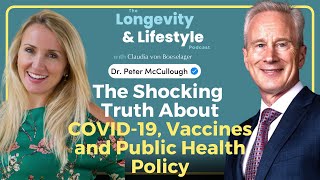
In this Longevity and Lifestyle Podcast episode, host Claudia von Boeselager interviews Dr. Peter McCullough, a U.S. internist, cardiologist, and epidemiologist known for his dissenting views on the COVID‑19 response. Dr. McCullough argues that the pandemic has lasted five years—far longer than the 1918 flu—because mass vaccination accelerated viral mutation and prolonged societal disruption. He claims public masking was ineffective, caused physical (micro‑plastic/fiber inhalation) and psychological harm, and that quarantining healthy people was a policy error. The conversation turns to early outpatient treatment: nasal sprays, gargles, ivermectin, hydroxychloroquine, monoclonal antibodies, aspirin, anticoagulants, and other agents were allegedly suppressed by government agencies, medical societies, and the WHO, leading to unnecessary hospitalizations and deaths. Dr. McCullough highlights conflicts of interest within the FDA and other regulators, noting that many former commissioners later joined pharma boards. He presents VAERS data suggesting tens of thousands of COVID‑19 vaccine‑related deaths, especially among children, and describes the spike protein as a lethal component. The discussion expands to a historical critique of the childhood vaccine schedule, citing smallpox, polio, and pertussis incidents, the 1986 Vaccine Injury Compensation Act, and rising rates of chronic conditions allegedly linked to vaccines. He advocates for voluntary, risk‑stratified vaccination without mandates, rescinding the 1986 act, and allowing individuals to make informed choices. The episode concludes with a look at a growing “health‑freedom” movement, the work of the McCullough Foundation (research, media, litigation, policy), and a call for listeners to seek independent information.
Chapters
Welcome back, dear audience, to another episode of the Longevity and Lifestyle Podcast. I'm your host, Claudia von Boeselager, here to bring you the latest insights and learnings to improve your health, life, and happiness for longer. Thank you for being part of this tribe and wanting to be at your best each day. If you haven't already, make sure to sign up for my free weekly newsletter, where I share lots of interesting and fun things, inspiring tips and research around longevity, health, and life in general. Just go to llinsider.com. My guest today is Dr. Peter McCullough, a prominent American board-certified internist, cardiologist, and epidemiologist who has testified before the committees of the US and Texas Senate regarding treatment of COVID-19 and management of the pandemic. He has gained significant attention for his views on COVID-19, including early treatment protocols and vaccine-related discussions. He has published over 1,000 articles in medical literature. Today we will dig into topics like the pandemic response, lessons learned, childhood vaccinations, and much more. Please enjoy. Welcome to the Longevity and Lifestyle Podcast, Dr. McCullough. It's such a pleasure to have you with us today.
Thanks for having me.
I'd love to dig into the lessons learned from the COVID response. So where can we start with that? What should people know about in this regard?
You know, the big picture is this pandemic, the COVID pandemic, which is not over with, is 5 years in duration. The last global pandemic we had was the 1918 Spanish flu. It was 2 years in duration. Why is it lasting so long? What's extending it? And the best research points to the, to basically mass vaccination. If We try to vaccinate the entire world against a viral disease that's prevalent and it's mutating, that the virus quickly learns to mutate and escape the effect of the vaccine. And so the vaccination program, in my estimation, has prolonged the misery of the pandemic.
And that's, I think, a really interesting and important point for people to understand in terms of vaccines are developed on viruses that have since pivoted, iterated essentially. So they chop and change, and we don't hear nowadays that much about COVID and it's not a very hot topic in the media, yet it is still prevalent. It's not going anywhere, correct?
That's correct. Now, the progressive mutations have made it a much, much less severe disease. It's indistinguishable from the common cold. In my clinical practice, I don't even test for it anymore because essentially the entire world has had it, I think. I find an occasional patient who has not had COVID, But if the entire world had the illness, think about this. All of the efforts to stop the spread, all of the efforts on contagion control, contact tracing— remember, someone would get it and you trace the contacts— all of that had the pretext that one could avoid getting SARS-CoV-2 infection. And the pretext itself turned out to be completely false.
Why is that? Why was it just bad research? Or do you believe that something bigger was happening behind the scenes?
The first SARS pandemic burned out. It was really an outbreak, not a pandemic, but it burned out within about 90 days. And so it had a higher mortality rate, and it turns out people could avoid getting it. And so, or they did, they apparently avoided getting it. And so I think that was the original thought is, remember we heard monikers like, you know, just a few weeks to slow the spread, or this is going to be over with. And initially in 2020, I did think it was going to be a relatively brief pandemic, is what I thought. And, um, I had communicated with some doctors in Canada who faced the first SARS pandemic, and they said, yeah, it was about 90 days of wearing a mask. And I said, well, okay, I can do that. Little did I know that as a hospital-based doctor during that time, I would end up wearing a mask for 3 years continuously.
And the impact of that as well, right? Psychologically for human contact relations. And one of the most important things we know, the longest running study out of Harvard is the importance of human connection and having people not have any contacts with other humans being covered up. I mean, mass implications for mental health and wellbeing. But I want to understand a bit more from your view, what are some of the biggest things that went wrong as such? What could have been done earlier? And what are some of the other lessons that you would like to to share?
Well, since we're on masks, I'll just say that this was thoroughly reviewed. There were randomized trials and other prospective comparative studies. Public masking didn't work, and it didn't work at all. Partly, mask expert and engineer Richard Petty has shown that 17% of the air moves around the mask, doesn't, you know, goes around it, you know, around the upper and lower boundaries of the mask. The viral particles can go right through the mask., and so efforts at masking completely failed, and we know this because in the end now, our CDC says the only time we should wear a mask is when we face a patient in respiratory isolation, which is we're back to the original protocols that we had before the pandemic, and the reason why that's the case, this is very important for people to understand. I recently was on Fox News Business with Liz McDonald. I told her this, and she was, you know, blown away. The reason to do this is so medical doctors and nurses are commonly colonized with staphylococcal organisms in the nose. We actually have staph nasal carriage. And so if we go into a room with a patient who has influenza or COVID or paramyxovirus or some other upper respiratory illness, and we have an uncontrolled sneeze or cough, then the mask can start to block some of this droplet spread, and staph spreads by droplets, so we don't cause a superimposed staphylococcal bronchitis and pneumonia in, like, say, an influenza patient. You know, when people die of influenza, they largely die of staphylococcal secondary pneumonias. So the reason why we wear a mask in the hospital, or the same example would be surgery, a cardiac surgeon doing heart surgery uncontrolled sneeze, all that staphylococcal spread would go right into the wound and cause a serious chest wound. That's the reason why we wear masks in the hospital, not to protect ourselves. So what happened is the doctors, nurses, and the public started to think, wait a minute, I'm going to wear a mask to protect myself. Okay. And you started to see the interplay between kind of medical procedures and sociology and psychology. So people actually started to change their Twitter profile pictures to wearing a mask, covering up their face. Wait a minute, it's a Twitter profile picture. You can do that personally. You don't need to wear a mask. People started wearing masks in any type of situation. They would wear a mask while jogging outside or bicycle riding, or I was called on Fox News one time, primetime, to address an issue where a girl was on a track team in the United States, and she was running a 1,000-meter race, and they were required to wear a mask outside in this big outside track, and she just collapses at the end because she can't get the minute ventilation. So if we've learned anything, lesson learned, public masking doesn't work. It causes great harm. You mentioned the psychological harm. There was some physical harm in athletes, and I've been most disturbed because I wore a mask continuously for 3 years in the hospital, I'm most concerned with the data about the fibers of the mask going down into the lungs.
Hmm, yeah, can you talk a bit more about that?
You know that anytime you breathe in particulate matter in the lungs, the lungs have to handle it and try to get rid of it. I'm greatly concerned that fibers, paper fibers, or fibers that are made out of various petroleum products, that in fact could cause chronic inflammation in the lungs. I worry about that. Studies of masks show the masks retain fungal spores and bacterial material that could lead to chronic illness. We need to get the masks off people. This is important. They cause harm. I still go on airplanes nowadays in the United States, in Europe, and I see people wearing masks.
And also, I wonder with microplastics, etc., I mean, we know that there's a huge pandemic that microplastics are being found in every organ of the human body and other animals as well. And it's, it's really terrible. And I assume that also in the mask, because of the petroleum base, that those are being ingested as well. So that's another one to, to look out for.
So it's true. Let me give you a couple other lessons learned. So the public masking, it didn't, didn't work. The next one was putting healthy people into quarantine. Putting healthy people into quarantine. No, you know, ever since, you know, ever since yellow fever and all of the infectious diseases, sick people go into quarantine. Sick people while they could potentially spread the illness, not healthy people. So it was just the opposite. It's just the opposite of what people think. So this was a commonsensical thing. And, you know, in some places it became so extreme. Let's say Australia. I ended up having an Australian lecture tour as we worked our way through the pandemic, and I learned just unbelievable observations from the Australians, they were confined to their houses, and they, they actually had a 5-kilometer radius that they had to stay. Now, the virus doesn't know any boundaries, so it's not like 5 kilometers. And once somebody said they're perfectly healthy, so the only thing that made sense was that if someone was coming down sick and they didn't want to, you know, infect everybody around them, they should go home. And, you know, be out of the workplace for a few days. And initially that was 2 weeks, and our agencies ultimately refined it down to about 5 days, which is what you do for influenza or another common cold infection. But importantly, the most important public health policy would have had— that is employers being flexible and saying, okay, you're getting sick, you can go home. Or let's say air travel, "oh, you're getting sick, we'll be happy to hold your ticket and reschedule it when you're healthy and you can fly." So what we needed in public policy was flexibility when people were sick, not other measures. Other measures of, you know, you can't go into the workplace unless you wore a mask or took a vaccine or what have you. The public policy lesson was during a pandemic, allow for flexibility.
Completely agree with you that healthy people should be able to move about freely. And I think the impact of it, how many elderly people live alone, completely isolated. I mean, what impact that has on them. And I know from some parents with teenage children, the only thing they had left to do was be on devices or, you know, on gaming, etc., for hours and hours each day. And that impact, I think, is still to be seen of all these children who have gone through several years of being confined indoors, told it's bad to be mixing with others, especially people you don't know, et cetera. I mean, all these fears that are generated that still need to be worked through. So that in itself also is a huge pandemic, I think. And so what are some of the other ones that you were sharing?
Yeah, one of the big, big lessons learned is when an illness can cause hospitalization and death, The immediate medical and public health priority is to treat patients early to avoid hospitalization and death. Hospitalization and death are the two bad outcomes. They must be avoided. And every country in the world initially had absolutely no guidance on early treatment. In fact, to make it worse, some countries prohibited early treatment. They, like, for instance, Australia, the Therapeutic Goods Administration put out their first sets of guidelines, and it was about a dozen statements saying, do not do this, do not do that, do not use this medicine, do not do this intervention, do not, do not, do not. Well, then what should we do? And remember, it was 2 years in the United States before we had the first oral drug that was emergency use authorized to treat COVID-19, which was Paxlovid. Well, by that time, the virus had mutated and it was quite mild. So during the severe— so, so the National Institutes of Health in the United States provided no guidance on early treatment. You go across Europe, no guidance on early treatment. And it actually gets worse than that. It turns out that approaches on early treatment were suppressed. They were suppressed. And any person or company that offered a solution suffered immediate reprisal at the hands of government agencies or medical societies. So when we start up top and, you know, I published the first multi-drug, multi-agent protocol to prevent hospitalization and death with high-risk COVID-19. You're, you're talking to the originator of the McCullough Protocol, the most widely used approach in the world to help patients avoid hospitalization and death. I mean, that contribution, you'd think that Harvard or Karolinska or, you know, some prominent institution would want that mark that they have developed a protocol to, in a sense, spare people the misery of hospitalization and death. But yet you're talking to the singular first author. Now, I had considerable assistance from co-authors, and I published two critical papers in 2020. But I look back on that in my career, of course that was the most impactful work that I've ever done in my career. I have over 1,000 published scientific communications, but when I look back on it, a protocol for a worldwide pandemic that helped people avoid hospitalization and death, it's been credited in saving tens of millions of lives and sparing hundreds of millions of hospitalizations. I mean, what a massive impact. So what was in the protocol? What was suppressed? Well, we start up top with nasal sprays and gargles, simple nasal sprays and gargles, probably now about 2 dozen randomized trials or a very notable trial by Baumforth and colleagues using a xylitol-based product. And it turns out that xylitol, povidone iodine, the saline, the components of that nasal spray gargle are not so important as the regular use. It turns out using them twice a day was absolutely critical. But the point is, a nasal spray and gargle in a prospective double-blind randomized placebo-controlled trial, large trial, reduced the rate of getting COVID by about 72%. That was far better than a, than a vaccine. Remember, the first year of the pandemic, there were no vaccines, so everybody should have been doing nasal sprays and gargles. Now, sadly, I learned about it late. I learned about it from a clinical trial of apovidone iodine-based, again, another large prospective double-blind randomized placebo-controlled trial by Chowdhury and colleagues from Bangladesh. I learned about this in January of 2021, but if we could have done it over again, I would have had every household and every person outfitted with a nasal spray or gargle. In the United States, the brand names that are widely used now on the nasal spray side are Cofix Rx, Immune Mist, Betadine, Neomed. The brands of gargles that can be used are Spry, Scope, Listerine. You know, one could just simply use a saltwater gargle with some iodine. You can do homemade solutions. The principles of nasal sprays and gargles, they should be very comfortable. They should never burn or sting. If they do, they simply need to be diluted with some saltwater. And to this day, the message of nasal sprays and gargles has not been fully received by countries. You know, there's not a single government public health agency that makes this simple recommendation, not a single one, despite it's completely safe, is completely reasonable. In fact, there was a recent clinical trial published in Lancet respiratory diseases. It was done during the pandemic, but it was designed to help prevent the common cold. And just on-demand use of a saline nasal spray had a significant impact. You can imagine regular use, you know, regular use. So it started with nasal sprays and gargles. The United States, our Federal Trade Commission, sued and pursued every company making a product and tried to prohibit them from doing any research or doing any product promotion to help people. We had that one of the largest purveyors of vitamin D, oral vitamin D, turned out to be preventive and therapeutic. He was sued by the Federal Trade Commission, Dr. Eric Neuputi, ultimately huge settlement charge against him. We had hydroxychloroquine when fraudulent papers published on hydroxychloroquine to mislead people. Our FDA put out a warning, do not use hydroxychloroquine to treat COVID-19. Turned out it they had a modest effect, about 25% risk reduction. Ivermectin was the big one. So hydroxychloroquine was the big oral drug in the first year, and ivermectin was the big oral drug in the second year. Ivermectin in a prospective comparative well-done study published in CHEST, one of our best medical journals, by Dr. Rashter, ivermectin reduced inpatient mortality by 50% with COVID-19 in those early years. That drug is safer than acetaminophen or Tylenol. Well, every single person hospitalized should have received ivermectin. But it doesn't stop there. We had monoclonal antibodies which were high-tech, Operation Warp Speed, expensive. The United States government bought enough doses to treat every American. That means every person who came to the E.R. should have gotten an upfront dose of monoclonal antibodies. Sadly, they didn't.. And those who received the monoclonal antibodies, like I had very sick patients who received them in the ER, they survived the hospitalization. But those who did not get the antibodies, they succumbed and died in the hospital. And the list goes on and on. We saw suppression of the use of aspirin, anticoagulants, colchicine, incorrect doses of steroids. The steroid recommendation was, uh, the dose was way too low and it was the wrong steroid. Um, and, uh, and the improper and lack of use of antibiotics. There were papers published of inpatients who died of secondary bacterial infections. They didn't receive the right antibiotics. The use of remdesivir, a failed antiviral drug in the hospital, and the WHO came out early in 2020 and said, do not use remdesivir. Do not use it. It doesn't improve outcomes, may have toxicities, liver and kidney toxicities, And yet remdesivir became a standard of care in the United States. In the United States, they never varied from this. European Society of Critical Care and the WHO said don't use it. So if we've learned anything from pandemic response, the government should stay out of medical care completely. Doctors like myself should make the decisions for their patients, and we should be allowed to develop the community standard of care. Now, it turns out McCullough Protocol was so effective, had at least 85% reductions in hospitalizations and deaths. So the Association of American Physicians and Surgeons, a leading medical organization, did adopt it, and they produced a home treatment protocol in October of 2020. And that did carry a community standard of care. And that's the reason why so many people were spared hospitalization. But early treatment And the failure of every doctor in every hospital and every nurse and every administrator, the failure of them to face the illness and treat it early is a huge, huge mistake and a big lesson learned.
For so many millions of people that suffered to extensive degrees, some with their life around the world. Why is this, Dr. McCullough? Why were these blocked? Why were these not further researched? Why was early prevention not focused on? It's a completely missed opportunity around the world. What was going on, what would you say?
The medical community was initially gripped in fear. I think if they understood that they had to face the illness and treat patients, they themselves could get a potentially fatal illness. And that's the title of my book, Courage to Face COVID-19. The medical community needed courage to face COVID-19. In the United States, we estimate it was only about 500 doctors who were willing to take the risk and treat COVID patients. We have a million doctors in the United States. It was only 500 that took the risks. The nurses were more courageous. There were, you know, more nurses that stepped out. We have about 7 million nurses. So initially, I think it was a lack of courage. And then later on, given fear, and then when the government agency said, do not do this, and they even made false claims like it doesn't work. In the case of ivermectin, it was, it was terrible. The FDA came out with a campaign. Now, since when does the FDA come out with a campaign against a drug, but they did on social media and they said ivermectin is just a horse dewormer, a horse treatment, a veterinary product. But in fact, it's a human product, just, you know, won the Nobel Prize for being a human product. So, so, and ultimately the FDA was sued by Dr. Robert Apter, Dr. Mary Tilly Bowden, and Dr. Paul Marik. They were sued And ultimately the FDA settled and said, we'll take down all of our false information on ivermectin. The American Medical Association in 2021 waged a campaign, an official campaign to abolish the use of ivermectin. Why would they want to abolish the use of a perfectly safe product that doctors found useful in treating COVID-19? We saw this all over the world. One of the most exaggerated examples of this suppression of treatment was billionaire Clive Palmer. In Australia who I know personally. He had procured in 2020 enough hydroxychloroquine to treat the entire country of Australia. It's about as big as Texas in terms of population. The Australian authorities seized the ivermectin and seized the hydroxychloroquine and destroyed it. So this suppression of early treatment, because it was so global, And it was so well coordinated. I had a chance to inquire. I interviewed Lisa Myron, who's an investigative journalist in Canada. She believes it was coordinated through the World Health Organization, which has over 140 global, what's called national focal points. And they put out messages on the same day all over the world. And you wonder how these messages came out and they were instantaneous across the media. She thinks the WHO was calling the shots. Here's a couple you may remember. Early on, there was a simultaneous messaging on the same day all over the world, and the phrase was, no one is safe. No one is safe. Right. Another one, it was crisis of the unvaccinated. You know, it came out all at once. And my friend believes potentially the suppression of early treatment was a global coordinated campaign by the WHO. But I can tell you, those who most intensely suppressed early treatment were the same people and the same entities that most strongly promoted vaccination, that the two were linked. The suppression of early treatment created fear, suffering, resulted in hospitalization and death, And that drove people to mass vaccination. And when the vaccines first rolled out here in Dallas, Texas, do you know people waited in line for hours to receive a vaccine?
This blind hope that it would cure everything. I had to travel between Europe and the US, and in order to travel, I had to be vaccinated, which was unfortunate because I would have preferred not to. I would have preferred focusing on building my immune system. However, only after my third vaccine, which I had to get as part of the travel, 'Well, did I get COVID?' And not only once, but twice as well. And so this was almost the joke, right? I mean, what, what are you doing this for? And what are the damaging consequences for it? And I'd love to touch on a few other points also around vaccines in general and children. But before that, I think what is very clear is, you know, who really benefits from this, right? And when we look at big pharma, and I was looking at some of the statistics here as well, and astoundingly Pfizer, BioNTech, Moderna, and Sinovac, collectively made $90 billion in profits from the COVID-19 vaccine and related medicines in 2021 and 2022 alone. And these companies were reported to make $1,000 in profit every second from the COVID-19 vaccine in 2021. We are hearing more with different information that is being shared across the US about how big pharma is involved with media and a lot of politicians, their biggest supporters financially are also from Big Pharma as well. So the conflict of interest is so extreme. What role do you see that playing in what panned out here?
The conflict of interest, I'm glad you pointed it out. It's subtle. People don't see it as readily because it's not direct payment real time, but it's largely future jobs and the agency officials are currying favor for big pharma for a future reward. So 9 out of the 10 last FDA commissioners, they actually worked for big pharma. Scott Gottlieb, former FDA commissioner, a young commissioner, he's on the board of Pfizer. And he got a frequent contributor position on CNBC, a financial, you know, cable network channel promoting Pfizer vaccines. And in fact, he said he was going to actively lobby against Robert F. Kennedy being confirmed as HHS Secretary. Just as an example of how clear this is, the FDA commissioner after him, Stephen Hahn, he was the one who fought against hydroxychloroquine, promoted remdesivir, ushered in the vaccines. Stephen Hahn joined Flagship Capital, which is the venture capital firm for Maderna. The two leading public health officials in the UK and Denmark respectively, they joined Maderna as senior executives. There can't be anything more clear than this, that the public health sector and these regulatory officials have become corrupted by this huge money in Big Pharma. You mentioned $98 billion. Let me tell you, an oral drug that would be considered a blockbuster in internal medicine, let's say a blood pressure medicine or cholesterol medicine, would earn $1 billion in its first year of sales. $1 billion. That would be a big deal. And they can spend half that amount in research and development. These vaccines were rushed forward. The government paid for the research and development. There were no marketing costs. The government marketed the products for the companies and the government bought the products. From the companies. So this was a— this earnings was massive because it didn't have development costs or sales and marketing costs, and it was pre-purchased. Even if the products failed, like in you, the vaccines failed, you didn't have to pay for that. Your government did.
I'd like to touch on vaccines in general, and especially around childhood vaccines. Can you share your views on childhood vaccines and I've heard Bobby Kennedy talking a lot about this as well. What are your views around this, Dr. McCullough?
Well, let's take the COVID-19 vaccine first since that's part of the routine childhood vaccine schedule. This is mind-blowing. The COVID-19 vaccines, so Pfizer, Moderna, the original formula, they did become fully FDA approved, but they were short-lived because they were supplanted by boosters and none of the boosters have ever been fully FDA approved. They're still emergency use authorized even though there's no public health emergency for several years. And to make matters worse, these unlicensed, unapproved emergency use authorized vaccines, Pfizer and Moderna, are on the routine childhood schedule all over the world. I talked to someone in Canada yesterday and The Canadian children have to take this vaccine to attend school. In the United States, multiple states have really no exemption pathway like California, New York, Connecticut, West Virginia. And so the children are effectively force vaccinated with the COVID-19 vaccines. Well, where are the problems with the COVID-19 vaccines? They have led to record injuries, disabilities, and deaths. Our CDC vaccine event reporting system has never reported more than 150 deaths in any year since 1990 prior to the pandemic, and about half of Americans take vaccines per year. We are now at, with the COVID vaccines, CDC confirmed 19,000-plus confirmed deaths, confirmed deaths with permanent VAERS numbers. That means there's autopsies, there's death certificates, and, and the published studies that have evaluated this, that the vaccine is the cause of death. The doctors report the deaths in the system because they've determined the vaccine is a cause of death. I've reported deaths in the system, and I wouldn't report a death if it wasn't due to the vaccine. I wouldn't take that risk and expose myself to fines or imprisonment on a submission. So I stand behind the submissions of deaths that I submitted. Believe me, every one of those VAERS deaths is very likely due to the vaccine, or the vaccine contributed significantly to the death. We know about 1,150 are on the same day. They just die in the vaccine center the next day. We've never seen a shot that's so immediately lethal. When you took your 3 shots, you could have lost your life right there. That's how dangerous they are. And then about another 1,200 the next day.
These are, these are in children or across the board, the vaccines being taken, just to be clear.
Across the board. Now, the majority of deaths occurred in 2021. They rolled out. Those were the most dangerous vaccines. We've had over 100 children die of the vaccine for sure. Now, the vaccines became progressively safer because they coded for milder versions of the spike protein. The reason why the vaccines kill human beings is Pfizer and Moderna are the genetic code for the lethal part of the virus called the spike protein. So I can show you the spike protein. Here's the virus. The spike protein is the spine on the surface of the virus. Just like COVID can cause a blood clot and heart damage and kill a patient, it's because of the spike protein. It was genetically modified in the Wuhan Institute of Virology to be lethal intentionally. And so in fact, when you take the vaccine, you are taking a run of production of a lethal protein in the human body for an uncontrolled duration and an uncontrolled quantity. That's how risky this is. Now, that's Pfizer and Moderna. Now, Janssen and AstraZeneca are an adenoviral vector. So they have a virus come in and it dumps the payload for the genetic code of the spike protein. And hopefully that's cleared out of the body. Sinovac and Coronavac, those are actually the killed virus that you get the whole virus in the vaccine. But with all the vaccines, one is exposed to this dangerous spike protein. And it's the most reckless idea I've ever heard of. I'm the only public figure in the world before the vaccines came out that published a concern regarding the vaccines. And I published that op-ed in The Hill. In August of 2020. You're looking at the only person in the world— there wasn't a single other public health figure, a chief of medicine, not even Robert F. Kennedy expressed concerns like I did. Not even, not, not even those who were already concerned about vaccines had the intuition and the insight to understand what was going to happen to humanity. You're talking to the only person in the world. It's an— it's a startling observation. So it was an unbelievably reckless and lethal idea to do this. And then to make matters worse, quickly people were told, well, even if you had COVID, take some more shots, load some more spike protein in the body. Even if you're pregnant, which we never give pregnant women new vaccines, just take it any time during pregnancy. Just keep going and going and going and going. We knew that this mass vaccination program was was off the rails. Now this COVID vaccine is part of an ever-expanding routine childhood vaccine schedule.
I saw that, um, for CDC recommends, I think from the age of 6 months if I'm not mistaken, which is just wild. And my father's 86 years old, based in Florida, and he's like, oh, I need to go and get my updated COVID-19 vaccine. And I've begged him to stop it. He's focused on his health. He's fine. He's not going to get it. And I think it's fearmongering and this false sense of hope in that what a vaccine can do, but not even appreciating the damage that it does. So I commend you for your courage to speak up about it. I know the amount of censorship. I know people whose accounts were taken down where we're trying to talk about alternatives. If I mention anything about it, even on my one, it would have to have the disclaimer to check if the information was correct, et cetera. So it was really a mass censorship that was going on as well and a big taboo. So I'd love to continue also with the childhood vaccines.
I think mandatory reading now is a book by Bistianich and Humphreys called Dissolving Illusions, Dissolving Illusions, which is the best referenced book about the history of vaccines. And sadly, vaccines have a very dark history in medicine, very dark. Late 18th century and certainly through the 19th century, the smallpox vaccines, which were developed from the fluid lymph of horses and cows, or even human-to-human transference of fluid through rubbing arms, was grossly contaminated. It was contaminated with staph and strep and tetanus and syphilis. People died of the smallpox vaccine. They died of the vaccine. It didn't even work. And it got so bad in the late 19th century that parents were put in jail if they did not vaccinate their children. It led to uprisings in Toronto, Ontario, and in London, UK. In the UK, it led to the Anti-Vaccination League, league. When people say anti-vax, where'd it come from? It came from the smallpox debacle. I mean, people, people being put in jail if their kids don't take a vaccine. That's the dark history of public vaccination. Starts with smallpox. Ultimately, over time, the smallpox scourge improved over time. By the time the world was declared eradicated from smallpox, it was only about 10% of people had taken taking the shot. So it couldn't have been the vaccine. It was improved hygiene and, and people, you know, kids not sharing bedsheets and taking showers and, and, you know, good nutrition. But it started with smallpox. Then we usher in polio. And with the polio, the, the oral polio vaccine, which I had, you may have had too, the sugar cubes, that contributed more polio to the water supply. And so polio, you drink it, it's actually in the water. So that was a disaster. So they stopped that. And we got to the injectable polio vaccines. During the years where I took the injectable polio vaccines, it was contaminated with a cancer-promoting DNA fragment called SV40. This, this generated an entire Institute of Medicine report. This is how bad this is. And, you know, the conclusions are we don't know in people my age how much cancer was due from the polio shots. Okay. And then there was another famous incident called the Cutter incident. And that's where Cutter Laboratories produced an injectable polio vaccine where the poliovirus wasn't killed enough and people got polio. Hundreds of thousands of people got polio from the shots. Sadly, some were paralyzed and some died. Now, ultimately, the polio shots improved in safety like smallpox. But again, this is the history And then finally, the cellular pertussis vaccine caused so many problems, kids having seizures, neurologically damaged. There were so many lawsuits that in 1986, under President Reagan, Health and Human Services and Congress wrote the Vaccine Injury Compensation Act. And in that act, it says vaccines have unavoidable harm, unavoidable harm, because once they're injected, you can't take them out of the body. And because they cause harm, the companies are going to be free of lawsuit liability. That's the history of the childhood vaccine schedule, which has now exploded. Now, albeit the vaccines, I think, have become safer, but they are excessively utilized since 1986. And there's many examples. So a child born today on the first day of life receives a hepatitis B vaccine. Well, an average healthy child is not at risk for hepatitis B until they start to have sexual intercourse or potentially get tattoos or, or, you know, into IV drug abuse, what have you, in the teenage years, and by that time the vaccine is worn off. It doesn't provide any protection. So the only baby born today who should get hepatitis B vaccine is if the mother has hepatitis B or is an IV drug abuser, period. There should be no child given, and yet it is routine in every child born in the United States. And it goes on from there and there. So we are up to around age 1, a child getting 16 different vaccine products and a monoclonal antibody called Bayfortis. And we are becoming increasingly concerned in the clinical community that there's causing side effects. We're seeing escalating rates of food allergies like peanut allergies that we've never seen before allergic dermatitis, asthma, neuropsychiatric disorders like attention deficit disorder, Asperger's, autism spectrum disorder, seizures. And every time we look at this, the children who forego vaccination are healthier. There's 5 studies showing that if a healthy child born today, no background medical problems, skips all the vaccines, they are healthier. And over the course of history in the United States, there's always been 2.5% of Americans who don't take any vaccines. Vaccines, the Amish, other Quakers, other sects. And, you know, there hasn't been a return of measles or polio or smallpox in that group at all. And they're healthier now with the COVID-19 vaccine debacle. That number, according to the CDC, of parents rejecting all vaccines is up to 10%.
In an ideal world, let's put it this way, where you could have your wish, what would you recommend for parents and for families in the United States in particular because the vaccine schedule has just exponentially grown since the 1980s. What would be the ideal scenario for families, their children, and vaccinations?
Ideally, I would say first and foremost, there should never be a mandate to take a vaccine for any activity. Vaccination should be purely elective like any other medical or surgical procedure. That means no requirements for school. For employment, for the military? None. Vaccination should only be for personal protection because vaccines don't protect others. If we've learned anything, even on the CDC website, it says the polio vaccine doesn't stop transmission of polio. And we look at outbreaks of measles and mumps, it happens in the vaccinated. So it's obvious they don't fully stop transmission. So in an ideal world, there would be no mandates around vaccine or any other medicine. In the United States, the Association of American Physicians and Surgeons in 2020, seeing this develop, passed a resolution against all forms of vaccine mandates. All of them. Just, just no mandate. The COVID vaccines are so dangerous that states like Texas have banned mandates for COVID vaccines. We, we can't see any person mandated to take a shot that's going to kill them right on the spot like the COVID shots. Now, secondly, in an ideal world in the United States, we would rescind the 1986 Vaccine Injury Compensation Act. Just get rid of it. The companies have to stand behind their products. I think if that happened, immediately the companies would start to withdraw their products that they know have serious side effects. And then and, you know, we would let the markets settle out. Now, as a doctor, clinically, what I would do, a healthy child born today, no vaccines, period. None, none, none, none. A child born with serious lung disease, let's say cystic fibrosis, a congenital diaphragmatic hernia, a problem called Kartagener syndrome. You know, the respiratory vaccines could play a role. I mean, they're only partially protective at best, but then the risk-benefit the benefit starts to come up higher. Someone whose spleen has been taken out, I feel pretty strongly that they get a certain set of vaccines, which includes the Haemophilus influenzae B vaccine and the pneumococcal vaccine, meningococcal vaccine, and we can go down the list. But so what I'm talking about is risk stratification instead of a mass battery of vaccines given to everybody who who doesn't need them and is only at risk for side effects, selective use of vaccines for those at risk and only with full informed consent and by personal choice.
That sounds very sensible, I think, to give people back the ability to make choices and decisions about their own body, about their own children as well. I was listening to something that Gillian Michaels, I don't know if you're familiar with her, was saying, and she just said, I wonder, you know, what is the proof behind the clinical trials experience? Like what is actually published regarding the Hep B? We were talking about this before in infants. How do they test for safety? And she showed exactly, she went in and she's like, I didn't know. So I went in and had a look at the documentation and lo and behold, it says that they did in 3 clinical studies, there was only 434 doses of the Recombivax HB, right? The HB virus, 5 mcgs were administered to 147 healthy infants and children up to 10 years of age who were monitored for only 5 5 days. Only this very limited timeframe where they monitored for side effects. And you were mentioning the list of seizures, autism, ADHD, Asperger's, all these other consequences. These are shown much, much later. And so they're essentially ignored by the companies that are producing these vaccines because they're only looking at the first 5-day window. Are fevers reducing, et cetera? But this is not the way to test medication for safety at all. And as, as you said yourself, there's enough evidence that they're not effective, yet people are still going ahead and giving all their children all these vaccines. And I grew up obviously having been vaccinated back then and when my children were born as well. Knowing now what I know, obviously you start questioning things. And I think that one of the challenges is, and this is I think important, is that schools and military and all different bodies and even employers changing their policies so that it's not mandatory to be vaccinated and to have these different vaccines as well. What would it take for that to happen, Dr. McCullough, what do you think?
We'd have to have an executive order or legislation banning this. We just can't force people to take vaccines. You can't get it out of the body once you take it, and like you, I took all the vaccines. In fact, I took extra vaccines. It was required for me to be on hospital staff to take an influenza vaccine, so I counted up the number of shots that I've taken. It's 69 shots. So I can't be anti-vax, but I do wonder. I mean, I got to the point personally where I think I had over 20 colds in a year, head colds in a year. I was continually sick. I was on TV. I was always coughing and sneezing. And, you know, there's been randomized trials of the influenza vaccine, and it does result in people getting more colds. It actually tricks the immune system and actually reduces the ability to fight off the common cold. Cold. So, you know, I'm finally, I think, on my third year of not taking an influenza vaccine. I'm finally getting healthy. I've had the prior 6 months now no common colds. I'm going to go for an entire year without any colds, I'm hoping. So we don't know, you know, what are the negative consequences of taking all these vaccines. But even people our age, it's now suggested that we get not only an annual flu shot, but my age, a respiratory syncytial a pneumococcal vaccine, a shingles vaccine, and it keeps going and going and going. The vaccine industry now is like a freight train and it's out of control, going off the rails.
Hopefully work that you're doing and others in the space as well will help to raise awareness and shift things. So I'm cautiously optimistic. I'm glad that you've come on also to share your views and to spread the word as well. Where do you see the future of public health and pandemic response strategies evolving from here?? We talked about some of our wish scenarios, but what do you see as things developing in maybe in other jurisdictions around the world?
There is now a strong movement among the public for health freedom. And you go on social media and you find all kinds of people making statements largely along the lines that you and I have talked about. They want freedom of choice on whether or not they take a vaccine. They want the ability to decline all vaccines for their children. They want justice for vaccine injuries. And I can tell you, once somebody has decided that they're not going to take any vaccines, they're not going to go back and change their mind. Right? I mean, you expressed regret for taking 3 COVID-19 vaccines. I bet you'll never take another COVID shot, no matter what coercion you face, right? Yeah, same here. I would never take one. People say, well, we're going to threaten your job, we're going to threaten your existence. Doesn't matter. You can't make me take one. That sentiment is so strong and growing, it's not going to go away. So recently, a vaccine promoter, Dr. Peter Hotez in Texas, here in Houston, was saying that this anti-vaccine sentiment is rising. He's right. People are not going to take these. And the vaccine manufacturers manufacturers, the harder they push, and the government agencies, the harder they push, the greater resistance they're going to face.
So let's watch this space and see where we are in the, in the coming months. Are there any upcoming projects or initiatives you're currently focusing on that you'd like to share?
Well, I want to point people to the McCullough Foundation, mcculloughfnd.org. It's a leading nonprofit. Tax-deductible donations support our efforts in 4 major areas. One is investigative scholarship. We've broken, you know, McCullough protocols for not only early treatment, but vaccine detoxification, our work on the origins of bird flu, and considerable contributions now. McCullough Foundation is, you know, probably the most prominent organization publishing in the peer-reviewed literature on pandemic response. Secondly, in the media, like today, and if you follow us, our Rumble channel and our Courageous Discourse Substack, most widely read medical Substack in the world. The third area is in justice. We're involved in court cases that have gone all the way to the U.S. Supreme Court and prevailed. And then finally, public policy. McCullough Foundation is a big player on Capitol Hill, in the Senate, the House, almost certainly will be in the senior advisory role for the new administration. Remember the doctors who have taken jobs in the administration. The sad part about it is they're employees, so they can no longer express their personal opinions. The most powerful people in Washington will be unpaid external advisors like Vivek Ramaswamy and Elon Musk. And I think there'll be some that will rise in healthcare. So McCullough FND, follow me at my professional website, PeterMcCulloughMD.com. That'll take you everywhere. The McCullough Report on America Out Loud talk radio, my book, Courage to Face COVID-19, and follow me on Twitter. I've got the top doctor account of doctors who, you know, are legitimate, who are seeing patients, making medical decisions in the specialty area. And across the social media platforms. Thank you so much for having me on the program.
It's been such a pleasure, and we'll link all of those in the, in the show notes as well. Do you have any final ask, recommendation, or any parting thoughts or message for my audience today, Dr.
McCullough? My final message is follow Claudia von Boeselager, follow me, follow people in the independent media. Do your own research, do your own research, and never again accept as a source of truth something that's pushed to you through a government mainstream media medical orthodoxy narrative. It's just too critical now. We've been burned. I gave you the history of this. People were burned back in the smallpox era. They've been burned during the COVID era. There's no substitute for doing your own research and getting independent opinions. First opinion, second opinions, third opinions, and Thank you so much, Dr.
Mukalla, for coming on today. Thank you, dear audience, for listening and tuning in as well. It's been a pleasure.
More from Claudia









Can Psilocybin Slow Aging? The Study on Telomeres, Inflammation & Survival with Dr. Louise Hecker

