The World of Medicinal Mushrooms: Facts, Benefits, & Industry Insights With Pioneer Jeff Chilton
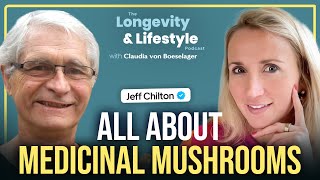
In this Longevity and Lifestyle Podcast episode, host Claudia von Böselager interviews Jeff Chilton, a pioneering figure in the modern medicinal‑mushroom industry with over four decades of experience. The conversation traces Jeff’s early fascination with mushrooms in the Pacific Northwest, his ethnomycology studies at the University of Washington, and a decade of hands‑on work at a commercial button‑mushroom farm. A pivotal 1989 trip to China sparked his focus on medicinal mushrooms, leading to the creation of the first organic mushroom growers workshop in China (1996) and the founding of Nammex, a company that supplies certified‑organic mushroom extracts worldwide. Jeff explains mushroom biology – spores, hyphae, mycelium, and fruiting bodies – and why the fruiting body (the mushroom) is the primary source of bioactive compounds. He highlights beta‑glucans as the main immunological potentiators, triterpenoids (especially in reishi) for liver health, ergothioneine as a potential new vitamin, and UV‑converted ergosterol (vitamin D₂). The discussion covers the ten most studied medicinal species (shiitake, reishi, lion’s mane, turkey tail, chaga, cordyceps, maitake, etc.), their specific health benefits (immune support, cognition, energy, blood‑sugar regulation, gut health), and practical culinary tips for incorporating fresh mushrooms into the diet. A substantial portion of the interview is devoted to product quality: the difference between fruiting‑body powders and myceliated‑grain powders, common adulteration (starch‑rich grain‑mycelium blends), testing protocols (beta‑glucan, triterpenoid, heavy‑metal, pesticide, microbiological panels), labeling practices, and a simple iodine‑starch test for consumers. Jeff stresses the importance of organic certification, especially for Chinese‑grown mushrooms, and describes the rigorous double‑testing his company performs. The conversation also touches on market dynamics (China now produces ~85 % of global mushrooms, the rise of multi‑species supplements versus focused blends), dosage guidance (typical capsule counts, month‑long supplies), and the emerging psilocybin sector, where Jeff’s company holds a Health‑Canada license for research‑grade strains. Finally, Jeff shares his personal philosophy on prevention, local food sovereignty, low‑impact living, and his hope that people will re‑connect with nature and make mushrooms a regular part of their diet for longevity.
Chapters
I look at mushrooms as something for prevention. Put it into your diet, it's going to be helping you stay healthy. It's prevention, that's what it's all about. It's just like taking a vitamin.
My guest today is Jeff Chilton. Jeff is an instrumental figure in the creation of the now booming, really having its renaissance, medicinal mushroom product industry. With over 40 years experience in mushroom growing, he was one of the first to bring mushroom extracts to the North American market and organized the first organic mushroom growers workshop back in China already in 1996. Jeff, it's such a pleasure to welcome you on the Longevity and Lifestyle Podcast. Thank you for coming on today.
Claudia, thank you so much for having me. It's great to be here.
So, Jeff, as I mentioned briefly in your bio before, you're definitely one of the early Western pioneers in understanding the power of mushrooms. You studied ethnomycology at the University of Washington in the late '60s. And started working on a commercial mushroom farm in 1973. Where did this passion for mushrooms come from? Please share.
Well, you know, I was born in the Pacific Northwest, Washington State, Seattle area. And, you know, what Washington State is known for, it's called the Evergreen State. The reason why it's evergreen is that we get a lot of rain. And so, we have green forests, lakes, rivers.
It's just a beautiful area and it's one of the best places in the world for wild mushrooms.
So these mushrooms were all around me when I grew up. And then when I went to university, I studied anthropology, social anthropology. I loved learning about other cultures, but the University of Washington also had a mycology department, and that's the study of fungi. And so I thought, well, I'll take courses in mycology as well.
And so, you know what I did?
I put them together and I studied the use of mushrooms worldwide as food, as medicine, and in shamanic rites. But after university, what do you do with a degree in anthropology, especially in the 1970s?
So I thought, well, I'd really love to learn how to grow mushrooms. I thought that would be so cool.
I went to the only mushroom farm in Washington State in 1973, applied for a job, got a job.
I was there for the next 10 years.
And Claudia, I was literally living with mushrooms. It was a very large farm and just many, many rooms full of mushrooms growing. I loved every minute of it.
What was really cool was because it was an agaricus farm, the button mushroom, but we had a Japanese scientist there and he was growing shiitake, oyster mushroom, and enokitake. So I also got to see how these other mushrooms were being grown.
So for me, it was just like, what a wonderful opportunity.
So literally, I was living with mushrooms and eating fresh shiitake mushrooms in the 1970s.
Nice. So Jeff, during these 10 years and especially being exposed to the shiitake and all these beautiful other different types of mushrooms as well, what would you say were some of the biggest or most profound insights you had during this time? What were the real sort of aha moments?
Well, you know what, mushroom growing is very demanding. Mushrooms do not sleep. And when you have crops, every week we're putting in 8 new crops and throwing away 8 older crops.
So it's a continuous cycle. So there's always houses, mushroom houses in every stage of development. So you have to be harvesting every single day. And it takes an army of people. Every single mushroom you have ever eaten has been harvested, has been picked by hand. Think about that. I mean, the bottleneck in all produce or fruits or vegetables is harvesting. With mushrooms, it's even worse because in one single room you've got maybe a million mushrooms and people have to go in there every day to harvest them.
Now, having known that and been at this very large farm for 10 years, I realized that maybe I didn't want to be a commercial mushroom growing in terms of running my own farm because of the demands of it.
People are harvesting there on New Year's, on Christmas. There is absolutely no day off.
So, so what I had studied and what I read more about were what were called medicinal mushrooms. And so in 1989, after my very first trip to China to go to an international mushroom conference, which must have been very interesting in itself, you must have done well. And at that point, I realized that I could grow mushrooms in China. I could organize growers over there because one of the things that I understood was is that if you're growing mushrooms as a business, you can certainly grow them for the fresh market.
You can earn a reasonable profit from that.
Let's say if you sell your fresh mushroom for $5 a pound. Well, supplements are dried powders.
You have to now dry those out. That $5 a pound, now you have to get $50 a a pound for that same pound of mushrooms. The economics do not work for supplements.
So, I realized that very early and I thought, well, first of all, if you're selling mushrooms as supplements, it's a dry powder.
It can sit on the shelf.
It doesn't have to get to market immediately.
Fresh produce, it has to get to market. Right away or it spoils.
So that was also very attractive. You're like, ah, I know, I don't want to be a babysitter to a mushroom farm as much as I love mushroom farms. And, uh, but so I realized that, and all through the '90s I traveled throughout China. I visited farms, uh, production facilities. I went to research stations. I, um, went to conferences, made many, many contacts.
You know, Claudia, today China grows 85% of the world's mushrooms.
Wow.
I didn't realize the number was that big.
Wow. Can you imagine 85% of the world's mushrooms?
We compared, Jeff, out of interest, if I may, like, what was it back in when you were going around there in the '80s and '90s? What percentage of the world market did China grow of mushrooms then?
I mean, China was just beginning sort of to grow because back then it still maybe was only 50% of the world's mushrooms.
Okay. So it's really exponentially grown.
Yeah.
But, you know, in the United States and Europe, we were focused on the button mushroom. And the button mushroom is really interesting. It started—
the history of the button mushroom started in France in the limestone caves. So they were growing it in France in these caves. It's actually called the Mushroom of Paris.
And, you know, I love the button mushroom. I like all kinds of mushrooms, but I still eat it. A lot of people go, oh, it's, you know, it's so boring.
But no, I still love that. And it's a wonderful mushroom. But what they were doing in China, and, you know, look, Medicinal mushrooms, the reason we know about them is they were used in traditional Chinese medicine for thousands of years. That's where it all started and that's why we know more about them. So being over there, going to research stations, traveling all over the country, visiting farms, I mean, it was fascinating.
And listen, I don't know if you've been to China, but back in the '90s, it was totally different than today. Today it's one of the most modern countries in the world.
When I'm in China today, I'm riding on high-speed trains that are going 300 kilometers an hour. I mean, their highways are better than our highways. Their buildings are all brand new.
So really, that's what started me in my current business. And it all started in 1989 when I went to China for that first time and learned more about it.
Yeah. So just to mention, my father had to go to a conference, I believe it was 1988, in Beijing. And he did a video. And if you imagine those videos back then, he had this whole big apparatus and then the bag of him in a taxi on one of the main main roads in Beijing. I don't remember the name of it. And there were hardly any cars, lots of bicycles, of course. And it was pretty empty. And I lived in Shanghai for 4 months in, gosh, 2005, went to Beijing. And I mean, already then the traffic was like a whole nother level. I'm like, this does not look like the video I remember. And then obviously exponentially, exponential growth since then has completely changed as well. So But I'm curious, Jeff, as well, to hear about your mission. What made you decide to really focus on that? You had the initial conference in China. I'm even thinking, how is your Chinese? Because I can imagine at the time it wasn't as English-friendly as maybe they might be today. So very curious about that. And what was that spark? Happened within you to be like, I'm going to make this my mission and started traveling around China?
You know what? I don't think it was so much as, as making it my mission other than I loved the whole mushroom world in terms of, you know, out here we hunt wild mushrooms every year. I truly believe in mushrooms as one of the most important foods for us. And, I'm always telling people, before you supplement, put mushrooms into your diet. They're a fantastic food.
I call them the forgotten food and the missing dietary link.
I really think they're a very healthy food that provides lots of benefits. But, I guess trying to stay within this category to make a living, I thought, well, Nobody is really bringing these functional medicinal mushrooms to North America yet. And, I thought that's something that I could really do. I studied it for many years.
I mean, I knew all about these medicinal mushrooms back in the '70s. And, that to me was really fascinating. Okay, here you've got a food product,, but it also has these other properties to it. And, and, you know, Claudia, I really believe in food as medicine. I think that concept is so important because look, diet is the basis for our health. A good diet is, is just the foundation.
And, and I thought, God, if I could be bringing people this mushroom and it's in a basically a powder or however, however the supplements come, they come in many different forms.
If I can be doing that and staying in this natural products market, I just thought what a wonderful area to be in. And I tell you, the whole natural products market in the 1990s was new.
It was exciting.
There were lots of great people in it.
And, you know, the only problem with it is back in the '90s, it's like, okay, you're selling a nutritional mushroom. The government says, well, is it a food or is it a drug? You know, it's like vitamins are still just being accepted by then, right? So, so for me, it was just an exciting area to be in. It furthered my interests in mushrooms and created a really nice, wonderful business.
Beautiful. And so let's talk about the medicinal mushroom components, which some people may or may not be that familiar with. People sure like, oh yeah, I have an egg in my— sorry, I have a mushroom in my omelet, right? But there's a difference between sort of that or looking at it from a medicinal point of view and especially thanks to TCM, traditional Chinese medicine, which has been using this for thousands of years. So can you walk us through a little bit that medicinal mushroom benefits and use cases and what you've seen in your career?
The first thing I really like to do is kind of explain what this, what we call a mushroom, what is this thing anyway? And if you're going to grow mushrooms, How do you do that?
Mushrooms don't have any seeds, Claudia. How do I plant them? What do I do?
Well, mushrooms don't have seeds, but they have spores. These spores are from a mushroom. They're out in our environment. They land on the ground. They land on pieces of wood. The spore, when the conditions are right, will germinate into a very fine thread-like filament.
And, this filament is called a hypha. And, when multiple of these hyphae come together, they will form a network, and that network's called mycelium.
And mycelium is the actual vegetative body of the organism. And the mycelium, we normally never see it, you know, because it's under the ground. It's embedded in its substrate, which is what it grows in, the substrate, whether it be a piece of wood or whatever. And you know what it's like when, when you're walking along and you see a mushroom and you go, oh my goodness, where did that come from? And a lot of times you might even say it wasn't there yesterday.
The fact is it was, but it wasn't quite big enough for you to notice. And, and, and actually, if you get down and you pull it out and then you look where it came from and look down into the ground, let's say, You'll see this white fuzzy mold-like growth. That's the mycelium.
So that's the actual vegetative body. When conditions are right, that will form a mushroom. And that's the fall here. And in the UK, the fall, that's the mushroom season. So up comes this mushroom. It starts with a very fine little what we call a pin, and then it grows into a button and it matures.
And when it matures, the stem's up, the cap opens up, there are gills underneath the cap or pores. Some mushrooms have pores, like thousands of pores, and that's where the spores are created.
And out come the spores, and now we have completion of the life cycle of this organism.
And the important thing to remember is that there are, with every supplement, they need to tell you what is the plant part of that supplement.
So if you're buying ginseng, it's the root. It's not the plant, the leaf, or something like that. If you're, if you're buying ginkgo, okay, it's the leaf. Echinacea, it's the flower.
So the part of it is very, very important.
So with this organism, there are 3 plant parts or fungal parts that are used as supplements. There are spores, believe it or not, which is kind of, whoa, that's kind of interesting. There is mycelium because, for example, in China, they grow a lot of mycelium in liquid culture in big tanks, and then they pull it out of the liquid, separate it out, and then they have mycelium. Or mushrooms. So those are the 3 plant parts. The spore is the reproductive part, the mycelium is the vegetative body, and the mushroom is what they call the fruiting body. So the 3 plant parts, that's super important when you go to buy a product. You really need— because today vendors will sell any number of these particular products. And now, Why and what is it in these mushrooms that is important? And that is the beta-glucan.
The beta-glucan. And what we've done is we have identified through traditional Chinese medicine, what are the important mushrooms that they've been using?
Well, there's about 10 of them.
I've got a book from China that actually lists 270 different mushrooms that have some activity that have at least one scientific study that shows that.
But, oh, 270 mushroom products? No, I don't think so. Let's look for just the 10 important ones.
And then, I'll go, okay, is there any scientific data or research behind them.
And from those 10, there's a lot of scientific research. Put those 2 together and that's what we'll utilize in the business. Now, there's so much information on the beta glucans.
And what do the beta glucans do?
They are immunological potentiators. And, you know, God, we've learned so much about the immune system lately, haven't we?
And it still continues to be so important.
Yeah. And this gets back to diet and foundations of health because these beta glucans, and they make up 50% of the cell wall of a mushroom, and they are composed of a lot of fiber.
Mushrooms have a lot of fiber. They're up to 50% fiber. Amazing. I know.
And, you know, I tell people high in protein. I mean, depending on the species, every species will have a different profile when it comes to nutrition. So maybe 20 to 40% protein, primarily carbohydrates, but good carbohydrates.
Mushrooms do not have starch.
Mushrooms have mannitol, trehalose, very slow-acting carbohydrates. You know, that's what we're looking for. We're not really looking for starch to go, oh my God, my blood glucose has gone way up and now it's coming way down. No, we want slow-acting carbohydrates. That's what mushrooms provide us. So they digest slowly and a lot of it is fiber. So it goes right in. Guess what? That fiber will feed our microbiome.
It's a prebiotic.
Wow. Another cool thing from a mushroom. So not only do we get the nutrients, but those beta glucans come down, they will hit certain receptor sites that we have, which will activate the production of immune cells. So the primary benefit of these medicinal functional mushrooms is immunological potentiation. They are considered a biological response modifier.
That's the key to every one of these functional mushrooms.
Now, each one will have other compounds in there, but that's what's most important are these beta glucans.
And so somebody listening is saying, okay, I need to strengthen my immune system, so should I just go and eat You know, tons of mushrooms. What is the protocol? What are, where should somebody start who maybe has immune system issues or just wants to boost their immune system? What would you recommend?
Well, the first thing I recommend is, is put mushrooms into your diet. If you don't have mushrooms into your diet and, and the mushroom I would highly recommend as a prime choice edible is shiitake.
Have you, do you eat shiitake mushrooms?
I love shiitake mushrooms.
Oh my God. Aren't they wonderful?
They are my favorite mushroom. I mean, they're just incredible. You know, the flavor is strong.
It leaves, it leaves actually a really pleasant aftertaste too.
So shiitake mushrooms, I'll say if you've got shiitake in your markets, buy shiitake mushrooms. Now, the agaricus mushroom is a good mushroom as well.
So, but You know, in, in, in the 1980s and the 1990s over here, we had maybe one mushroom in our markets. That was, that was the button mushroom, one mushroom.
And it wasn't really until probably 1990 that smaller farms came along and started to grow a lot of other mushrooms like shiitake, like maitake. By the way, the R&D project of the Japanese scientist at the mushroom farm I worked on back in the 1970s, we introduced fresh shiitake into the local market and it flopped. What's this weird thing?
And you know what the feedback was is that this mushroom has too strong a flavor. Can you imagine? And now I was shocked.
And so, so the, the owner of the farm dropped that whole program, and it really took small farms in the late '80s and '90s to come back in and start to produce these mushrooms and slowly build up to what it is today. So, I mean, it's like, oh my God. But at any rate, that's the first thing I tell people. Eat mushrooms.
And God, I mean, you know, Claudia, they're so versatile.
You can do so many things with them. And the one thing I will say to people, because if you have children, most children will say, oh God, I hate those mushrooms. They're slimy. They're, you know, And I'm like, well, that's because you haven't cooked them properly. You put them in a pan, you maybe fry them up, you're on a low heat, all the water comes right out of them. Now they're swimming in a lake and you wonder why they're slimy and unpalatable. No, you have to cook 'em at high heat.
That will keep the water inside them. They will shrink. They'll be half the size when you're finished cooking.
But I like to even brown them on the different sides, but cook them properly and you won't have people calling them out as being these slimy things.
How do you cook yours out of interest? You add onion?
Cook them? Oh, oh, you know what? I will, I will, you know, I mean, I, I will cook them if I'm, if I'm eating meat, I'm a meat eater. I will usually cook them, like just fry them up and just have them as a side dish. And I'm eating them almost with every bite of that. Piece of beef or whatever it is. Or if I'm doing a stir fry, I put them together with all sorts of different vegetables. Anytime I do a stir fry, that's what I do. And the other thing too is I like to make, make up tacos. So, so I'll throw in a bunch of ground beef and that starts to go and that's got a lot of oils in it. And then I'll throw in the mushrooms, maybe green peppers, you know, just about anything, the kitchen sink in there. And that's what I'll fill my tacos with. So that's important. And then the second part of that is, look, if you feel like you want more, look towards a supplement. And the only thing I'd say about supplements and is, look, when it says take 2, you know, unless it's something like vitamin D and you know exactly what's in there, well, with a herbal supplement,. If it says take 2, take 4. I know the problem with that is it gets expensive, but, you know, look, if you want something to really work, you just can't go with what it tells you to do on the label.
That's interesting because I am, I'm taking one at the moment and I am taking 2 and it says to take 2. So now I'm like, oh, should I take 4? Yeah. But I'm like, oh, maybe I should up it. Well, I'll try tomorrow and I'll let you know, Jeff.
Well, you know, the way, the way that works is, is, most bottles have 60 capsules. And if you take 2, that's a month's supply. So that's the whole thing, right?
Yeah, exactly. No, that's true as well. So Jeff, we were talking about a few different things. We were looking at the medicinal mushrooms and would you say it's very important to mix up the types of mushrooms that you are having to have the medicinal benefits? Or if you see shiitake, always buy shiitake? What is your recommendation to get the most benefits?
Oh, that's so interesting because you know how there's products out there that you can buy that are like, okay, they have 101 different herbs in them and it's like, oh, my product's got more herbs than your product or my product's got more mushroom species than your product. What happens is there's this kind of idea out there that more species is better, and that's absolutely wrong. I tell people, look, we have one product in our retail line and it has 5 mushrooms species, 5 mushroom species. And, beyond that, all you're doing is you're diluting the important ones and putting in minor species. So, these companies that have 10 species, there's a company out there that has 17 species and then another one came out and had 25 species.
And, I'm just going, this is not helpful. People who are buying those products are being fooled because they're losing out on the value of the really important ones.
So again, anything that's got more than 5, just don't even bother with it because that would be the upper level. And, you know, sometimes it's better just to stay with one particular species like reishi.
Reishi is a fabulous mushroom. Have you ever seen a reishi mushroom?
I think I have seen one once, and then obviously I'm more familiar with it in powder form, which I'll add to a smoothie or something like that.
Well, you know, reishi has the form of like a ram's horn and it's red.
It's beautiful. You can, you can shine it up, but it is made almost made of wood. It's hard and woody. You cannot eat it. It's only something that if you have a real reishi mushroom, you chop up and make a tea out of. The other thing about reishi is it's very bitter.
So, but those bitter compounds are called triterpenoids and they're very good for our liver.
I was at a conference in China in 1996. It was a conference on reishi mushroom and there's a traditional Chinese medicine doctor there. I asked him about how he used it and how much he said, He used as much as 30 dried grams of reishi mushroom per dose.
And I thought, wow, that's, that's really high. But he said it was his number one herb for the liver.
That was really great information coming right from somebody who was a longtime practitioner. And, and so the beauty of reishi, and, you know, one of the things that that Nammex does is we test all of every batch we make. We test it in the case of reishi for these triterpenoids. We also test for beta glucans.
And what we have found through all our testing, and we've been testing our products this way for about 7 or 8 years, reishi and turkey tail turn out to be the very highest of the mushrooms in beta glucans. Wow, that is great information. And the level of triterpenes in a reishi mushroom are quite high too, as much as 4 to 5% triterpenes.
So, so the important thing, you know, it's kind of like a reishi isn't a reishi, is it a reishi?
Because different of these mushrooms grown at different places will have different levels, especially of the triterpenoids. Cannabinoids.
So, at any rate, if you have a reishi product and you're going like, "Okay, is this really a true reishi product?" Well, it is if it's very, very bitter. If it's not bitter, you do not have a reishi mushroom product. And, Claudia, this is something that I like to educate people about. There are products in the marketplace that people grow I was telling you about mushrooms. You can't grow them in North America or even England and put them into the supplement world. I mean, if you're a small grower and maybe you sell some at a high price to your local herbalist and she's selling directly to her patients, it works out. But as you get bigger and in the marketplace, it just, the economics are not there. So what companies do over here is they'll grow mycelium on sterile grain, and what they do is the grain is colonized, it's grown over with this mycelium, then they will dry it out, grain and all, then they will grind it to a powder. Now, this is, this is like grain and mycelium, grind it to a powder, and they'll sell it as a mushroom. And you are probably unaware of this, most people are, but in your marketplace, probably 50% of the products are this. And what these end up being is mostly starch with very, very little, very low beta glucans. And we did a major study about this. I published a white paper on this called Redefining Medicinal Mushrooms, and we showed what was going on. And, these products were 5% to 10% beta-glucan when a mushroom is 25% to 60% beta-glucan.
And, these were up to 60% what is called alpha-glucan, which are the starches. A mushroom does not contain starch. It has very, very low amounts of glycogen. Isn't that kind of cool? A mushroom produces glycogen as its storage carbohydrate. Exactly.
What are you doing producing glycogen? Okay, I get it. You're a mushroom. You're not a plant. You're not producing, you know, starches as a plant. You're a mushroom and you're kind of like us in some ways, you know, because the mushroom is also breathing, is breathing in oxygen and giving out carbon dioxide. So, it's like, wow, not like a plant, it's more like us in those areas. So, this is very important for people to understand because, and one of the ways you can tell is you can, if like a reishi, you taste it and it's not bitter and you're going, well, this kind of just tastes like flour.
One of the tests you can use for most of the mushrooms is what they call an iodine starch test.
Just take some of that, a teaspoon of that product, mix it up in a quarter cup of water, put in 10 drops of iodine. If it's got starch in there, it will turn black. If it's a real mushroom product, it will not turn, it will just stay the color of the iodine unless it's a real dark product to begin with, and then it's kind of difficult to do this test. But that's a really good test to use to find out because can you imagine people buying a mushroom product and it's actually just buying grain starch?
Well, no, for sure. And there's so many, like, there's more and more products coming to market. So I think it's so important for people to know what to look out for. And are there any labeling restrictions so that people can at least go and read and look for beta glucan or whatever it might be on the label, or it wouldn't they don't have to put it on the label.
Well, you don't have to put it on, but, but look, if the company that's selling the product does not put, you know, we, we have the beta glucan on all of our retail line, the amount of beta glucan in the product. And when we sell the product in bulk, we will say, okay, it's got X amount of beta glucan in it. A lot of companies that are growing these starchy products will say, oh, we've got really high levels of polysaccharides.
Beta-glucan is a polysaccharide.
The problem is that starch is a polysaccharide. So, that test does not work. So, you just have to look at the label and it should say mushrooms. If it says mycelium, that's probably what it is. And, some of these companies will actually say in the other ingredients myceliated brown rice or myceliated oats or something like that. So, you can figure it out, but a lot of people just look at the front panel on it and it's got a picture of a mushroom and it says reishi mushroom or shiitake mushroom. So, they think that's what it is and they don't read the fine print. So, your listeners really need to be aware of that because look, adulteration has been around for centuries and centuries. I was just watching a program last night about honey and how much adulteration is going on in honey. And so, it's going on in the mushroom category.
Have to be careful. Yeah. And so, let's talk about the concept of organic mushrooms. And obviously, when some people hear China, they think pollution and issues with food contamination, et cetera. So, what is your view? And obviously, you've been there and That said, TCM medicine has been around for thousands of years and some of these farms, I assume, are holding certain quality standards. But, how important is that organic piece? And then, especially if it's coming maybe from China?
Well, you know what? My company's been organically certified since 1992. And, I'm in China organizing farms to grow mushrooms for me. And I'm working with one particular person who's my production partner who will turn those into mushroom extracts. I knew I had to get these farms certified organic. I brought in this certifier from the United States, OCIA, and in 1996, we had the first organic mushroom workshop in China. 3 years later, we had organic-certified mushrooms, and they're certified by European certifiers. And look, I'm just as concerned as anybody else about products from China. These are all grown deep in the mountains of China away from all of that heavy spraying. But look, it's such an interesting idea of contaminated foods. And I was telling you about this documentary on honey. There's such a thing called colony collapse of honeybees. And one of the situations is all of the chemicals that are being sprayed in the United States. So a lot of people are like, oh, I'm going to point over there at somebody else.
Whereas in the United States, I think we put more chemicals on our fruits and vegetables than anybody in the world.
And this is—
well, a lot of the food we've got are contaminated that way.
So really, it's very easy to point fingers. And just to give you another example, which I think is outrageous, Canada. Oh, we're so concerned about global warming and oh, we're going to get away from fossil fuels and we go on electric cars and oh, oh, oh.
I was just in the Rocky Mountains where I go every year.
They've got the biggest coal mines in the world in the Rocky Mountains.
And what are they doing with that coal?
Did they just go, okay, we're going to stop producing coal?
No, they produce trainloads of coal.
They send it down to Vancouver.
What do they do with it in Vancouver?
They ship it to Asia to burn. And they're claiming, oh, we're just such good people.
We're on this program. No, if you really were serious, you would not be selling that coal.
And this is the same thing with this whole idea of pointing the finger somewhere else and it's not us.
No, of course not.
So that kind of hypocrisy and the way right now the West, the United States especially, is demonizing China. Because China's all of a sudden, you know, it's a world power now.
And, you know, it's funny, we sent our industries to China.
We financed factories in China. They produced goods for us that came back. People loved it because it was cheap. You know, the quality is good or bad, whatever you wanted to pay. But people thought, oh, we got good prices and all of a sudden they're to blame.
For what's going on.
It's bizarre to me because you shouldn't be pointing at China if this is an issue.
Point at American business. They're the ones that went over there. Europeans too. They went over there and built the factories.
So, it's like, come on. But, no, I totally believe in organic certification. It's very important. Every batch we do before it leaves China, we measure heavy metals, we measure a pesticide panel, we do a microbiological panel before that product ships.
We test it like that. When it gets to our warehouse in North America, we test it again. So they're tested twice.
We can't sell the product if it doesn't meet heavy, heavy metal standards, pesticide standards. So no, our products get tested so heavily.
I mean, I don't want to sell a product that is contaminated. I absolutely don't. This product is supposed to help people with their health.
My God, Claudia, can you imagine if, you know, not only that, nobody's going to buy it if it says, oh, we've got high lead or, oh, we've got pesticides in it.
Yeah, please don't.
My customers are not going to buy it.
We, we, we get basically for the companies that buy from us. And we have companies large, we have some of the biggest companies in the world buying our products. We, they, they go through a long, we just had a, a maybe the biggest company in the world. I'm not, I can't mention them yet, but it took 'em 2 years to actually do that, the quality control of our products and go through the whole process of R&D and everything else.
2 years before they qualified us.
Rigorous testing and you qualify then.
So that's— Yeah.
Yeah. Well, exactly. And so it's very important and organic certification to me is very important and I encourage people pay the extra money, basically support organic or what's now being called to regenerative agriculture. It's so important that it's being grown without chemicals and we're giving back to the soils rather than just depleting them.
So it, it's a very important issue.
Jeff, I'd love to touch on the different types of mushrooms because people hear the names like turkey tail or like chaga and they're like, what, what is this? And like these very funky names that sound very fun, but like, are they really good for us? What is the difference? What should people be focusing on? And where is a good place to start? You said, you know, eat mushrooms in general. You mentioned shiitake, but maybe you can walk through a little bit the the main different types of mushrooms that are particularly beneficial for people and where they can start?
Yeah. Well, you know, the most popular mushroom we sell right now is a mushroom called lion's mane. Why is that? We weren't selling hardly any of it 8 years ago. Yes, right. Cognitive function. And, and it's considered a nootropic. It has, it has compounds in it that stimulate what's called nerve growth factor. Nerve growth factor helps to organize our neurons. It will actually sort of stimulate their production. So science has demonstrated that it's helpful. There is some clinical trials done in Japan that demonstrate that elderly people who take tests before and after show some rise in cognitive abilities. So lion's mane, that's a good one if you're looking for cognitive help.
Which frankly most people should. And I mean, my mother suffers dementia, sadly. She's on it. My father's 85, he's on it.
Why not, right? I know.
And what'd you say your name was again?
I forget.
Exactly.
It's like, what are we doing here?
Yeah, it doesn't get any better, believe me. At any rate, lion's mane, When it comes to immunological enhancement, turkey tail is a prime one, reishi is a prime one. All of them have that benefit, but those two, reishi and turkey tail, would be the top ones. Maitake is also pretty good at that. Maitake also has shown to lower blood sugar. And a lot of it too is just the fact that mushrooms are slow-acting, a lot of fiber moving through. So they can actually— they consider maitake, they say, well, if you're eating mushrooms that's kind of more filling and it's slow acting. So maybe you're not gonna stay hungry. Shiitake, great immunological mushroom as well.
Other benefits, chaga. Have you ever seen a chaga?
Mm-mm. Oh my God. You know, chaga's not even a mushroom. It's this gnarly growth, from a fungal pathogen on a birch tree, and, and the birch tree reacts by producing what's considered a canker off the side. It's black, it's irregularly shaped, used as a tea for the stomach. So I encourage people, if you have stomach or digestive issues, try chaga. You never know, chaga might be something that would work for you. Cordyceps Are you familiar with cordyceps at all?
Those are the ones I took this morning, 2 of them. So now I'm thinking, what happens if I take 4?
So I might be— well, and I'm going to want, I'm going to want you to tell me after the program what brands you're taking because I can fill you in on a little bit. Yes, please do.
But cordyceps, you wildcrafted up in Tibet.
Cordyceps is actually, it parasitizes a certain type of moth and the larva of that moth, which is a caterpillar, it will hibernate over winter.
Come spring, summer, up comes this little tiny grass-like fungus that we call cordyceps. They will harvest the cordyceps caterpillar and all.
And that's what they will use in traditional Chinese medicine, caterpillar and all. I tried to introduce that to the marketplace in the '90s and I had people looking at it and going, I'm sorry, my customers are vegetarian.
Yeah. Oh, really?
Exactly. I wonder.
Yeah, that's right.
Caterpillar meat. Okay.
But, but at any rate, what's, what's interesting is that that caterpillar fungus, the value of that is $15,000 a dry kilogram. Nobody can afford that.
We grow a different species of cordyceps that is used interchangeably and it does not grow on an insect. It's called Cordyceps militaris.
It's this beautiful orange fungus and it grows up like little blades of grass. And that's what we grow and produce.
And cordyceps has been used for fatigue, given to, to people who are sick with some kind of an illness that they just can't get over.
So that's when the TCM doctor will prescribe them. Cordyceps. And again, lack of energy, lethargy, fatigue, that's what they've used cordyceps for. So of course, what do we use it for in the West?
Well, athletics, of course.
More energy. That's right. That's right. So that's primarily where cordyceps gets utilized today. And, you know, the really the top species that we're selling now are reishi, chaga, cordyceps, and lion's mane. That's what I call sort of like the top 4. Turkey tail is actually probably the next one. It's really getting more and more popular. But, those 4 again have very specific properties above and beyond just the beta glucans and the immunological benefits that come from that. So, that's where if you're looking for one particular benefit. You can decide whether you want cognitive or energy, lack of energy, or maybe your stomach, something like that. Or, again, overall, if there's one particular mushroom you want to look at, it would be reishi. That would be the one species that I would say if you're looking for one that gives you a good balance overall, not just the high level of beta glucans, but also these wonderful triterpenoids.
Reishi is the one. Reishi is the magic one. And, I'd love to just touch on turkey tail because I'm not that familiar with it. And, I believe it was Paul Stamets' mother who had a form of cancer and he put her on turkey tail and she managed to be cured from that. Have you seen research about the power of turkey tail?
I have. And, that story is actually incorrect. Believe it or not, a lot of people think that he cured his mother with Turkey Tail. He did not. He was giving her that prior to her going on to chemotherapy with some very effective chemotherapy drugs. Herceptin was one of them, and I think another one was Taxol, and it was those chemotherapy drugs that actually cured his mother. And if you listen very carefully to his TED Talk, he actually will say that in there, but he's talking about turkey tail. So, so all of a sudden the whole world thinks, oh, he cured his mother with turkey tail. He did not. And I've looked at— yeah, I mean, it's a great story, but that, that did not happen, unfortunately. So people still spread it around, but I've got the actual doctor's report report on it. And I've read that and it's very clear that, you know, she reported that his mother was taking Turkey Tail when the doctor saw her and, you know, an advanced stage of cancer at that point in time and said, well, she doesn't mind people taking these, but she prescribed her this Herceptin and she's still taking Herceptin to maintain what she's got.
And Herceptin is very, very effective, up to 60% of these specific cancers.
So it's a very effective chemotherapy drug. And look, chemotherapy to me is like, oh my God, I never want to go through that. My wife had cancer at a point in her life, and it was very advanced, and she decided know she wasn't gonna go through that. And really at that point in time, nothing was really gonna help. But again, I look at mushrooms as something for prevention. Put it into your diet. It's going to be helping you stay healthy. Not if you're a smoker, not if you don't get any exercise, not if your diet's terrible and you're eating a lot of sweet things, But put it into your diet. It's prevention. That's what it's all about. It's just like taking a vitamin. You know, people go, yeah, I'm taking vitamin D.
Oh yeah.
How do you feel today after just taking so much vitamin D yesterday? Oh, I feel wonderful. The vitamin D, man, does that ever do give me that wonderful feeling?
No. You take these vitamins for prevention.
You're like, okay, just in case I'm not getting enough vitamin D or vitamin C or something. And look, people in the northern hemispheres, we do not get enough vitamin D. I'm always telling people, you know what's really cool, Claudia, is that a lot of people say, well, mushrooms produce vitamin D. They don't.
But if you expose them to UV light, the compound in them called ergosterol, which is similar to our cholesterol, you know, here we go, another sort of mushroom-human thing, turns that ergosterol in the mushroom into pre-vitamin D2.
And that's something that we are doing right now. And we have mushroom powder vitamin D product. It's nothing but mushroom powder. There is no, you know, D3, which is a good vitamin, of course. And that's what we manufacture. The processing of that, if you ever look into that, you will just be shocked at the chemicals used to produce vitamin D3. Our vitamin D2, and look, a lot of people say, ah, D2 is not as good as D3. The top scientist in the world for vitamin D has said it is just as effective. You take it on a long term, there's really no difference. And I am really stoked on the ability to provide people with vitamin D from a natural source that has got no processing other than it is exposed to UV light for a certain period of time.
It's amazing. Wow, that's exciting.
I didn't realize that. So, oh yeah, I'm totally excited. And the other thing that that you need to know about mushrooms is they're high in a compound called ergothioneine.
Have you heard of ergothioneine?
I have, because I've had Sean Wells on the podcast, but please share for my audience who might have missed it.
Ergothioneine, a lot of scientists and doctors consider that to possibly be a new vitamin or a vitamin, basically. We don't produce that. But it accumulates in certain parts of our body that are under stress, under oxidative stress. And one of the best places to get it— mushrooms.
Isn't that amazing?
Mushrooms are one of the few foods out there that is very high in ergothioneine. We are growing a mushroom that produces a lot of it. And, that's a new product for us as well. So, you can get ergothioneine from a natural source from a mushroom powder. Oh, God, it's just wonderful. I take it every day. I encourage people to take ergothioneine every day.
Super exciting. Jeff, I want to ask you, and people hear mushrooms are like, "Oh, is this magic mushrooms?" And so, psilocybin, I know that psychedelics are having a renaissance and there's a lot of research going into them for mental health and therapeutic purposes. What's your view on what's happening?
You're talking to somebody that was of coming of age in the '60s.
Come on, Claudia.
Of course I know. Well, look, I ate them in the '60s and all through the '70s and grew them. And I think it's a wonderful thing that prohibition may be coming to an end. It came to an end with cannabis, which, you know, I grew up in my whole life prohibition of cannabis, and I smoked it in my younger days. Now it's legal. I don't smoke it. So it's just, well, oh well. But no, I fully support this, whether it's mental health issues, especially I think for addiction issues. I think that's going to be a wonderful area. My company actually has a Health Canada license to grow psilocybin mushrooms. So we are currently involved in research and development of different species and building up cultivation techniques for them and also complete chemical profiles of different species of psilocybin mushrooms that ultimately we can deliver to researchers who want to research these different mushroom species. So no, I think it's wonderful. I think it's something that the time has come to look at these things. I mean, besides the fact that we can talk about them in a medical way, but look, I still support them recreationally and I also support them sort of metaphysically. I mean, I don't know if you've had any experience with these things, but let me tell you, it's something everybody should have. And mushrooms are a perfect introduction to these, and the experience is otherworldly and ineffable, blissful. Joyful feeling of one and connectedness. And absolutely. And, you know, we need that more than anything in the world right now. We need people to understand that we're all connected here in this wonderful organism that we live in. I mean, we're all connected. And so we have to be aware of that and take care of it all.
Yeah. I last night was at a talk, actually. I'm not sure if you're familiar with Eckhart Tolle, whose, um, The Power of Now is his book, which was quite famous.
I don't know if you came across it. Oh, did you say Eckhart Tolle?
Yes, exactly. Yeah, yeah, yeah.
Yes, indeed. Yeah, 75 years young, spoke for 2 hours to a sold-out room, and I'd say there's probably about 50,000 people in there. I mean, it was unbelievable. Not one seat was free. Wow. And yeah, and so he was also— I'd love the analogy he mentioned yesterday, which was we think we're the ripple on the surface of the ocean and we're kind of looking at the other ripples left and right saying, oh, this one's bigger. And like, what does this ripple have and whatever? And we forget that we are all the ocean.
Aha. Yeah.
I really love that analogy. You think you're the wave, but actually you are the ocean and we are all the ocean and we are all connected as well. So I think it's a beautiful time and renaissance that's happening at the moment.
Absolutely. That's just a beautiful thought.
Absolutely a beautiful thought. Yeah. Jeff, if you could live to 150 years old with excellent health, how would you spend it?
I would probably spend it hiking through our mountains. And, you know, I'm not one that necessarily, you know, oh gee, I've got to create this machine or that machine or do this. No, I love just getting out in nature. I love hiking. My wife loves hiking, and also I'm a very passionate trout fisherman. So I love to do that. I was just out in the Rockies fishing, and it's just beautiful. I mean, you know, there's nothing to me quite like standing in a small river that the water is crystal clear. You can see right to the bottom. It's cold. You could drink it. And you've got forests around you. And it's just being out there in nature and being a part of that. And to me, that is what really feeds me as much as anything else. And it's just beautiful. And that's what I would do. I would just kind of be one of those people kind of strolling through life and just enjoying every moment.
Beautiful. What excites you most, Jeff, about the future of health and well-being and longevity in the coming years and beyond?
Well, I'm really hopeful that more and more people take control back and stop shopping in those inside aisles of the supermarkets. And I think this whole thing of local food production and healthy food production and healthy diet, I think hopefully again, as more people realize that and realize there's a better way to grow food rather than industrial agricultural or industrial production of animals or anything like that. There's a better way, Claudia, and there are a lot of people working hard to bring that to us and to help with that change. That's the change. These large corporations are not going to bring us change. They're not going to be able to solve the problems that they created. No, no incentive as well. Oh, I mean, so that falls on people at a local level doing it locally and, and again reestablishing relationships with the natural world. So that's my hope as we move forward, and there's glimmers of it, but it is so difficult today in this world where it's just they push us to consume, consume, consume. We have to stop being consumers and be more enlightened about what we eat, what we do, how we dress. And, you know, we don't need the latest car. I drive a car that's a 2002 model. I do my best not to drive. I like to walk. I will walk before I will drive. My car has very limited miles on it. I just don't, you know, look, I could afford whatever car I want, but that doesn't, you know, I don't even have any idea what these new models are, what they look like or what's what. I mean, I just don't pay attention to that.
Yeah. So an electric car, right?
So yeah, well, you know, and so again, consumption, let's stop consuming so much because that's, one of the big issues that we have. We have too much waste. We need to address that. Recycling is a part of it, but that's not the answer. We have to go beyond that.
So beautiful. Jeff, where can people interested in understanding more about you and your work and Namex and what you're doing in your products, where can people find you online?
Our website is namex.com, N-A-M-M-E-X dot com. We actually have a menu that is education. I've got lots of great slideshows there, Claudia. I've got slideshows of how we grow our mushrooms, how we process them, lots of good information there. And then our retail division is realmushrooms.com, and it also has great information there. So come and learn. Don't worry about purchasing. I don't care whether you purchase or not. I just, I just want people to understand and to have a much better idea of what these mushrooms are all about how they can help you and what their role is in nature and so forth.
Beautiful.
Jeff, do you have a final ask, recommendation, or any parting thoughts or message for my audience today?
Well, my parting thought is just eat mushrooms. Put mushrooms into your diet. It is so important. It's a wonderful food. Again, it's the missing dietary link. Get it into your menu, into your food, eat them regularly. All of the research shows that people that eat a lot of mushrooms live longer. So think about it as just something that will help you in your longevity and also keep you healthier.
Beautiful. Jeff, thank you so much for coming on today and sharing your wisdom.
Thanks, Claudia. I've really enjoyed being here with you.
Thanks so much.
Thank you.
More from Claudia









Can Psilocybin Slow Aging? The Study on Telomeres, Inflammation & Survival with Dr. Louise Hecker

