Thrive State, Peak Performance & Longevity with Dr. Kien Vuu
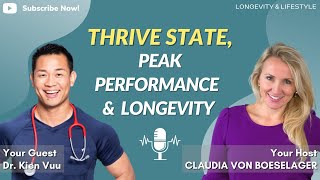
Dr. Kien Vuu, a refugee-turned-physician, explains how purpose can extend your lifespan by seven years and improve your telomeres. He breaks down his Pause-Awareness-Choice framework for rewiring automatic patterns, and warns against expensive bio-hacks until you master sleep, nutrition, movement, stress, relationships, mindset, and purpose first.
Chapters
Hello, dearest listeners, and welcome to the Longevity and Lifestyle Podcast, where I invite pioneers and thought leaders in their respective fields to give us the strategies, tools, and practices to live better and help reach our our true potential. My guest today is celebrity longevity doctor, Dr. Kien Vu, also known as Dr. V. Dr. V is one of the most sought-after health professionals in the United States, and his inspiring story takes us on a journey from being the only baby to survive on an 8-month-long refugee boat to turning his own health around and sharing his advice in his newly released book, Thrive State. Your Blueprint for Optimal Health, Longevity, and Peak Performance.
Dr.
Vu's personal life and health transformation happened by looking inward and focusing on his path to self-discovery, self-love, and self-acceptance, whilst also overcoming multiple chronic diseases himself. At his VuMD Longevity and Performance Clinic in Los Angeles, Dr. Vu works with top corporate executives, athletes, celebrities, and high-performing professionals to optimize their health and enhance vitality and performance. Dr. Vu also trains the next generation of health physicians at UCLA, directly driving the shift from 20th century pill prescription and rapid diagnosis method to the 21st century preventative and health optimization approach. In this episode, we discuss Dr. Vu's path to where he is now, his personal struggles that has transformed into successes, and how to live an abundant, happy, and full life in optimal health. Of course. Before we begin, please subscribe to the podcast to get your weekly dose of longevity inspiration. I'd love to hear from you. So please leave a comment to let me know what you think on Apple Podcasts or iTunes, or reach out to us on Instagram @longevityandlifestyle. Thanks. And please enjoy.
Welcome to the Longevity and Lifestyle Podcast, Dr. Kien Vu, or also known as Dr. V. It's a real pleasure to have you on today.
Thank you so much for having me on. It's great to be able to connect with people from the other side of the world, knowing that, you know, no matter where we're at, we are still in a human experience. We are still in this together. And to connect with you is a real joy.
Thank you so much. Yeah, it's such a pleasure. And across the pond, as they sometimes say as well, right? So you are one of the most sought-after longevity and performance physicians in the United States and slowly globally as well. But before we get into that, I would love to start with your own story and health journey. You've overcome a lot of obstacles in your life, from my understanding, and I know you're going to be a big inspiration for my listeners here. So can you tell us about that journey and how it shaped your path to medicine?
Yeah, certainly. Let's start a couple of years ago where I find myself in a health despair, and then I'll go even further back because I'm going to share how my story up to that, how early experience in my life has shaped my disease that I got a few years ago. So, about 5 years ago, somebody would pierce inside my life and they would say, wow, this guy's got a pretty ideal life. He's a medical doctor. He's got a dream house. He's got the car. He's got everything in life that is deemed, quote, success on paper, right? And for those people who are not watching, I did the air quotes, quote, success, right? So, I was traveling around the world. I was speaking on you know, the advances in interventional radiology. So for those people who don't know, I'm a conventionally trained medical doctor, M.D. I was trained in the field of interventional radiology. So radiology is medical imaging, X-rays, CT scans, ultrasounds. It's all this advanced technology, probably the most advanced technology available to medicine these days. We can use that to detect and pierce inside the body to see what disease look like. And as an interventional radiologist, I basically use those technologies to do minimally invasive surgeries or minimally invasive interventions on people. So I worked with people with end-stage diabetes, cancer, renal disease. And as a radiologist, I also knew what those diseases look like in the body. So I was really educated and knew the broad spectrum of the different diseases that were there. And in fact, I was probably at the top of my game treating a lot of these diseases. But then I found myself, you know, being at the top of my game underneath the white coat, I was overweight, I was diabetic, I had high blood pressure, and I was on prescription medications. And I looked at myself in the mirror many days and I said, wow, I didn't like the man I had become. And how am I a doctor who's giving medical advice and telling people to be healthy when I'm a walking chronic disease statistic myself?. And, you know, I didn't understand why that was the case. And, and certainly I thought maybe I was just dealt with bad genes and that's why my life is the way it is. Mm-hmm. And it was really at that point I started to do a deep dive, a deep dive into trying to understand, okay, my life will not be subjected to medications only for the rest of my life. How do I turn this around? And it was really diving into a little bit of who I am as a person. And how I became this doctor. And, you know, the Dalai Lama had a quote. He said what he found most interesting about humanity. He said, man, because he would sacrifice his health in order to make money and then sacrifice his money to recuperate his health. Yep. So, you know, I was really that story. And actually, a lot of my clients share that very similar story to me. So for people who don't know, you know, I was an immigrant to America. I was born a couple years after the end of the Vietnam War in Vietnam, you know, and they basically seize all the businesses, seize all the money that was there. My parents were pretty much left with nothing, and they said to themselves, this is no place to raise a child. And so, overcoming all odds, they basically took me, escaped with me by boat, and we were on a refugee boat filled with 2,000 refugees trying to sail to a better future. In fact, we sailed— yeah, 2,000. Wow. I was probably one of the few infants on the boat, the only one that survived So brave.
I'm getting goosebumps literally, like thinking about this. Why?
Every time I talk about it, I get goosebumps too, because my daughter right now, she's 6 months old today. Oh, congratulations. Thank you so much. And I just look at her and I'm like, how did my parents have me at that age on a boat with 2,000 people? I mean, they were like, kid, there was no space for you to kind of walk or crawl. We were basically carrying you on this boat for 8 months.
And also not to fall off. And I mean, 8 months as well, to even think about that.
8 months on a boat. There were people that basically fell off the boat. People died of dysentery. I had dysentery. I nearly died as well. And then once there was room in the refugee camps, we were in the refugee camps in the Philippines. And then as an early Christmas present in 1979, I'm dating myself right now, we're sponsored to America. And one would think a child growing up having survived this refugee experience would be so—
As an infant though, right? I mean, obviously they're 8 or something.
There's no conscious memory of it, but, you know, I look back now, there's certainly, you know, what my parents went through.
Trauma.
Yeah. You know, this trauma, and there's certainly some trauma that I picked up too, because there's a lot of energy of fear, of paranoia that transferred over. Yeah. And so as a kid growing up, you would think, oh, okay, this kid would be very grateful that he survived this experience. But that wasn't the case. You know, I grew up, we were in a very poor neighborhood in Los Angeles, and I got bused to a more affluent area for school. And when I was there, I was probably one of the few Asian kids that were there. And so I was constantly being teased for, you know, not being white, for the holes in my hand-me-down clothes, for the stinky Chinese food my mom sent me to school with, right? Go back to your home country, Chinky! I got all of that. And so, you know, those experiences really shaped me. And I remember a lot of times coming home from school, just not liking who I was, not liking the skin I was in. I wish I was taller. I wish I was richer. I wish I didn't have my family. I wish I lived in a different neighborhood. So all those feelings of not being worthy and not being enough, That's what drove this person. And I constantly had to develop this shell of, how do I become somebody? You know, my skin's not accepted. How do I become somebody who could belong when inside I didn't really feel like that was the case?
And throughout my life— how do you build that facade, right? And I think that that's a lot of like learned behavior, but I'm sure you're going to get to it, but it's the core inside is just not strong, right? So yeah, you push through.
Yeah. And you know what, that's a great motivator for a lot of people. And a lot of people, you know, develop, you know, parts of the personality that is good. You know, for me, you know, I developed, you know, wanting to be happier, learning how to speak or entertain or to have a bubbly personality. But all that was just shy, right? All that, you know, as a facade of this inside not being enough. And no matter what I achieved on the outside, the inside still felt the same way. And I was constantly chasing, chasing, chasing, chasing. Chasing that thing that the Dalai Lama said was success or money, right? And I had basically used that white coat to cover up for that not-enoughness I had inside. Well, guess what? When your body's going through that stress, when you're in that mode of chasing, you don't feel that, you know, those feelings of true gratitude or that you can be yourself. You're in stress. And a lot of people, when they're in those stress states, as I talk in my book, will reach for unhealthy habits. They might not sleep very well. They're not going to eat very well. Certainly they're not going to move. They're not going to live a life congruent with a healthy state. And these are things I did not learn in medical school. It was really tapping into who I truly am as a person, acknowledging, accepting, and loving who that person is, and then diving deep into nutrition, epigenetics, and what it really means to be healthy that I was able to reverse my conditions in 4 to 6 months. And it was really The ability to do that without medicine, without the stuff that I got trained to do, said, oh my God, there's a whole new world out there. Yeah. And you know, the reason why I share that story is to let people know that really you, you know, I'm looking in front of the camera, you are really your, your best medicine. Yeah. And if you could understand who you are, if you just understand why you're here and just live that way and share yourself with other people, that's the medicine that will, you know, puts you at having the highest odds of being in optimal health, having longevity and peak performance, and, you know, puts you at very low risk of getting chronic disease, potentially even reversing your disease if you're not that far along.
Yeah. And that's what's so exciting, I think, as well. And that's the purpose of what we're doing with Longevity and Lifestyle is bringing pioneers and thought leaders like yourself on. I mean, we've had Dr. Dale Bredesen with his Reversing Cognitive Decline and Alzheimer's, the program my mother's on. So it's very close to my heart as well. We've touched on so many amazing things. So I think at the beginning you said about 5 years ago you had this kind of, you know, looking in the mirror thinking, I'm treating all these diseases, yet I'm on the path myself. And you did a deep dive. How did that deep dive look like? How did you reverse your own chronic diseases?
Yeah, great question. Well, it just started off with what did I know? And I didn't really know a lot when I first started. But I said, you know what?
You were a trained doctor.
So I was a trained doctor.
The thing is, they didn't teach any of this stuff, right?
The stuff that they have at the hospital, I'm going to give you examples. The foods that they had at the hospital, some hospitals I worked at actually had fast food. They were there. All the hospitals had these energy drinks that were there that were loaded with sugar. And basically, you know, my mornings were large cups of coffee with like 6 pumps of International Delight, you know, which is a lot of sugar, plus energy drinks throughout the day. So it was like getting a heaping amount of sugar in my body, which is very inflammatory. So the first things I did was just remove the sugar, remove the energy drinks, started to eat a little bit better and be a little bit more conscious about sleeping and working out. And I already noticed huge shifts when I started to do that. Then I went a little bit deeper. Then I went into the more personal development route and really started to understand myself and understand the emotional states I was in. And then I started to study emotional states. And hopefully we'll get into this later. The emotions that we feel every day actually dictate our biology. And when I started to understand that and started becoming aware of, okay, well, where am I spending a lot of these emotions? All right, well, if it's these emotions that are putting us in an inflammatory state, can I shift that? What are some things I could do to shift some of that? As I started to do that, I started to notice, okay, even more shifts that are happening in my body. Then I went, you know, and did a lot of the personal development things. And I just started to be like, I am much more connected now, knowing myself, showing up as myself, and then using my story or my experiences to help other people. Yeah. Then there was that spiritual side. It was that community side. And as I studied epigenetics, I knew all of these things actually has biochemical changes that happen in our body that actually gift us with abundant health, peak performance, and longevity when we start to tap into these things. So that was basically the journey. It started off. Really kind of working on the physical things that I knew. And then as I started to dive in deeper with myself, it was mastering the emotional, the mental, and the spiritual aspects of what contributes to how our cells behave. And basically it was that entire learning that I put in my book Thrive State right behind me.
Yeah. And I'm really excited to talk about that in a little bit as well. And there's so many aspects I love because also, you know, I've discovered years ago also like meditation and emotional states and things like that as well. I'd love to hear your view and talk a little bit more about your journey and what she learns about it and also about epigenetics and that, you know, it is science-based. You can actually see what is happening in the body in these different states as well. It's so incredible. But what would you say is the— or what in your view is the relationship between chronic diseases, performance, and longevity? How does that all correlate with one another? Because I think many people see it like, oh, this is heart disease or this is dementia. These are all not interrelated. They're not interlinked. But What's your view on that?
Yeah, that's the conventional medicine view of things. You know, they break it down into these organ systems and you've got one specialist for everything and they're not understanding how they all work. You know, as I started to build my understanding of epigenetics and, and all these other things, it's all very related and things that you need to do to fix this one heart disease over there might be the same things you need to do to fix depression and anxiety and all these things because they're all connected. And what is these things? Well, you know, it all boils down to the state of our cells, right? Cells work together through energy to form tissues. Tissues work together through energy to form organs. Organs work together in organ systems, and then they make up who we are, right? So if we want longevity, peak performance, optimal health, we want all our systems to be optimal, right? We want our nervous system to be optimal. We want our musculoskeletal system to be optimal. You know, we want, you know, cardiovascular system to be optimal. And what then What does that all boil back down to? Well, if we want optimal systems, then we need optimal tissues and optimal cells. So if we have optimal cells and our cells optimally functionally, that's when we have longevity, peak performance, and optimal health. Well, the flip side of the coin is basically what causes chronic symptoms and chronic disease. If you have suboptimal cells, you form suboptimal tissues, suboptimal organs, suboptimal systems. You have suboptimal cardiovascular system. That's when you've got maybe high blood pressure, atherosclerosis, heart attack, and stroke. Suboptimal immune system will give you chronic infections, autoimmune disease, or cancer. Suboptimal nervous system will give you dementia or Alzheimer's disease and things like that. So it's suboptimal systems that will lead to symptoms or chronic symptoms or chronic disease. So that's how they're all related. So it's really how the cell is functioning.. And here's the good news. That state of ourselves has less to do with what we got from mom and dad, which is our DNA, but actually how the DNA responds to its cellular environment. And the great news is this. What makes up that cellular environment, or what I call the bioenergetic state? What makes up that bioenergetic state is made up of the things that you feed yourselves. And in my book, I call them the 7 bioenergetic elements. If you focus your life on these 7 things, you create an energy around the cells, and you're telling your cells, hey, I'm gonna give everything you need for optimal health, longevity, and peak performance. And what are those 7 things? There's sleep, nutrition, movement, stress and emotional mastery, relationships, our thoughts and mindset, and purpose. And we focus on those things. That's kind of like the 80/20 rule or the 90/10 rule. You know, it's not 100%, but if you master those 7 things, your ability to have optimal health, longevity, and peak performance are really high., and you getting chronic disease or those chronic symptoms are gonna be very low. I mean, for the rest of the 10% or maybe 20%, it might be, you know, an infection or it might be a heavy metal or an allergy where you would talk to a doctor like me. Exactly. Yeah. But for generally everybody else, if you focus on those things, your ability to access the very best version of yourself as well as optimal health is really in your fingertips.
Yeah. Which is so exciting as well. And I love that you're empowering people and sharing this information. And I'd love to just even take a deep dive into those 7 different areas.
Yeah.
And just what are your top tips and just to walk through them because, you know, people are like sleep. Yeah, I need to sleep more. Like, what does it mean? I mean, I wear an Oura ring and it's been a real eye-opener for me. I'm still trying to figure out how to get more REM sleep. I'm good at deep sleep and other things, but REM sleep, nope. Could you just walk us through the top tips for the 7 different areas?
Sure, certainly. We went through sleep. Sleep is so important because it controls your circadian rhythm, which is really the ebb and flow of how your body responds, you know, during the day, right? You need to wake up, you know, in the morning. So you need some cortisol burst in the morning to kind of wake you up. And then later at night, things wind down. Everything is tied together, right? Your circadian rhythm is tied to your digestive system. And there's certain times in the day you should be exercising and thinking and things like that. So it's all tied together and that's all tied together also in the hormones that are released. And sleep is one of those things that allows you to reset. And if you're not getting good sleep, your hormones are, are off, you may feel like crap.
Which is why sleep is so important. I've had many years of that as well.
Yeah, I can test it. So how do you get better sleep? Well, I mean, if we look at it throughout the day, sleep doesn't start right when you decide to say, oh, okay, you know what, it's time to go to bed, right? I wish. In order for you to get good sleep, it's really the routine that you carry throughout the day, right? Because if your circadian rhythm is off when you really want to get to sleep, you might not be able to. So how do I start off my day? Well, I start off my day when I wake up, trying to go outside and getting a lot of sunshine immediately. Sunshine to your skin, sunshine to your eyes. That will reset your circadian rhythm. It will give you that little cortisol bump.
And how many minutes?
What would you recommend? I would say 20 to 25 minutes. And everything you can do during that time is getting some exercise. Exercise. Then you're getting a two-for by doing both in the morning. Yeah. Now, throughout the day, it's not a matter of if, but when stress hits you. And having things throughout the day for you to, you know, to ground yourself back. So it might be a meditation practice, it might be walking, it might be journaling, it might be doing some of those things throughout the day just so that, you know, you could be grounded. Otherwise you let stress take you over when you're trying to sleep at night. Those things are still in your mind, right? The monkey mind. Yeah, exactly. Then we talk about stimulants like alcohol or caffeine. I don't drink any alcohol anymore, and then I certainly limit any coffee or caffeine before 2:00 PM, and then making sure that you exercise every day. That movement of exercise, particularly when you get in, in the morning, is gonna help you sleep at night. Mm-hmm. When you're getting ready to sleep, turning off the blue lights or wearing blue light blocking glasses so that, you know, the blue light actually suppresses melatonin, which is necessary, you know, for you to get deep sleep, maybe some of that REM sleep. So I don't know if blue light blocking glasses would be good for you.
Well, yeah, I have all the The screens that turn colors. But yeah, I need to optimize and hack this. So I— to be continued.
But yeah, go ahead. So that's great. And then also, you know, making sure you have a nice sleep environment. Use your bed for sleeping and for sex only. You know, don't do the TV in there and things like that. So have a really nice environment. You might want a good sleep routine, which might include a warm bath, a massage, something like that. And then, you know, maybe even some journaling, you know, journaling what you did during the day, what you were grateful for during the day. What you need to do tomorrow, that's going to get that stuff out of your head and onto a piece of paper so that you're not, you know, enumerating it, you know, when you're trying to go to bed. So just having that, that whole kind of day routine to prepare you for a good night's rest, I find those things to be very, very helpful.
Really, really helpful. And what about some of the other areas that you touched on then? So, I mean, you said also with exercise and people are like, you know, I went for a little walk, you know, for 2 minutes.
Is that exercise? What's exercise? Walking is exercise. Exercise and movement, which is why I label it movement and not necessarily exercise because some people are like, I will not exercise. You're willing to move. Okay. And, and you know what? That's what our ancestors were. You know, all these things that I'm saying, all these 7 things are the mental, physical, emotional, and spiritual things that our ancestors were basically programmed in our genes to be able to, to live. And it's really the departure from living that way is what's screwing with our biology and giving us chronic symptoms and chronic disease. You know, our ancestors moved every single day. Right now, a lot of people have desk jobs in front of the computers and they're not moving. So any form of activity that you are willing to do every day, the more you move, the better. And in my book, I talk about different movement strategies. I weightlift because, you know, lean muscle is the most metabolically active tissue we have in our body, which is great. For, you know, keeping blood sugars in check and for you to have great metabolism. So I weightlift and then I also do high-intensity interval training. And once a week I go out for a long sprint, you know, but—
and is that for men and women as well?
Would you recommend?
And I mean, a lot of our listeners are more like, you know, optimizers wanting to be peak performers. We also have people with different illnesses as well. Right. But if you wanted to optimize things, would you say, you know, that weightlifting, growing muscle, especially women tend not to do that as much.
Would you highly recommend that? Yeah, I would probably say don't do it necessarily to look like a bodybuilder.
No, that's hard. I know bodybuilders are like, people think they can just come to the gym and look like us.
They're like, no way. Yeah. Right. But I would say focusing on having more lean muscle is important because having lean muscle is gonna increase your bone density. So as you get older, you know, you don't fall and suddenly have a fracture. A fracture after a fall, particularly in the elderly, is one of the highest incidences of people going into death because your body has to overcome a lot. It's an inflammatory state, that trauma of having a fracture, which is why I think developing lean muscle is very important. So I think as we get older, I think that's more important. And again, it's not so that you're looking like a bodybuilder per se, because if you don't have that, you lose lean muscle, your body replaces that with fat.
So it's nicer to have the muscle, right? Exactly. And the fat as well. You gave a famous TEDx talk called The Unconventional Prescription. You are your best medicine. Can you talk a little bit about that and about the vision and mission that you have with it?
Yeah, well, the talk was really, you know, before I wrote the book and it was rediscovering who I was as a person and stepping into that person, stepping into my authenticity and showing up to the world as me. Along with all those positive emotions that were there, was my medicine. That's how I reversed disease. And really it was the idea that, you know, so many people are not awakened to who they are in their life. And as you awaken to you and as you rediscover you and as you live as you, you'll find that maybe if you happen to be dealing with some disease before, stepping into yourself is a great starting point to reverse that.
I love that. And you talked about the emotional journey. So you were— when you had 5 years ago your moment and sort of looking at the diseases and fixing that, but then it was the process around emotions and thoughts and mindset. Can you talk us a little bit about that journey that you went through, the different processes and what you recommend to clients and patients?
Yeah, certainly. So we bring up stress and emotions, and I would probably say that I don't think I was a very happy person. I was always chasing things.. And I showed up with a smile all the time, but that was the mask I learned to put on, right? Yeah. And then I started to study the different emotional states, like when you're stressed, when you're worried, when you're fearful, when there's hate in your body, when there's resentment there, those negative emotional states actually drive up the inflammatory response in our body. Your body really has, you know, when we talked about our optimal cellular state, if you're giving the cell everything it needs,. It's like, awesome, I'm gonna do what I'm here to do, which is grow, which is to heal. And we've got enormous capabilities to heal. Yeah. When you don't give the cell what it needs, it thinks that it's in danger or it's in a stress or survive state. And that's when you activate the inflammatory process. So those negative or lower vibrational emotional states, like I just mentioned, makes your body actually think that you're in a stress or survive state. So what happens in that state? Well, your body, will actually increase inflammation and it will lower your immunity. And that really sets the stage of getting chronic symptoms and chronic disease, just like I talked about before. So when I started to understand that, I was like, oh my God, if I spend my time in these worried or stress states, how do I get out of it? One, here's the cool thing with everything that I'm mentioning here. These are all energetically connected in our body. These physical mental, emotional, and spiritual practices are all connected. If you are low in one area in your life, if that's a hard area to address, the cool thing is because they're all energetically connected, you could work on something else that might be easier. And for a lot of people, raise it as well. Okay. Yeah, a lot of it is working on the physical stuff before working on all these other things. You'll notice that it's easier. Like, for example, as I started to sleep better, eat better, and move, I naturally just felt better. Those were all the physical things. Then you have more energy to tackle some of these other things. And as you start to feel better, you're gonna start to think better, which will also, you know, now that things run in, like everything outside of life might be the same, but you see it from a different lens because when your energy increases, your antenna for receiving start to change as well. Right? That's the other cool part is recognizing as you shift one thing, it makes it very easier to shift the other thing.. And, you know, the great thing to do, you know, with the emotional things is just recognizing, oh, okay, I've got these emotions here. Now, where does it come when we talk about thoughts or mindset and our belief systems? Well, these things, and a lot of it, we come up with thoughts and our beliefs at a very early age, you know, from the ages of 0 to 7, our brain's like a sponge that will take in things like, you know, ancestral things that, you know, might get passed down to your parents who get passed down to you. Stuff you see in the media, in your family, society will start to put in all these belief systems that are in your brain. Now you've got a set of belief systems, and basically the circumstances in the world kind of run through these belief systems, and then you will interpret that as safe or not safe, right? And then your body will react with an emotion, right? And it's through these subconscious beliefs then that give us these emotions. And you then you got to say, oh, okay, well, I'm stressed out. So is there a saber-toothed tiger right behind me right now? Or am I falling off a 10-story building? Because if that's not the case, oh, then there's something on the inside. Maybe it's that belief that I'm not enough. Maybe it's the belief that I'm not worthy or that I don't belong. Some of these limiting beliefs that got implanted in there that was not really you. And if you start to understand that that's the case, that unless there's true danger, that you're facing. And if that danger is not there, then, then you got to say, okay, maybe there's these beliefs. And, you know, I don't go through that in my book, but I do go through that in my online course, the Thrive State Accelerator, which I'll give your listeners a discount if they want to do. But there are exercises that you can actually do to, to question some of those beliefs and to start to install some new empowering ones. So if you start to shift some of those negative beliefs that put you in those negative states and then have the intention of really installing these positive ones that put you in these positive emotional states. Because as those negative emotional states increase the inflammatory process, emotions like love, like gratitude, like laughter, like connection, all those emotional states are actually anti-aging.
Which is so fantastic. And I mean, not only do they feel good, It's like win-win-win, right? Right, exactly. Your healthspan increases, your longevity increases, you feel good, you have better relationships. I mean, it's really amazing. And how was that journey? I mean, out of interest for you, how did you come to that? How did you go down that path from, you know, looking at yourself in the mirror and thinking, what am I doing wrong? Okay, I need a fix from the outside. And then how did you find that way to the emotional side of things?
Because that's, you know, quite far away from traditional Western medicine. Yeah. So I have to admit to the audience here that, you know, I am a constant work in progress. There are times that, you know, I find myself, you know, in that monkey mind, but oh, and you know, sometimes I find myself there, you know, for a couple of minutes, sometimes there for a little bit longer. And then finally I'm like, okay, no, I'm gonna snap out of it now. I've indulged in this long enough. So, you know, I'm constantly doing the work. And what does it look like for me in the process? Well, it's, you know, installing new practices and having the awareness of what you might be going through. If you can kind of look at yourself and look at your life and then look at your mind, if you can be the observer of your mind and not be like, okay, all my thoughts in here are real. And let me tell you, everybody, your thoughts, most of them, 70 to 80% of your thoughts are negative and are false, but they're used to protect you. You know, they're used to protect you from danger or perceived danger because, you know, our body feels like if we don't belong or fit in, you know, you might get cast away. Our ancestors used to get cast away, you know, out of the village. Yeah, exactly. And that's a dangerous thing. Exactly. So it's used to keep us safe, but it's a very primitive brain. It's great, you know, that something like that's there so that when you're touching hot water, you pull away right away. But it's not there—
it's not so great if you're not aware of it and it leads your life. So what are your favorite hacks hacks in a day that some of the audience members could maybe use as well when you catch yourself going down that negative path or that monkey mind taking over? Because it has such a profound impact also on your health.
So what are little hacks that someone could try and do? Great question. You know, one of the things Tony Robbins says is, in your head you're dead. So if you find yourself actually in your head and not necessarily in your body or in the present space, if you're just in here, your body thinks that there might be danger or might be stress going on, right? So, and then when you're in that space, you're in the sympathetic state of your body, right? Fight, flight, freeze, right? So techniques that bring you back to the parasympathetic to calm you down is so important. So here's some hacks. And these are basically hacks that you would do when you can imagine there's no saber-toothed tiger behind you and you're just relaxed. Well, what happens? Well, one, you could do things from the physical level, right? If you start to breathe very slowly, into your— in through the nose, out through the mouth, just very slowly. And you keep your exhale longer than your inhale. What you do is you activate your vagus nerve and you put yourself into the parasympathetic state. Because guess what? Will you be feeling that way or breathing that way when there's saber-toothed tigers behind you? No, you wouldn't, right? You're panicking, you're breathing very fast. So that's one way to hack it. The other thing is, well, what does deer like to do when they're not being chased by a saber-toothed tiger? They'll just when they're just grazing, you know, in the meadow, they're just going to look up into nature and just gaze, right? Soft gaze. So if you get out in nature and you softly gaze out, you know, in nature, you relax your eyes. And again, that's not something you do when there's two tigers behind you, but your body learns to do that. So when you do that, when you just do a soft gaze, you bring yourself there. Other hacks you can do is listen to music that puts you in those positive emotional states. So use music, use movement, right? If you could just stand in a power pose, right? There's a Harvard study that demonstrates that if you stand in a superhero or a heroine's pose, you actually lower cortisol and you increase testosterone, which increases the feelings of confidence that you have in your body.
Yeah, there's a great TED Talk by Amy Cuddy as well.
Yeah, I love that one. Yeah, it's really, really great. You know, I go through a lot of these little hacks, but I'm, you know, just pulling stuff out of my head. There's a great quote that I constantly go back to, and it's from Austrian Holocaust survivor Viktor Frankl. You know, he was a physician, you know, in the Holocaust, and he witnessed a lot of friends pass away and a lot of just atrocities in that camp. And he said this: between stimulus and response, there's a space, and in that space is our power to choose a response. And in our response, lies our growth and freedom. And this just says this: we could have all these subconscious beliefs or things that might be leading the way that might not be us. But if we can pause and create that space and then decide, decide in that space how we want to respond, that's the magic. So if you find yourself like caught in a negative emotional state, pause and do 10 deep breaths in through your nose, out through your mouth. What does it do? Again, activates your vagus nerves. Puts you in parasympathetic. All right? And then I want people to ACT, or ACT, which stands for awareness, choice, and then take action. So you might have the awareness, okay, I'm starting to feel nervous, worried, anxious, whatever it might be. Okay, have that awareness. Ask yourself where it is in your body. All right? So I'm starting to feel this thing. Here's the thing, when you start to tap into that parasympathetic state, you already start to notice that that charge will start to dissipate. You're not going to be as nervous or worried. Then you might have the awareness, okay, I'm starting to feel this way. Well, why is that the case? Oh, is that that belief that I'm not enough again? Is that that, you know, stress, you know, or money or whatever it might be? It might be those things that come up. Then you see, choose. All right, just for fun, can I choose to be happy or feel gratitude or feel love or feel connected? Can I make my body feel that? That, you know, and this is all a muscle. When you train this, you get better and better in doing that. Then you choose that intention, and then from that new energy or intention— love, gratitude, joy, whatever it is— take a new action from that space. Yeah. When you do that, you really like short-circuited the old response that you're conditioned to, and you're creating and laying down tracks for something new. And really, it's just training your body to be in those positive emotional states. And that way, you are not subject to basically all that negative programming that, you know, we grew up with that is in our brain, but instead choose the reality we want to step into and live as that. And I find that to be, you know, very, very empowering, because you could use that same technique if you're starting to not feel anxious or worried, but oh man, I really want to reach out for that chocolate cake right now. There's that stimulus, between stimulus and response, there's a space. Do the 10 deep breaths and do that ACT process. And hopefully you choose to like go for a walk or sip on some sugar-free sparkling water and make that choice as well. And it's really our choices and our habits and our actions that make up our bioenergetic state as well as our longevity, performance, and optimal health.
Yeah, and so beautifully said, and thank you for sharing that. And also the quotes— Viktor Frankl is such an inspiration also. And I'd love to take a deep dive into your book now. Thrive State: Your Blueprint for Optimal Health, Longevity, and Peak Performance. So how did it go from having your own eureka moment, doing your own discovery, you had the TED Talk, and what was your motivation behind putting it all in the book and bringing it all together and the bioenergetic model really getting it out there?
Can you talk a bit about that? Yeah. So I saw a lot of changes in my body as I went through my disease reversing process. But I wanted to make sense of all of it. And I also wanted to put it together in a way that it's easy to understand. And also as a framework I can use to say, okay, can I diagnose or can I help somebody else with this problem? Because, you know, modern medicine says, hey, you get this medical history, but you're not asking questions, how much they're sleeping, what they're eating, you know, and all these other things in their life. So I wanted a tool I could use. And as I started to study, health and epigenetics and anti-aging or regenerative medicine, I started to notice these patterns, right? Well, what are the things to decrease depression? You know, like, okay, exercise, sleep better, eat better, like, okay, your blood pressure.
Okay.
Exercise, sleep better. So all these different things are all these different diseases. What are all the common things that are common? They start to show up over and over and over again. And once I started to understand that, I started to understand that, okay, disease isn't some, some isolated thing in one particular organ system, but it's because the cells aren't given what they need. And basically when the cells aren't given what they need, our body is not talking to each other in an optimal way. That's when you get, you know, disease symptoms. And when I pieced that all together, I was like, wow, this is really a good framework to approach life and health and made a lot of sense. And that's why I wanted to put it together. One, so that I had something I could work with my clients with. And I found that once I evaluated somebody's bioenergetic state and where they were, and as we started to address some of those things, a lot of their symptoms sort of disappeared. That was really the crux of, as the putting it at all into a system. And I go into the science of how the old way of thinking about health is, you know, you get stuff from mom and dad, which is your DNA, and that's the health that you're given. But that's actually not the case. Our DNA is not a fixed thing. You know, if our DNA was fixed, you know, nothing was changeable. We would basically be a one-cell thing because, you know, you've got the same DNA in every single cell. But what makes your eye cell different from your lung cell, different from your heart cell, is that not all the genes are turned on at exactly the right time. And it's how these genes are turned on and turned off on a moment-to-moment, like microsecond-to-microsecond basis. That what determines how a cell behaves. That's how you get the different cells in your body. And that's how you get optimal health in your body as well, is how this DNA is being expressed. And it turns out that the DNA is constantly listening and interacting with the environment that's around it, this bioenergetic state. And as I, you know, start to explain it this way, people are like, oh, wow, I had no idea I can be in control of my bioenergetic state. So I find putting it in a framework that people can truly understand empowers them. And when people can say, oh my God, I'm in the thrive state, that's something that people can reach for and really empowers them to do their own work.
That's so fantastic. And I'd love for people interested to understand, you know, say a patient comes to you and they're saying, you know, I'm a bit tired, I'm, you know, off my game maybe a little bit, but I don't know what it is. What does that process look like for you?
Understanding what's going on in their bioenergetic model and their state. Yeah. So in the not too distant future, we'll have AI be able to recognize like people's facial gesture because all energy is all linked. So you might be able to just read somebody's facial expressions and understand what their biology is. I, I think we'll get there. I mean, I think, even think a friend of mine came up with a technology to use AI and facial recognition to determine if you got COVID or not. Right now, we've got, you know, basically surrogates for our health. So what does it look like when a patient comes to me is one, I do a bioenergetic assessment. So I'm asking them about those 7 bioenergetic elements in their life, and then, you know, seeing what type of symptoms that they have. Once I get their bioenergetic assessment in terms of what their lifestyle is, I also do a pretty complete laboratory analysis. I'm looking at markers for inflammation, I'm looking at markers for cardiovascular disease. I'm looking at markers for insulin resistance because those are the big ones. Yeah. And I also test for some micronutrients or the main ones that people are deficient in. And I would probably say that if people start to just shift their bioenergetic state through lifestyle, a lot of those other things change. But for some people, there are some, you know, new methods in anti-aging when it comes to hormone optimization, nutrient optimization, and peptide therapy. You know, I put some people on that. But here's the good news. For the most part, you know, you don't really need that per se. I mean, if you look at centenarians from people that live in Sardinia or in Okinawa, they don't got any of that fancy stuff. They're, they're just right at the basics.
And the basics are basically those 7 bioenergetic elements we talk about in my book. Mm-hmm. Yeah. And we mentioned them before. I love that. And so you're very energetic and empowering, and I'm sure anyone who's come in contact with with you directly, you know, is able to follow. But how do you get people to change habits and routines? You know, I think everyone has these good intentions. How do you get people to really persevere and to make that shift?
Oh, that's a great question. Well, I have something I put people through in my program, which is called the HERO prescription. It's really just my framework of how do I work with people. And HERO stands for something, H-E-R-O. And H is hunger, right? If you want to make people change, very oftentimes they find that if it's just for themselves, they're not going to do it. So people need to know what drives them. What is their hunger? What is their why? Are they changing because they want to be the best versions of themselves for their children, you know, for their spouse, for their community, for their family? But what is it? Usually if it's for themselves, it really reaches a limit. You're not going to draw in— they're like, okay, well, I don't really need to do that for for myself. But if it's for something bigger, knowing your why, you know, like Simon Sinek says, knowing that why is so important. So once I know that, it's always a lever I can tug on somebody that I'm working with. The next part, E, is energy, which is really the bioenergetic state. It's really 7 bioenergetic elements. Where are they? What are the things that are really throwing them off? And how do we install new things? The R part is reclamation. And what is reclamation? It's really knowing your identity and seeing you as this next version of yourself. So, one, you've got the hunger and then, you know, two, you've got the tools that you need and what you need to do to install new habits. What's going to make you move on that? You know, for me, you know, my energy before was, you know, I'm somebody that was not enough and I would never reach that and I'm always chasing, chasing, chasing. But what about installing a new identity? What about saying, no, I am somebody that shows up, I'm somebody that wants to do the work. I'm somebody who wants to contribute this to the world. And knowing that every single day, and I have a person visualize who they want to be physically, what, how they want to contribute, and leaving them with that identity so that they could say, okay, now I've got all these things that Dr. Vu wants me to do, you know, for my bioenergetic state, I am this type of person to do that. And the last part is, you know, a lot of people come to me for because Look, everything in the bioenergetic state thing, you could learn from my book, Thrive State, or you could take my course, the Thrive State Accelerator. But some people, you know, want to go a little bit deeper, and that's when we do the lab work. That's when we maybe look at their hormones and optimize that. That's the O, which is optimization. Because for some people, you know, they wanted to just sort of get to that next level. And there's certain things, you know, as we age, we tend to lose, you know, certain things like, you know, our hormones. Hormones naturally kind of decline. Now, working on your bioenergetic state will make sure that everything's optimally functioning to a certain level. But for those people who want like a little extra boost with the latest in sort of integrative medicine, regenerative medicine, things like that, that's the optimization part.
What are your favorite hacks in the optimization parts for those biohackers out there, myself a bit included? Which areas do you find the most exciting?
What's happening at the moment? I keep things pretty simple. I mean, I'm willing to try a lot of different things and, you know, I've spent so much in trying to upgrade my body that I don't know what is doing what, you know, accumulation and then the placebo effect probably as well, right? But here's a cool thing too, like, I don't mind, you know, the placebo effect. I just want to know, like, hey, look, if it works and my mind making it work, hey, I want to know, right? Well, you save some money, I guess, right? Right. Have fun. What are some of my favorites? Well, you know, I love a nice ice bath and, and cold plunge. Oh, what's, what's your time limit? What can you manage? I'm in there for 5 to 7 and honestly I can be in there longer, but I'm just like, hey, this is good. I'll get out for a few minutes and I'll jump in again.
Do you do it with like the Wim Hof breathing technique beforehand?
Yeah, I do that with Wim Hof breathing. You know, I was at an A-Fest, which is a Mindvalley conference, and he was there and we all jumped in the jacuzzi. Together filled, but it wasn't the true experience. It was a cold jacuzzi, but there was a lot of bodies, so I don't think we got as cold as we did, but it was great practice for when I did it later on. I find that to be very helpful. A lot of people are into a lot of the greater hacks. I like to keep things very simple.
I intermittent fast, and I— what does that look like for you?
What is your time window? My time window is 1 PM to about 6 or 7 PM, and I just want to let people know this. It's like, you know, if you just look at how our ancestors did it, that's probably the right way. And what did they do? There are times that they ate and there's times they didn't. They did not eat 3 times a day. No. And it wasn't every day that they necessarily ate, and not every day that they, you know, fasted. There was sometimes they ate more than others. So I feel that variability, you know, might be fine. But I think, I know people wanna stick to a schedule and, you know, it's good for their lives. Mine is a little bit more scheduled, but if you just think, hey, I don't need to eat all the time, you know, and just eat when you're hungry, eat when your body, like, hey, you know, gives you a little tug versus emotionally eating or, you know, eating when you're bored just to fill in a gap.
Yeah. And I think what you said before also with that reconnecting with your body is actually reconnecting with what is actually hunger, right? So I think so many of us have grown up for, you know, you have your 3 meals a day. Some people even have like 5, meals a day with snacks and things as well, you've actually forgotten what the sensation is to feel real, like genuine hunger. And actually, if you study it as well, and I mean, you'll know this better than me, but, you know, if you actually wait long enough, the hunger sensation will go. And people who've done longer fasts, myself included, I mean, if I have sparkling water with some fresh lemon, if I'm feeling hungry and this is on a fast, it actually goes away within 5 minutes, and then I'm fine again for the next 24 hours. And if I talk to the people, they're like, you're starving yourself, what are you doing?
And I was like, no, I'm actually rejuvenating myself. And it's really— I mean, it feels really great for anybody who hasn't tried it yet. You feel so much sharper, you know, you're not sluggish. And just like you said, you know, you basically did that very thing, you know, like Viktor Frankl, you created space with a little bit of time with a little bit of sparkling water, which is why I drink it so much, because there's so many bags. I have it myself here.
I'm like, nope, you know, I'm gonna grab this instead with the fresh lemon as well. You touched on something that I really love as personal topic also that I've been sort of discovering the last years, but purpose and the why. How do you advise patients and clients and people you come in touch with and inspire on finding their purpose and finding their why? How do you help, or what advice do you give them on that journey?
Well, that's a great question, and I struggled with this for a little bit too. But, you know, I had done the science behind, you know, studying purpose and this concept called eudaimonic happiness, which is the happiness you feel when you feel connected to something bigger. It's the happiness that you feel when you're giving back. And it turns out that people that develop this eudaimonic happiness or purpose, you know, in America, they live 7 years longer. You've got a lower chance of getting a cardiovascular event, such as a heart attack or a stroke. Your telomeres are also longer. And for those people who don't know what telomeres are, they're basically these base pairs at the end of your DNA that protect your DNA from getting degraded. So it's a marker for longevity. And so the next question is, if purpose or eudaimonic happiness has so much great health benefits, how the heck do I find mine? And you can do a state of analysis paralysis going, oh man, I really need to find mine. And it's, as I start to study from the spiritual teachers, it's less a matter of finding rather than remembering. Remember that our natural state, if I look at my daughter now, she is constantly in a state of joy. And if she's not, it's because she needs something, right? She's hungry or something's uncomfortable. That's her natural state. And those emotions, those positive anti-aging emotions that I talk about, we all have them as kids. I mean, unless we were given a lot of trauma. But I mean, we know what gives us those positive emotional states. And if we could remember those things that give us those positive emotional states, and we do those things, those things are kind of like our passions, which is ingrained into our own DNA. And we do those things and we serve other people with them. And sharing us with other people, then really, that's our purpose. And our purpose is also this. Our purpose is also the gifts of the struggle that we have been through, that we have overcome, and now have this power, the superpower, because we've overcome something. And share that. So our purpose really is all the things that bring us joy. It's all those things that life has given to us to overcome. It's really us. Your purpose is you. Your purpose is just sharing you with other people, with your community, with your neighbor, with your family, with the world at large, and sharing your gift. And your gift is really just the authentic version of you. So as you discover you, if you discover You know, what brings you those positive emotional states again? That's the cool thing. I mean, our biology is really gifting us with abundant health and peak performance when we know who we are, and then we get to serve the brilliance of who we are with other people.
Wow. That's so powerful. So beautifully said. And thank you so much. And I think that's the, you know, Joseph Campbell's hero's journey, right? So that we go on and then being in service to others and giving back again. And what gratitude and pleasure it is to also serve others and being able to share something that was so difficult and traumatic and vulnerable in your personal journey. And the fact that you've taken that, turned it around, and now are helping so many people around the world. So it's really, really incredible. I'd like to talk about emotional intelligence, which you obviously have a very high EQ. You said that you've trained it partially, but I think probably some of it's innate as well. But Can you talk a little bit about EQ or emotional intelligence, emotional quantum, and how is it different to IQ? And are there ways to actually improve someone's EQ and why this is important?
So emotional intelligence is just really being aware of your emotions and how it affects your actions, your behaviors, and all of those things and understanding where things are coming from and being able to shift your emotions as necessary. Necessary. Your IQ, or your intelligence quotient, really are basically the aptitudes that you might be given with, like how well you're able to understand a concept or to be able to make certain calculations. That's your IQ. That's completely different from your EQ. But your EQ is so important because you transfer your emotions, your energy, to other people. And if you're in those lower vibrational emotional states— anger, fear, resentment, jealousy, worry, anxiety, your ability to think in that state is diminished and your ability to communicate with another person is diminished and your ability to influence the other person is also very diminished, which is why EQ is so important in business settings and speaking and being able to coach, you know, because if you're in those emotional states, you know, you're really not going to get across what you truly want to get across and being able to understand that And being able to understand, okay, where are you in the emotional realm? And can I then tap into more positive emotional states or emotional states that are more constructive for conversation, for communication, for influence, for co-elevation of other people? And super important. And yes, you can train that. And you know, a lot of the practices come really from awareness. Can you always pause where you're at and go, oh. I'm triggered again. All right. Oh, where did that trigger come from? All right, let me explore the ways that thing is, you know, has come from. And always constantly being able to be the awareness, you know, being aware that you are aware. Once you are in that state, you can maybe from the bird's eye view start to see some of the old programming and go, okay, that's old programming, I could choose something different.
The steps just to recap. So basically the pausing, then the awareness, And then the realization and then the choice, right? And then you rewire yourself and then you go from there, which gets you to this thrive state of being able to rechoose your emotions. And yeah, I love that. Really, really great. I have a few rapid-fire questions for you that we're always interested in hearing before we wrap up. And I've really been enjoying this. I feel like we could talk all day. What are some bad recommendations you hear in your area of expertise?
Yeah, bad areas are a lot of people right now in the States talk about hormone optimization, talk about some of the new type of hacks that could be potentially very expensive. You know, some people do stem cells, exosomes and things like that, you know, as well as, you know, do hormone optimization. I think, you know, it's important, great, but you need to optimize somebody's bioenergetic state first. You know, don't throw thousands and thousands and tens upon thousands of dollars, you know, with these products when you're not mastering somebody's bioenergetic state. Because if you're in a poor bioenergetic state, your markers are all gonna be off just because you're in the poor bioenergetic state. And you're gonna be more in an inflammatory state. What a lot of these other things do, they're great in terms of being able to have growth factors to help put people in a more elevated state, but they attack inflammation first. You know, you're pouring in all these things with, you know, you're just fixing basically the hole in your boat rather than, you know, kind of building it up. So I would probably say, you know, one of the mistakes people do is they don't work on the lifestyle factors first. Let that be your base. From that point on, then you see if there's still any other cracks that you could use new technologies for.
But don't use that first if you're You got a lot of leaks in your boat, you know? Yeah, that's really wise advice. What are some of the learnings or insights that your clients you work with have found the most valuable?
What I think they find most valuable is really, you know, the pause, right? I think so many people just like myself a few years ago and myself now that I catch myself, I'm still like this every day.
So I'm not gonna let people know I'm, I'm some guru that doesn't go through this. Yeah.
But you're an optimized human, I should say. Right. Right. The monkey mind is there. The monkey mind is something that we got trained to do. That's where all the old programmings, the not enoughs, all these things that are constantly— Ego. Right. Yeah. And that actually sits in something called the default mode network in our brain. And I just briefly touch upon, you know, the work of psychedelics and what it can do to kind of like allow you to be a little bit more conscious of your monkey mind. Mm-hmm.
But.
Recognizing that, being able to see that, and being able to see that you've got a new choice and not necessarily there is, I think, something that my clients go, oh, wow. Oh, I was in the matrix.
You know, I don't know if people are aware of that.
Yeah, of course. I'm in the matrix. Okay, I could choose something different. And that distinction there, I think, is very empowering. Because really, that movie is really what Viktor Frankl says, between stimulus and response, there's that space.. And then you've got that seed of the power. And there are certain days I'm like, you know what, I'm in the matrix.
And you know what, I'm just going to torture myself in here for a little bit, just because.
And so that tomorrow I'll remember why I do. Right, right. That's my choice. I'm gonna do that. And then you're like, oh my God, okay, that's enough here.
I'm gonna choose different and I'm gonna make a different direction. I love that. What is your— and you've given us some really beautiful quotes.
But do you have one favorite quote or piece of advice that has been a real game changer for you? Yeah, so there's a quote from Byron Katie, which Tony Robbins adapted to, which is, things in life don't happen to you. They happen for you. And I butchered the quote, it's something like that. And that just goes to show this, that, you know, no matter where you are, if you can always see, you know, your life and use that mindset shift to approach anything you have in life, you can shift your emotional state right there. You know, when my bank accounts went like, you know, dropped, you know, when COVID first hit, I was faced with that.
I was like, oh my gosh, you know, how is this happening for me?
Well, I'm sure you learned something through it, right? What was your learning? Well, absolutely. Well, I had to put exactly what, you know, you know, I was writing my book. And it was like thrive state.
How is this thriving right now?
When my bank account just went, whoa, thriving despite the bank account. Right, right. You know, I had, you know, a partner in my life. I had a daughter who was, you know, still in her mom's womb. I had a new bonus daughter come in my life. And then right at that point, like, I, you know, I've never been lower, you know, uh, before with all my assets and with business, like, you know, booming. And I was like, how is this the thrive state? And here's the thing, like, you know, prior to that, I've never really opened my heart or my mind or my life to anybody. I was constantly thinking of myself. It really was an opportunity for us to come in together, be vulnerable with each other. And, you know, really that point in my life has allowed, you know, me to open up my heart so much more.. And that has been invaluable. And so, you know, that quote is just very, very special because if you can really accept what that quote is, you could always take whatever you're going through at that moment and ask yourself at that moment, rather than wait the next year, 5 years down the line where you learn your lesson, you could be like, oh no, I'm gonna figure it out now. I'm gonna figure out now, how is this happening for me now? Yeah. Because you know, you'll figure it out in 5 years ago. Oh, okay. Yeah, that was a blessing. But why give yourself the 5 years of torture and just go, okay, well, how is this a blessing now? How is this happening for me now? And if you can practice that as a practice and build that into emotional muscle, very, very powerful tool because you'll then have another practice to build emotional mastery, you know, and again, mastering your emotions is really mastering the medicine for your life.
Yeah, I love that. Steve Jobs said in a Stanford Commemoration speech from 2005, it's only when you look back and you connect the dots. And I think that's really nicely said because you realize it. But I really like your hack to say, you know, even though you're feeling the pain, the pressure, the state at the moment, like, what could be the benefit of it? And shifting that view, that perspective in the moment instead of waiting for 5 years of that. So that's really good advice. What has been your most exciting purchase in the last 6 months. I love details and brands.
Most exciting purchase in the last 6 months can be $10, can be $100, $1,000. Yeah, yeah, yeah, yeah. I'm trying to think here. Oh, uh, yes, I was saying my most exciting purchase, which is also a sleep hack. Oh, okay. Because it helps me with sleep, which is something called a Snoo. S-N-O-O. And if you don't know what that is, it's a baby crib that causes a little wobble or rock.
So it allows my daughter to sleep through the night.
The question is, is it for you or for her?
Well, it's for both of us. It's a win-win all around. Win-win. A Snoo. Very cool. Yeah. And anything to have the kids sleep. I know. Exactly. What's been the biggest challenge you faced in the last 5 years?
So you've talked about a few different ones, but what would you call your biggest challenge? And how did you overcome that? That's great. I mean, there's so many challenges. I mean, one, we've got the health challenge, we've got sort of COVID challenge, you know, transitioning all of that, I would say that, you know, it's related to what I talked about before was really, you know, we're transitioning a lot of, you know, beings and souls in my household right now. You know, we've got my bonus daughter who, you know, still probably feels a little bit of resistance, not understanding, you know, what this new dynamic is. And there is some, you know, time she goes, you know, I hate you, and things like that. And that's very hurtful. But, you know, there are times I respond negatively to that, like, okay, well, I'm providing this home, how do you feel that way? Then I'm like, no, look at what this child has gone through. You know, she's gone through a divorce, she's gone through this thing and transitioning. Now I got to compete, you know, with time with mommy with this guy, with this fool, right? And understanding that, right? And seeing how I could show up better as a person, showing up for my partner, you know, who've had her share of traumas. I've had my share of traumas that put up walls, you know, to each other. All right, how can we let that wall down? How can we show up with love even in times we want to fight? That's been constant work that I choose. And then, you know, showing up as a dad and being somebody that my, my younger one— and I feel this with both my children— how do I show up as the very best version of myself to them? What type of life? How do I teach them self-worth? A lot of that I'm navigating now, and I never got a chance to navigate that. You know, I was, what, you know, 40, 40 years I was pretty much not willing to open up my heart. And I would probably say it's a challenge, but it's also a challenge I take on very happily.
And I know that I'm evolving myself as a man, as a father, as a lover during this process. Wow. Thank you for sharing that. And so powerful as well. And I guess this will also be more information that you can be sharing in, in your learning journey on this to help other people as well. So it sounds really profound. You are so high energy and doing so many amazing things at the same time.
What are your your weekly or daily routines and practices that have really helped you perform at such a high level? Yeah, so it's all routines. When it's not built into a routine and practice, then you can be assured that the monkey mind will come around, right? And it's really the monkey mind paired in with, you know, all the junk from society's teaching as you're growing older or whatever. That combination there is the chronic disease, right? When we could just tap into who we really are and why we're really meant to be here and to celebrate that is really, truly, it's medicine. So because we were kind of programmed in that way, I think unless you learn meditation earlier on as children, which I'm going to see how I can implement that into my children's life, is practices. And so, you know, I wake up in the morning, probably about, you know, 5:30 or 6 every morning, and I go outside, I'm getting some sunlight, and I'm moving. And then I go to a gym where I am with community. My trainer is a Hollywood trainer. He trains a lot of celebrities, but he's also one of the most positive people I know. And putting myself in people that have that kind of energy is infectious. You know, you want to be successful, you want to be healthy, you know, pick the right community because that energy is infectious. You'll pick up on their mindset, you'll pick up on their habits. So I have that. And then after that, I, you know, I'm really kind of looking at myself. And I'm practicing sort of a combination of visualization and meditation. Like, how does the perfect day look? How do I want to show up today? There's going to be stuff that hits me. How do I want to show up? And just telling myself that from the beginning. This is really part of that reclamation part of my hero's process is like this new identity. Can I be that even though I might not feel that way? Can I be that like intentionally? And I go on through my day knowing that, hey, there's going to be some curveballs throughout the day and things like that. But setting that morning ritual, that morning routine is so important because, you know, I know so many people, the first thing that they do, they wake up is, is go to their phones.
And right when you go to your phone, that's when you say, okay, monkey mind. Yeah. This body, this, yeah. Yeah. Half reactive and I'm behind in those emails. Yep. It's a downhill battle there.
Right. So powerful to start your day like that. Yeah. I mean, there's lots of stuff, other stuff I do during the day, but I would probably say just starting off my day with that is so important. And then little practices too, that, you know, practices that I do with my partner to make sure that, you know, we are connected every day because sometimes, you know, you could dive into your work and you're not connected and having practices to include each other, you know, like every time we leave each other or come back, we gotta make sure we connect first, which isn't something that I get to try or do.
I like that.
Would you mind expanding a bit on that? How does that work? Well, yeah, there's a coming and going, right? And you can either come and go and not connect as a unit. And this just might be leaving the house or leaving the room or whatever it may be. But, you know, I usually am up, you know, my partner or my fiancée is up sometimes in the middle of the night feeding the baby, which I don't wake up for. But she could be tired during the day, but not atypical. Sometimes I would just leave and go into work because she's still sleeping. But Now I know that, you know, as I leave, you know, maybe just connecting for a second, it could be embraced and acknowledgement of, you know, here we are, you know, and as I returned from whatever I'm doing, hey, let's connect first before we talk about what we need to do with kids. Let's just, you know, be here.
Let's check in and ground our energies together as a unit. That's so powerful. I really, really like that. And I think this is going to be a part 2 conversation. We can dig into some of these these really amazing aspects. What are some of the most exciting parts of the future of health, well-being, and longevity that you see coming in the next years?
Well, you know, I think, you know, there's two things. One, I believe that, you know, old school is coming back. The practices that basically our ancestors have to live a long life, and those practices, you know, people will just start to understand Hey, I don't need all these fancy things to live a life full of health, vibrancy, and joy, you know, and have peak performance. I don't need to pay into that much. It's all these lifestyle things. Those practices are coming back. And I feel that, you know, what's new is exciting is actually quite old. So that's number one. And so the second thing is there are things, there are some really, really cool things when it comes to like, you know, testing the epigenome in terms of, you know, measuring our age. Things that have to do with embryonic stem cells and their ability to help lower inflammation and to heal things in the body. That's really exciting. And really looking at different parts of our genes that go, oh, okay, you've got a small propensity to, you know, not handle this certain grain or this nutrient or whatever very well. There's more precision medicine as we get a little bit more advanced. I think that's all cool. And they're really kind of divergent parts of each other. One part is really, hey, we could do it all ourselves and these older practices. And then the other part is using technology to maybe kind of take us up a notch, up to the next level.
So I think all that stuff. Yeah, it's exciting what's happening. And I think there's such an explosion. I was listening to David Sinclair speaking, and I mean, he's been in the space for such a long time, and he said alone the last 3 years, I mean, he's having trouble keeping up. There's such an exponential explosion of all these different areas and, and options optimizations that are coming through. So yeah, it's an exciting space to be in. For my listeners interested in understanding more about your work, where they can buy your book, how they can follow you, can you share some of the resources that they can do that and where they can find your book?
Absolutely. So you could get a copy of my book at thrivestatebook.com. Uh, you can, you know, you can even sign up if you want the first 3 chapters where I talk about the bioenergetic it's emailed to you instantly. Go to that site, thrivestatebook.com. You can get it wherever books are sold as well. How do you find out a little bit more about what I do? My website is kienvu.com or md.com. It leads to the same place. You can find out more about my work, my speaking, and whatnot. And also at kienvu.com, you could find my Thrive State Accelerator. So, you know, in addition to my book. It's basically what I do with my one-on-one clients, with my celebrity clients in LA. I break that all down to a course. And right now, it's not launched yet, but people could still purchase it. It's half off now, but I'll give your listeners a code. If you use the code PODCAST25 when you're signing up for the Thrive State Accelerator, you get an additional 25% off.
And then I'm on Facebook, LinkedIn, Instagram at Kien Vu MD.
Amazing.
Thank you so much. And I'll link all of these in the show notes as well.
Just before we finish up, do you have any final ask, recommendation, or parting thoughts or message for my audience? Yeah, I just want to remind everybody out there that, you know, the doctor of the future is you and really you are your best medicine.
Fantastic. Thank you so much for this advice and inspirational talk, Dr.
V. It's been such a pleasure to have you on today.
Hey, it was great to be on. Thanks for having me. Hi everyone, this is Claudia von Boeselager again. Before you take off, thank you so much for listening to the podcast today. I hope you learned as many valuable insights on living better for longevity as I did. I'd love you to join our longevity tribe so we can learn and grow together, as well as hear your feedback. So please subscribe to the podcast and leave a review to let me know what you thought.
Thanks so much and take care.
More from Claudia









Can Psilocybin Slow Aging? The Study on Telomeres, Inflammation & Survival with Dr. Louise Hecker

