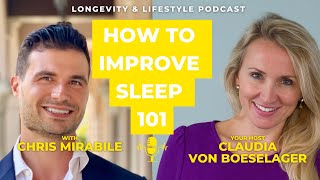
In this episode of The Longevity & Lifestyle Podcast, host Claudia von Boeselager interviews sleep enthusiast Chris Mirabile, who shares how he transformed his life by prioritizing sleep. Mirabile explains that good sleep dramatically improves mood, memory, and overall perception of life. He details practical tools he uses: a comfortable blackout sleep mask for total darkness, and a precise earplug insertion method that creates a deep seal to block ambient noise and prevent microarousals that fragment sleep. He emphasizes that sleep quality matters more than total time in bed, noting that unnoticed microarousals can degrade rest. Mirabile also discusses lifestyle factors: stopping food intake at least three hours before bedtime, ensuring sufficient daily calories (especially after intense exercise) to avoid early‑morning awakenings, and a supplement stack—magnesium as a baseline, valerian extract for rapid sleep onset, and occasional herbal options like California poppy and chamomile. The conversation blends personal anecdotes with actionable advice for listeners seeking better sleep hygiene.
Chapters
I failed to realize for most of my life how important sleep is, not only for health, but just for my subjective perception of life. In other words, if I'm enjoying myself and I'm happy and I'm in a good mood and my memory is sharp and cognition is great, or am I dragging along? And, and so sleep, I've over the past decade or so really prioritized that in my life. And so there are certain things that I do to improve my sleep. I used to really— yeah. So I used to always focus on having the blackout shades, but I travel a lot. So what I've gotten used to is just sleeping with a sleep mask, finding one that's very comfortable that doesn't let any light in. So I found one that works really well for me. The next—
you don't mind sharing? Because my audience loves specifics.
Sure, sure. I don't know it off the top of my head, but I can share it with you if you want to add it to your—
we can add it in the show notes. Perfect.
Yeah. Next I would say is earplugs. First of all, the first time I was using earplugs, I wasn't putting them in my ears properly. And I've realized most people don't, they just squeeze it a little bit and push it. And then they're sticking out of your, someone's ear. And it's, that's not in your ear if it's sticking out. If you can see it, it's not in your ear. There's a way you can watch YouTube videos, but you have to like lift the top of your ear and pull the bottom of your ear and then spin it so that it's very, very small, almost like a golf tee, and then stick it in your ear as deep as you can go. And then let it expand. And then that is when you get a good seal. And the first couple of weeks sleeping with it, it was irritating. And in the middle of the night I would like take it outta my ear, but eventually it became comfortable and it has been a game changer for me. I've been doing it for years now, especially when I lived in Manhattan where there's like noise outside, completely blunted that. I didn't hear any noise outside. And now even not being in, in a busy city like New York, but having a girlfriend, having a dog, like when, if she's getting ready before me, I don't hear it. I sleep through it perfectly. And most people don't realize that there, there can be noises that are waking you up throughout the night that you are unaware of because you fall back into sleep. They're called microarousals, and microarousals will disrupt the quality of your sleep. And what's most important is the quality times the quantity, right? And so if you're not getting the good quality and you think you're getting good sleep because you're in bed for 8 hours, does not doesn't necessarily mean that you are. I would say that is, is fantastic for me. Then dietary patterns, just making sure that I stop eating about at least 3 hours before bed, but that I've had adequate calories for the day. I exercise a lot and I found that if I'm too severely hypocaloric, like I worked out really hard and I didn't eat enough calories for the day, I'll wake up at 3:00 AM, 4:00 AM and have trouble falling back asleep. So I need to be mindful of that and make sure I've eaten enough food for the day. And then supplements, magnesium is the go-to for most people. But beyond that, I've experimented with practically every type of sleep-related supplement out there, California poppy and chamomile extract and so on. I find valerian to be a really nice balance. I take a half a dose of valerian extract and the NOW brand, very easy and inexpensive to find on Amazon. And I find that really helps me to fall asleep very quickly. And stay asleep throughout the night.
Hi everyone, this is Claudia again. Before you take off, would you like to get a short email from me with some short but sweet fun tips, tricks, and updates on all things longevity and lifestyle? This could be cool products that I've discovered, interesting posts or articles I've read, and other fun and helpful things around longevity and lifestyle I've found for you. It's a very short piece of inspiration for you a few times a month. So if you want to receive it, check it out by going to longevity-and- and-lifestyle.com. That's longevity-and-lifestyle.com. And leave your email to sign up for the next one.