Top Biohacking Strategies for Better Sleep, Recovery, and Longevity with the Biohacker Babes
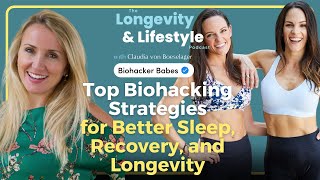
Sisters Renee and Lauren Sambataro, the Biohacker Babes, walk through sleep optimization, circadian rhythm alignment, and tracking heart-rate variability to measure stress and recovery. They focus on concrete moves: seven to nine hours of sleep, consistent wake times, reducing environmental toxins like mercury and mold, and using breathwork and devices like Apollo Neuro to activate the parasympathetic nervous system.
Chapters
Welcome back, dear audience, to another episode of the Longevity and Lifestyle Podcast. I am your host, Claudia von Boeselager, here to bring you the latest insights and learnings to improve your health, life, and happiness for longer. Today's episode is part 1 of 2 of my conversation with Renée and Lauren from Biohacker Babes. To catch part 2, head over to Biohacker Babes Podcast, found on all podcast channels. My guests Renee and Lauren are sisters who grew up in a health-driven family, exposed to biohacking concepts from a young age. Their father, Jean Sambataro, known as the original biohacker and the pioneer in holistic dentistry, taught them the importance of individualization and experimentation. Renee is a certified nutritional consultant and holistic lifestyle coach with a master's degree in nutrition. While Lauren is a Broadway performer, corrective exercise specialist, and functional health coach. Together, they co-host the Biohacker Babes podcast, which aims to create insight into the body's natural healing abilities, strengthen intuition, and empower listeners with techniques to optimize health and wellness. Today's episode, again, is the first part of a part 2 podcast with Renee and Lauren. And if you want to catch the second part, then check out the Biohacker Babes podcast for part 2. Please enjoy. Welcome to the Longevity and Lifestyle Podcast. Renee and Lauren, it's such a pleasure to have you both with us here today. I'm so excited we got this in, and I'm delighted to share with my audience about your work and you guys as well, because you've had such early exposure to biohacking from your father's work, right? And so how has your understanding and practice of biohacking evolved over the years?
So many iterations and changes. Yeah, I know.
Who wants to jump in?
So different. I mean, I feel like the early exposure, whether it was well understood or super clear, is questionable. Like our dad had biohacking tech when we were kids in the '80s, so we were exposed to like alternative methods very early on. I feel like our understanding of biohacking was maybe the cleanest then, cuz it was just like, let's be curious and try things outside of the box. Like let's just see how the bioindividual body responds to these things, knowing that conventional medicine may not have all of the answers. So, that was in a very innocent way, probably the cleanest understanding of biohacking. And then, we kind of went through our own health journeys and probably a lot of myth-busting and trial and error and trying pill for an ill or zeroing in on one root cause. Well, now we know it's many root causes. So, I think we would both agree it's been quite a journey. And I'm just kind of laughing. I'm like, "Oh, maybe we were better biohackers when we were kids." But yeah, no, I think we probably have started and maybe where we are now is a little bit the same where it's like we have a curiosity mindset. We know it's multiple root causes. We know this journey never ends. We know that it's bio-individual and we know like curiosity, I think, is like one of the greatest kind of perspectives going into this journey of biohacking. Like we just have to continually be curious because it's always changing. Our cells are changing, the environment is changing. So I don't know, that was like a broad spectrum answer. I'd love to hear Renee's.
I love curiosity.
That's such a great word for this. And I think being open-minded and again, going back to our dad, like in 1985 when someone said, hey, the mercury fillings in your patient's mouths might be making them sick. And as a traditional dentist, he said, what? What? Oh wait, maybe I should look into that. Just that being like open-mindedness from him. I think we learned that at a young age, like don't ever write something off because the FDA says it's okay, or traditional medicine says this is the way. Maybe it is, but maybe it's not. Maybe there's something else out there. And then, yeah, I think both of us going through our own health journeys and realizing, like, it was so— like, I had chronic fatigue syndrome in my early 20s, and people are always like, what was the one thing? I'm like, oh no, no, no, no. It was like so many things.
Yeah.
And so Yeah, I think just always staying open-minded, especially like with how fast the technology and the scientific research, especially in the longevity space, is growing. We have to always be asking more questions and staying curious, which is really fun and exciting.
Yeah, I love that. And I think it's such an important point. And I was almost wondering, is it like this innate intuition to be curious in terms of like, is there another way? Because if you're coming from medical school, you know, you're trained in a certain way, you're told it's this way and that's it. But it's this curiosity, but also this like belief in self, like I, you're empowering yourself essentially to go down a rabbit hole and understand it better. Right. So I think it feels like, right. A bit of it, like trusting self-empowerment also. And that curiosity to search for other answers that aren't text-based answers.
We're all naturally intuitive. We all have, we are born with intuition. I, maybe there's some genetic defect that maybe someone doesn't have that, but But I think there's so many things that get in the way. Environmental stressors and toxins are, I think, can be one of the biggest contributors to a limiting belief mindset. It's not just the psychology, it's the physiology and what we're exposed to, what our cells are constantly being told. And so I think this process of coming back to our intuition, because the world, our society, you know, myths that we've been taught about nutrition and health have not only distracted us and kept us like in this little box, but also like stressors and toxins are clouding our, our powerful innate intelligence. So there's a lot of processes to like peel that back. But I do believe that we're all naturally intuitive.
Yes, I love that as well. And it's about tapping into it. But probably we can go down a tangent. Yeah, that may be another.
Yeah.
So I'd love to hear how you guys differentiate, or you ladies, I should say, differentiate between biohacking, healthspan, and longevity in your approach.
Oh, that's a great question. You know, I— to me, it's all the same. I think it's just like what your personal goal is. But, you know, biohacking, some people say it's just a trendy word. Some people don't like the word because they don't like the word hacking. And that's fine. Like, I'm like, whatever you want to call it, as long as you are taking a bioindividual approach, right? You're understanding that your body is different from everyone else. You have a goal, whether your goal is overcoming some kind of current illness, chronic disease, you want to live a longer, healthier life, right? The healthspan, longevity, whatever it is. And then using ancestral wisdom, right? Like the biohacks our ancestors did, getting out in nature, grounding, sunshine, fasting with the latest technology of today. We have so much that we can offer people. I mean, the AI on our phones that can help us, you know, achieve these goals faster, the data, the wearables. It's so, so complex and exciting. But I think it's just combining all of those and whatever you want to call it. But at the end of the day, you're taking responsibility for your health and you're making the steps and changes to achieve that health goal.
I love that. Can you both share your top 5 strategies or practices for health optimization that you have found most effective?
Yeah, I, I would jump in with number 1 is sleep optimization. That's been the biggest game changer for me and for a lot of my clients. And the cool thing about sleep optimization is, I mean, that has a huge bucket, right? There's so much we can do to optimize sleep and typically why people aren't sleeping well. It could be 100 different reasons. So there's a lot to unpack there that could be like a full year of experimenting to figure out what works best. But when we're sleeping better, then we want to, we want to eat better, we have better energy, we want to work out, we're in a better mood, we can be better friends, sisters, podcasters, spouses, all the things. We can give back to our community. I just think sleep is the number one hack. And for me, it was really big because I definitely was that person. Maybe all three of us are a little bit like that, you know, perfectionist type A. Back in the day, I was sleeping 4 or 5 hours a night for years.. And man, that just like flipped my life upside down. Now I sleep twice as much, if not more.
Yeah.
So I would say that I think that's number one. And, you know, we're spending a third of our lives sleeping, so who doesn't need to optimize that?
That's 100%. I mean, for me as well, I noticed that. But I'm curious, Renee, like, what would you say? Is it just the length of time sleeping or what was the biggest differentiator? Was it more getting more REM sleep, getting more deep sleep? Like, what did you notice that was the real game changer with your sleep?
Yeah, I mean, definitely the length helped. I mean, no one, no one can get by on 4 or 5 hours of sleep. I'm sorry, that's not— maybe there's a few genetically inclined people that can do 6 or 7 hours, but I think more people need around 8 at least. So definitely the length helps at first, but then looking at quality, and I think that's where the data with a wearable can be really great. I still go back to the Oura Ring. I've had that for 6 years and it's so cool to see the trends. The longer you have one piece of tech and see the trends over the years, it's so, so fascinating. So, so yeah, obviously getting into the quality, for me it was more deep sleep. REM sleep wasn't really an issue for me, but deep sleep, you know, number one thing is no alcohol. Number two, watching stress. Number three, watching blue light exposure before bed. I would say those were the top three for me to increase deep sleep.
Yeah.
So, quality.
Okay. So, that was number 1. I would say number 2. What's number 2? Yeah.
And, Lauren, do you want to share another thing?
This is part of the same thing, but number 2, I would say, is really honing in on circadian rhythm. Our bodies are meant to be in rhythm and we can create good circadian rhythm with good sleep hygiene, but it really extends across the whole 24-hour day. How are we in rhythm with these natural light-dark cycles? Like, the sun and the moon are teaching us how to behave, but we've become so out of sync with that.. And every organ system has a clock in the body. And so, it's looking for these external cues at how to be in rhythm, how to be in sync. And if we're in sync and in rhythm, then everything operates so much better. So, it actually, like on the scheme of the pyramid, like food and exercise become a little less of a priority if your body— you're focusing on the rhythm of the body. So, with the good sleep hygiene, I think just consistency, like sleep-wake times more consistent. And this is always highlighted to me so deeply when I travel. I travel a lot. Important this rhythm is because you travel and you feel like everything gets out of whack. It's like, because your body's confused. And just having that consistent sleep-wake cycle, eating relatively at the same time, exercising relatively at the same time, really conditions the body to just be in this flow. Because, you know, we're just a bunch of cells and electrons, like, resonating and vibrating and floating around in space. So they're just looking, they just want to be in harmony. That's the ultimate goal. So like, if we can create harmony, then a lot of these little things that we are fixated on tend to improve. And I would just, I guess an example of fixation would be like glucose. I went through a long period of time where I was like only doing glucose with clients. I gathered like so much glucose data. At the end of the day, I was like, it's less about the carbs, it's more about your circadian rhythm, your sleep hygiene, and your toxic burden. So my third one would be like unload your personal toxic burden. And we all have it. We know we're all exposed to a lot of crap in the environment, but some people have more exposure to mercury. Like our dad, both of our parents like handled mercury in dental school. So we have mercury exposure. Not everyone has that. Some people like if you work in construction or HVAC are more exposed to mold or asbestos. Like it's really important to know, or lead. It's important to know that personal history so that we can address it. Because carbs are not going to be the enemy if your toxic bucket is full. Carbs are not going to be the enemy if your circadian rhythm has no rhythm.
Yeah, right. I think that's such an important point. What do you do when you travel? I'm curious, Lauren, like, it's tricky, right? Different time zones, etc. What are like maybe the number one thing that you prioritize if you're traveling to reset your circadian rhythm?
Well, I try to plan the timing of the travel accordingly. I don't always do it well. In fact, I did not do it well this past week. I traveled too late. I got into an Airbnb too late. And so I didn't have a lot of time to adjust and assess the environment. The environment actually, it's where I am right now. Um, it has something funky going on. And so, um, potentially, yeah, there's a lot of things. So I was actually just talking to my dad last night cause I was telling him like, I haven't been sleeping here. So he's like, you need to make like this travel thing. I was like, if I made it, it's like out of control. So I'll, I'll simplify in a second, but I'm like, man, if I traveled with like a Faraday tent I could sleep in and air purification because like there's a lot of stuff again we're exposed to. So I would say one is just try to plan the timing so you don't get out of rhythm with your sleep schedule. So if you're crossing time zones, you know, it's not always perfect with a 3-hour, 6-hour, whatever difference it is, but we just want to sink into a rhythm as quickly as possible. So I always prioritize sleep and like social— socializing is very important to my health and my joy and my nervous system, but I will like skim that off if it means that my sleep is going to be supported first. So yeah, I would say just like finding a schedule that works for me so I get the sleep and the recovery. As Renee said, like, if you're not sleeping, nothing else is going to work. You're not going to detox, your brain's not going to work, your glucose is not going to work. Like, nothing's going to work if you didn't sleep.
So scheduling. Yeah, so scheduling. So I think we're on number 4. So we have the detoxing, circadian rhythm, we've got the sleep. What's number 4?
This episode is brought to you by OneSkin. If you're like me, you know the power of feeling confident in your skin, and that's why I'm so excited to share today's sponsor, OneSkin. Their products make it simple to keep your skin looking and feeling healthy, strong, and vibrant without the need for complicated routines. It's all about science-backed, effective skincare. OneSkin's secret is their proprietary OS-01 peptide, the first ingredient scientifically proven to target and reduce aging cells that cause lines and wrinkles and thinning skin. I've been using their products for a while now, and the difference is amazing. My skin feels refreshed, hydrated, and looks younger. But don't just take my word for it— OneSkin has over 4,000 5-star reviews. Now is the perfect time to try it for yourself. For a limited time, get 15% off your first OneSkin purchase using the code Claudia15. CLAUDIA15 when you check out at oneskin.co.
That's oneskin.co.
Start your journey to healthier, younger skin today.
I would say looking at your autonomic nervous system, I think we all need more parasympathetic support. And, you know, if anyone's not familiar, you know, we need some sympathetic activity, right? You know, being on this podcast, we're all probably a little more sympathetic right now, you know, going to work out like we need that. That's good. But then I think balancing it with the downtime, I still see a lot of my clients are not getting enough of that. And obviously sleep is the biggest time for that, hopefully, right? We're hopefully in a parasympathetic state the whole night we're sleeping. If you're not, that's— there's more to unpack there. But incorporating at least, I think, 30 minutes a day, or for some people it's even just 5 minutes a day of doing breathwork, mindfulness, meditation, maybe bringing in some tech like a BrainTap or a PEMF or Sensate, something like that to downregulate. Or like a vagus nerve stimulator. I've been playing with that a little bit more.
You have—
which one do you have on?
The Apollo?
Apollo Neuro? Yeah. Nice. I think everyone should have at least one piece of tech that's going to do that for your nervous system because we're not going to get rid of like the crazy craziness that's going on. At all times around us. So finding at least 5 minutes a day to downregulate, but then also supporting your nervous system the first hour in the morning and the last hour before you go to bed, because we know the brain is very sensitive to everything that we're inputting at that time. So in the morning, you know, staying away from checking your phone as long as you possibly can. You know, I know some work schedules, that's tough. But if you can get out in nature, Give your body that time to wake up in the morning without technology. And then same thing before bed, no technology, really winding down, telling the nervous system, hey, this is, this is time to rest, rejuvenate, relax, all the things. So some, some kind of nervous system thing. And then looking at HRV for that, right? Like if, if all the things we're doing, are they working? And heart rate variability I think is the best thing we can, we can look at for that. And everyone has, some typically something to measure. I know the Apple Watch isn't great at it, but Oura Ring, Biostrap, Whoop, something like that to really see are we supporting the nervous system.
And for people perhaps not that familiar with HRV and what a powerful tool it actually is for tracking, can you unpack it a little bit just so people can really understand HRV?
Yeah, this is my favorite thing to track. So Yes. So, yeah, so heart rate variability, it's the variation between each heartbeat. And so when we are measuring that, you know, typically these wearables are looking at your HRV overnight and then so you're getting a score in the morning. There's also some tech where you can measure it in the moment, like Elite HRV or Hanu Health, which is, I guess, going to be going away soon, sadly. But there's different tech with that. But anyways, big picture, higher number means you're more resilient to stress, you're more recovered. Lower number, less resilient, not recovered. But you can't— this is an interesting biometric because you can't compare it to other people. So when we say, oh, I have a high HRV, is it high for you or is it high compared to your spouse? Right? We never want to compare to someone else. It's all— it's a very personal thing. So like for me, my average is 140. If I hit 190, holy cow, I am recovered. I am ready to go do an intense workout. If I see 50, it doesn't really happen. But if I do, like, I'm probably getting sick, like red flags, shut it all down, you know, versus someone else that maybe their, their HRV average is 40. That is okay for that person. But you want to look at the variation. So is it increasing or decreasing by 20%? That's an okay range. Is it increasing or decreasing by 40%? That's a huge range. So really personalizing it, but HRV can get a little a little confusing, but, but I would say big picture, high is better.
Low, we got to watch out what we're doing and watching the trend as well.
Yeah.
Yeah.
The trends over time are really cool.
Yeah, exactly. Yeah.
Can you share a particularly impactful biohacking experiment or experience that significantly influenced your health journey?
My gosh. In our last 5 minutes. Yeah.
How do we do it?
Yeah. Well, can we go, like, a little off, maybe something out of the realm of things we've spoken about already? Like, if we were to do a fifth one, I feel like a lot of pressure there. I'm like, oh my gosh, is it movement? Is it food? Or do we come back to mindset, the brain, which really controls everything? I would say maybe one of my most impactful biohacks is really looking at the underlying narratives that carry me through my entire lifetime and inform my choices for my health journey. And using plant medicines, psychedelics have been really revealing at uncovering these deep narratives that again, it's like the carbs are not the enemy if you have this underlying belief that says that your cells will express in this way. So just looking at emotions and thought patterns and beliefs and mindset, I think can really just part the clouds in so many ways and inform so much and really create a lot of ease and provide a lot of answers. I mean, there's so much to dig into here, but we create compassion, we have more gratitude, we can forgive, we see more insights, we have more downloads, we understand, there's more clarity. Like, there's just so much that can be gained by opening the mind in that way. So for me, I've uncovered and, and answered so many of my health questions just by sitting in a moment of quiet in solitude with plant medicine. But it's like, I don't— there's no other hack for that. There's no pill. There's no other practice that, that's been the thing.
Powerful. Beautiful. Thank you for sharing.
Yeah, that's huge. I think one of the biggest eye-opening experiments or experiences I had was almost 20 years ago. Our dad heard about this machine called the Light Portal, and it uses vibration, color therapy, binaural beats, crystals. At the end of the day, all it's doing is it's immediately putting your body into a parasympathetic state. So, going back to what I was saying about the nervous system. And there were only, I think at the time, 5 in the whole country. And I was living in Tampa, Florida at the time. And my dad said, "Hey, there's one in Tampa. It's down the street from you. Will you go check this thing out for me?" Sure. As a biohacker, I'll test it out. Why not? I go over, I do an hour session, life-changing, completely life-changing. I realized I don't think I had ever really been in a parasympathetic state. I had been go, go, go for so many years, type A, productive, not sleeping kind of a personality. And I came out of that and I was like, I can think clearer. I have this like beautiful energy. I'm creative. I truly had never felt that before. And so then I immediately called my dad. I'm like, okay, you got to buy one of these. So now there's one in Maryland. But, you know, there, and that was almost 20 years ago. So now, I mean, today we, like I said before, we have so many gadgets and devices that can do similar things for a lot less money, which is great. But that just opened my eyes to like, wow, the stress I've been putting on my body has been a huge hindrance to my health. And just stopping and slowing down is, is a huge step. And to add to what Lauren said, in recent years, I've also played with plant medicine a little bit. And the beauty there is during, whether it's maybe a microdose, a macrodose, it forces you to be present. And I, all, it also taught me like, oh gosh, I'm not very good at being present. There's, there's a lesson here. Like you can't multitask when you're doing that. You can't think about other things. You can't be planning other things. It forces you to sit and be in the moment and listen to what's happening in your body. And I think that's a great lesson for a lot of us.
Yeah. And for life in general, I had the pleasure of hearing Eckhart Tolle, you know, The Power of Now, speak live. Yeah. And it was like, I don't know, 60,000 people in this auditorium and you could hear a pin drop and he's just sitting in a chair on the stage. He's so amazing. And he's like, listen for the silence. And I think I love one of the things he said is that life is a series of nows. And that's it. Like, we're not the future, we're not the past. It's just now. And so it's just remembering that and getting present. Of course, The monkey mind is like often the next thing, but it's like, no, it's all about the now. Yeah, absolutely love it. So as our time is finishing up here, so dear audience, this is part 1 of 2, so please check out the Biohacker Babes podcast for part 2 and where we will do it. But before we finish up, ladies, I'd love to hear what your recommendation or parting thoughts or messages for my audience today, any ask or otherwise.
Hmm. I would get really clear on what recovery is needed for your body, cuz everyone is so different. Like shut out the noise and be really brutally honest. Like what do you need? Because we get stronger in our recovery and you can hear that in many ways. Like your workout recovery, your sleep recovery, your thought recovery, your, you know, just a little break from work. Like what do you really need and can you honor that? And maybe it's just even the question now, like, can I, can I honor that? Can I think about honoring that? Because everything that expresses through health is like through our recovery.
Oh, I love that.
Yeah, I would add, you know, for the, the biohackers, the longevity enthusiasts, you know, I think it's easy to get overwhelmed by all the things. There's just so much we can be doing for our health every day. So I think taking a step back and maybe just picking one thing to track for the next 4 weeks could be HRV, could be a biological age test. Just pick one thing and really focus on that. And I think that can help drive you forward with all your other, you know, health habits, health goals. So just pick one thing to focus on.
That's really powerful. Where can people learn more about what you guys, our ladies, are up to, um, via website, social media? Where would you like to—
our website is biohackerbabes.com, and that's where you can find mostly podcast stuff and our resources. Our podcast, The Biohacker Babes, releases every Monday on Apple, Spotify, all the places. And then we spend a lot of time on Instagram. That's sort of our hub. So we have biohacker_babes on Instagram and then we have our personal pages. I'm Lauren_Sampatero and Renee is ReneeBells on Instagram. So great place to message us if you want to get in touch.
Beautiful. Well, thank you so much for coming on today. Thank you everybody for listening and make sure to tune into round 2 over on the Biohacker Babes podcast. Talk to you then.
More from Claudia









Can Psilocybin Slow Aging? The Study on Telomeres, Inflammation & Survival with Dr. Louise Hecker

