TOP Books You Need to Read in 2022 | Episode Remix
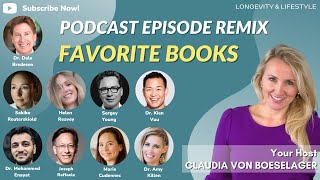
In this remix episode of the Longevity and Lifestyle Podcast, host Claudia von Boeselager stitches together short clips from recent interviews where guests share their favorite books and discuss cutting‑edge ideas in longevity, biohacking, and health optimization. Sergey Young explains why he wrote The Science and Technology of Growing Young, emphasizing the scarcity of public knowledge about longevity investments and the confusing flood of health advice. He celebrates rapid advances in gene sequencing, CRISPR, and the global rollout of gene‑therapy‑derived vaccines, framing the current era as a massive, positive experiment. The conversation then moves to wearable health technology, with mentions of continuous glucose monitors, smart rings, and upcoming smartwatch capabilities that could track most vital signs. Another guest recounts an early fascination with the brain‑computer analogy that sparked a career focused on neurodegeneration. Throughout the episode, multiple guests recommend books ranging from classic literature (The Count of Monte Cristo) to nutrition critiques (Dr. Lustig’s The Bitter Truth), spiritual synthesis (Perennial Philosophy), aging theory (Why We Age), telomere biology (Telomerase Revolution), and modern longevity economics (Juvenescence). Finally, a deep dive into the Thrive State framework explains how a bioenergetic model links cellular gene expression, lifestyle factors, and disease, offering a practical diagnostic and therapeutic toolkit. The episode serves both as a teaser for full interviews and a curated reading list for anyone interested in the science, technology, and philosophy of extending healthy lifespan.
Chapters
Welcome to another episode of the Longevity and Lifestyle Podcast. I'm Claudia von Boeselager, here to uncover the groundbreaking strategies, tools, and practices from the world's pioneering experts efforts to help you live at your best and reach your highest potential. Today's episode is a remix of short clips from previous week's episodes on guests' recommendations of must-read books. It serves as a teaser into the wealth of insights and entertaining anecdotes and valuable tips from the various conversations I've had the pleasure of having to give you a flavor of the episode and guest. So if you'd like to check out the full episode and more, simply go to longevity-and-lifestyle.com/podcast. Please enjoy.
What is the book that you've gifted most often, Amy?
Oh wow, that's a good one. I have a lot of books that I love. I'm trying to think about when I gifted a book last time. I don't think I've even gifted a book in a while. I've read a lot of, like, a lot of Dave Asprey's books we've gifted for different, for patients and people because our clinic is in a lot of those books. And so we'll gift those to to people for that reason. I've gifted The Giving Tree, you know, the kids' book, The Giving Tree, a lot just because I love that story and it makes me super happy. Those are probably the main ones. I read a ton, but I actually haven't given a lot of books away, which is kind of sad.
Yeah, perfect. Let's talk a little bit more about your book, The Science and Technology of Growing Young. First of all, congratulations on writing a book. Not everyone gets that far, so really fantastic. And I also love the title. I think it sums it up really nicely. What was the purpose behind writing the book? What was your vision when you sat down to start writing it?
Yeah, so, well, a number of things. One, in Longevity Vision Fund, we're looking at 200 companies a year, and we allow to labs, to the minds, the thoughts of entrepreneurs and greatest scientists. And I thought I just need to share it with the public. It's such a unique access that we enjoy through our fund. And again, there are very few funds investing in longevity technologies today. So it's a very rare knowledge and I wanted to share it with the audience. So that's number one. Number two, longevity became such a confusing information space. I think it's always been like, but recently it's been a problem. Like today you read you need to do your stem cells injection like immediately. And then tomorrow you read, well, it's FDA hasn't approved that, so you just need to wait. It's very risky. And then this happens with everything, like putting butter in your coffee. Coffee is right or wrong. Blueberries are great. And then next week, blueberries are eroding. It is toxic. Yeah, it's toxic. And the acid from the blueberries erodes your stomach from inside. So a lot of people just going into default mode, like, if this is important enough, this will find me through the medical system. Otherwise I'm not gonna bother because it's really confusing. So I thought I just need to bring a more balanced view because we have a lot of brilliant scientists in our scientific advisory board or in the companies that we're investing in. We have like access to the best technologies and I'm doing a lot of experiments. I'm not a biohacker. I actually am pretty conservative guy, but whenever I have access to something really modern, you know, I'm just doing that.
And you're one level down from the biohacker. We have to coin a term, Sergey.
Yeah, yeah, yeah, yeah. That's true, by the way. And I kind of thought, well, this is what I need to share with the public. And I also do believe that we are so focused today on like a negative side of the healthcare system today. So we actually forgot and we don't really take time to celebrate. Think about gene editing and gene therapy. 30 years ago, it took 13 years and $3 billion in US to sequence human genome. In fact, they actually wanted to stop the experiment after the first 2 years because they managed to sequence like 1% of the human genome. So they quickly calculated that it's going to be, what, 100+ years to do that. And funny enough, and luckily, the computing power has been more and more affordable and the cost of it has been democratizing itself. And they finally completed it. Well, these days you can sequence human genome, like the most important parts, in the course of a few hours and it costs $200. Or 30 years ago, the gene editing in the form of almost like the only technology which was available these days, which is CRISPR, like genetic scissors. It's been available only to the people who had like nothing to lose on this planet. They were terminally ill, they were about to die, and they become like the only people. Yeah, the guinea pigs.
Yeah, exactly. Like a last resort experiment.
Well, right now we're all participating in a gene therapy experiment on a global scale. I do believe it's a positive experiment, but like Moderna, AstraZeneca, well, this is all the outcome of gene therapy. Yeah, that's amazing. And this is what happened in the last 30 years. And it's going to be more and more like our variables. I'm like full of variables. I'm streaming.
I've got the trackers.
Yeah. Our ring here, continuous glucose monitor.
Levels Health. Okay.
Yeah.
I've got those as well.
So like, if we are taking care of our cars with computers, with sensors, our body and our mind are much more important. We should do that. So then watch the wearable space. All these Apple Watch, Fitbits, Whoops will become our personalized healthcare devices. I think with the addition of like measuring glucose in the blood and measuring our blood pressure in the next couple of years, I think Samsung Watch already launched this feature and it's gonna be 90 to 95% of the indicators that we would like to measure on a regular basis.
I'd love to take a step back and perhaps you can tell listeners where this journey to finding the protocol actually began. Have you always been fascinated with neurodegenerative diseases? How did you stumble, if you will, on this path?
Yes, I was a freshman at the California Institute of Technology and I read a book about the brain called The Machine The Machinery of the Brain by Dean Wooldridge of TRW fame. And he talked about the relationship between computers and the brain. And I was interested in computers and I thought, oh, this is really interesting. You've got this amazing computer inside your skull with a huge number of synapses. And I started reading, got very, very interested in what the brain was all about and how it worked. And ultimately I got interested in why we have diseases of the brain and why there's such horrible diseases. You know, if you look at the various types of disease, the area of greatest biomedical therapeutic failure has been in the area of neurodegeneration. So, you know, again, as someone said, everyone knows a cancer survivor, no one knows an Alzheimer's survivor. And of course, you could say the same thing for ALS and frontotemporal dementia.
So—
What is a book that you have gifted most often? Some of your favorite books to gift?
So one is The Count of Monte Cristo. Yeah, it's just a page-turner and a great read. So I've gifted that quite a few times. And then in terms of science and sugar, the, oh God, Dr. Lustig's book.
I think I've heard of him. Yeah. There's The Bitter Truth.
The Bitter Truth.
Sorry.
Yeah.
Dr. Lustig and The Bitter Truth.
He writes really well and he's very, very passionate about particularly fructose and so on. But he writes in a way that I think is accessible to most people. And it just definitely alarms you to the issues with sugar. And then also on a more sort of philosophical, spiritual side of things is Perennial Philosophy by Aldous Huxley. So Aldous Huxley, you know, is famous for Brave New World, mostly as a dystopian, like future kind of and so on. But he was an incredible writer, reader, intellectual, philosopher, philosopher. And he was the editor for the Encyclopedia Britannica for quite a while because he's read everything. And he summarizes and synthesizes all this wisdom and learnings from different religions and spiritual practices and things from around the world and does it so eloquently and beautifully and humbly. I think his book, The Perennial Philosophy is just wonderful and so insightful. And you basically don't have to read all the different spiritual traditions around the world because he's got them in there in such a succinct and deep way.
And then as far as books are concerned, you know, for understanding aging, I think even though it was written like more than 20 years ago, Stephen Olstad, He's a zoologist that does a lot with aging. He wrote "Why We Age." That was one of the books I read back when I was just getting into the field. And he talks about the need to use other models besides mice to understand aging because mice are optimized for short lifespans, not long lifespans. And they're good for looking at certain diseases and, you know, they're good laboratory animals, but they're not really that great for studying aging. But he also talks about evolution and the evolutionary theory of aging, which I think is very important to understand if you're really going to kind of go into aging. I mean, you can go into it as a biohacker and just say, look, I want optimum performance. But some people go into it with the idea that, well, should I mess with Mother Nature? And that's the problem, is that when you understand that Mother Nature didn't intend— we're not selected or evolved to live to 50, 80, 90. We mostly died in our 30s of unnatural causes. And so there's no plan. It's, it's like that you use the analogy of of the car, or I use the analogy of the dentist, is, you know, the car is designed to work, you know, and have a warranty for 5 years. After that, if you want to be running it 15 years, you've got to keep on checking it, replacing parts, doing your diagnostics on it. We do that in dentistry, you know, we just don't do it in medicine. But we're still just screening for disease instead of screening for health. And health erosion starts a lot longer before disease. And so, you know, that I think is really important to watch. Michael Fossel's book on telomere biology, Telomerase Revolution, is very good. There's, of course, David Sinclair's book, Lifespan. Those are sort of the top ones. If you really want to dive into cell biology, Michael's book, Cells, Disease, and Human Aging, is sort of one of the bibles that I read. I would say, you know, those are— that's a lot of reading there, but you're always getting pointed to new stuff.
Different books that I've been reading and really enjoyed— Atomic Habits. So I think like habits that you form will definitely help set you up for the day, but also like your evening. So, you know, that book is incredible. It really made me understand habits, addictions, different things like that. So, you know, addicted to chocolate or something like that, you know, tell yourself Okay. I'm going to eat this chocolate right now. But say it out loud. What different things that make you happy during the day? So if it is that piece of chocolate and that makes you happy.
So there's a great book by Christiana Figueres, who's really kind of single-handedly was the woman behind the Paris Agreement in 2015, which seemed like the most impossible task at the time. And she's amazing, called The Future We Choose. So I highly recommend that as a great read. Another one is more of an unusual one, is The Sacred Cow, which is an absolutely brilliant documentary and book. Do the documentary if you can't, you know, if you don't feel like doing it, but the book does go into a lot more detail, and it's very much promoting regenerative agriculture as pretty much the solution to climate change and dispelling a lot of myths around cows being the reason, you know, there's a lot of, and I won't go into it now, but she basically puts forward the nutritional, environmental, and ethical case for better meat and for regenerative agriculture. Yeah, that was a really, really fascinating read recently. I would say those are really probably my two most seminal ones that I kind of will go back to a lot.
For listeners interested in understanding more about biohacking and optimizing health better, what are some resources or books you recommend to start with?
Okay. So I really like a book called Juvenescence: Investing in the Age of Longevity. I don't know if you've read that by Al Chalabi and Jim Mellon. I like that book because for those people that are interested in what's the convergence of biohacking and longevity science, it's written a few years ago, but it summarizes it very well. Like where does biotechnology fit? Where does gene therapy fit? It's written from the perspective of a biotechnology perspective. Rather than a biohacking perspective, but it gives you that lens of perspective, which is quite interesting. Another book I really like is by Aka Hintze, who's— rest in peace— passed away now. He wrote a book called The Call.
The Call. C-A-L-L. C-A-L-L. Sorry.
And he actually started a center called the Hintze Performance Center, which they do coaching around basic principles of health as well as mindset. And you can see the evolution of that where you apply a bit of kind of basic health coaching with how to control your state. But he's worked with Formula One drivers and some cool people. So that's a, that's a really cool book and inspired me a bit as well.
Also, and I'd love to take a deep dive into your book now, Thrive State: Your Blueprint for Optimal Health, Longevity, and Peak Performance. So How did it go from having your own eureka moments, doing your own discovery, you had the TED Talk, and what was your motivation behind putting it all in the book and bringing it all together and the bioenergetic model really getting it out there? Can you talk a bit about that?
Yeah, so I saw a lot of changes in my body as I went through my disease reversing process, but I wanted to make sense of all of it. And I also wanted to put it together in a way that it's easy to understand and also as a framework I can use to say, okay, can I diagnose or can I help somebody else with this problem? Because, you know, modern medicine says, hey, you get this medical history, but you're not asking questions how much they're sleeping, what they're eating, you know, and all these other things in their life. So I wanted a tool I could use. And as I started to study health and epigenetics and anti-aging and regenerative medicine, I started to notice these patterns, right? Well, what are the things to Decrease depression, you know, like, okay, exercise, sleep better, eat better, like, oh, your blood pressure. Okay. Exercise, sleep better. So all these different things are all these different diseases. What are all the common things are common? They start to show up over and over and over again. And once I started to understand that, I started to understand that, okay, disease isn't some, some isolated thing in one. A particular organ system, but it's because the cells aren't getting what they need. And basically, when the cells aren't getting what they need, our body is not talking to each other in an optimal way. That's when you get, you know, disease symptoms. And when I pieced that all together, I was like, wow, this is really a good framework to approach life and health and made a lot of sense. And that's why I wanted to put it together. One, so that I had something I could work with my clients with. And I found that once I evaluated somebody's bioenergetic state and where they were, and as we started to address some of those things, a lot of their symptoms sort of disappeared. That was really the crux of, as the putting it at all into a system. And I go into the science of how the old way of thinking about health is, you know, you get stuff from mom and dad, which is your DNA.
Mm-hmm.
And that's the health that you're given. But that's actually not the case. Our DNA is not a fixed thing. You know, if our DNA was fixed, you know, nothing was changeable, we would basically be a one-cell thing because, you know, you've got the same DNA in every single cell. But what makes your eye cell different from your lung cell, different from your heart cell, is that not all the genes are turned on in exactly the right time. And it's how these genes are turned on and turned off on a moment-to-moment, like, microsecond-to-microsecond basis that what determines how a cell behaves. And that's how you get the different cells in your body. And that's how you get optimal health in your body as well, is how this DNA is being expressed. And it turns out that the DNA is constantly listening and interacting with the environment that's around it. This bioenergetic state. And as I, you know, start to explain it this way, people are like, oh wow, I had no idea I can be in control of my bioenergetic state. So I find putting it in a framework that people can truly understand empowers them. And when people can say, oh my God, I'm in the thrive state, that's something that people can reach for and really empowers them to do their own work.
Hi everyone, this is Claudia von Boeselager again. Before you take off, would you like to get a short email from me with some short but sweet fun tips, tricks, and updates on all things longevity and lifestyle? This could be cool products that I've discovered, interesting posts or articles I've read, and other fun and helpful things around longevity and lifestyle I've found for you. It's a very short piece of inspiration for you a few times a month. So if you want to receive it, check it out by going to longevity-and-lifestyle.com. That's longevity-and-lifestyle.com. And leave your email to sign up for the next one.
More from Claudia









Can Psilocybin Slow Aging? The Study on Telomeres, Inflammation & Survival with Dr. Louise Hecker

