Turning Back Time: Claudia von Boeselager on the ROI of Health, Reversing Biological Age & Longevity
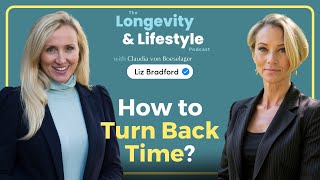
In this episode of the Longevity and Lifestyle Podcast, host Liz Bradford interviews Claudia von Boeselager, a former Goldman Sachs banker turned longevity coach and founder of Longevity & Lifestyle and the Lumara Collective. Claudia shares how she reversed her biological age by 17 years using a data‑driven, systematic approach that treats health like a business investment. The conversation covers her personal health crisis, the importance of defining a strong "why," time‑blocking, decluttering digital distractions, and building repeatable routines to avoid decision fatigue. Claudia walks through practical, low‑cost tools (sleep wearables, VO₂ max AI bike, gut‑health supplements, hormone testing, DEXA scans, GlycanAge) and higher‑budget bio‑hacks (NeuroVizr, micro‑impact platforms). She emphasizes sleep, stress management, nutrition, movement, and social connection as the core, free‑or‑low‑cost pillars of longevity, while debunking myths that longevity requires extreme age targets or expensive, complex protocols. The episode ends with rapid‑fire questions highlighting data‑centric health optimization, the overlooked value of joy/laughter, and the highest‑ROI health investments under $1,000. Throughout, sponsors for CAROL bike, Pendulum, Juvent, Kineon, and Calocurb are mentioned. The overall message is that treating health as a high‑ROI investment—clarifying purpose, measuring data, automating routines, and focusing on fundamentals—can dramatically extend vitality for busy high‑achievers.
Chapters
Welcome back, sweet friends, to the Longevity and Lifestyle Podcast.
This week, I am thrilled to share a special conversation from the Health ROI Show with Liz Bradford, a former banking executive turned health optimization strategist, where we dive deep into how to get the highest return on investment from your health. We explore what it really means to optimize your health like you optimize your business—data-driven, systematic, and focused on measurable results. In this episode, you'll hear how I reversed my biological age by 17 years and the systems that make it possible, why getting clear on your why is the secret to sustainable health habits, practical frameworks for high achievers to manage time, energy, and longevity, the truth about hormones, sleep, and biological testing for both women and men, and how to invest in your health today for massive compounding returns tomorrow. It's a powerful, practical, and deeply personal conversation about building a lifestyle that helps you thrive at work, at home, and for the decades to come.
If you enjoy this episode, please feel free to share it as well. Thanks so much for tuning in, and let's dive in.
Jumping in quickly, it's Claudia von Boeselager. I absolutely love bringing you these conversations for free each week, and I can do that thanks to the generous support of our sponsors. These are brands I've personally vetted and believe in, and I think you'll love them too. Supporting them means you're also supporting the show, your own longevity journey. Thanks for supporting them. Now here's today's sponsors. This episode is brought to you by Carole Bike. Did you know that one of the strongest predictors of how long and how well you live is your VO2 max? It's a key indicator of your cardiovascular fitness. The challenge is VO2 max naturally declines by about 10% every decade after age 30. As someone who's always looking for the most efficient ways to optimize my health and longevity, I knew I needed something something that fit into my busy schedule. That's where CAROL bike comes in. Backed by published research, this isn't just another stationary bike. CAROL uses AI-powered reduced exertion HIIT, or re-HIIT, to deliver the same cardio benefits as a 45-minute jog in under 5 minutes—just 2 short sprints. Studies show CAROL can improve your VO2 max by 12% in just 8 weeks. Making you up to 10 years fitter. It's truly a game changer. If you want to future-proof your health and longevity without spending hours in the gym, check out carolbike.com/claudia for a $300 discount just for you, dear audience. That's carolbike.com/claudia. This episode is brought to you by Pendulum. If you've been listening to this podcast, you'll know that longevity isn't about quick fixes. It's about supporting your body at the root. And one of the biggest realizations I've had from talking with experts is that so many foundational systems, from your energy and metabolism to immune health and even mood, all start in your gut. That changed the way I approached my own health, and it's exactly why I'm such a fan of Pendulum. They're a science-driven company pioneering a whole new approach to gut health. In fact, Pendulum is the first company to bring live akromancia to market. This is a game changer. I recently I started taking their Metabolic Daily, and I can tell you, I'm already noticing a real difference. My digestion feels smoother, I have more consistent energy, and I love knowing that I'm supporting my gut at such a foundational level. For me, this is a cornerstone of longevity. If you're serious about your health and lifestyle, this is where to start, because when you support your gut, you support your entire body. And for you, dear audience, get 20% off your first Pendulum membership order by heading over to pendulumlife.com/claudia. That's pendulumlife.com/claudia20. The discount is automatically applied at checkout.
First of all, a huge welcome to Claudia von Boeselager. I hope I pronounced that. You got it. Fantastic. Who is a former Goldman Sachs investment banker and tech entrepreneur and longevity expert and a peak performance specialist and coach as well. So a fantastic person. To have here in our first series of the Health Return on Investment, ROI, show. You help high achievers, from visionary leaders to entrepreneurs, so very much our audience, optimize their health, energy, and longevity for a life of vitality and purpose. So we really, on a mission basis, could not be more aligned.
I'm at such a pleasure to be here. Thank you.
Absolute pleasure. I have a super long bio, so I'm going to pick from it because I'm going to encourage people to go and check out your profile and obviously your own podcast. But you're the founder of Longevity and Lifestyle, which is a performance coaching platform. You have an amazing podcast podcast of your own in which you interview experts on exactly kind of the topics we're about to touch on. And you're also the co-founder of the Lumara Collective, which is a global longevity consultancy. So leading innovation for longevity clinics. So obviously used to be in finance, used to have one of those kind of push, push, push corporate careers. And since leaving, you have reversed your biological age by 17 years based on everything I've learned and heard from listening to your own podcast. So as some of our listeners won't have had that pleasure yet, we would love to start with that., if that's possible. Tell us a little bit about that journey, how you did it. Um, and I'm sure lots of people will be frantically taking notes. Beautiful.
So thank you so much for the lovely introduction. And yes, I think that I've always been that sort of A-type, and I'm sure it sounds like your audience is like this too. Perfectionist, moving the goalposts, and never enough, more, more, more. And I stupidly in my 20s thought, well, I can sleep when I'm dead. I could manage to get by on those 3 hours of sleep. And of course, 20s, no kids, it's a little bit easier than it is these days. But of course, what happens? You burn yourself out, right? And so just different chronic health issues began to creep in, chronic sinusitis, gut health issues. And it really came to a pinnacle one day when I had absolutely no energy. And it's funny because you have such a belief of yourself of a high-energy person, but when your body's not kind of going with you, and I guess a lot of people realize this maybe when they hit 60 or 70, and I was sort of early 30s and I was like, what, what is actually going on here? This is not me. I couldn't believe it. I was having trouble even climbing the stairs. I had just had a call from my doctor saying, you know, blood markers are in the reds. I'm literally 2 weeks weeks away from hospitalizing you. Like, you have to take this seriously. And that was a real aha moment for me. It was like, hang on a second, if it's already this bad, it's not even lunchtime. I've got businesses to run. I've got small kids. What's the next 10 years going to be like if it's already this bad? And so that set me down many a rabbit hole of understanding that you can actually optimize your health. You can do so many things proactively, contrary to our Western medicine of putting a plaster, a Band-Aid on it, of, oh, you got a headache, you know, here's a pill, right? Because you need to look at the root cause. It's so essential as well. And so for me in that journey and learning personally, obviously we're all different, right? We're all an N of 1, but major things that I needed to optimize was around my sleep, to take it really seriously and actually understand the biochemistry, what is happening while we sleep. I'm happy to touch on it in more detail if you like. And then also gut health, repairing gut health and taking a complete deep dive into that and then setting myself up to win with certain protocols so that I don't need to have decision fatigue every day. I can just have a certain routine that works really well for me, for my body, and just allow me to be optimizing my state. And obviously people are hearing more and more about these biological age tests, and there is a lot of fluff, I'd say, out there in the market. And people are like, oh, we have our own biological age test, etc. One that I'm a firm believer in is GlycanAge, which is based off of 20 years of research, and it looks essentially at inflammation in the body. And many people will have heard the term inflammaging, right? So that aging happens because of inflammation in the body and in different systems. And so I quite like their test. And so I do need to do an updated test, but the, the last one I I could take was 17 years younger, and my goal is to get down to being 20 years old again biologically and stay there until I'm 100 chronologically. So a little mission I have on the side just for fun.
I mean, just for fun. And you're doing that with, as you mentioned, you have young children as well, right? So it's not like you can just spend your whole time meditating and doing your 5 AM morning routine and everything else. Like, you have a very busy life. Yes. Do you— how did you sort of get to that stage where it kind of near breaking point, 2 weeks of hospitalization, but busy career, busy family? How do you find the time and the capacity to really focus? Because I think that's where most of our listeners really struggle. They know they need to make change, but it just feels too overwhelming and they're not sure how to find the capacity to do it.
Yeah, that's a really great question, and I get that a lot with clients of mine. They're like, you please don't give me anything else to add because I feel like I'm already at 120, 150%. And so this is— I have a certain process I take my clients through as well, but one is really starting off with getting clear on your why. So if you know that, you know, be it I want to be I want to be around for my kids, or, you know, I have a family history of cardiac issues. I don't want to go down that path, whatever that why is for you. If it is, I want to go, you know, climb Mount Kilimanjaro, whatever it is, but having a very powerful why typically will be above and beyond yourself that will get you out of bed in the morning, and that will be your motivation. And then the next one where I take clients through was actually taking a deep dive into what does your weekly schedule look like? What are you spending your time on that mightn't be of the best interest of you? And if you have any questions, how long you're spending on WhatsApp or social media or WeChat, If you're an agent, whatever it might be, you can just look in your phone and you can see exactly that like, oh, I spend 2 hours a day on social media. Maybe I can cut that down to 30 minutes or whatever that number might be for you. So first is always looking, what can I declutter out of my life? Where am I wasting time that is not of the best, highest interest of me? And then once you get a bit of clarity around what are the routines, what are the systems that you could set up for yourself, you just— I love from the sort of tech entrepreneur perspective, you set it once and roll it out from there. So you avoid the decision fatigue. So, you know, okay, I, my kids wake up at 7 AM, I will be going to bed earlier so I can get up at 6, 6:30, whatever it is, I can have my optimal morning routine in peace and calm, set myself up to win the day, I show up better for my kids, whatever it might be, right? And then you set up the different instances. So, it's automated in your calendar. That's what I personally need to do. I juggle multiple businesses. And if it's not in my calendar, it doesn't exist is frankly where my motto as well. So those are some of the systems and ways of getting clear on the why, you know, of decluttering things that are not important in your life. And when you have your why, it's easier to say no to the things that are not truly aligned with your mission, and then setting yourself up to win by automating it and having it in your calendar. So you don't even need to think, and you avoid that decision fatigue.
That scheduling piece is just so critical. And that was a total game changer for me. So a year ago, I was still in banking. So I had a full-time MD role in banking in Asia. And as you know, then the working hours really stretched there. I had two side businesses and I was dealing with kind of medical systems for care for my, one of my parents back home. And it just, I had to be, everything I committed to had to be literally time blocked into the diary because I found I was saying yes to everything still, as always. But then I hadn't really thought about, well, when am I actually going to do this? And the first thing that suffers is your sleep. And then you just can't show up as a good human if you're on like 5 hours sleep a night. It just doesn't work that way. So, time blocking is really key. And yeah, the social media thing. I recently had to delete Instagram off my phone. As I was finding I'm so addicted to the Reels. So someone, a friend would send me a link to a Reel. I wouldn't normally be on Instagram, but I'd click on the link because my friend thinks this will make me laugh, which it did. But then I'm doing this and then I'm like, it's 20 minutes later and it's nearly 10 o'clock at night. This is the very worst possible time to be doing it. But it's like, you know, they have so much money tailored to addict you to it. Exactly. Not a battle I can fight.
I just can't have it there. No, I mean, these are— it's engineered on human psychology from the best information and data to make you addicted to it. So, you know, it's not your fault. We all have the best discipline, but like, it's gone above and beyond that as well. So I know people have deleted off their phones. Some other people have it on like the last screen, like whatever it might be that is needed for that too. Yeah.
Yeah, that's smart. I mean, I have it for work, so it's on my normal thing, but it's like once I've stopped working, no access. 'Cause otherwise, you know, it is just the, and these are rocket scientists, right? So of course they can get me to look at something.
Harder than me. Don't fight the machines.
They know what they're doing. Exactly. So I think we've kind of covered what prompted you to take the leap career-wise and obviously phenomenal success since then. And you can tell that you really live and breathe that purpose. But your, your client base is obviously, as you said, I think I'll use your term, A-type. They're very busy executives. They're entrepreneurs. They're extremely busy people. So how do you structure health optimization for them outside of obviously saying, right, start to look at what you can simplify and declutter. But if someone's working, for example, an 80-hour week, how do you sort of simplify optimization for them? Where would you start, and where would you advise that our audience starts to look?
It's really important that people, first of all, as I mentioned, get clear on their why. Why are they looking to do this? Because it's not something like there's a, oh, you know, take this pill and you'll be fine. Like, this is an effort. This will take time. You need to carve out a bit of space and bandwidth because you're gonna wanna understand some of the details behind it and not just blindly take on things. But then you also need to either have a, a coach or a good doctor who you trust that you can work together with. Because at the beginning it is a bit of, you know, you test it out. Does this work? Does this, you know, is this compatible with me? But you also wanna establish a baseline. And so this could be anything from, you know, bloods and different panels to, you know, for some people maybe even testing their gut health. So for me, when I tested mine, I even, cuz I've lived in third world countries, et cetera, I've traveled a lot. I had H. pylori, which a lot of people die from in Mexico as well. It destroys the inside of your gut lining. And these are things that, you know, can happen. And I would say, you know, I was healthy, etc. I didn't know unless I tested for it as well. I appreciate that testing is expensive. I know some people travel to other destinations to do some of the testing as well. We can obviously test till the cows come home as well. So it's finding that balance of these are certain symptoms, these are my family history, this is where we should look into in a little bit more depth as well. By having that baseline and things like a DEXA scan, bone density, I mean, there's so many important things, but finding also somebody who can interpret those results. And this is what I think is important to understand is that if a medical practitioner has not been trained on certain things, so if they have no idea about menopause, because guess what? It's not really taught in medical school. And perimenopause, even though it affects half the world's population, if they don't feel comfortable talking about it, it's either I don't do that or it's not important because they don't wanna go down that rabbit hole. So keep looking until you find the right practitioner that can support you. It might be multiple practitioners as well, but having your why, figuring out what's your baseline, having good trusted support, and then looking at things like the basics. And this I think is really important as well. Some people are like, oh, you know, Bryan Johnson spending $2 million a year on biohacking. I can't afford that. Like, I don't have that budget. I've got kids. There's so many things people can do that are free. Yes, free, $0, whatever currency you work with, pounds, et cetera. So number one is sleep. And I think that that is so absolutely fundamental for me. I wear an Oura ring. I found that very useful. It's not everybody's price range. Not everyone would like to wear Ring. That's fine. There's different ones as well, but it really helped me understand the phases of sleep, making sure I'm getting enough deep sleep. Also REM sleep is something that I would really struggle with as well, and you can optimize around that. Number 2 is managing stress levels, which is obviously tricky when life is busy, but how can you do certain protocols in your day? Start your day off right. Maybe there's meditation, breathwork, sunlight, but also doing check-ins during the day, and that's a big thing for me. So my Oura will say like, oh, this has been a high stress day, and I I function relatively well on that. Obviously, I know to the detriment, but I know I need to put in breaks in, in during the day as well. And you can even set reminders on your phone, whatever it might be. And even if it means going for a quick walk around the block between meetings, whatever someone's schedule allows. So sleep, breathwork, or trying to control the stress levels as well. Nutrition is obviously key. Yes, it does cost money, but really taking care of getting the right nutrients, taking care of yourself, making sure you're hydrated, of course, as well. Many of us don't drink enough. You want, your body wants to function really well. And I think that Western medicine doesn't like us to believe that, but the body wants to heal. It wants to do well for you, but you need to kind of give it the right tools and resources as well. And then things like meditation, right? As I mentioned with those breaks with breath as well, but just coming back to center, being present, being in the moment, finding that calm as well, grounding, walking in nature, spending time with friends. We know from Harvard's longest running study from 1938 that the number one for longevity and happiness later in life is that social connection as well. So it's almost like going back to the basics. And obviously you can biohack and do tons of other things around it as well. But if you can get those core things sorted and done in a very good way without a price tag, essentially, you're already doing really well.
There are so many threads in there that I want to pull on. I'm going to— if you don't mind, I'm going to start with sleep. So as you can see, also an Oura wearer. I'm also testing out the Whoop this month to see like how the data compares and everything else.
They've upgraded it, right? It's quite exciting.
This is the 5, and I was really scathing about the 4, so they were like, well, do you want to try the new one? And so, so far, very interesting. Interesting. But to your point, sometimes outside of the price range of people, to which my comment to clients is always, or my question or challenge to clients is always, well, should we take a look at your other subscriptions that you're currently paying? Because like normally there's a Netflix, there's a Disney, there's a YouTube, there's a, like, there's a lot of other stuff that doesn't necessarily contribute to our wellbeing that much. Yes. And I don't mean that in a judgmental way, but I think to your point, like sleep is the absolute foundation. And I say this as someone who I'm always really bad at prioritizing it, and I know I have to, and that's why I have the wearables to make me actually see the data points. So I don't drink, but when I do drink, you can really see the impact on me. Yeah, through the floor. Yeah, I tend to— even though I'm a morning person, I tend to then get caught up after dinner. For example, if I log back on, I'll find 3 hours later I'm still working because I just get into flow and everything else. But then that obviously massively interrupts than going to bed and everything else. So I do think that it's a good investment. So there's the piece around affordability. You also mentioned biomarkers being expensive as well. And I mean, our whole thing is the return on investment of health. What have you seen over time around, you know, if you invest, if you choose to prioritize investing in this now, what impact and return can people expect in the future? Because I think as humans, we're very bad at thinking any further than maybe a year, 2 years into the future. But really what we're trying to do is make sure that people are optimizing for later in This episode is brought to you by Juvent.
If you or someone you love has been struggling with chronic pain, arthritis, poor bone health, neuropathy, circulation issues, or even something as frustrating as constipation, this could be a real game changer. The Juvent Micro-Impact Platform, breakthrough technology trusted by leading doctors and supported by over $45 million in research. Stand on the vibrational plate for 20 minutes and its gentle micro-impacts work at at the cellular level to stimulate circulation, strengthen your bones, and ease pain naturally and effectively. And because I want you to experience this for yourself, Juvent is offering you $300 off. Just head to juvent.com/claudia. That's juvent.com/claudia. And use the code Claudia to claim your discount today. This episode is brought to you by Kineon. When it comes to longevity, it's not just about living longer. It's about staying active, strong, and pain-free as you age. And that's exactly what the Kineon Move+ Pro helps you do. It's a wearable red light and laser therapy device that works at the cellular level to reduce inflammation, ease pain, and speed up recovery naturally. I love that it helps support your body's own repair process, not just mask symptoms. It's portable, easy to use at home, and trusted by athletes, biohackers, and health enthusiasts who want to keep moving and performing at their best. If you're ready to move from pain to possible, head over to kineon.io/claudia.
That's kineon.io/claudia.
CLAUDIA to get 10% off your Move+ Pro. This episode is brought to you by Calocurb. For those of us who struggle with food cravings, Calocurb is a natural, science-backed way to support appetite control and reduce cravings without relying on synthetic appetite suppressants. Its key ingredient, amaracate, works with your body's natural GLP-1 response to help regulate hunger signals and promote a feeling of Wellness. Clinically evaluated and made from botanical ingredients, Kalocurb encourages mindful eating and healthier portion control. Personally, I take it before going out for a meal or whenever I feel cravings creeping in. If you want to experience it for yourself, visit kalocurb.com/longevityandlifestyle and use code Claudia10 at checkout.
Yeah, and even optimizing for today, I would argue that like, imagine you had 20% more energy every single day. What would you do with it? Like, what would do with all that boundless energy time? What would your relationships be like with your kids, with your loved ones, all the things that you could actually do and achieve and whatever is important to you, right? So even starting with just today, but then obviously looking, going down the line, and, you know, depending on what age bracket someone is in, in 5 years' time, the majority of your friends might look and feel and even talk about things that like, oh, my hip and my this and my back and right, where you'll be like, I don't know any of this, like, I'm doing super well, I'm doing my strength training, and I'm doing my weights, and I feel absolutely amazing. And then keeping in that state for as long as possible. And I mean, I've talked to 80-year-olds, almost 90-year-olds who are going, doing spinning 4 times a week and doing their weight training, traveling around the world. And they're like, you know, my friends keep getting younger because the ones at my age, they're not doing anything. They're so boring, you know? And so I say this a bit more in jest, but I think, you know, for me personally, the goal is to live really well every day until I hopefully just drop like that and to avoid that last 10 years of pain and stretched out. And before we hit record, I was just sharing that unfortunately I lost my mother to late-stage dementia. Dementia last week, and she was someone with unbelievable boundless energy. She's had multiple head trauma and lack of HRT post hysterectomy in Ireland back in, in the '90s. And so there, those are the foundational things for her. Obviously there's different factors that contribute to it that we know of as per science from Dr. Dale Bredesen and other leading neuroscientists. But that painful time, not just for the actual person fading away, but for all the family members. If you, if anyone listening has someone like with cancer, whatever it No one would wish that type of suffering onto anyone else. And that's what it is with the health ROI. This is a choice that each and every one of us has every single day. And it doesn't mean we have to be perfect and live by it, you know, a disciplined routine. If you're able for that, beautiful. But you know, life gets in the way. We're traveling, they're serving airplane food and there's nothing else. And you've got a 10-hour flight, whatever it might be, you make do what it is, but you know, in general that you've got a really good baseline so that you can pick your poison for the times that you decide to let your hair down or do a little bit differently. Some people are very strict and just live one way, and we're all human. But I think if you have that very strong baseline of focusing on your health, the things that do you good, not only will you get the ROI today, but every single day until it is time to move on.
I hadn't even thought about the energy, but should do, obviously. But like, imagine how much more you can achieve with 20% more energy every single day, how much you can compound that benefit through that. We were actually chatting in the community. We have office hours every Tuesday, and we were chatting this morning about Brian Johnson, and someone was saying, but do you think he's happy? And I was like, doesn't look— I mean, you're welcome to tell me otherwise, but it doesn't— there does come a point where— and you mentioned relationships and how important those are— if you're optimizing everything, and as you just said, you have some people who live very, very disciplined lifestyles. I'm kind of on the fence of like, I think once it starts to intrude into you being connected socially, actually, that it's not a net positive anymore. Like, if it means you're living in such a rigid way that yes, you might live for a very long time, but you're going to be doing it in a lonely fashion, that's not ideal either. So I think to your point, it's really about finding that balance and what works for every single individual.
Yeah, I don't know if you saw the documentary on Brian Johnson as well. So he had his son living with him for a year. So he was like, I'm very happy about this. And then obviously, the people that follow his Don't Die movement gave him that sense of joy with community as well. But yeah, I think it's important. And there was one point, and I was guilty of it, I was— had my intermittent fasting schedule down. And I had certain foods, and I would do this, and I was doing keto, and friends were having a dinner, and I wouldn't eat. And I was a bit like, oh, and this is getting a bit late. And I realized, like, what am I doing? Like, I'm so miserable. Like, this is not me. And I need to find that balance as well. So I think for majority of people finding the right balance of very healthy most of the time, but enjoying life is just so fundamental.
Yeah. Another example of where the 80/20 rule can come in, right? Live really, really well for the 80% so that you've got the 20% leeway to do the stuff that really brings you joy. Yeah, exactly.
And hopefully it's not just eating McDonald's and, you know, not moving or something like that. So hopefully that 20% is like, you know, somewhere, somewhere in the middle.
No, no, I doubt it will be, but it might be like a really nice glass of red wine with friends over dinner or like with a steak or something like whatever it may be. No zero No judgment. Um, all right, so let's assume we've convinced people at this point that it is worth investing in. You mentioned some of the tests that you'd recommend already. Is there like a panel or anything that you would recommend people get? I realize it would vary significantly based on gender, stage of life, and everything else, but if you were to recommend just like one or two tests that everyone should be getting, what have you come across in your research?
Yeah, so what I'd say is like ideally look for a functional medicine practitioner because you want to look at optimal ranges, right? So you're looking at all your bloods, you're looking at all your hormones, your minerals, your vitamins, all basic things that our body needs. But then also I would say is that DEXA scan, and we mentioned it before as well, bone density, particularly for women but also for men. This is definitely something that you want to do, but also checking for visceral fat because you can have someone who looks the most slender, but if they have all this visceral fat around their organs, they could really be detrimental, very detrimental to their health as well. I think the biological age test is interesting to know, but again, I don't think that that's an essential. But for women, definitely hormones. The tricky thing is that there are different types of hormones hormone tests, it's not perfect. You need to continue to see it. Typically it's diagnosed symptomatically, so looking at symptoms and how you're feeling, but know that from the age of 35, women can be entering perimenopause. And even after childbirth, hormones are all over the place. And then we wonder, you know, why we're feeling more depressed, et cetera. I mean, I'm someone who with my second child experienced postnatal depression as well, obviously compounded by lack of sleep and different factors. But I think that for women to look at it, I mean, for one thing, I was very surprised when I did my Dutch test for my hormones is that My, my testosterone was like almost zero. You think, oh, I'm female, I don't need testosterone. Everyone needs testosterone. Actually, women produce more testosterone than they do estrogen, interestingly. And so if you don't have any, just getting through the day, being sharp, being focused, obviously helps with libido, things like that as well. But there are different things that are very beneficial that have been misinterpreted for so long. And that's, I think, the challenge is that, as I mentioned before, menopause isn't taught in medical school. Nutrition is not taught in medical school, although that's looking to be changed. There was a lot of falsely interpreted data from the Women's Health Initiative. I've interviewed on my podcast Dr. Joanne Manson, who ran that study. And I think that slowly but surely, more awareness is coming out that those were actually skewed media headlines that have impacted a huge generation of women, sadly. And so I know I've gone off on a bit of a tangent here, but I know it's super relevant. Yeah. And I really just encourage all women, and there is synthetic hormones, and then there's body or bioidentical, depending where you are in the world, hormones as well. And just try and find someone who really knows their stuff and is able to help with it. There are world-leading experts. I've had some on the podcast as well. You will feel so different. It's not normal to have brain fog every day. It's not normal. Obviously, the night sweats are a little bit more later stage, but women are giving up their careers because they're like, I can't function the same way anymore. Well, there is a reason. Check your hormones first. Doctors typically say, oh, this is normal, or you need an SSRI, you're feeling depressed, like this This is it. Check the hormones first. Check the hormones first. So I can't say it enough, but I've seen amazing results also with, with people who have started to tackle that and they've just bounced back as well. So it's almost a new form of life. It's amazing.
I'm so pleased that this is coming more into the mainstream now. And like, even when I was in Hong Kong, people are talking about it more in a culture where normally there's a lot more stigma around that type of thing. But you've got very senior female leaders who are just like, the brain fog, I just lose words mid-meeting in the boardroom. Or, you know, just to your point, just so much less energy. And feeling like everything is such an uphill battle. And it's so easily addressed if people test the hormones, but also test them more than once at different phases, and don't just accept like the ranges which are so, you know, outdated that people just go to your point, oh, you just need an antidepressant, or just get over it. Before I deleted Instagram, in my feed was always just a ton of like memes about if a man's testosterone plummeted overnight, you know, we would rush him to hospital. We wouldn't tell to just sort of sort it out and buck up sort of thing. So I'm really pleased that there is a lot more now in the mainstream about this, and people are more aware that there is help there.
100%. And, and for your male listeners as well, research shows that from the age of 30, men's testosterone decreases by 1% per year. And there is a real pandemic on lower testosterone levels because of all the endocrine disruptors and microplastics. And I think I read somewhere, research, um, that a man now in his, I want to say, 30s has the same level of testosterone than a 6-year-old in the 1950s. So it's just a radical decrease because of the synthetic materials we're wearing, microplastics. Every Starbucks cup, we're like, oh, it's a paper cup. Guess what it's lined with? Plastic. You're putting a hot beverage in, you're drinking microplastics every day. I've had Dr. William Li also on the podcast as well multiple times, but he really talks about the dangers of all these microplastics we're getting. The chopping board, the spatula we're using, those— I mean, I've had throw away so much stuff over time. So just that awareness that men are also very much impacted by this too.
And it does have a significant impact, doesn't it, when testosterone plummets for men as well, like just mental, physical, everything. So it is a super important thing to be focused on.
100%. I've had Dr. John Gray on also. So his meaning is that when, when men's testosterone is high, they're achieving, they feel good, they're providing. When testosterone decreases compared to estrogen that men also have, they're much more emotional, less drive, they're unhappy. So for men curious, have a chat— andropause is real— with a practitioner about trying out the testosterone replacement therapy and just see how you feel.
Our audience is actually 50/50, so I will make sure that we link to that episode of your podcast, if that's okay, so that people can go explore further. Because I do think it's something that people— again, there's a bit more stigma about it, and actually it's nothing to be ashamed of, and it's a very important thing to have addressed if you're experiencing some of these challenges. Yes. Fabulous. All right, so from all the positive stuff, I'm really interested— you've been doing this for 15 years, you apply a tech mindset to everything that you do— what is the biggest sort of longevity myth that you've come across that you would like to bust?
I think there's a few. One is that it's just about being 120 years old or 150 years old. I don't think there's a gold standard for a definition of longevity. So I think, as I mentioned before, for longevity. It's about how do you live in your best state today and live like that for as long as possible. And typically, if you are living at your best and not worrying about decline, not worrying about health issues, you can not only be in service to the ones you love, but to a greater collective and greater community. So can you imagine what a beautiful place the world would be? So that's one myth about thinking longevity, I can worry about that when I'm 90 or 100. It's about living longer. No, it's about living at your best self today for as long as possible. And number 2 is that it needs to be super complicated or super expensive. And those are things that I shared also before is that there is toolbox of things that are free or very low cost, right? Walking in nature, morning sunlight, sleep, breathwork, meditation, et cetera. And the importance of social connection, I think, is really important too, that it's not just about the tests and the labs and the blood draws, but going back to being out and chatting with people. And I think this is actually really, really important for society today, that people are glued to looking at a screen and a telephone and have forgotten the art of long-form conversation like we're having right here now and actually sitting down with multiple people and having conversations and not everyone with the screen out or a phone out. And it was interesting, I heard a conversation between Simon Sinek and I believe it was with Trevor Noah. And he said that even having your phone face down on a table is giving the message to somebody else that whoever might call is more important than you. I don't even, I can't even take that 10, 15, 20 minutes, 1 hour, whatever the time is to put my phone away unless obviously there's an emergency. Emergency. But I think, or I would encourage people to just reflect on how could you be more present? How could you cherish the people that are so special to you and you're investing time with, sitting together with, and, and really be present by putting that phone away?
It's something that we've become so used to, just like even texting while listening and stuff. I catch myself doing that sometimes to my dad, and my dad just looks super crestfallen because it would never occur to him in a million years to do that, whereas I'm just like, I'm just multitasking. Super, super. But, and actually someone said to me the day we went out for a walk with the dogs and they left their phone, and I said, did you not need your phone? And they were like, the person I want to be with is right here, so I'm not going to bring my phone. And I was just like, oh wow, okay. Like, it made me feel amazing, you know. It's just a good friend and everything else, but I was like, wow. So I really want to try and do that a bit more for other people as well and just show how much I respect that time and appreciate that time. I can't think of a better way to kind of wrap than all of the guidance you've just given on really prioritizing matters. We do have 5 quickfire questions though, if you're up for them. So the very first one, complete this sentence. The biggest difference between average and elite health optimization is— I would say data.
I know that sounds a bit nerdy, but I think that way you really know what's happening and you're moving the needle on the right stuff.
And to your point earlier, having someone to help close that data knowledge to action gap as well, like really interpret it for you. Second question, what is the one biome marker that you would recommend everybody should get, but 90% of people ignore?
Often in a day you smile and laugh. Brilliant. That is brilliant. I would say you won't find that on a blood panel. No, you won't.
You just have to think about how to log it. That's genius. Okay, brilliant. If you had 90 seconds to optimize a CEO's health ROI, what would you focus on?
I mean, they have 90 seconds to, to do— I would say almost like jumping on a trampoline or something like that. You've got lymph drainage, your endorphins, you've got BDNF going on there. Increasing moods, breathing going on. So yeah, jumping on a trampoline in 90 seconds, very efficient.
And you can really tell that we did not send these over beforehand, so I'm loving this. Um, okay, two more. The first one is, what health investment has the highest return on investment that costs under $1,000?
Again, I guess would depend where people's weakness or challenges are.
It depends is always my favorite answer to everything. It's tricky.
I mean, for me, my Oura Ring I think is excellent. Understanding my sleep, real game changer for me. Brain health is a big passion area of mine. My mother had late-stage dementia. I've gone down many rabbit I'm loving a NeuroVizr, which is pulsating light. There's research out of MIT showing that it actually not just helps with neuroplasticity, but actually clearing amyloid plaque. Very, very promising. Yeah. So the NeuroVizr I'm a big fan of, and it's great for brain training and just keeping really mentally fit and sharp.
For those of us who did do the whole, I'll sleep when I'm dead thing for like a decade, two decades of our career, I think most of us are frantically searching for every single hack we can do now. It's like, I'm there learning Mandarin, I'm there doing Sudoku, anything for neuroplasticity. So we'll definitely look that one up and link to that as well. Very final one. What's the most expensive health mistake you see people make? Getting bad advice.
Bad advice is the most expensive mistake you can make, where somebody telling you, for example, if you think your memory's not what it used to be and it's like, well, you're fine. Come back when you're actually progressed with dementia instead of getting on top of things now. Trust your intuition, I would say, and be very, very wary of bad advice. Don't model someone who hasn't done it before. If you see someone who's in peak health and has figured it it all out, you can model them. Someone who's sitting on the couch eating McDonald's, whatever it might be, right, all day, don't be taking advice from them. So, bad advice will be the most expensive mistake you can make.
Very, very sound advice to close out the podcast. And obviously, we will link to yourself for someone who needs good advice as well. Is there any other way that our audience can help you, find you? I'll link to your LinkedIn and obviously all of your companies that are available publicly. Anything else that we can do or any key message you'd like to lead us with? Thank you so much.
Yeah, so people are welcome to reach out at any time on Instagram. I'm Longevity and Lifestyle. LinkedIn is Claudia von Boeselager. Tricky name, but thank you for linking to it. Obviously, my website is longevity-and-lifestyle.com or Lumara Collective, lumara-collective.com. I'd say parting message is for people to really understand, just like Warren Buffett teaches, and twofold. One is the biggest investment you can make is, or the best investment you can make is in yourself and understand compounding interest. So by investing in yourself today, you are essentially compounding and achieving exponentially faster your goals than waiting for next year or waiting for in 5 years' time, or it's not so bad just yet, let me see how long I can go. So, Warren Buffett is probably one of the greatest geniuses of our times, and looking at ROI, right, he definitely has that one figured out. Invest in yourself, invest the time, invest the energy. Yes, it takes a bit of work at the beginning, but if you've gotten to where you are in your career, which sounds like your audience has, you understand the benefit of it. And really just focus on prioritizing that, not just for yourself, but for all your loved ones and what you can get out of this lifetime.
So that's what I'd leave you with. That is amazing. Perfect analogy, perfect quote, perfect tie-in to ROI. So thank you so much. And I have no doubt that people are all going to go and identify their purpose to invest in their wellbeing now. So, Claudia, thank you so, so much. It's been an absolute pleasure. We will link obviously to everything you've got and obviously your own podcast, which I would strongly recommend people listen to. In researching for this, I've learned so, so much listening to your podcast. So I would strongly recommend everyone listens to that as well.
Hi everyone, it's Claudia von Boeselager again. Before you take off, would you like to get a short email from me to you several times a month with top tips, insights, and strategies to help optimize your life, health, and business? This could be interesting posts or articles I've read on life and longevity optimization, cool biohacking or lifestyle products that I've discovered, and other fun things to help you be at your best. It's a very short piece of inspiration for you. So if you want to receive it, check it out by going to llinsider.com. Llinsider.com. That's llinsider.com, and leave your email to get the next one.
More from Claudia









Can Psilocybin Slow Aging? The Study on Telomeres, Inflammation & Survival with Dr. Louise Hecker

