Understanding The Vaginal Microbiome And The Impact On Women's Well-Being With Pita Navarro
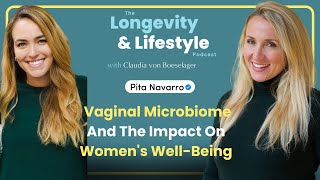
In this Longevity & Lifestyle Podcast episode, host Claudia von Böselager interviews Peta Navarro, founder of Evvie, about the vaginal microbiome and its central role in women’s health. The conversation begins with a sponsor message before moving into Navarro’s personal journey from Mexico to the US, highlighting how women have been historically excluded from clinical research (until 1993) and the resulting diagnostic gaps. Navarro explains the vaginal microbiome as a local immune system dominated by lactobacilli, its protective functions, and why Evvie chose it as the entry point for a precision‑female‑health platform. They discuss how current PCR tests are limited, the need for broader sequencing, and the surprisingly receptive response from providers across functional, family‑medicine, and OB‑GYN specialties. The link between gut health and vaginal health is explored, noting anecdotal correlations with IBS/SIBO but acknowledging limited research. Menopause is examined: estrogen decline reduces glycogen, leading to dysbiosis, and Evvie’s data can predict menopausal status with 99 % accuracy. Fertility implications are covered, with evidence that lactobacilli dominance improves IVF outcomes and a meta‑analysis of 17 studies linking dysbiosis to lower pregnancy rates. Probiotic options are reviewed, emphasizing the lack of regulation and the importance of vaginal‑specific strains. Navarro outlines Evvie’s roadmap: building the largest vaginal microbiome dataset, characterizing dysbiosis across ages, races, and conditions, then linking it to preterm birth, IVF, and other diseases. The discussion expands to the broader issue of female under‑representation in AI training data, the new Women’s Health Research Initiative, and the need for gender‑balanced datasets. Finally, they stress patient empowerment—asking providers about gender‑specific testing, seeking second opinions, and using community resources. Resources, social media handles, and recommended reading (the book Sex Matters) are provided.
Chapters
This episode is brought to you by Leela Quantum Tech. In the past two centuries, our understanding of longevity has revolutionized. From a mere 30 years average lifespan in 1800 to nearly 80 years today, we've made incredible strides. Now it's time to embrace the future of aging with Leela Quantum Tech. Leela Quantum Tech brings you products charged with quantum energy, Designed to restore balance and vitality, these products can help in managing stress, improving sleep quality, and promoting mental clarity, contributing to a younger biological age. Our modern lifestyles can accelerate aging, and EMF radiation is everywhere. With Leela Quantum Tech, you can combat this trend and focus on utilizing the balancing effects of quantum energy to maintain your youthfulness and shield yourself and your loved ones' well-being. To bring balance to your everyday life, boost your health and vitality, visit leelac.com, that's L-E-E-L-A-Q dot com, and embark on a journey to a longer, healthier life. And for you, dear audience, get a 10% discount on Leela Quantum Tech products with code LONGEVITY10. That's L-O-N-G-E-V-I-T-Y 1-0 at checkout today.
Welcome to the Longevity and Lifestyle Podcast, Peta. I'm so excited to have you on today.
Thank you so much for having me, Claudia. It's such an honor. I'm such a big fan of all of the amazing work you're doing on longevity.
Thank you so much. And I'm so excited to dig into your topic because it's so important. And I'd love to start with, if you can share some more about the groundbreaking work that you're you're doing in transforming vaginal healthcare, but I'd love to understand where it stemmed from. And, you know, can you share a little bit about your journey and your background to deciding to get into this important space?
Yeah, of course. You know, I have always been fascinated by science and medicine. I think, you know, growing up in Juárez, Mexico, I saw firsthand how a lack of resources can have a detrimental impact, not only on women's physical health, but also on her socioeconomic mobility. So I started seeing when women in their families, or when they're 14, 15, they don't have access to family planning, to the right health educational resources, that really takes a toll on the poverty cycle and how they're able to continue their education, get a job, find a stable family. And so to me, it really was the center of if you are able to care for women, to provide health and education resources for women, they can go on and live healthier lives. They can go on and be strong moms or strong caregivers. And so I really fell in love with the idea of helping women and uplifting women by providing them with access to the best possible healthcare and the best health education. And I think, you know, when I came into the US to continue my studies in medicine and in science, I was absolutely shocked to realize that some of the problems that I was seeing in very poor communities in Mexico, I was seeing in, you know, in hospitals in the US where I can guarantee you, you know, most women have their own version of going to the doctor's offices, having symptoms that can't be explained, the doctor saying everything looks normal, or, you know, you should drink more water, you're too stressed. And I think, you know, really the amount of frustration comes from both the patient and the provider side. And I was really shocked by the lack of data that I was able to get on my own body in the US. And as I dug into why is this happening everywhere in the world, you know, in all different types of income classes, we really looked into the fact that underpins EvieNow. We found out that in the US, women weren't required to be in clinical research until 1993.
They were banned. They were even banned from it.
Yeah. Women of childbearing age were banned from research until 1993. And so, as you can probably imagine, the downstream effects of that in the healthcare system are absolutely massive, right? To this day, we're still diagnosed 4 years later than men across 700 diseases. And so once we started really digging into the research, like, why is this happening? Why can't we get the the right diagnosis, the right treatment, it really made our own frustrating experiences in the healthcare system make a lot of sense, right? You know, as Janine Austin Clayton, who's at the NIH, said, we literally know less about every single aspect of female biology compared to the male biology. And women are different from men in every single way from their DNA on up. I really believe that the most urgent issues facing women's health today is because all medical models, both in research and in practice, are male-centric, which erases all the unique biological differences between men and women. Um, and I think it's, it's tough to swallow that this bias can actually jeopardize a woman's life. Um, and so all of this research, or from our own experiences in the healthcare system, what I grew up seeing volunteering a lot of hospitals in Mexico and as well as in the US, um, it pointed to a massive opportunity to harness those unique signals that the female body is constantly giving off that we never really studied the female body. And so we thought, you know, if we actually got better at measuring and tracking these unique signals, we could finally do a much better job at predicting risk, treating diseases as they uniquely manifest in the woman's body, and also understanding how to educate women on their symptoms and their health issues. And so that's really what we're building at Evvie. We're set out to do, to build a platform to really unlock the power of precision female health, because I would say we finally are starting to have precision healthcare, but really for middle-aged, mid-sized white men. And so we're really excited to be able to build this database on thinking about what are those biomarkers that we've been previously ignoring in our definitions of health and disease, and how can we use those to help women feel healthier and feel better.
I mean, it's such an important mission as well. And I think so many people are just not even aware. And I'm talking about medical doctors included. I have a lot of friends and I was at a talk the other day about functional genomics and how depending on how your genes are expressed, the hormones are the conductor of the symphony, right? And then your gene expression that as estrogen breaks down, it can be, you know, either protective to the body or very toxic. And so women are just given birth control and be like, oh, you know, you should just be on it. Or actually, better yet, don't even have a period. Just continue 365 days a year of overdosing hormones to yourself. Or even with HRT, it's just kind of like, oh sure, just, you know, try and see how you feel, etc., without actually knowing what's going on. So I think this is so, so, so important. And I'd love to— for you maybe even to take a step back is like, what is your roadmap and why are you focusing first on the vaginal microbiome and what does that what are the next steps thereafter in terms of the biomarkers and things that you're looking at?
Yeah, you know, usually when we say we're starting with the vaginal microbiome, we get one of two questions, either what is the vaginal microbiome, um, or why are you starting there. So I'll start with a quick 101 on the vaginal microbiome, and then I can dive into what we're doing in the microbiome and the roadmap ahead. Um, but if you think of the vagina, um, and its role in the female body, it's essentially the structural connection between the outside world and your most important reproductive organs. And as for the microbiome, you know, most people know what a microbiome is, the concept at least, the community of microbes that live on different parts of your bodies, includes bacteria, fungi, viruses. We have one in our gut, we have one in our skin, in our mouths. Turns out, we also have one in the vagina. And these microbes in our vagina have really co-evolved with us to do a lot more than just hang out there. It turns out they play a really interesting and protective role for us, which I like to refer as your local immune system. So really, the, the vaginal microbiome can be a critical determinant of, of health. And then, in terms of why we started there, I would say we talked to a lot of women, we talked to a lot of providers as well, and it seems like women were experiencing these conditions without really relief, they would go to the doctor and statistically, they're more likely to get misdiagnosed than correctly diagnosed. And even if they get correctly diagnosed, they're more likely to recur within 3 months of treatment than to get better. And so this pointed out to a huge consumer problem that we can start with. And when we talked to doctors alike, they were equally frustrated. Why? I don't have, you know, more tests I can give. I don't have any novel treatments I can give. The treatments for bacterial vaginosis haven't changed since 1980, right? It's 2023. It's shocking to think that a treatment doesn't work. It's like as if you have a sinus infection in 6 months, it keeps coming back, right? I think it would have been solved by now if it was a different population experiencing this condition. And so when you think about the vaginal microbiome as your local immune system, it's usually dominated by protective bacteria. Most of which are called lactobacilli. And these protective bacteria are functioning as your local immune system by doing a few different things. So one, they produce lactic acid, keeping the vaginal environment optimal and acidic, making it really difficult for pathogens to survive and replicate in the vagina, meaning that even if a pathogen gets into your vagina, they can't really make it upstream and cause havoc because it's an acidic environment. But I always say anything fun, right? If you have sex with a new partner or if you have your period, your hormones can start to fluctuate, your vaginal pH can actually rise, and some of those bad microbes can take over that protective bacteria. And that's when women start experiencing common infections like bacterial vaginosis, UTIs, yeast infections. And it turns out that, you know, your local immune system is responsible for actually a lot more than just these infections that women experience so often. This breakdown is also associated with much broader health outcomes like fertility or IVF failure, preterm birth, STI acquisition, cervical cancer progression, and so much more. So, it makes so much logical sense that without a protective vaginal microbiome, you no longer have this barrier preventing pathogens from going upstream. And so, for us, it seemed like very important to start with, if we're able to actually help women deal with their vaginitis, then we can also do research on, you know, how are these conditions related to cervical cancer progression or STI acquisition, fertility outcomes, preterm birth. And so I think there was an amazing opportunity on the data side. But there was also a very prevalent and frustrating problem that women are experiencing. And so I always like to say we're doing patient-centric research. So we started with the patient who's the most incentivized to change and, and needs more help. And through that, we are building the datasets that will allow us to do a lot more interesting research.
Mhm, so exciting. And can you share a little bit more about how you are gathering the data? Like, how does that process look like? Where are you in that process? And how receptive are providers as well to this? Um, because they're obviously— obviously if they're trained in a certain way, it's like, oh well, at medical school I learned this way, like, what are you guys doing, right? So I'd be curious to hear how that experience is.
Yeah, I mean, I've been actually very pleasantly surprised. I thought it was going to be, you know, an uphill battle with providers, but I would say even from the last 2 years, you know, when we started off by saying, you know, you need to pay attention to the vaginal microbiome, these conditions are recurring, women are suffering from this, I think providers were already using a PCR test. You know, there's LabCorp and Quest already have PCR tests. So it wasn't that hard. Women are already going to the doctor for these conditions. They're already doing a type of sequencing for test— testing for the presence or absence of bacteria that we know are related to these infections. I think a lot of the education we were doing with providers are, why are these tests coming back negative and the patient is still experiencing symptoms? And that's because we are only looking for— the current tests only look for 4 to 5 bacteria. That could potentially be causing these symptoms. And if that comes out negative, the doctor says, you know, you don't have an infection, when in reality there's hundreds of bacteria that could be causing this, and our tests are just limited and biased in what they're looking for. And so, um, we've definitely had worked with amazing providers who have been so receptive to it just because they also experience the frustration with their patients. Um, and it, it's also heartbreaking as a doctor, you know, to have this patient come back over and over again, and you can't really help them. Um, so I would say in the beginning we had a lot of, um, functional medicine doctors be really interested and open to it, and now we're seeing all types of providers. We have family medicine doctors, we have OB-GYNs, um, and I think this just speaks to the problem that it's frustration on equal sides, right? Um, and I think, um, a lot of the work we're doing too is educating the patient, um, and so when they go to the doctor, they're not as frustrated or they're more educated on you know, what symptoms should, should they highlight with their doctor? What are all the things they need to know or ask the doctor to have a much more productive conversation? Um, and so I think it's been, um, it's been really great working with providers. I think there's different types of providers who are more open to it, but they give, they give us a lot of hope, I would say. And I think as we start gathering data, we can then, um, you know, next year we're really excited. We're gonna present our data at ACOG and at several different medical conferences. And I think, you know, that will, will slowly start to change. And I think we're also getting a lot of doctors reach out to us saying, my patient is bringing this test to me, can you educate me on it? And so it's kind of like a bottoms-up approach, I would say. But it's been great. There are amazing providers who are out there hoping to help women. They just haven't necessarily had the right tools.
Yeah, high time. So really exciting what you guys are doing. How much would you say the gut microbiome, the health of the gut microbiome and the correlation with the the vaginal microbiome? How much are they correlated, would you say? And like, what are things that people can do through nutrition or other factors to have an optimal vaginal microbiome?
Yes, that is a great question. I unfortunately have to answer it like many other questions I get, which is we don't have enough research to start pointing to this is exactly what we know. But what I can say is that, you know, gut microbiome modulation really points to systemic immunity as well and systemic inflammation. And so naturally, if you have a gut microbiome that is low inflammation and protective. I would say, speaking from our data that we see, you know, we haven't made correlation studies or any statistically significant links, but we do see a lot of women with gut issues that also have recurrent vaginal issues, whether that is SIBO or IBS. And we do see that a lot. And so I think there is definitely a link. We also have women tell us, you know, I cut X, Y, Z from our diet and that really helped with my symptoms. And women right now know their bodies a lot better than the medical system, I would say, in the science community. And so we like to say, you know, if that is working for you, it's probably linked to inflammation. And so we, we highly encourage women to continue doing what they're doing if they find a diet that works for them. But I think it's, it's definitely related. I would say interestingly, the gut is very related to, for example, PCOS because of insulin regulations and other things. And so as we kind of start connecting the dots, I am, I am very optimistic. We'll definitely find something. It's just a matter of researching and having the right studies for it. Yeah.
And I mean, it is just so crazy how much women have been neglected from clinical trials and research and that, you know, things are only just coming to light and that tests like this are only now in 2023, like what you guys have been working on, right? You know, available, right? It's like, you know, how is this possible? Although in other areas of science as well. So it's, it's so exciting. I'd love to touch on perimenopause and menopause and, you know, what are you looking already specifically at, you know, transitions in that phase? And do you have recommendations for women in that phase of life as well, which is so important and can really wreak havoc on health if not managed correctly.
Yes, of course. We do a lot of education on, on menopause. I think, you know, previously our women's education on menopause was hot flashes. You know, that, that's all you experience. And in reality, it's so multifactorial that, you know, I think now there's 36 symptoms associated to. And so I think a lot of the work we do is especially for perimenopause, where you're kind of like, do I have an illness? Do I have a cold? What is happening to my body? It's this big area of, you know, am I in menopause? Am I not in menopause? But, we actually are very surprised. We have about 20% of our customers are in menopause, and that is because there is such a high relationship between estrogen and the vaginal microbiome. Estrogen produces something called glycogen, and glycogen is actually what healthy lactobacilli bacteria use as an energy source. And so, when you start seeing those estrogen levels decline, you start seeing women having their vaginal symptoms, whether that is dryness that leads to irritation, or whether that is infection. I will say most of the studies on the vaginal microbiome have been done on women of reproductive age. So, it's hard to say, you know, this microbiome, what we think of a healthy, an optimal microbiome is for women of reproductive age should be the same for menopause. But we do see, we know women in menopause are having, you know, symptoms. Whether that is they've never experienced vaginal symptoms and all of a sudden they have recurrent UTIs or they have BV or odor or discharge, it's really correlated to estrogen. And so we like to work with menopause specialists on how do we approach this more holistically, right? Whether that is addressing the dryness, if they have an infection, addressing the infection. But I would say, for example, women are more likely in menopause because of the lack of estrogen have what we call dysbiosis or high diversity of bacteria. Some women have vaginal infection symptoms, some women don't. They just, they just have the atrophy symptoms, the dryness. And so it's really tricky. They really have to go with the right providers because if you just run a LabCorp test or a Quest test, it can come back as positive for BV. But that might mean that that is what their microbiome looks like now. Right. And a lot of the risks with dysbiosis are associated with preterm birth, IVF outcomes, fertility outcomes. And so I think there should be a lot more research on what is an optimal microbiome in menopause for asymptomatic women. But we are doing a lot of research. We actually are— the first pass we took at can we use the vaginal microbiome to predict a condition, whether that was endometriosis or menopause or PCOS. So really, can we find a microbial signature associated with it? Menopause was actually the strongest signal. We were able to predict whether someone was in menopause or not with 99% accuracy, and that didn't include age. I was just looking at the microbial composition of someone. And so hopefully we can use the vaginal microbiome, especially for those women who are transitioning and they're not really sure what is happening. Then it's hard to have data on your body on what is happening. So we're excited about the work we could potentially do in the menopause space.
That's super exciting. And because again, like, why is there no predictor yet? Right. I'm speaking to a few different people in the space, but like to identify when menopause might come, I think the best indicator is like, when, when did your mother have menopause? Right.
Exactly.
It's like a real like, okay, there's other environmental factors and stuff that could be taken into consideration. But I'd also love to touch on the fertility component. This is obviously a huge thing. I'm actually going to be at Buck Institute at Jennifer Garrison's hosting the Longevity Summit next week. And obviously she's working on, you know, reducing ovarian aging because of the exponential aging of the ovaries compared to other organs in the body, which has a huge impact on women and women's health as well. And I'm sure you guys speak with her too to understand for fertility. So to come back to fertility point, what— how can you explain for people just thinking like, okay, how does my vaginal microbiome influence fertility? Is it not different components? Like what is the impact there? And what's the correlation and what could people— should, should people be thinking about?
Yeah, of course. If you go back to, you know, how I was explaining the vaginal microbiome as your local immune system, I would use that as a premise of how does it link to fertility? I would say overall there is evidence that Lactobacilli dominance is beneficial for fertility. And this seems to be true for just about any population that is studied, you know, even in different geographical areas. There is the normal healthy population, those that have recurrent implantation failure, miscarriage, unexplained infertility. Most, most studies point to lactobacilli dominance being beneficial for fertility. So up until last year, we really knew, you know, lactobacilli is associated with optimal fertility and pregnancy outcomes. Dysbiosis is associated with suboptimal outcomes. And actually, there has been some more, much more exciting evidence that suggests that microbial modulation actually improves fertility outcomes. And so the main goal is really to get a patient to a lactobacilli-dominant state. Um, if that happens, then the pregnancy rates go up. And we also see that with assisted reproductive technologies. Um, although I will say specifically for IVF and other, um, uh, reproductive technologies, there's a few things to keep in mind as we dive into the research. One is most studies are pretty small and on very specific populations. There's also a variation in sampling location. Some look at the endometrial microbiome, some look at the vaginal microbiome. And I always like to remind people, you know, the fertility journey is complicated and there's a lot of different patient populations to potentially focus on. But there was actually a really interesting meta-analysis done where they looked at 17 studies. I think it included like 3,500 patients. And it found that vaginal dysbiosis in IVF couples was associated with both early pregnancy loss and a reduction in clinical pregnancy rates. And so really going back to the, you know, you want to be in a state of lactobacilli dominance because you want to have that local immune system. And really, we've never really had a way of testing, right? Or a lot of doctors are starting to test for you know, vaginal infections before doing IVF. But I would say my, my favorite researcher in this space, her name is Immaculada Moreno. She's based out of the Carlos Simón Institute in Spain. She's doing fascinating research on, on the microbiome's role in fertility outcomes in IVF.
That's so exciting. And would you say, okay, so you go from testing, right? So what are solutions? What are things that people can be doing? And also what are conversations people should be having with their care provider, right? Their gynecologist or obstetrician, potentially. What should people be aware of, would you say?
Yeah, of course. I would say there's, there's almost like two cases for testing your vaginal microbiome. I would say in the beginning, when you are going to the preconception appointment and they're telling you, you know, you need to live a healthier lifestyle, you need to stop drinking alcohol, stop smoking. These are the things to consider in your life. This is how your nutrition should change. That is a great moment to actually look at your microbiome. When you are way before you go into thinking about IVF or assisted reproductive technologies in the preconception age, I think testing your microbiome, you know, you're testing all sorts of things when you are thinking about this. And so really testing your vaginal microbiome can definitely be very, very helpful. And conversations to be had with your doctor, I would say, are, you know, how would this affect my fertility? And I would say a lot of the education should probably be done. I don't think they would go to the doctor's office and get education on their vaginal microbiome. There are some doctors that are very advanced and very comprehensive that potentially do endometrial microbiome biopsies, which are helpful. But I would say with thinking about how can I be healthier, your vaginal microbiome should definitely be a part of that conversation. And then I say when you go to doctor for IVF, for example. You have now tried for 6 to 12 months, you're not able to get pregnant, you're going to the doctor, they're running a lot of different analysis, you know, seeing if there's any, anything in your tubes that's abnormal, looking at any hypothalamic pituitary failure, dysfunction of your ovaries. That, that is also the right time to do it. And usually those tests, they all come back. If they all come back negative, the patient gets put into this black box of you have unexplained infertility, right? And what I am hoping is that we can do enough research to have that 30% be a lot less and us being able to point to actually it's your microbiome. And that's a great— that's great news because we can— we know how to modulate it or we know how to— or we can start gathering the data on how to actually transition your microbiome to a Lactobacilli-dominated state. And so I think that is also when we should start testing, especially that black box. It can be so frustrating for women, right? And it can feel like such a biological failure when there's really— we're not doing much for these women. We're just kind of leaving them as unexplained. And I think that is a misuse of the term unexplained. I think it's just we haven't really looked into it. And last year, there was a really interesting study done out of Japan. It was the first interventional study looking for people who had experienced recurrent implantation failure. They would look at their microbiomes, and for those that had dysbiosis, they would put them through antibiotics and probiotics. So they would modulate the microbiome, and those that were able to modulate the microbiome actually had the same fertility outcomes as those who started out in a lactobacilli state. And so that, I think, will prompt fascinating research and hopefully a lot of hope for women most importantly, that get put into this unexplained infertility bucket.
That's beautiful. Yeah. And I know I have friends who've gone through this unexplained infertility and later they've had better outcomes as well. But it's so painful because you see kids everywhere, right? And if that's your focus and it's not working and it's not working year over year and yeah, I think it's, it's, it's such a beautiful solution for so many women suffering that really want to have children or couples obviously as well. Right. And where it's just been such a struggle that this is a key piece that hasn't even been thought about or tested or looked into. And is it a matter of, you know, providing, you know, the good bacteria, right, the probiotic? And is there quality ones or is there certain ones that are better than other ones? Can you maybe talk about like what's available at the moment for women to, to be testing but then to be supplementing them with?
Yes. Unfortunately, there is— it's hard to say, you know, there is there are amazing products out there, mostly because a lot of over-the-counter probiotics, they're not regulated, so they can have additional ingredients that aren't disclosed or we're not entirely sure their effect on the vaginal microbiome because it hasn't been studied. I think in Europe, there is a brand called Gynoflore that doctors actually really recommend. And I think in the US, you know, there is There's a lot of researchers that have these novel strain selections that are currently undergoing clinical trials, but what's available over the counter to women, um, there are, I would say, the most well-researched strains that are in most of the products you find over the counter. Um, there's also a lot of doctors that recommend, um, they, they'd get the compounding pharmacies to actually create vaginal suppositories with Lactobacilli strains to help with that. And I'm not sure if actually the probiotics that were used in the study in Japan were— are available over the counter to most women. But I would say there, there is a lot of probiotics out there with minimal research. So it's hard to help women decipher, you know, what is your money, what's not worth your money. A lot of the times women are already Lactobacilli dominant. And the education we do is, you know, you don't necessarily need to take all of these. These things, actually. You are, you know, your microbiome is in a good place right now. But I would say that the thing I would really recommend is looking at the ingredient list and seeing if there is any additional ingredients that shouldn't be in there and if they're able to find any research online on the specific strains mentioned and what they've been researched for. A lot of the times they're researched more for overall health or gut health. But I would say it's important to have vaginal-specific strains, whether that is crispatus or, um, janssenii, um, gasseri in your probiotic.
You guys need to invent this.
I know, we're working on it.
What are some of the, um, roadmap items that you guys are working on that you're most excited about over the next few years?
Yeah, um, well, there is There's so much work to be done. I think what excites me and my team about this space is that there is really not a lot done yet. We do stand on the shoulders of amazing researchers who have gotten us here. And so, it's really one, working with all of these researchers in the academic centers on, okay, we now have the largest data set on the vaginal microbiome and the metadata associated to it, and start tapping into the labs, you know, whether they're working on diabetes, whether they're working on preterm birth, but also really running clinical trials and better characterizing disease. I think, in the beginning, we started the company, we said, "I want to predict preterm birth. I want to predict IVF." And, what we have learned is we have to take so many steps back because we first need to understand the very basic conditions. We don't really understand, or I would say properly, what dysbiosis means, for all ages, for all races, for all conditions and demographics. And so we're going to really start out with better characterizing disease. And once we have that better characterization, then we can start linking it to all of the diseases that we— where the microbiome plays an important role. I think we are really interested in definitely helping those with unexplained infertility and what can we find in the microbiome. So we're definitely looking into the fertility space over the next year and also just using our data to advance, you know, our understanding of the vaginal microbiome and working with all the scientists in the community to advance.
It's so beautiful, so exciting. And I was just thinking like what role or what, you know, if there's measures for even like younger girls as well, right? So we obviously talked about like the other end of the spectrum, sort of menopause and things like that too. Sort of getting ahead of the game, do you think that there is potential in the future to— I mean, I guess they're less at the gynecologist as well. Like, would you be able to access that? But to even help maybe, I guess, from teenage years or something like that as well, to set them up for a positive start in life, to then go into the 20s, 30s, etc.? Do you think that there's scope for looking at younger age girls as well, just to ensure that they are in a healthy state going into their 20s?
Of course. I think the very least we can do is start with education, right? Like, nobody taught us about— like, I had never even heard of the vaginal microbiome up until a few years ago as a scientist in women's health, right? Like, how had we never heard about it? It plays such an important role. And I think part of it stems from people's, you know, even saying the word vagina is hard for people. And so I think just doing a lot of education in the teenagers and really helping them be comfortable with, you know, how do I talk about my symptoms? What is a symptom of an infection versus what is a cyclical system? How does my life affect my vaginal health and how does my vaginal health affect my life? I would say, but I think research is a little tricky on minors. And so I think that it would just require probably an IRB-approved clinical study to look into it. I would say if you compare it to what we're doing with our real-world data set, it's a lot easier to gather data, unfortunately, and it's a lot easier to work with patients who are willing to gather data. But we always get parents emailing us saying, you know, my 12-year-old is having, you know, recurrent vaginal yeast infections, or even, even babies who are in their diapers for so long, you know, are starting to get a lot of yeast infections. And so it's definitely something we want to look into. And I think even how we can start today is just education.
Mm-hmm. So phenomenal. Thank you so much for the work that you're doing for the women around the world. It's just so, so important. And this absurdity of knowing so little about women and the female body, I mean, this— we really need to exponentially change this. So Thank you. I really applaud you as well. Peter, can you share what excites you most, more in general now, about the future of health and longevity and well-being in the coming years, um, and beyond?
Oh my gosh, I think we can be talking about this for hours. I think, you know, every day I'm reminded of, you know, it's so depressing we don't know anything about the female body, but I think in a way it's actually equal parts exciting. I think We are, I think, finally getting a little bit of attention now and a lot more funding, I would say. I think I have a reason to definitely be optimistic, I would say, especially with recently President Joe Biden announced the first ever, which is hard to believe in 2023, but Women's Health Research Initiative. And so I think that we're finally starting to get attention. I think whether that is because everyone's finally figuring out that we control most of the healthcare spend or we are the chief medical officers of our family. I'm extremely excited about all of the companies that are popping up, um, that are actually starting from a research-centric approach. I think there have been a lot of amazing companies that have increased our accessibility, right? So they have made the standard of care available online, but I think when the standard of care is somewhat broken, you're really scaling access to a broken system. And so I think we're now starting to see a lot more companies that are focusing on the research, that are focusing on why are ovaries aging before any other organ in our body? How can we create models of disease to actually properly study, right? Because if we don't have models of disease, we can't properly study the disease. We can't create medications or drugs, and we can't really understand what's going on in the female body. So there's amazing labs and companies working on How can we create better models of disease, whether that's the vagina on a chip or organoid research? That is very exciting. And so I think if we kind of go back to first principles and we say, let's start with biology because we kind of skipped over the biology and we just started giving women medications that weren't invented for them. And so I'm really excited about this change in mindset of, wait a minute, we have to start with the research. Let's actually understand from a biological perspective what is going on, and through that, then start creating a new standard of care. But I'm optimistic. I think we're getting a lot of excitement, and I think we are screaming from the top of our lungs that we need to help women and we need to research their bodies a lot more. And I think we have a unique opportunity, I would say, because as we think about, you know, AI and generative AI, and if we don't have training sets with female body and female biomarkers in them, then we can't even use these algorithms that are being invented to diagnose cancer or to diagnose other conditions because people who look like you and I, we're not in the training data sets. So how can we actually play, Abby, play a pivotal role in thinking about how do we include our data in AI predictive diagnostics? And I think in terms of generative AI, vaginal health will be completely left behind because there is no data to, you know, to generate information. And so I think I'm excited about the opportunity that Evvie will play, making sure that we don't get even further left behind in the world of AI.
Yes, so important. And thank you for sharing that. Yeah, and I think that's a really interesting point around with the AI, right? It's training on datasets, but the datasets are They don't include us.
Yeah.
You don't have them. And how, what do you think, like what's the solution to that? How do we help people to understand the importance of training datasets or trying to get access to data that is specifically for women? Like, is it there? Is it available, do you think? Or do you think it's just completely not even available to, for the AI to be training on?
Yeah, I would say it's going to depend on each condition. I think, you know, we're going to have to be— hopefully the guidance on how you create these algorithms before actually using them to diagnose is going to be to report on the demographics of the data that was used in order to train. And I think it'll just require a lot of rethinking of You know, how do we actually build fair algorithms that will properly diagnose women? And I think for female-specific conditions, there is still a lot of research to be done before we start even training models. So I think for the, for the conditions that AI is being applied to, whether that is heart disease or whether that is, you know, all different types of conditions, for example, heart disease and lung cancer, number one killers of women. So we can start thinking about if those are the number one killers of women, what is being developed in this space and how can we make sure women aren't being left behind? Because that's what happened right in the 1980s. That's when we started figuring out, wait a minute, you know, in the 1980s, heart disease was the number one killer of women and men. And it was an amazing technological age of creating stents and creating statins and a lot of pills. And so much innovation was done. And 20 years later, the rate of heart disease in women kept going up while in men it started going down. And that is the first time when we looked back and we realized, wait a minute, when we were inventing all of these screening procedures, all these medications, women were never included. And so that should be, I think, a good learning as we think about generative AI and predictive AI, making sure that we have a reporting system in place and we also have the checks and balance of how can we make sure we make it better for specifically women diagnosed. And I think the thing to remember is, the 1993 law in the US required women to be included in clinical research. And I think now that the NIH is doing great work on— now you have to publish your research with sex as a biological factor, to where before you were just saying this is how effective it was, but we didn't know it was effective, you know, this strong in women and this in men. So now we're starting to get all of these reporting systems in place. It's just a matter of making sure the doctors and the clinicians who are treating the patient understand the limitations of the tools that they're using.
Yeah. And I think for women to feel empowered to ask those questions to their healthcare providers and, you know, is this safe for women? I saw some statistic at the talk that I think 80% of adverse medical conditions for medication is on women, and purely because the medication was tested on men and not on women as well. And, um, Yeah, so it's really time to change here. And I mean, part of my time here in the UK, and they've introduced talk therapy for women of menopausal symptoms, which is like, you know, talking about it will help the physical symptoms be better. I mean, it's just like, how is this possible in this day and age? So I think it's allowing women— trust yourself, listen to your intuition. Like, we're so much more Why is it? We just have to touch into that. And like, if you feel like something is off or wrong, you know, get a medical opinion, get a second or third one as well, and just know that the medical system, as with, you know, status quo, the way it is, is not focused and caring for the women as it should be because we don't have the medical research around it as well. So feel empowered, ask questions, ask again. Don't be told, oh, it's just, you know, your symptoms are— go on an SSRI or whatever it might be that you— if your symptoms feel like symptoms, then they probably are real and you can get to the bottom of it as well.
Exactly. I always like to tell people, you know, women, when you go to the doctor, ask if the medication that they're giving you was ever tested on women or what the efficacy was on women. And also ask what are the tests that they are deciding not to run and why, right? Like, there is— because there is so much that doctors are kind of on autopilot. I don't blame them, they have 15 minutes, but they're not thinking about how you could be different from one of their male patients. And as a patient, you are completely in the right to ask as many questions as, as you can.
Mm-hmm. Exactly. I mean, since my young age, my mother always sent us with like, make sure you have your 10 questions ready for the doctor.
That's a great—
I always liked it.
Yeah. Some doctors, you know, like it. Most doctors, I would say, won't be delighted, but I think they, they would be happy to educate the patient or at least answer questions.
Yeah. No, I mean, I've had the, I've had another example of my first obstetrician. I have 2 kids, right? But the first one, um, he honestly went on to— I would come with my questions and he's like, oh no, don't believe what you hear from other people or what you read on the internet, always different. And I was like, but I still have questions that I would like answered. And then my, my then husband asked a question. He's like, you're not even pregnant. It's like, this is not good medical care. So anyway, ladies listening to this, and to feel empowered, ask the questions. You have every right. You're not making it up. It's not just some weird whim.
Yes.
Women are so neglected, if you will, in so many respects. And so just take your symptoms seriously. You have every right to be feeling the best and be the best version of yourself. So, and your vaginal microbiome is just as important. So focus on that too. For my listeners interested in understanding more about the vaginal microbiome for longevity and health optimization, what are some online resources or books books or other materials you recommend they could start with?
Yes, we have a lot of our resources on our website. I would say our content team has done an amazing job at taking everything my team works on, on the research side and science side, and translating that into information for our users. I would say there is a lot of amazing books. I would say there is a book called Sex Matters that I highly recommend that kind of dives into how the bias in the medical system actually affects women. That would be mine. If you were to read one book, it would be Sex Matters. And yeah, I think there is— there are amazing resources online. I would say there are also amazing communities where women are being very open about their symptoms, whether that is on Reddit or different Facebook communities where women are educating other women, or at least making them feel like they're not suffering in silos. But I highly recommend the Sex Matters book as my all-time favorite book. And yeah, I think if you, if you don't find information on our website, feel free to email us. Our science team is always reading every single paper that is published every week. And we are trying to make sense of, you know, is this something that our audience would want to learn about? And so you can go to askavi.com. And submit a question if you don't find the resource there.
Beautiful. Piten, where can people follow what you're up to and Evie's up to? What are social media handles or websites that you'd like to send people to?
Yes, the blog is evie.com/askevie. We're on Instagram as Evie. We're also on TikTok doing amazing videos. And we're also on LinkedIn. And you can definitely follow my personal LinkedIn. I like to post about the research I'm reading or via the blog posts. But we're also available if anyone wants to learn. Please feel free to reach out.
Beautiful. Thank you for being so inclusive. Peter, do you have a final ask or recommendation or any parting thoughts or message for my audience today?
Oh, that's a great question. Um, I would just like to— one, for all the women who are out there listening to this that have had their own story where they feel dismissed or they lose hope, um, or they're suffering in silo with symptoms, I would just say you're not alone. We are doing as much work as possible to, to help understand your bodies and help treat your conditions. And I would also say, you know, just to repeat what we always said is you have the right to seek a different doctor until you find the right answer, until you find an empathetic doctor. You have the right to ask questions. You are the expert on your own body, right? Whatever you're feeling, is your body telling you something? And just be relentless in finding answers to the symptoms you're experiencing.
Beautiful. Thank you so much, Peta, for coming on today. Thank you for the work that you're doing from all the women around the world. People listening, um, here today. And thank you everyone who's tuned in and made it this far to better understanding women's health. Um, so, so grateful for you all.
Thank you so much for having me, Claudia von Boeselager.
Such a pleasure. Thank you.
Bye-bye.
More from Claudia









Can Psilocybin Slow Aging? The Study on Telomeres, Inflammation & Survival with Dr. Louise Hecker

