Unique Powerful Ketamine-Assisted Psychedelic Therapy Medicine - Healing Depression, PTSD, Anxiety
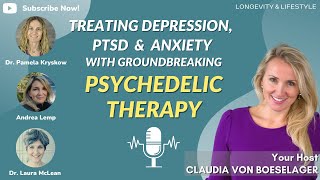
Dr Pamela Crisco, Dr Laura McLean, and Andrea Lemp describe Roots to Thrive, a 12-week ketamine-assisted therapy program for depression, PTSD, and anxiety. The program uses group sessions and three in-person ketamine weekends, with outcome data showing 80-90% reduction in PTSD symptoms and estimated savings of $50,000 per participant.
Chapters
This episode is brought to you by Nootopia. Nootopia is a bioptimizers company with the first ever 100% personalized nootropic stack. Think a powerful brain-specific supplement. Nootopia has been a real game changer for me. When I take one of their stacks, I get hyper-focused for the toughest tasks. My verbal fluency and creativity improved dramatically and reduced stress to boot. To say goodbye to afternoon energy crashes, boost your emotional intelligence, activate neurogenesis, and more, check out nootopia.com/claudia to receive 10% off your order. That's nootopia.com/claudia. Hello, longevity friends. This is your host Claudia von Boeselager, and welcome to the Longevity and Lifestyle Podcast, where I I invite pioneers and thought leaders in all things longevity and lifestyle to give you the strategies, tools, and practices to live better and help you reach your highest potential. Today's episode is a panel conversation with some of the incredible Roots to Thrive team, Dr. Pamela Crisco, Dr. Laura McLean, and Andrea Lemp on psychedelic medicine, mental health, and groundbreaking therapy methods for healing and wellbeing. My first guest is Dr. Pamela Crisco. She's a medical doctor with a strong interest in psychedelic medicine, mental health, and chronic pain. She is a founding board member of the Canadian Psychedelic Association. Dr. Crisco is actively involved in research related to psilocybin, MDMA, ketamine, mental wellness, chronic pain, and neurogenesis. She's also co-investigator on the largest microdosing study, microdose.me, which is ongoing with 14,500+ enrolled participants. Dr. Crisco is a clinical instructor at University of British Columbia and adjunct professor at Vancouver Island University as the medical lead on the Roots to Thrive ketamine-assisted therapy program, which treats healthcare providers with PTSD, depression, anxiety, and addiction. In real life, she loves foraging in the forest, ocean kayaking, growing kale, and daydreaming in the hammock. My second guest is Dr. Laura McLean. A physician whose background includes practicing internal medicine, respirology, and critical care, and for the past 9 years, primarily sleep medicine. Most recently, Dr. McLean has been working as a consultant in sleep disorders in a multidisciplinary lifestyle medicine clinic in Canada. Her connection with the Roots to Thrive program started as a participant in Cohort 3, and she has now become a team member, currently in the role of a co-facilitator mentee. My third guest is Andrea Lemb, who has been leading health and wellness programs in Vancouver for over 30 years. A specialist in community and hospital mental health and addictions, Andrea has practiced and led in diverse specialty hospital and community settings. She's a graduate of BCIT's psychiatric nursing and registered nursing programs and a graduate of UBC's bachelor and master of science in nursing programs. Andrea concluded her 30-year hospital and community career shifting from the limits of conventional psychiatry, and she now supports individuals, groups, and leaders to recover their full health and unlock their true potential in body, mind, and spirit. Addressing the root cause of disease, this approach represents combining the new fields of psychedelic and functional medicine. In this episode, we dig into addressing the root cause of disease, mental health, including for anxiety, depression, PTSD, psychedelic medicine, and groundbreaking ketamine-assisted therapy methods, the Roots to Thrive program, what role psilocybin, MDMA, ketamine, chronic pain, and neurogenesis play, the importance of a holistic approach to treatment, and much more. Before we begin, please hit subscribe to the podcast to get your weekly dose of longevity and lifestyle inspiration, and share this episode with those you love. I would also love to hear from you, so please leave a comment to let me know what you think, or reach out on Instagram @longevityandlifestyle. Please enjoy.
Welcome to the Longevity and Lifestyle podcast today. So we have Pamela, Andrea, and Laura, all three of you, in our first panel discussion. So excited to have you on.
Great to be here, Claudia.
Perhaps we can start with, I'd like to invite each of you to give a brief background to yourselves and your journey that brought you to where you are today, and perhaps touch on maybe some of the pivotal moments in your journey that really shaped you.
So I am currently a medical doctor, primarily specializing in chronic pain, but my journey into medicine was not direct. I started out with a degree in criminology. And working in the criminal justice system and really working from social justice side of things. Thought I would probably go into environmental law at some point. And then, you know, life is windy and I moved into being a city firefighter for 8 years. And really that's where it really solidified for me I wanted to go into medicine is the part that I enjoyed the most was the medical emergencies and helping people on that level. I was always hounding the ER docs after what happened to the patients we brought in, find out how that happened or what happened with them. Then moved into medicine. In the last maybe 5 to 10 years, started realizing that psychedelic medicines were going to make a comeback and that there was going to be a way in the future of integrating these medicines back in together. Probably that happened for me because of my criminology degree that I already understood the war on drugs and I already understood the propaganda around it. These were actually well-studied medicines that had then been taken away. And so that's what brought me into this part of the journey here with the Roots to Thrive team is the ability to marry social justice with being a physician and bringing back medicines that actually work for our patients. And I'll hand it over to Andrea.
Thanks, Pam. So I began my journey as a nurse over 30 years ago and started off in forensic psychiatry. And worked then with refractory schizophrenia and depression. So that's difficult to treat, schizophrenia and depression, and then moved into running teams in the hospital, in the community for over 20 years and really jumped on any new practice that became available. Like for example, biological medicine in the '90s and early 2000s was thought to be the be-all end-all for treating mental health issues. And It certainly works for certain people, certain individuals have a fantastic response, but others it's not so great. And what's being revealed is that having individuals on antidepressants for a long period of time may not be the optimal thing. So I first discovered psychedelic work 7 years ago, and I've been training in functional medicine over the past 3 years, and combining the two where you can look at your response in the body, and cognitive behavioral therapy and psychotropic medications can take you to a certain point, but I always found that certain patients and people in the community, they could only get so far and then there was a blockage, and so in the work with psychedelic medicine, I found it could take you beyond the default mode, which is your typical response, your conditioned response, and begin to really look at what's underneath and move individuals forward in a way I haven't been able to see before. And being able to find this team and work with each of them has been phenomenal. It's something I never expected to happen, and it's been amazing. So I'll pass it on to Laura.
Thanks. Yeah, so I took the more direct path into medicine after high school, did university, went to medical school and I trained as an internal medicine specialist and then subspecialized in respirology and critical care. I practiced primarily critical care but also respirology, also known as pulmonary medicine, I guess, in the U.S., and internal medicine for years. And then in 2012, for various reasons, I shifted gears and developed an interest in Sleep medicine. An opportunity came up for me to make a change, and I did some more training and had some great mentorship and became a specialist in sleep medicine. From there, I focused primarily on that specialty and was working hard, very much in the sort of traditional Western medicine approach, just seeing lots of patients and feeling a lot of pressure. Actually to see patients and pump them through and make money and all that stuff. Everything came to a grinding halt for me in 2019, 2 years ago almost exactly, when I got diagnosed with breast cancer.
I'm so sorry.
Thanks. Andrea was actually there the day I got diagnosed. That's another story. But I just suddenly had to stop, drop everything, and start taking care of myself. So it turned out to really be probably one of the best things that ever happened to me, actually. There was a big silver lining in that dark cloud. First of all, it was when COVID started, and so my whole family had to be home with me when I was going through treatment. So that actually was great. But I did a lot of work on myself during that time. I had already been experimenting a little bit and moving towards plant-based eating. I've always been someone who's really physically active. I've had an interest in meditation and that sort of thing, but really didn't take the time to do it. So I spent a lot of time quietly meditating, reading poetry and that kind of thing. And so as the year progressed, and it became clear that I was going to survive, and, you know, had to figure out where to go next, I had a lot of conversations with Andrea, who happens to be my next door neighbor, and my dear friend. I'd been hearing about the Roots to Life program and she suggested it might be a good idea for me to go through as a participant, given what I'd been through. And so that's how I came to the program, was really as a participant. And the experience that I had and the shifts that it created for me in my life, just, it was so, so profound that my heart told me that I had to become part of the team and help with this movement. I think of it as a movement. What I got from the program, I want to take that and help make it bigger and share it with more people.
So beautiful, Laura. Thank you for sharing that. And Andrea and Pam as well. And Laura, if I may, what were some of the shifts that happened from going through this program?
I would have told you intellectually, that I love myself and that I have self-compassion and that sort of thing. I've been to enough sort of retreats and, and I thought I had done the work. But I realized in Roots to Thrive that I was fully in my head with all of that. It was all up here. I wasn't really feeling it in my body. And the experience of Learning to really feel my body sensations and understand what was going on and to talk about emotions connected to those body sensations, that was not easy and it was quite, at times, I guess I would say physically painful. After one particular ketamine session especially, I got to a deep, dark place, and it was then that I really figured out, oh yeah, there's stuff there that I don't love myself, and I don't trust myself and respect myself, and I figured that out. And so coming out of the 3 ketamine sessions and the 12 weeks of the program, I learned that I can trust myself, I can listen to my heart, I can feel what's inside me, and that if I follow that, I'm not going to go wrong. And so far, with all the decisions I've made. And there's been a few other changes. I've recently joined a lifestyle medicine clinic and I'm now a lifestyle medicine specialist as well as a sleep specialist. Like, this is— my heart is telling me this is where we need to go. So that's the big shift.
So beautiful. And thank you for sharing that as well. And I'm also on my journey to improving intuition. And I think women obviously have an advantage to that, but when you can really function from the heart and from intuition and learn how to listen to your body, it's just so powerful. So So, you know, your program really, I think it enables that for people who go through it. I'd love to dig in a little bit more firstly around what you perceive, and I'm not sure who would want to answer this one, but perceive as the challenges of the traditional mental health model.
Okay, well, maybe I'll speak to that since I'm the one with the mental health background. So as I was saying in my introduction, the, Traditional practices include medications, and so it's a biological model, and cognitive behavioral therapy, so that combination. However, you can get to a certain place with cognitive behavioral therapy, you can understand your life story, but that's just it, it's staying in the story and whatever you've been conditioned along the way, and it may not relate to your authentic self, which is, you know, your thoughts and your deep-down emotions and your physical sensations in your body. So as I was saying, you can get to a certain point and individuals describe almost like a blockage. They can't get past that point, and it's because they've become disconnected from their true selves, so their authentic selves, by this conditioning. And so that kind of a challenge, the only time I've been able to see getting past it is through the use of psychedelic-type therapies where you bypass the default mode network. And so the default mode network, as I've said, is what you've been conditioned to believe, and it's your set point, it's your go-to, it's the pathways that are well-worn in your brain, you just go straight to them. And so what we're trying to do now is go into our emotions and our physical sensations in our bodies and then choose what we want to believe and then choose our actions and reset that mode. And that's part of the work we do in the program is beginning to have practices that we do that take us out of the stress and anxiety and depression and back into a homeostasis, so to speak, and that being our choice.
It's so powerful because I think the more people realize that by default our belief systems are set from childhood, so it's a 3-year-old belief system that, you know, a child has formed and without knowing that there is a choice to actually see things a different way. You could run all through life being really unhappy and reaffirming childhood beliefs by seeking the same thing out. So it's such a mind shift once you're able to understand that and the choice as well. Pam, I'd love to touch on something you said about the war on drugs and psychedelics. For those potentially unfamiliar, can you talk a little bit about the history of psychedelics and then what happened in the '70s that quickly changed the model from medicinal purposes?
So in the 1950s, '60s, and into the '70s, there were thousands of research studies going on around psilocybin and LSD especially, and LSD was actually gaining a lot of traction. MDMA was coming onto the scene and actually stayed legal until 1985, but the rest were scheduled in about 1972 with a lead from the American government, from Nixon, and then the UN Declaration on Drugs And so at that time, the research was very promising. It was the psychiatric movement. These medicines were being used for alcoholism and depression with good success. There was a lot of write-up. Psychiatrists were traveling from all over North America to come up actually to Saskatchewan. Weyburn Psychiatric Institute in Weyburn, Saskatchewan was a leader in Canada. There was all sorts of stuff going on all over where psychiatrists and psychologists were actually experiencing these medicines. In Weyburn, actually staff were taking LSD to see if they could experience the psychosis that patients were experiencing, and then it was of course realized that it's not really a psychosis that you get with LSD, it's a totally different experience, but that was a bit of the thought pattern at that time, and one of the stories I really like, historian Dr. Erica Dick, who is a Canadian psychedelic historian and is a phenomenal researcher, tells of a story where one of the architects, I believe, was given LSD and he was in one of the rooms in Weyburn. And because of that experience being on LSD, when he came out, he said, we can no longer have black and white checkered floors because I was convinced I would fall through the hole of the black checker under the experience. And so I can imagine that these patients, why they might not want to get out of their bed is the floor looks menacing. It looks like a whole bunch of holes. And so stuff like that was kind of happening back there in addition to staff using LSD for alcoholism. British Columbia had what was called the Hollywood Hospital, where people came from all over the US to deal with alcoholism with LSD. And so I give you all of that to say that like, this was legitimate medicine and it was moving forward in those times. And then the war on drugs came and it was essentially a cultural and racist control. They recognized that there was the war resistance to Vietnam. The Black Panther movement was strengthening, there was a lot of unrest, like people were demanding their civil rights, and you can't really just criminalize people for that, but you can criminalize the drugs they use. And if the teens don't want to go to war because they want to be at a music festival, then if you criminalize the use of these drugs and make it look like a menace, then you'll get a lot further. And so there was a full propaganda machine that was brought out there, and I think many of us in North America were fully ensconced in it. And it was in my education all the way through, like, this is your brain on drugs, the fried egg in the pan, you know, people that you would see, that person's burnt out because they did LSD. And so it was a really, really strong propaganda, but it wasn't based on science. It wasn't driven by science. It wasn't driven by scientists. It wasn't driven by MDs, but nonetheless, it took these medicines away from us. Like I said earlier, MDMA managed to last until 1985. Psychologists and psychiatrists were training on using it for couples therapy right up until the day it was scheduled in the U.S. and they were fighting against it. They were like, no way, this is a fantastic psychiatric medicine. And then we've had this 40-year break. It just really shows you how strong propaganda is. But once you know that there was no scientific data presented, there is no push from the medical community, you have to press pause and go, what the hell? And we should be angry because we should be 40 years ahead of where we are right now. If we can clear that propaganda out, then we can have an adult conversation and pick it up now where we are. As a physician, I'm angry. We shouldn't be where we are. We should be way ahead of where we are. And it was only because of propaganda that we got there. We should be very angry at the politicians of 40 years ago for what they did.
Yeah.
And also to keep so many people suffering and unable to seek the treatment. And I guess maybe just for people listening as well, I mean, are there risks? Risks of taking psychedelics in any shape or form? You know, might not be for everyone. Is there anyone that's excluded from a use case?
I think there's a risk-benefit ratio. I'll jump in here, and Laura and Andrea, please jump in too. There's a risk-benefit to everything. You know, we get in cars every day with the risk-benefit ratio. We take medicines all the time with the risk-benefit ratio. And so I think of psychedelics exactly the same way. What are the risks? What are the benefits? And that's how we need to look at it. We need to look at it objectively and scientifically and recognizing nothing's risk-free. You know, I'm drinking coffee here. It's not risk-free, you know, but there's a great benefit. I'm really enjoying it. So, you know, we can weigh everything that way in a really adult way. Right. And that is a kind of a remnant of the propaganda. That we don't look at psychedelics like that, that we don't look at these medicines and going, psilocybin is really helpful for PTSD or for alcoholism or smoking cessation or for reducing violence. So who's the right population at the right dose at the right interval, and what's the set and setting and the container of that, or whatever that is? You know, we can have an adult conversation like that, and then we can have another conversation about when do we use ketamine or when do we use would we use MDMA, or why would we use 5-MeO-DMT, or ayahuasca, or wachuma, all these substances. I think we're smart enough, we're scientific enough, and we've got the data, so why don't we move forward and then fill in the blanks with the research?
I just wanted to jump in as well, because when you were asking about the limitations of the current mental health system, one of the limitations is that we don't get to the root cause, and in this psychedelic model, We expect, like, there is a little bit of risk of some dysregulation initially as we start to actually feel the emotions. When you're depressed and anxious and have trauma, you're to a certain extent disconnected and not feeling those emotions or physical sensations in your body, and as we go through psychedelic therapy and start to look at, in the ketamine experience, for example, you begin to see experiences in your life, and the work we do is to help shape how you see those differently now, how you can respond to them in the way you choose. But initially, you'll have a certain amount of dysregulation as those emotions rise up and you're not used to feeling them. And when Pam was talking about the set and setting, that's what we're referring to. We are present and available as you're going through that and supporting you through that. So it's experiencing it a different way in connection with others that helps to heal, as opposed to just treating with medications.
I think it's so true. And also in many different areas of medicine. I mean, on the podcast, I have, you know, doctors, scientists from across the board, but it's all really about moving towards this, in my view, 21st century model of getting to the root cause. That you can't just prescribe and put a Band-Aid on it and think, okay, the headache will go away. Well, you haven't actually solved for the root cause. And when you solve from the root cause, it's so many other things are avoidable. I mean, you know, Alzheimer's is reversible these days and preventable. Cancer, so many type 2 diabetes, you can get off of it in a few months on a certain protocol. So that's why it's so important that that shift takes place, that people realize, okay, how do we get to the root cause of this? What is the root cause? And look for therapies that help with that. So that's so powerful. Thank you for sharing. I'd love to jump over to the program that you offer. Can you talk about the program in itself and how it's structured?
Roots to Thrive started first off as a quality improvement program, just Roots to Thrive, which was a 12-week resiliency program. And it was started with a grant and primarily with nurses. The first pilot was very successful, and then came the psychedelic portion, which was the ketamine. So ketamine is the only legal psychedelic right now in Canada. The other ones are on the path towards that.. And so what we did is we put them together. We took the 12-week resiliency program and we put the psychedelic experience into it to accelerate the healing. So the way the program is currently structured, and it's a program that's in constant quality improvement. So we're constantly making it better based on the feedback from our team and from mostly from our participants, how can we make it even better? And so it's a 12-week program online. Our participants come together for 2 hours a week in a big group. And what we have is some teachings there that we call coming to knows where different team members teach on what is relevant at that time for that cohort of people based on the challenges they have come into our program with. It's usually a combination of PTSD, depression, anxiety, addiction, eating disorders, et cetera, and other mental health challenges. And then they go from a big group online, and COVID has made this completely necessary to happen this way, and then they go into small groups, small group formats that are facilitated with two facilitators with very specific targeted questions. So the whole program takes the best of all psychodynamic theories and takes the best pieces and puts them together to create a unique offering. And so based on what's happening in the team, they go into the small groups They do some small group work. They start to model unconditional positive regard and compassionate witnessing so that they're starting that healing process right away in a community. And then that same community then also has their psychedelic ketamine journey as a group. So they come together, they get to meet each other for the first time, they have a psychedelic journey, and they integrate together. And then there's group integration within the bigger program again, and a continuation. So 3 psychedelic weekends within that 12-week program.
Is that in person then, or it's also virtual?
The psychedelic journey is in person. They all come together, they come together to the facility, and then they meet for the first time on the first one. And then it's a complete ceremonial container that is set up, already set the setting, a ceremonial container. They have their journey, they have their integration, and then they have integration sessions continuing in back into the 12-week program, meeting online. And then they come again on 2 more weekends, and then they have the option at the end of the 12 weeks— we don't just like— they're not just done. Then they can move into our alumni where other offerings and other support is there, and they can also have future sessions.
I guess I would just say that surrounding this whole community of practice piece is all kinds of different supports. There's access to the psychiatrist who is involved with the program if people need a little extra one-on-one or something there, or we have someone who does energy work, people can access that. There's a number of different clinical counselors. So if anybody needs something extra, or if they need to talk about functional medicine and get some advice from Andrea, like, they have that access and it happens right away. There's no waitlist or that kind of thing. And these people get treated so lovingly, I guess. They're held in multiple layers in a really safe way.
And I just wanted to say that connection Laura was just talking about, that's so fast. In our healthcare system in Canada right now, you might be waiting months to get in to see a psychiatrist, so this is really extraordinary. And also the piece with functional medicine, what I've been noticing as we've been going through the program is that when you're in a trauma response, for example, that's a high level of cortisol and you're not coming back to homeostasis. That high level of cortisol being released on a consistent basis causes things like gut dysbiosis because, you know, you're not digesting, resting and digesting when you're in that state. And it can cause immune responses that are dysfunctional because you're not in a good immune response when you're in sympathetic mode. So it's things like that that I see on a consistent basis. So once you start to learn to feel what you want to feel and, you know, the physical things that you want to start making choices, individuals start to notice that they have gut dysbiosis. I'm seeing consistently there's issues with the gut, there's issues with their immune response, there's issues with hormonal systems. And then once you start to feel better in your mind, you can start to work on those issues in the body. It's kind of an extraordinary thing that all comes together and snowballs into wellness.
The one thing I should add though, Claudia, that I didn't say is, and Laura alluded to it, is that we are actually a really big multidisciplinary team. I totally missed that part. So it's not just us, like we have MDs, we have psychiatrists, we have clinical counselors, we have spiritual care workers, we have Indigenous elders, indigenous team members, functional medicine, sleep experts, addiction experts, palliative care experts. It's a flat hierarchy. There's no hierarchy. We all come in at the same level and we all hold that container of the program. And so it, like Laura said, there is somebody there for everything. It's the whole human approach, completely recognizing we don't want to break people up into their little parts. So we brought the whole team together, and the team is ever expanding as other experts and other people with other things come in. They join the team equally at the same level, the flat hierarchy.
Yeah, you don't hear much or often about such a flat hierarchy, but I think it's so incredible how not only do you go into such depth and of healing, but over— if you think about it— such a short space of time. I mean, you're talking about 12 weeks, obviously you said there's the alumni program, but you know, some people are in traditional, let's call it talk therapy for 10 years, 15 years, 20 years. And while that to a certain extent serves a purpose, they might not actually be getting to the root cause and solving the underlying, and then with the health issues that come from that, et cetera. So within, you know, a 12-week space of time, that transformation must be just so incredible to see in the patients that you see in Roots to Thrive. I'd love to touch on a point regarding the group structure, because I think some people obviously, and especially if you're suffering from some specific mental health issues, you mightn't feel comfortable in sort of a group dynamic. But what is the power in the group structure, and how do you help people get very comfortable with operating in that way?
Can I just start this off? Because this is something I've really observed. I've facilitated 3 groups now, 2, 3 groups, and every single time you bring together individuals who don't know each other, and they look around in that group the first week, and they— everybody is very, very different from each other, and you can see the look of kind of trepidation on everyone's faces, and then we start to practice unconditional positive regard and compassionate witnessing, and by about week 3, there's an extraordinary shift of the safe container and being able to hold each other. And being able to witness each other and feel love and compassion. And that is the bypassing the disconnect that's been held by the depression, anxiety, and trauma. So it's an extraordinary thing. And we always say, you know, individuals sign up for the ketamine, but they stay for the community of practice, the small group.
I think Laura should comment on this too, because she's got both perspectives very fresh, but it is You know, we are craving community and we're craving love and connection. And this idea that you need to heal by yourself, or it's your own problem, this changes in community. When you're listening to somebody in the group share about their shame and you too feel shame, you can go, wow, I really care about that person. They're worthy. I too must be worthy. So there's this group healing that is happening from the shares and people recognizing their challenges in other people.. And as a physician who's like, I mean, I think of myself on both sides and I'm a patient and I'm a physician. It's, I'm a whole person, but you know, previously working in the one-on-one model or the dyad model with psychedelics, the healing in community is exponentially faster. It is so much faster than the one-on-one. And I understand that people would like, oh, my problems are unique. My problems are different. Well, the reality is they're human problems. And that's our seed of I belong, I deserve, I'm good enough, I am loved, I am worthy. And that has to come from community and love. And it's just such a better model. I would never go back to the one-on-one personally. I would never go back to doing it because the acceleration of healing in group is so much more exponential.
Beautifully said, Pam. The thing that I am amazed by is how these small groups are created in a way, and I think it comes from the little bit of education coming in that we're giving the participants and the guidance and the modeling that the facilitators do. There's almost instantly this feeling of safety and this feeling that we can be a little bit vulnerable and test that out and see what happens and what comes back. And that's really the magic of it, is just this really safe place to share things that you've maybe never shared with anyone before. The wisdom that comes up from the groups, I just, I went through as a participant in Cohort 3, and now I'm a mentee facilitator in Cohort 4, 4, and I every week am amazed by the wisdom that the group comes up with when they're witnessing each other and listening to each other with compassion and with their hearts. We're constantly as facilitators writing down quotes of really deep, amazing, profound things that are coming up. It's really beautiful, and it really is— there is something about that community, that social connection, that is such a deep human need, I think. We can't be alone. We— I agree with Pam, I can't see how you could heal in isolation.
Well, I just want to ask Pam, you get to float groups, Pam, and you see them from the beginning to the end, and I've heard you comment before the extraordinary changes you see that we may not be aware of because we're in it all the time.
Yeah, so what Andrea is speaking to is, as I said earlier, each group has two facilitators, each small group, to the big group, it's a big team, and each small group has 2 facilitators. And then there's those of us that float through the groups. So I'm in a different group every week of all the small groups. And so it may be many, many weeks before I return to a group that I've been in before. And watching the change is just amazing. Like it's just someone who you could see was constricted and contracted, wasn't sharing. Is suddenly leaning in and opening their heart and talking about their challenges and the insights. Like, you see these changes that are just— it's phenomenal. Like, it's why we went into medicine. It's why we do this. It's actually— this is what we had always hoped for, is these kind of transformations and changes in people. So it's kind of like when you haven't seen a friend for a couple of years and their hair has grown, you know, 6 inches like that, except it's faster.
It's faster and much more profound than just the hair, I guess.
In the community, they get to see each other, that it's not just a linear process. You expand and then you contract, as Pam was saying. So they can see that some will go through difficulties as they're receiving the ketamine experiences. As they start to feel their emotions, we talk about the different tools you can use to pull yourself back to homeostasis, so to speak. And they see each other doing that, and that really offers the encouragement because they see, you know, them feeling better as well. And so it's this process of creating that spacious awareness that you can go to when you feel anxiety or depression, and doing that in community and supporting each other and seeing each other get better.
And you mentioned before about integration. For those unfamiliar, can you talk about the importance of integration after such an experience.
I want to answer that, but I also want to say there's something else there that's really poignant about what Andrea said and is really important for people to hear, is life is a journey, right? It's up and down. And so some days you're up and some days you're down, but the reality is you're still going up, you know, like you're going up like this and you're still having these dips, but you're going up. And in the small groups, they witness that when they're having a great time, like when they're really getting insights, the group sees them like, wow, And when they're having a tough time, the group sees that too. And so what begins to become in our awareness is you don't go from the bottom of the mountain to the top of the mountain and everything's great. That's the error in a lot of our thinking. If I just do that, my life will be better. I will be happy. Everything will be great. And it's just not like that. It's up and down, but it's building that resiliency in it that, oh, I don't have to be down as long this time. I have tools, I can reach out, you know, like that's the thing is like they're not going backwards even though sometimes they'll think, oh, I'm going back to my old habits. They're never going back to their old habits. You cannot go back. It's always a forward journey, even though there's dips, but the dips become smaller or they become shorter or you use more tools and the good times get better. There's this mythology sometimes with people that they've gone backwards. The group doesn't let them see that. They're going, okay, we can see you're having a hard time and you're so articulate about it, you have such insight about it, you know.
And so they're holding that container, holding up the mirror to reflect back that they think they're going backwards, what it sounds like, but they're being much more articulate about speaking about emotion, which in itself is very helpful, I could imagine.
Absolutely.
And then integration. Integration is, you know, the neuroplasticity we think is in that 36 hours after, and so they do a bit of integration right after their session on the same day, and then they have opportunities for 2 to 3 more after that. And what we've done is something quite interesting, again something that feels a little outside of people's comfort zone, but it stretches that what we call the window of tolerance. They come into the integration sessions, which are online, and they're randomly assigned to different integration groups, which may or may not include people from their small group or from their journey group. And the feedback has been from the participants that it's very powerful because you are now being witnessed and heard by strangers who accept you and hear you. And, you know, you're heard. And that stretches that window of tolerance even wider that, oh, I am lovable, I am okay, I can expand who I include in my community.
Such profound realizations. Andrea, did you want to say something?
I think as Pam was referring to that neuroplastic 36 hours, what they experienced in the ketamine journey gives them the opportunity to view things from a very different perspective. Of their conditioned mind. So they're able to see things and consider them carefully, you know, in a group that witnesses them and gives them unconditional positive regards. So they can choose how the perspective that they wish to see that experience from versus what their conditioned mind just went to all the time. And it begins to shift everything.
I'd love to jump into a few rapid-fire questions before we get into more details of the two different programs that you have. We've discussed some of them, but thinking of the word successful, who's the first person who comes to mind and why?
I'm just gonna say it's actually my kids because I feel like they are living their true lives and they're happy and fulfilled. They have their ups and downs But there's a lot of, yeah, love and optimism that I see in them, and I think that's success.
Yeah, I'm kind of on a similar vein. I'm thinking of my partner who's following his flow and his dreams and happy.
I think about my family as well, but I also think about our team because it's all of us just experiencing life and becoming more resilient. You know, you think about success having things in your life, but really It's more connection to each other. And so what I notice is that as we become more connected, we feel more successful because we're just happier. That's the happiness quota, right? Being connected and feeling like you have some resilience and that you can rely on others and that you feel safe. For me, that's successful. And so other members of our team, even in the 2 years I've worked with them, I've seen them become more resilient because We're all doing our own work as we go through this. As humans, we're always going to have stressors. We're always going to have things that are traumatic, but it's how we place them that determines whether or not they will have an effect on our bodies and our emotions. And so I see us each placing them differently and moving forward more successfully and having a happier and, you know, just calmer and more resilient life.
Such a gift. Yeah, I agree. So all of those were so beautiful. Thank you for sharing. What are some of the daily or weekly routines and practices that help you all perform at such an amazing level?
Can I take that one first? Because I've been working on the chill medicine side for a while now. So for me, when I was working in the healthcare system, I got really, really sick. I also had a diagnosis of breast cancer, and I had to really pull back as Laura did. And it initially started with learning how to meditate, and then as I started to calm my emotions, being able to look at my diet, eating a whole food, high micronutrient diet with lots of fiber, low sugar, and low inflammatory, but also then adding in exercise. I exercise at least 3 days a week, and coupling meditation, breathwork, exercise, and diet are really the kind of pillars in my life. And as soon as I notice one of them goes off, then— and also connection to community, of course— any one of those things going off, I've got pull them back in because you notice the symptoms right away. And that's the big part. You really start to notice symptoms quickly, and you assess your life and pull back in the pieces that, you know, work for you. And each person is going to be very different but similar.
Sorry, that's so well put to the point. Yeah, I completely agree with that as well. And if, as you said yourself, if one of the pillars is off, you need to correct it quickly because then they'll all start shaking. They all kind of tumble down as well.
I've distilled mine down to a couple things, two things right now that's aligned with everything Andrea said, is flow and choice. Is that following what feels right in the moment, like honestly feels inspired and purposeful. And then choice in every moment of what I do is that, you know, whether it's food, so what I go to eat or what I go to drink, or what activity I do, that I have a choice in every single moment, to make the right decision for me in that moment. So whether it's, you know, broccoli versus something that's not so broccoli-ish, that's a choice, you know, and it's that simple. I can make a choice and I am fully able to course correct and make a new choice if I want to.
Yeah, similar to what you guys have said, for me, what keeps me nourished is Giving myself time. I work at giving myself time early in the mornings to meditate, and being outside and being physically active is huge for me. That's when I feel my flow, if I'm out riding my mountain bike or running or something, and the energy starts to flow through my body and in my brain, and I can really kind of reconnect and stay present with what is important And something I've been noticing since I've had this recent experience with having to stop work and then restart again in a very different way is that I am so excited about what I'm doing because I know I'm following my heart and I'm choosing what feels right, like what Pam said. And it's so much easier to do a whole bunch of stuff when you're coming from that place. Like, it used to be really hard to get up and drag myself to work and do, you know, get on the computer because it really wasn't what was right. It wasn't what my heart told me I should be doing. I wasn't listening to my heart. So I think that for me has just been a key to just a really increased capacity.
So wonderfully said. And I think as Joseph Campbell says, it's, you know, following your bliss. And I really love that word bliss because I feel like it's not just what you'd like or what makes you happy, but it's really that bliss. And that flow state. And I think, you know, that's almost for me the secret of life. If you can find your bliss and actually go and do that, you know, as you said, you don't have to pull yourself out of bed in the morning. It's not such a struggle to do the work. You actually, you know, you're almost wondering, you know, I'm being paid to do this. I love it. You know, this is great. So that's my greatest wish for anyone really, is to find that bliss and be able to pursue that. And it just— so many things shift because of it, I think. So really nice. Thank you for sharing that. Another rapid-fire question for you. So in the last 5 years, what new belief or behavior or habit has most improved your life?
I'll just jump in and I'm going to say whole food, plant-based eating for me. That has really shifted me inside and out, my whole being. It's thanks in large part to Andrea for teaching me about that and helping me fine-tune how I do that.
I think for me, especially in working with this team over the past couple of years, it's being able to have a connection, such a strong connection with others, because that has helped me to regulate along with all the other practices. But when I feel safe and connected and on purpose, and you combine that with things like exercise, plant, you know, high nutrient diet, and, you know, things like meditation and breathwork, And just being heard by others, that level of connection has been a huge shift for me.
For me, it's been flow, which again, still goes into all of this. Flow brought me to the team. Flow speaks to what Laura was saying, is that when you're in the right path, it's easy to do a ton of stuff because it's fun. And so really flow, just really what doors are open, stop banging my head against the wall. Go through the open windows, go through the open doors, see where the yeses are, walk away from the nos. There's more than enough in this lifetime to do inspired work to do. And so going towards that work all the time and leaving the other stuff for other people that are inspired to do that. So just flow, flow in eating, flow in exercise, flow in connection, flow in work, flow in play. And listening. And that's really just going back to the inner healer. Like, I know what's best for me, so if I show up as my best Pam in this world, then that's a benefit. And so that's my job, is to stay as the best Pam in flow so that I can show up fully, completely for those that I care about and love.
So beautiful as well. Thank you for sharing that. Would you say that the majority of the participants that go through program experience similar benefits, I think you could say, of the flow state and the connectivity? Is that sort of what everyone experiences at the end, or what are some of the benefits that they feel after the program?
Everybody comes out at a different place. They come in from different places and they leave at different places, but they leave with a big toolbox and they leave in community and they leave with the tools to move forward to their next level. So I kind of think of it more like an analogy, like almost like a video game. You know, people are leveling up based on where they're at, and there's never an end in levels. And hopefully what's happened at the end of the 12 weeks is they have taken it up quite a few and they have filled up their toolbox with options and they see the world differently. They see potential differently. The blinders have been widened to opportunity, and then they can continue. Everybody's coming in differently. Everybody's leaving differently, but hopefully there are many, many levels above what they entered. So we're not going to see the same results, but quantitatively, you want to know numbers, like we're seeing 80 to 90% reduction in PTSD and depression. Anxiety, not quite as much, closer to 70%, but anxiety is like just pervasive right now. And we suspect because we have clinical trials, our research projects, attached to our program, we're going to be, you know, studying to find out like how successful are we in other things like improving sleep, improving chronic pain, improving eating disorders, improving substance use, improving end-of-life distress, like all those things we're going to study it because we're seeing the numbers in our program and we already are studying these things. We are a research program as well.
Yeah. Just to tap onto a little bit of what Pam was saying. I was in a group last night and some of the individuals were describing, for example, periods where they had more happy times, like more quantifiable times in their life where they felt happier, or less reactive times and more periods where they just felt, as Pam was saying, a flow state where they felt connected to others and could, you know, bring the tools in. So it's just, as Pam was saying, a matter of feeling those feelings is noticing when you're having those happier times and then bringing those tools in more quickly the next time.
You were mentioning about research, Pam. Could you touch a little bit more on that? Because I think that's another very interesting aspect of the work that you are all doing, that you actually are using it for research purposes as well to make an impact. So could you talk about that?
We fully recognize that in order to make the shifts that we need in healthcare, that we have to provide data. Our program is not covered. We are a nonprofit, a cost recovery nonprofit, and this program needs to be covered. We cannot be in a situation where you have to be able to afford therapy to get the therapy you deserve. This is a huge moral distress for us that it is not covered, and we're doing the research to fill in those gaps. So to show that these programs work, that when you do high-quality multidisciplinary full service, treat the whole human, restore the whole human, that you get good results, even if you don't believe in it, it's still a huge cost savings. I mean, even if you only care about money, at least you can care about people and money. I hope you care about both, but the cost savings is probably astronomical. And we're actually researching the cost savings of our program. I suspect looking at the numbers already, that we're saving at least $50,000 per person to the healthcare system that goes through our program.
Over a lifetime?
Over a lifetime, and in some cases even shorter. If you've got a firefighter off work because of PTSD, that's $90,000 to $120,000 a year in disability payments, you know. So if they go through our program, which is just under $6,000 Canadian, that's a massive savings. That's a 15-time savings in one year. Nothing else touches it. And so we're filling in the data. So the program came in first as a quality improvement, and we're publishing on the quality improvement parts. Now we're working on publishing on the PTSD data, the depression data, the anxiety data. All the cohorts that come through are consented at the beginning if they want to contribute their anonymized data to the science to be published. And then when we publish and we can show that people are coming in at this and they're leaving at this, and then you can put what is that cost savings, then you have a really strong argument to policymakers and to health ministers and to hospital administrators, people that have to make those decisions based on the budget and what they can cover. We're doing that. And also we're providing the data for other people around the world to say like, this model works. Not only is your team healthy, strong, and nourished, But your participants are getting that too.
Everybody.
It's a win-win situation across the board. So for that reason, we're continuing to study and we're continuing to partner with researchers. I think we have 5 PhD researchers working with our team now to work through this and make sure we publish on it.
Out of curiosity, what would be the biggest win that would come out of the research? Would it be that insurance would cover these types of treatments around the world?
Yeah, it should be covered. That would be the win, that our program is covered within the Canadian healthcare system and that other countries that have different systems, that insurers look at it and go, this is a hell yes, this is an absolute yes.
Tammy, you mentioned on the whole person approach, could you explain about what exactly you mean by that?
I think of this as where this is what Both of them said, and we all say, our whole team says, is we have to build that foundation. We're not treating the peripheral symptoms. We need to treat the whole person, and then all those other things disappear. I don't want to treat the eating disorder behavior. We want to treat the whole reason for it. That's really how I think of it and how our program thinks of it too.
I'll just say that if we look at the link between trauma, for example, I'm just using trauma as an example, and physical health, you can't not look at the whole person. So the ACEs study, which I'm sure you're familiar with, that came out showed that individuals who had scores of 4 or higher had a far greater likelihood of having physical health issues in their adult life. So as you begin to, you know, help individuals with connection and regulating their emotions and becoming curious about how they feel in the bodies, they can begin to look at, as Pam was saying, the root cause pieces. So when you're in a cortisol response all the time, a stress response, as some of our participants are, just one example is cardiovascular disease. When you're in a stress response, you're having platelet clotting, and that's a typical response in case you get struck by something, you want to repair your body. But if you're in that state all the time, it affects you in such a way that you can have cardiovascular disease. That's just one example in all the systems in our body. So if you can begin to look at an individual as a whole person, and each person will have different symptoms. And so that's one of the pieces that I do is I can do an assessment to understand which systems in their body are affected. So as well as looking at the mind part, we'll look at what pieces of the body we can start to affect change. And people become more curious as they start to feel better.
Do you do testing as well? Some functional medicine testing?
I can do it, but I find we've got so many individuals in our program, and I'm working on the mental health piece as well, which is, you know, my background specialty, that I'll work with an individual for a few sessions and then I'll refer them on to some trusted functional medicine practitioners with kind of a referral note saying this is what they've achieved in our program and it's so great, and here's what they're ready to work on now. And it's like peeling back all the layers, right?
Wonderful.
Laura, did you want to say something?
I was just going to say a little bit about where I'm feeling really excited when I see patients as a sleep specialist, people who get referred to me at the Lifestyle Medicine Clinic. In the past, I worked just in my narrow little scope. Person's got sleep apnea, prescribe a machine for them and instruct them they better use it or else. That didn't always work very well. As I've been learning more and being more open to listening and paying attention and all this new learning that's coming, being given to me, I'm seeing what's always been there. Patients who come to the Lifestyle Medicine Clinic, they're often referred because they have metabolic syndrome, they've got coronary artery disease, type 2 diabetes, hypertension, eating addictions, food addiction, binge eating, that kind of thing. And then, oh yeah, they've also got insomnia. They come into my clinic and I see all this, and then I see that they're on a few different antidepressants. They've got a history of being diagnosed with depression and anxiety. No one's ever asked them if they have trauma, but they have nightmares. So I've started asking the question, and it just is shocking how often the answer is, well, yeah, I have nightmares and I have a history history of trauma. So as I'm seeing that and making these connections, it's so exciting for me to be in a place where I, I'm able to feel like I'm getting it and I can actually help these people figure out how to get to that root cause. My own patients, I tell them all the time about the Roots to Thrive program. I'm sure they're getting all kinds of calls. It's just such a hopeful thing. And patients get it. Like, I don't need to tell them that it's all connected. They know. They're just waiting for someone to recognize that and put it all together so that they can work on it. A lot of people have that sense that no one's ever named it because they've been referred to 5 different specialists. So that's where I'm excited about the whole person approach. It's just such a wonderful way to practice medicine, and I wish I would have figured it out 30 years ago.
I'd like to kind of tap on something something that you said, Claudia, too, about like, do you do testing? And this is where I kind of get on my soapbox a little bit. Like, we can test out the yin yang, an image of the yin yang, but if the foundations of a person's house are not strong, then to me it feels asinine in a way. Like, if they're not drinking water, if they're not hydrated, if they don't have the tools of food to support their biological processes, If they don't have enough fat in their diet to make cholesterol, to make hormones, to make new cellular walls, like we've got to do that first. And if they're not, you know, moving their body in some sort of meaningful, enjoyable way daily, we've got to help them with that. If they don't have connection in their life, we've got to help them with that. There is no pill, no test, no imaging that is going to insert some sort of magical answer if we don't build the foundations. Medicine has done this to patients, and medicine has done this to ourselves. And we have to retrain ourselves out of this. In my chronic pain clinic, people want to get all sorts of stuff. And I'm like, you just walked in here with a big mass of Coke, and you have a bag of chips in your purse. Like, let's build the foundations. Like, seriously, this is not rocket science. This is foundational medicine. And like, we need people to do first things first and then see the next steps. There's no reason to order blood tests if somebody is not eating real food, right? Like, what's the point? I mean, we do it because that expectation has been met and the pushback needs to be against biohacking. Like, I'm all for biohacking. Like, what is the best way to do things? But what's the point of biohacking and wearing all sorts of devices if you're not hydrated, if you don't move your body, if you stare at a screen all day? You know, like, you have to do A, B, C, D, E, F, G first. And we have to move back to that. Like, we really have to move back to that. Patients have to do it. They can do that. They don't need us to tell them to do that. But we'll tell them, and we need to tell them that. We need to not say, oh, let me send for your MRI. No, you're 100 pounds overweight. Why? What is the seed of that? How can we help get to the seed of that? And then I promise you, your knees won't hurt anymore once we help the seed of that.
It's so important. And I think it's so important for people that you say that, right? Because there's so much with like political correctness and you don't say things, but it's, you know, just stating the obvious, really, but, you know, what are the basic things that everyone should be doing that, you know, 100 years ago was completely normal and somehow we've forgotten that we're on this digital mode of watching TV and on our screens the whole day and not feeling connected, right? Because you're staring at a device, eating very unhealthily, not moving, etc. So getting those fundamental foundations in place first and foremost as well. Yeah, so thank you for your powerful message, Pam.
Andrea, did you want to say something? Getting those foundations into place is far more likely to happen when you're in a connected group where you feel supported, safe. So it's all about coming together.
Yeah, very true. Let's dive into the different programs. You've got two different programs. Can you elaborate on the two different ones? What are the differences between them and what type of people would be more suitable for the one than the other?
Well, the Roots to Thrive one is the one we've been mostly talking about. And what we did is we created an offshoot called My Community Thrives. So in Canada, the health minister has been beginning to grant what we call Section 56 exemptions. So patients who are palliative, well, with end-of-life distress or anxiety can apply individually to the health minister for an exemption to use psilocybin mushrooms. In a therapeutic context. And mostly those have been granted and been done in one-to-one therapy. But what we did is we had 9 patients who had their exemptions and we created a group program for them. So building on what we knew was missing from the Johns Hopkins trial and the NYU end-of-life stuff is the patients came out of that and they wanted connection after they wanted to talk about what was going on. And so we made a truncated version of our Roots to Thrive program, called it My Community Thrives. It's also a nonprofit. In fact, all the professionals from our team, from the Roots to Thrive team that provided the services in the other one, did it pro bono so that it would happen. And we made a 6-month program where there was 3 weeks of the 9 patients getting to know each other. And then they came together in person to do their psilocybin journey as a group. And then they integrated together for another 3 weeks integration in the program. And then that 6 weeks is over and they are still meeting together. Like there's still a community meeting together. And so that program exists and as more exemptions are offered, and people are ready to enter into another group session, then we will continue to offer that in a nonprofit situation. Andrea, do you want to add anything to that?
You're on that team as well. Yeah, I'm just thinking of one example of a participant. I did her intake, and so everyone has a stage 4 terminal diagnosis, and during that intake I couldn't really talk to her. All she could do was she couldn't communicate with her children or her partner about the kind of existential distress she was feeling in this diagnosis. And after going through the 3 weeks and then the psilocybin experience, there was something she said that will stay with me forever. She said that it was so profound that she didn't feel fear anymore, that she could go right now and it would be okay. And it was because she could see her connection with others and everything. And wherever she was going, it was going to be okay. And she was able then to have the conversations with family members and important people and just start to place herself in her life in a way that she could feel more dignified in the process.
What a wonderful gift to, you know, end of life and stage 4 diagnosis to be able to reconnect with your family, even at that stage. So really so wonderful. Out of interest, because my mother suffers from dementia, do you treat also patients with dementia? What type of effects have you seen, if at all?
We would have some people that maybe have some early memory issues but not dementia per se in the program. I think there's some very promising research around some of the psychedelics, especially in the microdosing range. I think there's some promising research coming with psilocybin microdosing for dementia. Researchers in the UK, they think possibly LSD, maybe even 5-MeO-DMT. And this is all early research stages. So probably in the microdosing range, there might be something. So thinking of it more as a vitamin or a daily therapy, as opposed to more of a bigger psychedelic Okay, I must look at it for my mother.
Might sign her up. So I'd love to ask each of you, what would be your vision for the future? So let's say fast forward 2 to 5 years down the road, what would be the ideal reality coming out of all this amazing work that you're doing?
I've been thinking about what am I hoping to see in my lifetime, and I've said to myself, I may not see the change that I'm hoping for in my lifetime, but I hope it comes in someone's lifetime, maybe my kids or their kids. In 5 years, like, my hope is just that there's more openness to the type of practice that we are in with the Roots to Thrive and with functional medicine and lifestyle medicine. If the medical community, the Western medical community could just open up to that.
That's my biggest hope. So my biggest hope as well is the connection, connection of mind and body in mental health. For so many years, all I saw was this disconnection of only treating the mind and then seeing what happened to the body as a result. And just that ability to bring it all together, which is what I've been able to do studying functional medicine and with this psychadelics and moving it all forward and having that connection piece. I'd like to be able to see individuals achieve optimal health based on bringing those pieces together. That would be something I would love to see.
I have a big tent vision. What I see, what I want, and I want it now, so within 5 years, damn right, is that this this big tent approach happens, that you don't have to wait till you have PTSD or an eating disorder or depression, that we have whole human services, that we move— instead of seeing drug advertisements on TV, we see water and exercise and food and happiness and connection advertisements, and that people are doing that, that we are building up ourselves as whole humans, that taking that responsibility back into ourselves, into our families, into our communities, and demanding that of our healthcare systems. And that you get access to these types of services, whatever you need, early, so that you're not 17 years later with PTSD or 5 years later with sleep apnea or 2 years in of metabolic disease, that you get it right away, what you need early on, right away, and that we move away from an economy of disease management to an economy of wellness optimization, and that we demand that. And I think we have the right to that. And I think we physicians and nurses and healthcare providers can demand it all we want, but it has to come from the grassroots. It has to come from people. They have to talk to their political people and say, we demand wellness. This is what we demand. We don't need more groups that are lobbying for better cancer treatments. We need groups lobbying for cancer prevention completely. You know, we need that money to go there. We shouldn't have to have a whole bunch of disease foundations. We should have a whole bunch of wellness foundations and we can get there. Like our program shows that we can do that. Functional medicine shows that we can do that. The work that Laura does shows We know how to do this. We are smart enough to do this. We have the resources to do this and we should have it now. And so I think that's our big tent vision is that our program is just going to keep expanding. We're going to bring in more expertise. We're going to show that it works. We're going to kick down some doors and say this has to be funded. This is why we're on this planet is to optimize and to be good citizens, good family members. Like joy, fun, happiness. That's what I want.
Yeah, me too. I'm signing up for that one. I love it. It reminds me of my— she's passed now over 15 years ago— but my then 94-year-old German grandmother used to go to these German holistic spas, if you will, for 2 weeks at a time each year. And they do a whole body check and they see what's sort of slightly off and they'll correct it on time. And which is why she was travelling until the age of 94 and living so well and so long. And I think it's moving to that system of also the holistic part of it, which includes mental health and then physical health and how everything's intertwined and getting to the root cause of things and picking it up early because so many chronic diseases are preventable. How much happier people's lives will be, how much more fun we can all have. And we're living in this bliss and on purpose. I mean, sort of an ideal world, but it would be beautiful if we can get there sooner than later. So really exciting. Where can people learn more about what you're up to? Is it website or social media? And potentially people are interested in donating or else bringing a version of this project to their local communities.
Yeah, well, they can connect with us in two places. The program Roots to Thrive is rootstothrive.com, R-O-O-T-S roots, like roots of a tree, rootstothrive.com. And that is the 12-week resiliency program. There's actually two programs there. There's the 12-week resiliency program, and there's the same program with the ketamine-assisted psychotherapy part of it. Both of those, you can reach us that way. And then the psilocybin My Community Journeys, you can find us at mycommunitythrives, all one word,.org. Both programs are nonprofits. Both programs accept donations for scholarships into the program. We really do try to do everything we can to have access to everyone who wants to be in the program, and so that's mostly any donations that come in go to scholarships to make sure we can, we can uphold that.
Which is wonderful. Do you have any final ask, recommendation, any parting thoughts or message for my audience?
Take care of yourself, have fun, Follow your flow. You deserve good things, well things, and you know, we're all on this earthship together, so let's make it a good one.
And I would just say, no matter what background you've had and experiences you've had, it's possible to shift. I've seen some extraordinary shifts, and my past conditioning of what was possible has changed dramatically by what I've seen and what what is possible.
I think self-compassion and self-love is really important to take time to really feel that and practice that.
Wonderful. Thank you all so much for coming on today and sharing this beautiful mission that you're on. Such a pleasure to have discussed it with you. So thank you so much.
Thanks, Claudia, and, you know, much love to your audience and Thank you.
Thank you, Claudia.
Thank you, Claudia. It was lovely to meet you and an honor to be on the program.
Hey everyone, it's Claudia here. Before you take off, I hope you enjoyed the episode and learned as much as I did. If so, please hit subscribe so you don't miss out on our next episodes. I would also love to hear what you thought, be it your favorite part, quote, or other feedback from the episode. So please leave a written review on Apple Podcasts or on social media. And if you think this episode will help someone in your own life, share it with them. Together we can change our own lives and the lives around us for the better. Until next week, goodbye, farewell, and choose to live well.
More from Claudia









Can Psilocybin Slow Aging? The Study on Telomeres, Inflammation & Survival with Dr. Louise Hecker

