Yale Professor Marc Brackett, PhD - On Building EMOTIONAL INTELLIGENCE
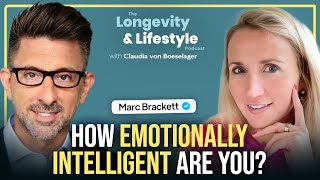
In this Longevity and Lifestyle Podcast interview, Yale professor Marc Brackett, founding director of the Yale Center for Emotional Intelligence, explains emotional intelligence (EI) as the ability to reason about feelings and introduces his RULER framework—Recognizing, Understanding, Labeling, Expressing, Regulating emotions. He describes how RULER is taught in over 5,000 schools across 27 countries, reaching about 4 million children, and shares research showing reduced anxiety and depression, higher academic performance, and better teacher well‑being. Brackett discusses practical self‑awareness tools for adults, such as the Mood Meter, the How We Feel app, and his book Permission to Feel, and offers personal reflection and regulation techniques (e.g., attributing feelings, breathing, reframing, exercise). He outlines how emotions influence attention, memory, decision‑making, relationships, mental health, and performance, and highlights common challenges—lack of surrounding EI, failure mindset, and environmental stressors. The conversation moves to implementing EI at home, in schools, and in workplaces, describing bite‑sized corporate training via his OG LifeLab, pulse‑check surveys, and role‑modeling by leaders. Brackett also mentions future research on mentorship, regulation strategies, and bio‑hacking, and provides resources for listeners (website, social media, virtual book clubs). The interview ends with a call to give oneself and others permission to feel fully.
Chapters
Many other factors involved in anxiety and depression, but I think a big piece of it is not picking up on the little emotions that creep in and not having really good strategies to manage them.
My guest today is Professor Marc Brackett, the founding director of the Yale Center for Emotional Intelligence and a professor at the Yale School of Medicine. Marc has dedicated over 25 years to studying the critical role of emotions and emotional intelligence in various aspects of life, and has delved into the influence of emotions on learning, decision-making, creativity, relationships, health, and performance. Mark authored the bestselling book Permission to Feel, which has been translated into 22 languages, and co-created the award-winning app How We Feel to promote emotional skills and well-being. Please enjoy. Welcome to the Longevity and Lifestyle Podcast, Mark. Such a pleasure to have you on today.
Thank you very much. It's great to be here.
It's a real honor because this is multi-generational. My kids are also big fans in their school of your work as well. So I'm so delighted to be speaking to you today. And we're gonna dig into the topic of emotional intelligence for everyone listening, such an important topic, but some may be more or some less familiar with what exactly is emotional intelligence. So Marc, can you— can we start there? Can you expand on like, what is emotional intelligence? And why is it so important to understand emotions and to transform our lives because of it.
Well, that was a lot right there. So let's start with just kind of what is this thing that we call emotional intelligence? And I think at the simplest level, and I give credit to my mentors, Peter Salovey and Jack Mayer, who were the original theorists. And what they talked about was the ability to reason with and about our feelings. And so that's why it's an intelligence, right? Because it's about our reasoning ability and specifically around emotion. Now, to get more granular, the model that we've been working on here at the Center for Emotional Intelligence at Yale, we call RULER. And so RULER is an acronym for 5 skills. The first is recognizing emotions. So I'm reading your facial expression right now. Are you interested? You know, are you not interested? Are you excited? Are you calm, content, happy? You know, whatever the word is, I'm trying to kind of pick up on the cues in your face, your body language, your vocal tone, your behavior. The U in RULER stands for understanding emotions. So why am I having these feelings? Where are they coming from? What's the psychological difference in terms of anger and disappointment or stress and anxiety? The L is getting really precise with language. So what are the words that I want to use to describe my feelings? If it's anger, is it peeved? Is it irritated? Is it enraged? You know, getting really granular. The E in RULER is expressing emotions, knowing how and when to express emotions with different people across different contexts. And if your audience is very culturally diverse, So understanding those cultural differences, you know, that, you know, in America we do this like firm handshake in some parts of the United States, and then other countries we bow to each other. Some places eye contact means one thing, other places it means something else. So how do you express your feelings in ways that you can communicate them effectively? And then the final skill, which is the one that people think about a lot, and the one I'm writing my next book on, is all about regulation. So what do we do to deal with our feelings? How do we prevent unwanted emotions and reduce the ones that are driving us out of our minds? And, or just maybe for having a good day, how do we savor that positive feeling?
Beautiful. So I'm excited to dig into a few aspects there. And so with this framework, and I think for people listening in different contexts, what's beautiful is that at my children's school, they've been practicing it and learning it. And, you know, for people maybe unfamiliar, there's what they call a mood meter, right, with different colors or different quadrants. And the kids every day check in, how are they feeling, and then they express it. And I love it sometimes. I mean, my— now she's 7, but when she was 4, she was even like, Mommy, I'm feeling a bit discouraged today. I was like, oh, that's a big word. And just expressing that. And, you know, when I was growing up, we didn't— and especially in my household, my mother was an eternal optimist, like, tomorrow's a new day, we don't really need to talk about this, everything's fine, to the detriment of mental health and things that are coming about. Can you talk a bit about the impact you're seeing that your work on emotional intelligence and teaching it is having on transforming people's lives?
I would be delighted. And so, Claudia, what you're referring to is the name of our program, or our approach to social and emotional, which is called RULER, which I'm proud to say is now in 5,000 schools. Across 27 countries, we've reached about 4 million children. So we're feeling really good about that, that reach. And RULER is, it's got different things going for it. First, it teaches adults and children these core principles. Like one of them is the one your mother didn't know, which is that all emotions matter. There's no such thing as a good or a bad emotion. I think that's so important. You know, it's like, no, everything's gonna be fine. It's like, no, things are not fine right now. There's a pandemic. It's really weird. I'm anxious and I don't think you should tell me not to be that way. And who knows what tomorrow's gonna bring? So a core principle is that all emotions are information, they're data. That's one of our core principles. The second is that there are these tools like the Mood Meter that you referred to. And the Mood Meter is a tool that is based in a lot of science that says that how we feel, one way to access that is through building deep self-awareness around A, what's going on in my mind? Do I feel pleasant? Do I feel unpleasant? Do I feel like approaching the day? Do I feel like avoiding the day? And in the Y-axis, it's energy. So do I feel energized or do I feel depleted? And then we take those two axes and create our four quadrants, which is the yellow, the red, the blue, the green. And those represent different feelings. That's upfront. And there are other tools that we have to teach children how to self-regulate, co-regulate, how to take on other people's perspectives. And so now what does the research show? Well, the research shows that schools that adopt these practices, RULER and others, have students who are healthier. They have less depression, less anxiety. They perform better academically. So students have higher grades and they're more focused. They spend more time on task. Teachers, the same, better mental health, better well-being. And then the schools are just generally more pleasant places to be. There's less bullying and more positive interactions among many other things. But those are the core kind of outcomes of our research and other people's research.
Which is such beautiful benefits. I mean, that's sort of win-win-win for everyone involved as well. I'd love to touch on the topic of self-awareness, where it needs to start with as well. And maybe for people listening as adults interested in applying this in their lives, if we're untrained to have that self-awareness, especially in terms of emotions, thinking of adults here, what are some tools and strategies that you recommend people can start with?
Part of the reason why I wrote my book, which is called Permission to Feel, was that we had done all this work in schools and thousands of schools are using RULER, but then there are parents and there are aunts and uncles and there are people who don't have children and there's people whose kids are already gone. And people just, it was like this, I think it was like, it's a concept that people, think they know about when they hear it, but don't really get it. A lot of people think emotional intelligence, for example, is about being charismatic, right? Or having a good personality. It really has nothing to do with your personality. There are people like me who are highly neurotic, emotionally intelligent people, and there are people who are very even-keeled and all fine who are emotionally intelligent. People who are outgoing and emotionally intelligent and people who are shy We want to separate personality from emotional intelligence. Given that, you know, most of us, including myself, didn't have an emotion education.
Myself included. Yeah.
I had the opposite of your upbringing, which was, you know, like, it was more like everything was drama. You know, you lost your— you lost that again. I can't believe it. You know, oh, everybody go nuts. Or, you know, I would— I was a little a little bit of a troublemaker. Who do you think you are? Get to your room. Wait till your father gets home. Like, oh, can't wait for that. And so whether you have the kind of, call it, toxically positive experience where everything's going to be fine, let it go, tomorrow's a better day, or you have the world's coming to an end, it's like everything's drama. Either way, you're not getting the education because there's no, like, actual skills being taught. Yeah. There's no words to teach you about how you're feeling being discussed.
Yeah.
And so it was interesting for me because as a scholar, you know, I write a lot of articles for research and you summarize, like, the theory of emotional intelligence in, like, 3 paragraphs. And then I was challenged with like writing a whole book on this concept. And it really was eye-opening for me to just sit back and like think, okay, so what do we know about perceiving emotions? Like what do we really know? Like firstly, what is self-awareness around emotion perception? What are the barriers to that? How does it vary within individuals, whether it be gender or race or culture? And it was really just eye-opening for me and very satisfying to just like flesh it all out. And then, you know, provide people with a place to go to, to like have their little emotionally intelligent dictionary around these skills. And it's very interesting because there's a lot to contain. For example, among, you know, for self-awareness around emotion perception, You know, I grew up in New Jersey, a very kind of middle-class neighborhood, mostly white people who were kind of Irish Catholic, just for whatever that reason is. And so like, that was my exposure to facial expressions and people and culture, you know? And then at 18, I got involved in, or much earlier, but at 14, I got involved in the martial arts. And then at 18, I got the chance to go to Korea. And I was like, oh my goodness, like, this is a different world, literally. You know, the way people communicate, the way they touch, the way they look at you, and the way they think about emotions. And it was really interesting for me to, you know, recognize that about myself, that I was biased myself. In terms of the way the world operates is through Mark's lens. But Mark's lens is a narrow lens because Mark's lens was from Clifton, New Jersey. Then I moved to New York City. I'm like, oh my God, this is a whole other world. And then I traveled to many other countries. And so your question about self-awareness, it's a big, big, big question. 'Cause then you're never fully self-aware.
Yeah, 'cause of the bias that's there, right? And it's just a life, it's life.
You can't be exposed to everything. And it's sometimes it is, it's a bias. It's not always, you know, a bias that's an intentional kind of negative thing. It's just basically exposure.
Yeah. And even with exposure, there's exposure and there's exposure. I mean, I was speaking to someone else who had an Italian exchange student who came to Texas and was complaining about everything. Had the exposure, but she was like, you know, she didn't like it because the pizza wasn't like they have it in Italy. She was Italian, uh, people were saying her name wrong, like all these different things. So it's being open, I guess, to the exposure and appreciating other perspectives, would you say, as well?
Yeah, definitely. And, you know, honestly, when it comes to being a family member, a manager, a leader, colleague, we got to spend time reflecting. You can't just go, go, go, go, go, which is what we do here in the United States. We just go, go, go, go, go. We don't pause. We don't take a deep breath. We don't sit back. We don't reflect. And I think without that reflection, we're missing a lot of information about ourselves, about our behavior. About our relationships, about our performance and feedback that we might want to get. I'm a big fan of reflection.
I love this topic, Mark. So I'm going to ask you, what does your reflection process look like and what are some of the questions you ask yourself when you are reflecting?
Well, the big one is how am I feeling, right? Of course. But so RULER, where you can actually kind of ask yourself RULER questions. Which are things like, am I pleasant or unpleasant in this moment? What's my energy like? What happened before I entered into this situation? What might be causing my feelings? What am I really feeling? Am I comfortable, like, speaking and talking about my experience? Why might I not be comfortable? What's my strategy for dealing with the feeling? Let's say I'm irritable from something that happened in the morning, and then I have to engage in a meeting. Or read something and give feedback, just pause before I enter into that and say, you know, how are you feeling, Mark? You know, you ready for this? Are you in the right place for this? All those kinds of like reflections I think can be really important.
And let's say you have to go into an important meeting or it's something that you need to get done and you check in with yourself and like, am I ready for this? And the answer comes up as no. Yeah, which is me all the time. So what are practices that you do to overcome it?
Well, one big one is trying to attribute whatever the reason that I'm not ready for the meeting, that language is going to get tricky. One thing that I like to do is attribute the feeling to whatever is kind of getting in the way. And so if I can say, like, if I'm in a meeting with a friend here or a colleague at work, like this happened this morning, actually. And sometimes, you know, we call it like it's direct or indirect. So if it's indirect, it's like, you know, I have two dogs and sometimes I love my dogs, but they sleep in the bed with us and sometimes they're like, you know, licking my face at 5 o'clock in the morning. I'm like, why didn't we crate these dogs? Like, why do we have this the worst habit in the world? I have no sleep. I love these dogs, but it's like, I love that they love me unconditionally, but like, how about at 7 o'clock in the morning or 6:30, not at 5 o'clock. And then I'm tired and then I go to work and I have a meeting and it's like I'm irritable and I'm like giving someone kind of harsh feedback. And I had to be like, Mark, like this has nothing to do with this person. Like they're fine. They're actually doing great work. This is all to do with the fact that you're annoyed that you didn't follow through on creating your dogs and now you have disaster at home. And so that kind of an attribution to its cause is really helpful for everybody. Yeah. So that's a big thing for me is trying to make sure I kind of categorize what I'm feeling and attribute it to the thing. And then I can say, all right, Mark, like, this person is not responsible for fixing your dog problem. You're their colleague, you're their boss. Your job is to be present.
Yeah.
Now that I know that's why I'm irritable, I can take my breath, reappraise, and go. And it really does work. Now, sometimes it happens in the moment where you're with your husband, your wife, your partner, your colleague, and they do something that drives you out of your mind or irritates you or whatever. And then you're like going back and forth about something. And that's harder, right? Because that's, that's like in the moment. You have to be like, all right, Mark, your control issues are really coming out right now. Like they didn't do what you wanted them to do and you're angry about it, but you didn't even ask them to do it. So like, whose problem is it? What I'm getting at, and maybe I sound like I'm a lunatic, I don't know. That's kind of like, because I'm someone who experiences like strong emotions and I'm very kind of all over emotionally, I have to really do this in order to be a role model. I mean, I am the director of the Center for Emotional Intelligence after all.
100%. You need to practice what you preach. But I think there's so many of us, and I mean myself included, and if I have lack of sleep, if my kids are doing something, I need to like check in. As well. So what, what are some of those? Do you count to 10 or count to 10 backwards? You take 3 breaths, some people leave the room, like, what are some of the things you do to actually stop yourself, especially if it's an in-the-moment thing that like you were just saying, so that you don't react in the wrong way?
But it's a place of higher emotional intelligence, you know, because I guess I'm an intellectual, and I hate that term, but that's, I'm an academic. I'm quite cognitive and so that works for me. I mean, I do a lot of things. I'm a really fanatic about exercise and eating healthy. It's just a thing that I really feel strongly about for myself and it makes a difference. So if I'm having a really— I'm just writing and I'm feeling stuck, I'll just go work out or go to the yoga class or take a walk or make a cup of coffee and just sit. But in the moment, which is where you need to regulate oftentimes, and it's the hardest, my go-to strategy, I have one go-to one. I have many, but the one that will save me at the last moment is I actually remind myself that I'm the director of the Center for Emotional Intelligence.
I guess that's your why, right? Use.
And it's a visual that I create because the director of the center is actually someone who is like Yoda, you know, like wise, skillful, not like, you know, someone who just explodes and has no self-regulation. And it just works for me. I'm like, or I do sometimes, like, I'll say the littlest things like, Mark, take the high road. You can get through this, Mark. Come on, take the high road. It's like, yeah, you know, and it works. I mean, these are things that research shows work for sure.
And I think maybe you were given, you know, and brought up in this very emotional surrounding in order to achieve what you've achieved now. Imagine you came from a very harmonious place and you were trying to talk about how to regulate emotions and you didn't have an idea. So clearly this is part of your path.
Yeah, you're making an important point though, Claudia, which is that growing up in kind of all this deep harmony and then when bad things things happen or stressful things happen, you've had no preparation. Yeah, I feel very prepared. Been there.
We have our— we all have our journeys. Exactly.
And now a quick word from our sponsors.
Thank you so much for your support as it helps keep our content free for everyone.
This episode is brought to you by ProLon. If you want the health benefits of fasting, such as healthy aging, weight loss, energy, and mental clarity while still being able to eat, ProLon's fasting-mimicking products are for you. ProLon is the first and only clinically tested, doctor-recommended fasting nutrition program based on over 20 years of research and developed by the Longevity Institute at the University of Southern California in collaboration with 17 other prestigious universities. I'm a fan of the ProLon 5-day fasting nutrition program. It's primarily plant-based, non-GMO food, is shown to rejuvenate your body's cells the same way fasting would, and if done 3 times per year, can reverse your biological age by 2.5 years. Check out Prolon's 5-day fasting nutrition program and subscribe to do the program every 4 months for the best results by going to prolonglife.com. That's P-R-O-L-O-N-L-I-F-E.com. And for you, dear audience, get 20% off with code Claudia20 at checkout today.
And now back to the show. Mark, can you share a bit for people listening and trying to understand a bit better, like how does emotional intelligence impact various aspects of life such as relationships or work performance even, right? And even well-being.
I like to talk about the role of emotions and emotional intelligence in 5 kind of areas of everyday life. The first is attention and memory, you know, like the learning pieces. You know, how we feel drives what we attend to, right? So when we're afraid or feeling fearful, we're not in like, oh, that's interesting. No, we're in, how do I get out of here? Right? That's our brain is like self-protective.
Fight or flight. Yeah.
Yeah. And so how we feel and how we deal with our feelings influences attention and memory. The second is decision-making. You know, we like to think that, you know, we're like perfect decision-makers. Truth is, I have made some pretty bad mistakes.
Everyone has.
That can be like, you know, knowing the research on like, don't go into your stock portfolio when you're anxious, right? And then somehow or another, like, so bad, and you sell it when it's at its low, you know, and then of course it goes back up. So I've learned like, well, I'm not going to that. I'm going to like delegate my retirement to somebody else.. But that's an emotional thing, right? Because the fear response that jumps in and says, you know, I'm going to save what I got. I'm not going to, you know, but it's not very well informed because I'm not a stockbroker or an expert in markets. And then everyday decisions like, do I eat that? Do I not eat that? Do I go to the gym? Do I not go to the gym? Do I say something kind? Do I say something cruel? It's all emotion. The third, which is related to that one, is relationships. I always think about emotions as being signals to approach or avoid. And so how I feel on the inside and how I perceive other people is a signal. It's like, Mark, oh, I don't feel— I don't want to go to work today. Or I see someone who's kind of looking like that and I'm like, stay away from them. They're not going to be nice. That's a signal. The fourth is just mental health, you know, and that, you know, when we have emotions, especially strong ones, and we're not aware of them and we don't know how to deal with them, they oftentimes take over. You know, it's how we have— we get to have anxiety disorders or depression. I mean, many other factors involved in anxiety and depression, but I think a big piece of it is not picking up on the smaller little emotions that are, you know, that creep in and not having really good strategies to manage them. And then the final one I just say is like your performance, you know. You know, where I work, it's a lot of people who are high performers. You know, everybody's got the best grades and the best test scores. They all did great things. But the question is like, how do you deal with feedback? How do you deal with the frustration and disappointment? How do you deal with the thing when someone actually is maybe smarter than you or, you know, gets things done faster than you or has more connections than you have and you're feeling envious or jealous or angry. Can you deal with that? And I feel, and I've seen in my research, that if you can't deal with that aspect of your life, oftentimes you don't achieve the dreams you have.
Because you get in your own way or what's happening?
Yeah, because you feel demoralized from the feedback and you can't bounce back. Or you get so anxious, you know, from the public speaking or something like that, that you don't actually get the chance to share your ideas. Because if you're going to be really creative and successful, and depending on the field you go into, you're going to have to overcome a lot of strong feelings. Like, I always think about it like, I've been rejected a lot in my life. You know, I write papers, they're like, we don't like that paper. Or, you know, some people, you know, rejection is just part of the, you know, schools sometimes were like, we don't want this in our school. Like, you don't want this in your school? Like, who are you? You know, like, you're weird. You're damaging children. And so like, that's separate from like all my knowledge of RULER and all my knowledge of emotional intelligence, right? And my skill at writing curriculum and doing workshops and trainings and keynotes. Like, that's a skill.. But the question is, when I'm doing that keynote and someone says like, you're a blank, or who the blank do you think you are, or this is baloney, do I crumble or do I have the resilience and strategies to deal with it?
And so it's, you need both. And building that resilience muscle, I guess, as well. Speaking of which, like, what would you say in your opinion are the most common challenges individuals face in developing and applying emotional intelligence? And how can they overcome these?
I think some of the larger challenges are that just because you're developing your emotional intelligence doesn't mean everybody around you is developing theirs.
That's a very good point.
Yeah. And so like, you gotta be really careful about that. The second, I think it's more layered than just learning the initial skill. For example, I made a commitment to be my best self. But I fail a lot, you know. And, and, you know, so what's my mindset around my failure? Am I just sort of like, I knew I was going to become my mother and father, you know? Or do I say, you know, Mark, like, what was the reason that you failed? Can you go upstairs, just take a little time and think about it? And so now you need to work on the thing, you know, that got in the way, not just being your best self, but the thing that got in the way of being your best self. It could be something as simple as getting more sleep. Sometimes we need multiple— our strategies are layered.
Yeah, like learning to crate the dogs.
Yeah. Which is never going to happen.
But so the knock-on effect of that.
We're getting blackout curtains. I think that's going to be the new thing.
We try whatever it takes now, but sleep is so important, as everyone in my audience knows as well. I wanted to ask you a question around something I've been digging into over the past year around decision fatigue, the concept that there is a certain amount of decisions we can make in a day. And so we should choose our decisions widely— wisely, sorry. Is there something similar around emotional intelligence? Like, are there certain practices we should have in place so that we can ensure a higher level of emotional intelligence and we, we flex the positive muscle? Versus draining ourselves and then automatically ending up in a more negative emotional intelligence, intelligent place. Does that make sense?
I get where you're going. I'm gonna clean it up a little bit.
Yeah.
I don't think your emotional intelligence changes that quickly, right? So like it's just, it's an intelligence, right? It's gonna be, you know, it'll grow incrementally if you work on it, just like cognitive abilities grow up to a point, right? Yeah. But what happens is that Like life, like I said earlier, when I get up too early and I don't exercise and I eat a crappy breakfast, it's hard to exercise my emotional intelligence, right? So even with all the emotional intelligence in the world, I'll make poor decisions. And I see that happening when I travel. I've gotten much better at this over the last couple of years, but previously I remember there was one time I went, I don't even know where I was going. And I ended up in a hotel that was like in nowhere land America. For me anyway, it was like I didn't know where I was. I was like literally in the middle of nowhere. And I say that because there was no restaurants, there was no place to eat. And I was starving because I had gotten off the flight and gotten a car to go to the place. There was nothing open. I got to the hotel and I remember being wired, tired, turning on the television, watching the news at like midnight, eating a bag of gummy bears.
Right?
That's me. I just caught myself after like half the bag, I'm like, what is happening right now? And it was just, you know, I don't know. I don't eat that kind of stuff in general, but I was like, I was feeling kind of desperate. This was probably not so positive. I was exhausted, tired, and all my habits that I had been working on for years just went like, bye-bye. And so those are moments of like, you know, that's, you know, for me, because, you know, being healthy is important. You know, I had— and I say that because, you know, I had a mom die young of cancer and a father die of heart disease. And, you know, people, my family to not take care of themselves. And so I'm trying not to be obsessive about it so I have a heart attack being so obsessed. But I'm trying to, you know, I want to live a long life and I want to be healthy when I grow old. But, you know, I've learned bad habits and I'm breaking those as I grow older and practicing. And point is, related to your question, is that the skills of emotional intelligence are always going to be expressed in an environment. A personal environment, you know, where if you're like, life is really stressed out and you're in this trip and it's, you know, you're just wired and tired and overwhelmed, or you have all the potential as a child, but you're growing up in a violent neighborhood, you know, and, you know, there's a lot of gun violence or there's a lot of poverty and the, or, you know, or neglect We can't negate the fact that we gotta work on all aspects of the system. If that— I hope that resonates. It's so like, if it's in a workplace, the culture and climate influences your ability to be emotionally intelligent in that environment. In a school setting, right, the culture climate of the school matters, right? How teachers treat each other, how the principal treats this and being in communities. I worked with a school district recently where there was lockdowns because of horrific things happening once or twice a week. Your nervous system will be affected by that, and that's going to make it harder for you to apply the skills of emotional intelligence. So I just want to say this last piece right now, which is that We often put the onus on the individual to figure it out. And I think that's the wrong way to go. We have to collectively work together and create emotionally intelligent communities.
And would you say that starts with the schools and the educators, which then filter onto the—
It starts at home, I think. Yeah, it starts at home from birth. You know, what kind of empathy, compassion, warmth, supportiveness, do you provide that child? Right? Are you cultivating those, you know, the environment where that child can explore? You know, in many ways, reflection is a privilege. Right? You know, because I have the time and space to do that in my life. I didn't have that as a kid. You know, as you may know, you know, I was abused as a child.. And I had horrific abuse and I had, you know, a lot of bullying. And so my reflection was not reflection, it was more survival. And that's not the kind of reflection I'm talking about. You know, I'm talking about the, you know, the space to kind of examine things.
Yeah. And so sorry to hear that, Mark. Yeah. I think for perhaps some, like maybe teenagers or parents with children, where this is all the first time that they're hearing this, and they're like, okay, how can I implement this? Or, you know, how can I bring this into the home but also share this with the school? What are ways that people can, can begin to implement this at home in a home environment, but also, you know, to share with their school to get them to start doing this too?
So a couple things. I mean, the first is, without being a shameless self-promoter, you can read my book, Permission to Feel. It's a great beginning. You can listen to it if you don't like to read. But the other thing that we have also is I had the honor and privilege to work with the co-founder of Pinterest on a new app called How We Feel, which is available for free on iOS and Android.. And it's that Mood Meter tool with 144 words to describe your feelings with 36 research-based strategies to help you regulate your emotions. So go download the app and play with that because it really is a nice accessible way to build emotional self-awareness and healthy regulation. Those are my two recommendations. And then obviously you can read other things. But I do think that before you can start building your skill, you do have to learn a little bit. And some people just don't understand the science. And so I felt it was important to write about the science so that when people are like, I don't think this is important, I'm like, I'm glad you don't think that way now, but read this and maybe I can shift your thinking.
Exactly.
And let's talk about in the workplace. You touched on it before, but how can employers and leaders create an environment that supports and encourages emotional intelligence among employees, or among all employees and leadership as well? And what are some tangible steps that they can do to promote emotional well-being at work?
It's funny you asked that because I've been asked that a lot over the last couple of years, and I, I get invited to do presentations at a lot of these big companies. And then I was like, well, what's next? And I was like, I don't know. And so I started this company called OG LifeLab, which is for the business world. And what we learned in building out our modules for the corporate space was that, A, people don't have time. Nobody wants to go through like the 6-hour, 10-hour, 2-week training. And so what we decided that was going to be helpful, we've now shown that it is, is bite-sized kind of modules, like 10-minute module on why emotions matter, what is emotional intelligence, What is emotional labor at work? So giving people those bite-sized pieces of education. And then the reflection piece is important where they get some coaching to talk about like, well, where have you been living on the Mood Meter and why? And what are your goals? And let's, let's work through your goals.
So if you—
people can go through that training, which I think is really— people love it. We work with companies like Amazon and Kohler and St. Jude's Children's Hospital. The app is a great thing because you can just spread it throughout your organization and then you can actually sharing function where you can see how each other is doing. And then I think importantly, you know, as managers, as leaders, is, I mean, you've got to be one step ahead. I ask myself all the time, you know, how can I be the best possible role model for emotional intelligence? And oftentimes it's fighting the things that I want to do in that moment, right? Because I made a choice to be a leader, to be a manager. Um, it doesn't come naturally to me. What comes naturally to me is like sitting in a coffee shop and writing, you know, that's, you know, or like thinking about a new study and like collecting the data. That's what I love. But I knew I needed an organization to do this work. It wasn't just about me. It was about building a team to help make the world a better place. And so, you know, when you're in that kind of position, selflessness is a big factor. And oftentimes it's like, Mark, you're doing just fine. Like, yeah, you're neurotic, but whatever. Like, what does your team need? How do they feel when they come to work? You know how they feel. And so at our center, we do this. We ask people not only how they feel, we ask them how they want to feel. And then we ask them, well, what would help you to feel those emotions? And things that are reasonable, like getting 20% raise, like, sorry. But what are the realistic, attainable behaviors that we can all do for each other so that we can experience that? So part of the reason why after this recording, I have to go into our cafeteria because today's the first day we're doing our little once-a-month breakfast for everybody. And I have to show up for that because I'm the one— well, it was somebody else who designed it, but that's, uh, something that people felt was important, like just even once a month having a breakfast together.
Yeah. Um, I'm curious to hear what your feedback, um, sessions are for your team. Like, what, what do you talk about and what do you plan? Some companies have like a 360-degree feedback review. Do you guys do like a special emotional review?
I mean, feedback is important. It's a gift. And with the emotion piece that I was just referring to, we do, uh, pulse check-ins. So every quarter We give our staff a survey. We also, we want them to feel valued, appreciated, connected, et cetera. Ask them from 1 to 5, have you been feeling that way? What's working? What would you like to see more? And so it's just a continuous feedback loop of working toward creating the best possible emotional climate for people to work.
Yeah, I mean, again, you have to be the role model in this as well, so.
Yeah, and you have to hear things that you don't wanna hear, you know? Sometimes they wanna see more of you, sometimes they want less of you, you know?
And that's okay.
It's like, that's okay. More of me for what? Less of me for what? Let's talk through it. And you want more autonomy here? That's fantastic. Let's just make sure you're gonna be successful. You know, I think that we're not brought up learning how to listen and be nonjudgmental. And empathic. And so like just taking this, you know, like, oh, I mean, I'm grateful. I go, fabulous that someone wants more autonomy. You know, how do I support you in that? As long as you're going to be successful, I'm fine. And, you know, maybe it's my need to control that needs to be managed as opposed to, you know, anything else. You know, maybe it's— and so I don't want to impede someone else's success because of a need that I have. You know, they have to live their life and I have to support them in their life. And that's what I think leadership and management is about.
Yeah. And that, that, that reflection, like, where is it coming from?
Right.
And the answer is, well, what role does reframing and the concept of reframing play in emotional intelligence and naming emotions? Because we were discussing, you know, childhood and we have childhood beliefs. So sometimes we'll be triggered by something. That's coming from some childhood situation. And so the power of sometimes reframing it, being like, well, you know, taking it from another perspective can be powerful. So what is your view on reframing in order to see emotions from a different perspective?
Yeah, I think it's fantastic. I think it's one of the most well-researched strategies for dealing, you know, with difficult feelings. And there are many forms of it. I use it a lot personally. And part of like, Marc, you're the director of the Center for Emotional Intelligence, is a reframe, right? I'm looking at the situation from the lens of that person as opposed to the person who's been activated in the moment. That is a form of reappraisal or reframing. I think my colleague Robin talks about this, it can be a slippery slope only when you're being manipulated. And so you wanna be mindful, like, are you being forced to reappraise or is this done authentically? Authentically. Yeah. Like if someone is telling you to reframe, like, Mark, you should do this. Or Mark, you're too sensitive. It's like, hmm, I'm not sure it's your job to tell me I'm too sensitive. Yeah. So like, maybe I'm just a nice guy and maybe you're trying to get something out of me, you know, or the reverse. Or someone tells you that you're not a kind person. It's like, well, is this a projection on your part or is this the truth about my behavior? Like, that's where all that reflection comes in and that self-awareness and that kind of like finding those trusted friends for feedback.
Becomes really important. Yeah, and I think also having that reflection time to have— to really know yourself and have that confidence in yourself so that you can see it as a projection versus making it mean something about you, I guess, as well, right? Exactly. Mike, looking ahead, what do you see as the future of emotional intelligence research and its impact on society?
I have my own research right now. I'm trying to learn two things. One is I'm very curious about people who have had or don't have feelings mentors, not academic mentors. I've had mentorship about how to do research, but like the mentorship on kind of emotional intelligence. And then the second is, given that I'm working on another book on regulation, I'm really trying to figure out like what are the top strategies that are helpful for most people? And then kind of are there profiles of strategies that work for different people so that we can have, learn about ourselves and have go-to strategies, whether it be social support, whether it be journaling, whether it be reframing, whether it be breathing, whether it be yoga.
What are the ones that are working the best for the most amount of people? Have you looked into the biohacking space, Mark?
Cool water therapy, heat. Yeah, it is. It's very interesting. I actually do that now. This morning I've been in that cold water for 2 minutes. I was ready to blow my mind. Good for you. And it really does make a difference. So biohacking is all good. I'm not sure it's going to change the way I speak to my partner.
But it's one, you know, like again, we need a repertoire, you know, of strategies. Yes, 100%, a bouquet. Exactly. Yeah. Just before we finish up here, Marc, if you could live to 150 years old in excellent health, how would you spend your time?
Well, I have a feeling talking about emotional intelligence by the time I'm 100 is gonna get a little old. And so if I'm in good health, I really like being in other cultures and countries. So I imagine myself not in big cities, like with traffic, but I imagine myself transporting myself on some magic carpet from a little village in Spain to another village in Italy, to then a little village in Japan and China, and then South America, Central America, and just kind of like observing the world. Beautiful.
That sounds very fun. You can teleport yourself. Mark, for my—
maybe.
Yeah, exactly. Yeah, we are always welcome. Let me know. For people interested in following what you're up to and your work and research, where would you recommend they find you and keep up with you?
I think just going to my personal website, which is marcbrackett.com. Is the best place. And then from there you can learn about the app, my book. You can learn, follow me on Instagram and Twitter. You know, I'm pretty active there. I only use it for the good. And yeah, delighted for people to stay in touch. I run the virtual book clubs over the summer for people to join to learn more about this stuff. They're free. And you know, my hope is that we just get people involved in the work.
So whatever it takes. Beautiful. So we'll link everything in the show notes for people listening. Mark, do you have a final ask or recommendation or any parting thoughts or message for my audience today?
The concept that I've been writing about, which is permission to feel, is something that I don't think we should take lightly. And so My hope is that your listeners will not only give themselves the permission to be their true, full feeling selves, but give everyone they work with, they live with, that permission as well.
Beautiful. Mark, it's been such an honor and pleasure to have you on today. Thank you so much for your time. I know you're dashing to your important team event, so we'll finish up as well. But thank you. Pleasure. And when you finish your next book, I'd love to, to have you, uh, on and we can discuss that as well.
So thank you so much, Mike. Thank you. Good to see you.
More from Claudia









Can Psilocybin Slow Aging? The Study on Telomeres, Inflammation & Survival with Dr. Louise Hecker

