Cliff Auerswald walks through a reverse mortgage example: a 64-year-old with a $340,000 house borrows $50,000, pays $6,100 in closing costs, and owes about $56,000 on day one. At 3.69% interest compounding monthly, the balance could exceed $100,000 in a decade without payments. There are no prepayment penalties.
Chapters
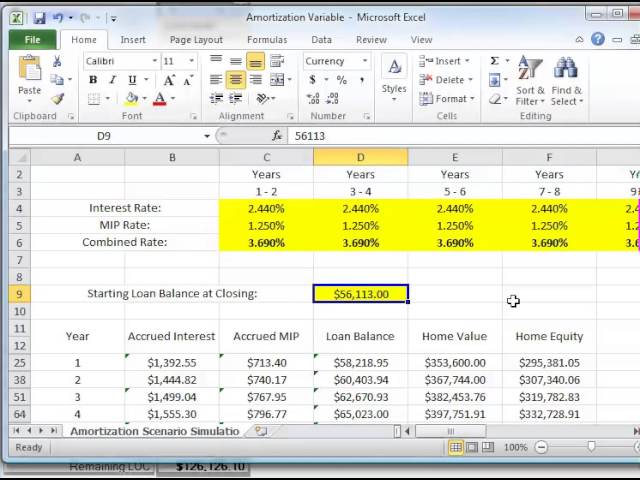
This is Cliff Auerswald with All Reverse Mortgage Company, and today I'm going to be answering a question common actually with some people coming to reverse mortgages for more of a short-term need. And I'm going to outline how the reverse mortgage can fill that, but a lot of times reverse mortgages do come with closing costs, so for extremely short-term solutions, we probably wouldn't recommend it. This potential customer of ours is looking for only $50,000, where a reverse mortgage actually provides much more. You get a percentage based on your age of anywhere between 50, 60, 70% of your appraised value. Just depends on how old you are. And in this case, I have a quote on a $340,000 home and a borrower who who is, uh, 64 years old who qualifies for a maximum line of credit of principal limit of $182,000. Uh, but he's only looking to pull $50,000 for the time being. Uh, unfortunately with reverse mortgages there are closing costs and those are origination fees, there's, uh, title insurance, recording charges, uh, and settlement fees, which escrow, title, appraisal, all those add up. And in this case, we have total finance closing costs of about $6,100. So cost you $6,100 just to access $50,000. Might not be your best bet. Your first thought, I would think, is to go to the bank and get a line of credit there. Oftentimes you get a line of credit for nothing to set up at a bank, but then of course you have to qualify qualify, and then you also have to make payments back. And if you're on a fixed income and you can't really make those payments immediately, uh, the reverse mortgage may be, um, your only option. So in this case, I have a line of credit available, and we're cash advancing from the credit line $50,000 at the closing. So day one on the reverse mortgage, your owing balance would be the $50,000 plus the closing costs of approximately $6,100, and that would come up to $56,000 day 1. And the question my reader has is, how much would his loan balance add up to over time, uh, allow— with the reverse mortgage if you started off by borrowing the $50,000? So day 1, we have an owing balance of $56,000. Which was the initial advance in the closing costs. In each month thereafter, we have to charge the loan balance the note rate. Uh, there's an insurance rate as well of 1.25%. Right now, the total interest charges to the loan balance would be 3.69%. That does include the, uh, note rate and the mortgage insurance rate that FHA charges on this program. So we would take the $56,000 And we would add up those two rates, and you can do a simple calculation and divide by 12 on that interest, and it's going to be about $172 a month to start out with being added to that loan balance. And these loans do compound interest, so if you are just deferring interest on interest, your loan balance will rise, and then that larger loan balance will then be charged interest for that month. So these are compounding negative amortizing loans. Unless you make a payment back, this loan balance will rise over month after month, year after year. So $56,000— the question was how much will he owe year after year, and that's unknown, uh, because interest rates right now— well, interest rates on all credit line type of products, whether it be a line of credit that you go get at the bank or a line of credit on a reverse mortgage, they're all monthly variable rates. And the The reason why they're variable is because the bank does not know what interest rates will be at the time that you choose to borrow your funds. Right now, the current interest rate environment is still very low. We have a 2.4% start rate. Lifetime cap can go as high as 12.4%, which is 10% over the start rate. On this loan, I can make different assumptions. Say year 1 and 2, 3 and 4, we have an increase in rates. Maybe they skyrocket. In a few years from now, and I can show a customer custom amortization schedules showing how much that loan balance may accumulate year after year. This is a— after full 12 months, after full 24 months, and it just keeps going and going. So what cost you $6,000 in closing costs to borrow $50,000 can also add up to even $100,000 over, you 10, 12 years from now if you're not making any payments back. So sometimes this could be a misconception of where people say reverse mortgages cost a lot, but it's really your choice. It's if you're willing to make mortgage payments back, it's not going to cost you as much as if you just defer that interest. It's allowable to make mortgage payments back just like you would with any other type of loan, and anytime you make interest payments back, then you'll have the benefits of the interest tax deduction. And you'll keep your balance from rising. Reverse mortgages carry no prepayment penalties, and the loan can be paid off at any time. Thank you for watching. This is Cliff Auerswald with All Reverse Mortgage Company, 1-800-565-1722.