Reverse Mortgage Rates & Quote Review by All Reverse Mortgage
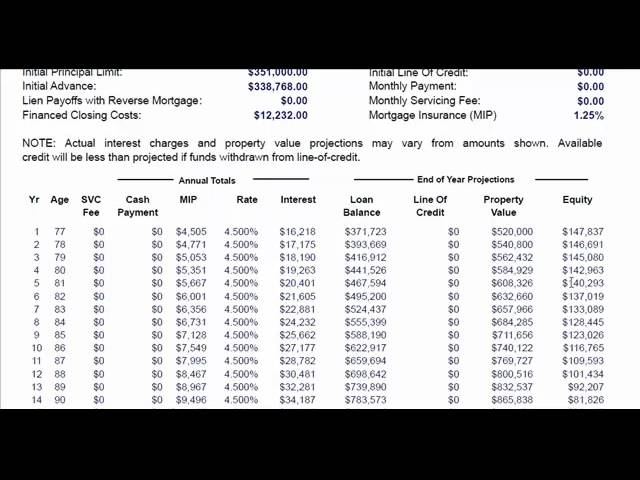
Cliff Auerswald breaks down how to read a reverse mortgage quote, using a $500,000 home example that qualifies for a $351,000 loan. The standard HECM charges 2% mortgage insurance plus closing costs; the newer Saver program costs less but lends less. After five years at 4.5% interest, the loan balance hits $467,000, but the FHA guarantees you never owe more than your home's worth.
Chapters
This is Cliff Auerswald with All Reverse Mortgage Company, and today I am doing a video tutorial about the reverse mortgage quote, how you receive these documents. They're pretty standardized when you're shopping against different reverse mortgage companies or reviewing your different reverse mortgage options. So what I'm including are the 3 main pages which we as an industry all use and have adapted to. This major— this main page is going to look similar to throughout different lenders, and it's really just a summary page. We call this the loan calculator page or loan summary page, and basically what it does is it just outlines the different programs that are available from, you know, in the current market, or different lenders. Brokers use different lending sources to put together a nice array of programs for their customers. Banks usually, they just have their own programs. So it's just good practice to shop around, get a couple different quotes, and see what the differences are being charged you. Some people think that reverse mortgages are all the same, or somehow they have to be because they're federally insured and all of that. And it's true that all reverse mortgages share the same safeguards, but different lenders and different brokers are able to charge their own interest rates, their own margins, their own closing costs. And they're gonna vary from lender to lender and broker to lender. So in this case, I've got a borrower who was born in 1935, and I just plugged in a property value of $500,000. Of course, appraisal would have to be done, but for this purpose, we're just making an assumption. And this— what this is called is the available principal limit. It's a really important factor. This is actually behind the scenes. There's a You know, when the program was created by the FHA, the Federal Housing Administration, they created this calculator that actually spits out results on factors by your age. So the older you are, the more you're gonna get from the program, the higher the factor is. What normal mortgage companies would call that a loan-to-value, we call this the available principal limit, which is on the fixed rates, which is in fact the loan amount itself. So On this case, you're gonna have a loan amount of $351,000, and then you've got the mortgage insurance premium if you choose to go with the program that gives you the most amount of money. If you want the program that is less as far as closing costs are concerned, there's a new, very attractive program that was brought out late last year in 2010, which is called the HECM Saver. And the Saver essentially is the same reverse mortgage, has the same safeguards as the regular program, but it offers a little less money, and for that less money, you also get to save in the closing costs. So some people might think that this is more of a short-term solution, but really, if you don't need as much money as what the regular programs produce, it could be a wiser decision in case you have to sell the house, or maybe you just don't have a need for the amount of money that the standard programs have, you're certainly going to save on the closing costs. And that's something that our industry has evolved to. I think that the high closing costs and fees have been the major objection to taking a reverse mortgage, um, since its inception. And this provides a cost-effective, lower-cost solution for those both on fixed rates and, um, the monthly adjustables, which is the credit line features. Okay, so moving along, you're gonna see, uh, mortgage insurance premium. That's gonna be the same from lender to lender. It's 2% of your property value if you choose to go with the standard program, and it's waived on the Saver option. Origination fees vary. Currently, we don't have to charge any origination fees because these programs are doing very well in the secondary market, so we're actually paid directly from the lenders. So right now, at least, you know, it's always good to go visit our website and get current interest rates. Sometimes these videos get outdated. Right now we charge no lender origination fee, and we have a pretty nice interest rate, probably one of the lowest fixed rates that ever existed in the reverse mortgage market, 4.5%. And then the other closing costs, which is just a summary of all of the third-party fees that you're going to see on any type of mortgage, really. You're talking about, you know, escrow, title insurance, which is for the lender, recording, and, you know, pretty much what people call the junk fees in mortgages. But that's going to vary a little bit from lender to lender, not really too much, because these are true third-party required fees to close a mortgage. And then if you're in a state where, like Florida or, um, Virginia, where there's state taxes, they'll be included in there as well under the other closing costs section. Then the available funds is basically a net figure. So you start off with a loan amount of $351,000, we finance all the closing costs. Typically there's nothing out of pocket except for the appraisal, which gets put on a credit card when you're in the process of a reverse mortgage. Then we finance the mortgage insurance if you are going with this program, or just the third-party fees if not, and you get a net figure of $338,000. And that is the summary of the reverse mortgage loan. The next page you're going to see is, uh, an estimate of closing cost worksheet. This is basically this new Dodd-Frank bill that came out, one regulation after another is just changing the way mortgage originators are disclosing or required to disclose consumers up front. We're not allowed to give a true good faith estimate anymore. So what we have done— and actually we're not allowed to until you actually take the application— but if you're shopping around for interest rates and fees, we have to give you something so you can compare line by line. So what we've given As an industry, we, we have adapted to this, um, this disclosure, which is just an estimated closing cost. It's gonna go line by line. All of these fees are mandatory on the reverse mortgage, with the exception of the counseling fee. If you find an agency that's doing counseling free of charge, this would not be included. Sometimes we just include it in the upfront estimates. No matter what, because we don't know whether you got counseling for free or not at this point. If you just requested a quote off the website, we haven't spoken with you personally yet. So it's good to know that one thing about reverse mortgages is that FHA does not allow for any lender or broker to throw in any possible closing costs that's, that's not real. There's no application fees allowed, there's no processing fees. It really— there's only certain allowable fees And in this case, you know, you've got the mortgage insurance premium or not if you have the saver plan. You have the escrow fee. This is the company that basically puts together the closing. They order the demands if you have a current mortgage for payoff, and they just handle ordering the title policy for the lender. Title policies are a little more expensive on reverse mortgages, mainly because all of these fees are actually based on your appraised value of your home and not actually the loan amount itself. Itself. So sometimes you're gonna think that you may see these to be a little higher than average loans for conventional or forward mortgages, what we call them. But the fees are all based on appraisal, that's why. And last is what we call the amortization schedule. The amortization schedule, I'm gonna show you how this works line by line. This is actually assuming that you took a lump sum program, which is the 4.5%. And what we did is we start off with a beginning mortgage balance of $351,000. And a lot of times I just tell people, really, you know, this equity line over here, I just don't like seeing it. Nobody knows what current property values are gonna do, but I guess if you want to make the assumption that real estate is still gonna, you know, appreciate 4% a year. We can tailor these to different, you know, outlooks if you want to see 2% or none. But really, at the end of the day, the only thing that really matters is the loan balance column, because this is the true loan. This is how much you're gonna owe year after year. So even though reverse mortgages, you're gonna accrue interest on a monthly basis, you're gonna get a monthly statement, you'll always know every month how much interest was added to your balance. We include a yearly outlook so that you can, you know, if you have plans for, you know, selling the home, say, 5, 10 years down the road, or you're moving into a nursing facility, or, you know, whatever your plans may be in the future, it's nice to know how much of a reverse mortgage balance you'd have to pay off in that event if you had to sell the house or refinance. So after, you know, 5 full years of interest, that that mortgage balance that started at $351,000 added up to $467,000. Now at that time, if you sold the house, we use this 4% appreciation. It's just a standard that this industry uses. Then you would net from your sale another $140,000, which would be net equity left in your property. Of course, if your home value is higher than that, it's all your equity. The reverse mortgage is not set on how much able to get. It's just where you use this, this equity column just for illustration. So, and another important aspect of the reverse mortgage is that you can never owe more than the home is worth in a bona fide sale. So if you sell the house and say year 10, or even go down to year 15, that is one large reverse mortgage balance. If your home value did not appreciate at all or some, and you're just upside down, the FHA guarantees you and your heirs that you never owe more than the home value. So no debt can be passed on through the estate. So these columns represent years, yearly figures. So, excuse me, So what you have is you've got an MIP column and you've got an interest rate and interest summary column. So this for the entire year, there's basically every month we, or the servicing company, is going to collect in interest. They're going to add to your loan balance 4.5% on this case in interest, plus the ongoing mortgage insurance premium, which is 1.25%. So it's important to know that all reverse mortgages have an additional 1.25% that gets added to your balance in an interest rate format, really to continue insuring the loan and all the safeguards that the FHA provides consumers and lenders associated with these loans. So on an entire year's worth of interest, that $16,000 you're looking at is basically just 4.5%. That compounded month after month starting from a $351,000 loan balance. And then that $4,500 you see after 12 months, that's actually 1.25% monthly, which totaled $4,500. So you, you take your, you know, all your interest on, on the mortgage insurance and the $16,000 on the, the interest, and you've got a mortgage balance that, that went up to went up in interest by $20,700 after 12 full months. Now you can make payments back on reverse mortgages, and we're actually seeing a lot more customers conscious of that and trying to keep the interest from negatively amortizing so high. You know, if you make partial payments back, it's going to offset this compounding interest quite a bit. Considerably down the years. If you ever want to know how much you want to make as a payment back on your reverse mortgage, then you're just gonna simply add the interest and the mortgage insurance up and divide by 12. So in this case, somebody who took out a reverse mortgage for $351,000 and would like to make interest payments back to stop the interest from accruing would make a payment of around $1,726 is what my calculator says. And at that point, then the loan balance would just remain at the $351,000. And that is how you're going to review a reverse mortgage quote. Now, the amortization schedules are gonna vary. Fixed rates are easy to show because it's a lump sum program. These monthly adjustable programs, the line of credit features, these are very difficult to predict, of course, because it's an open line of credit and nobody knows how much you're gonna borrow and for, you know, at what time and what interest rates you're going to do. These are all monthly adjustable. They're definitely the smarter way to go. It sounds weird to say adjustable rates. Sometimes people have a fear of them, but it's not about the rate, it's about your circumstances. If you have a property that's free and clear, do you need lump sum of $300,000-something, or you can have a credit line that you can access as you go. So the credit line is, is guaranteed, will never be frozen on you, and you only owe as you go. So if you only borrow $50,000 or $100,000, that is what the interest is applied towards, not the $343,000. That's the available line of credit. And on the next video, I'm going to do an amortization schedule that shows a little bit about the line of credit and how it has a guaranteed growth rate. Thank you so much for tuning in. All Reverse Mortgage, www.allrmc.com.