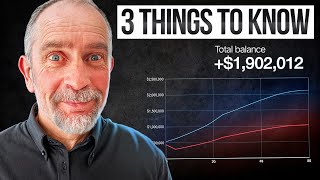
Craig Wear explains why Roth conversions after 75 rarely benefit you directly, but can save heirs 70% of the tax savings through inherited IRA rules. The catch: conversions trigger higher Medicare premiums and Social Security taxes now. Skip them if you have no heirs.
Questions this video answers
Around age 75.
About 30% of benefits go to the client during their lifetime and about 70% go to heirs.
Chapters
Hey, this is Craig again. Welcome back to the channel. So what do you do if you're 75 years old or older and you want to do. You got a big IRA and you want to do Roth conversions. So if you're that IRA millionaire and you're 75 or older, I got a couple of things that I want to mention to you. First of all, congratulations. You've done a great job and I hope you have been enjoying the fruits of your labor for many, many years. And you've got this large Iraq, and the result of that is that it's spitting off some significant required minimum distributions. My guess is that you're watching this video because those RMDs are much more than what you need. They're causing your Medicare premiums to go up and maybe they for years they maybe have been causing your Social Security to be taxed at a higher amount than had you maybe done conversions earlier. The other thing I'll say to you is, you know, it's water under the bridge. So I can't tell you how many people we speak with tell us, gee, I wish I'd have met you 10 years ago or five years ago. That just is what it is. You know, be thankful and grateful that you've got the assets because these truly are first world problems that we're dealing with. Right. But they are problems nonetheless. But let me say this to you. And if you're, if you're 75 or older and you're thinking about doing Roth conversions, there's a couple of things that I think that you should be aware of. The bottom line statement to you that I'll say is that if you do conversions after about 75 years old, and there's no hard stop on that, it needs to be determined for everybody. But generally around that age, there's probably not enough time left in your life span for a financial calculation to be able to prove to you that it was worth it for you to do it to benefit you. There still will be tax savings for you, but I don't think it's going to be enough to offset the cost of doing it. However, if you're really concerned about, gee, what am I going to leave for my kids and my heirs, whoever those are going to be, and what are the how are they going to deal with all this money sitting in a taxable account that they have to take RMDs from? They got to distribute it within 10 years. Anytime they need something, they got to pay taxes. If you're really trying to make sure that you're not. You're not going to leave them with just a mess and force taxation on them, then Roth conversions can make some sense because the net benefit can still be hundreds of thousands of dollars of less taxes in total that everybody's going to pay on the deal. Now, one of the things that I hear people say a lot is I don't care what my kids are going to pay in taxes. If they get anything, it's more than I ever got, and they can just pay the tax on it. And I get that. But at the same time, what you're also saying is I'm okay with the government getting the amount, a bigger amount than what my kids are going to get. I'm okay with the government getting more than what they're entitled to, because I'm just going to kind of put my head in the sand, and I'm not. I'm just going to forget about it. And I don't. I don't mean that in an ugly way, but I'm just trying to catch your attention that that's really what you're saying is that I don't care if the government gets a bunch of it. My kids can just kind of fight with the government over it. What I think you have to realize is that doing conversions after 75 is still important. If it's important to you that your heirs are going to be in a much better position or. Now, I don't mean just financially in terms of how much more money they have. I just mean in terms of how they manage what you've left them and what problems it causes for them. And if your conclusion is, I don't really care, that's their deal, I'm out of here, then fine. But realize that you're probably leaving hundreds of thousands of dollars or more at the doorstep of the IRS that possibly could be more strategically planned leading up to that. I know a lot of our clients that are 75 and older still see enormous benefits over both of their lifetimes. But it's. If the benefits are are X, probably 30% of the benefits go to the client during their lifetimes, and 70% go to the heirs. And yours may be different than that, but to put it into a very quick analogy, you kind of get some idea, there is some benefit to you. But if I were 75 or 80 years old, I wouldn't do conversions. If I didn't have any heirs, I would just leave it alone. But if you do have errors and people important to you, then there's a real reason to take a look at it. You can go to our website@q3adv.com. We've always got webinars going on that you can plug in and kind of learn more and see whether it fits in your case or not. All right, Take care. Have a great day. God bless you.