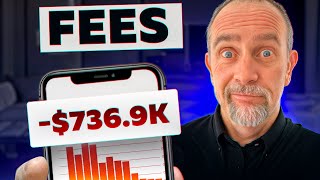
Craig Wear shows how investment fees quietly drain retirement savings. A $1M portfolio earning 7% annually grows to $7.26M with 0.1% fees but only $4.3M with 2% fees by age 95. Hidden costs in funds, advisors, and annuities can cost millions over decades.
Questions this video answers
Session two of three.
7% annual rate of return.
$7.26 million.
$5.7 million.
$4.3 million.
Chapters
Hey there. Welcome back. So this is Craig again. So this is session two of three that I'd like to just kind of share with you some of the three of the biggest risks that there are to your investment portfolio in an attempt to kind of help you protect your retirement wealth. So as I said in the last video, the stock market's up almost 30% last year and it's another huge year for investors, two in a row. But big years like this, as I said, bring their own set of challenges, especially if you have a significant amount of assets that saved. Not that losing money is less important if you have less money, but the numbers are bigger. And so a 10% change is hundreds of thousands of dollars. And it just, it feels more compelling. If nothing else, the percentages are the same, but it feels bigger and it's actually risking a lot more dollars. Today I'm going to walk you through the second of the three big risks that I've identified that I think could quietly undermine your retirement success. If you like just good information and education, I'd appreciate you hit like button, subscribe to the channel, and this kind of stuff will come to you as soon as it kind of comes off of my brain onto the social media stuff that we have available. If you didn't download the free ebook, I'm going to offer it again. But in this one, I'm going to, I'm going to be able to share some specific numbers with you that I think will be enlightening and maybe alarming. All right, so let's kind of jump in. Look, in strong stock market years, emotions run high and hidden fees often go unnoticed. And there's a temptation to even chase performance that kind of creeps into your psyche. And if you're like almost retired or you're, or, or you're already drawing from your ira, you want to avoid these mistakes because they can be very critical if you make one of those mistakes. Just to reiterate, I know a lot of videos that are done by people in our industry, my industry, are designed to convince you to move their money over. And they're just, they're just trying to run their business. And I appreciate, respect that we don't manage client assets. So what I'm trying to give you is purely an educational look kind of behind the curtain to help protect your retirement. All right, so this is a three part series. The first part dealt with emotional, making emotional decisions. And today we're going to hit in the second. And remember, I've had 40 years of watching people and of Advising people, watching clients do well and watch what happens when the relationship goes sour. And normally it goes sour because of investment performance. There was a statistic I saw several years ago that said that 85% of any particular financial advisor's client base would be willing to move to another firm if they found a better way of managing their assets. So that becomes the number one reason why people leave. Sometimes it's founded, other times it's just because people don't understand what the world of investing really has to do with and the patience that you have to have for some of that. But there are reasons that there are times that you need to consider leaving your advisor. And in the E book I provide some information on that. I'm not going to take our time in these videos to do that. So in our last video, we discussed the impact of emotions on making your investment decision making. So the second one is really the hidden cost of fees. So here's a problem. In a year when the s and P500 gains nearly 30%, it's really easy to overlook the fees that you're paying. After all, I mean, everyone's making money. Money, right? So when everybody's making money, everybody's happy, nobody pays attention. But in. But even in those great years, those excessive fees quietly erode the amount that's there for you and your heirs year after year after year. The reason why fees matter more after a big year is that if your portfolio grew by 30%, you might assume, hey, I'm on track. But those hidden either fund fees, advisor costs, or annuity expenses are still taking a slice out of those gains. And when there's a lot of profit there, a lot of gains there, you don't notice the fees as much. But look, I want to share some numbers with you that not everybody kind of calculates and understands or not not really understand, but is enlightened about is look, on a $1 million portfolio, if you're paying a 1% in total fees, all in, that can cost you nearly $2 million of fees. I mean, of gains of growth by age 95, even in years when the market is strong. So here's the impact. On a $1 million portfolio, let's assume that you get a 7% annual rate of return. If you had a fee of 0.1%, that million dollars at age 95 would be worth 7.26 million. When you're 95 years old, if your internal fees are 1%, then the total value at age 95 is $5.7 million. That's a decrease or a loss in value of $1.8 million. If your fees are 2%, counting your advisor fees, your wrap fees, your internal fees to the ETFs, the mutual funds, your value at age 95 is just 4.3 million. So that's a decrease in value of $3.2 million because of the fees that you're paying. So a year like this gives you an opportunity to evaluate. Are the fees eating away at your gains? Just because there were a lot of gains doesn't mean that that those fees aren't taking away from what's going to be there for you later. Are emotions guiding your decisions? Are you chasing returns? Are you taking more risk than you normally would because things have been really good? So look, big market years don't happen every year, right? You know that you've been around the block plenty. But protecting your wealth means locking in some of the progress and avoiding those unnecessary risks and focusing on what really works over the long term. I've got that ebook that I mentioned to you last time. It's a title three biggest risk to your portfolio and three criteria to know if it's time to switch managers. You can get that as a link somewhere underneath here or on a page someplace. I go into a lot more detail, give you a lot more specifics on each three of these and if it's something that you like, download the book and enjoy it. I hope it makes a lot of sense to you. Appreciate you tuning in. Click the like button, subscribe to the channel so that you'll know whenever that comes out. Take care.