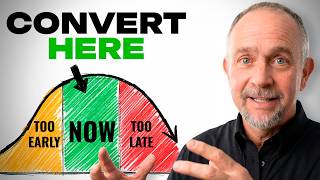
Craig Wear shows when Roth conversions actually save millions. A couple with $1.9 million in IRAs cut their lifetime tax bill by $1.8 million. Three signals matter: over $1 million in tax-deferred accounts, age 59-75 with planning flexibility, and heirs who'll face inheritance taxes.
Chapters
Do Roth conversions actually save you real money, or do they just kind of make you feel smart because you're doing them? So the honest answer is this. They can save you real money, but how much they save depends entirely on you and whether you plan ahead. Let me give you a real example. So we worked with a couple, we'll call them Tom and Karen. They had just over $1.9 million in their IRAs. And on the surface, everything looked fine. Strong savings, no red flags. But. But when we modeled their retirement, they were on track to lose well over $2 million to lifetime income taxes. With the strategy we put in place, they reduced that by $1.8 million. And that's not theory, that's kind of real money. And it happened because they recognized three key signals that told them a strong Roth conversion plan would save them millions of dollars. The scariest thing about Roth conversions isn't doing them wrong. It's finding out too late that you should have. So in this video, I'm going to show you those three signals so you'll know when Roth conversions aren't just a good idea, but can actually save you hundreds of thousands or even millions of dollars. Okay, so first I need to show you something most people don't realize when they set up a tax deferred account. Let's say you get a new phone, you turn it on, you set the language, and just like that, it works. You can make calls, you can send texts, no problem. But after a few days, you notice a few things. The text feels little small, especially when you get to a certain age. Right? The screen is way too bright at night, and notifications keep going off all over the place when you're trying to sleep. Luckily, you can adjust all of that. You make the text bigger, you turn down the brightness, you set the sleep mode. All those things make it work better. The default settings weren't wrong, they just weren't optimized for you. So tax deferred accounts sort of work the same way. They come with default rules, and those rules are set by the irs. The IRS decides what when the money comes out and how much comes out. And it's all based on a percentage of your account balance at the end of every year. So the larger your IRA or 401k, the more you're forced to withdraw and the more you pay in taxes. That's why the first signal a Roth conversion can save you serious money is when you have over a million dollars in tax deferred accounts. Because without a strategy, you're going to Be stuck with default rules instead of designing taxes around your goals. The the second signal shows you how much flexibility you still have. So think about buying tickets for a limited run show. So recently I was in Las Vegas for a business conference. And while we were there, we looked at tickets for wizard of Oz at the Sphere. Early on, seating chart was wide open, great seats everywhere, no urgency. A few weeks later, when we went back to buy, same show, very different options. We could still go, but the experience wasn't the same as if we'd booked earlier. So Roth conversion planning works kind of the same way. Over time, your tax flicks, flexibility declines, required distributions begin, other income starts stacking in. So you still make good decisions. You just have fewer good seats to choose from. We've seen this play out clearly over and over and over. We worked with Mike and Ellen, and separately, Chris and Laura. No relation. Both couples had about $2 million in IRAs and 401ks when they came to us. Both saved significantly on lifetime taxes, but Mike and Ellen avoided about 2.6, where Chris and Laura avoided closer to 1.5 million. What was the difference? Well, the only difference was that Mike and Ellen reached out in their early 60s while they were still working. Chris and Laura had waited until after RMDs had already begun. So if your best planning years are still in front of you, that's your second signal. That Roth conversions can save you hundreds of thousands in taxes. Between roughly age 59 and 75. You still have meaningful flexibility. And even after that, there's still a lot you can do. Which really brings us to the third signal. Even later in life, Roth conversions can still protect your money. When the third signal shows up, think of your IRA and 401k. Maybe like a house that you've inherited. It's a good house, solid, full of history, lots of memories. You move in, you start settling things. Then one day, a pipe bursts, water spreads throughout the walls, the carpet's ruined. Suddenly, what felt like a gift becomes a project. Contractors, insurance calls, decisions that can't wait. The house is still a gift, but now it comes with urgency, costs, and someone else's timeline. That's exactly how inherited retirement accounts work today. Under current rules, your heirs don't get to stretch taxes over their lifetime anymore. They get 10 years. And those 10 years often fall during their highest earning seasons. So instead of leaving a gift, you're leaving a tax schedule that they just can't avoid. So look, if you care about your heir's tax burden, your charitable impact, and maybe how your wealth carries forward. That's your third signal that Roth conversions don't just save you money. They protect the people that you care about most. And if you want to see how this plays out for you, there's a link below to our specialized RMD calculator that will show you exactly that. Okay, now, just because these signals exist doesn't mean Roth conversions will save you millions. Most people hear this, and they go to their cpa, their financial advisor, maybe an AI tool, or even Google. And that's where things start to break down. It's like asking an architect to furnish your living room and an interior designer to build a bridge. Both are talented, both with skill sets, but they're completely different. Most CPAs and advisors only see a handful of Roth conversion cases over their entire careers. Maybe at the best, a few a year. And AI tools will even tell you not to rely on them for decisions like this. That's why we've built our team of Rothologists. This is what we do every day across thousands of scenarios. Roth conversions are powerful all on their own, but they're even more effective when you also know how to pay the taxes intelligently. So if you want to see the smartest way IRA millionaires pay Roth conversion taxes, watch the next video.