Optimizing Your Retirement Income with Roth Conversions
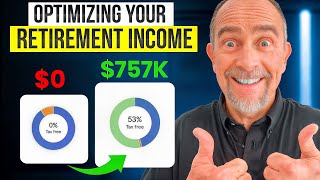
Craig Wear explains how to use Roth conversions to cut lifetime taxes and required minimum distributions. The strategy works best for households with IRAs of $1M or more. You pay conversion taxes upfront, often from brokerage accounts, to move money into a Roth.
Chapters
Okay, Craig, we are here again. So this video is kind of part two of optimizing your income in retirement using different buckets that you have. The first video really talked about a lot of the basic fundamentals of what happens in each. What are the different buckets and what happens when you make withdrawals from each of the buckets. And if that was too elementary, then I hope this steps up a little bit. But I often get notes that people don't understand some concepts. So I try to keep the cookies on the bottom shelf for most of us. And so this one is probably a little bit more advanced, but still probably not at the PhD level of income distribution planning. That happens when you, when somebody knows a lot more about your financial situation. I'm trying to give you general principles and some ideas that have worked for us with a lot of clients over the years. And then you take those, do with what you want. And obviously you can always connect with us. We'd love to schedule a time with one of our advisors to talk to you, but we don't sell financial products. We don't manage clients portfolios. We only provide game plans and strategy and ideas to folks for a fee. So in part one, as I said, we covered the fundamentals and the implications of withdrawals. In this part, I'm going to share some of those ideas on how to use each of the buckets and how to give ideas to improve your strategy. So one of the things that we'll start with is just comparing IRA withdrawals and brokerage account withdrawals. So from a tax efficiency standpoint, the ira, remember, you had it totally tax deferred for all these years. So now you're going to have to pay tax every time you pull money out of it. In brokerage accounts, you either have a pot of money sitting there that's liquid that you're using it to pull out of, that has no tax implications. In that brokerage account, you're experiencing a tax impact each year. So as companies and stocks and funds that you own start paying dividends, those are taxable. If you sell something to buy something else because of a market change or just because of your, your investment advisor does it, it creates a taxable benefit, a taxable income to you. And those are good things because if they create a taxable income means you're making money. But it still is a tax and it still is something that has to be managed. And if you have a larger brokerage account of a million or 5 or 10 or 20, those numbers of taxable income can be really big. And so it's not so much a matter of do I have enough to give me enough income, it's how do I keep Uncle Sam out of my back pocket the best that I can. And of course, along the way with trying to figure out how to do this withdrawal strategy, there's always in the back your mind, what's the impact on my long term financial health if I take money out of this account? Am I going to draw it down too quickly? Are the investments performing the way that they ought to do? I have to manage the investments a little different. All those are things that come into all these different buckets, right? But another consideration is just the flexibility and the access that you might have in these different buckets that you have. If you have all your money in a brokerage account, then you go put it into an annuity. Now your access is limited. You saved a little bit of tax because you're kicking the can down the street a little bit more by putting it into a deferred annuity. But now you can't get to it. And so each of these investment decisions have an impact on what's going to happen in your ability to get income out and what the tax implication is going to be with it. So one way of improving your withdrawal strategy is very significantly, in many ways is to do Roth conversions. Roth Roth conversions can have the impact of significantly enhancing your withdrawal strategy because you reduce those require minimum distributions that are going to come to you. And the way you do that is through converting that IRA to a Roth ira. Now what happens is down the road, you have potentially a lot lower taxes for the rest of your lifetime. You get to pay a little tax. You have to pay a lot of tax on the front end. But in our calculations, if you're a good candidate for Roth conversions, you'll save literally millions of income taxes because of, you're going to dramatically reduce or totally eliminate your required minimum distributions. As you're doing distributions, you want to think about this balancing act of pulling money and where am I going to have it? One of the strategies of doing Roth conversions is just to convert enough of the Roth enough of your Iraq so that the resulting required minimum distributions keep you well below the minimums for your itemized deductions, for maybe charitable contributions, all those kinds of things. So you're going to, you're going to want to really play with turning the dials and trying to really maximize it. And we've just found that people who do massive amounts of Roth conversions over an accelerated time frame give themselves a lot more flexibility of managing those income streams. If, if nothing else, as I said before, if you've got at least a million in an ira, I know that those resulting required distributions are probably going to cause some problems for you down the road. Whether it's immediately or whether it's well into your 70s and early 80s. Those RMDs can, can get pretty significant. If you use Roth conversions to balance out some of your other taxable income and retirement withdrawals, you can better manage staying in lower tax brackets and getting enough income that you need that'll hopefully last for the rest of both your lifetimes. The other thing is, people are normally very reticent to take money from the brokerage account to pay the taxes on doing the conversions. And actually, if you'll draw down some of that money in that brokerage account in order to pay the taxes for the Roth ira, you'll see a multiplying effect of tax benefits. Because now there's not as much in the brokerage account to create the capital gains short and long term, all the dividends. You just move that money and that investment strategy over to your Roth ira. So now maybe where you had a brokerage account that was a few, a million or two, you pull that down by way of paying taxes. And now your Roth IRA is a lot higher. Your regular IRA has gone down significantly. And if you can find just the right balance in there, then what you do is you end up with a life where maybe your RMDs go straight to your charity, your church, through something called qualified qualified charitable donations. Your primary income is, is derived from other sources and you supplement that with Roth IRA money, which is totally tax free. And your brokerage account maybe is just let is just to leave the long term things there that you're going to end up giving to your heirs. And when you die, they get a step up in their cost basis. So now you've kind of beat the tax dragon in a lot of different ways. But people have a tendency to just simply withdraw money from the brokerage, leave the IRA alone because they don't want to pay the taxes. Well, they think, well, my brokerage is liquid, I can get to it. I'm going to only have capital gains tax if I do conversions. I don't want to pay the capital gains tax. Let me ask you something. If you were to do a large IRA conversion to a Roth and you needed $100,000 to pay the taxes, would you rather pay the 100,000 because you sold something and have to pay a 20% capital gain, or would you rather take it from your IRA and have to pay at ordinary income tax rates? So between the two, I'm going to choose paying out of the capital gains tax to make it work. Now, in a, in a perfect world, that's the scenario. We have a lot of clients that, that the only real bucket they have is an ira, and it's a big ira, but they don't have any other books to pull money out of. But never fear, yeah, the Roth conversion strategy will still work out just fine with you. It happens. We see it happen over and over again. So there's this constant question that you have to ask yourself of balancing out, how much do I have in brokerage that's going to create taxable impact? How do I use that to my benefit to lower this IRA and to increase my Roth IRA so that I have enough income? I have income that'll last as long as I need it to last. And I'm doing that at the lowest possible tax that I can over my lifetime, which may mean short term, you pay a lot more tax than on the next several years in order to set yourself up for success for the rest of your life and your spouse and remaining heirs. You know, a lot of our clients come to us and they're really astute with financial stuff. They got all kinds of spreadsheets, they're good at math, understand the fundamentals of a lot of different financial concepts, but they find that having kind of people that specialize in this in their life is a really good thing. We have tools that we use and special training that our advisors go through week after week where we understand a lot of this stuff. And at some point you may decide that you need somebody as a kind of an unbiased third party to give you some advice on it. We know a lot of people come to us and their financial advisors kind of dismiss it, or they tell them just to convert to the top of their current tax bracket. And they don't really see an evaluation of all the different things that are out there. And of course, there's always people in the financial community that have a story to tell, and the story is really just so that they can sell you an annuity or an insurance product or get you to move their money over to them. I don't really trust those. If they're, if they're not doing it independent of a product sale or an expanded relationship, then I personally don't trust that the information that you're going to get is truly fiduciary. And non biased. But you'll figure out when you feel like you need to see somebody that knows that they're talking about this. Let's just kind of recap. So there's. Everybody develops these buckets over their lifetime, the buckets of money. And the real challenge is how to figure out how to get the right strategy. And I've tried to give you just a few little tidbits. If you know, if, if your strategy is totally relying on, well, I'm just going to take it out of the Iraq then unless, unless that IRA is really small, then you're subjecting yourself to a lot more tax over your lifetime than you probably need to. If most of your money is sitting in a large brokerage account, then you don't have a lot of control over your taxes over your income at all. Or you just hold on to stocks over a lifetime and take whatever dividends and then still you don't have any control over paying the tax on the dividends. So a really good way to maximize or optimize your income is through doing accelerated Roth conversions that now give you that third bucket, that's a substantial bucket that can save taxes, that can give you more flexibility in managing your assets, sorry, managing your income. The assets will be the same inside all the buckets. So just think about some of these kinds of things and see how that fits into what you want to have done in your life in the future. There are other videos that we have that you can watch that kind of fill in the gaps on a lot of this stuff. There will be a button underneath this that if you feel like you want to talk to one of our CFPs that focus on this, you can click and then you can request a meeting to have a conversation with somebody. We typically will only work with folks that have around a million dollars in their IRAs. Not because we're being discriminatory, but because we know those are the folks that really need the biggest amount of help or that we can help the most and have the biggest financial impact on. If you've got less than that, then I would get with your financial advisor and ask them to kind of prove to you what is best, what's the best strategy for you. But thanks for watching. I hope this has been good information and we hope to be back soon with even more. So if this is the kind of stuff you like to consume every so often, click the like button, subscribe to the channel and you'll get to know next time the first little tidbits out. So take care. Have a great day. God bless.








