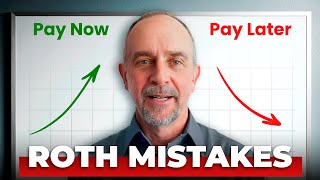
A short educational YouTube talk by Craig (a CFP with 14 years' experience) aimed at savers holding roughly $1M+ in retirement accounts. He lists the five costliest mistakes in Roth IRA conversions: (1) stopping conversions at your current tax bracket, (2) avoiding conversions because of short-term Medicare premium increases, (3) halting due to temporary increases in Social Security taxation, (4) ignoring the tax burden left to heirs under the 10-year inherited IRA rule, and (5) failing to coordinate conversions with charitable and family gifting. Bonus mistake: attempting conversions without a specialist. Emphasis is on front-loading conversions when appropriate, long-term tax outcomes, and coordinating gifting/charitable deductions; concludes with a webinar CTA and subscribe prompt.
Questions this video answers
14 years
Over $8 billion in projected tax payments
2026-01-24
Savers with a million dollars or more in IRAs and 401(k)s
Chapters
A Roth conversion can be one of the best financial decisions you ever make or one of the most expensive mistakes of your lifetime. If you're watching this and you've saved a million dollars or more in IRAs and 401ks, I want you to hear this really clearly. The difference between giving a half a million dollars of unnecessary taxes to the IRS or passing it down to your heirs usually comes down to a handful of very common errors. Errors I see smart, successful people make every single week. Today we're walking through the five costliest mistakes people make in a Roth IRA conversion. Plus, I'm throwing in a bonus mistake at the end that you're going to want to listen to. And if you don't know me, I'm Craig. Over the past 14 years, I've helped IRA millionaires avoid over $8 billion in projected tax payments. Let's start with mistake number one. Stopping at your current tax bracket. This is the most common mistake I see by far. People say, I'll just convert up to the top of my current tax bracket so I don't have to pay much tax. That sounds logical. It feels safe. But usually it's driven by fear not math. Think of taxes like this. When you leave money in an ira, you're not avoiding taxes, you're just postponing them. And for people with at least a million in their IRAs and 401ks, postponing often makes the bill much bigger. What we've seen over and over when moving people through our proprietary software is that people who get the biggest benefit from Roth conversions get usually have to go into a higher tax bracket than they're comfortable with. Not only that, but they need to do it faster than they feel good about. I know, I know. Your financial advisor tells you you make too much money and so you shouldn't do conversions. Or they tell you, nah, just convert to the top of the tax bracket and you trust them. You built a relationship. They've done you a solid in other areas of your life. Unfortunately, in this particular area, they're just wrong. They don't specialize in this. They're a general practitioner. But in this one area, you need a specialist. We've never seen where it was an IRA millionaire's best interest to delay doing conversions or to only stop at the top of their current tax bracket if they were in one of the middle tax brackets. The second mistake is letting Medicare premiums scare you. Now, let me be really clear. Yes, your Medicare premiums are going to go up temporarily. Medicare Part B and Part D Premiums are based on your income. And when you do a Roth conversion, you're intentionally increasing income for a short window. But here's the part people miss. Those extra premiums are usually tiny compared to the taxes you avoid long term. In fact, most of the aggressive conversion plans we run show tens of thousands and often over 100,000 in Medicare premium savings over a lifetime. The mistake most people make is focusing on a few uncomfortable years instead of focusing on the big picture of 20 to 30 years of retirement. People say if I do Roth conversions, more of my Social Security be taxed. That's true, it will be. But again, only for a short period of time. Let's look at it like this. If you have a large ira, that account keeps growing, that's filling up your future required minimum distributions or RMDs bucket. And eventually those RMDs force income on you whether you want it or not. That means higher Medicare premiums, more Social Security being taxed. So at the end of the day, you're going to end up with higher Medicare premiums and Social Security tax anyway, whether you do conversions or not. Aggressive Roth conversions are not creating a problem. They're front running a problem that already exists, allowing you to do it when it's beneficial to you, as opposed to just kind of rolling with the punches. You're choosing when to pay the tax instead of letting the system choose for you. This one doesn't get talked about enough. What kind of tax situation are you leaving behind for your heirs? Under current rules, most heirs have to empty inherited IRAs within 10 years. That means large forced withdrawals, often during the peak of their earning years, often at very high tax rates. So here's a silly visual to drive the point home. Let's say you work your entire life building a beautiful house for your family. Something that would still be a gift to them long after you're gone. But after you pass, the government comes, takes the front door, the windows and the roof. Now, gift is nothing but a shell of a house. It's nothing like what you intended to be your legacy for your family. It is shockingly easy for a third or more of an IRA to end up going to taxes. So without strategic planning, it can turn out to be just a tax nightmare. When money is in a Roth, nobody ever pays taxes on it. Not you, not your kids. Your gift is able to be given exactly as you intended. Doors, windows and all. The fifth mistake is overlooking how Roth conversions can work with charitable giving and family gifting. If you already give the causes that you care about or you like helping kids and grandkids while you're alive. This matters. There are strategies where you can offset a large Roth conversion with a large charitable deduction. It gives you a huge tax deduction. You get the tax benefit now, the charity gets funded over time at your discretion. You've given away the money, but it's sitting in a pot and you can continue to give it over your lifetime. The other thing we found too, which is really different from when I started in the financial planning business, is that baby boomer generation has handled their money very differently than the previous generation. We see many of our clients like to make large gifts to their kids, help them with a house, help them with grandkids, education, take them on big trips. So it's more of a mindset of enjoying the act of giving and watching what it does for the family or the people you care about while you're alive. These decisions should be coordinated with Roth planning, not separated from it. Alright, so here's the bonus mistake. Trying to do all of this without someone who specializes in it. Most financial professionals are generalists. That's not a criticism, it's just reality. Roth conversion strategy is a specialty, and at the end of the day, what concerns me is that most of the people that are out talking to you about Roth conversions, what their real objective is, the way they get paid on it, is by selling you an annuity or selling you a life insurance program. And they've come up with all, all kinds of crafty marketing schemes that tell you they're going to pay the tax for you, or you can become your own bank. And at the end of the day they just want to manage your money or sell you an investment product. Get your strategy first and then go do all these things as they're appropriate to you. If you want to take a huge step toward that strategy, join in our next free webinar in the link below. I think you're going to find it incredibly helpful. All right, let's quickly recap what we've covered. Mistake number one, only converting up to the top of your current tax bracket. It feels safe. But for IRA millionaires, it often creates a much bigger tax bill later. Mistake number letting Medicare premium increases scare you. Those increases are usually temporary. The tax savings are often permanent. Mistake number three, stopping conversions because more of your Social Security might be taxed. If you do nothing, that problem usually shows up anyway. Roth conversions just let you control when it happens. Mistake number four, ignoring the tax burden you're leaving to your heirs without planning a large portion of an IRA can quietly disappear to taxes. Roth money doesn't have that problem. Mistake number five Overlooking charitable and gifting strategies. When coordinated correctly, they can dramatically improve the outcome of a Roth conversion. And the bonus mistake? Trying to do all this without someone who specializes in Roth conversion strategy. The conversion itself is easy. Getting the strategy right is where the value is. Hey, if you found this helpful, let me know in the comments. Make sure you subscribe to the channel so you don't miss videos like this every week. And now that you know know the mistakes to avoid in Roth conversions, you'll want to know how to fully optimize them. You can join me here and find out.