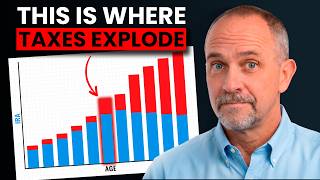
In this video Craig Wear, CFP®, warns high‑balance IRA owners that the IRS’s required minimum distribution (RMD) rules can create a hidden, multi‑million‑dollar tax trap. He uses a tree‑and‑storm analogy to show why a large traditional IRA becomes increasingly vulnerable as it grows, and why waiting until RMDs start can be disastrous. Wear then outlines three proactive strategies for “IRA millionaires”: (1) shrink the IRA early by converting portions to a Roth, thereby reducing the account balance before RMDs begin; (2) deliberately pay higher taxes now to lower the future RMD base and avoid bracket‑gaming pitfalls; and (3) address the broader chain‑reaction of tax issues—including Medicare surcharges, spouse and heir impacts—by planning for the entire lifetime tax outcome rather than just the annual RMD line. He illustrates each strategy with client case studies (David & Carol, Tom & Kathy) that saved $1.8 million and $900 k respectively, and explains how a $2 million IRA could generate $120 k+ in annual taxable RMDs, triggering over $1 million in lifetime taxes. The video ends with a call to use an RMD calculator and watch a follow‑up video on spousal impacts.
Chapters
If you're not planning around your RMDs, you're walking right into the trap the IRS has set for you years ago. Most of my clients worry that RMDs will destroy their savings that they spent decades of their lives building. But just because the IRS laid the trap doesn't mean your savings are doomed. There are 3 strategies for IRA millionaires that make RMDs really a non-issue. So in this video, I'm going to show you what those 3 strategies are, how I've used them to help our clients avoid 6 and even 7 figures in lifetime taxes, and I'm going to walk you through how to implement them yourself so you can stop worrying about the future and go enjoy your retirement. So first, you need to understand what actually makes a large IRA so dangerous. Most people think RMDs are a problem just deal with later. But for people with large IRAs, like $1 million plus, the real danger stays hidden for years before the first required withdrawal ever begins. Because RMDs are only one part of the problem. You see, the real danger actually lives in your IRA itself. You see, your IRA is kind of like a tree. You start by planting a sapling and with care, dedication over time, it grows into a beautiful tall oak. Oak tree. And a lot of people focus on growing the tallest tree possible because a tall tree looks impressive and sturdy. And that's what makes this trap so easy to miss because tall trees may look sturdy, but when a storm comes, it has a different problem than a smaller tree. It catches more wind, it takes more force, and the bigger it gets, the more damage it can do if it falls. So if your IRA is the big tree, RMDs are that storm. And the taller that tree is by the time the storm hits, the more dangerous it becomes. Most people look at that and think the answer is just to hope the storm is not too bad, or wait until it arrives and deal with the damage then. But that's not how you protect a tree. You protect a tree before the storm comes by making sure there's less strain on it, less weight pulling against it. Because when you cut back some of the branches while you still have control, the tree catches less wind and is much less likely to fall over when the storm finally hits. We have some friends in Florida who have this beautiful ficus tree. Every year they have a nursery come in and they get in and they just chop the heck out of the tree. They take a lot of the interior branches branches off, and it's for this reason. It keeps the tree healthier, but in their case, they live right on the intercoastal, and it keeps the wind from just blowing down this beautiful decades-old tree. That's the shift that most people miss with a large IRA, because protecting the account from taxes at all costs might feel smart today, but if that means never trimming it back, then all you're really doing is letting it grow bigger and bigger and more vulnerable. So the first strategy is to shrink the IRA before the IRS forces money out. And with the traditional IRA, that means strategically using Roth conversions to reduce the size of that account before RMDs begin. So that's exactly what we did for David and Carol many years ago. And instead of waiting for RMDs, we started reducing the size of the traditional IRA while they're in their late 50s and early 60s before they even became a problem. That one shift helped reduce their projected lifetime tax bill by $1.8 million. But that strategy comes with its own trap. Most financial advisors will advise against doing Roth conversions because it means you pay more tax. And that's their job. They make make sure you don't pay taxes when you can avoid it. But when it comes to RMDs, that's kind of like painting over a rusty pipe. On the outside, it looks as good as new, but on the inside, corrosion keeps spreading and it won't be long until you're dealing with a big leak. So if all you look at are this year's taxes, then avoiding extra taxable income seems like a smart move. But protecting your IRA from taxes now is also stopping it from getting smaller, which means your future RMDs aren't getting smaller either. And that's where the second strategy comes in. So instead of aiming to stay in your current bracket by strategically moving into higher brackets now, you relieve more of the pressure RMDs cause than if you had just played it safe. And that's the shift that most people miss. Because the goal is not to win the tax bracket game this year. The goal is to reduce the amount of money that's still trapped inside that future forced tax system. So stop trying to win the tax bracket game. Tom and Kathy were actually doing this, but once we showed them the bigger picture, they realized paying some tax now was really a much better trade-off. And that helped them save an additional $900,000 of taxes that were going to be due on their IRAs that were worth about $2 million. So also a quick note, I've actually seen analyses where converting at the client's current tax bracket submitted them to more taxes than if they'd done nothing to convert at all. They simply walked into a nightmare using a totally logical but misinformed strategy, at least for IRA millionaires. So what does that bigger picture actually look like? Well, if someone has $2 million in an IRA and it grows to around $3.2 million by the time RMDs begin, the required withdrawal can easily be over $120,000 a year. That is 6 figures of taxable income that's being forced out of one account every single year. And that's on top of all the other taxable income like Social Security, pensions, capital gains, and that'll bump up your Medicare surcharges as well. So that's how this trap can cost IRA millionaires over $1 million in lifetime taxes. It doesn't just create large forced withdrawals, it triggers a chain reaction of lifetime tax problems that affect your retirement, the surviving spouse, and even your children or other heirs if it's not handled properly. So the third and the biggest strategy is not just aiming for smaller RMDs, but to prevent the chain reaction of tax problems that will show up if you do nothing. Because it's not about reducing one line on a return, the goal is to improve the entire lifetime outcome. For you, for your spouse, and yeah, you can leave them in a terrible position if you don't play your cards right. I'll tell you how to avoid that in just a second. But to get a better idea of what your RMDs will look like, head over to the RMD calculator in the link below, which doesn't just project your numbers, that's easy, but it's going to show you how much you could save in lifetime taxes based on over 2,000 clients we've helped do the same thing. And to find out how much of an impact your IRA could have on your spouse, go watch this next video.