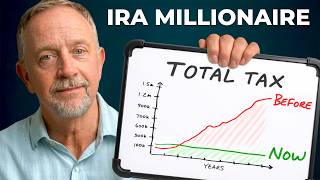
CFP Craig Wear explains why CPAs often miss the bigger picture on Roth conversions for IRA millionaires. Converting large amounts now incurs tax but prevents massive future required minimum distributions that trigger far larger taxes, Social Security taxation, and Medicare premium increases. A couple in his case study went from a projected $2 million tax bill to $800,000 using this strategy.
Chapters
Most IRA millionaires I meet are working with a very good CPA. They're organized, they're careful, they help you minimize taxes every single year, and that's important. But here's the question almost no one asks: are you minimizing this year's taxes or your lifetime taxes? Because those are two very different objectives. Your CPA is trained to solve for one year at a time, maybe the next one. A strategic Roth conversion plan, on the other hand, has to look at decades ahead. And when you zoom out, something surprising happens. Strategies that look conservative, even responsible on this year's return, can quietly increase what you pay over the rest of your life. So in this video, I'm going to show you why that happens and the simple visual that changes how you see your IRA forever. Say you have a glass of water that represents this year's income tax. Every time we do a Roth conversion, we're pouring a shot of water into the glass for the part of your conversion that gets taxed as income. So if that water level in the glass already looks high, adding another shot feels, well, reckless. The level rises quickly and it feels like you're making your tax situation much worse. That's why many CPAs advise against converting when you're already a high tax bracket. The rising water level makes it look like you're losing more and more in taxes. And the next belief makes that fear even worse. So let's draw a line across the middle of the glass. That line represents the next tax bracket. As you pour each shot into the glass, the water gets closer and closer to that line. So when the water is about to hit the line, the instinct is to stop. One more shot feels like stepping into something dangerous. This is why CPAs recommend you stay under the line, because crossing into the next bracket just means that you end up paying even more in taxes. And it's their job to avoid that. So to stay under the line, they give this next piece of advice. Because instead of pouring a full shot into the glass, wouldn't it be smarter to use a tablespoon? Adding a small spoonful of water at the time, the water level barely moves and you can be much more precise. It feels controlled. It feels responsible. And there's no scary risk of suddenly crossing that line into the next bracket. That's why CPAs often advise to convert slowly, spread it out. Their strategy is built around minimizing movement of the water level because that's what causes the fear of paying high taxes. Now, technically, converting more does mean that you're going to pay more taxes, but this is where people trip up. They think hitting a higher tax bracket is like being driven off a cliff, but it's more like walking up steps. Only the portion above the line is taxed at the higher rate, not the entire glass. So instead of letting your fear of the line decide what you do, ask how much of your income would actually sit above it. Now, there's There's one final trick that CPAs like to use to help lower taxes. Instead of adding less water, they look for ways to lower the water level. They harvest losses, increase deductions, they help you adjust income timing, and the water does drop slightly, so you pay less tax. But every client I have this conversation with is surprised to learn that years of careful deduction planning barely makes a dent to what they pay in lifetime taxes. And that's because this whole time, something's been missing from the picture. Until now, we've only looked at the glass, but the glass is tied to something larger. These two jars. When we do a Roth conversion, we move a full cup out of the pre-tax jar and into the Roth jar. And at the same time, we have to pour the shot into the glass. So the more we try to move from the pre-tax jar to the Roth jar, the more the glass fills up. So it seems smart to go slow and prevent taxes and higher brackets. But when you use a tablespoon instead of a cup, only a tiny amount leaves the large jar, but that jar still needs to get taxed. And if we don't choose to tax it now, when required minimum distributions begin, the IRS takes that jar and starts pouring it for you. You don't get to choose the timing. You don't get to choose the amount. The IRS decides how much must come out every single year. And if that jar has continued to grow for 10 or 15 years, the required amount can be far larger than what most people are going to expect. Those forced withdrawals stack on top of Social Security. They stack on top of pensions. They can increase Medicare premiums. And when one spouse passes, the surviving spouse is left with the same size jar, but only one set of tax brackets. That's the loss in control most people never see coming. And so yes, CPAs are right to say that converting more will cause higher taxes now. But when you stop focusing on the glass and start looking at the jars, you actually get to take control over how much you end up getting taxed in the future. And this is what has helped so many of our clients save 6 figures or more of lifetime taxes. Like Joe and Jill, who only paid $800,000 in projected taxes when they would have paid close to $2 million if they'd played it safe. So keep this in mind. Your CPA is trained to prepare returns and minimize this year's tax, and that work is very important. It keeps you compliant, it keeps penalties away, and it protects you today. But when your retirement account holds 7 figures, solving only for the glass leaves a growing tax problem inside the jar. Tax preparation optimizes this year's income tax. Strategic Roth planning maps your lifetime tax exposure so more wealth stays in your control. It maps projected RMDs. It models survivor brackets. It layers in Social Security timing. It stress tests against future tax rate changes. And then it intentionally fills certain brackets now to prevent much larger forced taxation later. So if you're ready to start looking at the jars instead of the glass, I've created a free training specifically for IRA millionaires in which I'm going to walk through how to evaluate your lifetime tax exposure, how to think about Roth conversions strategically instead of annually, and how to regain control over the taxes on your 7-figure IRA. Just click the link below, watch the free training now.