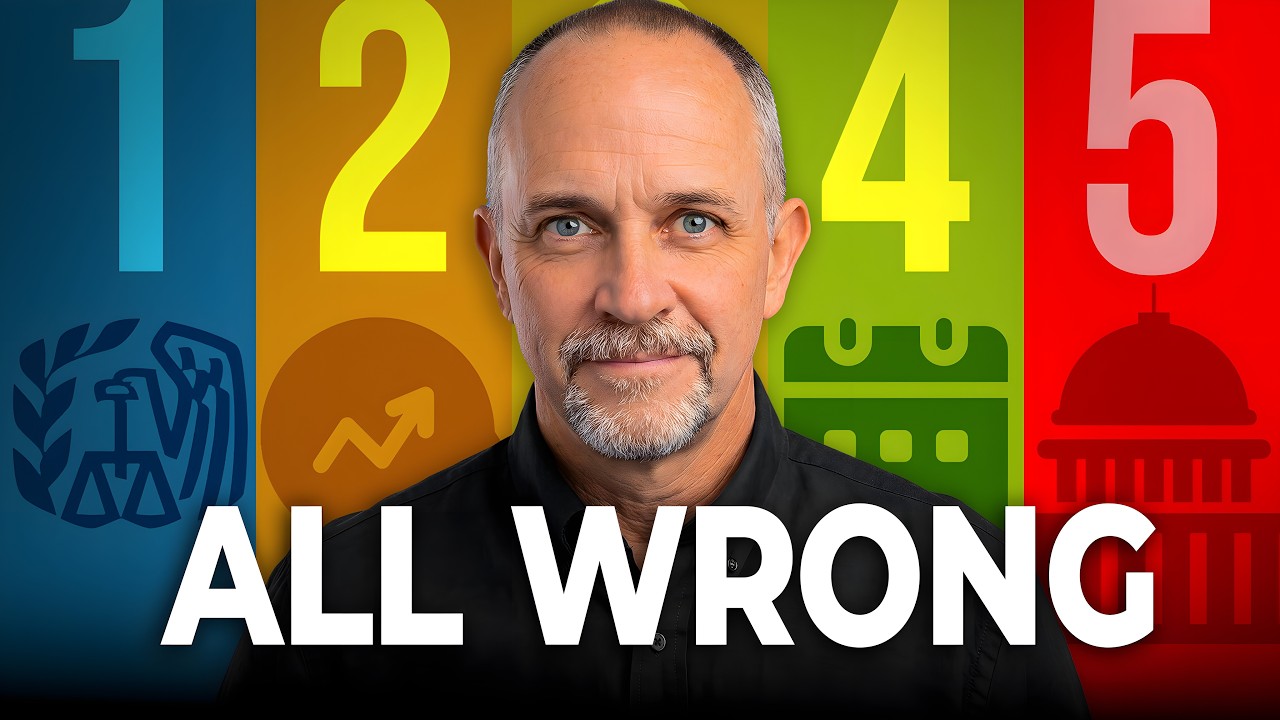
In this video, CFP® Craig Wear outlines the five primary reasons why high‑net‑worth IRA owners—often called “IRA millionaires”—delay or avoid Roth conversions, and he adds two bonus observations about advisor expertise and planning software. The first myth is a psychological aversion to paying taxes now; the second is a perceived opportunity‑cost argument that the money would grow better if left in the pre‑tax IRA. The third concern involves short‑term tax ripple effects such as IRMAA, the 3% Medicare add‑on, and Social Security taxation, which Wear argues should be viewed through a lifetime‑planning lens rather than a year‑by‑year view. The fourth myth is the expectation that retirees will be in a lower tax bracket, which for large IRA balances often fails because required minimum distributions (RMDs) push income into higher brackets and can create a “widow’s tax trap.” The fifth reason is distrust of future legislative changes, despite historical congressional support for Roth accounts. Bonus #1 explains that many financial advisors lack deep Roth‑conversion experience, leading them to advise against conversions even though they excel in other areas. Bonus #2 highlights that mainstream financial‑planning software often omits the specific parameters needed for IRA millionaires, prompting Wear’s team to develop custom tools. Throughout, Wear uses a conversational, persuasive tone, providing a simple numerical illustration to debunk the opportunity‑cost myth and urging viewers to adopt an accelerated, lifetime‑focused Roth conversion strategy.
Chapters
From my experience, there are really 5 main reasons that keep IRA millionaires from protecting their wealth through doing Roth conversions. So in this video, I'm going to give you what I think those 5 are, and I'm going to add a couple of bonuses on the end that I think will really hit home in what you're doing. Look, if you've gotten to the IRA millionaire kind of status, you're in the top 10% of American savers. You've done the right things for a long period of time, and it's worked out. The challenge is when you get to that point, there are reasons why you have to do things different than what somebody maybe that's got a little bit more modest IRA is. You know, we talked to hundreds of people every single week through our CFP®s and through our rothologists. I've asked the team what they think. I've gotten some input on what they hear a lot. And it's really consistent with what I've heard for 16 years now. So here are the big reasons why that may be keeping you from getting all that you can out of Roth conversions. Number one is a lot of people, they just say, look, I just don't want to pay the taxes. I got a great friend right now and that's exactly where he's at. He's got a lot of money in IRAs and he's at a high tax rate and he just psychologically, he just doesn't want to pay the taxes. I get it. But what he doesn't really get and what you may be having a hard time with is just the psychology in all this. So it's not really about if you're going to pay the taxes or not, it's about when you choose to pay them. And by getting an accelerated Roth conversion plan in place, you actually take control over when you pay the tax and how much you pay the tax as opposed to just waiting until your RMDs kick in and then pay whatever the government tells you you have to pay. So that's the first reason. The second reason is, you know, a lot of people that talk to us are do-it-yourself folks, smart people. They understand the concepts. They know the math. They tend to use us anyway. Anyway, but they come to us with the big objection of, look, there's this opportunity cost. If I pay now and I assume nothing else changes, then why would I want to use money today to pay taxes when it could be sitting in my account and growing for all those years? And gosh, that sounds smart. That sounds totally logical. Problem is the math just doesn't work out. Let me give you a quick illustration. So let's say you have $300,000 sitting in your IRA and you could convert it or you could just leave it there. If you leave it there, that $300,000, let's say it doubles from $300,000 to $600,000. Then you pay the tax and let's say the tax rates are 30%. So $600,000 minus the 30% in tax of $180,000 leaves you with $420,000. On the other hand, the other opportunity is that you could take the $300,000, pay the tax now, $90,000. You're left with $210,000. It doubles for 12 years and how much do you have? $420,000. They're the same numbers. So this opportunity cost conversation is really irrelevant in itself. The numbers simply say you're You're holding off for nothing. If you think you're going to be in a huge tax place differently down the road, that still does not validate waiting, but that would be where your mind goes next. I'm going to handle that here in just a minute. So the third reason is that they are really concerned about paying all these higher taxes this year and the ripple effect that it's going to have throughout the rest of their tax return. IRMAA premiums, the 3% add-on tax from having too much income, the tax on your Social Security, all those kinds of things. And I get that and they will, but tax planning isn't something that should be done year by year when you're looking at Roth conversions. And I appreciate my CPA and the people that have helped me do the returns for all over all the years. You know, I do want to pay attention to what's happening this year, but really we're talking about tax planning is a lifetime event. It's one of those things that you plan for what's going to happen over your lifetime. Because when you open the lens and you don't get too focused on this year, what you discover, there's a tremendous amount of tax that you can avoid if you plan for it properly. Okay, so that's 3. Let's go to number 4. A lot of people tell us, look, I'm going to be in a much lower tax bracket in retirement. And so I'm just going to wait. Well, maybe, but it really depends on the size of your IRA. And of course, our message and our niche that we've tried to help for a lot of years is to the IRA millionaires. So if you have a more modest IRA account balance, then probably that would work, right? You maybe can just wait. It'll work out for you. But when you have a larger IRA, all of a sudden your RMDs are probably going to push you up into higher brackets anyway. And gosh, there's so many bullet points I can give you here, but what our research has shown us is for IRA millionaires, the compounding effect of that much money over just a year or two or three is an increase in dollar volume that you cannot overcome with a lower tax rate later. In addition to that, you've got to consider the fact of what happens if you don't do these conversions. What happens when one spouse passes and leaves the other? That's what we call, and the industry calls, the widow's tax trap. So all of a sudden what you find is the remaining heir maybe has less income, but they're taxed at higher brackets because of the difference between married filing joint bracket and tax rates and single payer tax rate. You could easily leave your spouse with an extra 20%, 30%, 40% additional tax in increase in the amount of tax by just waiting. So it's really important not to wait and not to expect that you're going to have a lower bracket later on. The other reason I don't hear as much now as I did a few years ago, but I think it's just generally true that people just don't trust the government. There for a lot of months, we used to hear they're going to tax me now. I'm going to convert to the Roth, pay the tax, and then down the road, they're going to change the law and I'm going to have to pay tax on that, or they're going to confiscate my Roth or something. And look, I get it. We elect 400 and some odd people every so often, and then they get to decide what happens. And for the most part, none of us like what the outcome is. But if you go back and you study the history of Roths and you study how Congress has grown to love Roth IRAs, I think you'll convince yourself that there's very little chance that a Congress is going to come in and do something. I mean, That's like going into the barnyard and killing the golden goose. Congress loves Roth IRAs. It raises all kinds of money for Treasury. They remember back, I don't know, 2010, 2011, you could do massive conversions and they gave you like 2 years to pay the taxes. So you got this tax-free or interest-free loan from the government to go do something pretty significant. I don't know whether that it was consciously done this way, but what it proved to Congress was holy Toledo, this is a huge revenue generator. And then throughout the last 15 years, they passed more and more laws to open opening up the Roth IRA. The SECURE Act made a lot of things more available. And now 2026, you've got these catch-up contributions inside of 401 plans. Those have to go to the Roth account. They're loving it. I mean, for the first time ever, we've now had the government saying, no, this has to go to a Roth. They don't like the deductions. They like the money coming in and paying the taxes. All right. So those are the top 5 that we hear. Now, I promised you a couple bonuses. So let me give you a couple bonuses. Bonus number 1 that we hear a lot is, well, my advisor said that I shouldn't do conversions. And I totally understand that because because they think those same 5 things. They think that is where the standard is. And unfortunately, they're probably really good at what they do in all the other areas that you pay them for, but they don't work with this regularly. And so they haven't been pressed into the corner to have to figure this stuff out, nor have they had thousands and thousands of conversations with people like we have. And they haven't had to go develop those plans, stand behind them. They're in a business of doing something totally different. They're in the business of helping you to manage your money or to get you into financial products that help accomplish things that you do in the future. They don't focus on this area. They maybe do a half a dozen Roth conversions a year. And my perspective is 15 or 16 years of doing this and thousands of clients that we've, that we've already helped and many more times that of iterations to try to find the best outcome for each of those clients. Plus we've had 15,000 conversations with people just like you probably where we've had to think through these things and talk through these things and come up with answers for things. So your advisor's not necessarily bad at what they do. They're probably great at what they do. They We just don't work with this area. No different than going to primary care physician and them telling you that you got a heart problem. And then where do you go next? You go to the cardiologist, right? And so we're that cardiologist in the industry. We don't manage client assets. We don't sell investments. We don't sell financial products. This is the only thing we do and we're really good at it. And we've had a lot of experience in it. So bonus number 2, to kind of round this out, there's a lot of software that's come on the market. There are a lot of software that financial advisors use. In fact, we probably use some of the same software. We have a different pieces of software that we use now that are off the shelf, commercially available for financial planning industry folks. They're standards of the industry. And then there have been a lot of offshoots of people just developing a little product, selling it to you as a public. There's all kinds of stuff that's come in and we regularly look at all of it and see what's out there. We want to be better if we can be better. And what we find is those resources just either lack in maybe a couple of really important details that aren't covered or they lack the specificity and the parameters for the IRA millionaire in mind. And the things that we've learned are different for that. And so we have a whole team of developers that do nothing but help us patch the blank spots or the open areas that all this other software doesn't cover for us. And that's how we know that we come about what we believe is the best opportunity and the best recommendations for our clients. So I get it, there's a lot out there that we got to deal with. I hope these 5 points and your bonus points help you a whole lot in what you're doing. And if you want to get some more information, here's a link below to maybe a little bit more detailed info about maybe how to pay the taxes or what some of the biggest mistakes or the best decisions that people are making right now in the country for Roth conversions. So thanks for listening. Take care. Have a great day.