This Planning Mistake Makes Roth Conversions USELESS
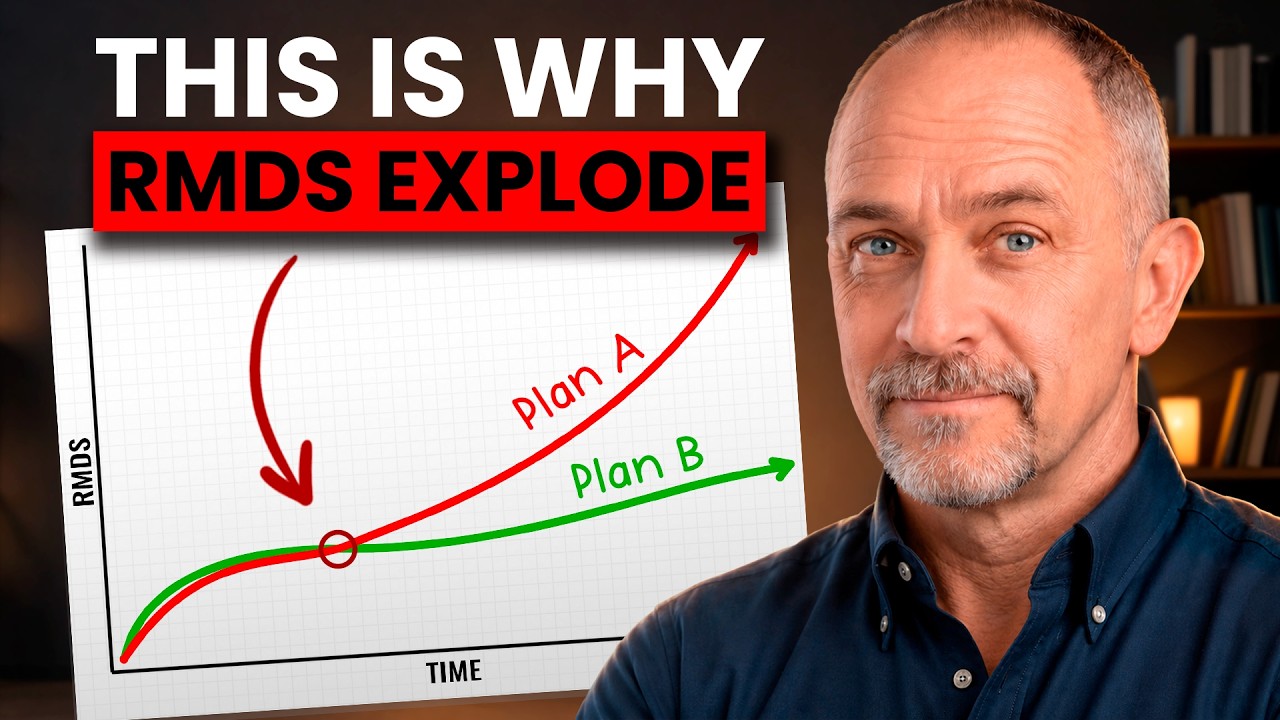
Craig Wear shows how most Roth conversion strategies fail because they lack a clear long-term goal. A couple with a $7 million IRA could avoid over $3 million in taxes by projecting lifetime RMDs and tax burden instead of converting without a destination. Running multiple scenarios beats a single static plan.
Chapters
Hey there, look, about 90% of IRA millionaires who come to us with existing Roth conversion plans are making the same big mistake that make their entire plan useless. And it's not converting too little or starting too late that's the problem. It's something that kind of sneaks through the cracks before they even realize that it's really a problem. So in this video, I'd like to show you what the mistake is, how you can avoid it right away, and I'll even show you how to fix any damage this mistake may have done already to your tax bill. So maybe your conversion plan doesn't end up being useless. To start with, let me show you how the mistake sneaks in through the cracks so you you know what's happening in your plan. Have you ever watched a show called The Amazing Race? So it's kind of one of those reality shows. Let's say you and your spouse or partner are contestants on The Amazing Race, where you have to travel to a location, complete a task, and then you get to the final destination as fast as possible and you compete against other people. Now, there's two ways that we watch people approach the race. Some teams hear the task and the destination and they rush off to try to get there. And that's how a lot of people treat Roth conversions. They know their objective is to reduce their IRA balance to prevent future RMDs, But in The Amazing Race, oftentimes the fastest team doesn't always get to the destination first. Every time they rush the task and they miss the steps, and then they argue about the directions and the detours, and it delays them from really getting to the destination. So when that happens with your Roth conversion, it doesn't just end up costing you time, it costs you money too, because your future tax liability is just going to keep growing. But teams with older contestants, it's interesting, handle that race a little differently. They pace themselves and they figure out the best way to get there and to get where they're going. Position, rushes to the nearest airport in 10 minutes, gets stuck with 3-hour layover, and then they're on a 40-minute bus ride to a totally different airport with a direct flight and they're delayed. So that wisdom around planning is what helped you build that 7-figure IRA in the first place. But that's also why the mistake sneaks through the cracks so easily. So you see in The Amazing Race, the teams get told what their task is and their destination is, and which is what really allows them to plan their route. But that's what most people miss in Roth conversion plans. They think the objective is to finish the task, but doing the task is only partway there to win the race, you also have to get to the destination. And if your conversion plan doesn't get you to the destination, then your plan and even your conversions won't actually save you much money in the long run. So in the case of Roth conversions, your destination isn't just to convert from taxable to post-tax or to broadly have less taxes. That's like saying your destination is Europe, but there's a big difference between going to Europe and ending up somewhere warm like Italy or going to Europe and ending up in frosty Norway. Only by being really specific about your destination can you make sure that your plan, your flights, your the hotel, what you pack, all of that matches your actual destination. You don't want to end up in Norway with flip-flops and summer shirts and a bikini, right? Trust me. So how do you know the destination for your Roth conversion plan? Well, unlike that trip to Europe, picking a destination isn't quite as straightforward, and skipping this step is what causes a lot of people to underconvert. Most people look at their IRA and their current tax bracket and make a decision how much to convert. That's what they hear all over the news. That's what they read in financial press. So that's got to be the right way. But even though your task right now is to convert, your goal is to reduce your lifetime tax bill. Otherwise, you're going to spend your highest leverage years underconverting with your IRA growing, outpacing your plan, and end up leaving your relatives to deal with the tax burden once you're gone. So you don't want your plan focusing on your current tax bill, but on how conversions you do now are going to affect your lifetime tax bill. And that's where the math gets a little complicated because there's a lot of moving parts here that change over time. If you want to skip the math and see if your plan is on track, we have an RMD calculator in the link below, which shows your projected projections based on the real numbers that we've had produced from thousands of clients. To know your destination, we have to project forward and see how your IRA will behave in the coming years. To keep it simple, think about how much your IRA will grow from now until age 73 or 75 or 80. Then look how much the government's going to force out of that every single year once RMDs start. That'll give you a kind of a decent sense of how much it'll end up costing you in taxes if you don't do anything. Let me give you a real-life example. 4 years ago, they started a journey with us. They had just learned about RMDs. And it scared the bejeebers out of them because they had like $7 million in IRAs between them. To give you some idea, that $7 million at their age 65 probably would have grown to say around $10 million or more in a balance, which every year starting age 73 would have generated over $400,000 of taxable income. And that number grows each year as not only as the balance grows, but as the factors that are used to calculate the RMD change as well. And that's just a standard IRS table. Today they reported that the Roth, all The home on its own was worth almost $11 million. All the taxes were paid out of the brokerage account on the side, which still has plenty of money in it. In fact, brokerage account now is probably going to be the biggest source of tax costs from dividends, interest, and capital gains each year, even though they spent and they used out of it to try to avoid that. There's still enough there. It's going to be a problem. Look, your destination should be exactly where they landed. Low taxes over your entire lifetime, not just lower taxes this year. The other big mistake I see people make is to just blindly trust that their plan or to convert the same amount each year, but that just often leads to a slow drift away from what the actual destination is. Look, over time, you're going to want to update your plan with the actual numbers and rerun your projections and make sure that they're still going to get you to your destination, which is the total number of lifetime taxes that you avoid. Obviously watching what your tax-adjusted net worth does over that timeframe. But for most of our actual clients, that number is over $3 million of tax avoidance. And most of our clients don't even have the $7 million IRAs to begin with, like this couple we told you about. And most of them end up with similar or the same or maybe slightly higher tax-adjusted net worth at the end of the game plan. So let's say you've already spent years under converting and suddenly you feel behind. The fix is not to panic convert extra aggressively at this point. Instead, take your conversions into account and run your projections forward based on where you are now. Your destination number is going to be different now, but it'll still give you a strong reference reference point for what your conversion plan is. The RMD calculator I mentioned that's in the description is really a great tool to just start to get an idea. But even with the destination now in place, there's still one big risk of your plan becoming totally useless. Because there's a difference between projecting the future and predicting the future. And while we're great at the first one, sadly, myself and my team still haven't figured out what the second one is. How do we actually predict the future? But that's why when we build an escape plan for a client, we don't run just one projection based on the destination and build a plan on top. That'd be like going all in on a mediocre poker hand. So a plan that looks perfect for a married couple filing joint can look very different if one spouse passes and the survivor is suddenly filing single taxpayer status. And it looks different again when the children inherit the IRA and have to empty it under the 10-year rule. And oftentimes the children are at their peak earning years or they've already retired and now they have their own tax plan set up and dumping all this money in their lap just ruins their tax plan. So instead of running one projection, we run multiple projections of likely scenarios, and we build a conversion plan that realistically keeps your destination number as the final goal. When you're running the numbers yourself, make sure to include projections as a couple, as a surviving spouse, and even as surviving relatives at different ages and how it's going to impact them at different stages of the IRA. Or, to make running numbers easy, head over to the RMD calculator again, link below, and that'll give you at least a projection range based on your actual numbers with all those variables in mind. And once you have your numbers, you can start fine-tuning your plan. And to help with that, I've covered 3 strategies that make RMDs as good as a non-issue in this video right here. So you can watch that next.








