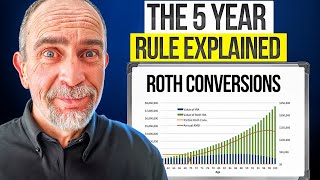
Craig Wear, CFP, breaks down the Roth IRA five-year rule for contributions and conversions. The contribution clock starts January 1 of your first Roth contribution year. Conversions have their own five-year clock, but if you're already 59½, you can access converted principal immediately. Near-retirees should consider accelerated conversions to lower future required distributions and lifetime taxes.
Chapters
Hey, welcome back to the channel. This is Craig Weir again. I hope to give you a couple of good ideas here today. We're going to. I want to clear up some confusion that exists around the subject of the five year rule around Roths. But more importantly, I want to give you a couple of quick tidbits that we give to our clients that maybe can really save you a ton of money. So let's first just kind of get to some fundamentals out of the way. This five year rule for Roth IRAs, it pertains both to contributions and then there's another set of rules that apply to conversions. And it's pretty important in determining when you start being able to start pulling out these tax free withdrawals, which is part of the reason for putting money into Roth to begin with. So let's first, let's take the easy part, which is just Roth IRA contributions and the five year rules around that. And a lot of you probably know all this stuff, so you're probably just hanging on for, okay, what's the tidbits that are so great, but I got to, I got to build the foundation, so just hang with me, we'll get there pretty quickly. The goal is how do we determine when the earnings on the IRA contributions can be withdrawn tax free? Remember, there's two different words I'm going to use here. They're really big and distinctive. Contributions versus conversions. Okay, contributions are when you take money out of your pocket and you put in conversions or when you take existing IRA money and convert it to a Roth. Right. So the clock starts on Your contributions on January 1st of the year in which you make your first contribution to any Roth ira. And this particular rule applies regardless of whether you contribute to the same Roth or multiple Roth IRAs over your lifetime. The requirement for you to be able to get the tax free withdrawals is that you have to meet two conditions. The Roth IRA must be open for five years and you must be at least 59 and a half years old or meet some other conditions which are disability or first time home purchase or that kind of thing. So for example, if you contribute money to a Roth in 2020 during the year, the five year period ends January 1st of 2025, and you can then withdraw all the earnings tax free if you're at least 59 and a half years old or you meet one of these other little qualifying conditions. So now let's talk about Roth conversions and that five year rule. So again, the clock starts each time you make a Roth conversion. It has its own five year clock that starts January 1st of the year you make the conversion. So even if you make the conversion in November of this year, which is 2024, the IRS assumes that that period started January 1st of the year in which you make the conversion. In order to withdraw converted amounts free of tax and penalties, you have to wait at least five years from the conversion year and you have to be 59 and a half years old or meet other qualifying conditions. So one of the things that is not widely known or is people get confused about is that the law says, and part of one of these little qualifying conditions is if you, if you're already 59 and a half years old when you do the conversion, you do have to wait five years to access the earnings off of all those conversions, but you have immediate access to the converted amounts. So if you convert $100,000 this year and you do that each of the next five years, and you're 59 and a half years old when you do it, you have all that half a million dollars all through that time frame. To be able to get access to 100,000 this year, 200,000 next year, 300,000 next year, 400,000 the fourth year, 500,000 next year. The only thing you can't do is take out more than that 500,000, because that would be then earnings. Then you'd have to pay tax on those earnings. But if you put in 100,000 and tomorrow you want to pull out 100,000, there's no tax, no penalty. If you wait a year and a half and you, you've made one conversion and you pull out $120,000, then you have tax on the 20,000. Hopefully that makes sense. But again, if you're already 59 and a half, you got instant access to all the conversions. So a couple of other real quick additional considerations, the withdrawals of your contributions would be kind of important in that the contributions to a Roth IRA can always be withdrawn free of tax and penalty at any time, regardless of a five year rule. Whatever you put in, you can take right back out. Let's talk about the penalties. If you withdraw earnings before you meet these five year requirements and you're not at least 59 and a half, you're going to definitely pay taxes on the earnings and potentially penalties unless you have one of these qualifying exceptions. Now to the meat of what I wanted to talk to you about. One of the things we've learned over a decade and a half of really focusing on Roth conversions and learning about it and applying it with our clients is that if you're nearing retirement, you really want to limit your new contributions to, to a Roth IRA and instead begin doing aggressive, accelerated conversions of your existing IRA money to the Roth. So. And that blows people's minds when I say that. But let's just look. If you could put $25,000 into your Roth 401k account, for example, this year you would take 25,000 of cash flow and at the end of the year you'd have another 25,000 in your Roth IRA. If you took that same $25,000 and you instead used it to pay taxes on converting some of your existing IRA money, and let's say you're in a. I don't know, let's just say you're a 25% tax bracket. To make it easy, you could convert $100,000 of your existing IRA money using that same $25,000 that you were going to put into Roth. Use it to pay the taxes on the conversion. That assumes you had no other money to do anything with. But I do that on purpose to really emphasize the, the reasons why and the value of why you don't want to keep putting more money in there. You want to convert the larger lumps, because converting those larger lumps is what you have to do in order to lower that IRA balance. And the reason you want to lower that IRA or 401k balance in favor of a Roth is, is to get away and get ahead of, I should say, the required minimum distributions that are going to start happening when you're 73 years old. Those RMDs, whether you believe it right now or not, if you have a million or more in your IRA, those RMDs are going to end up causing you a lot of headache and a lot of pain. Our average client saves about $3 million of tax over their lifetime and they got around a million and a half in an ira. That's because all this massive forced requirement of distributions go away as you get your conversions where your 401k balance goes down and your Roth IRA balance goes up. I did another video that you probably should look at that we will put in the references below that talk about how to optimize your income in each of these different by using these different buckets strategically. So I hope these are just some really good tidbits, some great ideas for you just to think about, but the math too. And if we can be of any help, be happy to remember we don't sell products. We don't want to manage your assets. We just like to give people good education like this, and we have a lot of people come to us and actually help us kind of figure out, okay, now how do I. How do I make sense of this? How do I put it all into a game plan? So hopefully this was helpful. Have a great day, have a great rest of the week, and God bless. Take care.