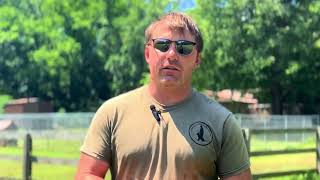
A guide to safe K-9 decoy work covering five essentials: physical conditioning for bite work, sweeping the training area for hazards, removing jewelry and securing hair before gearing up, inspecting bite equipment for damage, and never presenting anything to the dog you don't want bitten.
Chapters
Bang, bang! Welcome to our short set today. We're going to be going over some decoy safety. First and foremost, decoying is, well, in my opinion, the most fun aspect of training dogs. But with that being said, it's also one of the most dangerous and poses the most risk to either the handler, the dog, and especially the decoy and other individuals involved in the training. So we want to be mindful of these aspects to ensure that not only are we happy and safe, but our dogs are as well. So first and foremost, if you're going to get into decoying, you need to be in good physical shape. Includes our physical conditioning and some overall strength. Now, that doesn't mean, you know, you're a big strong guy, you go into the gym and work out a lot, that you'll be able to hold some of these dogs. It's not a stationary weight. It's moving you around, throwing you around, trying to get you to the ground. So having some good upper body strength, some good abdominal strength, is going to be key. Not to say that you can't develop that over time. I tell my students all the time, you will develop some decoy muscles as you go through the course. But we want to ensure that we're in good physical shape and that we can withstand long training sessions with these K-9s, especially during this time in the summer where we're peaking around the 90s here in Georgia. You know, you're going to be expected to wear a lot of equipment. So having that peak physical shape is going to be a real vital aspect to not only the safety of you, but also that dog so that you can get efficient training sets in. So next thing I want to go over before we start any decoying session, any sort of bite work, I want to make sure that I'm sweeping my environment and looking for hazards. So whether that's in a building, I want to look for glass, anything that might fall over that could possibly injure the dog or myself. Um, anything where the dog's leash may get wrapped up on. I want to minimize any sort of risks and hazards to myself and that dog. That being said, as the decoy, anytime that that dog is on the field and you're in that suit or any bite equipment, you are the safety range officer. What that means is if there's anything that is unsafe, you need to be able to recognize it and halt training. So I want to ensure that my environment is conducive to what I'm trying to accomplish, and at the end of that training session, nobody's getting hurt, including that dog. Next, we're going to go over some attire, and we're not even talking about equipment at this point. We're just talking about the attire that we'll be wearing, uh, before we don that bite suit or any other bite equipment. First thing we want to make sure that we do is downgrade. We want to downgrade, meaning any extra equipment that we might have on us, we want to go ahead and take that off. Belts are fine. You could go ahead and leave your belts on, but anything that's in your pockets, any jewelry, watches, you want to go ahead and take those off. Those are not only a hazard to the decoy, but it's also a hazard to the dog as well. If I have something in my pocket and I end up hitting the ground, it could injure me, give me a charley horse, and it could affect our set negatively. On that same realm, that dog ends up biting something hard in my pocket, it could result in some chipped teeth or some sort of mouth injury to that dog. So I want to make sure that I'm downgraded as much as possible. And another thing that we want to take into consideration is our footwear. I want to make sure my shoes have some tread to them. I want to make sure that they're fitted properly. I want to avoid anything that's going to cause me to slip, fall, or trip because that's not going to get me an effective set and it could potentially lead to injuries anytime we're on the ground. Lastly, we want to make sure that if we have any long or excessive hair that we are able to put that up in either some sort of ponytail or a bun to prevent the dog from actually latching onto that so we don't get our hair pulled as well. Next, we want to take into consideration what kind of equipment we're going to be utilizing for that set. So depending on what we're trying to work with the dog, we want to make sure that we have the appropriate type of equipment on. So for example, if I'm working in a dark building or in a dark area, and I might be working dead prey where I'm not placing the dog in a certain area or moving away from them, what I may want to do is either only allow that piece of equipment out for the dog to bite, or I could wear a full suit. So we want to make sure that whatever we're trying to do, we're doing it as safe as possible. Along with that, any equipment that I do use, I want to make sure that I go through a thorough inspection before I even put it on. I want to look through everything and make sure that it's operational. Any holes or anything that may cause some damage, some tears, something that could get caught in the dog's teeth, I want to go ahead and take that out of service and go ahead and utilize something that's going to keep both me and that canine safe. So last but not least, we have our golden rule, which is do not put anything in that dog's mouth that I do not want to get bit. So what does that mean? I'm not going to put any of my exposed areas near that dog's mouth. It's going to result in me getting injured, especially during patrol work. If we're wearing a sleeve, obviously we want to make sure that we're presenting that sleeve and not anything that might be exposed like our hands and our arms, legs, anything of that nature. If you're in the bite suit, though the bite suit is considered the safest way to decoy, we do have a lot of exposed areas on that as well. So we want to make sure we're keeping those exposed areas and only presenting to the dog what we want them to bite and get them targeting those areas properly. All right. So that's our short set for today. I appreciate all of you guys. Have a happy Fourth of July. Make sure you tune in to our podcast on Fridays. And as always, get out there and train. Bang, bang. Go!