Decoy Training | SOURCE
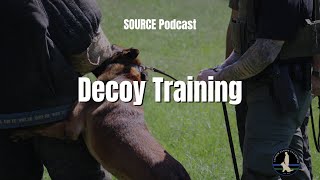
Canine trainer Brandon Martin explains decoy work in bite training, a physically demanding role that goes beyond being a target. The decoy reads the dog's body language, conditions behavior, and watches a dog progress from novice to finished bite dog, while managing risks like dental breaks and jamming.
Chapters
Welcome to the Source Podcast, guys. This is Simon. I'm joined with my wonderful guest and my fellow trainer, uh, Brandon Martin. Brandon, how you doing today?
Hey, good afternoon, Simon. I'm doing great. I can't complain, getting to do some work, getting to do some bite work actually today, which is— brings us to today's podcast and what we'll be talking about today, which is decoying.
That's awesome. Yeah, I mean, I was going to ask you how your course is going. Uh, you're doing a handler course, you got 2 patrol dogs in course right now, and then we got a bomb dog that we're working on as well. Not to mention you graduated 2 last week, so how's all that been going?
It's been good. Um, you know, switching from the trainer side of things, teaching trainer course, to switching to the handler course, you know, is always kind of— it's a little different. Um, but being able to, to work both sides of it is, is super important. And yeah, we graduated some guys last week. They're, they're on their way out doing great things for their communities. And then right now, like you said, I've got two full-service dogs as well, and those guys are— they're Coming along slowly but surely, coming along. And then, uh, the one bomb dog that we're working, um, just working him in constant rotation, trying to get as many reps and sets with him as we can.
Awesome. So as you mentioned, we're going to be talking about decoying, but real quick before we get started on that, I just want to get your perspective and kind of see what you've learned from making that transition and getting to look different look at how we operate here.
Yeah, as you know, um, going from the trainer side of things to the handler side of things is a lot different. Obviously we still handle dogs in the trainer side and we're still constantly working dogs, but it, it, it's just, it's different because you, you're more keyed on what the finished product looks like versus what the getting to that finished product. So essentially you've got dogs that are very close to being finished and then pushing them through to be finished by the end of the course. So it changes up the way that I, the way that I approach training on a weekly and daily basis versus how I would approach it in the training world. And probably my least favorite part is the lack of leash time I get. Kind of sucks. I really do enjoy working dogs, so I I have to kind of take myself back from that. I don't get as much leash time, really don't get any leash time, uh, unless I'm just kind of demonstrating something once or twice. But, um, that would probably be the biggest change for me is not being able to handle dogs. I just want to handle them.
And well, that's, that's really good to hear, and I like hearing that feedback. Um, and I think you need to be well-rounded as a trainer, and I've even kind of stepped aside and I've dove back into the pet world, so I'm getting all that leash time again. And to be honest, I'm really enjoying it because I really get to use a lot of my skills as a trainer, which a lot of it involves problem solving. And I always push— I try and push you guys too. Like, don't get caught up in the working dog stuff because some of your tools start to dull up because, you know, working dogs is easy. So Yeah, I think that I'm at that point where I'm like, hey, I need to get over the pet side and kind of sharpen my tools a little bit. But, um, I just want to put this out there. I'm hitting my buck phase, and I'm in my buck phase of my training career. Um, I'm the best dog trainer there is, and I just want to put that out there to everyone. So there's no one better.
Um, so Cesar Milan over here. Yeah, and, and, you know, kind of watching you take a step back and then seeing you put a lot more of your efforts towards our pet clients, because working dogs is kind of easy. You, you kind of know their background, you kind of know, uh, a little bit more about them. And then people bring in pets who they've rescued or they've had, you know, X amount of issues for Lord knows how long, uh, and it's trying to unbox all those issues and really get to the root of the problem. So you really do have to think outside the box when it comes to some of those pet dogs.
Yeah.
Um, but I have noticed in recent days, maybe even weeks, that your mood has changed a little bit because you're getting to work dogs more and you're getting to be— deal with dogs and not people as much.
Yeah. Well, I still deal with people and, you know, ultimately at the end of the day when we're training, we can't have a bad day. So I'm enjoying it.
No bad day training dogs is, or no day is bad training dogs.
Whatever the heck that meant. Yeah. Good try though. But, well, I'm going to challenge you, Brandon, you know, because you brought up a good point. You're not getting as much leash time. So I think that being in the handler course, this is an ample opportunity for you to focus on your instruction, because ultimately you have to instruct the person that's handling the leash, and that's a vital component of being a trainer. So you have that time, and it's a perfect opportunity to work on that. So take advantage of that time, and I'm gonna— I'm probably gonna throw you into another situation that makes you uncomfortable, but that's just what we're going to keep doing. And it's overall, it's all about your growth and development as a trainer. That being said, you know, let's get into it. Let's talk about decoying. Um, biggest thing that most people ask is, why the heck do you like getting bit by dogs?
And with that, it's probably one of my favorite parts of the working dog world is getting bit. I love decoying. Um, as far as what drew me to it or why I enjoy it, It's kind of, it's a fight, you know, you get in there and you get in that suit and you get to fight with an animal that is, you know, growing and developing, but it's the fight for me that I enjoy. It's the, it's probably the most physically demanding part of our job is being a decoy. And so I really enjoy that. As we've all kind of determined, I'm not the most intelligent human being. But I'm physically gifted in a lot of ways. And so being able to do something that I think that I'm relatively good at, which is in that physical kind of, you know, role, really is what I enjoy as far as decoying goes. And I know that we've had this conversation before. You know, it's one of your favorite things to do when it comes to working dogs because we'll fight over who gets to go in the bite suit from time to time.
Not lately, since I injured my ankle.
Yeah, that's true too.
You've been giving those ones to me, but you know, I'm only doing it just because I want you to get the experience. So, you know, sometimes I gotta step down. Everyone wants me to get in the suit and catch their dogs, and I'm like, no, we need, you know, there's this— we got to get someone else in there, get them that time and that experience.
So it's development, you know, it's development for me just as much as it is for the dogs. Um, but, you know, decoying, like I said, is— and I know one of your favorite things. So what kind of brought you to it? Why do you enjoy it so much?
I mean, I recognize that bite work and patrol work, um, it's almost a dying sort of art within the canine world. I think there's less of a need for it. and because of how tactics are changing, you know, it's something that's slowly dying, but it's something that I, I think one of the best things a trainer that, um, I worked with told me was it's when you're in the decoy suit, you are the trainer. You're intimately engaged in that training set. And something that I've found through decoying is There's no routine to it. It's not a routine whatsoever. And that's what I try and get students to understand. You're not just there. You're not just wearing a dog. Yeah, you're not an inanimate object. You are training that dog while wearing that suit. You give that dog feedback. You put pressure on the dog. You're paying attention to what the dog is doing. And not only that, you're feeling what the dog is doing. And I've never been a stranger to pain. My favorite saying is from the movie Road House with Patrick Swayze, where he says, "Pain don't hurt." And there's always been something exhilarating about getting in the bite suit. And it is sort of a therapy session for me sometimes. Sometimes I just need to rage. And, you know, throughout the day it rises and rises and rises. And let's get in that suit and let's rage a bit so I can release some energy. But, um, yeah, I mean, it's just, it's, it's something that— a tool that I utilize that I've seen a lot of benefits from. And I've learned a lot about canine behavior and, um, just the entire aspect of training just by catching dogs. And I, I love it. I mean, it's fun. Probably a lot of it is for the same reasons that you got into it as well.
So, you know, with, with decoying, like you had mentioned, it's not just an inanimate object wearing a dog while you're in this jacket. There's work that has to be done by that decoy. Um, and so there's a lot more that goes into it. People might see the videos and just like, oh, decoy's just getting bit, when in reality there's, there's a lot that goes into it. The decoys have to be proactive and reactive to what that dog is presenting. So leading into that, what does that look like? What does that entail as far as decoying? You know, you said you're the trainer. What does that look like as far as developing that dog? How does that person wearing that suit continue to grow that dog and not recess in their development?
Yeah, and I think that's an awesome question. Great question, Brandon. I think ultimately, you know, I'm utilizing the principles of conditioning and I'm reading canine body language, right? I'm looking for cues and signals of, you know, what that dog is experiencing. I do what I need to do on my part to get the behavior that I want out of that dog using reinforcement and frustration and other methods, um, and channeling some of those drags from that dog. So like, we like to teach our dogs, we like our dogs to have a full mouth grip, you know. And as a decoy, I'm analyzing what does this dog's mouth look like, what does that grip look like, is this dog comfortable on the bite, what do I need to do to get that dog to be comfortable, and how can I develop that dog even further. It's the most important— being a decoy is the most important aspect of developing a bite dog because if you've taken any of my decoy courses, which Brandon, you will never have, maybe one day. If you've taken any of my decoy courses, you've heard me say, and it's not something that I came up with, I think this is just a saying across the canine industry, so You know, if Maya ends up putting this as a Simon Says, I haven't said it, someone else has said it before me. You can take a good bite dog and make them a great bite dog as a decoy. In that same note, you can take a great bite dog and make them a mediocre bite dog depending on how good of a decoy you are. So that's something that you need to be aware of when you get into that suit and take the time to develop and you know, get the proper instruction necessary to become that decoy that turns good bite dogs into great bite dogs, that takes crappy bite dogs and makes them good bite dogs.
Um, so yeah, you kind of said a little bit about it, uh, while, while you were just explaining that. It's not just wearing a dog, it's reading body language. It's understanding conditioning, it's understanding what, what a dog needs to develop. And so there's— it's, it's almost like it, it is a skill. It is a skill to be a good decoy. It's a skill to be a great decoy. And you kind of mentioned it a little bit, but, you know, as a trainer, what are some key skills that a decoy who is also a trainer should possess or needs to possess in order to continue that dog?
Well, as far as skills go, like I said, you need to understand the basic principles of conditioning. You need to understand the basic principles of canine body language. You know, everything that you do outside of the bite suit also applies to that as well. And then on top of that, I think it's not necessarily a skill, but I think you just need the experience. You need to get exposed to it. You need to see it more often. I think one thing that's really overlooked with people, um, as far as decoying goes is you need to be a freaking athlete. You can't, you know, be smoking a pack a day and going out there and catching dogs. I mean, I knew people in the Marine Corps that could smoke an entire pack and run a 300 PFT like it was nothing. But you know, there was a very select few that I know that could do that. But you need to be in good physical shape. I think that's one of the most important aspects aside from your training principles. I think being a good physical specimen and being able to engage with that dog for a long period of time is going to be important. You see, and They're students, but you know, sometimes they, when they get into this, they don't take that into consideration and you see the fatigue and how fatigue does wear on it. And then it eventually affects the dog. If you're tired and you're not able to apply that training that you're taught, it's going to affect that dog. So I think if you're going to get into decoying, get into some good physical shape. Now, that being said, when you do have a dog on you, this isn't something that you can just go to the gym and train for. When you get that dog on you, it's, it's a, it's a dynamic weight. You know, it's not just sitting there like a bench press or anything like that. It's something that's alive. It's moving. And in a lot of cases, it's heavy and it's strong. So understanding balance and positioning is a vital aspect to that. And Fortunately for me, I was a wrestler, so I know how to manipulate my body, um, having a live body trying to manipulate it as well. So that's— I've seen people that come from those types of backgrounds do very well. But ultimately what it comes down to is that experience and spending that time in the suit and picking up on some of those things of how to manipulate your body to put yourself in successful positions that ultimately lead to the dog becoming successful in what they're doing.
One thing when I came through the trainer course that has stuck with me since, since then was the dog doesn't care that you're tired. Um, and you know, you, like you had mentioned, you see some of these— a lot of times students come through and they're not in the best physical shape. Uh, and so a lot of times they will struggle with bite work. They just get fatigued super quick. And it, like, like you had mentioned, or like I mentioned before, and that you've mentioned in the past, is dog doesn't cause the dog's not tired at that point. And that can, you know, tapping out early essentially can hinder the dog from its growth. Uh, if you're having to pull them off of a bite because you can't do something. And I think that the wrestling background, all the gym muscles in the world, they look good, but they're not as functional as they should be. Gym muscles don't necessarily do you any good in the, in the decoying profession. You know, with that being said, you've kind of mentioned it before, or in your previous, uh, question-answer, some ways that I feel like decoys could better prepare themselves, uh, physically speaking at least. What do you think some other ways that people can kind of prepare themselves physically in order to do bite work? I mean, I personally think the best way to get good at decoying is to decoy.
Yeah, that's pretty much it.
I mean, there's no other way to be There's no— there's not like a whole lot of physical— I mean, yeah, having good cardio is, I feel like, beneficial because it does kind of suck. But, you know, there's not like any kind of physical strength that really matters. You know, I feel like there are women that can— are much smaller than you and I that can still be good decoys. How do you feel about the mental aspect of it? This isn't necessarily something that I feel like I struggle with. I feel like it's just kind of getting in a bite suit. Like, I guess the first time I ever did it, there was probably a little bit of of, you know, anxiety or nervousness, like not knowing what to expect. But after that first one, it was like, all right, this is dope, this is game on, like this is the coolest part of this whole job.
Yeah, I mean, you know, there, there's a lot of anxiety associated with it the first time you do it. I think after that first bite, once you really get a taste of it and you see and you experience it, I think after that it's, you know, Ultimately, whatever your brain is telling you is going to be your reality. So if you take it as, this is the worst thing ever, it's hot, I'm in the suit, I'm sweating, it's— I'm in Georgia during the middle of summer, like, this is awful, um, I'm tired, that, that's what it's going to be. I've found that When it comes to those long sets, because people get tired, it happens. When you get tired and when you are feeling a lot of pain, because yes, you, you do feel pain. Those suits are designed in a way that it minimizes it, but you get a hard biting dog out there and they get a really good grip on you, you're going to feel it. I think it's all about how you set that mindset during those sets that's really going to help you push through and persevere. Like I said, you— whatever you are thinking in your head is going to be the reality. And the way that I look at it is no matter how tired I am, how much pain I'm in, at the end of the day, I'm looking at what that end goal is and what I want to accomplish with this dog. Because this dog is going to be responsible, more likely than not, for an individual's well-being. And I want to prepare that dog as best as possible through my abilities to ensure that when, at the end of the day, when they're done, or when they deploy together, that they make it back home together to their family. And I think that's what really helps. It helps put it into perspective, but it helps me persevere those tough moments. But I mean, what about you on your end going into a bite session?
Like I said, first time you ever do it, there's probably a little nerves, a little anxiety, not knowing what to expect. And, and you kind of mentioned, you know, it's not always the most comfortable feeling for you as a decoy. Uh, you— there is a little bit of pain sometimes involved. Um, but the way that I kind of look at it, uh, from a— from, from my perspective is I'm just a big chew toy for a dog. And now I know that we kind of talked previously about not just being a chew toy, like obviously you got to be reactive and, and work the dog, but For me, it is— it's more along the lines of like exactly that. I'm getting to work with a dog and I'm just on the receiving end of, of a bite. I'm safe, I'm protected for the most part. And so for me, it's just the fact of like I just get to be a big chew toy is the kind of the way that like mentally I prepare myself. Like, it doesn't suck. And kind of to your point, it's gonna suck if you think it's gonna suck. And it's enjoyable when you, when you put your mind to the, the idea that you're developing something that has a much bigger picture.
Yeah.
Um, and so for me, it's, it's just kind of enjoying the moment. Like, not a lot of people get to do this, and I personally think that I'm blessed to be able to, to work in this, you know, industry and, and do those kind of things. Uh, so it's just having a good outlook on it really is the way that I look at it. Uh, you'll see people come through our courses and things like that where from day 1 of bite work they're, they're all amped up, they're anxious, and they don't want to do it. And that a lot of times that carries throughout their whole course. They'll be the last ones to volunteer to get in the bite suit, things like that. And then you've got students who freaking love it and they come through and have like this high expectation of it, and that carries on as well.
Um, so kind of to your point as well, I think a lot of the times when I'm in that suit, you know, I'm just fighting clowns, rapists, and pedophiles. I heard Joe Rogan say that one time about being like on the treadmill. He's like, I'm fighting clowns, rapists, and pedophiles, murderers, um, robbers. Yeah, gang stalkers.
Um, I mean, that is kind of the end goal, right?
Like, I'm fighting the bad people. I am Batman.
I'm sorry, you, uh, you kind of mentioned a little bit of it, or we both mentioned a little bit of the pain aspect of it. There is a little bit of uncomfortableness, uh, from time to time. But, uh, what, what are some things that we can kind of do to mitigate risks mitigate injuries, things like that while decoying?
Yeah, that's— I'm glad you brought that up because there is a huge safety aspect of it. I think— I don't know the exact data on it, but I'd probably say, you know, from my experience, where I've seen the most injuries occur to not only trainers but also dogs is decoy work or patrol work, bite work. And I think ultimately where you need to start out with is setting up the environment, right? You need to look over the environment, set up your scenarios, look at any risks or possible hazards and remove those or mitigate them as much as possible. The second part of that is I want to ensure that I select the right equipment for what I'm trying to do. Say if I'm doing a scenario where I'm doing dead prey in a dark freaking room where I can't even see the dog and I'm going to be laying somewhere and I— my whole body is going to be exposed. Obviously, I don't want to do a hidden sleeve. I mean, you can, but I'm looking at that. I want to make sure that what I'm trying to accomplish with the training, I'm wearing the equipment that's appropriate for it, that's going to mitigate those risks. And then ultimately as the decoy, and you know what, those Army cats over at Fort Leavenworth saw one of my short sets and they were giving me crap about this. You, as a decoy, you are responsible for the safety. That decoy needs to be vigilant of what's going on on that field or that training environment. And if there are any hazards, they need to cease that training and make sure that nobody's getting hurt. Just like when we take the dog off the field, that decoy doesn't get out of that suit until that dog is put up and secured to ensure that nobody else is getting hurt. Because that dog comes loose, who's going to be responsible for making sure everyone's safe?
Well, if nobody's in a suit, somebody's getting bit.
Yeah. So our decoys need to be responsible for that. So be— as a decoy, make sure that you're vigilant and you're there to stop anything if it becomes unsafe, right? Risk mitigation is important. Absolutely.
One of the, I think, biggest injuries to dogs in bite work— well, one of two— is, is teeth being broken and jamming dogs up. I think that— would you agree that those are probably two of the bigger injuries that happens? From time to time, a dog's foot will get stepped on and stuff like that.
Yeah, I mean, definitely the dental. As far as jamming dogs, I've never jammed a dog. Yeah, I'm the best there ever was. But dental injuries is definitely probably like the number one thing that I see, and part of that is related absolutely too jamming a dog, you know, you run the risk of the dog breaking its tooth. So those are definitely some big ones other than maybe the dog falling or something like that. I've seen some scary situations where the dog gets caught under the decoy, but fortunately we haven't had anything too serious on that end. But yeah, those two definitely are. And a lot of that comes down to, you know, how we're catching those dogs and making sure that we're utilizing the correct techniques to ensure that our bite work training is being done in a safe manner.
Yeah, I think ultimately just learning how to properly catch a dog is going to mitigate a lot of injuries to a dog. I think that that one's pretty simple. Understanding how to remove the dog is going to help with some of that dental stuff as well. I have seen it personally where people try to just yank the dog off of the bite, and I feel like that could be a cause of some dental issues. I personally haven't seen a whole lot of injuries that come from bite work. Don't put anything in the dog's mouth that you don't want bit, I think would be a good, good topic. And I know you kind of mentioned a little bit of like a passive decoy in a dark room. Wearing a hidden sleeve. Well, if you're passive, you shouldn't be moving, and then you now have to potentially try and throw your arm into that dog's mouth when in reality you could have mitigated that risk by just wearing a full suit.
Yeah. Or I mean, there's cases and like, you know, that was just an example, but obviously if I'm hiding somewhere where I can just leave the area that I want bit exposed and everything else is protected, protected, I can absolutely do that. There's just a lot of scenarios. You just want to make sure that you set it up the right way, right? Because one thing as a trainer that I think a lot of people lose sight of is no matter what you're doing in regards to training, you get to set up that environment to get the results that you want. And I think even if that's detection or just behavior modification. Setting up that environment is something that's really overlooked, and at times that's something that we need to do, and that's a big, big aspect. And especially with decoying, like, you, you need to set up that environment oftentimes, and it carries over into that risk management just because of the nature of what we're doing. So let me ask you, Brandon, so far in your K9 training career, In regards to just decoying, what's been your most rewarding experience?
Like a specific time that I was like, wow, this is freaking great. I think one of the kind of the most proud moments that I have had as far as decoying is I did a dog for a local department where I did the majority of the training and I didn't even get to decoy for him that much.
Which was actually done by Keely Hill, one of our most impressive trainers, and shout out Keely.
Yeah, she did all— she did probably 99% of the decoying for that dog. But with that being said, the most rewarding or most fulfilling moment while training that dog or working with that dog specifically is, is doing building searches with him and getting to catch him as a decoy, being the decoy for that dog, uh, and just seeing how far from when I got him to when I was then eventually catching him, how far he had come, and just the simple tasks like area searches, things like that. But just seeing how far he had come, developed. There was times where I did catch him from time to time, but just seeing how much better he had gotten over that time.
Yeah.
From when I got him to when I finally got to catch him as a finished dog. I think for me, that was the most rewarding experience I've had as far as decoying goes.
I think that is really awesome, is seeing that progression. And seeing how far it goes and reaching the full capabilities of that dog. I think that's— I mean, that's why we're in this business is like getting a dog and getting to mold it and having it reach its full potential. That's one of the coolest things ever. So that was really good, Brandon. So thanks for joining us, guys, on our Source podcast. Make sure you tune into our short sets. Follow us on all the social medias, whatever you like doing on your phone, and obviously catch us again. If you got any comments, questions, concerns, go ahead, reach out to us, leave a comment, Facebook, YouTube, whatever you want to do, harass us. We'll be happy to answer some of your questions on a later date.
With that being said, before we close out, We have a decoys course coming up, don't we?
That is true.
And you know, if you are interested in learning how to decoy for bite dogs, decoy— our next decoy course starts October 14th. That is a week long, correct?
Yes, it is a week long. It is 5 days with me. I'm going to put you through the meat grinder. You're going to come out a different person at the end.
And that'll be it, folks. Thanks for joining us.
Go!
More from AJ

Running vehicles with K9 Chidori#workingdog #detectiondog #workingmalinois #malinois #drugdetection



Join us for group training this Saturday! Sign up on our website. #DogTrainer #DogGrooming

Smart Funding Ideas to Launch Your Dream Dog Business | Custom Canine Unlimited



Why is my dog reactive? #reactivity #dogreactivity #k9 #dogtrainer #dogtraining

It’s not too late to sign up for Group Training! | #dogtrainer #dogtraining #trainyourdog


K9 STEVE | Explosives Detection 💣#workingdog #policek9 #detectiondog #edd #trainyourdog