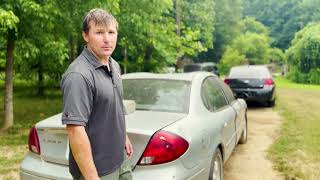
A narcotics detection dog handler explains the two-pass vehicle search method: the cast, where the dog independently sweeps the vehicle, and the detail, a hands-free re-sniff in a V/W pattern to catch missed spots. The handler stays close without touching, matching the dog's pace to prevent overrunning.
Chapters
Hey, bang bang! Welcome to our short set today. Today we're going to go over detailing, all right? More specifically, we'll talk about detailing on vehicles, but we can still utilize this in buildings as well, or any other of our search areas. So generally, for our narcotics dogs, when we do a vehicle sweep, we're going to make two passes. Our first pass is going to be what's known as a cast. The cast is more so of an independent search where we give the dog some lead and we take a step back and let them work the productive areas out on their own. On our second pass, we're going to want to do what's known as a detail. Now, the general rule of thumb is I want to cover over 100% of the vehicle on the cast. So if I start my dog on the driver's side tail light on the cast, when I make my way around, I'm going to work him back to the passenger side tail light. And then I'll step in and I'll go ahead and start my detail. So the big keys to our detailing. Number 1, I don't want to touch the vehicle or wherever I'm presenting. I want to just present the area. And as the dog goes to sniff it, I'm going to move on to the next area. I don't want my hand in front of that dog's face. I want the dog to be able to work that productive area. The pattern that we're going to work is a V pattern or a W. Whatever you want to describe it as, but I'm going to go high, low, high, low on all my productive areas. So if I was to do this backside, I'll present high here, low on that seam there, and then high here, right? And I'll continue that pattern as I make that pass around the vehicle. This gives us the opportunity to go over some of the areas and to spot check some areas that maybe our dog missed during the cast. So another key detail is if I'm on the side of the road, I want to stick as close to that vehicle as I possibly can so that there's no space and the dog doesn't overrun me. And as I'm doing this, I'm just flowing with the dog. Some dogs search fast, some dogs search slow. I want to go at the speed of the dog, but I want to make sure that I'm hitting those areas as I'm going through. Now, for my bomb handlers, I wouldn't necessarily recommend getting right next to a vehicle that might potentially have a bomb on it. But the way that I like to do my cast is if I have my dog in front of me, I may present an area, and as they go up to sniff it, I'll go ahead and step back. I don't like doing full details on explosive searches, but that all comes down to handler preference. I prefer to just spot check certain areas or some areas where my dog might have missed, or just some areas where my dog had some interest and I want them to take another look. Come back and see us again. Uh, we got our long-form podcast to come out Fridays and our short sets that come out every Tuesday. So check us out on social media and look forward to seeing you guys again. Thank you.