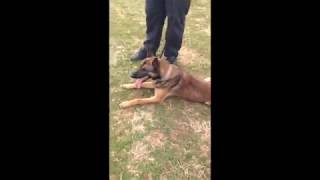
The video presents a hands‑on K9 training session led by Speaker A and Tommy, introducing trainee Johan to the standard obedience and patrol techniques used with Custom Canine Unlimited’s dogs, exemplified by Roy. The trainers emphasize a foundational approach: a loose lead and a flat collar are the baseline; handlers may upgrade to pinch, prong, or remote collars if desired. A proprietary command set is demonstrated, each prefixed with the dog’s name, covering heel ("Vulligan/Fuligan"), sit ("Zitta"), down ("oft"), stay ("blibe"), recall/out ("los"), and bite ("Stellan"). Hand signals (side tap, open hand) supplement verbal cues. Positional discipline is stressed—dogs must assume a left‑side heel and not circle the handler. Recall drills show the "los" command followed by "here" to bring the dog to heel. Bite work is detailed: dogs target the upper right arm or sleeve, deliver a full‑mouth bite, maintain grip without using their legs (corrected with "Nay, feet"), and are released on command. Post‑bite procedures include calling the dog off, returning to sit/heel, and optional "out" commands. The session also covers pat‑down techniques on an aggressor, and a chase‑off drill where a decoy runs, the dog bites on "Stellan", then the aggressor disengages. Throughout, the trainers stress calm, relaxed behavior, no premature barking, and flexibility in announcements, illustrating the consistent training methodology applied across all dogs in the program.
Chapters
Alright, Johan, we're going to run through some obedience with one of the dogs, Roy. This is the one I was telling you about that would, I think, be suited good for you. But all the dogs are trained the same way, so we're going to just run over a couple things on here. The first thing, again, I'll reiterate, the loose lead that is always kept at all times, and also that we work all these dogs on a flat collar. Again, It's your prerogative if you step it up to a pinch or prong collar, that's fine, or even a remote trainer. These dogs can handle that. That's not going to be an issue. We just lay foundation and we teach the dogs to work this way. That way, off-leash obedience and all that, we don't have an issue with. But he's going to run through some of the commands. The first command that he's going to run over is the heel command, which is "Fuligan." So go ahead, Tommy. Whenever the dog is not paying attention to him or out a little bit, he's going to pop and turn and make sure the dog is paying attention to him in all cases. So he turns with the dog, prepare the command, he stops. When he stops, the dog is to sit, just like so, looking at the the trainer or the handler at all times. Now, Johan, we're going to go through some positional movements with the dog downing and sitting up. The down command is the "oft," "oft," to command the dog to down, and then to make them sit Zitta. Zitta is the sit command. Make him sit. That's the sit command. As you see again, the loose lead and the flat collar. Go ahead and reward him. So he's going to give him a reward and then he's going to out him. He's going to play with him for just a second. All right, go ahead and out him.
Roy, los!
So again, prefix it with his name, Roy, los, and then he drops the toy. Again, you see there's no aggression. With the toys and they're topped out immediately. Alright, Johan, what we did, we changed dogs just so that you can see this dog work as well, just to show you the other dogs as well and get them in some of the videos. Although they're all trained the same way, for reference material, this will be a good place to start. So this is Janko and he's He's going to work some down stay, just like he is. He's going to tell him to stay. The stay command is "blibe" or "blibe." So the command that you would use is "blibe," and that tells the dog to stay where he's at. As you can see, the handler can kneel beside the dog. The dog's trained to stay until told otherwise. So now he's going to go into a He's going to call the dog to him from a distance and call him to heel. Again, you can use the heel command that we've always used, which is "Vulligan," and you call him to your heel. You can also use hand signals, which is a tap on the side as well, which he'll show you. That's to call the dog to a heel position from a distance. So Tom is going to go ahead and do that. He's going to tell him to stay, "Blythe." And then he's going to call him to heel. The dog is trained to come to the— straight to the left side. We don't train the dogs to go around the handler. We train the dogs to come straight to the left side and come straight to heel from that. So again, he's going to call him to heel verbally, and then he's going to call him— he can also call him with a hand signal, which is a tap on the side, just like that. Tell him to go down. If he needs to, he can get harder on the dog to make him go down.
Move in.
Tell him to stay. And from a distance, he'll call him to heel. Mulligan. Getting the dog to position himself like he's supposed to come to a sit command or sit position. Johan, before we send any dog to bite, what we train them to do is to be calm and relaxed and not to bark before they get sent or anything of that nature. So as you see, the dog is in obedience command at the heel and is on a down stay before he gives announcements. And you can modify your announcements any way you want to prior to sending.
All right, stop rustling the dog, stop rustling the dog, stop rustling the dog. Halt, halt, halt. Roy, los it! Here!
Here! Roy!
Here! Here! Off! Off! Good so brav! Good so brav! Good boy!
That's a boy! So on the recall, you're going to hear him say and call the dog's name to get his attention, and then tell him to los, and then to come here. So, "Los," in this case, is Roy, so it's going to be, "Roy, los, here," and the dog's going to come back, come to a heel position, and lay down or sit, whatever one you want. Now, on this one, he's going to send him to bite, and then he's going to call him off the bite after he sends him.
Stop rustling the dog. Stop rustling the dog. Stop rustling the dog. Still.
So each dog is trained to bite the upper right arm on the rear attack. If you're going to use a bite coat, of course, if you have a sleeve, then they'll target the sleeve as well. And this is every dog.
Holy—
once he's on the bite, of course, we teach them to get a full mouth bite and to re-grip on every bite to get as much of the suit as possible in their mouths. And they're not to push with their legs. If they do, he's going to tell them, "Nay, feet." We don't allow them to push with their feet. They need to grip with their mouth only. All right, now he's going to call them off the bite.
"Stand still.
Roy, loose." And he's going to go into a sit position behind them, and then he's going to call them to heel. "Roy, pull again." And that can be modified either way you want. As far as the out command goes, again, we just leave you with a lot of options. So we put them into a call after the bite. You can call them back as soon as he offs. That's up to you. All right. Yeah, go ahead and do a pat down. So he's going to put him at a down stay, which is oft— bliven is to stay, and you can use hand signals as well, and that's just an open hand to the dog. And then he's going to conduct a pat-down of the aggressor and he can go back. Now again, this is up to you. This is just something that we would normally do anyway. Once he gets the leash, we're going to do what we call a chase-off. And this is just something we do in training again to build the dog and to make sure that the dog is going to aggress when we want to. So what he's going to do here, the decoy is going to run. He's going to give the command for the dog to bite, which is Stellan. Once that command is given, they're going to chase the aggressor. The aggressor is going to peel off and go weak like he's just been chased off by the dog, and the dog is going to get put up. Decoy!