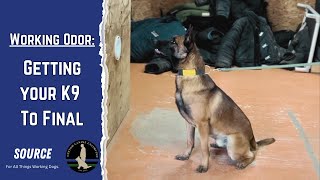
Trainer guides handler Serge on teaching a detection dog to sit reliably when it finds odor. Using only holes 1, 4, and 6 keeps the dog focused. Reward the sniff and lockup before adding the sit cue, then use leash pressure to shape the sit without confusing the dog with correction.
Chapters
Go! All right, Serge, we're going to go all high holes, and I only want you telling him one time, find it, control your leash, and that's it. Depending on what I'm reading, I may reward quick once he hits odor and locks up, because it'll make this sit a little bit easier. So I'm just backing them back a little bit to get a more solid, like, so we can really focus on the sit without deteriorating his, his detection. Okay, so I'm going to go all high holes only. So we'll still do 6, but I'm gonna do 1, 4, and 6. 1, 4, and 6. Okay. All right. Sit down. What I was reading earlier was the correlation between the sit and the odor was too long. So that's why I left it, because what he was doing was he was finding odor, locking up, and then, you know, maybe a minute goes by and he's still sitting there. And then he sits. So my thinking, my thinking is, is he sounds just like you, like a little girl. Um, yeah, that's right. But my thinking is, is he's, he's sitting in front of the wall. He's not sitting because of odor. So that's why I went back to rewarding him on odor, and then we'll implement the sit to make it clear. All right, I think we'll have more problems if we don't do that. All right, remember, odor triggers everything, and we need to make sure that's clear in the dog's head that it's odor that triggers the reward, not anything else. So odor triggers the sit. Sit. Whoo-hoo-hoo-hoo! Atta boy! As you increase the pressure on the loose, repeat it. So we loose, loose, loose, loose, until he lets it go. All right, we're in, um, 6. We're gonna get him on. He's gonna alert. We're in 4 here. He's gonna alert, right? When he does, I want you to just come up on the leash towards his— towards his ears. All right, as soon as his butt hits the ground, I'll pay. Okay, if he leaves this hole, then we'll just go back to doing what we're doing. We won't progress yet. Yep, if he leaves it, then I'll just continue paying him on, on the odor and go from there. Okay, be in position so you can come up on that leash. Okay. Hey, that's great line work. Without the good line work, you don't get that clean. So that's, that's the one of the biggest factors why we spend so much time working leashes, right? Because if you're choppy with that and not smooth, he leaves it. And then it messes it up. But no, you're perfect. As soon as he hits it, locks up, we get the change, you come up, and he— and then we pay. It's one continuous behavior. Odor, sit, pay. The odor is triggering the sit, so that's stay right there with it. My point is, if you weren't smooth with it, if you were too fast and choppy and it becomes a correction, then the dog leaves it and thinks he's getting corrected for odor at this stage. Okay, so it was perfect, perfect example of what we need. But also, we built the commitment to the odor, right? We're already halfway there by using the high holes. Dog's already in position. All it is is now breaking that leg down to put the butt on the ground. Okay, just makes the process easy and clear in the dog's head on what's expected. All right, we're at 6. We'll do the same thing. What are we? 6. Reset. I'll pay him on, on sniff. Good. Love them up. Put them up. That was 6. So the biggest thing— we did a couple things in this session. You know, obviously we've already gotten to the stage where the dog knows odor and such, but we're teaching the response to the odor. So essentially, the odor is the stimulus that triggers the sit, and we have to be careful. Some dogs are easier than others, and What we were seeing earlier when we were problem solving the dog, the dog was locating odor and then he would lock up and just stand and stare at the odor source. The problem with a dog that's new like this, we can create confusion in the dog in the sense that— and what we were seeing was it was taking too long because a lot of times we'll wait the dog out when they notice it in order to extinguish the behavior of standing up. But in this case, because the dog wasn't clear on what the expectations were, because he's very early on in training, the dog was standing. 3 or 4 minutes later, then he would just sit, and then we were paying him. Well, my thought process behind why we needed to change that was the connection between odor and sitting wasn't there any longer. It was taking too long. So in this case, we began to pay the dog on the sniff and the lockup, and we were only doing it on the high holes in order to then get the dog into position, get them to stay committed to where the odor is, and then to enforce the sit with the leash manipulation from the handler or the trainer, and then pay that. We did it on hole number 4, which went very smooth. Then when we get to hole number 6, as you saw the last part of that video, where the dog went back to the old behavior and started standing up. Well, instead of pushing that, you'll get to see the connection as it begins to click in the dog's head on what the expectations are as we continue to do what we're doing now, which is just paying the dog when he gets into odor, takes his head out of the hole, and we'll continue to enforce that behavior then we'll use successive approximation and begin to enforce the sit. But right now it's just too early. As you can see, when he pulled on the leash, the dog went back to standing up at the hole, and that's what we're trying to avoid. So we'll continue just to get the dog to sniff the high holes, find the odor, and be there in position. You'll see the dog will transition very early to the sit position without us forcing it. Which then the dog then makes the connection between the odor and the sit on their own, which is a much more or much solid behavior response to the stimulus because the dog is teaching itself how to respond and we're just manipulating the environment per se. So in my experience, we'll just get a stronger alert and a more consistent and reliable alert to odor if we go that route versus forcing it and making it happen quicker than it needs to. I go back to having a little bit of patience, and you'll see a much more reliable dog in that sense because the dog is teaching itself what to do.