Losing a Police K9 Partner, Overcoming Obstacles, and more with Lt. Paquette
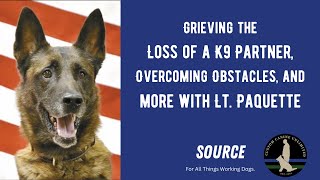
In this hour‑long interview on The Source Podcast, host AJ Vargas sits down with Lieutenant Patrick Parkett of the Greene County Sheriff’s Office, the veteran K‑9 handler who recently lost his longtime partner, Obie. The conversation opens with Pat introducing himself and describing the K‑9 unit’s jurisdiction along the I‑20 corridor in Georgia. Pat then paints a vivid portrait of Obie, recounting the dog’s unwavering focus, work ethic, and the deep bond they shared both on and off duty. A courtroom anecdote illustrates Obie’s reliability under pressure, reinforcing the handler’s confidence in his partner. The dialogue shifts to the emotional fallout of losing a K‑9, with Pat describing the raw grief felt by himself, his family, and the broader department. He emphasizes that preparation for a dog’s death is impossible, but coping hinges on faith, family, friends, and a robust support network—including a state‑wide peer‑support program, fellow handlers, and community members who rally at memorials. Pat details the spontaneous memorial service held at the sheriff’s office, the outpouring of cards, flowers, and social‑media tributes, and how such gestures helped him navigate the loss. The conversation expands to broader themes: the importance of treating K‑9s as family members, the challenges of retirement versus death for working dogs, and the need for handlers to cherish every training moment. Pat advises current and future handlers to build and lean on support systems, avoid isolation, and stay engaged with the wider K‑9 community. He also touches on systemic mental‑health issues in law enforcement—suicide, substance abuse, and the cultural pressure to “suck it up”—arguing that open dialogue and peer resources are essential. The episode concludes with mutual gratitude, a reminder of the power of community, and an invitation for listeners to reach out for help when facing loss or trauma.
Chapters
We're on The Source Podcast, and I'm happy to just be a part of this. You know, this was something that we thought was an idea, and just the feedback that we've gotten off this is just remarkable. I'm glad that you're on with me. For those that don't know Pat, and there's not many out there that don't know you, I mean, I'm blessed just to have a friend that's so well known. But we know you either love or you hate Pat Parkett, right? That's right.
I think if we ran a poll, I think a lot of my, my close friends and close friendships started out with the hate and, and it turned into a genuine friend.
Yeah. But I want you to introduce yourself to those that don't know you.
I'm Patrick Parkett. I'm, uh, Lieutenant with the Greene County Sheriff's Office. I'm over the K-9 criminal interdiction guys. We patrol I-20. We are in an area that is a major corridor for the entire East Coast. Our stretch of I-20, Greene County, is Greensboro, Georgia, which is halfway between Augusta and Atlanta.
I mean, we can probably do 52 episodes with you alone talking and teaching. But I really wanted to focus on how we prepare and how we take the loss, because I think there's a lot to learn, and I think you have a lot to teach in that, especially since you just went through it. Uh, so let's start off. If, if you don't mind, tell us a little bit about Obie. If you wanted people to know Obie, what would you say?
That guy, that guy was amazing, AJ. He was the epitome. I mean, he was just— every single day he just wanted to make me happy, right? I was telling my wife the other night, and I'll be honest with you, and I want to get into this, but my wife is devastated. Like, she's still trying to cope with it because what we don't realize a lot of times, and it's like this in law enforcement as a whole, But especially talking about the K-9s, these guys are as much a part of a family as anything. I mean, they're there. If we're going to work an off-duty or we're going to training or we're going somewhere and we leave that dog at home, our wives and our kids and our girlfriends, whatever you have, they have to take care of that dog for us, you know? And so I honestly, during this process, I've learned a lot. I mean, You know, that guy never— he never complained, right? He never complained. He never complained when it was time to run a track, right? He never complained. He was ready to run that track. He never complained to me that it was his. Every single time I opened that car door, his tail was wagging, his ears were up. He was ready to jump out of that car. And to be honest, AJ, the day that he got sick on me back in July, I believe it was, you know, I knew something was wrong with him. For me to look in my car, I just remember so many times that I'd be on a traffic stop and I'd look back and you could just see his little eyes right between the two seats, you know, and that was just him. You know, he was ready to work and he was ready to train and he was ready to please me. Like, that's all he wanted to do. And if we, if we Google police dog, what are we looking for? I found that in Obie. People think I'm crazy and I had it. Talking about motions to suppress, I had a motion to suppress one time and they had spent tons of money on this woman. She was phenomenal, one of the best to come out of Atlanta, right? Phenomenal attorney. She had me on the stand. She was wearing me out, right? Just on and on and on, just picking, picking, picking, trying to get this guy off of the 26 pounds of marijuana that he had in the trunk of the car, right? Just picking me. Then she focuses on the K-9. Now I'm not talking about 15, 20 minutes in. I'm talking about 2 hours in, right? Then she starts on the K-9, right? And she starts talking about, so your testimony today is your dog doesn't get distracted. I said, no, ma'am. So you mean to tell me cars coming by, your dog's not distracted? No, ma'am. You know, no, ma'am.
No, ma'am.
She says, so you mean to tell me— I think I was a sergeant back then. Anyway, you mean to tell me that if a squirrel ran across I-20 your dog wouldn't be distracted and chase that squirrel. And without missing a beat, I said, the only way that would happen is if he had 26 pounds of marijuana strapped to his back, just like your client had in the car. And she had no more questions. Right. But AJ, I'm confident. I was that confident in that guy. Right. I was that confident in Obie that he was going to be focused every single time we did something right. Every single time we did something, he was going to be focused. Nothing was going to distract him, right? And, and at the end of the day, to be honest with you, he may got a toy, he may have not gotten a toy, but either way, if I was praising him up, he was happy as he could be. He was happy as he could be. And, and that's the guy that I had, man.
I just, I think back through the many years, you know, while we reflect one minute on him and just the the moments, right? Like, they're just so vivid to me. He was ever consistent in what he did. It didn't, it didn't matter where we were, like, no matter what— South Carolina, North Georgia, Greene County— like, it didn't matter where we were, ever consistent.
I, I look back at videos, and it's a joke with— and, and you said this at the memorial service— it's a joke because I think we started this with Sharon and Abraham and them guys in Risen County, right? It's, it's become a joke with us we would joke and say, all right, the dope's out. All right, hold on, let me get Obie. Let me go proof the room, or let me go proof the car, right? And then Sharon, Sharon would say, let me go get this little mutt that he had, right? And then Abraham would say, let me get, uh, Denzel, you know? And it became a joke. But guess what, AJ? We were that confident in those guys, right? We were that confident in those guys, you know? And I have to say this, I think it's a good point to say this. I mean, we're talking about all these dogs You know, we just lost Yuri. You know, him and Jerome, they were one hell of a team. And it kind of hit me a little hard because I remember, and I haven't talked to you about this, but Yuri and Obie came in together and I was at canine school and Alan Cox and them, they came and got Yuri. But that's when I first met Jerome was when he came to get Yuri. So that kind of hit me hard. But, you know, those dogs were just the foundation, right? They set the bar. I'm proud to say that. And I, I'll tell you this right here. And I want you to find me somebody that can disagree with the statement I'm going to make. Those guys set the bar high, and the dogs that are coming out nowadays are just the same quality dog that, that we had back then and that we made what we made. But it's up to each individual guy nowadays to make your dog there. You know, it's not just the dog. The dog can't do it. Right? I, I will tell you this, and I tell my wife coming home the other night, um, from a trip, I was telling my wife, I said, if I miss training, right, if I missed a training day and I had to go back, Obie never missed a beat. He was still the same place he was when I went back to make that training up, right? And so the, the dogs are— the dogs know what they got to do. We as handlers just have to have the drive and the desire to do to make that dog do what he can do. And that's what all of us had. Talking about Jerome, you remember we were at that seminar. I thought about this driving down the road. Remember we were at this seminar and I ran that track for Jerome and here comes him and Yuri. I mean, and I can hear him coming in. That joker got 5 feet from me and I threw the toy and that toy went right by his head and he kept coming for me. You know what I mean?
Yeah, yeah.
That dog was a phenomenal dog, but That dog just didn't come into your kennel. That dog just didn't go to Richland County Sheriff's Office and become the legend that he was. That dog is no different though. You put in the training, you put in the want, you put in the desire, and you're gonna get a hell of a product.
We do this long enough and we begin to lose dogs, and it's been crazy over the last probably 2 months on how many dogs have just passed away. One of my buddies, the same week that Obie passed away, he put his dog down. And you get these calls, you get these messages, and I always take time to call the handler, even if I hadn't talked to 'em in 2 years or 3 years. When it's these relationships we build in this industry, that's like no other. And, you know, these dogs now that have laid the foundation for not just CCU, but for a lot of handlers. You know, you weren't a handler before you got this dog. And that's right, how they carry careers and how they impact careers and how they, you know, they become legends that we talk about, that we sit around when we're old and, you know, bald like you are now and gray like I'm getting. And we talk about what it used to be like our dads used to do. Son, I used to walk 2 miles in the snow. Well, I used to track 2 miles with Obie. These are the legends, son. I just had to pop the door, my dog ran out and ran the car on his own. Right now you have to have a leash on your dog. These are stories that are going to be told, and it, it's just amazing just to think back and just see all these dogs and how we remember these stories. I can't remember what I did yesterday. Mine's asking me about You know, this email or that email, I can't even remember the title she's talking about, but I can remember that training set that we did in Richland County. And when you threw the ball and Yuri just went straight past, I can remember that like, like we were just there. It's just amazing to, to see that.
Yeah.
Because you, you just don't forget, man. This, this industry impacts us that way.
That's right. That's right.
Now those handlers that haven't lost a dog and haven't had to face this, we can talk candidly with each other. Now. Not only are we friends, we've been through a lot together. We've shared some good times and some bad times together. And now we're at a point where I've went through you losing a dog, right? And that hurts. That hurts because I know your pain and I know you're hurt and there's nothing that you can do about it, right? There's nothing that I could say or do to help you per se, other than being there for you. But I want these peop— I want these handlers, these guys and girls I want them to know, like, going into this, what was the process that you kind of went through from the time that you kind of understood that the end was coming? And I hate to put it like that, but you knew like your days were limited with Obie. And I kind of want to talk through the process from that point to where we are today because I want people to, to kind of know what to expect.
I, I will tell you this, there, there— I have no answer. There is no way in my mind to prepare for it, right? There's just no way. I, I can say this to you, AJ, there's two things that's going to happen in a human life. There's two things that's going to happen in an animal's life. We're going to live and we're going to die. And it's simple. Right? And so we as humans, we want to prepare ourselves spiritually, you know, we want to prepare ourselves for the Lord, right? We can do all of these things. When it comes to these dogs, right, I was not prepared. Like, I'm not afraid to tell you, like, I, I knew it was coming, right? The vet professionally told me it was coming, right? But yeah, I was not prepared mentally for it, right? So I'm going to answer your question in several different ways. What I would tell new guys, what I would tell old guys, what I would tell, you know, veterans just like myself is when the day comes, right, you have to lean on the thing that got me through this whole process was the Lord first, no doubt, because I talked to him many times throughout the process. And but my family, my family, my friends, my coworkers, the community. Right, AJ, I can't tell you. I've got a stack of cards over here on my desk, right? I mean, over here on my table, cards that the school, the kids made. There's 300, 400, 500 cards that I haven't had a chance to read yet, right? There's flowers still coming to the sheriff's office, right? There's Facebook posts, there's Instagram posts, there's Twitter. All these posts is, is what has gotten me through it. Right. And so I would say when the day comes, right, whether the dog is tragically killed in the line of duty or whether the dog is old and retired and you have to put him to sleep, or rather he just passes on his own, you know, is you have to be mentally prepared. You can only prepare yourself mentally. The people around you are the ones that are going to get you through it. And I can tell you that that right there is what got me through it. You know, and this isn't a— this isn't a podcast to play, you know, praise AJ and praise your staff. Right. But I want to say this to you. You do not know from the moment that I reached out to you and said, I'm on the way to UGA and it ain't looking good. Right. I remember that vividly. Right. You never, ever, ever took a backseat to that. That was a priority to you. Right. You still had training going on at your place. You still had people trying to certify at your place, right? You still had all of these things. Those things were put on hold, right? Because y'all had to be there for a canine guy that was in need, right? And it's no different than my family, right? My wife, my— and I'll say this to you. When I went to the sheriff and I said, here's this, and the sheriff said, well, let's get a little memorial service together. We're going to get a little memorial service together. We'll have it back here in the break room. Right. Okay. All right. No problem. Right. And then next thing you know, so many people came together, right? So many people came together. There were people, AJ, that came to that memorial service with the mentality that I'm here for Pat, but it was just a dog, right? But there's people that left that memorial service with that same mentality and thought process going in that reached out to me and said, I left there with a total different perspective. I left there with a total different thought process. Right. And so those are the kind of things that get you through stuff like this. You know, I'm actually on the panel with these guys, but we have a peer support group right in Georgia. Georgia Department of Public Safety has a peer support team that Shane has texted me 4 or 5 times. Right. Shane has called me. You know, and so when it comes to our canine friends, what we have to do is we have to be prepared to reach out to our resources. That's the only way you'll get through that. We don't know what tomorrow's going to hold, but if you have to go through the loss of your canine, definitely do reach out to people you need to talk to. Lean on the people that you're closest to, you know. And again, we had my community, and my community is no different than any other community. But nobody in my community had anything bad to say. You know, nobody in this community here was out there saying, what in the hell is going on? We got 50 police cars riding down the road in a procession, you know, for a dog. No, they didn't say that. Yeah, they said that was a K-9. That was a police K-9, right? That was a guy who fought for the safety of our community, you know. And so That's why it's so important when people call on us, right? When people call on us, hey, we got career day at the school, tell me what time to be there. You know, hey, we got such and such at the school, tell me what time to be there, right? Because when you need those folks, those folks will be there for you. And those are the things that we have to do to get through it. And honestly, I agreed to do this podcast with you just for, just like you said in the beginning, if there's one thing somebody can take away You know, that, that's what I want them to take away. Serve your community with that dog, and when it is his time to go, the community will rally and support you, and that's what will get you through it.
Yeah, that's great advice, man, because, you know, oftentimes, especially law enforcement, right, where we really seclude ourselves when things happen, right? We, we pull away, you know, because we're not meant to be seen to be emotional.
That's right.
And, um, but on the flip side, you're telling us that we need to push out and we really need to embrace those that are reaching out to us, right?
That's right, that's right. I mean, we can't— you know, I'll tell you, AJ, the hardest thing during the whole process, right, I, I still have not been in my basement, right? Like, that's where Obie lived. I mean, he had his, his little pen down there that led to the backyard. And mentally, I'm just not ready to go down there, right? Like, I'm just not ready. I remember the last time I went down there, he was in his pen, right? His tail was wagging, his ears were up, right? He was ready to jump in that Tahoe and go to work. Right. And so I'm not, I'm not ready, right? I'm not ready at all. You know, it's just like getting in my Tahoe every single day. I still smell that dog. It still smells like Obie, right? I still look behind me and I got a K-9 kennel in my car. Right. But yeah, we just have to, again, I can't say this enough, our loved ones are what get us through this. Yeah.
And we can take, you know, the dog's death as a tragedy, right? And I think you can attest to this is pulling those people in close is really what helps you to cope, not to get over it. Yeah.
Yeah.
Because you, that only time can help that, but it helps you to cope and you really get to see the love of people and what we're called to do and really have that compassion when this tragedy hits, right? And versus pushing everybody away. And a lot of experts can talk about the same thing, right? They, we talk about suicide in our industry and in the veteran community. And most of that is when we seclude ourselves and pull away from everybody is when we get to our darkest moments. So we really need to really push out. And bring those people in that are close, you know.
That's right, that's right. Yep.
Now looking back, you know, what I think about, even one thing that you said was, you know, hearing him in the back of the car. And that, I think, thinking back when I lost my first dog, that was the biggest thing, that silence that was never there for the 5 or 6, 7 years that I had that dog. I always knew that he was with me cuz I always heard him. He always spoke to me. He always like the little mannerisms that they always had that was unique to that dog, whether it was rubbing his head against the cage so I can reach back and pet him, or that bark when somebody walked up to my car, that was gone in an instant. And that was really hard for me to get over, you know, especially in the moments where you were just by yourself. Riding in your car. You touched on that, and those are just things that you're always going to remember, and those are things that you're just gonna have to— time, time has to just pass, and, you know, and working on that. But now looking back, Pat, what have you learned from, from this situation that maybe you didn't realize at the time?
Again, AJ, it's like a human being, right? It's like a family member. It's like that dog is no different and was no different than my kids, right? So as I look back on it, I look back on it and I say, could I have spent more time with him, right? What could I have done different? You know, could I have played ball with him a little longer in the yard at night? You know, could I have taken him to the salon? Could I have taken him to the salon every Friday and got him a bath? I mean, there's so many things I can think back on. I would say, though, you know, there's nothing— there's nothing looking back that I can say that I would have done different. Like, there's nothing. I valued every single second that that guy and I were together, right? I valued that time. Believe it or not, and the handlers that are listening to this thing, they know what I'm talking about, right? We spend more time with those dogs than we do our own family. I mean, we spend— whether you're on a 10-hour shift, a 12-hour shift, 8-hour shift, or you work 7 days every 2 weeks, or you work 5 to 10 days every 2 weeks, however you work, when all the numbers come together, you still spend more time with those dogs than you do your own family. And so they're just not a partner to us. They become, I mean, they become as close as our families. And so I can say to you, just enjoy every single moment like I did. Like, you know, enjoy every single moment. Don't, don't dread training day, right? Don't dread training day.
Yeah.
You know, be happy that, that that guy's happy that he's fixing to bite a decoy. You know, be happy of the time that you get together with that guy or girl. You know, be happy with the time you got with those dogs. Because I'll tell you, I mean, again, K-9 handlers, they know exactly what I'm talking about. I mean, I wake up every single morning and say, if I could go to see Obie one more time, you know, if I could load him in the car one more time, if I could deploy him one more time. And so savor those moments, enjoy those moments, be grateful for those moments. You know, don't, don't feel like it's a burden that you got to go to K-9 training. Don't feel like it's a burden that you got to go to certification twice a year or 3 times or 1 time. How many times you certify a year, right? Don't be dreadful for that. Enjoy that time that you get with those dogs because like you said, it comes to an end. And when that day comes, then you look back and you go, man, what I would give. You know, we just had the seminar. Down in South Georgia. And I miss the fact that I wanted Obie to go one more time. I wanted to go one more time. Make the best of the time with your dogs because again, that the day comes when they're not with you anymore.
So, and I think back to my first dog, Pat, and you're kind of in a similar situation than I was in the fact that I worked my dog to the end, right? So my dog never really got to enjoy retirement. Mm-hmm. You know, when I found out that he was sick and trying to get treatment and kind of come to the realization that my days were limited, per se, not knowing how long it was gonna be, but knowing that, hey, it was coming. Do you regret the fact at all that maybe he worked to the end of his career? Because I often think about that.
You know, from my perspective, I do not, AJ. And the reason why— and I think when I say this, you're gonna agree with this and you're gonna think, damn, I never thought that way— and I do not regret that my guy worked until his last breath was taken, right? Because I'll tell you why. Because he was not happy at home retired, right? These guys are not happy if they're not in that patrol car and they're not doing what they want to do, they're not happy. And for Obie, I, I will say this, um, I'm not going to say I was selfish, but I feel like I catered to him because I knew that he didn't want to be left at home, right? I knew that. Like, I, I literally brought him to work with me every single day until the day he couldn't jump in that Tahoe. The day that he couldn't jump up in the Tahoe was the day I said he can't. He, he's just not going to make it, right? And like, these guys and girls are not happy retired, right? They're not happy retired, you know. And you can't take a guy that has been trained, that has been worked for 8, 9, 10 years, day in and day out, had the opportunity to sniff out bombs, to sniff out dope, had the opportunity to apprehend fleeing people, had the opportunity to, to to love on kids at a school, right? This had the opportunity— all these guys right here, you can't take them and put them in a pen and say, okay, but you're not going to work today. You know, you're gonna just basically fade away right here in your pen, because that's not what these guys want. To answer your question, no, I, I'm— I don't regret that.
Yeah, it's crazy when I reflect on that too, because I really do feel the same way you do. Right. And I can tell you why. And, and the reassurance of this, I was prepared. And like you said, we can't prepare, like we don't grasp the fact of what we're gonna go through emotionally when we lose our dog. Right. But we do kind of mentally prepare like, okay, the end of days are coming for my dog. I gotta kind of think about what I'm gonna do, how, how I'm gonna handle this. I did go to my department and let them know that this time is coming, and I would never allow my dog to suffer. He did too much for me. I came to that fact. Obviously, I wanted him to die naturally. My vision was sleeping, just to pass away in his sleep. Unfortunately, that didn't happen, right?
Right.
When I came downstairs and saw my dog couldn't even get up to urinate or to eat or drink. I had put chicken— I remember I had took chicken because he had really stopped eating. So I was trying to give him anything that I could think of to get him to eat because I was in my head, that's what I needed to do because I wanted to keep them, right? Like, I can help you heal, give you some good food, and you're going to start back eating, buddy, and you're gonna get over there and overcome it. But when I went down there and I knew, I went back upstairs and I told my wife like, hey, I gotta take— my dog's name was Argus— gotta take him to the vet. It's time. There's no way that my dog is going to lay there and won't even get up to go use the restroom. But Pat, the assurance that I worked him and provided for him the best quality of life was when I popped that garage door He jumped up because he knew that was the garage door that I opened and he was going to work. He jumped up like nothing was wrong with him, ran around my other car, and went to jump in the back of my, of my car. And at the time we had Crown Vics, so much so that I had to catch him because his mind told him it was time to go to work. But his body couldn't do it, and I had to catch him and help him into the car. And that was the assurance that he was doing what he loved to do every single day, no matter what. And, uh, so I'm 100% on board with you. Staying at home would have probably expedited his life because he would not have been happy. 100%.
No. Well, no. So hey AJ, that Crown Vic you're talking about, that was the one that had the two bubble lights, right? One on each side, the two bubbles. That, that was weird. And that is exactly what happened with Obie, right? He, uh, when I went down there that morning after my wife come up and told me, he was laying there, right? He couldn't stand up, but I picked him up I literally drove my car through my grass down to the basement. I picked him up, and when I put him in the back of that car, by the time me and my wife got in the car to take him to UGA, that joker was standing up, man. That joker was standing up in the back of the car, right, looking like, I'm ready to go, where we going? But by the time I got to the end of my driveway, he was laying back down. He was laying down in the car, right? And that's when I knew We both have no regrets on working those guys because, you know, leave them at home every day and they see that patrol car pulling out of the yard without them or once. And just to be quite honest with you, that played a lot in my decision. There's no way I could ever have another dog, right? I mean, that was my guy, right? I could never leave him in the kennel and then load up another dog and pull out in the patrol car, man, that joker would tear that kennel up to get out. You hear me? Running down the road behind my car, trying to get in my car, even retired, you know? And I have a good— well, you know, our friend, and he retired his dog Enrique, you know, over in Forsyth County. As mean as that joker was, now he's become a family dog. And you would have to fight Enrique's wife to take that dog to work now. I mean, he become— he's become part of the family.
Well, I mean, even if we drew the correlation between— think about these old guys, and you're going to be one of them where you're close, but these old guys that serve these careers for so long and been in law enforcement, what do we always say when they retire? Give them 2 years because they're not going to be happy doing nothing else, man. I, and I hate to say it, man, this is what we know. You know, I could never see myself retired. I just couldn't. People say that all the time. Well, when you gonna hang it up? I can't. There's no way possible. I gotta be involved. We're wired differently. And these dogs are the same way, man. Really are.
That's right. There's no other way to say it, AJ. There's not. I mean, that's the best way to say it.
Mentally, it's hard for us to comprehend the loss of our dog or, or that time is coming, right? A handler thinking right now, listening to this, well, I thought you were going to give me some ways to deal with this or not. No, we're, we're telling you upfront, you can't prepare for this. There's some things you can do, maybe, you know, notify your department and kind of get those things in order. Talk to some of us on, okay, well, cremation services that we've used, and you had a great one because I got to meet those guys that stepped up. You had a great vet that you had a partner with. With UGA that you were able to take them to that really show compassion. I remember you telling me about that and how great they always treated you, and then how great they were in this situation. But then it comes down to now you're planning— are you going to have a memorial service? What are you going to do with his ashes if you're going to have the dog cremated? And those are decisions you can think through. And prepare for it. But mentally preparing for the process that you're gonna go through emotionally is very hard. Um, because people handle grief in many different ways.
That's right.
And that's the hard thing. But I think we go right back to what you told us on pulling in your support group, your friends, your family, and embracing the community. Yes. Trying to reach out. To, to help you. And that's a hard thing to process. And as veterans that have went through it now, you know, we just want people to know, listen, you're going to go through a wealth of emotion. It's okay, that's fine. It's fine to cry. I seen Pat Perquette crying. I never thought I'd see that, ever, because I know how you are, right? But that's right, I could feel your pain, man. And that's the hard thing as a friend, sitting back and going, well, what can I do? What can I say? And, you know, we tread lightly in that, in that regard. And that's something I struggle with. Maya and I talked about it. I never want to be that guy that goes, well, this is for so I can look like I'm doing something, because that's never the intention, right? So how can I do enough to where I do enough for my friend but don't overdo it to where it appears to be ulterior motives, right? And that's what we struggle with, especially when you own a business, right? Because that's the first thing people go to is like, oh, they're only doing it for this or for that. And I was very cognizant of that. And so most of the conversations you and I had were behind the scenes, you know, because it wasn't about us, it was about Obie. First off, right? But your agency and it's about you. We have to honor those things and the service that this dog had. So really preparing for that. And we've been involved in, in many memorials over the years with handlers and we're always 100% like, it's the biggest honor that any handler could give us.
That's right.
Allow us to help them through this time.
Right.
And we really don't take that lightly. We learn from every single one. It gives us more experience to help others.
That's right. But if you think about it, AJ, there's one common denominator in every one of those services, and that common denominator is the support from everybody, right? These people are not at these memorial services because their agency or their department head made them go, right? These people are there because they want to be there. They want to be there to honor the, the handler and most importantly the dog. And I want to take this opportunity to tell people this is what everybody doesn't realize is that support system is what gets somebody through, a handler through that tough time. I mean, when I turn that corner And you were there. You saw it when I turned that corner that day and both sides of that hallway were lined with dogs, right? I froze, man. I went paralyzed. Like, I looked at my wife and I said, I can't walk down there, right? And then I looked around and I remember vividly, I looked at the fire chief and I looked at Chief Wiggins and he nodded to me and he said, You got to do it. I read his lips, right? And then I looked back down that hallway and I had all my canine brothers and sisters and the dogs are barking and some of them need a little obedience training. But yeah, I'm teasing, I'm teasing. But to see those guys and girls standing there, not because, not because they're sergeant or not because they're chief or not because their sheriff said you got to drive 4 hours to be there. You know what I mean? Because they said, we want to be there. And that right there, that support system is what I'm talking about that gets us through those times. You know, I said in the beginning of this topic that there's no way to prepare for it. I still stand strong on that. There's no way to prepare for it. But if you really want to, if there's any one word, if there's any one way that I could say would entertain that word of preparing for it, I would say it would be to build your support system, you know, to build your support system with your family, with your friend, with your fellow K9 handlers, you know, with everybody, you know what I mean?
So is there anything you would have done differently, you think, looking back?
I can honestly say there is not one thing that I would have done differently in our career, not one thing. We had a hell of a career. We had a hell of a career, AJ. People reached out to me afterwards and said to me, man, that video, you know, was that his whole career? Man, that, that was just a few cases, you know what I mean? I'm not here to be boastful or arrogant or nothing. I mean, that was just a few cases that got laid, right? Like, that video was 8 and a half minutes long. That video could have been an hour and a half long to put everything that that guy did in his career, you know. And so I, I wouldn't change a thing, man. I wouldn't change a thing. And, and I want to take this time to say this here. When we talk about the loss of a dog, right, with— I, I think that, that we don't only talk about the dog dying, right, or the dog retiring, or the dog— let AJ Vargas, for just a split second, let's talk about if the dog is taken away from you, right? Let's just say, because that is something that is common in our industry, right? Guys make mistakes, right? Uh, while I'm on this topic, and this is the direction, and I'm gonna say that, you know, I made a mistake. I, I don't— I, I will not say it was me. I won't say it was the share. I'll say that there was a time in my career with Obie that I parted ways with this agency, right? I was gone for 11 months, right? I was blessed and Obie was blessed with a hell of a guy that was assigned Obie, right? And Josh did a hell of a job. Elrod, he did a hell of a job with, with Obie during that time period. But I never gave up, right? Even though I suffered from the dog being taken from me, I never gave up. I always said I'm gonna get back where I was at, right? I always said I'm going to get back with Obie, right? I was going to do that, right? So I would say to guys that are, that are listening to this, I would challenge those people not to fold. I would challenge those people to continue to fight, to get back to where you at and to do what you want to do. Right. That's something that I want to add to that. That's just— I thought about when you were talking about losing the dog. We don't only lose them to retirement in this industry. People do dumb things and that's part of the discipline. They may get put back on road or You know, they may be suspended from K-9 for a certain period of time. You can't let that hold you down. You got to continue. You got to fight to get back where you were at.
Man, that's the old trainer in Pat, man. He's just like, push, man. Continue to push. But I love it, man. That's why we get along so well. We can't give up.
No.
You know, fold to adversity. We got to keep pushing and encourage each other, keep our network close. And there's, you know, a lot to pull out of an hour and a half talk between two old veterans and two old men, right? I say that because I ain't old at all, man. You know, I still run with the best of them. Just to let you know, Maya, don't be looking like that. But at the end of the day, man, there's a lot to unpack, you know, especially a topic that I've never read about. You search on the internet what to do when my dog passes or my canine dies. You just don't get any advice. And this is something that we need to talk about. We need to sit there and help each other out. You know, the last thing I want you doing when you've lost your dog is thinking about what to do next. We need to step in and say, hey man, I got you. Grieve over your dog and let me, or let us, and I say we because Pat, think about how many people stepped up. I remember having a meeting with the sheriff, the captain, your handler Matt Cowdrey, Maya Simpson, uh, the fire chief, uh, all the dispatch director, like all these people. And that's not even scratching the surface of the amount of people.
Yeah.
And, you know, sometimes we can be arrogant, and I came from the same cloth. We don't get along with the fire department because we work harder than the fire department, and everybody knows that, right? Right. But yet we get the most slack. So there's always that battle between us and the fire department. But let me tell you who was standing up blocking intersection, who stood attention and looked great and welcomed you guys with open arms.
The freaking fire department, like, when we left my house, as we were traveling down the road and the fire guys and the EMS people were standing, I literally almost couldn't even turn the Tahoe to take the procession through there. We have talked and talked for this entire time about the support system, right? So, you know, that's why we have to work so hard to build that support system. That's why we have to work so hard to make sure these guys know that they're appreciated. It's the same thing in the department, right? We cannot have the mentality as K-9. I will not tolerate— you talk to anybody that works for me, I will not tolerate arrogant or I'm better than you attitude just because we got a K-9. Because when it comes time for those patrol guys to, to, to come back and support us, None of them, none of them complained about it. I had guys that had to go 7, 8 o'clock the night before the service and pay huge amounts of money to have their pants hemmed on their Class A uniforms, right? Yeah, that's the support system that I'm proud of, right? The sheriff sent out an email and said, here's the details for the memorial service for Obie. It didn't say you're required to be there. It didn't say you're required to be in a Class A uniform. It didn't say to the fire department, you're required to be in a dress uniform. It didn't say none of that. Those men and women took it upon themselves to go to look the best, not for me, but for that four-legged guy, right? That's why they did that. And so when we talk about that support system, that's what we want to build, right? If we're the K-9 guy on duty that night, we're not too good to pull a wreck. That we're pulling up on. We're not too good to check a burglar alarm that we just passed the business. We're not too good to do any of that just because we got K-9 on the car. We're gonna lend a hand with those patrol guys just like they come to us when we need their help. And that right there is how you build that support system.
Well, it's crazy, man, because the foundation of where all this goes, and you're speaking about it right now, Simon spoke about it on the podcast that I spoke with him about, and he talked about community communication and the community that we have here. We spend so much time, and Pat, we know firsthand, we spend so much time downplaying each other a lot of times when we don't realize how important our community is. And I mean the community we live in, but also the K-9 industry and community. That we work in.
That's right.
We'll push people away rather than embrace them, right? Because we think that they know more than us, or they may find out a little secret about how we do things or whatever, versus embracing them. And it's in times like this— and you talked about it— bringing people in and, and building those relationships versus severing relationships.
Listen, AJ, I have never, ever— and this is my encouragement to everybody listening to this— if somebody calls me and says, hey, can we get your K-9s to do this? Can we get your K-9s on the operation tomorrow morning? Can we get your K-9s down here to run school searches? Can we get your K— I never say no, right? And in return, I had a situation a couple weeks ago. Of course, Obie wasn't in service. And the other dogs weren't available. And so I needed a dog to run a school search. And when I reached out to these folks, they didn't say no, right? It wasn't a, well, I got such and such to do tomorrow. I got— no, it was, can you send me the directions where I got to go? And so as a community, that's what we have to do. We have to support each other. So I would say, if you got a dog, be that guy. You know, I've worked many nights till 1, 2 o'clock in the morning and then had to get up and go somewhere that next morning to go do this or that. Be that guy that does it. Be proud to take your dog there. Be proud of that. And that's how, that's how we build that support system I'm talking about. And I promise you, it comes around. It comes around. I can pick up this phone right now. It's a joke, right? Everybody talks about all the people Pat knows, right? I can't tell you how many times a day my phone rings and somebody says, hey, I got such and such. Just, just today, somebody called me and said, hey, I got a parcel I need run. Who can I call? It's like, hold on, let me call so-and-so, you know. And, and so it goes along with everything that I teach and everything that I stand strong on. It's not only building that support system, it's the networking that comes with it. Don't be afraid to, to network with everybody. And, and that's what we have to do.
So yeah, that's right. It's crazy because you get these guys and girls that isolate themselves, even with training. They don't reach out, they don't attend training, and they don't train with other groups, or it's this way or no way. And I hear that from trainers all the time. If you're training with so-and-so, you can't come train with us. I literally had a guy tell me that a trainer told him that, right? So tell him to give me a call, man, and, you know, we'll have a talk, because that's just no— absolutely absurd to me. But that also tells me where it's coming from too, in regards to just scared that somebody's going to learn something new or learn something else or whatever. You know, it doesn't matter, man. We're all in the same game at the end of the day.
That's right. A couple of years ago, we were invited to a seminar. There was 108 dog teams there. I only know of 2 teams that were there that were from Custom K9, right? We were in South Georgia. Yeah, but we were treated no different than the other 106 teams that were there. As a matter of fact, not only did we go, but we won the damn competition, right? And so we really stepped on everybody's toes and we really said, here we are, right? We like Deion Sanders. We here, you know? And so, but, but I say that to say this. Did I agree with some of the ways that things were being done? No, I didn't. Did they agree with some of the ways that I was doing things? No, they didn't. But in the end, we accomplished the goal, and that goal being finding the dope, right? And so, yeah, in this industry, if we're fighting amongst each other, right, or we're territorial against each other, then the bad guys are winning, period. When anytime we have training— and I learned this from you— anytime we have training here, I don't give a darn where that dog came from. Right. If you're a canine handler, you want to come here, you come here. And now I'm going to tell you the way I feel. You know, if there's something you can add or help that person. I mean, I can tell you several times, AJ, we went— I'm not going to name the place, but I went with you to an agency one time and they had dogs that were, you know, from somewhere else. And we gave them our advice and they were on board and they took some things that they had learned one place and the things they learned from us. And you put them together and you make a product. I mean, it's no different than anything we do in this field. When we're fighting with each other, the bad guys are winning. So, you know, that's the other thing when it comes to that. Don't be selfish. So what? This guy works for ABC Police Department. Invite that guy to come to your training. Let's help that guy out because it doesn't just help my dog. We're helping the whole canine industry as a whole when we're making people better. You know, so that's right. Absolutely.
Well, you did mention a peer group, and I'd like for you to mention that peer group again, um, because we're going to add it to the show notes, um, because I want people to have that resource as well, uh, because a lot of people may not know that that support system, at least in the state of Georgia, is available. I'm sure most states have it for law enforcement.
They do.
But I do want to make sure that we get that in the show notes, because if you can't call a buddy, call them.
Right, right. 100%. And I lean on them a lot. Again, I've been to their post-traumatic stress seminar. I actually had called Shane. He's, he's the one assigned to our area. He's— I think Shane's ex-GBI maybe, or anyway. But State of Georgia has under this governor, Brian Kemp, has— again, he loves law enforcement. I mean, and he's going to do whatever it takes to make sure we're taken care of. They created, I believe it's called the State of Georgia Office of Peer Support or Department of Public Safety Office of Peer Support. But anyway, the leader of that group now is from GBI, and they got troopers on there, they got ex-deputy sheriff on there, David James. David was shot when I was a kid. He was my dad's partner in Augusta, and David was shot, hell, I don't, a bunch of times and he survived it. And he's on that, he's worked for the department for that peer support group. But I use them anytime there's a major incident involving an officer, whether it be an officer-involved shooting. I most recently used him, we had a pursuit where the guy committed suicide during the pursuit. And I had to reach out to those guys to help those officers. You know, but most importantly for us, those guys are one of us, right? They are either active law enforcement or they're either retired law enforcement, but they are an ear. You know, it doesn't matter what you got going on in your life, whether it's the loss of a dog, whether it's a traumatic event at work, whether it's an issue with your family, those guys are there to listen to us. They do a phenomenal job. I'm telling you, I've called them at 2 o'clock in the morning or 2 o'clock in the afternoon and they answer the phone and they're coming, you know. And so they are a heck of a resource.
You know, there's a reason why these peer groups were made available because again, you come back to where I come from in law enforcement, we were taught, you know, you don't talk to people, you, you deal with your grief, you deal with whatever's going on, but you better suck it up and keep moving on. Well, I'm here to tell you that's, that's not the best option.
No, no. And that's why our suicide rates are as high as they are. That's why our divorce rates are as high as they are. That's why we have so many officers that lean on substance abuse, whether it be alcohol or drugs, is because we are, man, we're taught to be the tough guy. You know, we're taught to be that guy. We have to be tough, right? But we have to talk. We have to talk. And I think sometimes we don't talk to our spouses for whatever reason. We just bottle it up and that's where we get into so much depression. And that's when we, next thing you know, that's when we're leaning on alcohol and drugs and it's just, it's, it's a domino effect.
Yeah, absolutely. And I know that wasn't the plan to go into this, but you know, we're dealing with a loss of a dog. We're dealing with emotions, we're dealing with trauma. Mm-hmm. And, and it's hard. And that's right. You know, we wanna resonate the steps. We want to give you, give everybody listening resources. We want them to learn from our mistakes and our successes, obviously. But we just wanna make sure that everybody has the resources necessary in dealing with the loss, trauma, any of those things. Because this, dealing with a loss of the dog is trauma. It is. And that's hard to get over or to even deal with. And you're really saying it best when you say bring in people close and giving us that perspective is, it's just awesome to hear from somebody that has a wealth of knowledge, somebody that came up through time of law enforcement in a long career. And it's coming from somebody that is telling you this is the way that we need to go. And guys, I can't resonate that more.
That's right. That's right. Yep.
Well, Pat, hey, man, I can't thank you enough. You know, my brother, my friend, like, I learned so much from you, and I'm really blessed to have you in my life, man. I can't thank you enough for being on here sharing, man, some knowledge.
I can't thank you enough. You know, it's no secret. Everybody says, man, Pat loves the camera, Pat loves the newspaper, Pat loves this. But honestly, AJ, I cannot thank you enough. For having me. It's done me a lot of good. I know you— we didn't talk before this. You shot me a text this morning and said, are you good talking about Obie? And honestly, I choked up for a minute, but it did me some good because I believe that he's still living through us, right, to help some other guys out there. Right. And that's why I'm honored to be on here. And I'll be glad to come on here any time I can and help anybody. And again, no matter what, we're just a phone call away. Way, any of us. And that's, that's how we need to be.
Yeah. Well, what everybody doesn't know is Pat said that we had to have a certain amount of followers before he got on this show. So we finally reached that milestone.
Okay. All right. Well, I was trying to text my wife behind scenes and say, hey, tell all your people to follow this thing. You know, I can't have just single-digit numbers here, you know. So, uh, What you don't know is half of them folks are my family, but it's okay.
Hey man, I love you, man, and I appreciate you.
More from AJ

Running vehicles with K9 Chidori#workingdog #detectiondog #workingmalinois #malinois #drugdetection



Join us for group training this Saturday! Sign up on our website. #DogTrainer #DogGrooming

Smart Funding Ideas to Launch Your Dream Dog Business | Custom Canine Unlimited



Why is my dog reactive? #reactivity #dogreactivity #k9 #dogtrainer #dogtraining

It’s not too late to sign up for Group Training! | #dogtrainer #dogtraining #trainyourdog


K9 STEVE | Explosives Detection 💣#workingdog #policek9 #detectiondog #edd #trainyourdog