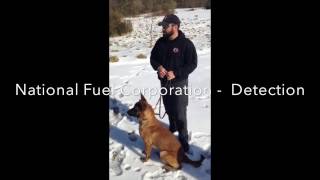
The video demonstrates a standardized explosive‑detection K9 training protocol used by Custom Canine Unlimited. Trainers walk through the complete search sequence, beginning with the "find it" command to start a vehicle or area search, and using a loose lead that is extended to the end of the leash so the dog can work independently. If the dog misses a spot, a brief tap on the leash redirects it, a technique the dog is trained to recognize. The trainers emphasize consistent command usage (e.g., "find it," "los," "out the dog") across all scenarios to simplify handler training. Flat‑collar corrections paired with a quick leash snap are employed instead of choke or pinch collars, reinforcing a foundation of humane control. Vehicle searches include pre‑opening doors and trunks based on prior operational experience. Reward cycles involve giving the dog a toy after a successful find, then releasing it with the "out" command. Throughout, the trainers stress repeatable, simple commands and controlled leash handling to ensure reliable detection performance.
Chapters
Johan, what we're going to do here is we're going to begin this search from a sit. Once we're ready to begin the search, we'll give him his search command, which is "find it." We'll run up, we work him as close to the end of the leash as possible, allow him to work independently and on his own. You'll notice on the vehicles, we have opened some of the doors on some of these vehicles based on the searches that I ran in Afghanistan and Iraq. ECPs, we always had them open the trunks and the doors on the vehicles before we ran them. We're going to begin the search now. Tigo, get up. Find it.
If the dog misses an area, you'll see the trainer will tap on the leash to redirect him in the direction that he wants him to search. So therefore, the dog is taught on that control mechanism to feel the leash tap, just like he just did. He'll re-detail that area and he'll continue on around the vehicle until he gets to where the source is. Once he gets to the source, he'll locate source, come back and sit, even if it's a low hide or whatever. All dogs that you guys are getting, Johan, they will be trained under the same commands and the same methodologies that we're going to display on each of these videos. You may see 2 or 3 dogs on these videos, but they are all the dogs that you're getting and they're trained under the same pretense. So even on the out with the toy, the out from the bite, and even the recall, we're going to use the same command so the dog automatically knows and it's re-established many times over to make it easier for you to train your handlers. So rather than confusing them with several different commands like most try to use, we're going to use very simple, very direct commands that mean the same thing in all situations. So in this case, the dog has been rewarded and we're going to go ahead and out the dog from the toy.
Vigo, los. Good job.
So we preface it with his name, get his attention, and then los command. Will let him out the command. One thing that you're not going to have with these dogs, for one, as you see in all aspects, we work control. That control being with the handler, a loose lead at all times, meaning we're not holding the dog back. We're taught the dog, or we teach the dog to do it on their own. With that being said, that's the reason why we keep the loose lead the entire time until we administer a correction on the dog. As you'll also see, all the dogs are taught on a flat collar. It's not a problem for you to put them on a pinch or a choker. I'm not sure what you're going to work them with, but for us, the foundation is always laid with a flat collar and we reinforce a flat collar correction in all instances. So we're going to go ahead and have Buck go ahead and out the dog again. Just like then, if he has some minor correction, he does that with a flat collar and a quick leash snap. "Good Soul." The command for him to search is "find it." We direct the area that we want him to search in, and then the dog is allowed to do it on their own. You see the dog overshot this area, and the trainer— "He's on source." Woo! That a baby! Oh man, she's all damn involved! Oh my!
Oh my!
Johan, this is, uh, the next series, same search where we started.
Again, no matter our search area, the trainer's going to make him sit, then he's going to direct him into the area that he wants him to search. Once he tells him that, he's going to use the leash as far away from him as possible. Independently, he's simply going to redirect the dog into the area. Once that happens, he'll keep moving through the search. No matter what he's directed to search, whether it's inside, whether it's on a vehicle, on a trailer, big truck, dog is totally taught to sniff and to search the area on its own. So he'll work the area, and the handler simply uses the leash control. Reinforces the Man, that a bike!