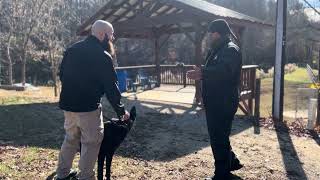
A trainer shows a handler how to correct timing in heel work on day two of a course. The collar goes high on the neck, just under the jaw. Corrections must come before the dog processes the mistake, and praise the instant the dog looks at the handler. Timing, not force, builds the foundation for a handler's entire career.
Chapters
Hey everybody, this is the week after Thanksgiving. We took the week off, which we didn't stop training, but some of you guys may have, so we gave you a week off of these short sets. So it's me, my experience, in my training. I'm going to give you a short set this week and we're going to talk about timing and the essential elements and how it transfers into everything else you're going to do as a handler and why it's so important. So I'm going to focus on timing this morning with a green handler and a green dog. Obedience. Let's work the heel command and I want you to focus solely on timing and the importance of timing. Again, I'll reiterate this. Make sure the collar's high on the neck, just under the jaw and just behind the ear. So you want to pull all that skin down underneath the collar. Yep. And on the bottom of his neck. There you go. I want to hear just a break in that buckle. When you apply your correction. And if the dog's not facing you and looking the opposite direction, make sure you turn. And I want crisp corrections and make sure you keep a loose lead. Okay? Yes, sir. Timing. All right, step off with your left foot. Heel. There you go. Turn and pop. Heel. Heel. Good. Then when he gets into the proper position, make sure he's watching you. Turn. Pop. Good. Now love him up when he looks at you. So there's two things that I want you to focus on. One is the timing of your correction. So if The second he's out of place, I want you to recognize that and apply a crisp correction. The second thing is, is that when he is looking at you, I want you to stop and love him up. Okay. Timing. And this is why we do this to start with every single handler, is because timing is going to carry you through your entire career. Whether you're delivering a reward, whether you're administering a correction, or whether you're giving praise. We want to recognize the behaviors that key us to him being out of position or about to commit a bad behavior, per se, so that we can give a correction. I always say that if we deliver a correction as the dog is processing the bad behavior, we're much better off. So we want our timing to be that much quicker. In the same sense, the moment that that dog is doing performing the correct action, we want to reward that. We will gradually increase the duration of time, but really what I want you focusing on is recognizing that specific behavior, either good or bad, and then giving a well-timed correction or praise. It's very easy to just deliver a crisp reminder with a collar correction, and that's why we're able to use a flat collar with 99% of our dogs. Is it's, it's based on timing. We don't need all these other tools to deliver the correction for us because we recognize the behavior early on and deliver correction. A lot of handlers will let the dog get way out here and then try to correct the dog, and all they're using is force. But remember, the dog has already processed the bad behavior, committed the action, and now you're correcting the dog for being out here. So if we catch it here, we take the thought out of the dog's head before they ever, ever— they're ever able to process that bad behavior. So just keep that in your mind as we run through this quick session. 5 minutes and let's work on that, okay? Turn opposite. Stay monotone for now. Good boy. Turn opposite the way he's looking. And just reinforce the command. For those that are just listening to this podcast that may not be able to see what's going on, this is a green handler. This is his third set with this dog, and I'm only working on the heel. I'm keeping it very simple, not only for the dog but also for the handler, and our sessions are only 5 minutes. That way I don't add too much into the equation for the handler that's getting used to his dog. But the same thing for the dog. That way, if the handler is making a lot of mistakes, it's not as detrimental to the dog right now. The dog's green, so the dog doesn't know him. So I'm focusing on the positive and letting them build a bond together. So for those that are sitting at home, just remember a couple of things. We can work a very long set and we can pound things into this session in order to try to fix a problem. But if we practice things 100% correctly each and every time for a short period of time, we can gradually increase the duration of time, both for the dog and for the handler. So I want to start off very simple and build complex tasks into it as we go through training. This is day 2 of a handler's course. New handler, new dog. And I know I've said that a couple of times throughout this, so I'm driving home that point that this is not a dog or handler that's been prepped for this. This is something very new for both of them. So you can do the same thing in your sessions. And if you think about this, in any discipline that you're working, keep it short, very precise, work on timing of both corrections and rewards, not the force of them.