Talking Puppies | SOURCE
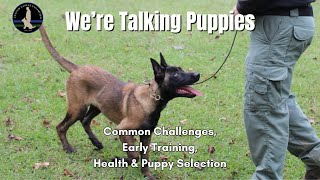
AJ Vargas and trainer Simon break down puppy development from birth to 16 weeks, explaining why socialization at 7-8 weeks and training at 8 weeks matter most. They discuss breed genetics, the risks of buying a puppy for a specific job, and why the ASPCA reports millions of dogs surrendered yearly. Get a puppy only if you can commit the time.
Chapters
Hey guys, welcome to another week of Podcast from the Source, all things working dogs. And today I'm joined with our head trainer, Simon. Simon, thanks for joining me again this week.
How's your, how's your day been?
It's been— I'm blessed. Like every day I get to come in here and work with you guys, I'm blessed.
That's awesome. Do you train any dogs though?
I trained zero. I trained zero. Yeah, yeah, yeah. But I did today just happen to see, look out my window of my office, which was very tempered, and saw you out there training and saw you running around the field chasing a dog. Now.
Yeah. Well, let me clarify, because perspective is one thing. One of my trainers was bouncing the balls down the hill and I'm not as fast as I used to be. And obviously, Yeah, and I didn't have a long enough line, so yeah, I was running around a bit, and I had to get on one of my trainers about that because he was embarrassing me.
Yeah, he was. It was quite embarrassing. I did take a video, by the way, of this, and at the right time, I will release this on all social media platforms. So stay tuned for this, uh, this, uh, comedy to come.
Yeah, I think, uh, Maya's been working on a blooper reel as well. I think she likes the gaffs, so she's been, uh, she's gonna slowly start putting that.
No, it's not a blooper reel, it's for our Christmas party. We have a whole slideshow. We didn't really take advantage of the Christmas party last year.
So yeah, very well.
Well, this week we get to talk about puppies. Yeah, which, uh, is one of those topics that I think you either love or hate. Um, and I say that just because for what we do, puppies are not really in the scheme of, I guess, our business plan or kind of what we would recommend for our clients. And we'll get a little bit into that as we move through this episode. There's a great place for somebody that trains puppies, as you've taken on several over the last few weeks, months since the release of the puppy class. So it's good to educate people on what it really takes to own a puppy and to raise a puppy, whether it be a pet or a working dog. So we're going to talk about that Give some stories about how one of our clients that I just talked to last night that has a puppy that paid an enormous amount for that puppy. So we get to delve into a lot of those topics that people don't like to talk about, and in the sense of being truthful when it comes to puppies, because they're always cute, right? They're always cool to have, fresh new puppy. Now we're reaching the holiday season and my favorite time of year, which is fall. It's nice and cool wearing our sweatshirts and enjoying this cool weather. I didn't see you sweating. Well, but with that being said, I hadn't seen you sweat all year because you don't do well.
Well, now we have offices, so I get to sit in the air conditioning.
I see.
That's where I get my training.
That's right. All right. But before we start, I need to encourage everybody like I've been told to do. To encourage everybody to subscribe. Hit that subscribe button below, like this video, ring that notification bell to make sure that you don't miss any uploads each Friday, and then definitely on Tuesdays with our short sets. So we're going to delve into a couple different things as we move through this episode, Simon, and one of those things is we're going to start from the beginning, right? Fresh puppy. There's some things that science teach us as trainers, but also as pet owners, and there's 5 critical stages for puppy development. They're pretty consistent between breeds. So yeah, you may have a deviation of maybe 10%, but it is— those 5 critical stages are pretty spot on. Can you delve into a little bit of those critical stages? And just tell our listeners what those stages are.
Yeah. So where we start off with those critical stages is we start from 0 to 3 weeks, which is going to be our first critical stage. And this is right from the day that that dog is born. That's when that critical stage begins. And, you know, there's no training that you can do. Typically, this is where the breeders are involved in to care for those dogs. But most importantly, all that dog really cares about is its mother, warmth, and food, which the mother provides all of that. Dogs can't even see. There's no point of training those dogs. We don't really get into training until we hit approximately about 8 weeks where you can start, where you'll be introduced to that dog And typically that's when breeders try and get that dog out of their kennels, per se. And you really can't start any discipline training until about that 12-week mark. But there's really critical socialization stages that occur in between those periods. 3 to 4 weeks is a really big socialization period where any sort of psychological damage that that dog encounters could scar them for the rest of their lives. At least, you know, that's what experience and science has told us.
But even— I don't mean to cut you off, but even with that, I mean, we can equate that to, you know, people that's been bitten by a dog at an early stage of their life and them getting bit as a kid. And then as they grow up as an adult, they're definitely afraid of dogs, and you can never get rid of that per se. They may become comfortable with certain dogs, but they're still not 100% okay with dogs.
Yeah.
So I look at it from that standpoint, you know, making that parallel between a child and a, and a dog. Although the dog may go through these critical stages more rapidly than a child, You still see that in children that are, you know, traumatized very young in their life as well.
And, you know, I'm glad you brought that up because the more I've been working with dogs and just in general, I found that there's a lot of similarities between dogs and people, like a lot, because ultimately, you know, when you actually think on it, think back to it, we're trained the same way as dogs, the same, you know, operant conditioning and classical conditioning is utilized on us. And I like to use those analogies with my with my clients and my handler students to kind of help them bridge that gap and have that understanding. Because, you know, oftentimes, you know, people just think of it as an animal. It's a dog. But there's a lot of similarities in the capabilities that that dog has to learn. Does mimic us in a certain sense. Now, it's not at the capacity of us, but it's along the same lines.
Yeah, I know a lot of people like to draw those parallels between you know, a dog and their children. I read some article here recently, and that beyond half, maybe like 80-something percent of people view their dogs as children. You know, I don't necessarily say I would go that far, you know, to parallel my dogs with my children. You know, now I've lost a couple of dogs in my time, and yeah, it hurt tremendously. But I couldn't, I couldn't draw that parallel with my kids. However, there are behavioral similarities in how my kids were raised and how dogs are raised in the stages they went through, you know, the terrible twos, you know, those types of things that we have to deal with, not to mention just getting a new puppy. And we always say, man, it's like getting a new baby. Yeah, I hope you're prepared for this because you're going to spend a lot of time taking that dog out, spending a lot of time with it, not just putting it up on the shelf and going, okay, well, it'll grow up to be a wonderful dog eventually.
Yeah, well, try, you know, locking your kid in the room and letting them do whatever the heck they want.
I didn't mean to bring up anything traumatizing. In all possible—
I was a latchkey kid.
Yeah, yeah, of course. So, uh, uh, growing up in the inner city of Chicago, you know, where it was rough.
South Side.
Yeah, but, uh, but yeah, uh, So, you know, going right into these critical stages, you mentioned, you know, that first critical stage where the dog sort of with the mom getting their needs met just strictly by the mother. And then as they move on, you talked about probably one of the most critical stages, which, which is that critical stages, that critical stage of socialization. And I think we don't realize that leaving a dog with a pack, a dog pack, too long gains— can gain a lot of adversity to that dog wanting to stay with dogs versus transitioning over to their owner or humans so they have an equal balance. And I've seen this in the training field where a dog would see another dog and just want to pull to go you know, be with that other dog or separation anxiety, if you will, where that dog is just yearning for that pack mentality.
And that reactivity, that is right, is a result of that as well, where you get dogs that just go crazy and they try and pull, and if they can't get to it, they start vocalizing. And correct, that's absolutely an issue. And then on that end, well, you're probably going to mention it, We have the opposite end of that spectrum where they're kind of taken out of that pack a little bit too early. That's right. Which can lead to other issues there as well, where they don't know how to socially interact with dogs or they're too clingy to humans as well, and they've been overly socialized with humans. So, you know, going back to the breeders, that's where, you know, looking into your breeders, especially when selecting that puppy and making making, you know, a sound decision and going with someone that you trust and you have a good feeling with and they're reputable is a really important aspect of that because they need to have that understanding to ensure that you get a dog that hopefully— dogs are going to have issues, but, you know, save you some money on the training end, I guess.
Yeah. Well, you're absolutely right. But, you know, even mentioning taking the dog away from the pack too early, could also be a downfall. We communicate with dogs on their level. And so a lot of what we do is utilize their pack mentality or their pack communication, if you will. It's probably not the right term that I wanted to use. However, we use those dog communication or those dog behaviors to communicate with the dog, even in training. Our tone of voice, our body postures, our facial expressions. All are drawn from what that dog learned when they were in the pack. And that's very important as well to push on with training. So there's pros and cons to, to each facet of those developmental stages. But I remember talking to a client one time and recommending, yeah, we won't start training. And I use training very loosely in these terms. Until about 16 weeks old. However, we need to start the imprinting process, socialization and things of that nature very early on, you know, about the 7-8 week period. And I remember her going to the vet and the vet speaking out about, oh, they can't start training at this age and all that. It's kind of disturbing because most vets that I know stay in their lane. They're on the medical side while we deal with the behavioral side of things and the training side of things. And so, you know, I had to kind of speak out to the client to say there's a reason why they're a vet and there's a reason why we are trainers. And when you miss these critical stages of development like this vet wants you to do, yes, we got to take precaution because they're not fully vaccinated. But even at our facility, we keep them separate, don't put them where other dogs are. There's precautions we take, but we still need to handle the socialization part of it during that critical stage. Would you agree?
Yeah, absolutely. And when I said, you know, training starts at 8 weeks, that's what I was referring to, is that imprinting.
Yeah, no, I knew what you were— I just wanted to make sure that everybody that's listening to us is clear, because as we, we, we understand, we have a context of what we're talking about, and not everybody does. And, you know, really about education and, you know, giving everybody the full scope of what we're talking about at this point is very important.
Yeah. And so people understand when we talk about imprinting, we— when we do that, it's mainly just building that foundation and laying the groundwork. And a lot of it is force-free and allowing the dog to discover and figure out its environment. Without us having to— with giving that dog guidance but not having to force anything upon it. We can set boundaries a bit later on. Not that, you know, a little interesting fact that I'll throw out there, um, because I was kind of reading into some puppy stuff a while back, but, um, it really made sense for me and it was something that I used to justify, you know, why we make corrections. And the first time that a puppy's actually corrected is by its mother.
Yeah, absolutely.
And that happens around that 7-week stage when the mother is unable to produce any more milk and the puppies start nagging her and they're, you know, biting at her and then they start biting at the face. So, you know, like you had mentioned, we communicate to dogs just like dogs. So what we do as far as corrections and whatnot is nothing abnormal from the dog. But going back to that imprinting stage, um, you know, a lot of that, what that kind of looks like, you know, is, um, say for example, I actually had a client that brought in a dog and it, when I opened the door and we tried letting it through the threshold, you know, um, the dog just freaked out for whatever reason. It mainly because obviously, you know, it's a young puppy, it's never experienced anything like this, and that's a critical point where we can be that guidance for them. And, you know, immediately the client wanted to start, "Oh, it's okay," and like allowing it— pacifying it— and allowing the dog to escape. And, you know, a lot of situations like that, you know, I tell people just ignore it, you know, if you don't make it a big deal. Because dogs, especially puppies, are going to feed off of us, and they feed off of, you know, what we put out there. So, you know, that's kind of what that imprinting looks like, is, hey, ignoring things like that, and we're laying the groundwork so that when that dog gets into a situation where they feel uncertain later on in the future, you know, they remember, oh, it's not a big deal, right?
Yeah. Well, stress. I think stress also, a lot of people don't realize stress is important in a young puppy's life. Now, I don't mean stress to the point of breaking mentally, but research has also shown that when you introduce stress to a puppy in a systematic form, controlled manner, when the dog learns to overcome stress, they're a much more stable adult. Donk. So when we introduce these things where the dog's a little bit iffy, or we're just manipulating the environment so they have no other choice, so they learn to overcome those stressors. And then again, you're building confidence in that dog as well, at least giving them the opportunity to realize that even when faced with adversity, I can overcome that versus shying away, running away. Or, you know, I think about pet owners in general. And, you know, I want my dog to be able to walk around and be around everybody. Yeah, but that starts at this critical stage of development.
Yeah.
You know, when you're missing those, those, those pieces of the pie, if you will, then you're really missing out on the big picture. And this is why it's important when you get a puppy to understand there's a lot of work that goes into raising a puppy. It doesn't guarantee everything goes away or all your problems don't exist because there are some genetic things that could be taking place as well. However, you do minimize the, the adversity that you may see from a puppy as an adult.
Yeah. And I love that you brought up that stress point because that's something that I can relate to in life as well. And just think about at work, think about if you had no deadlines, right? If you had like no one on top of you, you know, how much would you really get done?
Yeah, right.
But if we added a little bit of stress, we got deadlines, I got AJ coming into my office asking me, you know, where's these reports or stuff like that, you know, that added stress allows me— and it's not overwhelming, obviously there's a breaking point, but hey, that allows me to perform better because, hey, I got something and, you know, you're able to manage it, but it encourages you to, you know, put out your best performance as well.
Well, yeah, absolutely. Some people call it procrastination. I call it adding stress because I perform best during stressful times.
Yeah, I think we all do. We all have, you know, that certain point where that moderate amount of stress, you know, puts us at our peak performance.
Yeah, absolutely. Now going into, you know, let's talk about this last critical stage of development. And we skipped over some because some are irrelevant to what we're doing per se. But now this new owner has their puppy, got it about 6 or 7 weeks. They're working through the socialization period, being very careful not to put the dog at risk, like taking the dog to places where there's a lot of other dogs, could be potential unvaccinated dogs. So we find places where there's noise, there's disruptions, there's obstacles, and that could be in the backyard, that could be at your own home. But also, you know, exposing that dog to traffic noises, things moving around them, but in a controlled environment because the dog is, or the puppy is, not fully vaccinated at this point. So it's just important that we really monitor where that dog goes and keeps it as safe as possible until that dog becomes fully vaccinated. But now we've reached that point. All right. And now some formal training can take place in this last stage of development and adding some stress, right? About what age is that, that, that can start?
From personal experience and from my understanding, I mean, ultimately it's going to depend on the dog, but generally you can look at between 12 to 16 weeks where that can really start, where you can introduce the dog to a trainer and get started on working on those aspects.
Okay. So, and then again, we want the dog to be fully vaccinated at this point because we're going to get into some formal training now, add a little bit of stress. It's still— and again, me and Josh talked about this in the previous podcast. But all training should be positive. Would you not agree with that, or would you agree or not agree with that?
Well, it depends on, you know, how you want to frame that, because we got the cult side of it. There's a cult sector out there, and, you know, I like watching dog training videos because I like to see other people's perspective. But man, you open up those comments and there's a little sector cult in there that, you know, likes to just tear people down and, you know, they're like, we have the only way. But I think I know what you're referring to as far as positive training. Well, yeah, we should have positive results and the dog's feedback from what we're trying to teach them should, should be positive. There should be a positive association.
Well, you know, and that's my point, right?
Yeah.
And I'm driving this home. In two podcasts because I want people to understand that some discomfort is good. You just said it, being under a little bit of stress can bring out the best of you, and sometimes dogs need that as well. Um, just like everyone— I have three girls, and every one of my girls are different, and I got to find the ways to communicate and deal with each one of those differently. They're not a one-size-fits-all. And so dogs are very much the same way. We adjust. And that's the great thing about having great trainers, right, is when a trainer is very well educated and not washed down a path, they have the ability to use various techniques. Behavior modification has been around for over a century. We were not creating anything new. You know, we can use key terms or little catchphrases or this or that. But at the end of the day, behavior modification has been around for a very long time. And I'm saying the study of, not behavior modification in whole, because since the creation of animals, there's been behavior modification occurring, you know, but the study of behavior modification or the science behind it has been around for over a century. So we're not creating anything new. We're not some, you know, I don't even know what the word is, but trailblazers. We just have learned to read dogs, to utilize various techniques that best and most effectively, and I guess the best benefit for the dog as a whole. And sometimes that takes some discomfort for the dog as well, i.e., corrections. But it should always be positive because if it's negatively affecting the dog mentally or physically, then it's not accepted.
Yeah.
In our realm, at least.
Yeah.
But there's maybe some people that don't understand that concept.
Yeah. And, you know, A lot of trainers have different, you know, going back to that podcast that you're talking to with Josh, I actually listened to a bit of it this morning. But one thing that he, I believe he had brought up was actually like having that baseline of, you know, how you're going to train a dog. And that looks different for every trainer. And, you know, the thing about my baseline is the baseline that I have now is definitely not the same baseline I had 6 months ago to a year ago. I'm always adjusting how my tools work as I learn and gain experience in this field. And, you know, one thing I've, you know, I, I love the idea of a dog being able to figure things out.
Yeah, absolutely.
Um, I think that, um, if we're able to, you know, I think that that's always the best outcome. The dog figures it out on their own. I can set up the environment for them to make that decision and figure it out on their own, but if they don't figure it out on their own, you know, where do we go from there? Yeah, so that's—
or what if they make the wrong choice after learning?
Yeah, what the right choice is after they know what they're supposed to be doing, right? And you know, that's something where, um, You know, I'm frequently adjusting mine, but, you know, you have to have another avenue to go. And, you know, taking it back, you had mentioned, you know, your father. Imagine if your daughters never had any stress, right? Growing up, they never had any stress. Anything, you know, they wanted, you know, they, they got, you know. Now imagine how that would translate to adulthood. When they get put out in the real world.
Yeah.
Are they going to be successful?
No, no. And I'm going through that now with one in college who just started college and now experiencing times in her life where everything was not the best, you know, stress of school, stress of sports, a push that she's never got before, you know, really at that level. Yeah. And, you know, having to sit there and tell her, hey, You got to work through it. There's nothing that mom and dad can do for you at this point. Yeah, it's on you and it's on your shoulders. And you hope that you've prepared her for that throughout her life. Yeah, we all fail. We fail as parents a lot of times or, you know, things of that nature. We haven't trained every dog to the best that it could have been trained, maybe because we may have missed this key point. This may be experience. We've never seen this before, but you can only do it by applying that baseline, like you said, and then working through that with experience. Because behavior is, man, it's, it's a mixture in a pot sometimes where you're just trying to figure out what the triggers are, you know, what, how this dog best learns, and, you know, trying to unlock that lock, if you will, to get the best results you have now. But you can't do that behind a computer, you know, giving comments on everybody else's training, right? You got to be out there actually freaking doing it, right? You know, and you got to master your craft. I know there's some research out there on how much it takes to master a craft. I don't have those in front of me. And again, I vividly remember some research about that. But man, we practice this every day. Yeah. You know, make sound decisions. And the great thing that we have is a team. And I always say that, like, I've been doing this over 20 years, but if it wasn't for my team to get different perspectives, to see things that maybe I missed, we would never get the results that we get consistently that we get.
Yeah. And I can't— and to add on to that point, you know, this might shock you, AJ, but I do read books.
I listen to books.
I read books. No, you listen to books. I read books. Um, you know, I love what— I love reading books. I love, uh, watching videos. I just, you know, I, I like to expand my knowledge as much as I can.
And you're still behind the curve though, trying to get the experience.
Yeah, I gotta catch up so I can be deemed qualified. But, um, other than that, you know, like, I think what, you know, the best tool that I've had— like, you can be as well-versed and well-studied But, you know, the best experience you have is just working a freaking dog. And I think that helps put everything together. And that's kind of why our trainers course, you know, our trainers course and our handler course, the main focus of it is get out there and work the dog because there's just some things that you're not going to be able to learn from a book. You got to see it, you got to experience it, and you got to sit there and problem solve it.
Well, you know that, that keys me up. And if our listeners haven't listened to the episode with Josh, we're going to put it in the show notes, a link to that.
I haven't finished it either.
Right. But, but here's one thing that he said that really resonated with me is one of the pitfalls to what we have today of trainers is the overload of information. Everybody has an opinion. Everybody's done this or done that. So everybody wants to listen to this. And I remember one student in particular, and I know you'll know who I'm talking about. That would listen to all these podcasts and all this stuff, and it would only convolute his ability to train or to handle a dog.
Yeah.
And it really interfered because he wasn't at the level yet that he needed to be to understand and discern where the application of that knowledge fit in to physically handling a dog. The time and the reading of what he sees in front of him. But yet he was trying to quote or utilize all these big things that he heard. And I told him the only podcast he really needs to listen to is The Source. But he didn't listen to me about that.
I don't even think The Source exists.
It did.
But maybe that's what screwed up.
That was the issue we were missing. But my point behind that is, as Josh mentioned, doing the same thing, and I never thought about that. As much information as we have at our fingertips, sometimes it's too much and it creates problems. We gotta crawl before we walk. Yeah, you don't throw the puppy into bite work, you know, at 7 weeks old and go, okay, handle this.
You're not doing calculus if you've never done basic addition.
Correct. You know, and, and that experience needs— now I will caution people, and I say this all the time, You shouldn't be putting your hands on other people's dogs unless you've been formally trained and you stick to the level that you need, that you're at. And I say this, and this is not a kudos, but I took— even after being trained, being a police handler, being trained as a trainer, I took 2 years pro bono to work with people's dogs with the understanding that, hey, I'm new at this. I need to hone in my craft. I need to feel confident that what I'm doing and I might make some mistakes, I may misread some behaviors. But if you give me the opportunity, please allow me to work with your dog so I can get the experience that I need. And I spent 2 years doing that.
You get what you pay for, though, right?
To some, to some degree. But at the same time, we have to understand where we are in our careers and where we are in our training, right? Everybody wants to watch a YouTube video and go, I can do that.
Yeah.
Until you get out there and do that.
And to your point, you know, I've been in that kind of circle and that cycle where this guy's saying this, this guy's saying that, like, oh, I need to apply this. And, you know, that's where going back to what we were talking about earlier is, you know, and what I would recommend for people, I know we're talking about puppies and we're getting a bit sidetracked, but I think this is really important. We were talking about, you know, that baseline, you know, get a baseline established with formal training so you have something to work off of and you have a basic understanding, get some experience. And, you know, yeah, I listen to podcasts because I like to hear other people's perspective.
Yeah, absolutely.
What are other people thinking about something?
But you have the baseline to discern exactly what applies and what doesn't apply or what is good and what is bad.
Critical thinking. They need skills.
Yeah.
And, you know, I wouldn't say that I haven't, like, heard something on a podcast and was like, let me try that. Let's see, you know, if that's something that, you know, it doesn't really deviate too far off of, you know, what we— what my concepts are. And let me give that a try. And, you know, maybe it works for a particular dog and I just put it in my back pocket. And over time, you know, with reading and looking into other, you know, aspects of training, and trying to broaden my knowledge. Yes, my, my baseline as far as training goes has, you know, evolved, I would say, over that time. Yeah, but I needed that initial baseline.
You also have the support of other trainers. Yeah, right. I think I heard you say this one time. When you're isolated by yourself, you're the best trainer ever because there's no accountability. There's no— there's nobody challenging what you're doing. So obviously everything you're doing is right. Yeah, it's not until you surround yourself by a bunch of trainers that hold you accountable, that are watching what you're doing, that are querying why you're doing that, that you really truly get challenged to the point to where you stay— you form that baseline and you stay within that realm. Because we get projects all the time that not every trainer can handle, and that's the important thing. As well, from your standpoint, is knowing what trainer should handle what task because they're just not at that level to where you go, here you go, this is something you can deal with. Because I've even gotten in a situation where I'm just like, man, I'm stumped. I need some help. But thankfully, we have a bunch of trainers that can delve in. And even if it's not here, I have a strong network of other trainers that I can call on. And ask for help. And that's an important facet as well, because you're always going to get into something that you're just like, oh, I don't know about this. I mean, any other profession does it, right? Doctors, psychologists, they all seek out professional help when they get stumped. So why would we be any different?
Yeah, absolutely.
So looking at, uh, these puppies in general, right? And I don't think we deviated too far. These are important perspectives that people need to have, especially going in, because it lays the foundation to what you're getting into, right? I've heard so many clients go say, I've raised dogs all my life, I've been around, this dog is just stumping me. Yeah, because every dog is different and every puppy is different. I always like to say, well, I want I got a German Shepherd because of this, and I've owned 5 German Shepherds. Well, every German Shepherd is different. Every dog here is different. They have their own personalities. They have their own way that they learn, what motivates them, how they excel and how they don't, what they're good at and what they're not good at. And so even with a puppy, we have to make those adjustments. So people need to also look at and consider their lifestyles and what they're doing and what they want a puppy for. And it— man, I just, I hate to say this— when you have a specific task in mind like a protection dog or a drug dog or a tracking dog and you go out and buy a puppy to serve that specific task, it's very difficult Right. That's like going out and the NFL team going out and picking kids. It doesn't happen, but going out and selecting kids for their next quarterback and then raising them up to be a quarterback, it's just unreliable. It's not as reliable when you see that quarterback at the combine and you go, that's the one I want because it checks all the boxes of what fits into our team. So puppies or a gamble. And I just want people to understand that, that when you invest in a puppy for a specific task, it's a gamble because you don't always get what you're looking for. And most times, more often than not, especially on the working side of things, more fail than succeed, even with great genetics, because there's a lot of outside influences that will dictate how good they are. Obviously, a lot succeed as well, but the vast majority of them will fail when brought to that. So what should some people consider when they're looking at a working puppy versus a pet puppy? Are there any differences there?
Um, well, in those cases, I think one of the first things is looking at the breed. And okay, not that the breed is the end-all be-all, um, because there's obviously a lot of deviations from that, but you know, breeds do have a lot of similarities.
Yeah.
Um, just because, you know, you're talking about the various puppies within a breed have a lot of similarities, right?
Yes. But you want to look at that breed with selective breeding. Certain animals were bred with the purpose to utilize for specific things. Yes.
No matter what that is.
Working capabilities.
Yeah.
So you want to— if you're looking at a pet, you know, you want to look for something more along the pet lines. But if you're going to look into some of those working lines, you really want to take a look at that dog very heavily and maybe even understand the genetics of the parents before you make that decision. But like I said, it's not the end-all be-all with breeds. But as far as breeds go, if I'm looking for a protection dog, there's, you know, a handful of, you know, breeds that I'm going to be looking at.
But the same thing if we were looking for a detection dog, right? Then we're going to go to those sporting breeds that, yeah, have those capabilities. Yes, we would look at the parents and see what their drives look like, what their characteristics— that gives us some insight. To that particular puppy. It's not guaranteed.
However, it does give us the likelihood, you know, and I'm a gambling man, you know.
So, of course. So bringing up these differences and what the owner wants is also important on selection. But what I think the biggest thing that I see is laymen's, and I use that not in a derogatory form. I use that in a way that people are selecting puppies that have no experience in selecting puppies.
Yeah.
And so they go out and they fall in love with this cute little puppy or just take someone else's advice without getting someone that they trust or working with someone they trust. And a lot of times it doesn't work out that way.
Yeah.
In the way they want it to.
And, you know, I, I hate to say this, but Something that I've kind of realized about the canine industry is, you know, you— when you want to look at dogs or get training, you really, really, really want to find someone that you trust. Like, trust is a very big aspect, I think, in our industry. And, you know, not that I'm trying to bash the industry in any way. I just, you know, I—
well, here's, here's the thing though, Simon. We need change, right? Like, that's the reality of it. And this is crazy because one of our partners that are coming online with a new facility, just talked to him yesterday. He purchased 2 puppies, paid a deposit for 2 puppies, and mysteriously now the puppies have been stolen. And so he had to fight to get his money back.
Wow.
You know, but our industry is full of this. I don't understand why. And but those are reasons why we need people to make positive changes. And we're going to hear some stats in a little bit on why we also need positive changes being made from the puppy perspective. And it's important that our listeners understand that puppies are a lot of work, man. Like, and it could be financially harmful too, just because maybe this puppy takes more than what you're capable of doing. Obviously, we would like every puppy owner to be able to raise a puppy on their own, take it from puppyhood to adolescence, all the way throughout the life of the puppy and the dog. However, that's not the case, so you got to be like prepared if the need comes to seek out professional help and do that early. Yeah, because the longer you wait, the reality is the more it's going to cost you. Yeah.
And, you know, I just, I just because we have clients that come in that, you know, unfortunately they've, you know, gotten— how do I put it— the raw end of a deal. Working with someone in our industry. And, you know, that stuff really— that's why I have such a commitment to ensuring that I am taking care of that customer because I don't want to be one of those— we can call them predatory individuals like our partner has dealt with. And that's why, you know, I say why I love working at CCU and the trainers that we have is I see the commitment. That we have to our clients. One of my trainers had a client that brought up an issue that their dog was having, and, you know, he was like, hey, I'm gonna go do this, this, and this just to, you know, make sure it's right. It was a minor issue, but, you know, just that commitment that he had to that person and following up with them and checking in on them.
No, you should always put yourself in the shoes of the owner. You know, if I entrust somebody or a service provider now, that's not to mean that every outcome is going to be the outcome I want. However, the provider should always be honest with the client. One of the conversations we had yesterday with a client was the harsh reality of what they're facing with a working puppy and some things that they're going to have to do to achieve their goals. And that's their biggest shock, was the things that they have to do to get to that point. And it may not even work out in a year. But again, being upfront with them before they're just paying money. And I think a lot of times people are scared to be upfront because they're scared that the people are going to walk away. But I'd rather people walk away knowing that we told them the truth upfront or knowing what they're going to get into before they get into it, whether it be from a financial or time perspective, like how much time they're going to have to invest in making this a reality. You just don't wave the magic wand and all of a sudden this puppy is going to college and going to the pros, if you will. It takes a lot of investment to get to that point, and that's not just our investment from the training perspective, but the owner's investment in time and training. It just is. That's the reality of it.
Absolutely.
But as we look at this, you know, yes, there's going to be differences in training. There are some parallels a pet, you know, a dog being trained as a pet versus a dog being trained as a working dog. But there are some vast differences too on some approaches we would take. Right off the top of your head, do you know any of those differences that are the most extreme for people to understand?
Yeah. So as far as pet clients, one of the— and, you know, as With puppies, I think one thing that I really implement as far as the foundation goes is impulse control. You see puppies that, you know, they want to chase things, bite at things, and they're very sporadic. So one thing that I really try to implement with my pet dog, my pet puppy dogs, is, you know, to be more composed and more focused on the task and starting that off early where, you know, as far as my working lines, that's where I— that's a behavior I'm going to want to encourage because it's going to help me with the product or the task that I want to, you know, set them up for because it's going to ultimately lead to their success. And when you talk about going into a working dog, which I talked to a client about, and we might be talking about the same client as well, but I said at the end of the day, I want reliability. You know, you want a personal protection dog, I want it to be reliable. I don't want to give you a gun with no bullets. Yeah, right, because of that analogy. Yeah, yeah, that wouldn't feel good on my account.
But you could make it look like it had bullets in it.
Oh yeah, absolutely. I could put blanks in there and, you know, you know, and you're happy, you think you're good. But I think the worst thing in the world would be, you know, if the situation arose where that person needed that dog and it failed to do what they spent all this money to do.
Yeah.
And I, I would always be— and like, you know, that transparency, that transparency aspect is a huge aspect because I don't want anyone to go into the hole without the full understanding of, you know, that it might not work out. Well, that's so—
that's— it's so important. For an owner to know that, you know, I don't think it comes down to just getting the dog into training. It's what this ultimately looks like. And we spend a lot of time in education.
Yeah.
So that the owners are fully capable because they get this dog or this new puppy and they're excited and they want this and they want the world and they da da da da da. But then reality hits. Time and commitment. Some things being left alone and not addressed right now because it's going to hinder or help you later on in training. So the overall training plan looks a little bit different for a working dog in some of the things that we promote, some of the things we let go, and some of the things we don't control at this point because we want it to blossom.
Yeah.
To have the best opportunity later to be successful.
And, you know, on that point, you know, one of the things that people complain about the most when you get a puppy is what?
Yeah, the chewing.
It's biting me, right? It's biting me. Get it to stop biting me, right? And that can be really frustrating for owners, especially if they want to go down that protection line, having this puppy, you know, and trying to redirect them to a rag and not trying to completely shut him down.
Yeah.
And it's a very delicate thing to do to not, you know, kind of redirect those things and build that context of when it's appropriate, especially for someone that's never done it before.
Yeah. Then the reality of if you get this working dog and you can't train it and you're not getting professional help, I mean, just the— what could go wrong?
Yeah.
Yeah.
The number of things— this dog grows too big, force breaches, um, you know, you can't keep a thumb on it and this dog's just out control.
Yeah.
And then having the finances to obtain that professional help. There's nothing worse than an owner getting into a situation where they're like, well, I only have a week. I can only afford a week. But you took on this dog. Like, you know, you have to invest in it. And, you know, you don't wave a magic wand and change stuff. Some behaviors take time. and that commitment, unfortunately, in our industry costs. It costs money to, to do that, and we would love to be able to help everybody out, and that's the reality of it. If we came together and said, hey, can we give this client and just help this client out that's having these problems, we would all agree to say yes. Unfortunately, that doesn't keep the lights on. It doesn't, you know, It's just the reality of it. You got to make the commitments. Absolutely. Because you can't just put a dog on the shelf and expect everything to turn out good. Not every dog is like that. Um, I remember when Zach first started, him getting a phone call, this lady saying, well, I don't want to pay for nothing. I just want you to tell me what to do. I'm sorry, but it doesn't work that way. For one, we can't give advice without seeing your dog. That would— we would really be remiss for doing that because we don't We just can't do that. You know, we need to see your dog. We need to see what's going on and what influences of this behavior and that behavior is having on each other. Like, it's a— it's not as easy as and as simple as going, okay, pull the leash, tell them no, give them a treat. It just doesn't work.
I wish I could do that at the doctor's office and just call in. I don't even have to come in. I don't have to pay you nothing. I just, you know, that's right. Yeah, you went through all that schooling and all that experience just for me to call in and ask for free medical advice.
Yeah, I mean, I see it sometimes and we try to produce and probably the main reason for this podcast was to give people as much as we can without overstepping those bounds, you know. And so this, this podcast was formed by trying to educate people as much as we can from all demographics, from all demographics, police, can handlers, civilians.
Trainers, my trainers out there, shout out.
So now let's look at, you know, the— you talked about breed, we talked about, you know, some of the temperaments and, and such. What about the health of that puppy? What do you— what is somebody looking at to, you know, really tell if a puppy is healthy?
So I'm not the most experienced on this, and When it comes to the health and well-being of dogs, like, that's where I go to our kennel master, Deborah, for. Because I just— I, you know, I'm good at training, or I like to think I'm good at training. Other people might disagree. But, um, you know, I do know— at least everything I do know, I did learn from Deborah. And, you know, some things that we look at is obviously the dog's got to be vaccinated. And, you know, that's not just for the health of that puppy. And I didn't even know this, but it could actually affect dogs that are fully vaccinated and it can get them sick. Don't ask me how it happens. That's just— I'm trusting my sources on this one.
Well, you are not Google, right? But we can't get X-rays as a puppy, so we don't know about hip, spine, or anything anything of that nature at that age, we gotta wait, you know, we generally say at least 12 months.
Yeah. And it's 2.5 years to actually have a clear reading on their hips and elbows.
So now you're gonna invest in a year to 2.5 years before you really know whether your investment is gonna be sound from the joint perspective.
Yeah.
But then even with that though, You know, health is also visual, right? So every time a dog comes on the training field, and that's why we're such a proponent of grooming, brushing, checking a dog, even a puppy, on a regular basis. And we have some times set out twice a week, Tuesdays and Fridays, for brushing every week, and then washing at least twice a week. But also knowing what the dog's normalities are. So learning those dogs, and that's why Learning our clients is very important and what a dog normally looks like, what their gait looks like, what they generally— their, their confirmation looks like and what they normally feel like when something's not right. And oftentimes you can look at a dog and go, oh, something's going on. Don't know what it is, but you might want to get this dog to the vet and just have them checked out. I don't— you know, something going on that we don't know about. So it's important that even from a health perspective, that as trainers, we're taking a keen eye on everything that dog's doing. Now, me personally, I like to watch things from afar. I get better perspective when I see it at a distance versus when I'm right up on it. And so I'll often do that with dogs that I'm watching, or when a client's working a dog, or a handler or a trainer, and I'm watching them from a distance. And I can't count the number of times we found things wrong by just merely doing those visual inspections and those touches. I think I remember you one time taking a dog in for testing and getting them all the way through the testing process, and you didn't even realize the dog had a cut on its neck. Now, I understand you were new at this.
You're like my wife. You like to bring up old stuff.
But, you know, I ask myself, how does a trainer missed that.
Like, because I trusted someone, right?
So here's my point, and that's exactly what I want him to say without rehearsal. You trust but verify. Yeah, you go through your steps and your protocols. And if you don't already have protocols as a trainer of how you evaluate and test and inspect dogs, especially client dogs, to help them to keep their dogs healthy then I would advise you to start that. And we have— I know we have some podcasts that talk about the 10-15 rule, and I think we need to put one out on, on the steps that we would go through, because I'm very procedural. This is how my mind works. I'm organized. You go in my office, my stuff's organized. You go in his office, stuff is all right. My point is, is that thing— you miss less things when you are very systematic in what you do, and And when a dog comes out on a training session, we observe that dog, how it walks, how it walks away from us, what its appearance is, you know, overweight or not overweight, what the skin and coat feels like, how the dog generally looks, because those are all key indicators. If the dog urinates or defecates, we're going to look at that. These are all key indicators on how that puppy's health is. And how they're alert. They look lethargic. That's not normal.
Yeah.
So we have to train ourselves to even monitor these things because it's not all about training.
Yeah.
It is all— it is about the dog's health and well-being.
Yeah. And, you know, my knowledge as far as health is very baseline. And obviously everything that you covered, that's baseline, right? But to add on to that, you know, especially when you're dealing with puppies, there are certain issues that you can run into, and some of those include congenital issues and, um, genetical issues as well.
So, uh, word— I don't know, I didn't go to college like this guy did. Remember, he was going—
I dropped out. I dropped out 3 times.
Okay.
I graduated from Custom K9 University.
I just don't know if that word is a real word. So if we were playing Scrabble—
or excuse me, voice of reason, sorry for just bleep it out. Uh, voice of reason, genetical word, genetic. Okay, fair enough. Yeah, I tried.
Okay. Yeah, you're, you're a doctor, not a musician or a scholar of English, right?
Yeah.
Or—
and I just want to make— because everybody gives me crap about my misspellings. At times. So at least I speak. I may not know how to spell it, but I can speak it. But go ahead.
Fair enough. Um, but yes, we have those aspects as well that we want to look at even when selecting that dog as well.
Absolutely. And personal— if I go to someone's house or go to someone's kennel and it's dirty, I'm not getting a dog from you. Period. If it smells, I'm not getting a dog from you. I hate it. I'm walking away.
If you got multiple dogs in the same kind of—
I'm not doing it. I hate it. Personal preference. You do what you want to. But for me, that's a big thing.
Like, what's the small things, right? I mean, it's a big thing, but it's a lot of small things that go into it. And I guess that at least we could say from past experience, you know, when you see that attention to detail that someone has, yeah, to whether it's their facility or, you know, whatever.
And we're not saying they have to have a state-of-the-art facility, but I mean, the least you can do.
But it's a good indicator, you know, of, hey, you know, they're holding a standard. There's a standard in place. And, um, not saying that they're going to be perfect, but, you know, that's a good indicator that it's someone that could be reliable. Yeah. But yeah.
Also to me though, a clean kennel means healthy dogs. Yeah. If they've got dirty water pails or unclean kennel walls or anything, that to me says that dog could have any number of issues.
I actually, I tested a dog once and the dog had all the drives and was like, you know, and it was a dog that someone wanted to donate to us. I actually turned it down because I looked at the dog's water pail and it had moss growing in there and the dog was drinking out of it.
But you feel sorry because you want to get the dog out of that situation, right? Like, you're just like, oh man, yeah, it kills you.
Business decisions had to be made, so I was like, I don't know if I can take that risk because ultimately we gotta— if we're gonna sell the dog, we're going to do a health check. And, you know, there's other things to think about. And, you know, as much as I wanted to take that dog in, I looked at that water pail and I was like, oh, that's a big risk. You know?
Yeah. You know, you just— you get to that point where you, you begin to look at things with a fine-tooth comb. And at least from our perspective, we want the best for our clients. We're not perfect. And that's the— that's the thing, right? Like, We don't claim to be, but we've learned a lot in our experience. And some of those things are simple things like sanitation, health and well-being. There's too many other puppies out there from reputable breeders to not have to do that. And I hate it. Sometimes you pay a little bit more for that, but you pay for what you get. I think you mentioned that earlier. In, in this podcast, but not that, you know, it's all the time, but also the referrals that you get from people as well. And that's why it's important that we keep good company because we want to get referrals and we want to get referrals from other people. Hey, if we're looking for a puppy, we're going to reach out to our network and go, hey, where have you had success? And I can name probably 10 people that I know that have gotten puppies from reputable people that have turned out to be really nice dogs.
But well, I think that we might have to do a whole episode on building a network in the industry. Yeah, just because like I know from personal experience, I'm sure you guys as well, like if you can find a training company that is trustworthy and worth their training, then they can connect you with the right people. Whether you're looking for a dog or you're looking for a certain kind of training they don't provide, whatever the case might be.
Yeah, I mean, that's what it's about. If we can't service your needs, then we should have a reference for you to where you can get what you're looking for, especially in our industry. But I also refrain from giving references that I don't— either don't trust or that I don't know personally, because if I don't, you know how that stuff turns out sometimes. You were going to say something?
I was going to say—
never mind. All right, look, go ahead.
No, I was going to say, and they're not smelly.
Yeah, that's important. All right. You know, we've unpacked a lot during this episode. And, you know, I think I enjoy— I was watching, I think last Saturday you were working with a puppy with a new client. And just to see that little thing, ears perked up and the dog just sitting so pretty or the puppy sitting so pretty. Confidence walking around here. And I'm just like so excited to see where that puppy is going to be in 6 months, in a year. And that's the exciting thing to get in with a puppy, is to see— and the same excitement when you have a kid or a baby, and as they grow, you get to reflect on these milestones that they've reached and the great things that they've done. Even through some turmoil sometimes. It's just remarkable as a parent to see that, but as a dog owner as well. It happens very rapidly and you get to see it, but at the same time, deterioration can happen very rapidly if you're not careful. And so we got, as owners, have to be responsible on both ends of the spectrum. I've asked before we started this, I asked Maya of The Voice of Reason, as you guys know, or to look up some stats. And, and I think going through this entire podcast and talking about these critical stages of development and all these things that we talked about, I think we would be remiss if we didn't talk about responsible ownership. Yeah, because everybody wants a puppy because they're cute and cuddly, but sometimes that's not the right choice. And sometimes dogs are not the right choice for you at this moment because there is a big commitment that you have to take. And people get lost in the fact that they have to have that commitment. You can't just dump them off. Oh, you can't just not address the problems that you're having. And so you got to be committed before you even delve into this, before you get a puppy, a dog, or anything like that. Don't get this and then realize that it's a lot of work, because we're telling you up front, it's a lot of doggone work.
It is.
It's not easy.
Yeah.
And so that commitment— you can't put them in the crate and just forget about them and expect you're going to work all day, come home, let them out, and they're just going to miraculously, while they were in the crate, learn how to behave. You got to spend time with them. I had to spend enormous amount of times with my kids, you know, to to try to raise them the best that I could. There's no difference with a puppy. You got to spend time. You got to commit that to them, either you or pay someone to do it. So I think we would be remiss by not giving everybody some stats. So, Maya, we're at the grim point in this podcast where we got to give some stats that we don't necessarily like. No. Or feel good about.
And I will have these links below for reference, but this is coming from the ASPCA that, you know, there's about 3 million dogs surrendered to shelters per year. Of those—
hold on, hold on— 3 million, 3 million dogs each year, each year surrendered to shelters. So that means somebody had this puppy fever.
3 million people.
3 million people So look to your neighbors, look to your friends that want to get this puppy that you know shouldn't be getting a puppy. And you, you probably know someone like that, Simon, that you're like, oh, we're getting a puppy. You're like, you don't need a puppy, you can barely take care of yourself. Oh yeah, right. So my point is, 3 million people, that's astronomical.
Yeah, but of those, okay, most of them are between 5 months and 2 years, which I'm not a trainer, but that's about in that like tough puppy into Is that a teenager?
Yeah, yeah, yeah, terrible twos type, you know.
Yeah, so from 5 months to 2 years.
So get help to fix those problems. Dogs only learn behavior unless it's something genetic or something like that, but these are learned behaviors. You're good. These are learned behaviors that can be modified in most cases if you just spend some time or hire professional help. I'm not saying it's us. Find someone you trust.
Yep.
But commit to that. But verify. But verify. But verify.
But here's the sad stat.
Okay.
All right, Voice of Reason, make sure you grab some tissues because we know this is going to affect you.
It's sad. Of those 3 million, about 1 million are euthanized every year.
It's unfortunate. It is unfortunate.
And this number just increases, especially coming out of COVID because during COVID everyone was at home. Everyone got a puppy because they were bored at home.
And now you can't blame everything on COVID.
That's true.
I don't know, just blame it on bad decisions. Let's blame it on bad decisions, these people, right? And we understand circumstances happen.
Yeah, but find a friend.
Surely you got one or two friends that could help you out. And if nothing, play the guilt role on them, look like—
or blast them on Facebook.
Blast them on Facebook.
This is not advice.
Yeah, it's not. Yeah, don't blast people, but I would recommend like turning to your network and saying, hey guys, I can't take care of this dog anymore. Can somebody help me? Because I don't want this dog to be in a shelter. I don't want something terrible to happen to this dog. You know, early on in my career, when we were at our other facility, so it's been, it's been a while since I've heard this, but I knew a trainer that I knew, and this is crazy because it shouldn't even be like this. Or trainer recommended to at least 2 to 3 clients that I knew, 2 for sure, but I seem to think there's another one, that the dog was too much for the owner, so they needed to euthanize the dog. And it wasn't even major issues, it was just behavioral issues that needed to be worked on and educated. So for a trainer to recommend that, and this is something just totally overt, is, is beyond me. Like put in the work, modify the behavior. And if it's beyond your capability, that's where knowing people in your network to refer them to, to say, hey, they're better equipped for this type of issue. Believe me, the industry will thank you for this. Because if it's beyond my capability or Simon's, like, we have to recommend them to go to a great trainer that's very knowledgeable and at least is going to if there's a chance, is going to be able to help you. It's important, guys. It's so important. Just don't put them in the facilities. It's not a good life for them. And even, you know, with that being said, we even tell people here, like, it's not good for us to keep dogs in our kennel. We never want a dog to stay in our kennel. That's why we don't have 400 dogs waiting to be sold. We monitor that. Yes, we can expand our facility. But I refrain from that because it's not a good environment for a dog to be living in a kennel for an extended period of time. We call it, and it's just a general term, kennel rot, where bad behaviors begin to develop. And, you know, imagine you being in a kennel, you know, a vast part of your life in a, you know, small enclosure or, you know, just having runtime. It's not good.
I don't want to get prison.
Right. It's not good. They need to be out. So we don't even take dogs that are going to be in our kennel for an extended period of time. And we tether how many dogs we bring in because they're in a constant rotation. When we have a dog for an extended period of time, we, we do not do that. And that's why we don't take in a bunch of dogs from people.
Yeah, we do have a lot of people reach out, and I guess that would be another resource if you have a training facility around reach out to them. Maybe they have someone they know of that rehomes.
Yeah, we— you got to get those dogs into a new home. That's the best, you know, someone that's committed to changing and modifying their behavior, that maybe has the financial resources to do that. But putting them in a facility is, is not going to help the problem.
This is something I saw a couple of days ago, okay, but it was that owner surrenders, so like someone bringing in a puppy they can't handle anymore, are the first ones to euthanized in shelters because it's usually like they come in, they say, oh, the dog bit me or is aggressive or whatever. And so the shelter just takes their word for it instead of performing a—
Dogs bite animals. Yeah, like that's going to happen. You know, not that you want it or you want anybody to get hurt, but at the end of the day, dogs nip at times.
Absolutely.
Especially if you're not teaching them that that's a bad thing.
You know, or they play rough. Yeah, you get big dogs, they're not going to play the same way a 10-pound dog plays. Yeah, I'm speaking from experience.
And you know, I think it's kind of funny that you brought up about me working that puppy and all that, and I love that that was your perspective. But on my end, you know, it took a lot of patience. And that's one big thing about puppies, because we're on the topic of puppies, is that Yeah. And, you know, you got to see that product, that one glimpse that you took from your office to see, you know, what—
By the way, I was here on Saturday to see that. So go ahead. Since I've been working like 30 days straight. But go ahead. You had a day off or 2 or 3.
I'm about to have 3. So thank you for that. But, but no, it's—
it's difference between days off and suspension. But yes, you are getting days off. It's all about perspective, right? Absolutely.
You know, that was a dog that was nipping, I was biting. It was a working line dog that I was trying to turn into a pet. And there's a lot of patience that goes into it and a lot of consistency that needs to go into it. And when you make those commitments and you select maybe breeds that are kind of out of your realm, you need to be prepared to make that commitment.
But you also don't get to choose, right? You get a puppy and that's what you have. So now you don't get to like turn them in and get a new one because they're acting up a little bit. I'm thinking about when you're talking about patience. The first thing came to my mind was my youngest daughter when she was learning to read. And we're teaching her the word 'the.' And I remember her sounding this out. She's going to hate me for this when she hears this. He, he. I'm like, it's 'the.' You've already said it. 20 times before this point. And now you're having problems saying the same doggone word that you've already learned. But it goes back to patience. I could have destroyed her by being angry at her and pushing her. But even with the puppy, you have patience.
Yeah.
Like, have some compassion. Allow the dog to learn. And like you said, put them in an environment where they can learn versus being rough with them and you know, trying to force it down their throats. Every, every puppy's a little bit different, but what I do know, if you spend time, take a proactive step in teaching, the outcomes are much better than if you didn't. Okay, you want to work all day and put the dog in the crate and expect them to learn? It's not going to happen. You got to spend time and commit to that, or hire someone to do it. And if you can't commit to that, do not get a puppy. Don't. Just stay away from it. It's okay. Someone else will take on that responsibility.
I can say without a doubt in my mind, after this influx of puppies that we have, that not anytime soon do I plan on getting a puppy. I was kind of playing with the idea until, you know, I started working with these puppies. And ultimately, you know, having that patience is good, but be prepared to have it tested. Yes, they make sense.
Being honest with yourself. Yeah, like you, you realize, oh, that's not happening. They're cute and it's fun, right? Because everything's exciting for them until it's not. Exactly. And you've got an 80-pound dog that doesn't listen.
Yeah, but continue to chip away, you know. Um, but that's how we met, Voice of Reason. So if it wasn't for your bad, badass puppies, then we would have never known Maya. And now we share an office. But there are some resources out there, books, you know. We're in a world today of resources from the internet, YouTube, books. But don't take everything, you know. I'll say this again, not everything on the internet is true.
AJ, when are you going to write a book, man?
No, I don't write. Remember that? I don't write, I listen.
You can talk to text, speak to text it.
Yeah, yeah. Who has time to do that? I wonder where you find the time to do that. That's, that's what I—
you pay someone to do it for you.
But then it's not just put your name on it. There are puppy classes. They're great trainers. You know, CCU has a puppy class. We, you know, develop training plans for your young pup, behavior modification, help with reaching your goals through a lifetime. And that's an important building relationships with someone you can trust. Is so important, and no better time to do that than when your puppy's young. Help them develop. Get professional help. It will ultimately save you money. I promise you that, and a lot of heartache. All right. Even if it's just to have us on your side to go, hey man, you got it. Yeah, let's do it. You know, sometimes you just need that encouragement when you're pulling out your hair and your puppy's peed in the house and you've been trying to train it potty training. And but when you have someone on your side giving you advice and helping you or being there with you to teach the puppy, giving you these techniques, I'm telling you, it's, it's much easier. But guys, don't forget Tuesdays. Every Tuesday is our Short Sets. There's other resources there. We do a plethora of various topics each Tuesday, but they are what they are. They're short. So get a little dose for the week of training. Maybe some inspiration from these short sets. Okay, don't forget to leave your comments and your thoughts below. If you have show ideas or things you want to learn more about, please don't be scared to share those with us. We read every comment. May not comment back because some of them don't require it, or some things just don't need to be addressed. In the voice of Buck Allen, You rather people think you're an idiot lest you speak and confirm that you are an idiot.
So that's a good buckism.
That's a good buckism. I love it. Like, I use it all the time because I have to remind myself sometimes less is more. Okay, but don't forget to subscribe, follow us, check out what we're putting out there. Uh, again, it's not the end-all be-all, but we just teach and talk and give you guys perspective from our, from us and our years of experience and the things that we've overcome, the mistakes we've made, the positives that we've had, and we just like to share those things with everybody that listens to us or watches us. So, but it's not about us, it's about you, and if you learn one thing from our podcast, we're happy. That's We're about education. So have a great week. I'll see you guys Tuesday. Maybe not me. Somebody will see you Tuesday on our short set and then back here on Friday with our long-form podcast. I appreciate you guys' time. I can't thank you guys enough for following us, but don't forget to share the love. Share it with someone that might need this. Have a great week.
More from AJ

Running vehicles with K9 Chidori#workingdog #detectiondog #workingmalinois #malinois #drugdetection



Join us for group training this Saturday! Sign up on our website. #DogTrainer #DogGrooming

Smart Funding Ideas to Launch Your Dream Dog Business | Custom Canine Unlimited



Why is my dog reactive? #reactivity #dogreactivity #k9 #dogtrainer #dogtraining

It’s not too late to sign up for Group Training! | #dogtrainer #dogtraining #trainyourdog


K9 STEVE | Explosives Detection 💣#workingdog #policek9 #detectiondog #edd #trainyourdog