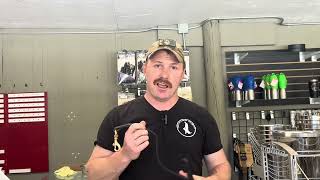
A trainer breaks down the two essential dog training tools: leashes and collars. Six-foot leashes work for obedience, while longer lines suit tracking and recall. Half-inch leather leashes offer better control than nylon, and buckled leather collars beat plastic fittings that break on working dogs.
Chapters
Hey guys, welcome to our short set today. Uh, today I got a fun one for you guys. We're here over at the CCU, uh, Pro Store, and I got some stuff I want to show you, so Today we're going to kind of go over the essentials of training. What are the essential tools of training? And ultimately, the two most important tools that I want is a collar and a leash. So let's start out with our leashes. Leashes come in different varieties, different styles, um, different lengths as well. So biggest thing is, uh, as far as obedience goes, I like to start out with a shorter leash to give me a little more control on the dog. Uh, usually I'll work with a 6-footer. Um, you can use shorter leashes as well. There's also leashes that are designed for working on the side of the road, and obviously we got our long lines as well that are perfect for tracking or working things that are gonna— we're gonna need a little more distance on, for example, the recall. So these leashes come in different types of styles, preferably, and what I've seen from a lot of trainers, is they prefer leather leashes. There's a good weight to them. Other individuals like using nylon leashes. Let's talk about our leather leashes. Your leather leashes are going to come in different types of styles. So there's ones that are braided like such, and they'll have their braids in different types of configurations. There may be a kind of a knot right here close to the buckle that allows us an area to grip. And then, uh, ones that aren't braided usually are sewn, or sometimes they have them where they're braided and sewn, or they put rivets in them like this one here. And then they also come in different types of thicknesses. I prefer using a half-inch thickness, but you can get anything up to an inch of thickness if you prefer. So finding a leather leash that you prefer to use or fits right in your hand that makes you feel comfortable is going to help assist you in training. And obviously the most essential key is it gives us that positive control we need with the dog. All right. So let's talk about our long lines, or some people call them our tracking lines. So these range from different sizes. I think our smallest is 10 feet and they can go all the way up to 100 feet. But that's kind of the range of sizes that we carry here. So the smaller you go, you know, it's more applicable for tracking on, say, the side of the road or in some thick woods. It's better to have a shorter line just so it's not getting caught up in the trees while you're tracking or not letting your dog veer off in the traffic. Let's talk about collars now. Collars are going to come in a lot of different styles. What I always recommend for people is getting a collar that's secures either a buckled collar or these Modern Icons, which have a really slick connection point here. It's kind of like a buckle, and they're very secure. You want to make sure that that connection is very secure. When it comes to collars that have any sort of plastics, you do run the risk, especially with these working dogs, of those plastics breaking. So I like getting something that's secure like this, or what I prefer most is leather collars. I I think they're a lot more comfortable for dogs, and I feel like I can get a good correction on them. But your leather collars that come in a buckle style like this are really handy, and they're great, especially this one because it's adjustable. You got different types of sizes you can do, and it's quick and easy to adjust. So a lot of that comes down to personal preference. A lot of law enforcement and, uh, people that are into working dogs, they, they like the customization of, uh, collars like this because they got some Velcro area where you can actually put, you know, the dog's name or sheriff's department or something like that. If you want to do it with a leather collar, you know, they have buckle or little plates that you could rivet on there. But ultimately, I'm— what I'm looking for is what I'm comfortable with and what I've had the best success with. And I like keeping a leather collar. I think it's less irritating. As far as material goes, and I just like how quickly I can make adjustments to it. So that's all I got for you guys today. Check out some more of our short sets and check out our podcast on Friday.