Visual Electric's Colin Dunn on the Designer Evolution
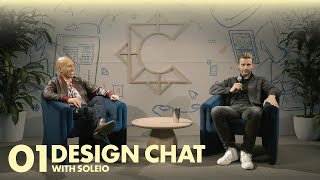
Colin Dunn, founder of Visual Electric, discusses building an AI design platform by applying a "minus-1 to 0" mindset and designing "with the grain of technology." He shifted from vague creative tools to workflow-focused products for mockups and brand content, and sees the future of visual branding moving from static guidelines to dynamic, AI-generated identities.
Chapters
Just a warm round of applause for Colin. Thank you so much for joining us. Colin, so when we first met, you were a new grad at Facebook, and my work as an angel investor is largely betting on people, and I was fortunate to get to work with you across multiple startups. And when it came time for you to work on Visual Electric, it was clear that you had gone through your own minus 1 journey. And so I wanted to start there. What was the minus 1 to 0 for Visual Electric?
I assume by minus 1, you just mean everything that precedes the 0 to 1 phase. I haven't heard that term before, actually.
It's a term of art here at South Park Commons. OK. Maybe trademarked.
I suppose if you want to go all the way back to the beginning, it was my first startup was my web design business I started with my twin brother in high school. The MRR was much lower on that then. But no, I mean, I've worked at a handful of startups. There's one actually just around the corner from here called Aspen. I think Aspen was probably the most formative startup experience I had prior to doing Visual Electric. And I think the biggest lesson I learned from Aspen was just being conscious of the types of risk that you are taking on as a founder. And what I mean by that is you can think about— you can categorize risk. There's market risk, there's execution risk, there's regulatory risk. And I think I wasn't a founder of Aspen. I was a second employee. But I think in hindsight, looking back, we were taking on market risk in the sense that we were building a product that didn't previously exist. There wasn't a thing that our tool was replacing. And as a design-focused team, I think taking on market risk is not necessarily playing to our strengths. Like, I think this is something that Apple has done really well and I think very intentionally, which is they tend to enter large established markets where design can differentiate and win. And as a design founder, I've taken that lesson to heart. And I've tried to work on problems that have low market risk but high execution risk and something that can win with design as a differentiator.
And then with Visual Electric, what was the space that you were exploring before you crystallized on a tool for creatives, which I think was the original positioning for the company?
Right.
What other ideas did you— explore and discard because I feel like that for a lot of folks who are considering their own entrepreneurial journey as designers, that negative 1 to 0 phase of like, well, which ideas do I pursue? You can join South Park Commons. You can talk to your friends. You can talk to investors. There's 101 ways to actually explore that. How did you go about it?
Yeah, I think I've used— as a designer, I apply the design process to everything in life. If you use the sort of IDO framework of viability, desirability, feasibility, I think my approach was to think about company creation in the same way that I think about any design problem, which is you understand the constraints and then you iterate on solutions within those constraints. And so thinking about that framework as the constraints, I tried to find people that could represent those different parts of the triangle. And so I had an investor who I was meeting with regularly. I had somebody who represented the customer, and I was sort of going on this co-founder dating process where I was meeting technical co-founders, and they unknowingly were serving as the sort of technical piece of that, the viability— or sorry, the feasibility piece of that. So My goal was basically just to make as much progress as quickly as I could and to be continuously probing these different people to get feedback and then bring that feedback into my design process and use it to inform the next iteration.
What advice do you have to prospective design founders in the co-founder dating space? Because that's something I don't think you've talked much about.
I mean, the parallels to dating are just very strong. It really is about chemistry. It really is. About finding someone that you click with. And it's like, how do you know if you've found your person? It's hard to really answer that other than to say you'll just know it when it happens. I think one heuristic I used early on was, as a design founder, I was not technical enough that I could actually build the product. So I did need a co-founder, a technical co-founder. And it was important to me that I found somebody who I felt willing to give half the company to. And if I wasn't willing to do that, I took that as an indication that it wasn't the right person.
That's a pretty good heuristic. How did the vision for Visual Electric evolve once you found your co-founder? Because so much of the art of company formation is the songwriting, the like, now we're going to share this body of work together, this product and this company. Walk us through that evolution for you.
Yeah, I think the company has been a slow evolution that's really mirrored the technology evolution. We're building a design tool on top of generative models. And I think our vision and where we see the technology going and the product going has really been rate limited by what's possible. And so as the foundation models have improved and as our capabilities come online, it unlocks the next level of product specificity and capabilities. But in the beginning, like you mentioned, we were positioned as a design tool for creatives. And part of that was just us not being yet confident that we had articulated who the customer was, but also it was a reflection of the use cases for AI were very broad still and very much exploration. People were just dabbling and testing the waters. I think as the technology has matured, the use cases have matured, and the workflows have matured, and it's allowed us to more confidently assert who our customer is and what the use case and the workflow is.
And I feel as though one of the things that might have been lost in the intro is that you've worked at multiple startups as a founding-level designer. You've worked with CEOs who are themselves designers. What were some of the lessons from those prior tours of duty that really have served you well in this new context where you're the chief designer? Now you're in charge of the design of the product and the design of the company.
Yeah, I've worked on a lot of design focused teams where there was just a strong design-led mentality. And I think if anything, I think I've become weary of that. And unchecked design-led teams can actually steer you maybe not in the right direction. So I've learned to maybe challenge the assumptions around what I personally value as a designer what the broader market values. I think I tend to overvalue, say, like UI and things like product feel and user experience. But that isn't to say that design isn't important. But I just think it needs to be checked by business function and not just like feasibility, but just kind of designing with the grain, not trying to invent things for the sake of inventing them. But really, I think there might be a designer who would feel like, oh, you're doing what's easy, meaning you're compromising your creative vision. But I think designing with the grain of technology is— it's where you will find, I think, a groove and where you can iterate quickly. So I think all those things need to have equal representation. And I've become— weary of teams that don't have that.
And do you find that given the materiality of the work that you're doing, that today there is an element of feeling the AGI with these models as they're improving, as the state of the art is advancing in real time, has it required you to change the way in which you do design work when compared to other contexts in which you've done zero-to-one design work? What have been the most noticeable changes and what advice do you have to founders that are thinking, all right, I'm going to try my hand at an AI startup in 2025. What should they know going into that exercise?
Well, in terms of where we're actually using AI in our day-to-day, I feel actually like I'm behind here, to be honest. Or maybe people are just overrepresenting how much AI is actually having an impact in their work. I've tried using the AI agents like Devin to actually ship code. And I've just found them to not work that well. So I know there's a lot of designers who are now using v0, or they're working more in software and less in Figma prototyping land. And I just haven't figured out exactly how to make that leap. So maybe it's just a function of— Product design is like 1/10 of my time right now. And so I just don't have the time to really figure that out. But it feels like there's maybe more opportunity there that I haven't fully realized. But I feel like there's a second part to your question.
Well, I also wanted to touch a little bit— you mentioned working with the grain of the technology, the material that you're working with. And I think that one subject that goes unrepresented in startup land is working with the grain of a co-founder partnership, right? Wearing the design hat, how has that helped you or aided you in the process of navigating and designing a company around that relationship specifically? What are you learning now in practice that would be difficult to reproduce outside of the CEO role?
Meaning how are my relationships with my co-founders?
Yeah, like how you design the business in so many respects and treating the co-founder relationship as a core element in that.
Right. Yeah, I mean, I think every co-founder relationship is unique. And I don't think there's any one definition of a CEO role nor a CPO role. I have a really great relationship with both my co-founders, but Adam and I are leading the product and the business side of things. And so he and I have a really great working relationship. He's also built and sold two companies previously, and this is my first startup, so I think he brings a lot of experience in that domain, which has been really valuable. But Adam is like a very unique person in that he understands machine learning really deeply and is also very design-minded. And that was a criteria I was looking for in a co-founder when I was doing my dating process. And I met a lot of ML engineers who didn't care about design or creative tools. And I met a lot of engineers who didn't have deep ML experience. So he was sort of a unique combination of those two things.
And then when anyone in this room looks at the space of tools, that they would compare Visual Electric to. What is the differentiator? What does Visual Electric do that no one else really gets? Or what is the strategy that sits behind this product and how you envision it evolving over time?
Yeah, I mean, when we started the company, we were observing that AI, like visual AI specifically, was starting to— improved very quickly. And despite it being early and not producing amazing results, it was still getting adopted by designers. And when we looked at the ways that you could actually use this technology, the products just didn't feel like products. They felt like prototypes. They felt like tech demos. It was chatbots and Discord and things like DALL-E 2, I think, was out at the time. So our initial thought was, we should build a tool that is purpose-built for designers to take advantage of this technology and really think from first principles. What would you— how would you design a tool like that? And it really was a broad charter and in some ways, I think, a bit of an R&D experiment. It's not like we were— we had some super narrow workflow that we identified from the beginning that we were just going to reinvent with AI. So there has been a little bit of just adapting to the market and to the changing technology landscape. I think there's been a few use cases that we've really hit on that have become, I think, the most common use cases. So one is mockups, which sounds really basic, but it's something that designers need to do a lot, which really ladders up into design as a storytelling tool and as a sales tool. So if you're a designer, you have a vision for a brand. It's one thing to present that brand as a set of vector artwork on a white background. It's another thing to superimpose that into an out-of-home ad or a tote bag. This is very common that you'll see in brand design presentations. And just seeing a brand in context, I think, adds a lot of life to it. And so that's one specific use case we've seen a lot of traction around. But I would say just broadly, the differentiation is building a product that works the way the creative process works and not the way the technology works, trying to start from what is the workflow that a designer is going to resonate with and bending the technology around that.
I love that you brought that up because I found out with Visual Electric and supporting you, there was tremendous market founder fit. You went to design school, you studied design in a more classical setting. And what are things that only somebody who's gone through that upbringing understands about the creative process that you might be able to illuminate for folks in the audience that may not have come through that process or that upbringing?
Yeah, well—
Because I feel like there's a key ingredient. This is the secret sauce of Visual Electric. This is the thing it understands that maybe a technical team would take a long time to uncover themselves.
Right. No, it's felt a bit to me like the Steve Jobs quote about the dots connecting looking backwards. I went to school for graphic design and transitioned into software pretty quickly after and spent a lot of time thinking, I wish I had studied something more technical, or there was some product design program that I had done. But now it feels like all of the experience I had both as a student and also working in various design studios has really helped me appreciate graphic design and maybe see an opportunity and have a perspective on that market that I wouldn't have had otherwise. But yeah, I mean, I think the graphic design process is not unlike the software design process in that you have to start broad, explore breadth, identify something that— some story that you want to tell, put together a collection of images, build that out into a brand identity system across art direction and logo. And so I think we have been trying to build a tool that allows for that process to unfold in a way that's aided by AI but isn't overly prescriptive. I think that's another lesson I've learned in past startups is it's easy to become overly prescriptive about how someone should use your product. And I think that has, in my experience, been very— it's limited the ability for a product to get option.
Are there surprising use cases that you would have never anticipated? Maybe other examples like the mockup one where you're putting products in situ and have studio-quality images but without having to actually hire a model and put the software on a device.
People have been using Visual Electric for storyboarding, which wasn't a use case we had originally thought of. But In hindsight, it feels obvious. It's a very natural thing to lay things out on a canvas, I think, in frames of a story. We've added video to the project recently. And I think turning storyboards into video, potentially having multiple videos that you stitch together, I think there's a very interesting workflow there that I'm excited about.
One of the things that I feel like I'm always learning from designer founders, like new frameworks and how to think about both product development but also the design process writ large. And one of the things I learned from you in a recent conversation is this idea that there's certain work that is done to produce products in the world, and then there's a separate sphere of design where it's around selling, around aligning a team around a vision, standing up the answer to what if, right? Say a little bit more about that latter part of the design process and what you think Visual Electric might be able to bring to bear for people who are in the job of selling, in the job of storytelling, in the job of standing up an answer to the what-if question?
Yeah, I mean, a lot of our customers are creative directors who work at companies like— well, I don't know if I should mention actually, but large brands that are doing awesome stuff, things like Super Bowl ads. And so you can imagine when you're producing an ad that's going to cost millions of dollars for the media buy, that there's a lot of salesmanship that has to happen around the creative vision, the concept. And so one thing that we've learned— actually, this is an aside, but I think maybe is interesting— is one of our early hypotheses was that AI, while not yet at the bar that we thought would be good enough for production use cases, we thought it would be good enough for concepting. And designers are a fickle bunch. And it turns out that it wasn't even good enough for concepting because a designer would rather use an image that was beautiful that less accurately represented the idea than they would want to use an AI image that maybe was more accurate but just didn't have the same visual impact. And I think that comes back to your question, which is if your job is to sell a vision, you want to get people excited. You want them to feel something. Putting up a bunch of shitty AI images is not going to accomplish that goal. And so it was only after we saw this step function improvement in quality where from our perspective, we were like, oh, great. These images are now suitable to be used in production. Sure, that was true. But also, it unlocked the concept and use case. And that was something I hadn't really anticipated. So we found that a lot of the— especially at bigger brands, like creative directors who are pitching internally can now present an idea at a much higher fidelity and in a way that captures all of the subtlety around art direction and camera and— lighting, and all of these things that they're very attuned to. But they can present this vision now in a way that satisfies both the emotional impact that they want their work to have, but also just being descriptive and accurate in terms of telling the story that they're trying to tell.
Without showing your entire hand, how should people be thinking about Visual Electric through the remainder of the year? You're obviously thinking about and designing around the expectation that the models and state of the art will continue to advance. And so part of the game of building new products is working in anticipation of that inflection. With that in mind, what do you see as the next evolution of Visual Electric?
I think the space that we are working in is— you could broadly describe it as brand marketing content. We're in the business of helping creatives build brand marketing content. I think Figma just announced a product called Figma Buzz, which feels like it's in a very similar space. But when I look at Figma Buzz, what I see is a tool that still very much feels like the legacy design tools of the past, meaning it's all layer-based, it's all direct manipulation-based. And I think the world we're heading to is one where everything is generated. And when everything is generated, the workflow will fundamentally change. And that was the premise in which we founded the company. And so in a world where everything is generated, what does the tool look like? And I don't know that you need to have so many knobs and dials. And the way that you work is going to feel much more conversational. And when you're generating pixels, those pixels could be anything. They could be text. They could be 3D assets. They could be video. So our bet is to— I think one thing I think about a lot is if you go back in time and you think about when Moore's Law was exploding and everybody was designing software based on the constraints of hardware at that time, It would be very easy to get caught up in what's possible right now and trying to solve within the constraints of memory and architecture at that moment. But if you just assume that the technology is going to improve exponentially and it will continue to get better, now put yourself in that future and then start designing the product that's going to benefit from those improvements rather than be disrupted by it. And there's sort of a delicate balance there because you also need— the trap is to start designing patches to the model. I'll give you a very funny example that we didn't build, thankfully, but almost did, which was when AI was really bad at generating hands, we were like, well, what if we just have a library of hundreds of hands? And you can position it over the image. And you can do image-to-image on that hand. And you'll fix the broken mess of hand. And we could have built a whole hand fixer. Tool. And that would have been a waste of our time for a small team to build that feature. But there's like 100 things like that that you can accidentally end up building that just become obviated by the foundation model getting better. And so there's a bit of a judgment call around what short-term limitations can you live with and just accept that they will get better or bet on them getting better. And then at the same time, how do you build differentiated unique workflows that are going to benefit from the rising tide. And I think the conclusion I've come to is a lot of the differentiation actually happens before and after. It's thinking through the next larger context in which work is happening and actually going from end to end and building a complete solution. And then that middle part, The middle part is just going to keep getting better as the foundation models improve. But all the work around the work, that will be lasting and durable.
That's awesome. I wanted to switch over to a topic that I hold dear, which is design hiring. You've been able to work with some incredible designer CEOs. And with time, you're going to be building a design team of your own. What are the qualities that you look for in a designer that a technical founder here in the audience might benefit from? When you think about the hiring exercise, what are the cues that you think you'll be attuned to, both in the context of the year 2025 and the product that you're building, but also just your own role in the design process after that first hire? And for folks that want to join, a startup like Visual Electric? What's the bull case for joining at a stage like this? What do they get to work on that no other company can offer them?
Yeah. So I think one trend I've seen in hiring in general is people are increasingly becoming full stack. And if you look at jobs that traditionally were very narrowly focused, you'll see that people are starting to bleed out into adjacent functions. And so one example that I like to give is Phi from Perplexity. He's like— I mean, I think they've hired more people since. This metaphor maybe is starting to fall apart because Perplexity is scaling. But he has been doing the work of multiple people for a long time. And he's responsible for a lot of the really great brand design work that Perplexity has been putting out. And I think a lot of that has been enabled by AI because AI is giving him the ability to just output twice or 3 times or 4 times as much content. So everything from videos to imagery to— he had a podcast. I don't know if they still do. But he was like a one-man band who's producing all of this content. That just would not have been possible pre-AI. And I think there's a similar metaphor maybe in product design where product designers are now able to actually output code and they can build components. And that's been a long-term trend of should designers learn to code, et cetera. But I think we're seeing now that all of these things are being turbocharged by AI. And so I think As a small team, and I also think that's one thing that AI is enabling is much smaller teams. As a small team that wants to stay small, one of the things we look for is where are you going to flex? Yes, you need to have your core competency that you're world-class in, but in what dimension can you flex into other areas? And so I think for product design, you could either flex into front-end engineering or you could flex into brand creative direction. And for Visual Electric, because we are a tool for creative directors, we've been looking for— and we're currently hiring for a designer who is an expert product designer but can flex into the creative direction, art direction side as well. Just because there's double value there for us. One is that person can help us with the marketing content we need to create. But also, they're just going to have a deeper empathy for the customer.
If we had a time machine and we end up in the future 5 years from now and you guys are crushing it, what do you hope will be the reasons why you're crushing it? What are the qualities and the approach to design and to company formation and to building products today that you hope will be what you attribute your own success to? It's like I often describe it as this is the sharp part of you. This is a sharp part of the company.
Yeah, I hope that we find— I think we are a general-purpose product right now that supports many use cases. I think the thing that I think will unlock the next level of growth for us is figuring out both a narrow use case or narrow workflow that is broadly useful to a lot of people. And without revealing too much of our roadmap, I think we have a hypothesis around what that is. And I like to use the metaphor around surfing. If you're kind of— you have to be in the water to catch the wave kind of thing. And I feel like we are more than just in the water. We're growing. We have a strong business right now. But when there's companies like Cursor that are growing at 100% month over month for— yeah, it sort of moves the goalposts a little bit. But I think for us to find that type of explosive growth, we need to find those vertical use cases and workflows. And I think part of it is just visual AI is behind LLMs. I think LLMs have taken off in a way that the generative visual models haven't yet because there's been more investment there.
I like the metaphor of being in the water. You became a designer founder before it was fashionable. And now we've got a call to arms that's being echoed across the Valley for more designer founders. What is your advice to somebody who is thinking about getting in the water? What do you wish somebody had said to you before you embarked? What do you think is the essential question there? How do people find either the courage or the impetus to start?
Oh, man. I was very— it took me 10 years to make the leap. I've been wanting to start a company for a really long time and had a lot of really bad ideas for startups. But I think looking back on it, I think that was probably a healthy amount of hesitancy to make the leap. I'm really glad that I waited until the moment that I did because I feel like this is a moment where as a designer, I have a point of view and I have a perspective that is unique. But at the same time, there's no better way to learn than to jump in. Perhaps if I had sort of taken the leap earlier, this would be now my second company and I would have a bunch of experience that I'd be building on. So hard to say, hard to predict what the counterfactual is. But the thing that— I mean, this is something I heard a lot and I think is probably not a unique perspective, but it's something that I'm feeling very strongly right now, which is you just have to really love the problem. And I think when I was thinking about startup ideas, I think it was easy to fall in love with the idea of building a company more than falling in love with the problem. And I think that there's a bit of a danger there because I think that will wear off pretty fast. I think as somebody who is a designer and cares deeply about the creative process, this is something I can just spend a lot of— I can spend infinite time thinking about. And that is the fuel that will keep burning no matter how things shift, no matter how things go. Yeah.
I love that. That's really profound. Looking at your own experience right now, is there any conventional wisdom that you're just in strong disagreement with? I feel like when you look at the landscape of— videos and venture speak and all the common tropes that startup founders are told? Is there anything that you're like, I don't know, man. In practice, this didn't really play out the way that everybody says it's supposed to play out?
That's a good question. I would hope so. Otherwise, I'm a really boring person. I mean, one thing that we did with Visual Electric that I think goes against convention is we just invested a lot in our brand. And I think most startups don't do that. We worked with a design agency called Manual. And I mean, we could make the argument that as a tool for brand designers, there's a certain utility there. But I think it would also be dishonest to not just say that I also just love graphic design.
And they're a great graphic design shop. They're very classical. They're very— yeah. They know their stuff.
But it has been an asset for us. I think one of the things that we hope to communicate with our brand is, this is for you, graphic designer. When you see this, you feel seen by us. And I think that shows up in a bunch of ways. But we certainly heard the feedback that just looking at the packaging, you can feel the difference very quickly.
I know that there was a little— not disagreement between us over this, but I remember being a little nervous about the graphic designer as the ICP. I'm like, I don't know, is that a job that people will still have in a few years? And I feel like you've done an incredible job of making— steelmanning the case for the graphic designer, right? I was trying to be really delicate with the— but I feel like you've done a really compelling job of steelmanning the case. And so for this audience, what is the argument, not merely for Visual Electric, but for this ICP, for this customer?
I think before I steelman my side, I'll maybe represent your side here for a second, which is design agents are coming. Graphic design is going to be automated. Why are you building a robotaxi for taxi drivers? That makes no sense, right?
Your words, not mine.
That was actually a comment on a Facebook post from— you're not the only one. But I think maybe the way I would reframe it is I think graphic design— for sure, AI is going to rearrange jobs. That's happening for sure. And I think one trend that we've seen is that things that could be thought of as replacing a certain function are often first adopted by people who are doing that job today. And so Cursor for Engineers is a good example. I just came across a tool that was an AI recruiter. And their customer is recruiters because it's helping you source leads. And so I think if you think about the progression of this technology and the products and the use cases, I think the most fertile place to start is where that work is currently being— is happening today. These are the people that are being paid to do that and are looking for ways to be more efficient at that. So if you reframe the job as graphic designer, if you just fast forward 10 years into the future and assume that AI has completely disrupted the way design works, the question is, what is the lasting jobs in that space? And it may be that the job of a graphic designer that we know today won't exist, that the person who's drawing the rectangles and typing the Helvetica and doing all of those things, that will be automated. But the thing that we're betting on still existing is that you're still going to need a person who knows how to tell a great story. You're still going to need somebody who has the ability to compose many elements together into a cohesive whole that speaks to other people. I think the job of a designer is really— or maybe creative director is even a better title to use— is it's like, how do I just tell a story about a brand that's really compelling and interesting to other people? And the way in which you do that, I think, is changing. And we actually want to be at the forefront of that. We're betting on it changing. But the taste and the human curation element of it, we're betting on being durable.
That's incredible. And I think it reminds me of that trope that an image is worth 1,000 words. To that end, do you think that there's anything there in terms of communicating with machines in a higher bandwidth capacity? I mean, today, chatbots are primarily text-based. And I keep thinking, this can't just be it. This can't be the final frontier. Is visual electric maybe another way in which not only we communicate visually to other people and unite people around a vision, but could we talk more effectively to computers through imagery?
Yeah, maybe we should update the phrase to an image is worth 1,000 tokens. It's true, though, that we've talked about this a lot. The amount of information that's communicated in a picture is far greater than is communicated in language, or at least in terms of information density. Certain words obviously have a lot of depth to them. Just any given block of text in any given image, I think there's a lot more information in the image. So yeah, I think— I mean, we're also just visual people. Every single person who works at Visual Electric is, for better or worse, a visual thinker. And it's just an area of personal interest for us. So we're biased. But yeah, I hope that we don't reduce human-computer interaction down to— just words in a chat box. I hope that we can preserve other forms of communication as well.
I'd love to open up the floor to questions from the audience. Does anybody have a burning question for Q&A? Chris.
Yeah.
OK, great.
Cool. Yeah, I guess my thought and question is around what a brand is going forward. One, the mediums through which graphic design will be presented will go beyond two-dimensional and incorporate time and space. And furthermore, we'll need to meet people's attention spans as they diminish. So I've been really struggling to think about what is a company in the future if you can just hook up an MCP dump truck to it and just pull all of its guts out. Like, you could do the same— like, what is a brand? You can sort of have disposable things that instantiate and then dissipate. So what mental models are you imagining for that? Because if you come up in the Milton Glaser world of graphic design, we're living in newspapers and billboards. But that's not the world that we live in. And I'm pretty sure he's dead. So how do you think this actually is going to evolve, given that you said that you want to bet on the future of the medium changing?
That's a really good question. Yeah, brand guidelines, I think, are kind of a relic of a bygone era. And they're really fun to make and look at if you're a designer. So I think they've lasted maybe longer than their utility has. But certainly, the idea that brand guidelines will be replaced by models is an obvious bet. But I think there's also other trends that are interesting around content and advertising and marketing becoming increasingly individualized and personalized. So one simple example of that is if you're a really big brand today like Apple, you can afford to go out and they do this. They will shoot every single ad that they run in 6 different regions with 6 different sets of people and wardrobe and makeup and everything is localized so that when they run their ads, it performs better. Most companies don't have the budget to do that. So AI is now— one of the use cases we've seen is localizing marketing content with AI. So you might have gone out and done a shoot, and now you can use AI to localize either just by changing the backgrounds to something to a different location or changing clothes or even actors and models. But I think maybe the larger change that's happening is one where— and we're also starting to see this as well— is I think the designer, the graphic designer— and this is something I learned from being in design studios— is they're kind of like an OCD type of person where they want maximum control. And they want to— like when I was working at Pentagram, nothing went out. That didn't have 10 passes on it for every Bezier curve had to be in the right place. And no mistakes were tolerated. Because if you're printing a book, you can't ship an update to that. So it's understandable. But in a world where everything's generated, everything's individualized, I think the designer has to let go of that control to some degree. And I think it's very possible that we were going to move into a world where the designer is really just defining a set of constraints around a brand. And they're creating the boundaries in which the brand is going to reform itself depending on the context and the audience. And it could get as specific as an audience of one. And that's just a completely different job. That's a much more abstract— you're not working directly on a— on a billboard that's going to get put up on the street. You're thinking in one level removed.
You're almost like a vibe director?
Vibe director, yeah, exactly.
I had an experience recently where I took a billboard that Framer had and I modified it in a way that I thought people would find that it was obvious that it was modified to promote the whole designer founder thing. And I think people didn't think it was modified. And it made me think like, oh, man, this stuff is getting so good. It used to be— you know what I mean? And it made me start thinking about how do you actually ensure people aren't abusing the tool? So as people who worked at companies where their tools were abused, how do you start thinking about just making sure this thing is a force for good? Especially since you're in the image creation and video creation.
Totally.
Yeah.
How do you think about avoiding unintended consequences like that?
Yeah. I mean, the use case you just described is actually one of the most popular use cases, which I was talking about earlier, which is mockups.
Right.
Yeah.
But one thing we've seen is—
I reverse mocked up.
Reverse mocked up.
It was a live thing that I then re—
yeah.
You mocked down.
I mocked down the mockdown tool.
But we found that companies will generate fake images of billboards and then post those images on social because having an out-of-home ad makes you look bigger than you are. And there's actually more eyeballs are going to see it on social than would see it if you actually had a billboard.
That is so Art of War.
I love it.
But no, I mean, to answer your question, I think that there's obviously safety level controls that are in the product that try to prevent certain types of things from being generated. And a lot of those come from— we're not training foundation models. We're using OpenAI's models. We're using Google's models. And so most of that is just coming from the model provider. I think there's maybe a larger awareness in society around AI. And that actually feels like a stronger antibody to misinformation than anything that any one player can do. And it seems like people's awareness— unfortunately, we're moving towards a future where you should assume every image is fake. I just think that you can't trust imagery anymore. That's really what's happening, or videos. Like has something been manipulated? How real is it? I mean, this has been true for a long time actually with just Photoshopping. And I think we are quickly getting to that point where most people are just aware that AI imagery exists and therefore are just skeptical of what they see and don't just trust everything is real. But yeah, I don't know if that answers the question.
But I mean, you're basically saying, hey, there's already a layer of that baked into what's being piped in.
Yeah, I mean, and I think there's two layers basically. There's the societal awareness, and then there's obviously a bunch of things that we do at the application layer to try to prevent abuse.
I guess this corner is asking questions. I love the way you were talking about designing with the grain. And as a product designer, I feel like I have to preach that a lot around just do a tab bar. Everybody knows a tab bar. Don't be special just to be special. But I think when you're talking about brand and storytelling, I mean, I love storytelling as a designer. I care about it. We've seen every Airbnb looks the same. Every website looks linear. Every subway ad looks exactly the same. And there's trend cycles where they have to change. But I worry that you're imagining people care more about really good storytelling than they actually do. And what they actually resonate with is the thing that looks exactly like everything they're used to, even if it has 5 or 6 fingers, even if the AI is a little bit wrong. Are you not over-indexing on designing for the creative director who cares about those things at Pentagram level versus the general public who just wants to be a bright color?
Right. I mean, we're not really designing for the general public. We are designing for creative directors. So I mean, our tool is on an infinite canvas, which is not the most consumer-friendly interface. So yeah, I think we're avoiding that by not designing for that person.
Well, I guess what I mean is if I'm a random business owner, not a startup founder who cares about design, why would I use Visual Electric versus using ChatGPT to make something that's 95% as good or 80% as good?
Yeah, I mean, one of the— early on, we felt like the consumer space was not a space that we could win. And the reason why is it's increasingly just commoditized. AI image generation is going to be part of every product, every platform. It's a feature. It's not a standalone company. And so the space that we felt like we had a shot at winning was a market where we could build a specialized deep workflow for a customer that had a different set of needs and a different use case than an average consumer would have.
Like the Super Bowl ad?
Yeah, exactly. Thank you.
I love that the other half of the room is raising their hands. I think that brings us to 3-2 as a score.
Okay, so when you think about something like poster or billboard, you have the image, and then you have text and other symbols. And right now, you guys are just doing images. So do you imagine a world where you have stuff like what ChatGPT can throw out, which is there are things that look like SVGs but aren't really? Or do you think about having SVGs directly in the product?
I think, yeah, I mean, I could definitely see us having SVGs in the product. I think going back to the point I was making earlier around what do we build as a feature in the product versus what do we bet on the model being able to do in the future, I think one of the things that we're betting on is the types of pixels that you'll be able to generate are going to be much broader than what you can generate today. For example, you could imagine us building out really deep workflows around adding text to imagery. And we've done some of that, but we haven't invested a lot in that. And if you look at something like Figma Buzz, they already have that product. They've built that today. And so I think it's a more interesting question, and it's a more differentiated approach to say, what happens if you don't need a text tool? What happens if everything is— every pixel is generated? And so obviously, we're not there yet. But that feels like a vector of attack on legacy design tools that is differentiated and has— we have a better shot at winning than trying to go head to head with a tool like Figma.
I think I saw another question over here. Marcy?
I was wondering what your thoughts were on open source versus closed source image models and how you think that's going to play out in the future. I mean, we love open source for— we don't train foundation models. So open source means we can self-host and have more control. So far, open source models have been much worse than closed-source models. And so we haven't really used them. I mean, when we first started the company, Stable Diffusion 1.5 was the best model we could use. I think unfortunately, stability wasn't a real business. And so it didn't sustain. There are companies now like Black Forest Labs with Flux. I'm trying to think if there's any other standouts. Ideogram is training a model, but I don't think they've released the weights for it. But it seems to me that— I mean, so far, if you just look right now at the market, closed source seems to be winning. And our allegiance is only to where the best quality is coming from. But certainly, I would be more excited if there was a— if we could use an open source model. Yeah, there's so much talk about design founders now. We need more design founders. SPC has been saying this for a long time. It's nice everyone else is catching up. You guys are design founders building for designers, but what do you think about design founders building for completely non-design industries? Totally. Yeah, I mean, I think we're at a really exciting moment for design entrepreneurs who have a design mindset because The technology is allowing everyone to be a creator. I think that's the enabling force of AI is that it's breaking down the technical barriers around creation. And so I think the value will accrue to people who have great ideas, great vision, can create compelling experiences. And I think designers have a lot of those. Qualities and attributes. So go to the App Store, pick a category where there's some product that has tons of downloads and is making a lot of money and has poor UX. And I think a designer could do today really well at kind of reinventing that. How would you recommend non-designers, technical founders, to learn design? Or like, I guess a lot of people are learning programming without having a computer science degree now that Coursera is around. What's the design equivalent for someone like me? Man, that's, that's a hard question. I don't know if there's the same shortcut. I think at the risk of sounding pretentious, I would say that great designers tend to have two things. One is they have naturally good design instincts. Like, the people who tend to go to art school or people that I know that are designers that I consider to be good designers, like, they just all say that, like, from a very early age, they just naturally were inclined to care about and think about design. The second thing is they just look at a lot of design. Like, I think training your eye And that's the part that unfortunately I don't think there's a great shortcut for. But looking at and really paying attention to what you respond to and trying to understand why you're responding to something is just training your own neural net, I suppose. But I don't know that— maybe the less pretentious answer is I don't know that— good design is as objective as maybe it seems. I think if anyone who just has a point of view spent enough time to develop that point of view and express it in a way that felt really clear and distinct, I think that would be good design. So I think just unfortunately, you just have to put in the reps, I think. There's no shortcut there from my experience.
I'll jump in on this too. I think the other piece is I find early in my career reverse engineering things, it was a very good way to learn. It's like find a thing that you think is well executed and then unpack it, reverse engineer it, copy it. I think that there's a reason why a lot of early career designers copy the work of others as their earliest projects because it's in the copying, the mimicry, that you understand a lot of these local decisions in practice rather than as a consumer of it. You realize, oh, they chose this type size versus this. And now I'm starting to see specific patterns emerge across other people's work. But to Colin's point, I think there is a fair bit of putting in the reps, like going to the gym.
Thank you.
In terms of generative brands that already use—
Here you go.
I'll trade with you. In terms of brands that already use generative AI today, why do you think certain brands are successful in using it and other brands' creations are perceived as slop? What do you think are the design principles behind those that succeed?
I'll use Perplexity as another— as an example again, because I think they really are just doing a great job of using generative AI in marketing and brand design. I think one of the qualities I've observed just generally with AI is being OK with the imperfection of it. And I noticed that with— we're very OCD about the product UI. And I think that maybe is one of the reasons why I've found things like Devin to not work really well for us is like, it's getting to like 80% or 90% quality, but it's not getting that last 10%. And so if you can create a brand that is forgiving of the imperfections and can be flexible enough to support the sort of variance you get in generations, I think that feels like a sort of important attribute. And I think the other thing Perplexity is doing in that regard is like, they don't really have a set of brand guidelines. They have maybe a font and a general vibe. But again, it's being a little bit open to the serendipity of generative AI.
I have a question. I'm curious about your thoughts on creativity and whether that's something that can be taught or maximize and how visual electric can push people beyond what they even thought possible?
Yeah. Well, so I went to art school. And people would be very surprised if they saw me draw that I went to art school. But I think one thing that I was taught early on was like, Drawing is not something that you are innately good or bad at. It's like any other skill. The people who are good at drawing are the people who've just spent the thousands of hours practicing drawing. And so I think there's a technical— there's a couple of things here. One is there's the technical ability to create art. And I think AI is really lowering the barrier to entry there. The second thing is taste. I think taste is— There's a really great video clip from Ira Glass. Maybe you guys have seen it, the taste gap, where he talks about the reason people get into art making in the first place is because they have great taste. And then there's this period of time where your taste is up here and what you're making is down here. And it's really demotivating because you look at your own work, and the same great taste that led you to get into art making is looking at your own work, and you're embarrassed by it. And so it's like, how do you close that gap? And the way you close that gap is through tons of iteration and volume of producing work. And I think AI allows you to— it's like a booster pack. You can just accelerate the pace at which you can make things and explore. So I think it allows you to close that taste gap a lot faster. And in terms of what is creativity, I mean, this is a philosophical question that we've talked a lot about over lunch at our— office. And another version of that question is, is AI creative? And I think the answer that I've come to is that creativity is just connecting two existing ideas together in a new way. And that's what humans do. We're all training our own neural net on things that we see in the world. And whenever we make something, we're drawing on that learning, whether or not we realize it. It's really not that different from the way that these machine learning models work. So I personally am of the opinion that AI is creative in the same way that humans are creative. But what makes it interesting to other people is usually a human in the loop. I don't know that you'd be that interested in going to an art museum of a bunch of AI-generated paintings. Paintings that had no person involved. But if there was a person who was doing the curation and was doing the prompting, that to me is infinitely more interesting.
Yeah, and that bears out in how people don't watch machines playing machines in chess, but we still watch machine-assisted humans playing machine-assisted humans in the same game. I think we might be up for time, if I'm not mistaken.
Yes.
OK. Colin, thank you so much for sharing your hard-earned wisdom with us.