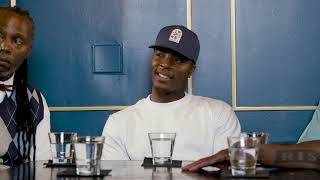
In this extended panel discussion, actors and mentors Taye Diggs, Daniel Ezra, Anthony Welsh, John A. Davis, and a moderator (Speaker E) explore the challenges facing Black young men and the responsibilities of fathers, mentors, and public figures. The conversation moves from the erosion of the traditional "village" that once raised children, to the systemic barriers—mass incarceration, under‑education, and economic scarcity—that keep many fathers absent. Participants argue that a lack of present, engaged fatherhood is the root threat to the next generation, and they stress the need for vision, mentorship, and intentional community building. The dialogue also touches on mental‑health stigma, the evolving definition of masculinity, and the pressures of fame, with Taye Diggs describing how he learned to compartmentalise public scrutiny. Later, the group shifts to personal relationships, discussing how dating, communication, and the concept of a "franchise player" (a long‑term, supportive partner) differ from the casual "roster" mentality of youth. Throughout, the elders share personal anecdotes, practical advice, and calls for humility, vulnerability, and a renewed collective responsibility to uplift Black youth.
Chapters
You start it and then I'll, then I'll take it from there.
How you been, sir? I'm well.
How's everything, sir?
Little guy's good?
He's at camp. Where? How far?
Like East Coast, 7 weeks. Dude, I was like, I didn't think it would hit me like that.
Yeah, man, it's not cute, man.
And the job's done.
You going to go?
You going to go?
Yep.
They're not allowed to—
Thank you for understanding.
Oh man.
Yep. Fellas, let's go.
Wait, is he going to do it? Are you going to do it like that?
Yes, that'll be it.
That's the only time I'll do it, you know.
Promise.
That'll be the only time I do it like that.
I should have Fellas, let's go.
All right, all right, brother. Nice and snug in the bug in the rug.
What do you think is the biggest threat to young men right now?
A lot of times I'm not going to censor what I'm going to say, I'm just going to speak from the heart. Joe and I were having a conversation about this before, and certainly being fathers, I think the biggest threat— very quickly, do we have an interpreter? Ask the question really slowly. Uh, so yeah, personally, I think the biggest threat for young men at the moment is a lack of leadership in terms of fatherhood. And John and I were speaking that I think one of the problems in our community is that there's loads of daddies but not enough fathers. And in terms of, in traditional sense, the, uh family values have broken down, but still fathers are just not as present as they should be. Um, that for me is where it starts. That conversation, um, is where it starts. We need to be present.
Which is, which is what, what is being present?
What I think is free, which is time. Um, unfortunately, you have to have a son work can get in the way, but I've had to train myself that he has to come first. When work's not in the way, it's easy to pick up my phone and just be wasting time, and he would tell me that. I know I can't remember though, kind of particularly around when COVID started, you know, he was in front of a screen homeschooling. That was a challenge in our relationship, but I just had to make time. There was me schooling him But taking that aside, having to go out and play with him even when you don't want to— there's times when I don't want to go play with him. There's times when you know what it's like, it can be somewhat challenging and you want to kind of distance yourself, but that's my job. Not until he's 18. This is a job for life. And I just think that there are so many of us having children but we don't have a blueprint to be a father because there are errant fathers. And I think my perspective, that's a lot of where our problems start.
I think that, um, the way I was raised, and, you know, coming from a serious church background, and it was always being said it takes a village to raise a child, and I think that the village has vanished. 100%. And everybody has scattered. But the child is still by himself, even as a man, even at your age. Before, don't walk on Mr. Brown's grass or he gonna scold you or he gonna wet you with his water hose. And he'd be like, don't you be going down there and messing with them gang members, boy, you gonna lose your life. I mean, those little small tips. Would help steer you in the right direction, even if the father was not in the home, which most of my friends, there was no father in the home, right?
I was just—
I was raised by a single woman, but the community— but the community took care of it. I mean, and if you did something, you're gonna get whooped by your neighbor. Then when you get home, you're gonna get whooped by your mama, right? That's— that was the community. That was the village, right? If you got caught stealing, They didn't have to wait on your mom. If Miss Brown seen you or Mr. Jones seen you, no, no, I got it. I'll take it from here. And that was, that was the way it was. But that was the community. It was a village. And I think that once we scattered and it was like, and for some reason, for some, you know, economics, others is scarcity, fear, you know, because now parents a lot of them. You can't talk to my son like that. You can't say that to my child. Not my son. My son is perfect. No, your son is an ass, right? So I just think that we have to figure out a way to bring the village back individually. It's, it's not just one person's job. It's all of our jobs as men. It's our job, no matter how old you may be and you're in another country, you're on foreign soil as far as We're concerned, right? But it's our job to protect you. It's our job to make sure that you're being steered in the right direction and not get caught up in the dark side, because there is a dark side of being in Hollywood. There is a dark side to, you know, just being a man. There's a dark side of being a Black man in this country.
I'm that dark.
I'm that dark side.
That's Darth Vader.
The only thing I would add is that vision, right? I think the combination of the two things that, you know, you talked about, Anthony and DL, is that you got to have that vision. And I think it's a huge threat when young men are systematically kept from having vision. So one of the side conversations we were having was about, you know, when you're in the hood and you only get to see certain options that are viable for you, you know, or if you are in that fatherless situation you have no window into the world to see what you could become, what you, you know, might need to become, you know, what are the lessons you need to learn that get passed down from the elders to the young person. So, you know, a lot of these things that we're talking about to me boil down to not having vision. If you have no vision, then you're left to your own devices to try and survive, and that usually ends up being you you know, a negative proposition. I heard recently in a podcast I was watching this saying, and I hold it because I'm sure it's true. It wasn't my truth, but it makes sense to me, is that the streets are undefeated, you know, in that if you're left to the streets, street's gonna win every time. Almost like Vegas, house is always gonna win. So vision is critical, um, and to me, and like I was talking about with Anthony, You know, that means being a father is paramount because I have two young boys. I have to be present to make sure that they understand, you know, what's possible for them and where they can go.
But it's interesting, I'm going to pick up on that. You said the father's not around. That's the fundamental question for me. Why are the fathers not around?
Why?
And as much as you just said that your father, you have to be present. So the difference is, what made you intrinsically know that you have to be present, and why the father's not around? Because I think they're linked, because you have a responsibility. Where does that come from? And conversely, why are they not around? Because you have that ingrained in you, you have that responsibility. So it has to come from somewhere.
Came from my father. I was, I was, I was one of those who had, had a father who you know, took that role seriously and, and was fortunate enough to, you know, be employed and gainfully employed, you know, so that there was that, uh, consistency, you know, and stability that he was able to be there for his family. Now, when you ask why aren't there fathers, there's any myriad of reasons, right? Criminal justice system, locks us up at inordinate rates compared to our population in the country, right? We get caught up in the legal system. You know, we've touched on education, and that's our conversation. We don't get educated in a way where we can ultimately land, you know, in a very competitive global job market. So then if that's the case and you're a father and you can't provide, and a whole generation of us have been taught to provide, what do you do? Some of us turn to the streets. You know, some of us, you know, feel like the better decision is to go away from our family so that we can do something. But there's a lot of systematic, you know, variables in my mind that lend to that absence of fatherhood that we know is detrimental to our families and communities.
I think that, you know, for Daniel, in understanding where you came from, as far as growing up and, you know, living in a life of lack. There's an old saying that says when you think life has robbed you, it's always an inside job, right? And a lot of times we make excuses for what we didn't have or what somebody wronged us or somebody did to us. I think it's imperative that you understand that, you know, and we do understand that hurt people hurt people. you know, whether it be, you know, abusive father or abusive mother or whatever the case may be. But we have to learn from the— our experiences and try to go opposite from those experiences and not wallow in it. Yes, yes. You know, there— we hear there's a saying that people say, don't cry over spilled milk. I'm a person that believes in why cry over spilled milk? I'll just get another glass. I'll clean that up and get another glass.
There you go, right?
So I like that, you know. So I just think it's important that you understand that the buck stops with you, right? You're creating a legacy for you, not only for yourself, but your future families, plural, right? Because yeah, you might experience that the lights might not be on, you know, at the end of the month, or you guys didn't get to eat, you know. And people don't know that. They don't know your story. But that's only a chapter that we can turn the page to and move forward to be into manhood, to be a better man that, you know— and there's nothing wrong with, I want to be better than my dad was. There's nothing wrong that I want to be a better parent, you know, do better parenting. And those things come from us, men, women, you know, not boys and not kids. We have to leave the childish things alone and become men. And this is the reason why I think it's very important that we had to have this conversation with you, so you, and not only you but your, your friends and people of your age, understand that it's important for important for you to stand up into your position. It's important for you to live in your purpose. It's important for you to have dreams and go after them and turn those into reality. Those are things that we all want and we see for you. We want to see you win, right? And we want to see other Black men win, right? That's what's kind of not fair.
What do you mean?
When I was coming up, I just wanted to be an actor.
I got lucky.
I was succeeding. And then once I got a little bit of fame, everybody came at me saying, what does it feel like? You have a responsibility. Do you deliberately pick these roles to be— and up to that point, I was like, I was just having fun. And in my younger days, I got resentful.
And I was like, I don't—
this isn't— I didn't sign up for this.
You black people do you. Yeah, yeah, yeah.
I'm black, but I'm also myself. Don't mess with me. But then, um, when I got older, I realized that it's not fair. It's not, uh, it's unlucky, but every step we make affects other people. Every step we make.
Come on.
So how do you, how do you, um, How do you balance that with living your life and feeling that responsibility?
I put it in my head and then I release it.
Okay.
But before it wasn't even in my head, you know what I mean? Because I believe that once it's kind of, you know, in the air, it's going to have some effect on me. Okay. But before, I didn't even realize it. You know what I'm saying? Like, I'm not gonna like select different roles or anything, but like, I'm— I have that on my mind, and that I think in itself is going to affect my trajectory.
So say, would you say that people looked at you as an actor or as a Black actor? Because there's two separate things.
Oh no, Black actor.
Because I've never read—
certainly where we come from, I've never opened newspapers and read an article about Jude Law, the white actor. It's just Jude Law. Or any Black actor, XYZ Black actor. So were you a victim of that? Oh, totally, totally, totally.
And in the beginning, everybody came at me and they were asking me, you know, what, what my experiences were with racism. And, and I, I didn't have anything.
Like, I was lucky.
I was getting on my rolls, but it wasn't until later when I caught on to the game and I was like, oh, okay.
Oh, okay.
I got to know what was that moment for you, right?
Because you could have easily just continued to say, I'm going to be Tay. When did that piece of, but I do have a, not responsibility.
No, responsibility.
So you are going to go responsibility. I do have responsibility.
It's there.
Yeah.
Yeah, and it sucked. It sucked at first, you know what I mean?
Because, you know, we're performers.
You want to be free, you know what I mean? And when I jumped off, it was awesome. And I was just flying. And that was something that grounded me, that made me realize it's not all candy canes and sugar plums.
But I think that—
This shit is real.
You know, as actors, for you guys, You do affect a lot of people because, for example, with Tay, and I told him about this, it changed my life physically. I mean, I might not look like I looked back then, but after he did Waiting to Exhale, I wanted to be like this man. I mean, the women were going crazy over him, so I went and started working out and got me some abs.
I wasn't in Waiting to Exhale.
I mean, excuse me, my fault. —helps Stella get her groove back. My fault.
Stella's got her groove back. Godfather 2.
But when I seen that, and Tay is this Jamaican man, and I didn't know if he was Jamaican or not. Angela Bassett cried.
Right. Yeah. You know, he was on Angela Bassett. Running around.
You know what I mean? But the thing is, is that it changed me because I felt like I could be like him. Right? And I started working out and started dressing and being free-spirited and chilling, you know, because of what I seen him do. So the point is, is that the responsibility, it still kind of falls on them, you know, unconsciously, because people want to mimic what he's presented on that screen.
Yeah, it kind of breaks, um, ceilings, I guess, because when I when I wanted to be an actor, it wasn't— it felt so far away that I didn't— I never admitted it to anyone. Like, up until acting came along, I was gonna, you know, go do sports science and, you know, physiotherapy and stuff. But it wasn't until, uh, Anthony and I are from the same city. Before he came to LA, he just happened to take a job at my high school, um, to just, uh, just to teach for a few weeks. And when he walked in, he was— that was the first British Black actor from my city that I'd seen. And he'd been on TV and he'd been on the stage and he'd done Shakespeare. I was like— and suddenly— and it wasn't until then that I was like, okay, I want to be an actor. And I started to— I knew inside, but I didn't say it out loud until I met Anthony.
And you didn't know?
You didn't know that he— No, which is interesting.
That's the first time he said it. And that was my story. That's what I wanted to do, but I didn't know anyone. Birmingham is a very industrial city. And you're not meant to have ambition. I remember going to my, um, careers counselor at school. So you get to kind of a year before you leave and you go and see a careers counselor who will advise you in the career you want. And I told him what I wanted to do. You know what he said? You can't do that. I can't believe you can't do that. Say that. You can't do that. That's what I wanted to do. Yeah. So I can't believe they said advise me on the career that I want. No, you can't do that. That's what they said in my school.
So, so, and think that they're doing you a favor, right?
By the way, think that they're being real with you, you know, to point you in a better direction that is going to be more pragmatic.
That's the thing. They said you can't do that?
Yeah. Yes, because, you know, their remit was— it was Thatcherite Britain. I'm getting into politics now. So in an industrial city like Birmingham, what you're meant to do is go through the school system you can get a job in a factory and work there for the rest of your life. That was never going to be the case. I don't like getting my hands dirty. So, but at that point, I discovered that I loved literature and I loved being on stage. I knew it, what I wanted to do. But, you know, my parents were very kind of religious, and that wasn't kind of moralistically where they wanted me to go. And that was fine, but I needed him to give me the tools to go back and articulate to my mom, 'Mom, this is what I need to do, and these are the paths I need to take because I wanted to go to drama school. I didn't know anyone who went to drama school. So then eventually, 10 years later, when I had the wherewithal and I traveled a bit and thought, no, that's what— that is what I'm going to go and do. And even when I made that decision at 22, I didn't tell my parents. I enrolled myself at college and we were kind of rehearsing, and my very first play that I did in a pub theater, I gave them tickets. 'Cause I thought, if I tell you that I'm doing this, you're just gonna kind of throw kind of water on it. Let me do the thing and you come and see it. And when they saw it, I remember driving home in silence. My dad was driving and my mom was sitting in the passenger seat and silence. And my mom says, if I didn't think you were any good, I'd tell you to stop. That was all I needed. They'd seen me do it, they thought I was serious, and they gave me the push. So at the point that I saw Daniel, I thought, I can't allow anyone to make the same mistakes. That's what you want to do, I want to support you, right? Having been through it and at that point got contacts, and I just— there's something about him. And at that point I'd gone to an acting school, and because I was slightly older, I was just focused, and I got on really well with the principal. And I just made a call because I saw something within him that I had, but he was much more mature, because at an earlier age he made that decision already. And I wasn't going to let him— that's what you want to do, I'll support you, but you've got to do it the right way, right? In terms of taking yourself seriously in training.
Let's back up a sec, because I think there's meat in what you just said that I don't want to leave on the bone. And that is that moment when you decided, I have to take control of my journey, not leaving it in my parents' hands, because that's what many young people do. Yeah. What was that moment? And how did you get there?
Traveling. Because I was kind of wanting to do this thing, not knowing how to, and I thought, well, I'm not doing anything in Birmingham. I want to see the world. I want to have a different perspective. Because I kind of figured out, well, actors kind of know a bit about everything, right? And I remember going to the theater for the first time. I'd never been to the theater. Took myself to the theater. I remember seeing A Doll's House by Henrik Ibsen, which is my favorite play up to this point. And I sat near the back and I was in tears just watching this thing happen. I don't know what it was, but I was watching this thing and I thought, I want to do that. I want to make people feel how they've made me feel. And went back, spoke to my mum and dad, and they were like, no, that's not a job for people like you. And I thought, I have to take myself out of this environment. Let me go and experience things for myself. I traveled and I came back and nothing was going to stop me. I've seen the world and nothing was going to stop me.
As an educator, when you are faced with that, when you have a child, a young man, a young boy comes to you with, um, quote-unquote unrealistic dream, like, how do you navigate that so you don't— you're not So you don't— what you said, going back to vision, like, you don't want to destroy, you want to uplift it, but it's also— but you know, how do you navigate that so that he's ready for whatever that next step is?
Well, the first part is, if you're, if you're any kind of educator at this point, you have to know that if a child trusts you enough to share their dream with you, yeah, you've just been given a sacred gift. You've made a connection with that child that you now have to treat like a diamond. That's where it starts, huh? And so that you can't even think of that dream as unrealistic. You have to now take on the role of their Sherpa. You know, you're now going to lead them up the mountain in any way that you possibly can. Yeah, yeah. They may, may not get there, but you— but that's— you do them a disservice by squelching what they brought to you, because that was a gift. And so you introduce them to wherever you can, much like y'all relationship. He knew that there was a process that he could put you onto, right? So if a teacher, if a kid came to me and said, I want to be an actor, if I'm not the acting coach, then I have to, you know, give them those books that are going to help them see. I have to take them to that show that's going to lend them, you know, add more to the vision. Any way that I possibly can to give them resources that's going to feed them, you know, that's my— that's now my job.
See, I think that that goes back to what we're talking about, that village again, right? One of the things that hinders us from growing, I think, from young men, young women, especially, you know, just from experience of my friends calling me lucky after I've done all of the things that I've done was Fear, false evidence appearing real, right? And when you don't have somebody that you can share that with, right? And it's almost like I have this dream, but everybody shoots it down. Parents, right? Then you go outside of your circle and then you might have a you, you know, a dean or a counselor, and then they say you can't do that. What he's experienced, what I've experienced. So then you, you tend to be quiet as opposed to letting the child dream as big as he can. And let's say, let's, let's, let's find out exactly what it is that you really want to do, right? And even with Daniel, I said, listen, you, you getting ready to be a director. See, I'm big on speaking things into existence. This is what you gonna do right now. I'm the barber on the show. Right. But I'm not just a barber. You see what I'm saying? I'm, I'm a counselor. I'm a confidant. I'm like, they call me Unc, but I love him. Right. And I truly love him. I love Tate. Right. And so I take on these, this, and I have a covenant and say, listen, this is where you're going. Because what I don't want to see is another young man who makes a lot of money and then loses it. I don't want to see a man who was a star and now he's on Skid Row. What I don't want to see is, is a diamond that's rough around the edges, and it takes leadership to polish that diamond up to make it shine as big as it can be so somebody really want to purchase it. And they're purchasing it with a hit TV show, right? So for me, it's not just him being an actor. It's me looking beyond that. I can care less about his stardom. What I care about is his heart. And so my thing is protecting his heart from all of the stuff that we have out here that can damage his, his, his vision. It could cloud his focus. And so it's my thing is to try to keep the light focused in the right direction. If this is where you're going, you could do it. This is where you're going. You need to be around the right people. I'm a firm believer if you're the smartest person in your crew, you need another crew. Crew, right? And that's what, what we're dealing with here.
Yeah. And the other piece is, the question I would have for you is, what allows you to accept that from him? Because you talk about generational stuff. I think that's where there's struggle, in that generations look at each other adversarially, right? So it'd be very easy— you come from a generation, you're an up-and-comer— it would be very easy for you to be wary of him because potentially he's taking your spot, and you not to be looking to him for, for leadership and guidance because he's the old head. Yeah, yeah, right. So what allows you to now accept these nuggets from people, you know, so that you can continue to move forward?
I think it's humility, um, knowing that I don't have all the answers, which you, you're kind of taught as a, as a young man to— even if you don't, pretend like you do, you know. Yeah, men, I think it's vulnerability. Men don't like to appear vulnerable. They don't like to appear, um, lost or in need of help, not in the know.
And I think it's changing now though. I, I think particularly with the onslaught of the whole awareness of mental health I think, yeah, I think it's attempting to.
I think there are attempts to, for sure. Slowly it's, it's, it's breaking down the, um, stigma attached to the stigma. And also just, it was a dehumanization, I think, of men, um, where it's like, it's almost like a robotic image that we had. And one of those images was, I don't need help, I'm good, I'll figure it out, I'm good. And For whatever reason, I very early on, I realized that, oh, the only way I'm gonna really do this and get to the level that I want to get to is help. And I never— like, it was never a threat when you came in. It was always like, oh, he's where I want to be, let me connect with him and see if he can— see if he can help me. You know what I mean? When I met Tay, same thing. Yeah, exactly. And, you know, DL is really big in like, uh, business and real estate. And so I'm like, oh, that's somewhere where I definitely need help, so let me, let me connect with him, you know? And it's, and it's, it's, it's having the humility and being humble enough to, to understand that I don't have all the answers and probably never will. And, um, you know, to have better people than me around me and be willing to do that. I think, but as men, you're kind of taught to not do that, you know. We celebrate this kind of lone wolf image. Um, it's almost aspirational to be like, I made it on my own, I did this on my own. I don't really want to do it on my own. No, you know what I mean? I, I don't really— it's, it's— it doesn't seem attractive to me. It feels lonely, it feels painful. Um, having people around me that I can call is one of the best gifts I have in life. Being able to like, you know, I'm having problems on set or something's happening on set, I'll call you, you know what I mean? If something, there's an immediate thing, I'll ask Tay, yo Tay. Things with like fame, I'll go to Tay, Tay, like when you were my age and you were on TV all the time, on the front of buses, like how did you? Tay, you know what I mean? If like I'm trying to get my finances in order so I don't go broke again, you know what I mean? And it's like, and it's, it's—
but don't you guys think that we got to go on, we gotta rewind the clock back no matter what our ages are, but we rewind the clock back to, to think about the way we were raised. A lot of us were raised, you know, as far as Black men were concerned, by women, right? And if there were fathers in the house, a lot of times they would— you can You can fall all the way down the stairs, busted lip, busted everything, father, "Get up, come on, boy, stop crying, be a man." And you were taught to be this man as a child. The woman nurtured, she would kiss you and kiss your knee or kiss your forehead, spit in your eye and do all of these things, but the father or the man was always telling you to be a man, be a man, be a man. And that blocked us, to me, is blocking us from being humble enough to open up because I have to be a man, so I can't show you I'm vulnerable. I can't show you I'm hurt. I can't show you that I'm going through a divorce. I can't show you that I don't know how to deal with being married or how to deal with, you know, when she just talking crazy and I'm ready to go. As opposed to being, or being able to go to somebody who's been in marriage for 15 years or 20 years and say, hey man, how do I handle this? Is because the minute I show vulnerability, to me, men seemingly feel as if they're being weak.
I respectfully have to disagree, only because I think there's such a new wave, I think, of masculinity taking place in terms of— I know you're a father, I know you're a father— with us being present and engaging in dialogue with our children now that was never offered to us. And I think in, in life when you go through things, and my parents were far from perfect, I think I had the ability to look at things and go, okay, well, when I get married, I don't want it to be like that. I know I want to be a different father to my child than my father was. Otherwise, we just keep passing down these negative legacies. So I think there's a personal responsibility to trying to change the status quo. But I do think we are much more open to our kids now. And speaking about you, actually, there's been times when I want to call you. I think, no, the job's done. He's got the tools. If he needs me, he can call me. Because oftentimes I think, I wonder how he's getting on. Is he eating? Is he, is he feeding himself properly? Is he looking after himself? And I'm thinking, no, you've trained him. I know he's in great hands. And you've got to trust that your job's been done as a parent, because I call you so. And if he needs me, he knows where I am. So it's about having the confidence in what the relationship is and what you've given him, and then you've got to fly.
I don't know if that's catching. But what if you don't have it?
But D, I do think the point that you're making that is, that is really salient is that you do have to look at what you've gone through and deal with it. And that's where I think the therapy movement that's happening in the Black community is, is really, really important because now people are finding vehicles to deal with the trauma that they've incurred and unpack it so that they can move forward in a way that you're talking about. And yeah, right, and, and, and learn from what they went through and not repeat the same generational mistakes.
And it's hard not to sometimes, right?
But like that, but even that required, um, even taking myself to therapy quiet. I almost needed permission from an elder, from a distant elder, because it wasn't until, um—
and you were literally going through stuff.
Yeah, and I was going through stuff. I remember I didn't know what a panic attack was until I read, uh, Charlamagne Tha God's book, and I was like, oh, that's, that's what I've been having. And I mean, if it wasn't a Black man that I admired, I'd never picked up that book, you know. But I read that book And that started it. And then once you have someone like Jay-Z talking about going to therapy, I'm like, okay, maybe I can, maybe I'll try it. Yeah. But it wouldn't happen otherwise.
But see, the way I was raised and in the hood, you man up, man up, right?
Because there's real cost, right?
What does man up mean? Be a man. But what does that mean?
It means protect yourself so you can survive.
Because if you show weakness, then somebody's going to take advantage of you. So man up. So you don't never show that. So when you say something like therapy, first of all, black people don't go to therapy from the hood. That's a white thing, not a black thing. That's a white thing. White people, because they crazy. We ain't crazy. Man up. Right? So for us, that's a different— and because we're crossed by water, it separates us. These are things that are real, that you show weakness. Because if we're— where, where my spirit and energy came from, most men go to jail. So you better not show no weakness because you already know where you're going. All of us is going. So you show weakness in there, you're gonna be somebody's bitch. You feel me? So the bottom line is, is you man up right now. So whatever you're going through, stop crying over that girl, period. My man, that's what it is. Now you might be being steered by the wrong elements, the wrong— because these are hood people that are, are doing no good or whatever. But the bottom line is, is that is who you looking up to. He got Jordans and he got a chain, and I'm trying to roll like that.
That's right, that's who I see.
So when you say man up, and that comes from a no father, and if you see your father, that's a good luck chuck. If you see him, you won the lotto. If he drives down the street, I done seen many of my friends and we on the bus stop and we see his father in a nice car and he won't even acknowledge or nothing. See you at the light and won't say nothing because of the problem that I got with your mama. Your mama is a B-I-T-C-H, so I ain't messing with you because of it. And you act like her too, you sucker. Okay, so. You feel me? So that's why I'm saying it's that part for him and other young men, they have to understand it. It's OK to be vulnerable. It's not that you're weak, right? Like watching Taye and Daniel do things, because I watch everything on set. Now, Nikhil does his thing, and he's great at it. And I watch Taye. I don't know about great. But the thing is, is that when Tay does his thing, he's always messing with Daniel, which you don't really get to see, but I wish you could. Because while Daniel is doing his thing, Tay is messing with him. And we all know from the back, and they say it, oh, here goes Tay. And Daniel has to stay on task, and he does. But we already know what Tay's gonna do. You see him doing it now. Right? But you're— what you've trained him to do is ignore Tay. Yes, right? But he, he is— he knows to stay on task. But Tay is teaching him something. He's teaching him how to stay focused. He's teaching him. And that again is where— again, this is where that village is. Because Tay could just be Tay, come out his trailer, not talk to none of us. And because he's a veteran, and there's a lot of sets like that. But Tay didn't do that. Tay said, man, this is my friend, this is what I'm gonna do, and, and he's just being Tay, but it's helping him become a better actor.
Do you think, um, mentally you're having an easier time now than, than back in like the '90s, early 2000s?
No, no, no. Ignorance. Was bliss. Do you know what I mean? Before I knew what the landscape of the business was when it came to Black people, like, I was flying high. You know what I mean? And my perspective was feel good for as long as you can. So if there are other people suffering, I get that, but don't bring me down. I'm cool. Come up to me. I mean, like, if I'm doing it, come up to me. Don't stay down here because you can't— you're not— that doesn't help anyone. You know what I'm saying? But the older I got and the more stories I heard and the more I began to understand this business, it's a trip. So then I had to really do everything I could to get myself out of that and try to find that young man that— he's gone. Like, I can't get that back. But I'm striving to it. But it's a trip. It's almost like you know too much. Yeah, it's like when your kid finds out there's Santa Claus. Yeah, yeah, yeah. Like, my dude was devastated. Devastated. And it wasn't just Santa Claus. It was like the Elf on the Shelf. Like, he took it— like, these kids, they take it serious. Yeah. They're like, oh, when I saw you packing in the car and you said Santa put the— they broke it down.
Yeah.
And for a minute, their lives were fucked up. And that's how I felt about the business. I was like, oh, everything these motherfuckers said was true. You're racist.
You're racist. This is true? What the—
And then you got to figure it out.
So let me ask you this. And this is for both of you. How do you balance— fame, and family? For me, there's no—
I mean, it's not a question. Family first. I'm lucky in that I've never had that issue. I don't know how other people do it. I don't know. I'm not judging them. I don't know how a cat could be away from their family for 8 months. I don't know how they do it. I'll never do it.
But, uh, yeah, for me, that's—
that made it easy for me, you know what I mean?
Like, I'm not trying to do that. So you created boundaries. Oh yeah.
Not even created, they were there. Before you started? They know not to come to me with something like, hey, there's— we're going to Australia and it's for 7 months. They know not to bring that to me.
They know not to bring that to me. Got it. What about you, Doc? But that's me.
Well, I mean, you know, that's kind of decisions I'll have to make when that time comes, but I've definitely thought about it. Um, I'm probably gonna— especially for the, you know, Tay's son's in very formative years, and for those years, I can't imagine not being around for them. Um, like, yeah, I think that's why so much work has to go into before kids. A lot of men, they won't— they'll start putting in work once the kid's here. But it's, you know, you could argue it's too late by then. You know, you almost have to be prepared. It's such a— it's like an asteroid hitting, like, when a kid comes. Just from what I've seen, from what I've seen, from what I've seen, from what I've seen, it's like, that's a— it's, it's, it's— that level of responsibility is, is terrifying I had a dog for 3 days because it was too much. Like, I had it and it was just this helpless thing and it was 8 weeks old and so, and it was too much. And I called NK, his wife, and said, I have to send this dog back, it's too much. And like, and so the, the thought of, of, of being at that level is terrifying. Um, so um, so yeah, I haven't even— I almost haven't even allowed myself to dwell too much because it's so scary to me. I'm excited for it, but it's, it's, it's terrifying for sure. And also because I feel like that's a— that type of relationship is like— I haven't even fully figured out like men and women thing yet, you know. Maybe we never will. That's, that's— that was another thing we want to talk about, like how like, as young men for relationships, most of us really don't know what we're doing. We're just, we're just kind of— there's no blueprint, and we're still figuring it out. And so, you know, as you know, guys with, you know, various like track records and marriages and stuff, like, how do you come— like, how do you come into a new relationship? Like, what, like, what do you do?
You can only be who you are. In that moment. Yeah, you know, like the thing that I would say, you know, I'm supposed to be generationally looking at is at this, is that you can only be who you are in the moment that you enter into that relationship and be honest in that, because there is no blueprint, right? Like one of the things that, you know, looking back on relationships prior to marriage is like it was all necessary, you know, and I was the dude who would often get hurt just because, you know, I was taught be nice and respectful. And that would be nice. Finish last. Absolutely. That's true. I certainly felt that way at points. Absolutely. Like, here I am, taught to be nice, taught to be respectful, you know, and here I was getting my head kicked in. Couldn't get people to understand. So then what it leads to is like, oh, fuck that, then I'ma just be what I see working, right? Like, this dude, right? Yeah, yeah, he's doing fine and he, he can pick who he wants, so I'm gonna try that route. And then I found that that wasn't me. And then it recorrects. But all those experiences were necessary for me to figure out who I was as a man in relation to, you know, now my wife and partner and Keichi. Like, if I didn't go through those, I wouldn't be coming up on 19 years of marriage because I just wouldn't be comfortable in who I am, and then it wouldn't allow me to be honest to, to her.
I think a partner who challenges you is a good thing. You know, uh, relationships are hard. I would not want to be in your shoes, man, as pretty as you are, because I just think— yes, in like trying to do it today, and in terms of your style right now, is this person accepting me for who I am? If I took All American, like if I got a job in Sainsbury's back home, like Walmart, would they still be my ride or die?
I think that from my experience of coming into, um, financial security, if you will, at an early age, so I was able to, to buy the cars I wanted and, you know, live all over the world and, and enjoy my life. I didn't have fame, but I had a great life. But I found that when you have multiple women all around and you're, you know, because see, my thing was being open. I don't want no relationship, I'm just having fun. If you want to hang out, cool. If you don't, that's cool too. But what I found, that the more and more that I slept with those women, after 2 or 3 times, and they say they down, they cool with it, they are, yeah, that's cool, I'm cool with that. But you don't realize that you're in a relationship even though you're not in a relationship, because eventually somebody's going to catch feelings, period, period. And then it goes, we had a conversation 2 weeks ago about this, now she says, I just want to know where I stand. Well, hell, you standing where you're at as far as I'm concerned, right?
Right, right.
You see what I'm saying? For the very nature though of when you lie down with someone, whether that's 20 minutes or 20 years, I'm gonna get really close. If you go in the toilet and have intercourse with someone for that period of time, you're in a relationship with them, right? Right.
So my point to that is, is that even if you're open with somebody, but if you going back and doubling back, you're in a relationship, period. And in my way was I felt that I was being honest So I could leave you. I can sabotage this situation and walk away and didn't feel nothing about it, not realizing I was leaving a trail of hurt behind. But I felt like I was being honest. But your honesty means nothing when there's relations being involved. It means nothing.
That action in and of itself, right, of y'all lying together. Yes. That exchange is more than any words of any conversation that you could have.
Me personally, I just want you to understand that you have to love you first and be okay with who you are first. And I have to sound off like what he was saying. The bottom line is at the end of the day, you have a different situation because you and Tay You guys are targets. I'm a target, you know, just because of Instagram and the things that I have. But I'm very particular on who I'm around and who I hang out with and things like that. I don't do the club scene. I don't. So you have to be careful. And I think that you're doing a good job by staying out of the press. I think you're doing a good job by not trying to be an Instagram famous type person, but you still have to always be careful and be mindful who you allow into your personal life, right? There's, there's one life of where you can hang out and be over somebody's house is another thing when they're coming to your house. That should be sacred. And, and, and, and people coming anywhere near your bedroom and things like that, that is, that's a whole nother animal that you're dealing with. So I just think that you need to be mindful and protect yourself But by all means, number one is love you, because you can't love anybody until you love yourself first.
It's such a shame as well, in as much as, you know, part of growing up, part of being a man is experiencing different experiences with different people. But now you have to be so wary, which is a shame because of the nature of your job that you've been kind of somewhat robbed of, you know, sowing your wild oats, because that is part of knowing who you are.
But it is interesting, I find, you know, looking at your life, you know, seeing how, you know, stuff has been in your life and the tabloids, like, and in the press, like, how do you manage that? Because you, you are, you are robbed of the anonymity. The anonymity is a piece of it, but, but also the freedom to do it, because you now have to be accountable, right? You know, if we find out about it, if the press finds out about it, who you're dating, who we know who you're with, like, it's almost like they expect from you an explanation. I never had to give an explanation for why our relationship broke up, right? Even, you know, I never had to give an accounting for, yes, well, yeah, I had slept with her, and then, like, that was never part of my narrative. But like, it's almost expected that you two would if we know who you're with, right?
And what they say has nothing to do with them, even outside of relationship. And beyond that, one more level, misunderstanding something that you may have I'm like, I didn't say that.
Right. So how do you do with that? How do you deal with after the fact and that stuff hits?
You know what? Naturally, I am a flighty and— what's the word— flaky person. Right. So I'm very— it takes me a minute to return phone calls. I'm very forgetful. And in that respect, it works for me because I forget to read comments. Oh, right, right. And people will come to me and be like, oh my Lord. What is it? Black— is it Shade Room? Did you hear what was out? Somebody— you were in this shade. I don't care. I don't care. So Black Twitter. I don't— nope. And especially when somebody comes at me. I say, you know what, do me a favor, I don't even want to hear it. I don't even want to hear it. Because as soon as it enters my, you know, what's the word, my hemisphere, then it's on me. But if I don't know about it, it can't help me.
Ignorance is bliss in that regard.
And I will stand behind that when it comes to celebrity bullshit. Right.
But it's never come to you in the streets? Like people, you know, come to you and be like—
People love to come to you in the streets. They love it. They love it. But I'm like, okay. And then I'm like, I don't read it. And I tell them, well, I don't know what happened. I don't know. I have no idea about— Wow. Yeah. That's what works for me. I don't read it at all because I'm too sensitive. You know what I mean?
I commend you. It's none of their damn business. You can have a relationship with whoever you want. With whomever you want, as long as they're two consenting adults, it doesn't— it's none of your damn business, with all due respect.
They don't care though. They do not care. It doesn't— like, none of those rules apply.
Do you think it's because you're in the public kind of psyche that they have a sense of ownership on you?
The situation where— and you know, you see it living in LA— I'd hate to even have a situation where you're trying to get to know know somebody and you roll up at a spot, you know, and now because of who you are, like, you get out of the car trying to be a gentleman and there's people, not even just paparazzi, but just regular civilians who, you know, had their phones out. I mean, yeah, you know, and now it's like affecting the whole experience. As a young man, walk me through a date.
Because I always hear so much, you know, it's like a date, a date, because you always hear, you know, if you're on Instagram, you know, it's horror stories of, um, you know, bad dates, um, of, you know, this person did this, this girl did this, this guy did that. So, so what, what do you do?
I'm gonna flip that on you. If you take someone on a date right now tonight. What would you do for a day?
I mean, for me, one of the— my favorite things about LA is the beach, and that's something we didn't have growing up. It blows my mind still that I can just drive to the beach. So I'm probably gonna keep it simple and do dinner and then like sunset on the beach. Um, that's for me, but I mean, that's think. But that's the thing, like, you, you can come upon some people who that's either not enough, or they want to see you flexing a little bit, or they expect it because I'm on TV. So they're like, oh, where's the, where's the champagne? Where's the this? Where's that? And I'm—
is it, is it a first date?
Yes, call it a first date.
The date is about investing and engaging in a conversation, gauging their interest.
And then I think— I mean, you would think, right? Like, to keep it simple, that's how we were raised, right?
To keep it simple, it's massive. Because again, an early date is really still about, like, do I even like this person that much? Like, we're moving from an initial level of attraction, whether it was like their eyes, like the ass, you like whatever, to can we have a conversation? Right, so if we're doing that at a 5-star restaurant, we've gone too far. Like, because it's, it's about other things as opposed to us getting to know one another. Can we really even have a conversation for 30 to 45 minutes if everything is so lifted?
Yeah, that's a good point.
Shit, for me, I'm always the one who starts the date out with I open up, okay? I'll tell you my likes, my dislikes, right off top. I ain't got time to play, right? I'm also that, that guy who honestly believes in the way you start the relationship. I mean, that, that date is the way you're going to start out your relationship, right? That's just the way I think. So for me, I'm more a natural type dude. You said the beach, I'm saying let's go on a picnic. Little speaker, little boombox, away from everything, away from everybody. I ain't got to spend a lot of money and I listen. See, one thing about for me when I deal with women, I listen. Problem with a lot of men is they don't listen. They hear but they don't listen. For example, I'll set you up. I call it precooking. Me and Tay had this conversation early, early, but I'll precook a woman. So what I mean by that is, is I'm going to ask certain things Right?
We don't all, by the way, subscribe to this.
So don't worry about it, but it's some good stuff.
Let's hear about it.
It's good stuff. So when I'm saying I'm precooking is what I'm saying is I'm warming this thing up. Right? Seasoning. I'm putting the seasoning on. I'm sprinkling it, right? I'm sprinkling. But what I'm doing is I'm asking questions, right? For example, if I know that I'm taking her on a picnic, she doesn't know she's going on a picnic, and I say, what kind of sandwiches do you like? You know? And I'm asking and she says she don't like mayonnaise. So I know when I make this sandwich, there will be no mayonnaise on that sandwich because I'm listening. You know, I'll be talking about something and, or, you know, we're talking about wines or things like that and I'll ask what type of wine she is. Now she has no idea, but I'm setting all of this up. So now I know that she likes a red wine or whatever and she likes it dry or whatever the case may be. So now when that picnic shows up, there will be no mayonnaise on that sandwich, there'll be some red wine. Wine. It'll be dry, you know, but I want to keep it simple. I don't want to do all of the fancy stuff. Although I have a lot of cars, I don't even— no, no, we taking an OG bucket. We not taking nothing fancy. We jumping in the OG Volkswagen Bug and we gonna go hit this corner because I don't think that— I don't want you to know what I have. I don't want you to be a part of that. When she say, what do you do? I say, I'm a barber. If a lot of girls now, their girlfriends is going to, uh, They gonna do they work. But the bottom line is, is for me, I'm not tripping because the bottom line, like, girl, you know he traveling to work. Girl, you know he work on this show. That's what hood rats do. They thirsty. I'm not, you not getting that out of me. I tell them I live with my mama and I tell them I work at a barber shop, period. And my barbers who, even though I own it, my barbers know not to say that I'm the owner. I work there because I'm trying to get the best. Instagram and Facebook has messed that up for us. We can't, we can't be who we— I used to say that I was— this is what I was, but now they see there's something else there.
They want to be curated. Exactly. You see what I'm saying?
They want to meet the curated. Yeah. So, so you gonna get the person that I am, and so we going on a picnic. That don't cost no money. And when I get finished with you, because I'm, I'm one of these type of dudes, once I get you, I got you. So when I get finished with you After that date, watch what happens. She going to work and she gonna like, girl, he took me in and we didn't. Because we're not doing the helicopter trip. You're not getting that with DL. We ain't going up there and popping bottles and red carpet. You're not getting that with me because I don't roll like that. I don't do that. And I— that's not my lifestyle. I think— you see what I'm saying? So I just think if you keep it simple and you not try to do stuff with what they could do and they're not doing that, being the opposite from that, what I thought I thought he was like this girl. He was really laid back and he wasn't really— and you got a music— your music collection in your head is massive. Man, go and take a girl on a picnic or down the coast and put that music on and enjoy yourself. Y'all ain't got to do nothing. Feed her, of course, but you ain't got to do nothing, man. We ain't got to do all that. I think it's changing.
I mean, I'm going to show my age now. When I was out dating, we met meet people, whether that's in a bar or restaurant, street, a friend of a friend, and would engage in conversation. I'll meet you at a bar or something. But now it's dating apps. I mean, I just kind of blows my mind. And then a friend of mine, uh, was talking to a girl and he literally had to stop talking to her on the app because he said, well, you know, me, we have nothing to talk about. They were just messaging each other for like 2 months.
Because they're trying to hit. That's it. They trying to hit.
It's a trip. You ain't—
those apps, I've never done one, but the— but, but I know my friends that do. That's, that's, that's inventory. That's an inventory list of who I'm hitting tonight.
And again, to, to my early point, that doesn't allow you to be honest in who you are, right, at that moment, right? There's so many skills that lead up to being successful in relationship that require face-to-face communication. And like, social media— I'm trying not to be the old man who says it ruins it, but it makes it more difficult to have an authentic connection, right? So again, my oldest is 14. I remember 14, there was a whole phase where we were going to middle school dances and you had to learn how to holla. Cross the room from where the boys were standing, where the girls were standing, and ask for that dance. And if you got shot down, how you were going to deal and recover from your homies, with your homies who just saw you get shot down. And she came with the big gun. Exactly. And you could hear it from the minute the girl said no, like you knew you didn't want to turn around. But that was a whole like skill set, like how to talk and how to deal.
Right? It was called courting.
Correct. That doesn't— like, that stuff doesn't really happen a lot anymore, or happens in different ways. Kids, you know, a lot of it gets done on social. So now when you do have to try and hold a conversation, like, you're kind of stunted because you haven't— that's not how you've learned to communicate. So it takes a little bit longer. So I think when it comes to the actual date, like, you got to keep those stakes low because you don't want to get caught out there now having to hold carry a conversation. You've never done that.
But you know what, you hit on— you hit on something because that's very, very important. Social media, the word social media, you would think that people would be social. They're not social, right? So now here we go, you went from a date to this being your girl, but you don't know how to communicate at all. So when she says something to you, like when women do We need to talk. Most men know what that means. We in trouble because that's— it's a long dialogue with that. We need to talk, and you gotta listen to it. You gotta listen, and then you got to be ready for the quiz. Because any woman— not a hood rat, not a Ratatouille, but a real woman, you know, franchise players— yeah, she gonna quiz you after. What did I say? And you were like, well, you basically said— yeah, but she want to know, you heard me? Or we're gonna hit the reset button and we're gonna do this whole hour-long conversation again. We have to learn as men to communicate not only with women but also with other men. Case in point, a lot of times when our friends either hurt our feelings, whatever, a lot of times we don't say nothing and we just not talk to them for a lot— a while. And sometimes it could go a year or two, as opposed to saying, you know what, you hurt my feelings. You know, messing around with Tay, and you sensitive. He was just playing. He didn't even know that you was on the sensitive side, but you are. So now Tay don't even have an idea that you pissed off at him because he was just playing. But you don't know he was playing because you— another, another thing that we need to talk about is our feelings. People, instead of dealing with the facts, they deal with their feelings. And social media does that. It allows you to speak your— what I feel, and this is how I feel, but that's not what happened. Tay was playing with you and you took it to the— and now he ain't my friend no more because he did this on All American season 1. We in 3, going into number 4, and you— but he didn't even know. We as men have to communicate when we're hurting. If you said something or we were all at— like you say, we all was friends and we met up, but you said something that might have been personal, that I gotta pull you aside. And I'm one of those ones that, let me holler at you right quick. And I'll go to the side and say, man, you didn't have to do that, man. You kind of embarrassed me, man. But you know, it's like, oh, I didn't know. Okay, but he really didn't mean no harm. But what we do now as men, a lot of times we just harbor those feelings. Women don't. Women go, and that's why they live longer than us, because they let it out. Men, we hold it in, whether we in foreclosure, whether we financially handicapped at the time, but we gotta have this, this, I'm a man and I'm still riding a Range Rover, but yet and still they trying to take it. That's why you parked yours around the corner. You see what I'm saying? Because we don't know how to say, hey, I'm doing bad right now. And that's all a part of communication. And so if you're talking about relationships and dating, communication is the start. It's the nucleus to holding. It's the glue to any relationship, period, point blank. It ain't about the big dingalingalingalingaling. It's about how do you communicate, because that only lasts for so long. Then here comes the real stuff, and these two men can tell you about it. And Tay, you know, partially— I mean, you, we can't talk about it because we ain't never been married.
So this is what I wanted to ask you. You, um, for those who don't know, he has a beautiful, uh, book called Married to the Franchise where he, uh, a concept called, uh, a franchise player. So would you be able to explain what that is and how you— how we find one, how we identify?
Yeah, so I mean, the, the genesis of franchise players, just college dudes being silly, right? Because what do you do, you know, you're in college, you watch a lot of sports with your roommates And so everything was sports metaphor. So when it came to talking about women, it was always within the context of sports, right? So, you know, again, in the years where you were trying to rack up a roster, right? Like you were trying to see as many people as you could be with as possible, right? Like, yeah, you'd have a roster, right? Of women. Of women, yes. And if it wasn't, you know, women, whatever, you know, the gender was. But yes, for us it was women. So you had a roster and then those who were special, who you knew you'd have to put time in, who were, you know, wife material as we deemed it at the time, those were the franchise players, right? Like those are the people that you want to have on your team. You want to sign them to a long-term contract. You know, these are the people that are going to lift you up, right? So that's ultimately as we got older, that's what it matured to, right? You lock them down. Absolutely. So everybody understands.
How do you know when you've found a franchise player? Ooh.
I will speak for myself. Speak on it. I will speak for myself. So, you know, let's lay the whole context out here. So my wife Nkechi is the, you know, the showrunner of All American. Um, and we went to college together. Um, we did not date in college, you know, much to my benefit. We would not have lasted in college because You know, I was just not mature enough, but I was— I experienced— I sowed my royal oats, as they say in Coming to America. Um, you were a hoe. I had hoeish periods, yes. Not— I wasn't a full-time— that wasn't me at the end of the day.
It's okay to be a hoe, but even when we met in college, I knew that she was special.
You know, at times she had her British accent still, so that was something I had never seen and a Black woman, I was like, whoa, that's different. But when we did start dating, it's like her international experience, her ability to connect with people, she was just very nice and genuine to everybody. You have a sense of if a person's gonna be a good mother. I had all those senses. So now you're checking boxes, right? Again, sports metaphor, excuse me, a baseball player would be a 5-tool player, right? Like, it's one thing to hold a conversation, it's one thing to have the physical intimacy part, But when you can do all of the things and check all of the boxes, that's franchisable.
So basically what you have done was called them and like said, hey, I need you to come to the office. Oh, bring your playbook too, because they're getting ready to get cut. And then she was the one who was able to get signed.
Absolutely. And at some point you understand, right? Like you go at some point from being, you know, the Minnesota Timberwolves to the Lakers. Right? Like, at some point you have to raise up your franchise and be more serious about what you're doing. And, and so again, that's what I talked about earlier. I had to be honest with myself. What is it that you're looking for, right? You've had a ho-ish time, you know. Are you really ready to settle down? And when I was, like, you know, that's when, you know, for me, God brought along the right partner. Um, and so it's been, like I said, almost 19 years ever since. But like DL was saying, that communication is critical because early on in our relationship, it was established that neither of us wanted to play games anymore. We were going to be honest with one another. We were going to communicate, you know, you share your story, I share my story, you know. And it was evident that we wanted to build together because if you're talking about, you know, franchise player relationship, it can't be one over the other. This is partnership. And long-term partnership. You know, you bring LeBron into your organization at this point, you realize he's not just a player. He is the franchise player. So you have to give him certain respect that you don't give to the 12th man, you know, on the team. My dad's biggest thing was like, if he told me anything about relationships, he was like, John, you got to find a woman who is going to grow with you and be there with you through thick and thin. And I never forget when we were early dating, I was working in school and I wasn't making no money, you know? And Katie would come around, you know, people that I work with, they'd be like, yo, she— the way she looks at you, like, you know, it was almost like she was looking at me like I was, you know, Jay-Z with the empire. I was still like, you know, I was an assistant teacher, right? And then I felt it. Right? Like, I felt that support, right? So if I— if I— we talked about dream and vision. So if I told her back then, you know, I'm gonna go to the moon, she's like, okay, let's look up these NASA trainings and let's get you to the moon.
But see, that's that support again that you just touched on. Something different, but it's on the same level, is when you have somebody on your team that's willing to understand the plays and go with the play, right? The play was we're going to the moon. She's like, all right, let me see about how much gas we're gonna need. You see what I'm saying? And when you have somebody that is a cheerleader for you, it makes you even want to do better, right? As opposed to a dream killer. A lot of people are in relationships, especially dealing with, um, you know, I see a lot of, of my age and your age are living a life of dysfunction because of the relationships that they're in. I've been with her because of this, I'm just— because we've been together for so long. But you guys hate each other. They don't— there's nothing that they have in common. They don't get along. Only thing they do have in common is the children, and they will stay there is because they, they're comfortable in dysfunction. I say don't ever live your life in dysfunction.
Last thing I'll say about the franchise player thing is that the skill set is critical, right? Because, you know, Beyoncé has that song, you know, Upgrades You, right? That's like the extreme version of what I have lived, to be real, in that, you know, you get with the right partner, a franchise player is going to challenge you, is going to push you, brings their own skills to the table that are impressive, that are exciting, that when you get, you know, when they— when you combine the talents, not as a championship, right? Like y'all live it on a daily basis. Y'all see what Nkechi brings to, you know, the show, right? Those same skills are also brought into our family. We thrive as a family because of those same skills, right? We work together as a team. You know, I'm always complimented by people who say like, oh my God, you know, you're the Black excellence, whatever you want to call it, you know, all of that. But it's because we work together, right? It's not, you know, I lead and you follow. No, it's, We roll this together.