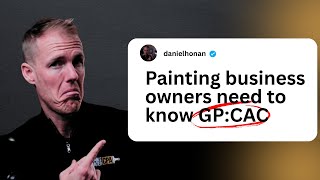
Daniel Honan, a CPA and former painting business owner, breaks down four financial metrics painters must track: gross profit per job, customer acquisition cost, the ratio between them (ideally 6:1), and cash conversion time. Your gross profit should be at least three times what you spend acquiring each customer.
Chapters
Most painting business owners know how many jobs that they have this month, but they don't know if those jobs are actually making them richer or just keeping them busy. In this video, I'm gonna give you 4 numbers every painting business needs to know: gross profit, customer acquisition cost, the GP to CAC ratio, and cash conversion. If you don't know these 4 numbers, you're flying blind. By the end of this video, you'll know exactly how to tell if a job is worth taking, how much you can afford to spend on marketing, whether growth actually makes sense. And why some months feel like you're super busy but still broke. Hey, I'm Daniel Honan. I'm a CPA and former painting business owner, and for the last decade, I've helped over 500 painting businesses grow from startup to multi-million dollar companies. I'm not here to turn you into an accountant. I'm here to give you 4 numbers you can look at any week of the year and instantly know we're good or we're in trouble, and here's why. By the way, if you like learning this way, I wrote a book called Profitable Painter that walks through these same frameworks in more detail. Budgeting, owner pay, cash flow, pricing. You can get a copy for free. It normally costs $20 on Amazon. All you gotta do is cover the shipping. There's a link in the description if you wanna go deeper. All right, so let's get into the numbers. Number 1, gross profit. Gross profit is how much money you keep from the job after paying for labor and materials. Here's the simple formula. Gross profit equals job price minus paint, sundries, and crew labor. Not rent, not your truck, not your salary, just direct costs to get the job done. Gross profit is the money that pays for everything else—marketing, office, overhead, and you. If this number is wrong, nothing else you do will fix the business. Two painting companies can both do $1 million in revenue. One runs 50% gross profit, the other runs 30%. Same revenue, totally different outcomes. One can afford better crews, better marketing, and owner pay. The other wonders why they're exhausted and still broke. And that's the power of gross profit. Here's your first action step. Take the last 10 jobs you completed. Write down the job price, materials, and labor. Calculate gross profit and gross profit percentage. If you don't know this number, you're guessing. Number 2, customer acquisition cost. Number 2 is customer acquisition cost, or CAC. CAC is how much it costs you to get one new painting job. Ads, lead services, sales time. And here's the formula: total sales and marketing spend divided by the number of new customers. And here's the rule that I want burned into your brain: your gross profit per job should be at least 3 times greater than your CAC. If you make $3,000 of gross profit on a job and spend $500 in sales and marketing to get it, that's healthy. If you make $3,000 on gross profit and spend $2,000 to get it, you're working hard for scraps. I had a painter tell me Facebook ads didn't work. We ran the numbers, he was spending about $650 to land a job that produced over $2,000 in gross profit. That's not expensive marketing, that's just fuel. Once he saw that, he stopped asking, "How do I get cheaper leads?" and started asking, "How do I scale this safely?" Your second action step: add up everything you spend in a month to get customers. Divide that by the number of new jobs that you book. That's your CAC. Write it next to your gross profit per job. Number 3: GP to CAC ratio. This metric is actually a combination of the two prior numbers, gross profit and customer acquisition costs. The GP to CAC ratio tells you whether growth helps you or hurts you. The formula is simple: gross profit per job CAC. Here's the rule of thumb: 6:1 GP/CAC ratio is ideal. 3:1 GP/CAC ratio or higher is healthy growth. 2:1 GP/CAC ratio is fragile, and below 2:1 GP/CAC ratio is dangerous. If you spend $1 to make $3 back before overhead, growth works. If you spend $1 to make $2, growth drains your cash. Same revenue growth, completely different lives. Your third action step, take your average gross profit per job and divide it by your average CAC. If it's below 3, you don't need more leads, you need better pricing, better estimating, or better marketing efficiency. If it's above 3, you've earned the right to scale. Number 4, cash conversion. Cash conversion is how long it takes you to get your money back after spending it. In simple terms, you spend money to get the job, you spend money to do the job, and then hopefully the customer pays you. In painting, it usually looks like this. Money out for ads, money out for materials, money out for payroll, then days or weeks later, money in. That gap is why painters feel broke even when they're booked out. Here's the goal I want you to remember. Ideally, you get your customer acquisition cost back within 30 days or less. That means your cash conversion is 30 days or better. Why does that matter? Because if you get paid back within 30 days, you can safely put marketing costs on a credit card and pay it off with your new customers' money before interest kicks in. That's not debt, that's float. And it's how businesses scale without choking on cash. Let me give you a real example. I worked with a painter named Mike. Great reviews, booked out 6 weeks, but every Friday he was stressed about payroll. Why? His deposits didn't cover materials or labor. He was floating jobs on his credit card and praying customers paid on time. So we changed the structure. Larger upfront deposits, had a clear mid-job payment, and then small final payment at the end. He also used his Sherwin-Williams and Benjamin Moore store credit to buy materials, giving him about 30 days of interest-free float there. Now look at what changed. Customers financed his marketing, his materials, his first payroll. Same jobs, same customers, totally different cash flow. That's customer finance growth. Here's your final action step. Pick an average job. Ask two questions. Does your deposit cover your CAC and labor? Does a mid-job payment gets you the rest of the way. If the answer is no to both questions, you're running out of profit and you're acting as the bank, and that's a fixable problem. Quick recap. Gross profit, that's what's left after labor and materials. Customer acquisition cost, what it costs to win a job. GP to CAC ratio, whether growth hurts or helps you. Cash conversion, how fast money comes back to you. If you know these 4 numbers, you know more about your business than 99% of painters. And if you want to go deeper, In the next video, I'm going to break down 4 cash flow plays painting businesses use to scale. Even for painting businesses located in states with legal limits on deposits, such as California, Massachusetts, Maryland, and Maine, these are simple moves you can make with deposits, payment schedules, credit, and job structure to stop cash crunches and fund growth without debt. Click the video on the screen now to watch 4 cash flow plays for painting businesses to scale.